


ASTM D2252-18
(Specification)Standard Specification for Fineness of Types of Alpaca
Standard Specification for Fineness of Types of Alpaca
ABSTRACT
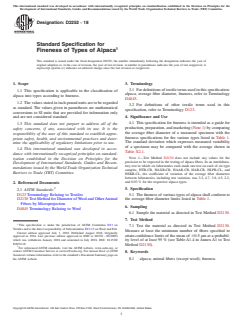
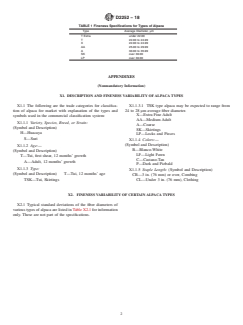
This specification is applicable in the classification of alpaca into types according to fineness. Five types of alpaca have been classified according to its average diameter limit, namely Type T Extra, Type T, Type X, Type AA, Type A, Type SK, and Type LP.
SIGNIFICANCE AND USE
4.1 This specification for fineness is intended as a guide for production, preparation, and marketing (Note 1) by comparing the average fiber diameter of a measured specimen with the fineness specifications for the various types listed in Table 1. The standard deviation which expresses measured variability of a specimen may be compared with the average shown in Table X2.1.
Note 1: Test Method D2130 does not include any values for the precision to be expected in the testing of alpaca fibers. In an interlaboratory test in which six laboratories each made one test on each of six type samples, HTB-CB, HAXB-CB, HAAB-CB, HAB-CB, HLPB-CL, and HSKB-CL, the coefficient of variation of the average fiber diameters between laboratories, including test variation, was 3.2, 4.7, 3.8, 4.5, 2.2, and 0.93 % for the respective alpaca types.
SCOPE
1.1 This specification is applicable in the classification of alpaca into types according to fineness.
1.2 The values stated in inch-pound units are to be regarded as standard. The values given in parentheses are mathematical conversions to SI units that are provided for information only and are not considered standard.
1.3 This standard does not purport to address all of the safety concerns, if any, associated with its use. It is the responsibility of the user of this standard to establish appropriate safety, health, and environmental practices and determine the applicability of regulatory limitations prior to use.
1.4 This international standard was developed in accordance with internationally recognized principles on standardization established in the Decision on Principles for the Development of International Standards, Guides and Recommendations issued by the World Trade Organization Technical Barriers to Trade (TBT) Committee.
General Information
- Status
- Published
- Publication Date
- 30-Jun-2018
- Technical Committee
- D13 - Textiles
- Drafting Committee
- D13.13 - Wool and Felt
Relations
- Replaces
ASTM D2252-05(2009) - Standard Specification for Fineness of Types of Alpaca (Withdrawn 2018) - Effective Date
- 01-Jul-2018
- Effective Date
- 01-Jul-2018
- Effective Date
- 01-Mar-2017
- Effective Date
- 15-Sep-2015
- Effective Date
- 01-Sep-2015
- Effective Date
- 01-Apr-2015
- Effective Date
- 15-Jun-2013
- Effective Date
- 15-Jun-2013
- Effective Date
- 15-May-2013
- Effective Date
- 01-Feb-2012
- Effective Date
- 01-Feb-2012
- Effective Date
- 01-Jun-2010
- Effective Date
- 01-Jun-2010
- Effective Date
- 01-Jun-2010
- Effective Date
- 01-Jul-2009
Overview
ASTM D2252-18: Standard Specification for Fineness of Types of Alpaca establishes a classification system for alpaca fibers according to their average fiber diameter. This international standard outlines the fineness criteria and categorizes alpaca types, enabling consistent comparison, grading, and quality control in the alpaca fiber industry. Developed in accordance with global standards principles, ASTM D2252-18 supports reliable production, preparation, and marketing of alpaca fiber by offering a clear methodology for determining fiber fineness.
Key Topics
- Alpaca Fiber Classification: The standard classifies alpaca into several types based on average fiber diameter, including T Extra, T, X, AA, A, SK, and LP.
- Fineness Measurement: Defines fineness as the average fiber diameter, measured in micrometers (µm), and provides specific ranges for each type.
- Testing Method: Refers to ASTM D2130 as the standard method for measuring fiber diameter, ensuring accuracy and repeatability.
- Variability Guidance: Offers data about acceptable variation (standard deviation) in fiber diameter within each alpaca type, supporting quality control.
- Trade Categories and Symbols: Specifies commercial symbols and descriptions for various alpaca types, age classifications (such as T for "tui" and A for "adult"), and physical characteristics.
- Unit Standards: States that inch-pound units are standard, with metric conversions provided for informational purposes only.
Applications
ASTM D2252-18 has broad practical applications throughout the alpaca fiber value chain:
- Producers can reliably classify and market alpaca fiber lots based on recognized fineness standards, ensuring transparent transactions and meeting buyer specifications.
- Manufacturers and Processors use this standard to assess incoming raw fiber, facilitate sorting and blending, and uphold consistent product quality in yarns, textiles, and finished goods.
- Buyers and Traders utilize these fineness categories as benchmarks for purchasing decisions, pricing, and contract specifications in the international fiber market.
- Testing Laboratories follow prescribed methods to measure fiber diameter and verify compliance with fineness requirements, supporting objective certification.
- Quality Assurance teams apply the standard’s variability guidance to monitor and control process consistency, reducing waste and ensuring customer satisfaction.
Related Standards
- ASTM D2130 - Test Method for Diameter of Wool and Other Animal Fibers by Microprojection, the referenced procedure for measuring alpaca fiber diameter.
- ASTM D123 - Terminology Relating to Textiles, providing definitions essential for understanding textile testing and specification.
- ASTM D4845 - Terminology Relating to Wool, offering relevant terminology used in the classification and specifications of animal fibers.
- International Standards and WTO TBT Principles - ASTM D2252-18 adheres to internationally recognized principles established by the World Trade Organization Technical Barriers to Trade (TBT) Committee.
By establishing clear, replicable criteria for alpaca fiber fineness, ASTM D2252-18 fosters quality, transparency, and global alignment in the alpaca and specialty animal fiber markets. This standard is an essential reference for anyone involved in the grading, processing, or trade of alpaca fiber. For more details and access to the full standard, visit ASTM International.


Get Certified
Connect with accredited certification bodies for this standard

Control Union Certifications
Global certification for agriculture and sustainability.

Bureau Veritas Bangladesh
Bureau Veritas certification services in Bangladesh.

ECOCERT France
Leader in organic and sustainability certification worldwide.
Sponsored listings
Frequently Asked Questions
ASTM D2252-18 is a technical specification published by ASTM International. Its full title is "Standard Specification for Fineness of Types of Alpaca". This standard covers: ABSTRACT This specification is applicable in the classification of alpaca into types according to fineness. Five types of alpaca have been classified according to its average diameter limit, namely Type T Extra, Type T, Type X, Type AA, Type A, Type SK, and Type LP. SIGNIFICANCE AND USE 4.1 This specification for fineness is intended as a guide for production, preparation, and marketing (Note 1) by comparing the average fiber diameter of a measured specimen with the fineness specifications for the various types listed in Table 1. The standard deviation which expresses measured variability of a specimen may be compared with the average shown in Table X2.1. Note 1: Test Method D2130 does not include any values for the precision to be expected in the testing of alpaca fibers. In an interlaboratory test in which six laboratories each made one test on each of six type samples, HTB-CB, HAXB-CB, HAAB-CB, HAB-CB, HLPB-CL, and HSKB-CL, the coefficient of variation of the average fiber diameters between laboratories, including test variation, was 3.2, 4.7, 3.8, 4.5, 2.2, and 0.93 % for the respective alpaca types. SCOPE 1.1 This specification is applicable in the classification of alpaca into types according to fineness. 1.2 The values stated in inch-pound units are to be regarded as standard. The values given in parentheses are mathematical conversions to SI units that are provided for information only and are not considered standard. 1.3 This standard does not purport to address all of the safety concerns, if any, associated with its use. It is the responsibility of the user of this standard to establish appropriate safety, health, and environmental practices and determine the applicability of regulatory limitations prior to use. 1.4 This international standard was developed in accordance with internationally recognized principles on standardization established in the Decision on Principles for the Development of International Standards, Guides and Recommendations issued by the World Trade Organization Technical Barriers to Trade (TBT) Committee.
ABSTRACT This specification is applicable in the classification of alpaca into types according to fineness. Five types of alpaca have been classified according to its average diameter limit, namely Type T Extra, Type T, Type X, Type AA, Type A, Type SK, and Type LP. SIGNIFICANCE AND USE 4.1 This specification for fineness is intended as a guide for production, preparation, and marketing (Note 1) by comparing the average fiber diameter of a measured specimen with the fineness specifications for the various types listed in Table 1. The standard deviation which expresses measured variability of a specimen may be compared with the average shown in Table X2.1. Note 1: Test Method D2130 does not include any values for the precision to be expected in the testing of alpaca fibers. In an interlaboratory test in which six laboratories each made one test on each of six type samples, HTB-CB, HAXB-CB, HAAB-CB, HAB-CB, HLPB-CL, and HSKB-CL, the coefficient of variation of the average fiber diameters between laboratories, including test variation, was 3.2, 4.7, 3.8, 4.5, 2.2, and 0.93 % for the respective alpaca types. SCOPE 1.1 This specification is applicable in the classification of alpaca into types according to fineness. 1.2 The values stated in inch-pound units are to be regarded as standard. The values given in parentheses are mathematical conversions to SI units that are provided for information only and are not considered standard. 1.3 This standard does not purport to address all of the safety concerns, if any, associated with its use. It is the responsibility of the user of this standard to establish appropriate safety, health, and environmental practices and determine the applicability of regulatory limitations prior to use. 1.4 This international standard was developed in accordance with internationally recognized principles on standardization established in the Decision on Principles for the Development of International Standards, Guides and Recommendations issued by the World Trade Organization Technical Barriers to Trade (TBT) Committee.
ASTM D2252-18 is classified under the following ICS (International Classification for Standards) categories: 59.060.10 - Natural fibres. The ICS classification helps identify the subject area and facilitates finding related standards.
ASTM D2252-18 has the following relationships with other standards: It is inter standard links to ASTM D2252-05(2009), ASTM D4845-10(2018), ASTM D123-17, ASTM D123-15b, ASTM D123-15a, ASTM D123-15, ASTM D123-13a, ASTM D123-13ae1, ASTM D123-13, ASTM D123-12, ASTM D123-12e1, ASTM D4845-10e2, ASTM D4845-10, ASTM D4845-10e1, ASTM D4845-09. Understanding these relationships helps ensure you are using the most current and applicable version of the standard.
ASTM D2252-18 is available in PDF format for immediate download after purchase. The document can be added to your cart and obtained through the secure checkout process. Digital delivery ensures instant access to the complete standard document.
Standards Content (Sample)
This international standard was developed in accordance with internationally recognized principles on standardization established in the Decision on Principles for the
Development of International Standards, Guides and Recommendations issued by the World Trade Organization Technical Barriers to Trade (TBT) Committee.
Designation: D2252 −18
Standard Specification for
Fineness of Types of Alpaca
This standard is issued under the fixed designation D2252; the number immediately following the designation indicates the year of
original adoption or, in the case of revision, the year of last revision. A number in parentheses indicates the year of last reapproval. A
superscript epsilon (´) indicates an editorial change since the last revision or reapproval.
1. Scope 3. Terminology
3.1 For definitions of textile terms used in this specification:
1.1 This specification is applicable in the classification of
alpaca, average fiber diameter, fineness, refer to Terminology
alpaca into types according to fineness.
D4845.
1.2 The values stated in inch-pound units are to be regarded
3.2 For definitions of other textile terms used in this
as standard. The values given in parentheses are mathematical
specification, refer to Terminology D123.
conversions to SI units that are provided for information only
and are not considered standard. 4. Significance and Use
4.1 This specification for fineness is intended as a guide for
1.3 This standard does not purport to address all of the
production, preparation, and marketing (Note 1) by comparing
safety concerns, if any, associated with its use. It is the
the average fiber diameter of a measured specimen with the
responsibility of the user of this standard to establish appro-
fineness specifications for the various types listed in Table 1.
priate safety, health, and environmental practices and deter-
The standard deviation which expresses measured variability
mine the applicability of regulatory limitations prior to use.
of a specimen may be compared with the average shown in
1.4 This international standard was developed in accor-
Table X2.1.
dance with internationally recognized principles on standard-
NOTE 1—Test Method D2130 does not include any values for the
ization established in the Decision on Principles for the
precision to be expected in the testing of alpaca fibers. In an interlabora-
Development of International Standards, Guides and Recom-
tory test in which six laboratories each made one test on each of six type
mendations issued by the World Trade Organization Technical
samples, HTB-CB, HAXB-CB, HAAB-CB, HAB-CB, HLPB-CL, and
Barriers to Trade (TBT) Committee.
HSKB-CL, the coefficient of variation of the average fiber diameters
between laboratories, including test variation, was 3.2, 4.7, 3.8, 4.5, 2.2,
and 0.93 % for the respective alpaca types.
2. Referenced Documents
5. Specification
2.1 ASTM Standards:
D123 Terminology Relating to Textiles 5.1 The fineness of various types of alpaca shall conform to
the average fiber diameter limits listed in Table 1.
D2130 Test Method for Diameter ofWool and OtherAnimal
Fibers by Microprojection
6. Sampling
D4845 Terminology Relating to Wool
6.1 Sample the material as directed in Test Method D2130.
7. Test Method
This specification is under the jurisdiction of ASTM Committee D13 on
7.1 Test the material as directed in Test Method D2130.
Textiles and is the direct responsibility of Subcommittee D13.13 on Wool and Felt.
Measure at least the minimum number of fibers specified to
Current edition approved July 1, 2018. Published August 2018. Originally
attain confidence limits of the mean of 60.5 µm at a probabil-
approved in 1964. Last previous edition approved in 2009 as D2252 – 05(2009)
which was withdrawn
...
Questions, Comments and Discussion
Ask us and Technical Secretary will try to provide an answer. You can facilitate discussion about the standard in here.
Loading comments...