

ASTM F1580-18
(Specification)Standard Specification for Titanium and Titanium-6 Aluminum-4 Vanadium Alloy Powders for Coatings of Surgical Implants
General Information
- Abstract
ABSTRACT
This specification covers the chemical, particle size, and cleanliness requirements for unalloyed titanium and titanium-6aluminum-4vanadium alloy powders for use as coatings, formed by sintering or thermal spraying techniques, onto titanium alloy surgical implants. The powders may be manufactured by the plasma rotating electrode, inert gas atomization, or hydride-dehydride process, or other method capable of producing powder meeting the requirements of this specification. This specification addresses only the powder requirements, and not the properties of the coatings formed from them.
SCOPE
1.1 This specification covers the requirements for unalloyed titanium and Ti-6Al-4V alloy powders for use in fabricating coatings on titanium alloy implants.
1.2 Powders covered under this specification may be used to form coatings by sintering or thermal spraying techniques.
1.3 This specification covers powder requirements only. It does not address properties of the coatings formed from them.
1.4 Finely divided titanium powder may be considered pyrophoric and should be handled in accordance with the appropriate guidelines.
1.5 Units—The values stated in either SI units or inch-pound units are to be regarded separately as standard. The values stated in each system may not be exact equivalents; therefore, each system shall be used independently of the other. Combining values from the two systems may result in non-conformance with the standard.
1.6 This international standard was developed in accordance with internationally recognized principles on standardization established in the Decision on Principles for the Development of International Standards, Guides and Recommendations issued by the World Trade Organization Technical Barriers to Trade (TBT) Committee.
- Status
- Published
- Publication Date
- 14-Nov-2018
- Technical Committee
- F04 - Medical and Surgical Materials and Devices
- Drafting Committee
- F04.12 - Metallurgical Materials
Buy Documents

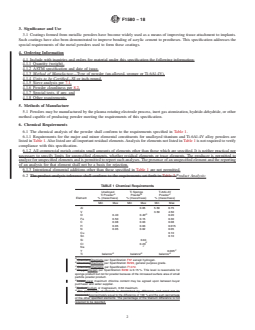
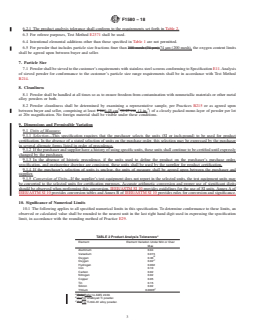
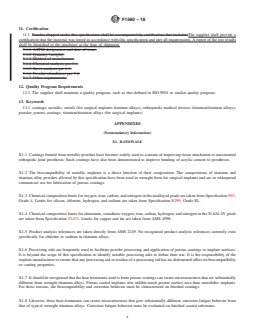
ASTM F1580-18 - Standard Specification for Titanium and Titanium-6 Aluminum-4 Vanadium Alloy Powders for Coatings of Surgical Implants
REDLINE ASTM F1580-18 - Standard Specification for Titanium and Titanium-6 Aluminum-4 Vanadium Alloy Powders for Coatings of Surgical Implants
Overview
ASTM F1580-18 is the internationally recognized standard specification for unalloyed titanium powders and titanium-6 aluminum-4 vanadium (Ti-6Al-4V) alloy powders used as coatings on surgical implants. Developed by ASTM International, this standard defines critical chemical, particle size, and cleanliness requirements for titanium-based powders designed for coating fabrication by sintering or thermal spraying techniques, specifically onto titanium alloy surgical implants. Although the standard addresses powder requirements only, it ensures the consistency and safety of the materials integral to medical implant surfaces.
Key Topics
ASTM F1580-18 covers several essential points to guarantee powder quality for use in surgical implant coatings:
- Powder Composition: Strict requirements on chemical elements present in unalloyed titanium and Ti-6Al-4V alloy powders, with limitations on both major alloying and trace elements to ensure biocompatibility.
- Particle Size Distribution: Specifies that powders are sieved according to user requirements, with particle size verified in accordance with established ASTM test methods.
- Cleanliness Standards: Calls for thorough examination to ensure powders are free from nonmetallic contaminants or foreign alloy powders, maintaining high purity vital for medical applications.
- Manufacturing Methods: Recognizes acceptable powder production techniques, including plasma rotating electrode, inert gas atomization, hydride-dehydride process, or other approved methods capable of meeting the standard’s requirements.
- Quality Assurance: Requires provision of detailed certification for every powder shipment, backed by relevant analyses and conformity to specified parameters.
- Safety Considerations: Notes that finely divided titanium powder can be pyrophoric and must be handled per proper safety guidelines to avoid safety hazards.
Applications
This specification is highly relevant within the biomedical and medical device industries, particularly for:
- Orthopedic Implants: Used as the basis for coatings that promote tissue ingrowth and enhance the long-term fixation of implants such as hip and knee replacements.
- Dental Implants: Ensures powder quality for surface modifications that improve osseointegration.
- Porous Coating Manufacturing: Powders compliant with ASTM F1580-18 are critical for producing porous coatings that help to better bond implants in the human body, enhancing both stability and compatibility.
- Thermal Spraying and Sintered Coatings: The specification supports both primary coating technologies, ensuring the resulting surface is suitable for surgical use.
The use of powders meeting ASTM F1580-18 guarantees that medical devices meet rigorous industry standards for cleanliness, purity, and compositional consistency, contributing to improved patient outcomes and reduced risk of implant rejection or failure.
Related Standards
ASTM F1580-18 references and aligns with several other key international standards to ensure comprehensive quality across the production and usage process:
- ASTM F67: Specification for Unalloyed Titanium for Surgical Implant Applications.
- ASTM F1472: Specification for Wrought Titanium-6Aluminum-4Vanadium Alloy for Surgical Implant Applications.
- ASTM B214, B215, B299: Standards for metal powder analysis, sampling, and titanium sponge specification.
- ASTM E11, E29, E2371: Standards relating to test sieves, use of significant digits, and chemical analysis methods.
- ISO 9001: Quality Management System Requirements.
- AMS 2249 and 4998: Aerospace Material Specifications relevant to chemical limits and Ti-6Al-4V powder.
- IEEE/ASTM SI 10: Guidelines for metric practice.
By adhering to ASTM F1580-18 and associated standards, manufacturers and medical device developers can ensure the reliability, safety, and performance of coated titanium implants for surgical applications. This standard is essential for maintaining high standards in the growing field of implantable medical materials.
Relations
- Effective Date
- 15-Nov-2018
- Effective Date
- 01-Mar-2017
- Effective Date
- 01-Oct-2013
- Effective Date
- 01-Jun-2013
- Effective Date
- 15-May-2013
- Effective Date
- 01-Oct-2011
- Effective Date
- 01-Dec-2010
- Effective Date
- 01-Jun-2010
- Effective Date
- 01-May-2009
- Effective Date
- 01-Nov-2008
- Effective Date
- 01-Nov-2008
- Effective Date
- 01-Oct-2008
- Effective Date
- 01-Nov-2007
- Effective Date
- 01-Jan-2007
- Effective Date
- 15-Nov-2006
Buy Documents
ASTM F1580-18 - Standard Specification for Titanium and Titanium-6 Aluminum-4 Vanadium Alloy Powders for Coatings of Surgical Implants
REDLINE ASTM F1580-18 - Standard Specification for Titanium and Titanium-6 Aluminum-4 Vanadium Alloy Powders for Coatings of Surgical Implants
Get Certified
Connect with accredited certification bodies for this standard

BSI Group
BSI (British Standards Institution) is the business standards company that helps organizations make excellence a habit.

TÜV Rheinland
TÜV Rheinland is a leading international provider of technical services.

TÜV SÜD
TÜV SÜD is a trusted partner of choice for safety, security and sustainability solutions.
Sponsored listings
Frequently Asked Questions
ASTM F1580-18 is a technical specification published by ASTM International. Its full title is "Standard Specification for Titanium and Titanium-6 Aluminum-4 Vanadium Alloy Powders for Coatings of Surgical Implants". This standard covers: ABSTRACT This specification covers the chemical, particle size, and cleanliness requirements for unalloyed titanium and titanium-6aluminum-4vanadium alloy powders for use as coatings, formed by sintering or thermal spraying techniques, onto titanium alloy surgical implants. The powders may be manufactured by the plasma rotating electrode, inert gas atomization, or hydride-dehydride process, or other method capable of producing powder meeting the requirements of this specification. This specification addresses only the powder requirements, and not the properties of the coatings formed from them. SCOPE 1.1 This specification covers the requirements for unalloyed titanium and Ti-6Al-4V alloy powders for use in fabricating coatings on titanium alloy implants. 1.2 Powders covered under this specification may be used to form coatings by sintering or thermal spraying techniques. 1.3 This specification covers powder requirements only. It does not address properties of the coatings formed from them. 1.4 Finely divided titanium powder may be considered pyrophoric and should be handled in accordance with the appropriate guidelines. 1.5 Units—The values stated in either SI units or inch-pound units are to be regarded separately as standard. The values stated in each system may not be exact equivalents; therefore, each system shall be used independently of the other. Combining values from the two systems may result in non-conformance with the standard. 1.6 This international standard was developed in accordance with internationally recognized principles on standardization established in the Decision on Principles for the Development of International Standards, Guides and Recommendations issued by the World Trade Organization Technical Barriers to Trade (TBT) Committee.
ABSTRACT This specification covers the chemical, particle size, and cleanliness requirements for unalloyed titanium and titanium-6aluminum-4vanadium alloy powders for use as coatings, formed by sintering or thermal spraying techniques, onto titanium alloy surgical implants. The powders may be manufactured by the plasma rotating electrode, inert gas atomization, or hydride-dehydride process, or other method capable of producing powder meeting the requirements of this specification. This specification addresses only the powder requirements, and not the properties of the coatings formed from them. SCOPE 1.1 This specification covers the requirements for unalloyed titanium and Ti-6Al-4V alloy powders for use in fabricating coatings on titanium alloy implants. 1.2 Powders covered under this specification may be used to form coatings by sintering or thermal spraying techniques. 1.3 This specification covers powder requirements only. It does not address properties of the coatings formed from them. 1.4 Finely divided titanium powder may be considered pyrophoric and should be handled in accordance with the appropriate guidelines. 1.5 Units—The values stated in either SI units or inch-pound units are to be regarded separately as standard. The values stated in each system may not be exact equivalents; therefore, each system shall be used independently of the other. Combining values from the two systems may result in non-conformance with the standard. 1.6 This international standard was developed in accordance with internationally recognized principles on standardization established in the Decision on Principles for the Development of International Standards, Guides and Recommendations issued by the World Trade Organization Technical Barriers to Trade (TBT) Committee.
ASTM F1580-18 is classified under the following ICS (International Classification for Standards) categories: 11.040.40 - Implants for surgery, prosthetics and orthotics; 77.120.50 - Titanium and titanium alloys. The ICS classification helps identify the subject area and facilitates finding related standards.
ASTM F1580-18 has the following relationships with other standards: It is inter standard links to ASTM F1580-12, ASTM F67-13(2017), ASTM E11-13, ASTM F67-13, ASTM B299-13, ASTM B214-07(2011), ASTM B215-10, ASTM F981-04(2010), ASTM E11-09e1, ASTM B215-08, ASTM B299-08, ASTM E29-08, ASTM B299-07, ASTM B214-07, ASTM E29-06b. Understanding these relationships helps ensure you are using the most current and applicable version of the standard.
ASTM F1580-18 is available in PDF format for immediate download after purchase. The document can be added to your cart and obtained through the secure checkout process. Digital delivery ensures instant access to the complete standard document.
Standards Content (Sample)
This international standard was developed in accordance with internationally recognized principles on standardization established in the Decision on Principles for the
Development of International Standards, Guides and Recommendations issued by the World Trade Organization Technical Barriers to Trade (TBT) Committee.
Designation:F1580 −18
Standard Specification for
Titanium and Titanium-6 Aluminum-4 Vanadium Alloy
Powders for Coatings of Surgical Implants
This standard is issued under the fixed designation F1580; the number immediately following the designation indicates the year of
original adoption or, in the case of revision, the year of last revision.Anumber in parentheses indicates the year of last reapproval.A
superscript epsilon (´) indicates an editorial change since the last revision or reapproval.
1. Scope* E29Practice for Using Significant Digits in Test Data to
Determine Conformance with Specifications
1.1 Thisspecificationcoverstherequirementsforunalloyed
E2371Test Method for Analysis of Titanium and Titanium
titanium and Ti-6Al-4V alloy powders for use in fabricating
AlloysbyDirectCurrentPlasmaandInductivelyCoupled
coatings on titanium alloy implants.
Plasma Atomic Emission Spectrometry (Performance-
1.2 Powderscoveredunderthisspecificationmaybeusedto
Based Test Methodology)
form coatings by sintering or thermal spraying techniques.
F67Specification for Unalloyed Titanium, for Surgical Im-
plant Applications (UNS R50250, UNS R50400, UNS
1.3 This specification covers powder requirements only. It
does not address properties of the coatings formed from them. R50550, UNS R50700)
F981Practice for Assessment of Compatibility of Biomate-
1.4 Finely divided titanium powder may be considered
rials for Surgical Implants with Respect to Effect of
pyrophoric and should be handled in accordance with the
Materials on Muscle and Insertion into Bone
appropriate guidelines.
F1472 Specification for Wrought Titanium-6Aluminum-
1.5 Units—The values stated in either SI units or inch-
4VanadiumAlloyforSurgicalImplantApplications(UNS
pound units are to be regarded separately as standard. The
R56400)
values stated in each system may not be exact equivalents;
IEEE/ASTM SI 10 American National Standard for Metric
therefore,eachsystemshallbeusedindependentlyoftheother.
Practice
Combining values from the two systems may result in non-
2.2 ISO Standards:
conformance with the standard.
ISO9001Quality Management System Requirements
1.6 This international standard was developed in accor- 4
2.3 Aerospace Material Specifications:
dance with internationally recognized principles on standard-
AMS2249Chemical Check Analysis Limits, Titanium and
ization established in the Decision on Principles for the
Titanium Alloys
Development of International Standards, Guides and Recom-
AMS4998Powder, 6Al-4V
mendations issued by the World Trade Organization Technical
Barriers to Trade (TBT) Committee.
3. Significance and Use
3.1 Coatings formed from metallic powders have become
2. Referenced Documents
widely used as a means of improving tissue attachment to
2.1 ASTM Standards:
implants. Such coatings have also been demonstrated to
B214Test Method for Sieve Analysis of Metal Powders
improve bonding of acrylic cement to prostheses. This
B215Practices for Sampling Metal Powders
specification addresses the special requirements of the metal
B299Specification for Titanium Sponge
powders used to form these coatings.
E11Specification forWovenWireTest Sieve Cloth andTest
Sieves
4. Ordering Information
4.1 Include with inquiries and orders for material under this
specification the following information:
This specification is under the jurisdiction of ASTM Committee F04 on
MedicalandSurgicalMaterialsandDevicesandisunderthedirectresponsibilityof
4.1.1 Quantity (weight),
Subcommittee F04.12 on Metallurgical Materials.
4.1.2 ASTM specification and date of issue,
Current edition approved Nov. 15, 2018. Published December 2018. Originally
approved in 1995. Last previous edition approved in 2012 as F1580-12. DOI:
10.1520/F1580-18.
2 3
For referenced ASTM standards, visit the ASTM website, www.astm.org, or Available fromAmerican National Standards Institute (ANSI), 25 W. 43rd St.,
contact ASTM Customer Service at service@astm.org. For Annual Book of ASTM 4th Floor, New York, NY 10036, http://www.ansi.org.
Standards volume information, refer to the standard’s Document Summary page on Available from Society of Automotive Engineers (SAE), 400 Commonwealth
the ASTM website. Dr., Warrendale, PA 15096-0001, http://www.sae.org.
*A Summary of Changes section appears at the end of this standard
Copyright © ASTM International, 100 Barr Harbor Drive, PO Box C700, West Conshohocken, PA 19428-2959. United States
F1580−18
4.1.3 Method of Manufacture—Typeofpowder(un-alloyed, 6.2 Product Analysis:
sponge or Ti-6Al-4V), 6.2.1 The product analysis tolerance shall conform to the
4.1.4 Units to be Certified—SI or inch-pound, requirements set forth in Table 2.
4.1.5 Sieve analysis per 7.1,
6.3 For referee purposes, Test Method E2371 shall be used.
4.1.6 Powder cleanliness per 8.2,
6.4 Intentional elemental additions other than those speci-
4.1.7 Special tests, if any, and
fied in Table 1 are not permitted.
4.1.8 Other requirements.
6.5 For powder that includes particle size fractions finer
5. Methods of Manufacture
than 74 µm (200 mesh), the oxygen content limits shall be
agreed upon between buyer and seller.
5.1 Powders may be manufactured by the plasma rotating
electrode process, inert gas atomization, hydride-dehydride, or
7. Particle Size
other method capable of producing powder meeting the re-
quirements of this specification.
7.1 Powder shall be sieved to the customer’s requirements
with stainless steel screens conforming to Specification E11.
6. Chemical Requirements
Analysis of sieved powder for conformance to the customer’s
6.1 The chemical analysis of the powder shall conform to
particle size range requirements shall be in accordance with
the requirements specified in Table 1.
Test Method B214.
6.1.1 Requirements for the major and minor elemental
constituents for unalloyed titanium and Ti-6Al-4V alloy pow-
8. Cleanliness
ders are listed in Table 1.Also listed are all important residual
8.1 Powder shall be handled at all times so as to ensure
elements. Analysis for elements not listed in Table 1 is not
freedom from contamination with nonmetallic materials or
required to verify compliance with this specification.
other metal alloy powders or both.
6.1.2 All commercial metals contain small amounts of
8.2 Powder cleanliness shall be determined by examining a
elements other than those which are specified. It is neither
representative sample, per Practices B215 or as agreed upon
practical nor necessary to specify limits for unspecified
2 2
betweenbuyerandseller,comprisingatleast6.45cm (1in. )
elements, whether residual elements or trace elements. The
of a closely packed mono-layer of powder per lot at 20×
producer is permitted to analyze for unspecified elements and
magnification. No foreign material shall be visible under these
is permitted to report such analyses. The presence of an
conditions.
unspecified element and the reporting of an analysis for that
element shall not be a basis for rejection.
9. Dimensions and Permissible Variation
6.1.3 Intentional elemental additions other than those speci-
9.1 Units of Measure:
fied in Table 1 are not permitted.
9.1.1 Selection—This specification requires that the pur-
chaser selects the units (SI or inch-pound) to be used for
TABLE 1 Chemical Requirements
product certification. In the absence of a stated selection of
Unalloyed Ti Sponge Ti-6Al-4V
unitsonthepurchaseorder,thisselectionmaybeexpressedby
A B C
Ti Powder Powder Powder
Element
% (mass/mass) % (mass/mass) % (mass/mass)
the purchaser in several alternate forms listed in order of
Min Max Min Max Min Max precedence.
Al 0.05 5.50 6.75
9.1.2 If the purchaser and supplier have a history of using
V 3.50 4.50
specific units, these units shall continue to be certified until
D
O 0.40 0.40 0.20
expressly changed by the purchaser.
Fe 0.50 0.15 0.30
C 0.08 0.03 0.08
H 0.05 0.03 0.015
N 0.05 0.02 0.05
A
Cu 0.10
TABLE 2 Product Analysis Tolerances
Sn 0.10
Element Element Variation Under Min or Over
Si 0.04
Max
E
Cl 0.20
F
Aluminum 0.04
Na
C
Vanadium 0.015
Y 0.005
B
G G G
Oxygen 0.03
Ti balance balance balance
C
Oxygen 0.02
A
Chemistry per Specification F67 except hydrogen.
Hydrogen 0.002
B
Chemistry per Specification B299, general purpose grade.
Iron 0.10
C
Chemistry per Specification F1472.
Carbon 0.02
D
Oxygen per Specification B299 is 0.15 %. This level is reasonable for sponge
Nitrogen 0.02
product but not for powder because of the increased surface area of small particle
Cop
...
This document is not an ASTM standard and is intended only to provide the user of an ASTM standard an indication of what changes have been made to the previous version. Because
it may not be technically possible to adequately depict all changes accurately, ASTM recommends that users consult prior editions as appropriate. In all cases only the current version
of the standard as published by ASTM is to be considered the official document.
Designation: F1580 − 12 F1580 − 18
Standard Specification for
Titanium and Titanium-6 Aluminum-4 Vanadium Alloy
Powders for Coatings of Surgical Implants
This standard is issued under the fixed designation F1580; the number immediately following the designation indicates the year of
original adoption or, in the case of revision, the year of last revision. A number in parentheses indicates the year of last reapproval. A
superscript epsilon (´) indicates an editorial change since the last revision or reapproval.
1. Scope*
1.1 This specification covers the requirements for unalloyed titanium and Ti-6Al-4V alloy powders for use in fabricating
coatings on titanium alloy implants.
1.2 Powders covered under this specification may be used to form coatings by sintering or thermal spraying techniques.
1.3 This specification covers powder requirements only. It does not address properties of the coatings formed from them.
1.4 Finely divided titanium powder may be considered pyrophoric and should be handled in accordance with the appropriate
guidelines.
1.5 Units—The values stated in either SI units or inch-pound units are to be regarded separately as standard. The values given
in parentheses are mathematical conversions to SI units that are provided for information only and are not considered stated in each
system may not be exact equivalents; therefore, each system shall be used independently of the other. Combining values from the
two systems may result in non-conformance with the standard.
1.6 This international standard was developed in accordance with internationally recognized principles on standardization
established in the Decision on Principles for the Development of International Standards, Guides and Recommendations issued
by the World Trade Organization Technical Barriers to Trade (TBT) Committee.
2. Referenced Documents
2.1 ASTM Standards:
B214 Test Method for Sieve Analysis of Metal Powders
B215 Practices for Sampling Metal Powders
B299 Specification for Titanium Sponge
E11 Specification for Woven Wire Test Sieve Cloth and Test Sieves
E29 Practice for Using Significant Digits in Test Data to Determine Conformance with Specifications
E2371 Test Method for Analysis of Titanium and Titanium Alloys by Direct Current Plasma and Inductively Coupled Plasma
Atomic Emission Spectrometry (Performance-Based Test Methodology)
F67 Specification for Unalloyed Titanium, for Surgical Implant Applications (UNS R50250, UNS R50400, UNS R50550, UNS
R50700)
F981 Practice for Assessment of Compatibility of Biomaterials for Surgical Implants with Respect to Effect of Materials on
Muscle and Insertion into Bone
F1472 Specification for Wrought Titanium-6Aluminum-4Vanadium Alloy for Surgical Implant Applications (UNS R56400)
IEEE/ASTM SI 10 American National Standard for Metric Practice
2.2 ISO Standards:
ISO 9001 Quality Management System Requirements
2.3 Aerospace Material Specifications:
AMS 2249 Chemical Check Analysis Limits, Titanium and Titanium Alloys
AMS 4998 Powder, 6Al-4V
This specification is under the jurisdiction of ASTM Committee F04 on Medical and Surgical Materials and Devices and is under the direct responsibility of
Subcommittee F04.12 on on Metallurgical Materials.
Current edition approved March 1, 2012Nov. 15, 2018. Published March 2012December 2018. Originally approved in 1995. Last previous edition approved in 20072012
as F1580 - 07.F1580 - 12. DOI: 10.1520/F1580-12.10.1520/F1580-18.
For referenced ASTM standards, visit the ASTM website, www.astm.org, or contact ASTM Customer Service at service@astm.org. For Annual Book of ASTM Standards
volume information, refer to the standard’s Document Summary page on the ASTM website.
Available from American National Standards Institute (ANSI), 25 W. 43rd St., 4th Floor, New York, NY 10036, http://www.ansi.org.
Available from Society of Automotive Engineers (SAE), 400 Commonwealth Dr., Warrendale, PA 15096-0001, http://www.sae.org.
*A Summary of Changes section appears at the end of this standard
Copyright © ASTM International, 100 Barr Harbor Drive, PO Box C700, West Conshohocken, PA 19428-2959. United States
F1580 − 18
3. Significance and Use
3.1 Coatings formed from metallic powders have become widely used as a means of improving tissue attachment to implants.
Such coatings have also been demonstrated to improve bonding of acrylic cement to prostheses. This specification addresses the
special requirements of the metal powders used to form these coatings.
4. Ordering Information
4.1 Include with inquiries and orders for material under this specification the following information:
4.1.1 Quantity (weight),
4.1.2 ASTM specification and date of issue,
4.1.3 Method of Manufacture—Type of powder (un-alloyed, sponge or Ti-6Al-4V),
4.1.4 Units to be Certified—SI or inch-pound,
4.1.5 Sieve analysis per 7.1,
4.1.6 Powder cleanliness per 8.2,
4.1.7 Special tests, if any, and
4.1.8 Other requirements.
5. Methods of Manufacture
5.1 Powders may be manufactured by the plasma rotating electrode process, inert gas atomization, hydride-dehydride, or other
method capable of producing powder meeting the requirements of this specification.
6. Chemical Requirements
6.1 The chemical analysis of the powder shall conform to the requirements specified in Table 1.
6.1.1 Requirements for the major and minor elemental constituents for unalloyed titanium and Ti-6Al-4V alloy powders are
listed in Table 1. Also listed are all important residual elements. Analysis for elements not listed in Table 1 is not required to verify
compliance with this specification.
6.1.2 All commercial metals contain small amounts of elements other than those which are specified. It is neither practical nor
necessary to specify limits for unspecified elements, whether residual elements or trace elements. The producer is permitted to
analyze for unspecified elements and is permitted to report such analyses. The presence of an unspecified element and the reporting
of an analysis for that element shall not be a basis for rejection.
6.1.3 Intentional elemental additions other than those specified in Table 1 are not permitted.
6.2 The product analysis tolerance shall conform to the requirements set forth in Table 2.Product Analysis:
TABLE 1 Chemical Requirements
Unalloyed Ti Sponge Ti-6Al-4V
A B C
Ti Powder Powder Powder
Element
% (mass/mass) % (mass/mass) % (mass/mass)
Min Max Min Max Min Max
Al 0.05 5.50 6.75
V 3.50 4.50
D
O 0.40 0.40 0.20
Fe 0.50 0.15 0.30
C 0.08 0.03 0.08
H 0.05 0.03 0.015
N 0.05 0.02 0.05
Cu 0.10
Sn 0.10
Si 0.04
E
Cl 0.20
F
Na
C
Y 0.005
G G G
Ti balance balance balance
A
ChemistryChemistry per Specification F67 except hydrogen.
B
ChemistryChemistry per Specification B299, general purpose grade.
C
ChemistryChemistry per Specification F1472.
D
OxygenOxygen per Specification B299 is 0.15 %. This level is reasonable for
sponge product but not for powder because of the increased surface area of small
particle powder product.
E
LowerLower maximum chlorine content may be agreed upon between buyer
purchaser and seller supplier.
F
SodiumSodium or magnesium, 0.50 maximum.
G
The percentage of titanium is determined by difference and need not be
measured.Approximately equal to the difference of 100 % and the sum percentage
of the other specified elements. The percentage of the titanium difference is not
required to be reported.
F1580 − 18
6.2.1 The product analysis tolerance shall conform to the requirements set forth in Table 2.
6.3 For referee purposes, Test Method E2371 shall be used.
6.4 Intentional elemental additions other than those specified in Table 1 are not permitted.
6.5 For powder that includes particle size fractions finer than 200 mesh (74 μm),74 μm (200 mesh), the oxygen content limits
shall be agreed upon between buyer and seller.
7. Particle Size
7.1 Powder shall be sieved to the customer’s requirements with stainless steel screens conforming to Specification E11. Analysis
of sieved powder for conformance to the customer’s particle size range requirements shall be in accordance with Test Method
B214.
8. Cleanliness
8.1 Powder shall be handled at all times so as to ensure freedom from contamination with nonmetallic materials or other metal
alloy powders or both.
8.2 Powder cleanliness shall be determined by examining a representative sample, per Practices B215 or as agreed upon
2 2
between buyer and seller, comprising at least 1 in.6.45 cm (6.45 cm (1 in. ) of a closely packed mono-layer of powder per lot
at 20× magnification. No foreign material shall be visible under these conditions.
9. Dimensions and Permissible Variation
9.1 Units of Measure:
9.1.1 Selection—This specification requires that the purchaser selects the units (SI or inch-pound) to be used for product
certification. In the absence of a stated selection of units on the purchase order, this selection may be expressed by the purchaser
in several alternate forms listed in order
...