

ASTM B280-23
(Specification)Standard Specification for Seamless Copper Tube for Air Conditioning and Refrigeration Field Service
General Information
- Abstract
ABSTRACT
This specification covers the requirements for seamless UNS C10200, C12000, or C12200 copper alloy tubes used for connection, repairs, or alternations of field air conditioning or refrigeration units. Materials in the form of billets, bars, or tubes should be used to produce a homogeneous uniform wrought structure by either hot or cold working. Each tube should be cold drawn to the finished size and wall thickness. Coiled lengths with soft annealed tempers should be bright annealed after coiling then dehydrated and either capped, plugged, crimped, or otherwise closed at both ends. Straight lengths with hard drawn tempers should be cleaned and either capped, plugged, or otherwise closed at both ends. The grain sizes, tensile properties, and eddy-current and cleanness test results should conform to the values listed herein.
SCOPE
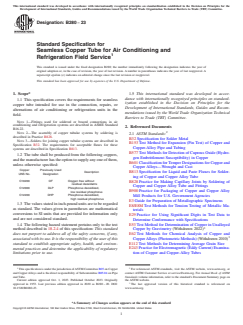
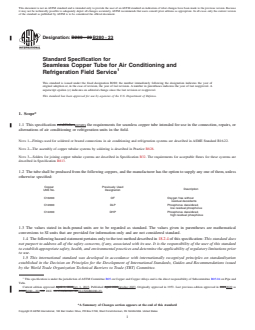
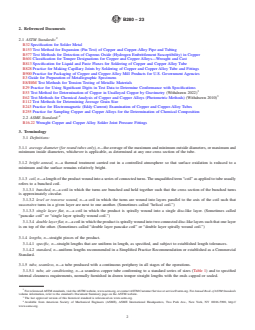
1.1 This specification covers the requirements for seamless copper tube intended for use in the connection, repairs, or alternations of air conditioning or refrigeration units in the field.
Note 1: Fittings used for soldered or brazed connections in air conditioning and refrigeration systems are described in ASME Standard B16.22.
Note 2: The assembly of copper tubular systems by soldering is described in Practice B828.
Note 3: Solders for joining copper tubular systems are described in Specification B32. The requirements for acceptable fluxes for these systems are described in Specification B813.
1.2 The tube shall be produced from the following coppers, and the manufacturer has the option to supply any one of them, unless otherwise specified:
Copper
UNS No.
Previously Used
Designation
Description
C10200
OF
Oxygen free without
residual deoxidants
C12000
DLP
Phosphorus deoxidized,
low residual phosphorus
C12200
DHP
Phosphorus deoxidized,
high residual phosphorus
1.3 The values stated in inch-pound units are to be regarded as standard. The values given in parentheses are mathematical conversions to SI units that are provided for information only and are not considered standard.
1.4 The following hazard statement pertains only to the test method described in 18.2.4 of this specification: This standard does not purport to address all of the safety concerns, if any, associated with its use. It is the responsibility of the user of this standard to establish appropriate safety, health, and environmental practices and determine the applicability of regulatory limitations prior to use.
1.5 This international standard was developed in accordance with internationally recognized principles on standardization established in the Decision on Principles for the Development of International Standards, Guides and Recommendations issued by the World Trade Organization Technical Barriers to Trade (TBT) Committee.
- Status
- Published
- Publication Date
- 30-Sep-2023
- Technical Committee
- B05 - Copper and Copper Alloys
- Drafting Committee
- B05.04 - Pipe and Tube
Buy Documents
ASTM B280-23 - Standard Specification for Seamless Copper Tube for Air Conditioning and Refrigeration Field Service
REDLINE ASTM B280-23 - Standard Specification for Seamless Copper Tube for Air Conditioning and Refrigeration Field Service
Overview
ASTM B280-23 is the internationally recognized standard specification developed by ASTM International for seamless copper tube used in field service of air conditioning and refrigeration systems. This standard defines requirements for seamless copper tubes made from UNS C10200 (oxygen-free copper), C12000, or C12200 (phosphorus deoxidized coppers) intended for connecting, repairing, or altering air conditioning and refrigeration equipment. Tubes manufactured under ASTM B280-23 ensure consistent quality, cleanliness, mechanical strength, and dimensional accuracy, making them a key material for reliable HVAC and refrigeration operations.
Key Topics
- Material Requirements: Specifies that seamless copper tubes must be produced from C10200, C12000, or C12200 grades, using billets, bars, or tubes to create a homogeneous, uniform wrought structure.
- Production Process: Tubes are cold drawn to final size and wall thickness. Coiled tubes require bright annealing and dehydration; straight tubes require cleaning. Both types must be sealed at the ends to maintain internal cleanliness.
- Mechanical and Physical Properties: Covers grain size, tensile properties, and interior cleanliness, all of which must conform to stringent specification values.
- Cleaning and Testing: Tubes must meet defined standards for cleanliness (residue limits), and pass non-destructive tests such as eddy-current examination to verify integrity. Additional procedures cover testing for hydrogen embrittlement and expansion capability.
- Dimensions and Tolerances: Precise tables define standard sizes, wall thicknesses, weight per foot, and permissible variations in both diameter and length to ensure compatibility and performance.
- Product Identification: Tubes are clearly marked for easy identification regarding manufacturer, grade, and compliance, aiding traceability in the field.
- Ordering Information: Guidance is provided on specifying details in purchase orders, such as copper grade, size, temper, quantity, and options for additional testing or certification.
Applications
ASTM B280-23 seamless copper tube is vital in many areas of the HVAC and refrigeration industry:
- Field Installation: Used extensively to connect components and repair or retrofit residential, commercial, and industrial air conditioning and refrigeration systems.
- Service and Maintenance: Standardized tubes simplify service, ensuring parts compatibility and system reliability, whether for new installations or system repairs.
- OEM Manufacturing: Equipment manufacturers rely on B280-compliant copper tubes for quality assurance and regulatory compliance.
- Compliance with Codes: Many local, national, and international plumbing and mechanical codes reference ASTM B280 for copper tube specification in HVAC/R applications.
Benefits of using ASTM B280 copper tube include:
- Consistent mechanical performance and pressure ratings essential for safe operation.
- Uniform cleanliness and dehydration to prevent system contamination.
- Availability in both soft coils and hard-drawn straight lengths for installation flexibility.
Related Standards
Several related standards complement ASTM B280-23, ensuring a comprehensive approach to copper tubing systems:
- ASME B16.22 - Specification for wrought copper and copper alloy solder joint pressure fittings.
- ASTM B32 - Solder metal specification for joining copper tubular systems.
- ASTM B813 - Requirements for fluxes used in soldering copper tube.
- ASTM B828 - Practice for making capillary joints by soldering.
- ASTM B601 - Classification for temper designations of copper products.
- ASTM B577 - Test methods for hydrogen embrittlement susceptibility.
- ASTM E243 - Practice for electromagnetic (eddy current) examination.
- ASTM E8/E8M - Test methods for tension testing of metals.
Compliance with ASTM B280-23, along with these related standards, is essential for achieving reliability, safety, and long-term performance in air conditioning and refrigeration field service applications.
Keywords: ASTM B280-23, seamless copper tube, air conditioning, refrigeration, field service, copper tubing standard, HVAC copper, C10200, C12000, C12200, copper tube specification, HVAC/R industry, tube cleanliness, mechanical properties, dimensional tolerances.
Relations
- Effective Date
- 01-Oct-2023
- Effective Date
- 01-Jan-2024
- Effective Date
- 01-Dec-2023
- Effective Date
- 01-May-2022
- Effective Date
- 01-Oct-2023
- Effective Date
- 01-Oct-2023
- Effective Date
- 01-Oct-2023
- Effective Date
- 01-Oct-2023
- Effective Date
- 01-Oct-2023
- Effective Date
- 01-Oct-2023
Buy Documents
ASTM B280-23 - Standard Specification for Seamless Copper Tube for Air Conditioning and Refrigeration Field Service
REDLINE ASTM B280-23 - Standard Specification for Seamless Copper Tube for Air Conditioning and Refrigeration Field Service
Get Certified
Connect with accredited certification bodies for this standard

Institut za varilstvo d.o.o. (Welding Institute)
Slovenia's leading welding institute since 1952. ISO 3834, EN 1090, pressure equipment certification, NDT personnel, welder qualification. Only IIW Au
Sponsored listings
Frequently Asked Questions
ASTM B280-23 is a technical specification published by ASTM International. Its full title is "Standard Specification for Seamless Copper Tube for Air Conditioning and Refrigeration Field Service". This standard covers: ABSTRACT This specification covers the requirements for seamless UNS C10200, C12000, or C12200 copper alloy tubes used for connection, repairs, or alternations of field air conditioning or refrigeration units. Materials in the form of billets, bars, or tubes should be used to produce a homogeneous uniform wrought structure by either hot or cold working. Each tube should be cold drawn to the finished size and wall thickness. Coiled lengths with soft annealed tempers should be bright annealed after coiling then dehydrated and either capped, plugged, crimped, or otherwise closed at both ends. Straight lengths with hard drawn tempers should be cleaned and either capped, plugged, or otherwise closed at both ends. The grain sizes, tensile properties, and eddy-current and cleanness test results should conform to the values listed herein. SCOPE 1.1 This specification covers the requirements for seamless copper tube intended for use in the connection, repairs, or alternations of air conditioning or refrigeration units in the field. Note 1: Fittings used for soldered or brazed connections in air conditioning and refrigeration systems are described in ASME Standard B16.22. Note 2: The assembly of copper tubular systems by soldering is described in Practice B828. Note 3: Solders for joining copper tubular systems are described in Specification B32. The requirements for acceptable fluxes for these systems are described in Specification B813. 1.2 The tube shall be produced from the following coppers, and the manufacturer has the option to supply any one of them, unless otherwise specified: Copper UNS No. Previously Used Designation Description C10200 OF Oxygen free without residual deoxidants C12000 DLP Phosphorus deoxidized, low residual phosphorus C12200 DHP Phosphorus deoxidized, high residual phosphorus 1.3 The values stated in inch-pound units are to be regarded as standard. The values given in parentheses are mathematical conversions to SI units that are provided for information only and are not considered standard. 1.4 The following hazard statement pertains only to the test method described in 18.2.4 of this specification: This standard does not purport to address all of the safety concerns, if any, associated with its use. It is the responsibility of the user of this standard to establish appropriate safety, health, and environmental practices and determine the applicability of regulatory limitations prior to use. 1.5 This international standard was developed in accordance with internationally recognized principles on standardization established in the Decision on Principles for the Development of International Standards, Guides and Recommendations issued by the World Trade Organization Technical Barriers to Trade (TBT) Committee.
ABSTRACT This specification covers the requirements for seamless UNS C10200, C12000, or C12200 copper alloy tubes used for connection, repairs, or alternations of field air conditioning or refrigeration units. Materials in the form of billets, bars, or tubes should be used to produce a homogeneous uniform wrought structure by either hot or cold working. Each tube should be cold drawn to the finished size and wall thickness. Coiled lengths with soft annealed tempers should be bright annealed after coiling then dehydrated and either capped, plugged, crimped, or otherwise closed at both ends. Straight lengths with hard drawn tempers should be cleaned and either capped, plugged, or otherwise closed at both ends. The grain sizes, tensile properties, and eddy-current and cleanness test results should conform to the values listed herein. SCOPE 1.1 This specification covers the requirements for seamless copper tube intended for use in the connection, repairs, or alternations of air conditioning or refrigeration units in the field. Note 1: Fittings used for soldered or brazed connections in air conditioning and refrigeration systems are described in ASME Standard B16.22. Note 2: The assembly of copper tubular systems by soldering is described in Practice B828. Note 3: Solders for joining copper tubular systems are described in Specification B32. The requirements for acceptable fluxes for these systems are described in Specification B813. 1.2 The tube shall be produced from the following coppers, and the manufacturer has the option to supply any one of them, unless otherwise specified: Copper UNS No. Previously Used Designation Description C10200 OF Oxygen free without residual deoxidants C12000 DLP Phosphorus deoxidized, low residual phosphorus C12200 DHP Phosphorus deoxidized, high residual phosphorus 1.3 The values stated in inch-pound units are to be regarded as standard. The values given in parentheses are mathematical conversions to SI units that are provided for information only and are not considered standard. 1.4 The following hazard statement pertains only to the test method described in 18.2.4 of this specification: This standard does not purport to address all of the safety concerns, if any, associated with its use. It is the responsibility of the user of this standard to establish appropriate safety, health, and environmental practices and determine the applicability of regulatory limitations prior to use. 1.5 This international standard was developed in accordance with internationally recognized principles on standardization established in the Decision on Principles for the Development of International Standards, Guides and Recommendations issued by the World Trade Organization Technical Barriers to Trade (TBT) Committee.
ASTM B280-23 is classified under the following ICS (International Classification for Standards) categories: 23.040.15 - Non-ferrous metal pipes. The ICS classification helps identify the subject area and facilitates finding related standards.
ASTM B280-23 has the following relationships with other standards: It is inter standard links to ASTM B280-20, ASTM E8/E8M-24, ASTM B828-23, ASTM E8/E8M-22, ASTM F2520-20, ASTM F2015-00(2019), ASTM F2014-00(2019), ASTM B813-16, ASTM B828-16, ASTM F1075-97(2018). Understanding these relationships helps ensure you are using the most current and applicable version of the standard.
ASTM B280-23 is available in PDF format for immediate download after purchase. The document can be added to your cart and obtained through the secure checkout process. Digital delivery ensures instant access to the complete standard document.
Standards Content (Sample)
This international standard was developed in accordance with internationally recognized principles on standardization established in the Decision on Principles for the
Development of International Standards, Guides and Recommendations issued by the World Trade Organization Technical Barriers to Trade (TBT) Committee.
Designation: B280 − 23
Standard Specification for
Seamless Copper Tube for Air Conditioning and
Refrigeration Field Service
This standard is issued under the fixed designation B280; the number immediately following the designation indicates the year of
original adoption or, in the case of revision, the year of last revision. A number in parentheses indicates the year of last reapproval. A
superscript epsilon (´) indicates an editorial change since the last revision or reapproval.
This standard has been approved for use by agencies of the U.S. Department of Defense.
1. Scope* 1.5 This international standard was developed in accor-
dance with internationally recognized principles on standard-
1.1 This specification covers the requirements for seamless
ization established in the Decision on Principles for the
copper tube intended for use in the connection, repairs, or
Development of International Standards, Guides and Recom-
alternations of air conditioning or refrigeration units in the
mendations issued by the World Trade Organization Technical
field.
Barriers to Trade (TBT) Committee.
NOTE 1—Fittings used for soldered or brazed connections in air
conditioning and refrigeration systems are described in ASME Standard
2. Referenced Documents
B16.22.
NOTE 2—The assembly of copper tubular systems by soldering is
2.1 ASTM Standards:
described in Practice B828.
B32 Specification for Solder Metal
NOTE 3—Solders for joining copper tubular systems are described in
B153 Test Method for Expansion (Pin Test) of Copper and
Specification B32. The requirements for acceptable fluxes for these
Copper-Alloy Pipe and Tubing
systems are described in Specification B813.
B577 Test Methods for Detection of Cuprous Oxide (Hydro-
1.2 The tube shall be produced from the following coppers,
gen Embrittlement Susceptibility) in Copper
and the manufacturer has the option to supply any one of them,
B601 Classification for Temper Designations for Copper and
unless otherwise specified:
Copper Alloys—Wrought and Cast
Copper Previously Used
Description B813 Specification for Liquid and Paste Fluxes for Solder-
UNS No. Designation
ing of Copper and Copper Alloy Tube
C10200 OF Oxygen free without
B828 Practice for Making Capillary Joints by Soldering of
residual deoxidants
Copper and Copper Alloy Tube and Fittings
C12000 DLP Phosphorus deoxidized,
B900 Practice for Packaging of Copper and Copper Alloy
low residual phosphorus
C12200 DHP Phosphorus deoxidized,
Mill Products for U.S. Government Agencies
high residual phosphorus
E3 Guide for Preparation of Metallographic Specimens
1.3 The values stated in inch-pound units are to be regarded
E8/E8M Test Methods for Tension Testing of Metallic Ma-
as standard. The values given in parentheses are mathematical
terials
conversions to SI units that are provided for information only
E29 Practice for Using Significant Digits in Test Data to
and are not considered standard.
Determine Conformance with Specifications
1.4 The following hazard statement pertains only to the test E53 Test Method for Determination of Copper in Unalloyed
method described in 18.2.4 of this specification: This standard Copper by Gravimetry (Withdrawn 2022)
does not purport to address all of the safety concerns, if any, E62 Test Methods for Chemical Analysis of Copper and
Copper Alloys (Photometric Methods) (Withdrawn 2010)
associated with its use. It is the responsibility of the user of this
standard to establish appropriate safety, health, and environ- E112 Test Methods for Determining Average Grain Size
E243 Practice for Electromagnetic (Eddy Current) Examina-
mental practices and determine the applicability of regulatory
limitations prior to use. tion of Copper and Copper-Alloy Tubes
1 2
This specification is under the jurisdiction of ASTM Committee B05 on Copper For referenced ASTM standards, visit the ASTM website, www.astm.org, or
and Copper Alloys and is the direct responsibility of Subcommittee B05.04 on Pipe contact ASTM Customer Service at service@astm.org. For Annual Book of ASTM
and Tube. Standards volume information, refer to the standard’s Document Summary page on
Current edition approved Oct. 1, 2023. Published October 2023. Originally the ASTM website.
approved in 1953. Last previous edition approved in 2020 as B280 – 20. DOI: The last approved version of this historical standard is referenced on
10.1520/B0280-23. www.astm.org.
*A Summary of Changes section appears at the end of this standard
Copyright © ASTM International, 100 Barr Harbor Drive, PO Box C700, West Conshohocken, PA 19428-2959. United States
B280 − 23
E255 Practice for Sampling Copper and Copper Alloys for 3.1.4.1 specific, n—straight lengths that are uniform in
the Determination of Chemical Composition length, as specified, and subject to established length toler-
ances.
2.2 ASME Standard:
B16.22 Wrought Copper and Copper Alloy Solder Joint
3.1.4.2 standard, n—uniform lengths recommended in a
Pressure Fittings
Simplified Practice Recommendation or established as a Com-
mercial Standard.
3. Terminology
3.1.5 tube, seamless, n—a tube produced with a continuous
3.1 Definitions:
periphery in all stages of the operations.
3.1.1 average diameter (for round tubes only), n—the aver-
3.1.5.1 tube, air conditioning, n—a seamless copper tube
age of the maximum and minimum outside diameters, or
conforming to a standard series of sizes (Table 1) and to
maximum and minimum inside diameters, whichever is
specified internal cleanness requirements, normally furnished
applicable, as determined at any one cross section of the tube.
in drawn temper straight lengths with the ends capped or
3.1.2 bright anneal, n—a thermal treatment carried out in a
sealed.
controlled atmosphere so that surface oxidation is reduced to a
3.1.5.2 tube, refrigeration service, n—a seamless copper
minimum and the surface remains relatively bright.
tube conforming to a standard series of sizes (Table 2) and to
3.1.3 coil, n—a length of the product wound into a series of
special internal cleanliness and dehydration requirements,
connected turns. The unqualified term “coil” as applied to tube
normally furnished in soft temper coils and with ends capped
usually refers to a bunched coil.
or sealed.
3.1.3.1 bunched, n—a coil in which the turns are bunched
3.2 Definitions of Terms Specific to This Standard:
and held together such that the cross section of the bunched
3.2.1 capable of—the test need not be performed by the
turns is approximately circular.
producer of the material. However, if subsequent testing by the
3.1.3.2 level or traverse wound, n—a coil in which the turns
purchaser establishes that the material does not meet these
are wound into layers parallel to the axis of the coil such that
requirements, the material shall be subject to rejection.
successive turns in a given layer are next to one another.
(Sometimes called “helical coil.”)
4. Ordering Information
3.1.3.3 single layer flat, n—a coil in which the product is
4.1 Include this information for contracts or purchase orders
spirally wound into a single disc-like layer. (Sometimes called
for products furnished to this specification:
“pancake coil” or “single layer spirally wound coil.”)
4.1.1 ASTM designation and year of issue (for example,
3.1.3.4 double layer flat, n—a coil in which the product is
B280 – 03);
spirally wound into two connected disc-like layers such that
4.1.2 Copper UNS No. (not necessary unless a specific
one layer is on top of the other. (Sometimes called “double
copper is desired);
layer pancake coil” or “double layer spirally wound coil.”)
4.1.3 Dimensions; wall thickness, diameter, and so forth
3.1.4 lengths, n—straight pieces of the product. (Section 13);
4.1.4 How furnished: coils or straight lengths;
4.1.5 Temper (for example, O60, O62, H55, or H58);
Available from American Society of Mechanical Engineers (ASME), ASME
4.1.6 Size (Tables 1 and 2);
International Headquarters, Two Park Ave., New York, NY 10016-5990, http://
4.1.7 Length (Section 13);
www.asme.org.
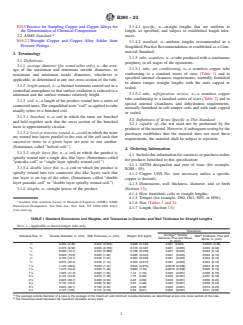
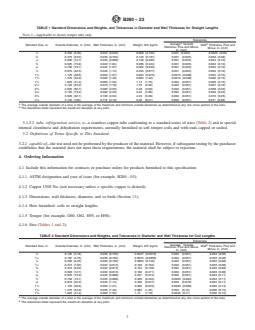
TABLE 1 Standard Dimensions and Weights, and Tolerances in Diameter and Wall Thickness for Straight Lengths
NOTE 1—Applicable to drawn temper tube only.
Tolerances
A
Average Outside B
Standard Size, in. Outside Diameter, in. (mm) Wall Thickness, in. (mm) Weight, lb/ft (kg/m)
Wall Thickness, Plus and
Diameter, Plus and Minus,
Minus, in. (mm)
in. (mm)
⁄4 0.250 (6.35) 0.025 (0.635) 0.068 (0.102) 0.001 (0.025) 0.0025 (0.06)
⁄8 0.375 (9.52) 0.030 (0.762) 0.126 (0.187) 0.001 (0.025) 0.003 (0.08)
⁄2 0.500 (12.7) 0.035 (0.889) 0.198 (0.295) 0.001 (0.025) 0.004 (0.10)
⁄8 0.625 (15.9) 0.040 (1.02) 0.285 (0.424) 0.001 (0.025) 0.004 (0.10)
⁄4 0.750 (19.1) 0.042 (1.07) 0.362 (0.539) 0.001 (0.025) 0.004 (0.10)
⁄8 0.875 (22.3) 0.045 (1.14) 0.455 (0.677) 0.001 (0.025) 0.004 (0.10)
1 ⁄8 1.125 (28.6) 0.050 (1.27) 0.655 (0.975) 0.0015 (0.038) 0.004 (0.10)
1 ⁄8 1.375 (34.9) 0.055 (1.40) 0.884 (1.32) 0.0015 (0.038) 0.006 (0.15)
1 ⁄8 1.625 (41.3) 0.060 (1.52) 1.14 (1.70) 0.002 (0.051) 0.006 (0.15)
2 ⁄8 2.125 (54.0) 0.070 (1.78) 1.75 (2.60) 0.002 (0.051) 0.007 (0.18)
2 ⁄8 2.625 (66.7) 0.080 (2.03) 2.48 (3.69) 0.002 (0.051) 0.008 (0.20)
3 ⁄8 3.125 (79.4) 0.090 (2.29) 3.33 (4.96) 0.002 (0.051) 0.009 (0.23)
3 ⁄8 3.625 (92.1) 0.100 (2.54) 4.29 (6.38) 0.002 (0.051) 0.010 (0.25)
4 ⁄8 4.125 (105) 0.110 (2.79) 5.38 (8.01) 0.002 (0.051) 0.011 (0.28)
A
The average outside diameter of a tube is the average of the maximum and minimum outside diameters as determined at any one cross section of the tube.
B
The tolerances listed represent the maximum deviation at any point.
B280 − 23
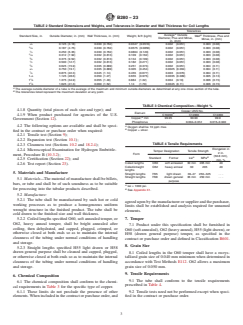
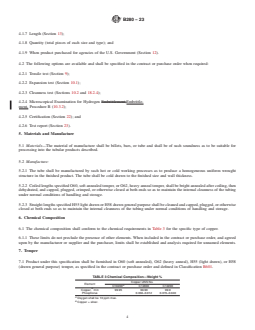
TABLE 2 Standard Dimensions and Weights, and Tolerances in Diameter and Wall Thickness for Coil Lengths
Tolerances
A
Average Outside
B
Standard Size, in. Outside Diameter, in. (mm) Wall Thickness, in. (mm) Weight, lb/ft (kg/m)
Wall Thickness, Plus and
Diameter, Plus and Minus,
Minus, in. (mm)
in. (mm)
⁄8 0.125 (3.18) 0.030 (0.762) 0.0347 (0.0516) 0.002 (0.051) 0.003 (0.08)
⁄16 0.187 (4.75) 0.030 (0.762) 0.0575 (0.0856) 0.002 (0.051) 0.003 (0.08)
⁄4 0.250 (6.35) 0.030 (0.762) 0.0804 (0.120) 0.002 (0.051) 0.003 (0.08)
⁄16 0.312 (7.92) 0.032 (0.813) 0.109 (0.162) 0.002 (0.051) 0.003 (0.08)
⁄8 0.375 (9.52) 0.032 (0.813) 0.134 (0.199) 0.002 (0.051) 0.003 (0.08)
⁄2 0.500 (12.7) 0.032 (0.813) 0.182 (0.271) 0.002 (0.051) 0.003 (0.08)
⁄8 0.625 (15.9) 0.035 (0.889) 0.251 (0.373) 0.002 (0.051) 0.004 (0.11)
⁄4 0.750 (19.1) 0.035 (0.889) 0.305 (0.454) 0.0025 (0.064) 0.004 (0.11)
⁄8 0.875 (22.3) 0.045 (1.14) 0.455 (0.677) 0.003 (0.076) 0.004 (0.11)
1 ⁄8 1.125 (28.6) 0.050 (1.27) 0.655 (0.975) 0.0035 (0.089) 0.005 (0.13)
1 ⁄8 1.375 (34.9) 0.055 (1.40) 0.884 (1.32) 0.004 (0.10) 0.006 (0.15)
1 ⁄8 1.625 (41.3) 0.060 (1.52) 1.14 (1.70) 0.0045 (0.11) 0.006 (0.15)
A
The average outside diameter of a tube is the average of the maximum and minimum outside diameters as determined at any one cross section of the tube.
B
The tolerances listed represent the maximum deviation at any point.
TABLE 3 Chemical Composition—Weight %
4.1.8 Quantity (total pieces of each size and type); and
Copper UNS No.
Element
A
C10200 C12000 C12200
4.1.9 When product purchased for agencies of the U.S.
B
Copper, min 99.95 99.90 99.9
Government (Section 12).
Phosphorus . . . 0.004–0.012 0.015–0.040
4.2 The following options are available and shall be speci- A
Oxygen shall be 10 ppm max.
B
fied in the contract or purchase order when required: Copper + silver.
4.2.1 Tensile test (Section 9);
4.2.2 Expansion test (Section 10.1);
TABLE 4 Tensile Requirements
4.2.3 Cleanness test (Sections 10.2 and 18.2.4);
Elongation in
4.2.4 Microscopical Examination for Hydrogen Embrittle-
Temper Designation Tensile Strength
2 in.
Form
ment, Procedure B (10.3.2);
(50.8 mm),
A B
Standard Former ksi MPa
4.2.5 Certification (Section 22); and
min, %
Coiled lengths O60 soft annealed 30 min 205 min 40
4.2.6 Test report (Section 23).
Coiled/straight O62 heavy anneal 30 205 40
lengths
5. Materials and Manufacture
Straight lengths H55 light drawn 36–47 250–325 . . .
Straight lengths H58 drawn general 36 min 250 min . . .
5.1 Materials—The material of manufacture shall be billets,
purpose
bars, or tube and shall be of such soundness as to be suitable
A
ksi = 1000 psi.
for processing into the tubular products described. B
See Appendix X1.
5.2 Manufacture:
5.2.1 The tube shall be manufactured by such hot or cold
agreed upon by the manufacturer or supplier and the purchaser,
working processes as to produce a homogeneous uniform
limits shall be established and analysis required for unnamed
wrought structure in the finished product. The tube shall be
elements.
cold drawn to the finished size and wall thickness.
7. Temper
5.2.2 Coiled lengths specified O60, soft annealed temper, or
O62, heavy anneal temper, shall be bright annealed after
7.1 Product under this specification shall be furnished in
coiling, then dehydrated, and capped, plugged, crimped, or
O60 (soft annealed), O62 (heavy anneal), H55 (light drawn), or
otherwise closed at both ends so as to maintain the internal
H58 (drawn general purpose) temper, as specified in the
cleanness of the tubing under normal conditions of handling
contract or purchase order and defined in Classification B601.
and storage.
8. Grain Size
5.2.3 Straight lengths specified H55 light drawn or H58
drawn general purpose shall be cleaned and capped, plugged,
8.1 Coiled lengths in the O60 temper shall have a recrys-
or otherwise closed at both ends so as to maintain the internal tallized grain size of 0.040 mm minimum when determined in
cleanness of the tubing under normal conditions of handling
accordance with Test Methods E112. O62 allows a maximum
and storage. grain size of 0.050 mm.
9. Tensile Requirements
6. Chemical Composition
9.1 The tube shall conform to the tensile requirements
6.1 The chemical composition shall conform to the chemi-
prescribed in Table 4.
cal requirements in Table 3 for the specific type of copper.
6.1.1 These limits do not preclude the presence of other 9.2 Tensile tests need not be performed except when speci-
elements. When included in the contract or purchase order, and
fied in the contract or purchase order.
B280 − 23
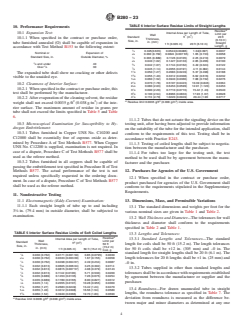
TABLE 6 Interior Surface Residue Limits of Straight Lengths
10. Performance Requirements
A
Residue
10.1 Expansion Test: Internal Area per Length of Tube,
Limit per
Wall 2 2
ft (m )
Standard
20 ft
10.1.1 When specified in the contract or purchase order,
Thickness,
(6.10 m)
Size, in.
in. (mm)
tube furnished annealed (O) shall be capable of expansion in
Straight
1 ft (0.305 m) 20 ft (6.10 m)
Length, g
accordance with Test Method B153 to the following extent:
⁄4 0.025(0.635) 0.0524(0.00486) 1.04(0.097) 0.0037
Nominal or Expansion of
⁄8 0.030 (0.762) 0.0824 (0.007 65) 1.65 (0.153) 0.0058
Standard Size, in. Outside Diameter, %
⁄2 0.035 (0.889) 0.1126 (0.0105) 2.25 (0.210) 0.0079
⁄8 0.040 (1.02) 0.1427 (0.0133) 2.85 (0.266) 0.0100
⁄8 and under 40
⁄4 0.042 (1.07) 0.1744 (0.0162) 3.49 (0.324) 0.0122
Over ⁄8 30
⁄8 0.045 (1.14) 0.2055 (0.0191) 4.11 (0.382) 0.0144
1 ⁄8 0.050 (1.27) 0.2683 (0.0249) 5.37 (0.498) 0.0188
The expanded tube shall show no cracking or other defects
1 ⁄8 0.055 (1.40) 0.3312 (0.0308) 6.62 (0.616) 0.0232
visible to the unaided eye.
1 ⁄8 0.060 (1.52) 0.3940 (0.0366) 7.88 (0.732) 0.0276
2 ⁄8 0.070 (1.78) 0.5197 (0.0423) 10.39 (0.846) 0.0364
10.2 Cleanness of Interior Surface:
2 ⁄8 0.080 (2.03) 0.6453 (0.0599) 12.91 (1.120) 0.0453
10.2.1 When specified in the contract or purchase order, this
3 ⁄8 0.090 (2.29) 0.7710 (0.0716) 15.42 (1.43) 0.0540
test shall be performed by the manufacturer.
3 ⁄8 0.100 (2.54) 0.8966 (0.0833) 17.93 (1.67) 0.0628
4 ⁄8 0.110 (2.79) 1.0220 (0.0949) 20.44 (1.90 0.0717
10.2.2 After evaporation of the cleaning solvent, the residue
2 2
A 2 2
Residue limit 0.0035 g/ft (0.038 g/m ) inside area.
weight shall not exceed 0.0035 g ⁄ft (0.038 g ⁄m ) of the inte-
rior surface. The maximum amount of residue in grams per
tube shall not exceed the limits specified in Table 5 and Table
6.
11.1.2 Tubes that do not actuate the signaling device on the
10.3 Microscopical Examination for Susceptibility to Hy-
testing unit, after having been adjusted to provide information
drogen Embrittlement:
on the suitability of the tube for the intended application, shall
10.3.1 Tubes furnished in Copper UNS No. C10200 and
conform to the requirements of this test. Testing shall be in
C12000 shall be essentially free of cuprous oxide as deter-
accordance with Practice E243.
mined by Procedure A of Test Methods B577. When Copper
11.1.3 Testing of coiled lengths shall be subject to negotia-
UNS No. C12200 is supplied, examination is not required. In
tion between the manufacturer and the purchaser.
case of a dispute, Procedure C of Test Methods B577 shall be
11.1.4 For tubes too large for the testing unit, the test
used as the referee method.
method to be used shall be by agreement between the manu-
10.3.2 Tubes furnished in all coppers shall be capable of
facturer and the purchaser.
passing the embrittlement test specified in Procedure B of Test
Methods B577. The actual performance of the test is not 12. Purchases for Agencies of the U.S. Government
required unless specifically requested in the ordering docu-
12.1 When specified in the contract or purchase order,
ment. In case of a dispute, Procedure C of Test Methods B577
product purchased for agencies of the U.S. Government shall
shall be used as the referee method.
conform to the requirements stipulated in the Supplementary
Requirements.
11. Nondestructive Testing
13. Dimensions, Mass, and Permissible Variations
11.1 Electromagnetic (Eddy-Current) Examination:
11.1.1 Each straight length of tube up to and including
13.1 The standard dimensions and weights per foot for the
3 ⁄8 in. (79.4 mm) in outside diameter, shall be subjected to
various nominal sizes are given in Table 1 and Table 2.
examination.
13.2 Wall Thickness and Diameter—The tolerances for wall
thickness and diameter shall conform to the requirements
specified in Table 2 and Table 1.
TABLE 5 Interior Surface Residue Limits of Soft Coiled Lengths
13.3 Lengths and Tolerances:
A
Residue
Internal Area per Length of Tube, 13.3.1 Standard Lengths and Tolerances—The standard
Wall
Limit per
2 2
Standard
ft (m )
length for coils shall be 50 ft (15.2 m). The length tolerances
Thickness, 50 ft
Size, in.
(15.2 m)
in. (mm)
for 50 ft coils shall be +12 in. (305 mm) and –0 in. The
1 ft (0.305 m) 50 ft (15.2 m)
Coil, g
standard length for straight lengths shall be 20 ft (6.1 m). The
⁄8 0.030 (0.762) 0.0171 (0.001 59) 0.85 (0.0795) 0.0030
⁄16 0.030 (0.762) 0.0333 (0.003 09) 1.67 (0.155) 0.0058 length tolerances for 20 ft lengths shall be +1 in. (25 mm) and
⁄4 0.030 (0.762) 0.0498 (0.004 67) 2.49 (0.234) 0.0087
–0 in.
⁄16 0.032 (0.813) 0.0605 (0.006 04) 3.25 (0.302) 0.0114
13.3.2 Tubes supplied in other than standard lengths and
⁄8 0.032 (0.813) 0.0815 (0.007 57) 4.08 (0.379) 0.0143
tolerances shall be in accordance with requirements established
⁄2 0.032 (0.813) 0.1142 (0.0106) 5.71 (0.530) 0.0200
⁄8 0.035 (0.889) 0.1453 (0.0135) 7.26 (0.675) 0.0254
by agreement between the manufacturer or supplier and the
⁄4 0.035 (0.889) 0.1780 (0.0165) 8.90 (0.827) 0.0312
purchaser.
⁄8 0.045 (1.14) 0.2055 (0.0191) 10.28 (0.955) 0.0360
1 ⁄8 0.050 (1.27) 0.2683 (0.0249) 13.42 (1.24) 0.0470
13.4 Roundness—For drawn unannealed tube in straight
1 ⁄8 0.055 (1.40) 0.3312 (0.0308) 16.56 (1.54) 0.0580
5 lengths, the roundness tolerance as specified in Table 7. The
1 ⁄8 0.060 (1.52) 0.3940 (0.0366) 19.70 (1.83) 0.0690
A 2 2 deviation from roundness is measured as the difference be-
Residue limit 0.0035 g/ft (0.038 g/m ) inside area.
tween major and minor diameters as determined at any one
B280 − 23
TABLE 7 Roundness Tolerance
When the composition is determined during the course of
manufacture, sampling of the finished product is not required.
NOTE 1—Applicable to drawn unannealed straight length tube only.
15.2.3 The number of samples taken during the course of
Roundness Tolerance Percent
manufacture shall be as follows:
t/D (Ratio of Wall Thickness to of Nominal Outside Diameter
Nominal Outside Diameter) (Expressed to Nearest
15.2.3.1 When samples are taken at the time the castings are
0.001 in. or 0.010 mm)
poured, at least one sample shall be taken for each group of
0.01 to 0.03, incl 1.5
castings poured simultaneously from the same source of
Over 0.03 to 0.05, incl 1.0
Over 0.05 to 0.10, incl 0.8
molten metal.
15.2.3.2 When sampl
...
This document is not an ASTM standard and is intended only to provide the user of an ASTM standard an indication of what changes have been made to the previous version. Because
it may not be technically possible to adequately depict all changes accurately, ASTM recommends that users consult prior editions as appropriate. In all cases only the current version
of the standard as published by ASTM is to be considered the official document.
Designation: B280 − 20 B280 − 23
Standard Specification for
Seamless Copper Tube for Air Conditioning and
Refrigeration Field Service
This standard is issued under the fixed designation B280; the number immediately following the designation indicates the year of
original adoption or, in the case of revision, the year of last revision. A number in parentheses indicates the year of last reapproval. A
superscript epsilon (´) indicates an editorial change since the last revision or reapproval.
This standard has been approved for use by agencies of the U.S. Department of Defense.
1. Scope*
1.1 This specification establishescovers the requirements for seamless copper tube intended for use in the connection, repairs, or
alternations of air conditioning or refrigeration units in the field.
NOTE 1—Fittings used for soldered or brazed connections in air conditioning and refrigeration systems are described in ASME Standard B16.22.
NOTE 2—The assembly of copper tubular systems by soldering is described in Practice B828.
NOTE 3—Solders for joining copper tubular systems are described in Specification B32. The requirements for acceptable fluxes for these systems are
described in Specification B813.
1.2 The tube shall be produced from the following coppers, and the manufacturer has the option to supply any one of them, unless
otherwise specified:
Copper Previously Used
Description
UNS No. Designation
C10200 OF Oxygen free without
residual deoxidants
C12000 DLP Phosphorus deoxidized,
low residual phosphorus
C12200 DHP Phosphorus deoxidized,
high residual phosphorus
1.3 The values stated in inch-pound units are to be regarded as standard. The values given in parentheses are mathematical
conversions to SI units that are provided for information only and are not considered standard.
1.4 The following hazard statement pertains only to the test method described in 18.2.4 of this specification: This standard does
not purport to address all of the safety concerns, if any, associated with its use. It is the responsibility of the user of this standard
to establish appropriate safety, health, and environmental practices and determine the applicability of regulatory limitations prior
to use.
1.5 This international standard was developed in accordance with internationally recognized principles on standardization
established in the Decision on Principles for the Development of International Standards, Guides and Recommendations issued
by the World Trade Organization Technical Barriers to Trade (TBT) Committee.
This specification is under the jurisdiction of ASTM Committee B05 on Copper and Copper Alloys and is the direct responsibility of Subcommittee B05.04 on Pipe and
Tube.
Current edition approved April 1, 2020Oct. 1, 2023. Published April 2020October 2023. Originally approved in 1953. Last previous edition approved in 20192020 as
B280B280 – 20.–19. DOI: 10.1520/B0280–20.10.1520/B0280-23.
*A Summary of Changes section appears at the end of this standard
Copyright © ASTM International, 100 Barr Harbor Drive, PO Box C700, West Conshohocken, PA 19428-2959. United States
B280 − 23
2. Referenced Documents
2.1 ASTM Standards:
B32 Specification for Solder Metal
B153 Test Method for Expansion (Pin Test) of Copper and Copper-Alloy Pipe and Tubing
B577 Test Methods for Detection of Cuprous Oxide (Hydrogen Embrittlement Susceptibility) in Copper
B601 Classification for Temper Designations for Copper and Copper Alloys—Wrought and Cast
B813 Specification for Liquid and Paste Fluxes for Soldering of Copper and Copper Alloy Tube
B828 Practice for Making Capillary Joints by Soldering of Copper and Copper Alloy Tube and Fittings
B900 Practice for Packaging of Copper and Copper Alloy Mill Products for U.S. Government Agencies
E3 Guide for Preparation of Metallographic Specimens
E8/E8M Test Methods for Tension Testing of Metallic Materials
E29 Practice for Using Significant Digits in Test Data to Determine Conformance with Specifications
E53 Test Method for Determination of Copper in Unalloyed Copper by Gravimetry (Withdrawn 2022)
E62 Test Methods for Chemical Analysis of Copper and Copper Alloys (Photometric Methods) (Withdrawn 2010)
E112 Test Methods for Determining Average Grain Size
E243 Practice for Electromagnetic (Eddy Current) Examination of Copper and Copper-Alloy Tubes
E255 Practice for Sampling Copper and Copper Alloys for the Determination of Chemical Composition
2.2 ASME Standard:
B16.22 Wrought Copper and Copper Alloy Solder Joint Pressure Fittings
3. Terminology
3.1 Definitions:
3.1.1 average diameter (for round tubes only), n—the average of the maximum and minimum outside diameters, or maximum and
minimum inside diameters, whichever is applicable, as determined at any one cross section of the tube.
3.1.2 bright anneal, n—a thermal treatment carried out in a controlled atmosphere so that surface oxidation is reduced to a
minimum and the surface remains relatively bright.
3.1.3 coil, n—a length of the product wound into a series of connected turns. The unqualified term “coil” as applied to tube usually
refers to a bunched coil.
3.1.3.1 bunched, n—a coil in which the turns are bunched and held together such that the cross section of the bunched turns
is approximately circular.
3.1.3.2 level or traverse wound, n—a coil in which the turns are wound into layers parallel to the axis of the coil such that
successive turns in a given layer are next to one another. (Sometimes called “helical coil.”)
3.1.3.3 single layer flat, n—a coil in which the product is spirally wound into a single disc-like layer. (Sometimes called
“pancake coil” or “single layer spirally wound coil.”)
3.1.3.4 double layer flat, n—a coil in which the product is spirally wound into two connected disc-like layers such that one layer
is on top of the other. (Sometimes called “double layer pancake coil” or “double layer spirally wound coil.”)
3.1.4 lengths, n—straight pieces of the product.
3.1.4.1 specific, n—straight lengths that are uniform in length, as specified, and subject to established length tolerances.
3.1.4.2 standard, n—uniform lengths recommended in a Simplified Practice Recommendation or established as a Commercial
Standard.
3.1.5 tube, seamless, n—a tube produced with a continuous periphery in all stages of the operations.
3.1.5.1 tube, air conditioning, n—a seamless copper tube conforming to a standard series of sizes (Table 1) and to specified
internal cleanness requirements, normally furnished in drawn temper straight lengths with the ends capped or sealed.
For referenced ASTM standards, visit the ASTM website, www.astm.org, or contact ASTM Customer Service at service@astm.org. For Annual Book of ASTM Standards
volume information, refer to the standard’s Document Summary page on the ASTM website.
The last approved version of this historical standard is referenced on www.astm.org.
Available from American Society of Mechanical Engineers (ASME), ASME International Headquarters, Two Park Ave., New York, NY 10016-5990, http://
www.asme.org.
B280 − 23
TABLE 1 Standard Dimensions and Weights, and Tolerances in Diameter and Wall Thickness for Straight Lengths
NOTE 1—Applicable to drawn temper tube only.
Tolerances
A
Average Outside
B
Standard Size, in. Outside Diameter, in. (mm) Wall Thickness, in. (mm) Weight, lb/ft (kg/m) Wall Thickness, Plus and
Diameter, Plus and Minus,
Minus, in. (mm)
in. (mm)
⁄4 0.250 (6.35) 0.025 (0.635) 0.068 (0.102) 0.001 (0.025) 0.0025 (0.06)
⁄8 0.375 (9.52) 0.030 (0.762) 0.126 (0.187) 0.001 (0.025) 0.003 (0.08)
⁄2 0.500 (12.7) 0.035 (0.889) 0.198 (0.295) 0.001 (0.025) 0.004 (0.10)
⁄8 0.625 (15.9) 0.040 (1.02) 0.285 (0.424) 0.001 (0.025) 0.004 (0.10)
⁄4 0.750 (19.1) 0.042 (1.07) 0.362 (0.539) 0.001 (0.025) 0.004 (0.10)
⁄8 0.875 (22.3) 0.045 (1.14) 0.455 (0.677) 0.001 (0.025) 0.004 (0.10)
1 ⁄8 1.125 (28.6) 0.050 (1.27) 0.655 (0.975) 0.0015 (0.038) 0.004 (0.10)
1 ⁄8 1.375 (34.9) 0.055 (1.40) 0.884 (1.32) 0.0015 (0.038) 0.006 (0.15)
1 ⁄8 1.625 (41.3) 0.060 (1.52) 1.14 (1.70) 0.002 (0.051) 0.006 (0.15)
2 ⁄8 2.125 (54.0) 0.070 (1.78) 1.75 (2.60) 0.002 (0.051) 0.007 (0.18)
2 ⁄8 2.625 (66.7) 0.080 (2.03) 2.48 (3.69) 0.002 (0.051) 0.008 (0.20)
3 ⁄8 3.125 (79.4) 0.090 (2.29) 3.33 (4.96) 0.002 (0.051) 0.009 (0.23)
3 ⁄8 3.625 (92.1) 0.100 (2.54) 4.29 (6.38) 0.002 (0.051) 0.010 (0.25)
4 ⁄8 4.125 (105) 0.110 (2.79) 5.38 (8.01) 0.002 (0.051) 0.011 (0.28)
A
The average outside diameter of a tube is the average of the maximum and minimum outside diameters as determined at any one cross section of the tube.
B
The tolerances listed represent the maximum deviation at any point.
3.1.5.2 tube, refrigeration service, n—a seamless copper tube conforming to a standard series of sizes (Table 2) and to special
internal cleanliness and dehydration requirements, normally furnished in soft temper coils and with ends capped or sealed.
3.2 Definitions of Terms Specific to This Standard:
3.2.1 capable of—the test need not be performed by the producer of the material. However, if subsequent testing by the purchaser
establishes that the material does not meet these requirements, the material shall be subject to rejection.
4. Ordering Information
4.1 Include this information for contracts or purchase orders for products furnished to this specification:
4.1.1 ASTM designation and year of issue (for example, B280 – 03);
4.1.2 Copper UNS No. (not necessary unless a specific copper is desired);
4.1.3 Dimensions; wall thickness, diameter, and so forth (Section 13);
4.1.4 How furnished: coils or straight lengths;
4.1.5 Temper (for example, O60, O62, H55, or H58);
4.1.6 Size (Tables 1 and 2);
TABLE 2 Standard Dimensions and Weights, and Tolerances in Diameter and Wall Thickness for Coil Lengths
Tolerances
A
Average Outside
B
Standard Size, in. Outside Diameter, in. (mm) Wall Thickness, in. (mm) Weight, lb/ft (kg/m) Wall Thickness, Plus and
Diameter, Plus and Minus,
Minus, in. (mm)
in. (mm)
⁄8 0.125 (3.18) 0.030 (0.762) 0.0347 (0.0516) 0.002 (0.051) 0.003 (0.08)
⁄16 0.187 (4.75) 0.030 (0.762) 0.0575 (0.0856) 0.002 (0.051) 0.003 (0.08)
⁄4 0.250 (6.35) 0.030 (0.762) 0.0804 (0.120) 0.002 (0.051) 0.003 (0.08)
⁄16 0.312 (7.92) 0.032 (0.813) 0.109 (0.162) 0.002 (0.051) 0.003 (0.08)
⁄8 0.375 (9.52) 0.032 (0.813) 0.134 (0.199) 0.002 (0.051) 0.003 (0.08)
⁄2 0.500 (12.7) 0.032 (0.813) 0.182 (0.271) 0.002 (0.051) 0.003 (0.08)
⁄8 0.625 (15.9) 0.035 (0.889) 0.251 (0.373) 0.002 (0.051) 0.004 (0.11)
⁄4 0.750 (19.1) 0.035 (0.889) 0.305 (0.454) 0.0025 (0.064) 0.004 (0.11)
⁄8 0.875 (22.3) 0.045 (1.14) 0.455 (0.677) 0.003 (0.076) 0.004 (0.11)
1 ⁄8 1.125 (28.6) 0.050 (1.27) 0.655 (0.975) 0.0035 (0.089) 0.005 (0.13)
1 ⁄8 1.375 (34.9) 0.055 (1.40) 0.884 (1.32) 0.004 (0.10) 0.006 (0.15)
1 ⁄8 1.625 (41.3) 0.060 (1.52) 1.14 (1.70) 0.0045 (0.11) 0.006 (0.15)
A
The average outside diameter of a tube is the average of the maximum and minimum outside diameters as determined at any one cross section of the tube.
B
The tolerances listed represent the maximum deviation at any point.
B280 − 23
4.1.7 Length (Section 13);
4.1.8 Quantity (total pieces of each size and type); and
4.1.9 When product purchased for agencies of the U.S. Government (Section 12).
4.2 The following options are available and shall be specified in the contract or purchase order when required:
4.2.1 Tensile test (Section 9);
4.2.2 Expansion test (Section 10.1);
4.2.3 Cleanness test (Sections 10.2 and 18.2.4);
4.2.4 Microscopical Examination for Hydrogen Embrittlement,Embrittle-
ment, Procedure B (10.3.2);
4.2.5 Certification (Section 22); and
4.2.6 Test report (Section 23).
5. Materials and Manufacture
5.1 Materials—The material of manufacture shall be billets, bars, or tube and shall be of such soundness as to be suitable for
processing into the tubular products described.
5.2 Manufacture:
5.2.1 The tube shall be manufactured by such hot or cold working processes as to produce a homogeneous uniform wrought
structure in the finished product. The tube shall be cold drawn to the finished size and wall thickness.
5.2.2 Coiled lengths specified O60, soft annealed temper, or O62, heavy anneal temper, shall be bright annealed after coiling, then
dehydrated, and capped, plugged, crimped, or otherwise closed at both ends so as to maintain the internal cleanness of the tubing
under normal conditions of handling and storage.
5.2.3 Straight lengths specified H55 light drawn or H58 drawn general purpose shall be cleaned and capped, plugged, or otherwise
closed at both ends so as to maintain the internal cleanness of the tubing under normal conditions of handling and storage.
6. Chemical Composition
6.1 The chemical composition shall conform to the chemical requirements in Table 3 for the specific type of copper.
6.1.1 These limits do not preclude the presence of other elements. When included in the contract or purchase order, and agreed
upon by the manufacturer or supplier and the purchaser, limits shall be established and analysis required for unnamed elements.
7. Temper
7.1 Product under this specification shall be furnished in O60 (soft annealed), O62 (heavy anneal), H55 (light drawn), or H58
(drawn general purpose) temper, as specified in the contract or purchase order and defined in Classification B601.
TABLE 3 Chemical Composition—Weight %
Copper UNS No.
Element
A
C10200 C12000 C12200
B
Copper, min 99.95 99.90 99.9
Phosphorus . . . 0.004–0.012 0.015–0.040
A
Oxygen shall be 10 ppm max.
B
Copper + silver.
B280 − 23
TABLE 4 Tensile Requirements
Elongation in
Temper Designation Tensile Strength
2 in. (50.8
Form mm),
A B (50.8 mm),
Standard Former ksi MPa
min, %
Coiled lengths O60 soft annealed 30 min 205 min 40
Coiled/straight O62 heavy anneal 30 205 40
lengths
Straight lengths H55 light drawn 36–47 250–325 . . .
Straight lengths H58 drawn general 36 min 250 min . . .
purpose
A
ksi = 1000 psi.
B
See Appendix X1.
8. Grain Size
8.1 Coiled lengths in the O60 temper shall have a recrystallized grain size of 0.040 mm minimum when determined in accordance
with Test Methods E112. O62 allows a maximum grain size of 0.050 mm.
9. Tensile Requirements
9.1 The tube shall conform to the tensile requirements prescribed in Table 4.
9.2 Tensile tests need not be performed except when specified in the contract or purchase order.
B280 − 23
10. Performance Requirements
10.1 Expansion Test:
10.1.1 Tube furnished in the O60 soft annealed or O62 heavy anneal temperWhen specified in the contract or purchase order, tube
furnished annealed (O) shall be capable of being expanded expansion in accordance with Test Method B153 to the following
extent:
10.1.1.1 The expanded tube shall show no cracking or other defects visible to the unaided eye.
Nominal or Expansion of
Standard Size, in. Outside Diameter, %
⁄8 and under 40
Over ⁄8 30
The expanded tube shall show no cracking or other defects visible to the unaided eye.
10.1.2 Unless specified in the contract or purchase order, this test is not required to be performed by the manufacturer.
10.2 Cleanness of Interior Surface:
10.2.1 When specified in the contract or purchase order, this test shall be performed by the manufacturer.
2 2
10.2.2 After evaporation of the cleaning solvent, the residue weight shall not exceed 0.0035 0.0035 g g/ft⁄ft (0.038 g (0.038 g ⁄m )
of the interior surface. The maximum amount of residue in grams per tube shall not exceed the limits specified in Table 5 and Table
6.
10.3 Microscopical Examination for Susceptibility to Hydrogen Embrittlement:
10.3.1 Tubes furnished in Copper UNS No. C10200 and C12000 shall be essentially free of cuprous oxide as determined by
Procedure A of Test Methods B577. When Copper UNS No. C12200 is supplied, examination is not required. In case of a dispute,
Procedure C of Test Methods B577 shall be used as the referee method.
10.3.2 Tubes furnished in all coppers shall be capable of passing the embrittlement test specified in Procedure B of Test Methods
B577. The actual performance of the test is not required unless specifically requested in the ordering document. In case of a dispute,
Procedure C of Test Methods B577 shall be used as the referee method.
11. Nondestructive Testing
11.1 Electromagnetic (Eddy-Current) Examination:
TABLE 5 Interior Surface Residue Limits of Soft Coiled Lengths
A
Residue
Internal Area per Length of Tube,
Limit per
Wall
2 2
ft (m )
Standard 50 ft (15.2
Thickness,
m) 50 ft
Size, in.
in. (mm)
(15.2 m)
1 ft (0.305 m) 50 ft (15.2 m)
Coil, g
⁄8 0.030 (0.762) 0.0171 (0.001 59) 0.85 (0.0795) 0.0030
⁄16 0.030 (0.762) 0.0333 (0.003 09) 1.67 (0.155) 0.0058
⁄4 0.030 (0.762) 0.0498 (0.004 67) 2.49 (0.234) 0.0087
⁄16 0.032 (0.813) 0.0605 (0.006 04) 3.25 (0.302) 0.0114
⁄8 0.032 (0.813) 0.0815 (0.007 57) 4.08 (0.379) 0.0143
⁄2 0.032 (0.813) 0.1142 (0.0106) 5.71 (0.530) 0.0200
⁄8 0.035 (0.889) 0.1453 (0.0135) 7.26 (0.675) 0.0254
⁄4 0.035 (0.889) 0.1780 (0.0165) 8.90 (0.827) 0.0312
⁄8 0.045 (1.14) 0.2055 (0.0191) 10.28 (0.955) 0.0360
1 ⁄8 0.050 (1.27) 0.2683 (0.0249) 13.42 (1.24) 0.0470
1 ⁄8 0.055 (1.40) 0.3312 (0.0308) 16.56 (1.54) 0.0580
1 ⁄8 0.060 (1.52) 0.3940 (0.0366) 19.70 (1.83) 0.0690
A 2 2
Residue limit 0.0035 g/ft (0.038 g/m ) inside area.
B280 − 23
TABLE 6 Interior Surface Residue Limits of Straight Lengths
A
Residue
Internal Area per Length of Tube,
Limit per 20
2 2
Wall
ft (m ) ft (6.10 m)
Standard
Thickness, 20 ft
Size, in.
(6.10 m)
in. (mm)
Straight
1 ft (0.305 m) 20 ft (6.10 m)
Length, g
⁄4 0.025(0.635) 0.0524(0.00486) 1.04(0.097) 0.0037
⁄8 0.030 (0.762) 0.0824 (0.007 65) 1.65 (0.153) 0.0058
⁄2 0.035 (0.889) 0.1126 (0.0105) 2.25 (0.210) 0.0079
⁄8 0.040 (1.02) 0.1427 (0.0133) 2.85 (0.266) 0.0100
⁄4 0.042 (1.07) 0.1744 (0.0162) 3.49 (0.324) 0.0122
⁄8 0.045 (1.14) 0.2055 (0.0191) 4.11 (0.382) 0.0144
1 ⁄8 0.050 (1.27) 0.2683 (0.0249) 5.37 (0.498) 0.0188
1 ⁄8 0.055 (1.40) 0.3312 (0.0308) 6.62 (0.616) 0.0232
1 ⁄8 0.060 (1.52) 0.3940 (0.0366) 7.88 (0.732) 0.0276
2 ⁄8 0.070 (1.78) 0.5197 (0.0423) 10.39 (0.846) 0.0364
2 ⁄8 0.080 (2.03) 0.6453 (0.0599) 12.91 (1.120) 0.0453
3 ⁄8 0.090 (2.29) 0.7710 (0.0716) 15.42 (1.43) 0.0540
3 ⁄8 0.100 (2.54) 0.8966 (0.0833) 17.93 (1.67) 0.0628
4 ⁄8 0.110 (2.79) 1.0220 (0.0949) 20.44 (1.90 0.0717
A 2 2
Residue limit 0.0035 g/ft (0.038 g/m ) inside area.
11.1.1 Each straight length of tube up to and including 3 ⁄8 in. (79.4 mm) in outside diameter, shall be subjected to examination.
11.1.2 Tubes that do not actuate the signaling device on the testing unit, after having been adjusted to provide information on the
suitability of the tube for the intended application, shall conform to the requirements of this test. Testing shall be in accordance
with Practice E243.
11.1.3 Testing of coiled lengths shall be subject to negotiation between the manufacturer and the purchaser.
11.1.4 For tubes too large for the testing unit, the test method to be used shall be by agreement between the manufacturer and the
purchaser.
12. Purchases for Agencies of the U.S. Government
12.1 When specified in the contract or purchase order, product purchased for agencies of the U.S. Government shall conform to
the requirements stipulated in the Supplementary Requirements.
13. Dimensions, Mass, and Permissible Variations
13.1 The standard dimensions and weights per foot for the various nominal sizes are given in Table 1 and Table 2.
13.2 Wall Thickness and Diameter—The tolerances for wall thickness and diameter shall conform to the requirements specified
in Table 2 and Table 1.
13.3 Lengths and Tolerances:
13.3.1 Standard Lengths and Tolerances—The standard length for coils shall be 50 ft (15.2 m). The length tolerances for 50 ft coils
shall be +12 in. (305 mm) and –0 in. The standard length for straight lengths shall be 20 ft (6.1 m). The length tolerances for 20
ft lengths shall be +1 in. (25 mm) and –0 in.
13.3.2 Tubes supplied in other than standard lengths and tolerances shall be in accordance with requirements established by
agreement between the manufacturer or supplier and the purchaser.
13.4 Roundness—For drawn unannealed tube in straight lengths, the roundness tolerance as specified in Table 7. The deviation
from roundness is measured as the difference between major and minor diameters as determined at any one cross section of the
tube. Roundness tolerance has not been established for annealed tube in straight lengths nor for tubes furnished in coils.
B280 − 23
TABLE 7 Roundness Tolerance
NOTE 1—Applicable to drawn unannealed straight length tube only.
Roundness Tolerance Percent
t/D (Ratio of Wall Thickness to of Nominal Outside Diameter
Nominal Outside Diameter) (Expressed to Nearest
0.001 in. or 0.010 mm)
0.01 to 0.03, incl 1.5
Over 0.03 to 0.05, incl 1.0
Over 0.05 to 0.10, incl 0.8
13.5 Squareness of Cut—For tube in straight lengths, the departure from squareness of the end of any tube shall not exceed more
than 0.010 in. (0.25 mm) for tube up to and including ⁄8 in. (15.9 mm) standard size; and not more than 0.016 in./in. (0.016
mm/mm) of outside diameter, for tube larger than ⁄8 in. standard size.
13.6 For the purpose of determining conformance with the dimensional requirements prescribed in this specification, any
measured value outside the specified limiting
...