

ASTM A836/A836M-14(2020)
(Specification)Standard Specification for Titanium-Stabilized Carbon Steel Forgings for Glass-Lined Piping and Pressure Vessel Service
General Information
- Abstract
ABSTRACT
This specification covers non-standard titanium-stabilized carbon steel forgings, as-forged fittings, and valve components and parts for glass-lined piping and pressure vessel service. Materials shall be manufactured by forging in the manner of hammering, pressing, rolling, extruding, or upsetting. Mechanical properties are certified on the basis of test material subjected to heat treatments to simulate glass-coating operations. Specimens shall conform to chemical composition and tensile requirements, such as tensile strength, yield strength, elongation, and reduction of area. A single retest may be performed to establish product acceptability when one or more representative test specimen does not conform to specifications. Repair welding shall be required only upon the approval of the purchaser.
SCOPE
1.1 This specification covers nonstandard as-forged fittings, valve components, and parts for glass-lined piping and pressure vessel service. Mechanical properties are certified on the basis of test material subjected to heat treatments to simulate glass-coating operations.
1.2 The values stated in either inch-pound units or SI units are to be regarded separately as standard. Within the text, the SI units are shown in brackets. The values stated in each system are not exact equivalents; therefore, each system must be used independently of the other. Combining values from the two systems may result in nonconformance with the specification. The inch-pound units shall apply unless the “M” designation of this specification is specified in the order.
1.3 This international standard was developed in accordance with internationally recognized principles on standardization established in the Decision on Principles for the Development of International Standards, Guides and Recommendations issued by the World Trade Organization Technical Barriers to Trade (TBT) Committee.
- Status
- Published
- Publication Date
- 31-Oct-2020
- Technical Committee
- A01 - Steel, Stainless Steel and Related Alloys


Overview
ASTM A836/A836M-14(2020) is an internationally recognized standard specification developed by ASTM International for titanium-stabilized carbon steel forgings intended for use in glass-lined piping systems and pressure vessel service. This specification specifically addresses non-standard as-forged fittings, valve components, and parts that require reliable performance when subjected to glass-coating operations. The document details essential manufacturing, testing, composition, and certification requirements to ensure suitable mechanical and chemical properties for demanding industrial applications.
Key Topics
- Material and Manufacturing Methods
- Forgings must be produced by methods such as hammering, pressing, rolling, extruding, or upsetting.
- The process ensures the final product meets the required quality and reliability for further glass-lining and pressure vessel use.
- Heat Treatment and Simulation
- Test materials are heat treated to simulate the glass-coating process, ensuring mechanical properties are maintained through subsequent manufacturing stages.
- Heat treatment specifics for the forgings or weld test plates involve normalizing to match real-world glass-lining conditions.
- Chemical and Mechanical Properties
- Chemical composition must conform to prescribed requirements for elements like carbon, manganese, phosphorus, sulfur, silicon, and titanium.
- Mechanical properties, including tensile strength, yield strength, elongation, and reduction of area, are certified through rigorous testing.
- Testing and Retesting
- One tension test per heat batch is required. A single retest is allowed if initial specimens do not comply, doubling the number tested for the nonconforming characteristic.
- Repair and Welding
- Weld repairs are permitted only with purchaser approval. Weld procedures must result in low hydrogen content and use materials similar to the base metal.
- Marking and Certification
- All forgings must be marked per specification, including special markings for repaired components or additional purchaser requests. Certification reports detail chemical and mechanical test results.
- Barcoding is accepted as a supplemental identification method if stipulated in the order.
Applications
ASTM A836/A836M-14(2020) is vital wherever titanium-stabilized carbon steel forgings are required for glass-lined piping and pressure vessel applications. Common industries and applications include:
- Process Piping: Used extensively in chemical, pharmaceutical, and food processing industries where glass-lined pipes provide corrosion resistance.
- Pressure Vessels: Components such as flanges, fittings, and valve parts that must withstand harsh process conditions and maintain integrity after glass-lining.
- Valve and Fitting Manufacturing: Ensures forged parts maintain essential mechanical properties following the intense thermal cycles of glass-coating.
- Custom and Nonstandard Fittings: Suited for applications requiring dimensions or shapes not covered by standard product specifications.
Related Standards
For comprehensive quality and compatibility, the following standards are referenced and often used alongside ASTM A836/A836M:
- ASTM A788/A788M - Specification for Steel Forgings, General Requirements
- ASTM A961/A961M - Specification for Common Requirements for Steel Flanges, Forged Fittings, Valves, and Parts for Piping Applications
These related ASTM standards define general requirements for manufacturing, testing, and ordering information, providing a robust framework for quality assurance in steel forgings for pressure-containing parts.
Keywords: titanium-stabilized carbon steel, glass-lined piping, pressure vessel service, steel forgings, ASTM A836, piping applications, non-standard fittings, valve components, heat treatment, mechanical properties, chemical composition, industrial standards
Relations
- Effective Date
- 01-Nov-2019
- Effective Date
- 01-May-2019
- Effective Date
- 01-Nov-2018
- Effective Date
- 01-Sep-2018
- Effective Date
- 01-Mar-2018
- Effective Date
- 01-Nov-2017
- Effective Date
- 01-May-2017
- Effective Date
- 01-Dec-2016
- Effective Date
- 01-Jun-2016
- Effective Date
- 01-Nov-2015
- Effective Date
- 01-May-2015
- Effective Date
- 01-Nov-2014
- Effective Date
- 01-Oct-2014
- Effective Date
- 15-May-2014
- Effective Date
- 01-Nov-2013
Get Certified
Connect with accredited certification bodies for this standard

Element Materials Technology
Materials testing and product certification.

Inštitut za kovinske materiale in tehnologije
Institute of Metals and Technology. Materials testing, metallurgical analysis, NDT.
Sponsored listings
Frequently Asked Questions
ASTM A836/A836M-14(2020) is a technical specification published by ASTM International. Its full title is "Standard Specification for Titanium-Stabilized Carbon Steel Forgings for Glass-Lined Piping and Pressure Vessel Service". This standard covers: ABSTRACT This specification covers non-standard titanium-stabilized carbon steel forgings, as-forged fittings, and valve components and parts for glass-lined piping and pressure vessel service. Materials shall be manufactured by forging in the manner of hammering, pressing, rolling, extruding, or upsetting. Mechanical properties are certified on the basis of test material subjected to heat treatments to simulate glass-coating operations. Specimens shall conform to chemical composition and tensile requirements, such as tensile strength, yield strength, elongation, and reduction of area. A single retest may be performed to establish product acceptability when one or more representative test specimen does not conform to specifications. Repair welding shall be required only upon the approval of the purchaser. SCOPE 1.1 This specification covers nonstandard as-forged fittings, valve components, and parts for glass-lined piping and pressure vessel service. Mechanical properties are certified on the basis of test material subjected to heat treatments to simulate glass-coating operations. 1.2 The values stated in either inch-pound units or SI units are to be regarded separately as standard. Within the text, the SI units are shown in brackets. The values stated in each system are not exact equivalents; therefore, each system must be used independently of the other. Combining values from the two systems may result in nonconformance with the specification. The inch-pound units shall apply unless the “M” designation of this specification is specified in the order. 1.3 This international standard was developed in accordance with internationally recognized principles on standardization established in the Decision on Principles for the Development of International Standards, Guides and Recommendations issued by the World Trade Organization Technical Barriers to Trade (TBT) Committee.
ABSTRACT This specification covers non-standard titanium-stabilized carbon steel forgings, as-forged fittings, and valve components and parts for glass-lined piping and pressure vessel service. Materials shall be manufactured by forging in the manner of hammering, pressing, rolling, extruding, or upsetting. Mechanical properties are certified on the basis of test material subjected to heat treatments to simulate glass-coating operations. Specimens shall conform to chemical composition and tensile requirements, such as tensile strength, yield strength, elongation, and reduction of area. A single retest may be performed to establish product acceptability when one or more representative test specimen does not conform to specifications. Repair welding shall be required only upon the approval of the purchaser. SCOPE 1.1 This specification covers nonstandard as-forged fittings, valve components, and parts for glass-lined piping and pressure vessel service. Mechanical properties are certified on the basis of test material subjected to heat treatments to simulate glass-coating operations. 1.2 The values stated in either inch-pound units or SI units are to be regarded separately as standard. Within the text, the SI units are shown in brackets. The values stated in each system are not exact equivalents; therefore, each system must be used independently of the other. Combining values from the two systems may result in nonconformance with the specification. The inch-pound units shall apply unless the “M” designation of this specification is specified in the order. 1.3 This international standard was developed in accordance with internationally recognized principles on standardization established in the Decision on Principles for the Development of International Standards, Guides and Recommendations issued by the World Trade Organization Technical Barriers to Trade (TBT) Committee.
ASTM A836/A836M-14(2020) is classified under the following ICS (International Classification for Standards) categories: 77.140.30 - Steels for pressure purposes; 77.140.85 - Iron and steel forgings. The ICS classification helps identify the subject area and facilitates finding related standards.
ASTM A836/A836M-14(2020) has the following relationships with other standards: It is inter standard links to ASTM A961/A961M-19a, ASTM A788/A788M-19, ASTM A788/A788M-18b, ASTM A788/A788M-18a, ASTM A788/A788M-18, ASTM A788/A788M-17a, ASTM A788/A788M-17, ASTM A788/A788M-16a, ASTM A961/A961M-16, ASTM A961/A961M-15, ASTM A788/A788M-15, ASTM A961/A961M-14, ASTM A788/A788M-14a, ASTM A788/A788M-14, ASTM A788/A788M-13. Understanding these relationships helps ensure you are using the most current and applicable version of the standard.
ASTM A836/A836M-14(2020) is available in PDF format for immediate download after purchase. The document can be added to your cart and obtained through the secure checkout process. Digital delivery ensures instant access to the complete standard document.
Standards Content (Sample)
This international standard was developed in accordance with internationally recognized principles on standardization established in the Decision on Principles for the
Development of International Standards, Guides and Recommendations issued by the World Trade Organization Technical Barriers to Trade (TBT) Committee.
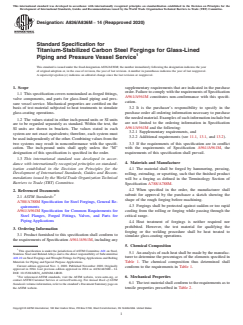
Designation:A836/A836M −14 (Reapproved 2020)
Standard Specification for
Titanium-Stabilized Carbon Steel Forgings for Glass-Lined
Piping and Pressure Vessel Service
This standard is issued under the fixed designationA836/A836M; the number immediately following the designation indicates the year
of original adoption or, in the case of revision, the year of last revision. A number in parentheses indicates the year of last reapproval.
A superscript epsilon (´) indicates an editorial change since the last revision or reapproval.
1. Scope supplementary requirements that are indicated in the purchase
order. Failure to comply with the requirements of Specification
1.1 This specification covers nonstandard as-forged fittings,
A961/A961M constitutes non-conformance with this specifi-
valve components, and parts for glass-lined piping and pres-
cation.
sure vessel service. Mechanical properties are certified on the
basis of test material subjected to heat treatments to simulate 3.2 It is the purchaser’s responsibility to specify in the
glass-coating operations. purchase order all ordering information necessary to purchase
the needed material. Examples of such information include but
1.2 The values stated in either inch-pound units or SI units
are not limited to the ordering information in Specification
are to be regarded separately as standard. Within the text, the
A961/A961M and the following:
SI units are shown in brackets. The values stated in each
3.2.1 Supplementary requirements, and
system are not exact equivalents; therefore, each system must
3.2.2 Additional requirements (see 11.1, 13.1, and 13.2).
be used independently of the other. Combining values from the
two systems may result in nonconformance with the specifi- 3.3 If the requirements of this specification are in conflict
cation. The inch-pound units shall apply unless the “M” with the requirements of Specification A961/A961M, the
designation of this specification is specified in the order. requirements of this specification shall prevail.
1.3 This international standard was developed in accor-
4. Materials and Manufacture
dance with internationally recognized principles on standard-
ization established in the Decision on Principles for the
4.1 The material shall be forged by hammering, pressing,
Development of International Standards, Guides and Recom-
rolling, extruding, or upsetting, such that the finished product
mendations issued by the World Trade Organization Technical
will be a forging as defined in the Terminology Section of
Barriers to Trade (TBT) Committee.
Specification A788/A788M.
4.2 When specified in the order, the manufacturer shall
2. Referenced Documents
submit for approval by the purchaser a sketch showing the
2.1 ASTM Standards:
shape of the rough forging before machining.
A788/A788M Specification for Steel Forgings, General Re-
4.3 Forgings shall be protected against sudden or too rapid
quirements
cooling from the rolling or forging while passing through the
A961/A961M Specification for Common Requirements for
critical range.
Steel Flanges, Forged Fittings, Valves, and Parts for
Piping Applications
4.4 Heat treatment of forgings is neither required nor
prohibited. However, the test material for qualifying the
3. Ordering Information
forging or the welding procedure shall be heat treated to
3.1 Product furnished to this specification shall conform to
simulate glass-coating operations.
the requirements of Specification A961/A961M, including any
5. Chemical Composition
This specification is under the jurisdiction of ASTM Committee A01 on Steel,
5.1 An analysis of each heat shall be made by the manufac-
Stainless Steel and Related Alloys and is the direct responsibility of Subcommittee
turer to determine the percentages of the elements specified in
A01.22 on Steel Forgings and Wrought Fittings for PipingApplications and Bolting
Materials for Piping and Special Purpose Applications.
Table 1. The chemical composition thus determined shall
Current edition approved Nov. 1, 2020. Published November 2020. Originally
conform to the requirements in Table 1.
approved in 1984. Last previous edition approved in 2014 as A836/A836M – 14.
DOI: 10.1520/A0836_A0836M-14R20.
For referenced ASTM standards, visit the ASTM website, www.astm.org, or 6. Mechanical Properties
contact ASTM Customer Service at service@astm.org. For Annual Book of ASTM
6.1 The test material shall conform to the requirements as to
Standards volume information, refer to the standard’s Document Summary page on
the ASTM website. tensile properties prescribed in Table 2.
Copyright © ASTM International, 100 Barr Harbor Drive, PO Box C700, West Conshohocken, PA 19428-2959. United States
A836/A836M−14 (2020)
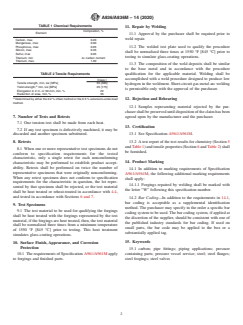
TABLE 1 Chemical Requirements
11. Repair by Welding
Composition, %
Element
11.1 Approval by the purchaser shall
...