

ASTM D7979-20
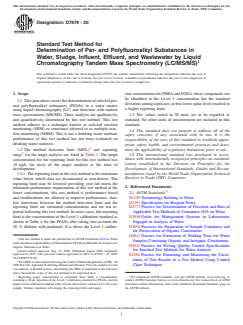
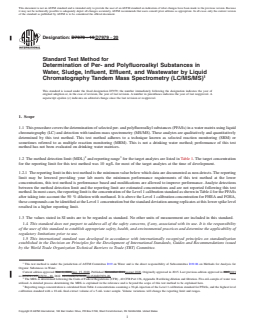
(Test Method)Standard Test Method for Determination of Per- and Polyfluoroalkyl Substances in Water, Sludge, Influent, Effluent, and Wastewater by Liquid Chromatography Tandem Mass Spectrometry (LC/MS/MS)
General Information
- Abstract
SIGNIFICANCE AND USE
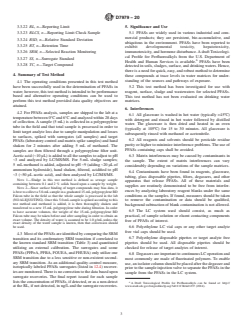
5.1 PFASs are widely used in various industrial and commercial products; they are persistent, bio-accumulative, and ubiquitous in the environment. PFASs have been reported to exhibit developmental toxicity, hepatotoxicity, immunotoxicity, and hormone disturbance. A draft Toxicological Profile for Perfluoroalkyls from the U.S. Department of Health and Human Services is available.6 PFASs have been detected in soils, sludges, surface, and drinking waters. Hence, there is a need for quick, easy, and robust method to determine these compounds at trace levels in water matrices for understanding of the sources and pathways of exposure.
5.2 This test method has been investigated for use with reagent, surface, sludge and wastewaters for selected PFASs. This test method has not been evaluated on drinking water matrices.
SCOPE
1.1 This procedure covers the determination of selected per- and polyfluoroalkyl substances (PFASs) in a water matrix using liquid chromatography (LC) and detection with tandem mass spectrometry (MS/MS). These analytes are qualitatively and quantitatively determined by this test method. This test method adheres to a technique known as selected reaction monitoring (SRM) or sometimes referred to as multiple reaction monitoring (MRM). This is not a drinking water method; performance of this test method has not been evaluated on drinking water matrices.
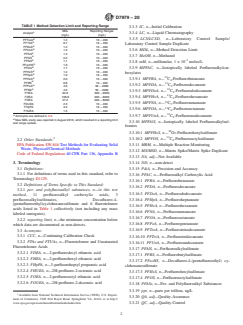
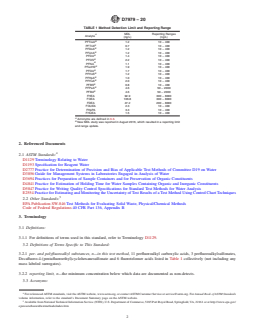
1.2 The method detection limit (MDL)2 and reporting range3 for the target analytes are listed in Table 1. The target concentration for the reporting limit for this test method was 10 ng/L for most of the target analytes at the time of development.
1.2.1 The reporting limit in this test method is the minimum value below which data are documented as non-detects. The reporting limit may be lowered providing your lab meets the minimum performance requirements of this test method at the lower concentrations, this test method is performance based and modifications are allowed to improve performance. Analyte detections between the method detection limit and the reporting limit are estimated concentrations and are not reported following this test method. In most cases, the reporting limit is the concentration of the Level 1 calibration standard as shown in Table 4 for the PFASs after taking into account the 50 % dilution with methanol. It is above the Level 1 calibration concentration for FHEA and FOEA, these compounds can be identified at the Level 1 concentration but the standard deviation among replicates at this lower spike level resulted in a higher reporting limit.
1.3 The values stated in SI units are to be regarded as standard. No other units of measurement are included in this standard.
1.4 This standard does not purport to address all of the safety concerns, if any, associated with its use. It is the responsibility of the user of this standard to establish appropriate safety, health, and environmental practices and determine the applicability of regulatory limitations prior to use.
1.5 This international standard was developed in accordance with internationally recognized principles on standardization established in the Decision on Principles for the Development of International Standards, Guides and Recommendations issued by the World Trade Organization Technical Barriers to Trade (TBT) Committee.
- Status
- Published
- Publication Date
- 14-Aug-2020
- Technical Committee
- D19 - Water
- Drafting Committee
- D19.06 - Methods for Analysis for Organic Substances in Water
Buy Documents
ASTM D7979-20 - Standard Test Method for Determination of Per- and Polyfluoroalkyl Substances in Water, Sludge, Influent, Effluent, and Wastewater by Liquid Chromatography Tandem Mass Spectrometry (LC/MS/MS)
REDLINE ASTM D7979-20 - Standard Test Method for Determination of Per- and Polyfluoroalkyl Substances in Water, Sludge, Influent, Effluent, and Wastewater by Liquid Chromatography Tandem Mass Spectrometry (LC/MS/MS)
Overview
ASTM D7979-20 is a standardized test method established by ASTM International for the determination of selected per- and polyfluoroalkyl substances (PFASs) in various water matrices using liquid chromatography tandem mass spectrometry (LC/MS/MS). This standard is essential for laboratories, environmental authorities, and industries seeking a robust, validated method for detecting and quantifying PFASs in environmental samples, including water, wastewater, sludge, influent, and effluent. PFASs are environmentally persistent, bioaccumulative compounds widely recognized for their potential toxicity and presence in diverse matrices across the globe.
Key Topics
- Target Compounds: The standard focuses on a range of PFASs, notably perfluoroalkyl carboxylic acids, perfluoroalkylsulfonates, and various fluorotelomer acids that are commonly found in industrial and municipal wastewater streams.
- Analytical Method: Utilizes liquid chromatography combined with tandem mass spectrometry (LC/MS/MS) and selected reaction monitoring (SRM), also known as multiple reaction monitoring (MRM), to achieve high sensitivity and specificity for PFASs analysis.
- Sample Types: Applicable to reagent water, surface water, sludge, influent, effluent, and general wastewater matrices. Note: This method is not validated for drinking water.
- Detection Limits: Provides method detection limits (MDLs) and reporting ranges for various target analytes, enabling quantitative analysis at trace concentrations (e.g., reporting limits for most compounds set at 10 ng/L at the time of standard development).
- Quality Assurance: Includes recommendations for calibration, use of surrogates, quality control samples, and procedural guidance to enhance data reliability.
- Performance-Based: Laboratories may modify specific aspects of the method to improve sensitivity, provided performance requirements are fulfilled.
Applications
- Environmental Monitoring: Essential for tracking PFASs contamination in municipal and industrial wastewater, surface waters, and sludge, supporting environmental risk assessment and remediation strategies.
- Regulatory Compliance: Enables laboratories and industries to comply with local, national, and international regulations governing PFASs discharge and monitoring.
- Research and Investigations: Facilitates scientific studies into the sources, distribution, and fate of PFASs in aquatic environments, offering a reliable tool for exposure and pathway assessment.
- Industrial Wastewater Analysis: Assists industries in characterizing PFASs releases, aiding in process optimization and control of PFAS discharges to the environment.
- Municipal Wastewater Treatment: Provides wastewater treatment facilities with a means to evaluate the effectiveness of PFASs removal technologies and document effluent quality.
Related Standards
- ASTM D1129 – Terminology Relating to Water
- ASTM D1193 – Specification for Reagent Water
- ASTM D2777 – Practice for Determination of Precision and Bias of Water Test Methods
- ASTM D3856 – Guide for Management Systems in Water Laboratories
- ASTM D3694 – Practices for Preparation and Preservation of Organic Water Samples
- EPA SW-846 – Test Methods for Evaluating Solid Waste, Physical/Chemical Methods
- 40 CFR Part 136 – EPA’s Code of Federal Regulations, including guidance on method detection limits
ASTM D7979-20 provides a scientifically rigorous and adaptable approach to PFASs analysis, ensuring laboratories can deliver high-quality, actionable results for environmental management and regulatory compliance. Suitable for a broad range of water and wastewater matrices, this standard is a cornerstone for the ongoing efforts to monitor and control PFASs in the environment.
Relations
- Effective Date
- 15-Aug-2020
- Effective Date
- 01-Apr-2024
- Effective Date
- 01-May-2020
- Effective Date
- 01-Apr-2018
- Effective Date
- 01-Apr-2018
- Effective Date
- 01-Apr-2013
- Effective Date
- 01-Jan-2013
- Effective Date
- 01-Jan-2013
- Effective Date
- 15-Jun-2012
- Refers
ASTM D3856-11 - Standard Guide for Management Systems in Laboratories Engaged in Analysis of Water - Effective Date
- 15-Nov-2011
- Effective Date
- 01-May-2011
- Effective Date
- 01-Mar-2010
- Effective Date
- 15-Jul-2008
- Effective Date
- 15-Jan-2008
- Effective Date
- 01-May-2007
Buy Documents
ASTM D7979-20 - Standard Test Method for Determination of Per- and Polyfluoroalkyl Substances in Water, Sludge, Influent, Effluent, and Wastewater by Liquid Chromatography Tandem Mass Spectrometry (LC/MS/MS)
REDLINE ASTM D7979-20 - Standard Test Method for Determination of Per- and Polyfluoroalkyl Substances in Water, Sludge, Influent, Effluent, and Wastewater by Liquid Chromatography Tandem Mass Spectrometry (LC/MS/MS)
Get Certified
Connect with accredited certification bodies for this standard

ECOCERT
Organic and sustainability certification.

CIS Institut d.o.o.
Personal Protective Equipment (PPE) certification body. Notified Body NB-2890 for EU Regulation 2016/425 PPE.

Eurofins Food Testing Global
Global leader in food, environment, and pharmaceutical product testing.
Sponsored listings
Frequently Asked Questions
ASTM D7979-20 is a standard published by ASTM International. Its full title is "Standard Test Method for Determination of Per- and Polyfluoroalkyl Substances in Water, Sludge, Influent, Effluent, and Wastewater by Liquid Chromatography Tandem Mass Spectrometry (LC/MS/MS)". This standard covers: SIGNIFICANCE AND USE 5.1 PFASs are widely used in various industrial and commercial products; they are persistent, bio-accumulative, and ubiquitous in the environment. PFASs have been reported to exhibit developmental toxicity, hepatotoxicity, immunotoxicity, and hormone disturbance. A draft Toxicological Profile for Perfluoroalkyls from the U.S. Department of Health and Human Services is available.6 PFASs have been detected in soils, sludges, surface, and drinking waters. Hence, there is a need for quick, easy, and robust method to determine these compounds at trace levels in water matrices for understanding of the sources and pathways of exposure. 5.2 This test method has been investigated for use with reagent, surface, sludge and wastewaters for selected PFASs. This test method has not been evaluated on drinking water matrices. SCOPE 1.1 This procedure covers the determination of selected per- and polyfluoroalkyl substances (PFASs) in a water matrix using liquid chromatography (LC) and detection with tandem mass spectrometry (MS/MS). These analytes are qualitatively and quantitatively determined by this test method. This test method adheres to a technique known as selected reaction monitoring (SRM) or sometimes referred to as multiple reaction monitoring (MRM). This is not a drinking water method; performance of this test method has not been evaluated on drinking water matrices. 1.2 The method detection limit (MDL)2 and reporting range3 for the target analytes are listed in Table 1. The target concentration for the reporting limit for this test method was 10 ng/L for most of the target analytes at the time of development. 1.2.1 The reporting limit in this test method is the minimum value below which data are documented as non-detects. The reporting limit may be lowered providing your lab meets the minimum performance requirements of this test method at the lower concentrations, this test method is performance based and modifications are allowed to improve performance. Analyte detections between the method detection limit and the reporting limit are estimated concentrations and are not reported following this test method. In most cases, the reporting limit is the concentration of the Level 1 calibration standard as shown in Table 4 for the PFASs after taking into account the 50 % dilution with methanol. It is above the Level 1 calibration concentration for FHEA and FOEA, these compounds can be identified at the Level 1 concentration but the standard deviation among replicates at this lower spike level resulted in a higher reporting limit. 1.3 The values stated in SI units are to be regarded as standard. No other units of measurement are included in this standard. 1.4 This standard does not purport to address all of the safety concerns, if any, associated with its use. It is the responsibility of the user of this standard to establish appropriate safety, health, and environmental practices and determine the applicability of regulatory limitations prior to use. 1.5 This international standard was developed in accordance with internationally recognized principles on standardization established in the Decision on Principles for the Development of International Standards, Guides and Recommendations issued by the World Trade Organization Technical Barriers to Trade (TBT) Committee.
SIGNIFICANCE AND USE 5.1 PFASs are widely used in various industrial and commercial products; they are persistent, bio-accumulative, and ubiquitous in the environment. PFASs have been reported to exhibit developmental toxicity, hepatotoxicity, immunotoxicity, and hormone disturbance. A draft Toxicological Profile for Perfluoroalkyls from the U.S. Department of Health and Human Services is available.6 PFASs have been detected in soils, sludges, surface, and drinking waters. Hence, there is a need for quick, easy, and robust method to determine these compounds at trace levels in water matrices for understanding of the sources and pathways of exposure. 5.2 This test method has been investigated for use with reagent, surface, sludge and wastewaters for selected PFASs. This test method has not been evaluated on drinking water matrices. SCOPE 1.1 This procedure covers the determination of selected per- and polyfluoroalkyl substances (PFASs) in a water matrix using liquid chromatography (LC) and detection with tandem mass spectrometry (MS/MS). These analytes are qualitatively and quantitatively determined by this test method. This test method adheres to a technique known as selected reaction monitoring (SRM) or sometimes referred to as multiple reaction monitoring (MRM). This is not a drinking water method; performance of this test method has not been evaluated on drinking water matrices. 1.2 The method detection limit (MDL)2 and reporting range3 for the target analytes are listed in Table 1. The target concentration for the reporting limit for this test method was 10 ng/L for most of the target analytes at the time of development. 1.2.1 The reporting limit in this test method is the minimum value below which data are documented as non-detects. The reporting limit may be lowered providing your lab meets the minimum performance requirements of this test method at the lower concentrations, this test method is performance based and modifications are allowed to improve performance. Analyte detections between the method detection limit and the reporting limit are estimated concentrations and are not reported following this test method. In most cases, the reporting limit is the concentration of the Level 1 calibration standard as shown in Table 4 for the PFASs after taking into account the 50 % dilution with methanol. It is above the Level 1 calibration concentration for FHEA and FOEA, these compounds can be identified at the Level 1 concentration but the standard deviation among replicates at this lower spike level resulted in a higher reporting limit. 1.3 The values stated in SI units are to be regarded as standard. No other units of measurement are included in this standard. 1.4 This standard does not purport to address all of the safety concerns, if any, associated with its use. It is the responsibility of the user of this standard to establish appropriate safety, health, and environmental practices and determine the applicability of regulatory limitations prior to use. 1.5 This international standard was developed in accordance with internationally recognized principles on standardization established in the Decision on Principles for the Development of International Standards, Guides and Recommendations issued by the World Trade Organization Technical Barriers to Trade (TBT) Committee.
ASTM D7979-20 is classified under the following ICS (International Classification for Standards) categories: 13.060.50 - Examination of water for chemical substances; 71.080.20 - Halogenated hydrocarbons. The ICS classification helps identify the subject area and facilitates finding related standards.
ASTM D7979-20 has the following relationships with other standards: It is inter standard links to ASTM D7979-19, ASTM D3694-96(2024), ASTM D1129-13(2020)e2, ASTM E2554-18, ASTM E2554-18e1, ASTM E2554-13, ASTM D4841-88(2013)e1, ASTM D4841-88(2013), ASTM D2777-12, ASTM D3856-11, ASTM D3694-96(2011), ASTM D1129-10, ASTM D4841-88(2008), ASTM D2777-08, ASTM E2554-07. Understanding these relationships helps ensure you are using the most current and applicable version of the standard.
ASTM D7979-20 is available in PDF format for immediate download after purchase. The document can be added to your cart and obtained through the secure checkout process. Digital delivery ensures instant access to the complete standard document.
Standards Content (Sample)
This international standard was developed in accordance with internationally recognized principles on standardization established in the Decision on Principles for the
Development of International Standards, Guides and Recommendations issued by the World Trade Organization Technical Barriers to Trade (TBT) Committee.
Designation:D7979 −20
Standard Test Method for
Determination of Per- and Polyfluoroalkyl Substances in
Water, Sludge, Influent, Effluent, and Wastewater by Liquid
Chromatography Tandem Mass Spectrometry (LC/MS/MS)
This standard is issued under the fixed designation D7979; the number immediately following the designation indicates the year of
original adoption or, in the case of revision, the year of last revision.Anumber in parentheses indicates the year of last reapproval.A
superscript epsilon (´) indicates an editorial change since the last revision or reapproval.
1. Scope tion concentration for FHEAand FOEA, these compounds can
be identified at the Level 1 concentration but the standard
1.1 Thisprocedurecoversthedeterminationofselectedper-
deviation among replicates at this lower spike level resulted in
and polyfluoroalkyl substances (PFASs) in a water matrix
a higher reporting limit.
using liquid chromatography (LC) and detection with tandem
mass spectrometry (MS/MS). These analytes are qualitatively 1.3 The values stated in SI units are to be regarded as
and quantitatively determined by this test method. This test standard. No other units of measurement are included in this
method adheres to a technique known as selected reaction standard.
monitoring (SRM) or sometimes referred to as multiple reac-
1.4 This standard does not purport to address all of the
tion monitoring (MRM). This is not a drinking water method;
safety concerns, if any, associated with its use. It is the
performance of this test method has not been evaluated on
responsibility of the user of this standard to establish appro-
drinking water matrices.
priate safety, health, and environmental practices and deter-
mine the applicability of regulatory limitations prior to use.
1.2 The method detection limit (MDL) and reporting
1.5 This international standard was developed in accor-
range for the target analytes are listed in Table 1. The target
dance with internationally recognized principles on standard-
concentration for the reporting limit for this test method was
ization established in the Decision on Principles for the
10 ng/L for most of the target analytes at the time of
Development of International Standards, Guides and Recom-
development.
mendations issued by the World Trade Organization Technical
1.2.1 Thereportinglimitinthistestmethodistheminimum
Barriers to Trade (TBT) Committee.
value below which data are documented as non-detects. The
reporting limit may be lowered providing your lab meets the
2. Referenced Documents
minimum performance requirements of this test method at the
lower concentrations, this test method is performance based 2.1 ASTM Standards:
and modifications are allowed to improve performance. Ana- D1129Terminology Relating to Water
lyte detections between the method detection limit and the D1193Specification for Reagent Water
reporting limit are estimated concentrations and are not re- D2777Practice for Determination of Precision and Bias of
ported following this test method. In most cases, the reporting Applicable Test Methods of Committee D19 on Water
limit is the concentration of the Level 1 calibration standard as D3856Guide for Management Systems in Laboratories
shown in Table 4 for the PFASs after taking into account the Engaged in Analysis of Water
50 % dilution with methanol. It is above the Level 1 calibra- D3694Practices for Preparation of Sample Containers and
for Preservation of Organic Constituents
D4841Practice for Estimation of Holding Time for Water
This test method is under the jurisdiction ofASTM Committee D19 on Water
Samples Containing Organic and Inorganic Constituents
andisthedirectresponsibilityofSubcommitteeD19.06onMethodsforAnalysisfor
D5847Practice for Writing Quality Control Specifications
Organic Substances in Water.
Current edition approved Aug. 15, 2020. Published August 2020. Originally for Standard Test Methods for Water Analysis
approved in 2015. Last previous edition approved in 2019 as D7979–19. DOI:
E2554Practice for Estimating and Monitoring the Uncer-
10.1520/D7979-20.
tainty of Test Results of a Test Method Using Control
The MDLis determined following the Code of Federal Regulations (CFR) , 40
Chart Techniques
CFRPart136,AppendixButilizingdilutionandfiltration.Five-mLsampleofwater
was utilized.Adetailed process determining the MDLis explained in the reference
and is beyond the scope of this test method to be explained here.
3 4
Reporting range concentration is calculated from Table 4 concentrations For referenced ASTM standards, visit the ASTM website, www.astm.org, or
assuming a 30-µL injection of the Level 1 calibration standard for PFASs, and the contact ASTM Customer Service at service@astm.org. For Annual Book of ASTM
highestlevelcalibrationstandardwitha10-mLfinalextractvolumeofa5-mLwater Standards volume information, refer to the standard’s Document Summary page on
sample. Volume variations will change the reporting limit and ranges. the ASTM website.
Copyright © ASTM International, 100 Barr Harbor Drive, PO Box C700, West Conshohocken, PA 19428-2959. United States
D7979−20
TABLE 1 Method Detection Limit and Reporting Range
3.3.3 IC, n—Initial Calibration
MDL Reporting Ranges
A
3.3.4 LC, n—Liquid Chromatography
Analyte
(ng/L) (ng/L)
B
3.3.5 LCS/LCSD, n—Laboratory Control Sample/
PFTreA 1.2 10 – 400
B
PFTriA 0.7 10 – 400
Laboratory Control Sample Duplicate
B
PFDoA 1.2 10 – 400
B
3.3.6 MDL, n—Method Detection Limit
PFUnA 1.2 10 – 400
B
PFDA 1.4 10 – 400
3.3.7 MeOH, n—Methanol
B
PFOS 2.2 10 – 400
B
-3
PFNA 1.1 10 – 400
3.3.8 mM, n—millimolar,1×10 moles/L
B
PFecHS 1.9 10 – 400
B
PFOA 1.7 10 – 400 3.3.9 MPFAC, n—Isotopically labeled Perfluoroalkylcar-
B
PFHxS 1.2 10 – 400
boxylates
B
PFHpA 1.0 10 – 400
B
PFHxA 2.0 10 – 400 3.3.9.1 MPFBA, n— C -Perfluorobutanoate
B
PFBS 0.8 10 – 400
B
3.3.9.2 MPFDA, n— C -Perfluorodecanoate
PFPeA 4.6 50 – 2000 2
B
PFBA 4.6 50 – 2000
3.3.9.3 MPFDoA, n— C -Perfluorododecanoate
FHEA 92.9 300 – 8000
FOEA 106.8 300 – 8000
3.3.9.4 MPFHxA, n— C -Perfluorohexanoate
FDEA 47.2 200 – 8000
3.3.9.5 MPFNA, n— C -Perfluorononanoate
FOUEA 2.3 10 – 400
FHpPA 3.3 10 – 400 13
3.3.9.6 MPFOA, n— C -Perfluorooctanoate
FHUEA 1.5 10 – 400
A
3.3.9.7 MPFUnA, n— C -Perfluoroundecanoate
Acronyms are defined in 3.3. 2
B
New MDL study was reported in August 2016, which resulted in a reporting limit
3.3.10 MPFAlS, n—Isotopically labeled Perfluoroalkylsul-
and range update.
fonates
3.3.10.1 MPFHxS, n— O -Perfluorohexylsulfonate
3.3.10.2 MPFOS, n— C -Perfluorooctylsulfonate
2.2 Other Standards: 4
EPAPublication SW-846Test Methods for Evaluating Solid 3.3.11 MRM, n—Multiple Reaction Monitoring
Waste, Physical/Chemical Methods
3.3.12 MS/MSD, n—Matrix Spike/Matrix Spike Duplicate
Code of Federal Regulations40 CFR Part 136,Appendix B
3.3.13 NA, adj—Not Available
3. Terminology
3.3.14 ND, n—non-detect
3.1 Definitions: 3.3.15 P&A, n—Precision and Accuracy
3.1.1 For definitions of terms used in this standard, refer to
3.3.16 PFAC, n—Perfluoroalkyl Carboxylic Acid
Terminology D1129.
3.3.16.1 PFBA, n—Perfluorobutanoate
3.2 Definitions of Terms Specific to This Standard:
3.3.16.2 PFDA, n—Perfluorodecanoate
3.2.1 per- and polyfluoroalkyl substances, n—in this test
3.3.16.3 PFDoA, n—Perfluorododecanoate
method, 11 perfluoroalkyl carboxylic acids, 3
perfluoroalkylsulfonates, Decafluoro-4- 3.3.16.4 PFHpA, n—Perfluoroheptanoate
(pentafluoroethyl)cyclohexanesulfonate and 6 fluorotelomer
3.3.16.5 PFHxA, n—Perfluorohexanoate
acids listed in Table 1 collectively (not including any mass
3.3.16.6 PFNA, n—Perfluorononanoate
labeled surrogates).
3.3.16.7 PFOA, n—Perfluorooctanoate
3.2.2 reporting limit, n—the minimum concentration below
3.3.16.8 PFPeA, n—Perfluoropentanoate
which data are documented as non-detects.
3.3.16.9 PFTreA, n—Perfluorotetradecanoate
3.3 Acronyms:
3.3.1 CCC, n—Continuing Calibration Check
3.3.16.10 PFTriA, n—Perfluorotridecanoate
3.3.2 FTAs and FTUAs, n—Fluorotelomer and Unsaturated
3.3.16.11 PFUnA, n—Perfluoroundecanoate
Fluorotelomer Acids
3.3.17 PFAlS, n—Perfluoroalkylsulfonate
3.3.2.1 FDEA, n—2-perfluorodecyl ethanoic acid
3.3.17.1 PFBS, n—Perfluorobutylsulfonate
3.3.2.2 FHEA, n—2-perfluorohexyl ethanoic acid
3.3.17.2 PFecHS, n—Decafluoro-4-(pentafluoroethyl) cy-
3.3.2.3 FHpPA, n—3-perfluoroheptyl propanoic acid
clohexanesulfonate
3.3.2.4 FHUEA, n—2H-perfluoro-2-octenoic acid
3.3.17.3 PFHxS, n—Perfluorohexylsulfonate
3.3.2.5 FOEA, n—2-perfluorooctyl ethanoic acid
3.3.17.4 PFOS, n—Perfluorooctylsulfonate
3.3.2.6 FOUEA, n—2H-perfluoro-2-decenoic acid
3.3.18 PFASs, n—Per- and Polyfluoroalkyl Substances
3.3.19 ppt, n—parts per trillion, ng/L
Available from National Technical Information Service (NTIS), U.S. Depart-
3.3.20 QA, adj—Quality-Assurance
ment of Commerce, 5285 Port Royal Road, Springfield, VA, 22161 or at http://
www.epa.gov/epawaste/hazard/testmethods/index.htm 3.3.21 QC, adj—Quality-Control
D7979−20
3.3.22 RL, n—Reporting Limit 5. Significance and Use
5.1 PFASs are widely used in various industrial and com-
3.3.23 RLCS, n—Reporting Limit Check Sample
mercial products; they are persistent, bio-accumulative, and
3.3.24 RSD, n—Relative Standard Deviation
ubiquitous in the environment. PFASs have been reported to
3.3.25 RT, n—Retention Time
exhibit developmental toxicity, hepatotoxicity,
immunotoxicity, and hormone disturbance.AdraftToxicologi-
3.3.26 SRM, n—Selected Reaction Monitoring
cal Profile for Perfluoroalkyls from the U.S. Department of
3.3.27 SS, n—Surrogate Standard
Health and Human Services is available. PFASs have been
3.3.28 TC, n—Target Compound
detected in soils, sludges, surface, and drinking waters. Hence,
thereisaneedforquick,easy,androbustmethodtodetermine
4. Summary of Test Method
these compounds at trace levels in water matrices for under-
standing of the sources and pathways of exposure.
4.1 The operating conditions presented in this test method
have been successfully used in the determination of PFASs in 5.2 This test method has been investigated for use with
water;however,thistestmethodisintendedtobeperformance
reagent, surface, sludge and wastewaters for selected PFASs.
based and alternative operating conditions can be used to This test method has not been evaluated on drinking water
perform this test method provided data quality objectives are
matrices.
attained.
6. Interferences
4.2 For PFASs analysis, samples are shipped to the lab at a
6.1 All glassware is washed in hot water (typically >45ºC)
temperaturebetween0°Cand6°Candanalyzedwithin28days
with detergent and rinsed in hot water followed by distilled
of collection.Asample (5 mL) is collected in a polypropylene
water. The glassware is then dried and heated in an oven
tube in the field and that total sample is processed in order to
(typically at 105ºC) for 15 to 30 minutes. All glassware is
limit target analyte loss due to sample manipulation and losses
subsequently rinsed with methanol or acetonitrile.
to surfaces, spiked with surrogates (all samples) and target
6.2 All reagents and solvents should be pesticide residue
PFASs(laboratorycontrolandmatrixspikesamples)andhand
purity or higher to minimize interference problems.The use of
shaken for 2 minutes after adding 5 mL of methanol. The
PFASs containing caps shall be avoided.
samples are then filtered through a polypropylene filter unit.
Aceticacid(~10µL)isaddedtoallthesamplestoadjusttopH
6.3 Matrix interferences may be caused by contaminants in
~3 and analyzed by LC/MS/MS. For 5-mL sludge samples;
the sample. The extent of matrix interferences can vary
5 mLmethanol is added, adjusted to pH ~9 (adding ~20 µLof
considerably depending on variations of the sample matrices.
ammonium hydroxide), hand shaken, filtered, acidified to pH
6.4 Contaminants have been found in reagents, glassware,
~3 (~50 µL acetic acid), and then analyzed by LC/MS/MS.
tubing, glass disposable pipettes, filters, degassers, and other
NOTE 1—Sludge in this test method is defined as sewage sample
apparatus that release PFASs. All of these materials and
containing between 0.1 and 2 % solids based upon a sample by weight.
supplies are routinely demonstrated to be free from interfer-
NOTE 2—Since surface binding of target compounds may bias data, it
ences by analyzing laboratory reagent blanks under the same
isbesttocollecta5.0-mLsampleinagraduated15-mLpolypropyleneBD
Falcon tube in the field so that the whole sample is processed in the lab conditions as the samples. If found, measures should be taken
(NOALIQUOTING).Oncethis5.0-mLsampleisspikedaccordingtothis
to remove the contamination or data should be qualified,
test method and methanol is added, it is then thoroughly shaken and
background subtraction of blank contamination is not allowed.
transferred to a new 15-mLpolypropylene tube during filtration. In order
6.5 The LC system used should consist, as much as
to have accurate volumes, the weight of the 15-mL polypropylene BD
Falcon tube may be taken before and after sampling in order to obtain an
practical, of sample solution or eluent contacting components
exact volume. The density of water is assumed to be 1.0 g/mLunless the
free of PFASs of interest.
exact density of the water sample is known, then that conversion should
6.6 Polyethylene LC vial caps or any other target analyte
be used.
free vial caps should be used.
4.3 MostofthePFASsareidentifiedbycomparingtheSRM
6.7 Polyethylene disposable pipettes or target analyte free
transition and its confirmatory SRM transition if correlated to
pipettes should be used. All disposable pipettes should be
the known standard SRM transition (Table 3) and quantitated
checked for release of target analytes of interest.
utilizing an external calibration. The surrogates and some
PFASs(PFPeA,PFBA,FOUEA,andFHUEA)onlyutilizeone
6.8 DegassersareimportanttocontinuousLCoperationand
SRM transition due to a less sensitive or non-existent second-
most commonly are made of fluorinated polymers. To enable
ary SRM transition. As an additional quality-control measure,
use,anisolatorcolumnshouldbeplacedafterthedegasserand
isotopically labeled PFASs surrogates (listed in 12.4) recover-
priortothesampleinjectionvalvetoseparatethePFASsinthe
iesaremonitored.Thereisnocorrectiontothedatabasedupon
sample from the PFASs in the LC system.
surrogate recoveries. The final report issued for each sample
liststheconcentrationofPFASs,ifdetected,orasanon-detect 6
A Draft Toxicological Profile for Perfluoroalkyls can be found at: http://
attheRL,ifnotdetected,inng/Landthesurrogaterecoveries. www.atsdr.cdc.gov/toxprofiles/tp.asp?id=1117&tid=237 (2014).
D7979−20
7. Apparatus 7.3.3 Filter Unit —Polypropylene filter units were used to
filter the samples.
7.1 LC/MS/MS System:
7.1.1 Liquid Chromatography System —A complete LC
8. Reagents and Materials
system is required in order to analyze samples, this should
8.1 Purity of Reagents—High Performance Liquid Chroma-
include a sample injection system, a solvent pumping system
tography (HPLC) pesticide residue analysis and spectropho-
capable of mixing solvents, a sample compartment capable of
tometry grade chemicals shall be used in all tests. Unless
maintaining required temperature and a temperature controlled
indicated otherwise, it is intended that all reagents shall
columncompartment.Thistestmethodusedaternarypumping
conform to the Committee on Analytical Reagents of the
system.At a minimum, a binary pumping system may be used
American Chemical Society. Other reagent grades may be
but the LC conditions in Table 2 must be adjusted to account
used provided they are first determined to be of sufficiently
forabinarysystem.ALCsystemthatiscapableofperforming
highpuritytopermittheirusewithoutaffectingtheaccuracyof
at the flows, pressures, controlled temperatures, sample
the measurements.
volumes, and requirements of the standard shall be used.
7.1.2 Analytical Column —A reverse phase Charged Sur-
8.2 Purity of Water—Unless otherwise indicated, references
faceHybridPhenyl-Hexylparticlecolumnwasusedtodevelop
towatershallbeunderstoodtomeanreagentwaterconforming
thistestmethod.Anycolumnthatachievesadequateresolution
toType1ofSpecificationD1193.Itshallbedemonstratedthat
may be used. The retention times and order of elution may
this water does not contain contaminants at concentrations
change depending on the column used and needs to be
sufficient to interfere with the analysis.
monitored.
9 8.3 Gases—Ultrapure nitrogen and argon.
7.1.3 Isolator Column —A reverse phase C18 column was
usedinthistestmethodtoseparatethetargetanalytesintheLC 8.4 Vials—2-mL amber glass autosampler vials or equiva-
system and solvents from the target analytes in the analytical lent.
sample. This column was placed between the solvent mixing
8.5 Polyethylene autosampler vial caps, or equivalent.
chamber and the injector sample loop.
8.6 Syringe—10 or 25-mL filter-adaptable glass syringe
7.2 Tandem Mass Spectrometer System —A MS/MS sys-
with luer lock.
tem capable of multiple reaction monitoring (MRM) analysis
8.7 Polypropylene Tubes—15 and 50 mL.
oranysystemthatiscapableofperformingattherequirements
in this test method shall be used. 8.8 pH Paper (pH range 1–14).
7.3 Filtration Device: 8.9 Class A Volumetric Glassware.
7.3.1 Hypodermic Syringe—A luer-lock tip glass syringe
8.10 Pipette tips—Polypropylene pipette tips free of release
capable of holding a syringe driven filter unit.
agents or low retention coating of various sizes.
7.3.2 A10-mLLockTipGlassSyringesizeisrecommended
8.11 Polyethylene Disposable Pipettes.
in this test method.
8.12 Acetonitrile (CAS #75-05-8).
8.13 Methanol (CAS #67-56-1).
8.14 Ammonium Acetate (CAS #631-61-8).
A Waters Acquity UPLC H-Class System, or equivalent, has been found
8.15 Acetic Acid (CAS #64-19-7).
suitable for use.
AWatersAcquityUPLCCSHPhenyl-Hexyl,2.1×100mmand1.7µmparticle
8.16 2-Propanol (isopropyl alcohol, CAS #67-63-0).
size column, or equivalent, has been found suitable for use. It was used to develop
this test method and generate the precision and bias data presented in Section 16. 8.17 Ammonium hydroxide (CAS #1336-21-6).
A Waters Acquity UPLC BEH C18, 2.1 × 50 mm and 1.7 µm particle size
8.18 PFASs Standards:
column, or equivalent, has been found suitable for use. Note: If back pressure is
high, a larger particle size may be used (3–3.5 µm). 8.18.1 Perfluorobutylsulfonate (PFBS, CAS #29420-49-3).
AWaters Xevo TQ-S triple quadrupole mass spectrometer, or equivalent, has
8.18.2 Perfluorohexylsulfonate (PFHxS, CAS #3871-99-6).
been found suitable for use.
8.18.3 Perfluorooctylsulfonate (PFOS, CAS #1763-23-1).
8.18.4 Perfluorobutanoate (PFBA, CAS #375-22-4).
TABLE 2 Gradient Conditions for Liquid Chromatography
95 % Water:
95 % Water: 5 % Acetonitrile,
Time Flow Acetonitrile 11
An Acrodisc GxF/0.2 µm GHP membrane syringe driven filter unit, or
5 % Acetonitrile 400 mM
(min) (mL/min) %
equivalent, has been found suitable for use.
% Ammonium Acetate
ACS Reagent Chemicals, Specifications and Procedures for Reagents and
%
Standard-Grade Reference Materials, American Chemical Society, Washington,
00.3 95 0 5
DC. For suggestions on the testing of reagents not listed by theAmerican Chemical
1 0.3 75 20 5
Society, see Analar Standards for Laboratory Chemicals, BDH Ltd., Poole, Dorset,
6 0.3 50 45 5
U.K., and the United States Pharmacopeia and National Formulary, U.S. Pharma-
13 0.3 15 80 5
copeial Convention, Inc. (USPC), Rockville, MD.
14 0.4 0 95 5
PFASs standards may be difficult to find, some sources of PFASs standards
17 0.4 0 95 5
that have been found suitable for use were from Aldrich Chemical Company,
18 0.4 95 0 5
21 0.4 95 0 5 Wellington Laboratories Inc., and Wako Laboratory. Standards from other vendors
may be used.
D7979−20
TABLE 3 Retention Times, SRM Ions, and Analyte-Specific Mass Spectrometer Parameters
Primary/
Retention
Primary/ Cone Collision MRM Confirmatory
Chemical Times
Confirmatory (V) (eV) Transition SRM Area
(min)
Ratio
PFTreA Primary 10.63 20 13 712.9→668.9 7.4
Confirmatory 20 30 712.9→169
PFTriA Primary 10.17 25 12 662.9→618.9 7.4
Confirmatory 25 28 662.9→169
PFDoA Primary 9.61 10 12 612.9→568.9 8.2
Confirmatory 10 25 612.9→169
PFUnA Primary 9.05 15 10 562.9→519 7.2
Confirmatory 15 18 562.9→269
PFDA Primary 8.45 20 10 512.9→468.9 6.5
Confirmatory 20 16 512.9→219
PFOS Primary 8.78 10 42 498.9→80.1 1.3
Confirmatory 10 40 498.9→99.1
PFNA Primary 7.78 20 10 462.9→418.9 4.9
Confirmatory 20 16 462.9→219
PFecHS Primary 8.1 10 25 460.9→381 2.2
Confirmatory 10 25 460.9→99.1
PFOA Primary 7.11 20 10 412.9→369 3.6
Confirmatory 20 16 412.9→169
PFHxS Primary 7.39 15 32 398.9→80.1 1
Confirmatory 15 32 398.9→99.1
PFHpA Primary 6.35 15 10 362.9→319 4.1
Confirmatory 15 15 362.9→169
PFHxA Primary 5.54 15 8 312.9→269 24.1
Confirmatory 15 18 312.9→119.1
PFBS Primary 5.66 10 30 298.9→80.1 1.6
Confirmatory 10 25 298.9→99.1
PFPeA Primary 4.68 10 8 263→219 NA
PFBA Primary 3.67 10 8 212.9→169 NA
FHEA Primary 6.14 15 20 376.9→293 3.6
Confirmatory 15 6 376.9→313
FOEA Primary 7.54 15 18 476.9→393 4.3
Confirmatory 15 12 476.9→413
FDEA Primary 8.83 15 8 576.8→493 3.2
Confirmatory 15 15 576.8→513
FOUEA Primary 7.54 20 12 456.9→392.9 NA
FHpPA Primary 7.54 15 12 440.9→337 1.1
Confirmatory 15 20 440.9→317
FHUEA Primary 6.08 10 12 357→293 NA
MPFBA Primary 3.67 10 7 217→172.1 NA
MPFHxA Primary 5.54 15 8 315→270 NA
MPFHxS Primary 7.39 15 34 402.9→84.1 NA
MPFOA Primary 7.11 15 10 417→372 NA
MPFNA Primary 7.81 15 9 467.9→423 NA
MPFOS Primary 8.78 15 40 502.9→80.1 NA
MPFDA Primary 8.45 15 10 514.9→470 NA
MPFUnA Primary 9.05 15 10 564.9→519.9 NA
MPFDoA Primary 9.61 15 12 614.9→569.9 NA
TABLE 4 Concentrations of Calibration Standards (ng/L)
Analyte/Surrogate LV1 LV2 LV3 LV4 LV5 LV6 LV7 LV8 LV9
PFPeA, PFBA 25 50 100 200 300 400 500 750 1000
PFTreA, PFTriA, PFDoA, PFUnA, 5 10 20 40 60 80 100 150 200
PFDA, PFOS, PFNA, PFHxA,
PFHpA, PFBS, PFecHS, PFOA,
PFHxS, FOUEA, FHUEA, FHpPA,
MPFBS, MPFHxA, MPFUnA,
MPFOA, MPFDA, MPFOS,
MPFNA, MPFHxS, MPFBA
FHEA, FOEA, FDEA 100 200 400 800 1200 1600 2000 3000 4000
8.18.5 Perfluoropentanoate (PFPeA, CAS #2706-90-3). 8.18.10 Perfluorodecanoate (PFDA, CAS #335-76-2).
8.18.6 Perfluorohexanoate (PFHxA, CAS #307-24-4). 8.18.11 Perfluoroundecanoate (PFUnA, CAS #2058-94-8).
8.18.7 Perfluoroheptanoate (PFHpA, CAS #375-85-9). 8.18.12 Perfluorododecanoate (PFDoA, CAS #307-55-1).
8.18.8 Perfluorooctanoate (PFOA, CAS #335-67-1). 8.18.13 Perfluorotridecanoate (PFTriA, CAS
8.18.9 Perfluorononanoate (PFNA, CAS #375-95-1). #72629-94-8).
D7979−20
8.18.14 Perfluorotetradecanoate (PFTreA, CAS the sample within 28 days of collection. No in-depth holding
#376-06-7). timestudyhasbeendoneonthedifferentwatermatricestested
8.18.15 Decafluoro-4-(pentafluoroethyl)cyclohexanesul- in this test method.Aholding time study was done on sewage
fonate (PFecHS, CAS #67584-42-3). treatment plant influent over 31 days and showed all concen-
8.18.16 3-perfluoropheptyl propanoic acid (FHpPA, CAS trations over the time period to be within the performance of
#812-70-4). the test method. This study used the complete sample, NO
8.18.17 2H-perfluoro-2-decenoic acid (FOUEA, CAS ALIQUOTING.Another study, where aliquots of sample were
#70887-84-2). taken, resulted in large losses for many of the target analytes.
8.18.18 2-perfluorodecyl ethanoic acid (FDEA, CAS # not Holdingtimemayvarydependingonthematrixandindividual
available). laboratories should determine the holding time in their ma-
8.18.19 2-perfluorooctyl ethanoic acid (FOEA, CAS trix.
#27854-31-5).
11. Preparation of LC/MS/MS
8.18.20 2H-perfluoro-2-octenoic acid (FHUEA, CAS # not
available).
11.1 LC Chromatograph Operating Conditions:
8.18.21 2-perfluorohexyl ethanoic acid (FHEA, CAS
11.1.1 Injections of all standards and samples are made at a
#53826-12-3).
30-µL volume. Other injection volumes may be used to
optimizeconditions.Standardsandsamplesshallbeina50:50
8.19 PFAS Surrogates:
methanol:water solution containing 0.1 % acetic acid. In the
8.19.1 O -Perfluorohexylsulfonate (MPFHxS).
case of extreme concentration differences amongst samples, it
8.19.2 C -Perfluorooctylsulfonate (MPFOS).
is wise to analyze a blank after a concentrated sample and
8.19.3 C -Perfluorobutanoate (MPFBA).
before a dilute sample to eliminate carryover of analytes from
8.19.4 C -Perfluorohexanoate (MPFHxA).
sample injection to sample injection. The gradient conditions
8.19.5 C -Perfluorooctanoate (MPFOA).
for LC are shown in Table 2.
8.19.6 C -Perfluorononanoate (MPFNA).
8.19.7 C -Perfluorodecanoate (MPFDA).
2 11.2 LC Sample Manager Conditions:
8.19.8 C -Perfluoroundecanoate (MPFUnA).
2 11.2.1 Needle Wash Solvent—60 % acetonitrile/40 %
8.19.9 C -Perfluorododecanoate (MPFDoA).
2 2-propanol. Eight second wash time before and after injection.
Instrumentmanufacturer’sspecificationsshouldbefollowedin
9. Hazards
order to eliminate sample carry-over.
9.1 Normal laboratory safety applies to this test method.
11.2.2 Temperatures—Column, 35°C; Sample
Analysts should wear safety glasses, gloves, and lab coats
compartment, 15°C.
when working in the lab. Analysts should review the Safety
11.2.3 Seal Wash—Solvent: 60 % acetonitrile/40 %
Data Sheets (SDS) for all reagents used in this test method.
2-propanol; Time: 5 minutes.
11.3 Mass Spectrometer Parameters:
10. Sampling
11.3.1 To acquire the maximum number of data points per
10.1 Sampling and Preservation—Grab samples are col-
SRM channel while maintaining adequate sensitivity, the tune
lected in polypropylene containers. Sample containers and
parameters may be optimized according to your instrument.
contact surfaces with PTFE shall be avoided. As part of the
Each peak requires at least 10 scans per peak for adequate
overall quality-assurance program for this test method, field
quantitation. This test method contains nine surrogates, which
blanks exposed to the same field conditions as samples are
are select isotopically labeled PFASs, and 21 PFASs which
collected and analyzed according to this test method to assess
were split up into eighteen MRM acquisition functions to
the potential for field contamination. Surface binding may bias
optimize sensitivity. Variable parameters regarding retention
data. This test method is based on a 5-mL sample size per
times, SRM transitions, and cone and collision energies are
analysis. If different sample sizes are used, spiking solution
shown in Table 3. Mass spectrometer parameters used in the
amounts may need to be modified. Conventional sampling
development of this test method are listed below:
practices should be followed with the caution that PFASs
The instrument is set in the Electrospray negative source setting.
containingproductsmaybepresentinsamplingequipment.All
Capillary Voltage: 0.75 kV
sampling equipment and supplies shall be PFASs free in order
Cone: Variable depending on analyte
Source Temperature: 150°C
to prevent contamination of the samples. EPA Publication
Desolvation Gas Temperature: 450°C
SW-846, Guide D3856, and Practices D3694 may be used as
Desolvation Gas Flow: 800 L/hr
guides.Samplesshallbeshippedonicewithatripblank.Once Cone Gas Flow: 200 L/hr
Collision Gas Flow: 0.15 mL/min
received the sample temperature is taken and should be less
Low Mass Resolution 1: 2.6
than 6°C. If the receiving temperature is greater than 6°C, the
High Mass Resolution 1: 14
sample temperature is noted in the case narrative accompany- Ion Energy 1: 1
Entrance Energy: 1
ing the data. Samples should be stored refrigerated between
Collision Energy: Variable depending on analyte
0°Cand6°Cfromthetimeofcollectionuntilanalysis.Analyze
14 15
PFAS surrogates from Wellington Laboratories Inc. or equivalent, have been Guides to help determine holding times can be found at: http://www.epa.gov/
found suitable for use. esd/cmb/research/bs_033cmb06.pdf (2014) and Practice D4841.
D7979−20
calibration levels are required when using a quadratic calibra-
Exit Energy: 1
Low Mass Resolution 2: 2.5
tioncurve.Aninitialnine-pointcurvemaybeusedtoallowfor
High Mass Resolution 2: 14
the dropping of the lower calibration points if the individual
Ion Energy 2: 3
Gain: 1.0 laboratory’s instrument can’t achieve low detection limits on
Multiplier: 511.1
certainPFASs.Thisshouldallowforatleastafiveorsix-point
Inter-Scan Delay: 0.004 seconds
calibration curve to be obtained. No problems were encoun-
12. Calibration and Standardization teredwhileusingthenine-pointcalibrationcurveindeveloping
this test method.
12.1 The mass spectrometer shall be calibrated as in accor-
12.2.1 Calibration Stock Standard Solution A (Level 9,
dance with manufacturer’s specifications before analysis.Ana-
Table 4) is prepared from the target and surrogate spike
lytical values satisfying test method criteria have been
solutions directly to ensure consistency. 500 µL of the surro-
achieved using the following procedures. Prepare all solutions
gate spike (20 µg/L), 500 µLof PFASs Target Spike I and 500
in the lab using Class A volumetric glassware.
µL of PFASs Target Spike II (refer to Table 6) is added to a
12.2 Calibration and Standardization—To calibrate the
50-mL volumetric flask and diluted to 50-mL volume with
instrument, analyze nine calibration standards containing the
50:50 methanol:water containing 0.1 % acetic acid. The
PFASs and surrogates prior to analysis as shown in Table 4.
preparationoftheLevel 9standardcanbeaccomplishedusing
Calibration stock standard solution is prepared from the target
appropriatevolumesandconcentrationsofstocksolutionsasin
and surrogate spike solutions directly to ensure consistency.
accordancewithaparticularlaboratory’sstandardprocedure.It
StockstandardSolutionAcontainingthePFASsandsurrogates
iscriticaltoensurethattheanalytesaresolubilizedintheLevel
is prepared at Level 9 concentration and aliquots of that
9 standard.
solution are diluted to prepare Levels 1 through 8. The
12.2.2 Aliquots of Solution A are then diluted with 50:50
following steps will produce standards with the concentration
methanol:water containing 0.1 % acetic acid to prepare the
values shown in Table 4. The analyst is responsible for
desired calibration levels in 2-mL amber glass LC vials. The
recording initial component weights carefully when working
with pure materials and correctly carrying the weights through calibration vials shall be used within 24 hours to ensure
the dilution calculations.At a minimum, five calibration levels optimumresults.Theendcalibrationcheckshallbepreparedin
are required when using a linear calibration curve and six a separate LC vial near the mid-level.All calibration standards
TABLE 5 QC Acceptance Criteria
NOTE 1—Table 5 data is preliminary until a multi-lab validation study is completed.
Initial Demonstration of Performance Laboratory Control Sample
Recovery (%) Precision Recovery (%)
Spike Conc.
Analyte/Surrogate
Lower Upper
ng/L
Maximum
Lower Limit Upper Limit Control Limit Control Limit
% RSD
(LCL) % (UCL) %
PFTreA 160 70 130 30 70 130
PFTriA 160 70 130 30 70 130
PFDoA 160 70 130 30 70 130
PFUnA 160 70 130 30 70 130
PFDA 160 70 130 30 70 130
PFOS 160 70 130 30 70 130
PFNA 160 70 130 30 70 130
PFecHS 160 70 130 30 70 130
PFOA 160 70 130 30 70 130
PFHxS 160 70 130 30 70 130
PFHpA 160 50 130 30 50 130
PFHxA 160 50 130 30 50 130
PFBS 160 70 130 30 70 130
PFPeA 800 70 130 30 70 130
PFBA 800 50 130 30 50 130
FHEA 3200 70 130 30 70 130
FOEA 3200 70 130 30 70 130
FDEA 3200 70 130 30 70 130
FOUEA 160 70 130 30 70 130
FHpPA 160 70 130 30 70 130
FHUEA 160 70 130 30 70 130
MPFBA 160 70 130 30 70 130
MPFHxA 160 70 130 30 70 130
MPFHxS 160 70 130 30 70 130
MPFOA 160 70 130 30 70 130
MPFNA 160 70 130 30 70 130
MPFOS 160 70 130 30 70 130
MPFDA 160 70 130 30 70 130
MPFUnA 160 70 130 30 70 130
MPFDoA 160 70 130 30 70 130
D7979−20
TABLE 6 PFASs Target Spike Solutions (PPB)
12.2.5 Depending on sensitivity and matrix interference
Concentration of Analyte in PFASs Target Spike Solutions issues dependent on sample type, the confirmatory SRM
PFASs transition can be used as the primary SRM transition for
PFASs High Target Spike Solutions
Analyte
Reporting Limit
quantitation during analysis. This shall be explained in a
Target Spike I Target Spike II
Spike Solution
narrative accompanying the generated data. A new primary/
PFTreA, PFTriA, 20 µg/L – 2 µg/L
confirmatory ion ratio will then be determined if switching the
PFDoA, PFUnA,
PFDA, PFOS, SRM transitions used to quantitate and confirm. The primary/
PFNA, PFHxA,
confirmatory SRM transition area ratio shall be required to be
PFHpA, PFBS,
within 35 % of the individual labs’new primary/confirmatory
PFecHS, PFOA,
PFHxS
SRM transition area ratio.
12.2.6 The calibration software manual should be consulted
PFBA, PFPeA 100 µg/L – 10 µg/L
to use the software correctly.The quantitation method is set as
FOUEA, – 20 µg/L 2 µg/L
an external calibration using the peak areas in ppt units.
FHUEA, FHpPA
Concentrations may be calculated using the data system
FHEA, FOEA, – 400 µg/L 40 µg/L software to generate linear regression or quadratic calibration
FDEA
curves.Forcingthecalibrationcurvethroughtheorigin(X=0,
Y = 0) is not recommended.
12.2.7 Linear calibration may be used if the coefficient of
shouldonlybeusedonce.Theanalyteconcentrationinthevial 2
determination, r,is ≥0.98 for the analyte. The point of origin
may change after the vial cap is pierced because the vial caps
is excluded and a fit weighting of 1/X is used in order to give
do not reseal after puncture. Changing the caps immediately
more emphasis to the lower concentrations. If one of the
after the injection should alleviate this problem. Calibration
calibration standards other than the high or low point causes
standards are not filtered. 2
ther ofthecurvetobe<0.98,thispointshallbere-injectedor
12.2.3 A second source verification standard should be
a new calibration curve shall be regenerated. Each calibration
incorporated into this test method at the discretion of the
pointusedtogeneratethecurveshallhaveacalculatedpercent
laboratory or project requirements. A second source standard
deviation less than 30 % from the generated curve. If the low
should be analyzed near the midpoint of the calibration range
or high point(s), or both, are excluded, minimally a five-point
to determine if the standards used are within 630 % of the
curveisacceptablebutthereportingrangeshallbemodifiedto
secondsourceconcentration.Iftheyarenotwithin 630%,the
reflect this change.
data shall be qualified stating in the narrative that the two
12.2.8 Quadratic calibration may be used if the coefficient
different sources of standards did not match the acceptance
of determination, r,is ≥0.99 for the analyte. The point of
criteria.Currently,asecondsourcefromadifferentvendormay
origin is excluded, and a fit weighting of 1/X is used in order
not be readily available for all twenty-four target analytes. In
to give more emphasis to the lower concentrations. If one of
this case, a second lot number from the same vendor may be
the calibration standards causes the curve to be <0.99, this
used. If a second source for any target analyte is not used it
point shall be re-injected or a new calibration curve shall be
should be clearly stated in a narrative accompanying the data
regenerated. If the low or high point(s), or both, are excluded,
package so that the end user of the data is aware that a second
minimally a six-point curve is acceptable but the reporting
source check standard was not used. At a minimum, a second
range shall be modified to reflect this change. Each calibration
source for PFOAand PFOS is strongly suggested when using
pointusedtogeneratethecurveshallhaveacalculatedpercent
this test method.
deviation less than 30 % from the generated curve.
12.2.4 Injecteachstandardandobtainitschromatogram.An
12.2.9 The retention time window of the SRM transitions
external calibration technique is used to monitor the primary
shall be within 5 % of the retention time of the analyte in a
and confirmatory SRM transitions of each analyte. Calibration
midpointcalibrationstandard.Ifthisisnotthecase,re-analyze
software is utilized to conduct the quantitation of the target
the calibration curve to determine if there was a shift in
analytes and surrogates using the primary SRM transition.The
retention time during the analysis and the sample needs to be
ratios of the primary/confirmatory SRM transition area counts
re-injected. If the retention time is still incorrect in the sample,
are given inTable 3 and will vary depending on the individual
refer to the analyte as an unknown.
tuning conditions. The primary/confirmatory SRM transition
12.2.10 A midpoint calibration check standard shall be
area ratio shall be within 35 % of the individual labs’accepted
analyzed at the end of each batch of 30 samples or within 24
primary/confirmatory SRM transition area ratio. The primary
hours after the initial calibration curve was generated, the
SRM transition of each analyte is used for quantitation and the
criteria in the individual labs’ quality system may be more
confirmatory SRM transition for confirmation. This gives
restrictive pertaining to the number of samples. This end
added confirmation by isolating the parent ion, forming two
calibration check, in a new not pierced sealed vial, should
product ions by means of fragmentation, and relating it to the
comefromthesamecalibrationstandardsolutionthatwasused
retention time in the calibration standard.
to generate the initial curve. The results from the end calibra-
NOTE 3—Isotope dilution may be used instead of external standard
tion check standard shall have a percent deviation less than
calibration for the native analytes that have a labeled isotope only.
30 % from the calculated concentration for the target analytes
Acceptance criteria must still be met. If a dilution is required, the isotope
correction may not be applicable. and surrogates. If the results are not within these criteria,
D7979−20
corrective action including re-occurrence minimization is per- results obtained for the surrogate recoveries shall fall within
formed and either all samples in the batch are re-analyzed the limits of Table 5. If the limits are not met, the affected
against a new calibration curve or the affected results are resultsshallbequalifiedwithanindicationthattheydonotfall
qualified with an indication that they do not fall within the within the performance criteria of the test method.
performance criteria of the test method. If the analyst inspects 12.4.1.1 The surrogate spiking solution was prepared by
the vial containing the end calibration check standard and adding 500 µL of a 2-mg/L Surrogate Mix in a 50-mL
notices that the sample evaporated affecting the concentration volumetric and diluted to 50 mL with 95 % acetonitrile: 5 %
orotheranomaly,anewendcalibrationcheckstandardmaybe water. Surrogate spiking solutions are routinely replaced every
made and analyzed. If this new end calibration check standard year if not previously discarded for quality-control failure.
has a percent deviation less than 30 % from the calculated
12.5 Method Blank:
concentration for the target analytes and surrogates, the results
12.5.1 At least two method blanks for every 30 samples are
may be reported unqualified.
prepared in water to investigate for contamination during
12.3 If a laboratory has not performed the test before or if sample preparation and extraction. The concentration of target
there has been a major change in the measurement system, for analytes in either/both blank(s) shall be less than half the
example, new analyst, new instrument, etc., an instrument reporting limit or the data shall be qualified as having a blank
issue and the reporting limit for the affected samples shall be
qualification study including method detection limit (MDL),
calibration range determination and precision and bias deter- raised to at least 3 times above the blank contamination
concentration. PFASs are common in the environment and
mination shall be performed to demonstrate laboratory capa-
bility. laboratories requiring continual evaluation to ensure that qual-
ity data is produced.
12.3.1 Analyze at least four replicates of a spiked water
sample containing the PFASs and surrogates at a prepared
12.6 Reporting Limit Check Sample (RLCS):
sample concentration in the calibration range of Levels 4–7.
12.6.1 Each batch or within the 24 hour analysis window, a
The Level 6 concentration of the nine-point calibration curve
reporting limit check sample shall be analyzed. The reporting
was used to set the QC acceptance criteria in this test method.
limit check sample is processed like a Laboratory Control
The matrix and chemistry should be similar to the matrix used
Sample just spiked at or near the reporting limit. The concen-
in this test method. Each replicate shall be taken through the
tration of the RLCS may be reported below the reporting limit
complete analytical test method including any sample manipu-
since the spike is at or near the reporting limit. This sample is
lation and pretreatment steps.
tocheckiftheanalyteswerepresentatthereportinglimit,they
12.3.2 Calculate the mean (average) percent recovery and
would be identified. The recovery limits for the RLCS are 35
relative standard deviation (RSD) of the four values and
to 150 %, if any analytes are outside of these limits the QC
comparetotheacceptablerangesoftheQCacceptancecriteria
failure is explained in a narrative accompanying the data.
for the Initial Demonstration of Performance in Table 5.
12.6.2 Five mLofASTMType I water is added to a 15-mL
12.3.3 This study should be repeated until the single opera-
polypropylene centrifuge tube. The sample is spiked with
tor precision and mean recovery are within the limits in Table
40 µL of surrogate spiking solution and 25 µL of PFASs
5.Ifaconcentrationotherthantherecommendedconcentration
Reporting Limit Check solution (Table 6) and then taken
isused,refertoPracticeD5847forinformationonapplyingthe
through the sample preparation and analyzed.
F test and t test in evaluating the acceptability of the mean and
12.7 Laboratory Control Sample (LCS):
standard deviation.
12.7.1 To ensure that the test method is in control, analyze
12.3.3.1 The QC acceptance criteria for the Initial Demon-
at least one LCS with the PFASs at a mid-level concentration.
stration of Performance in Table 5 were generated from the
A prepared sample, at the Level 6 calibration concentration,
single-laboratorydatashowninthePrecisionandBias,Section
was used in this test method, any mid-level (Levels 4–7)
16. Data from reagent, surface, and wastewater matrices are
concentration may be chosen using this test method. The LCS
showninthePrecisionandBias,Section16.Itisrecommended
is prepared following the analytical method and analyzed with
that the laboratory generate their own in-house QC acceptance
each batch of 30 samples or less. Prepare stock matrix spiking
criteria which meet or exceed the criteria in this test method.
solutions — Target Spike I and II in 95 % acetonitrile: 5 %
References on how to generate QC acceptance criteria are
watercontainingthe21PFASsatconcentrationslistedinTable
Practices D2777, D5847, and E2554, or Method 8000 in EPA
6. Spike 40 µLeach of Target Spike I and Target Spike II into
Publication SW-846.
5 mLof water to yield a concentration of 800 ng/L(PFBAand
12.4 Surrogate Spiking Solution:
PFPeA), 3200 ng/L(FHEA, FDEA, and FOEA), and 160 ng/L
12.4.1 Asurrogate spiking solution containing nine isotopi-
of remaining 16 PFASs (PFTreA, PFTriA, PFDoA, PFUnA,
callylabeledPFASs–MPFBA,MPFHxA,MPFHxS,MPFDA,
PFDA, PFOS, PFNA, PFHxA, PFHpA, PFBS, PFecHS,
MPFOA, MPFOS, MPFNA, MPFUnA, and MPFDoA are
PFOA, PFHxS, FOUEA, FHUEA, and FHpPA) in the sample.
added to all samples; including method blanks, duplicates,
The result obtained for the LCS shall fall within the limits in
laboratory control samples, matrix spikes, and reporting limit
Table 5. Spiking solutions are routinely replaced every year if
checks. A stock surrogate spiking solution is prepared at
not previously discarded for quality-control failure.
20 µg/Lin 95 % acetonitrile: 5 % water. Spiking 40 µLof this
spiking solution into a 5-mL water sample results in a
Surrogate Mix from Wellington Laboratories Inc. has been found suitable for
concentration of 160 ng/L of the
...
This document is not an ASTM standard and is intended only to provide the user of an ASTM standard an indication of what changes have been made to the previous version. Because
it may not be technically possible to adequately depict all changes accurately, ASTM recommends that users consult prior editions as appropriate. In all cases only the current version
of the standard as published by ASTM is to be considered the official document.
Designation: D7979 − 19 D7979 − 20
Standard Test Method for
Determination of Per- and Polyfluoroalkyl Substances in
Water, Sludge, Influent, Effluent, and Wastewater by Liquid
Chromatography Tandem Mass Spectrometry (LC/MS/MS)
This standard is issued under the fixed designation D7979; the number immediately following the designation indicates the year of
original adoption or, in the case of revision, the year of last revision. A number in parentheses indicates the year of last reapproval. A
superscript epsilon (´) indicates an editorial change since the last revision or reapproval.
1. Scope
1.1 This procedure covers the determination of selected per- and polyfluoroalkyl substances (PFASs) in a water matrix using liquid
chromatography (LC) and detection with tandem mass spectrometry (MS/MS). These analytes are qualitatively and quantitatively
determined by this test method. This test method adheres to a technique known as selected reaction monitoring (SRM) or
sometimes referred to as multiple reaction monitoring (MRM). This is not a drinking water method; performance of this test
method has not been evaluated on drinking water matrices.
2 3
1.2 The method detection limit (MDL) and reporting range for the target analytes are listed in Table 1. The target concentration
for the reporting limit for this test method was 10 ng/L for most of the target analytes at the time of development.
1.2.1 The reporting limit in this test method is the minimum value below which data are documented as non-detects. The reporting
limit may be lowered providing your lab meets the minimum performance requirements of this test method at the lower
concentrations, this test method is performance based and modifications are allowed to improve performance. Analyte detections
between the method detection limit and the reporting limit are estimated concentrations and are not reported following this test
method. In most cases, the reporting limit is the concentration of the Level 1 calibration standard as shown in Table 4 for the PFASs
after taking into account the 50 % dilution with methanol. It is above the Level 1 calibration concentration for FHEA and FOEA,
these compounds can be identified at the Level 1 concentration but the standard deviation among replicates at this lower spike level
resulted in a higher reporting limit.
1.3 The values stated in SI units are to be regarded as standard. No other units of measurement are included in this standard.
1.4 This standard does not purport to address all of the safety concerns, if any, associated with its use. It is the responsibility
of the user of this standard to establish appropriate safety, health, and environmental practices and determine the applicability of
regulatory limitations prior to use.
1.5 This international standard was developed in accordance with internationally recognized principles on standardization
established in the Decision on Principles for the Development of International Standards, Guides and Recommendations issued
by the World Trade Organization Technical Barriers to Trade (TBT) Committee.
This test method is under the jurisdiction of ASTM Committee D19 on Water and is the direct responsibility of Subcommittee D19.06 on Methods for Analysis for
Organic Substances in Water.
Current edition approved Nov. 1, 2019Aug. 15, 2020. Published November 2019August 2020. Originally approved in 2015. Last previous edition approved in 20172019
as D7979 – 17.D7979 – 19. DOI: 10.1520/D7979-19.10.1520/D7979-20.
The MDL is determined following the Code of Federal Regulations (CFR) , 40 CFR Part 136, Appendix B utilizing dilution and filtration. Five-mL sample of water was
utilized. A detailed process determining the MDL is explained in the reference and is beyond the scope of this test method to be explained here.
Reporting range concentration is calculated from Table 4 concentrations assuming a 30-μL injection of the Level 1 calibration standard for PFASs, and the highest level
calibration standard with a 10-mL final extract volume of a 5-mL water sample. Volume variations will change the reporting limit and ranges.
Copyright © ASTM International, 100 Barr Harbor Drive, PO Box C700, West Conshohocken, PA 19428-2959. United States
D7979 − 20
TABLE 1 Method Detection Limit and Reporting Range
MDL Reporting Ranges
A
Analyte
(ng/L) (ng/L)
B
PFTreA 1.2 10 – 400
B
PFTriA 0.7 10 – 400
B
PFDoA 1.2 10 – 400
B
PFUnA 1.2 10 – 400
B
PFDA 1.4 10 – 400
B
PFOS 2.2 10 – 400
B
PFNA 1.1 10 – 400
B
PFecHS 1.9 10 – 400
B
PFOA 1.7 10 – 400
B
PFHxS 1.2 10 – 400
B
PFHpA 1.0 10 – 400
B
PFHxA 2.0 10 – 400
B
PFBS 0.8 10 – 400
B
PFPeA 4.6 50 – 2000
B
PFBA 4.6 50 – 2000
FHEA 92.9 300 – 8000
FOEA 106.8 300 – 8000
FDEA 47.2 200 – 8000
FOUEA 2.3 10 – 400
FHpPA 3.3 10 – 400
FHUEA 1.5 10 – 400
A
Acronyms are defined in 3.3.
B
New MDL study was reported in August 2016, which resulted in a reporting limit
and range update.
2. Referenced Documents
2.1 ASTM Standards:
D1129 Terminology Relating to Water
D1193 Specification for Reagent Water
D2777 Practice for Determination of Precision and Bias of Applicable Test Methods of Committee D19 on Water
D3856 Guide for Management Systems in Laboratories Engaged in Analysis of Water
D3694 Practices for Preparation of Sample Containers and for Preservation of Organic Constituents
D4841 Practice for Estimation of Holding Time for Water Samples Containing Organic and Inorganic Constituents
D5847 Practice for Writing Quality Control Specifications for Standard Test Methods for Water Analysis
E2554 Practice for Estimating and Monitoring the Uncertainty of Test Results of a Test Method Using Control Chart Techniques
2.2 Other Standards:
EPA Publication SW-846 Test Methods for Evaluating Solid Waste, Physical/Chemical Methods
Code of Federal Regulations 40 CFR Part 136, Appendix B
3. Terminology
3.1 Definitions:
3.1.1 For definitions of terms used in this standard, refer to Terminology D1129.
3.2 Definitions of Terms Specific to This Standard:
3.2.1 per- and polyfluoroalkyl substances, n—in this test method, 11 perfluoroalkyl carboxylic acids, 3 perfluoroalkylsulfonates,
Decafluoro-4-(pentafluoroethyl)cyclohexanesulfonate and 6 fluorotelomer acids listed in Table 1 collectively (not including any
mass labeled surrogates).
3.2.2 reporting limit, n—the minimum concentration below which data are documented as non-detects.
3.3 Acronyms:
For referenced ASTM standards, visit the ASTM website, www.astm.org, or contact ASTM Customer Service at service@astm.org. For Annual Book of ASTM Standards
volume information, refer to the standard’s Document Summary page on the ASTM website.
Available from National Technical Information Service (NTIS), U.S. Department of Commerce, 5285 Port Royal Road, Springfield, VA, 22161 or at http://www.epa.gov/
epawaste/hazard/testmethods/index.htm
D7979 − 20
3.3.1 CCC, n—Continuing Calibration Check
3.3.2 FTAs and FTUAs, n—Fluorotelomer and Unsaturated Fluorotelomer Acids
3.3.2.1 FDEA, n—2-perfluorodecyl ethanoic acid
3.3.2.2 FHEA, n—2-perfluorohexyl ethanoic acid
3.3.2.3 FHpPA, n—3-perfluoroheptyl propanoic acid
3.3.2.4 FHUEA, n—2H-perfluoro-2-octenoic acid
3.3.2.5 FOEA, n—2-perfluorooctyl ethanoic acid
3.3.2.6 FOUEA, n—2H-perfluoro-2-decenoic acid
3.3.3 IC, n—Initial Calibration
3.3.4 LC, n—Liquid Chromatography
3.3.5 LCS/LCSD, n—Laboratory Control Sample/Laboratory Control Sample Duplicate
3.3.6 MDL, n—Method Detection Limit
3.3.7 MeOH, n—Methanol
-3
3.3.8 mM, n—millimolar, 1 × 10 moles/L
3.3.9 MPFAC, n—Isotopically labeled Perfluoroalkylcarboxylates
3.3.9.1 MPFBA, n— C -Perfluorobutanoate
3.3.9.2 MPFDA, n— C -Perfluorodecanoate
3.3.9.3 MPFDoA, n— C -Perfluorododecanoate
3.3.9.4 MPFHxA, n— C -Perfluorohexanoate
3.3.9.5 MPFNA, n— C -Perfluorononanoate
3.3.9.6 MPFOA, n— C -Perfluorooctanoate
3.3.9.7 MPFUnA, n— C -Perfluoroundecanoate
3.3.10 MPFAlS, n—Isotopically labeled Perfluoroalkylsulfonates
3.3.10.1 MPFHxS, n— O -Perfluorohexylsulfonate
3.3.10.2 MPFOS, n— C -Perfluorooctylsulfonate
3.3.11 MRM, n—Multiple Reaction Monitoring
3.3.12 MS/MSD, n—Matrix Spike/Matrix Spike Duplicate
3.3.13 NA, adj—Not Available
3.3.14 ND, n—non-detect
3.3.15 P&A, n—Precision and Accuracy
3.3.16 PFAC, n—Perfluoroalkyl Carboxylic Acid
3.3.16.1 PFBA, n—Perfluorobutanoate
3.3.16.2 PFDA, n—Perfluorodecanoate
3.3.16.3 PFDoA, n—Perfluorododecanoate
D7979 − 20
3.3.16.4 PFHpA, n—Perfluoroheptanoate
3.3.16.5 PFHxA, n—Perfluorohexanoate
3.3.16.6 PFNA, n—Perfluorononanoate
3.3.16.7 PFOA, n—Perfluorooctanoate
3.3.16.8 PFPeA, n—Perfluoropentanoate
3.3.16.9 PFTreA, n—Perfluorotetradecanoate
3.3.16.10 PFTriA, n—Perfluorotridecanoate
3.3.16.11 PFUnA, n—Perfluoroundecanoate
3.3.17 PFAlS, n—Perfluoroalkylsulfonate
3.3.17.1 PFBS, n—Perfluorobutylsulfonate
3.3.17.2 PFecHS, n—Decafluoro-4-(pentafluoroethyl) cyclohexanesulfonate
3.3.17.3 PFHxS, n—Perfluorohexylsulfonate
3.3.17.4 PFOS, n—Perfluorooctylsulfonate
3.3.18 PFASs, n—Per- and Polyfluoroalkyl Substances
3.3.19 ppt, n—parts per trillion, ng/L
3.3.20 QA, adj—Quality-Assurance
3.3.21 QC, adj—Quality-Control
3.3.22 RL, n—Reporting Limit
3.3.23 RLCS, n—Reporting Limit Check Sample
3.3.24 RSD, n—Relative Standard Deviation
3.3.25 RT, n—Retention Time
3.3.26 SRM, n—Selected Reaction Monitoring
3.3.27 SS, n—Surrogate Standard
3.3.28 TC, n—Target Compound
4. Summary of Test Method
4.1 The operating conditions presented in this test method have been successfully used in the determination of PFASs in water;
however, this test method is intended to be performance based and alternative operating conditions can be used to perform this test
method provided data quality objectives are attained.
4.2 For PFASs analysis, samples are shipped to the lab at a temperature between 0°C and 6°C and analyzed within 28 days of
collection. A sample (5 mL) is collected in a polypropylene tube in the field and that total sample is processed in order to limit
target analyte loss due to sample manipulation and losses to surfaces, spiked with surrogates (all samples) and target PFASs
(laboratory control and matrix spike samples) and hand shaken for 2 minutes after adding 5 mL of methanol. The samples are then
filtered through a polypropylene filter unit. Acetic acid (~10 μL) is added to all the samples to adjust to pH ~3 and analyzed by
LC/MS/MS. For 5-mL sludge samples; 5 mL methanol is added, adjusted to pH ~9 (adding ~20 μL of ammonium hydroxide),
hand shaken, filtered, acidified to pH ~3 (~50 μL acetic acid), and then analyzed by LC/MS/MS.
NOTE 1—Sludge in this test method is defined as sewage sample containing between 0.1 and 2 % solids based upon a sample by weight.
D7979 − 20
NOTE 2—Since surface binding of target compounds may bias data, it is best to collect a 5.0-mL sample in a graduated 15-mL polypropylene BD Falcon
tube in the field so that the whole sample is processed in the lab (NO ALIQUOTING). Once this 5.0-mL sample is spiked according to this test method
and methanol is added, it is then thoroughly shaken and transferred to a new 15-mL polypropylene tube during filtration. In order to have accurate
volumes, the weight of the 15-mL polypropylene BD Falcon tube may be taken before and after sampling in order to obtain an exact volume. The density
of water is assumed to be 1.0 g/mL unless the exact density of the water sample is known, then that conversion should be used.
4.3 Most of the PFASs are identified by comparing the SRM transition and its confirmatory SRM transition if correlated to the
known standard SRM transition (Table 3) and quantitated utilizing an external calibration. The surrogates and some PFASs
(PFPeA, PFBA, FOUEA, and FHUEA) only utilize one SRM transition due to a less sensitive or non-existent secondary SRM
transition. As an additional quality-control measure, isotopically labeled PFASs surrogates (listed in 12.4) recoveries are
monitored. There is no correction to the data based upon surrogate recoveries. The final report issued for each sample lists the
concentration of PFASs, if detected, or as a non-detect at the RL, if not detected, in ng/L and the surrogate recoveries.
5. Significance and Use
5.1 PFASs are widely used in various industrial and commercial products; they are persistent, bio-accumulative, and ubiquitous
in the environment. PFASs have been reported to exhibit developmental toxicity, hepatotoxicity, immunotoxicity, and hormone
disturbance. A draft Toxicological Profile for Perfluoroalkyls from the U.S. Department of Health and Human Services is
available. PFASs have been detected in soils, sludges, surface, and drinking waters. Hence, there is a need for quick, easy, and
robust method to determine these compounds at trace levels in water matrices for understanding of the sources and pathways of
exposure.
5.2 This test method has been investigated for use with reagent, surface, sludge and wastewaters for selected PFASs. This test
method has not been evaluated on drinking water matrices.
6. Interferences
6.1 All glassware is washed in hot water (typically >45ºC) with detergent and rinsed in hot water followed by distilled water. The
glassware is then dried and heated in an oven (typically at 105ºC) for 15 to 30 minutes. All glassware is subsequently rinsed with
methanol or acetonitrile.
6.2 All reagents and solvents should be pesticide residue purity or higher to minimize interference problems. The use of PFASs
containing caps shall be avoided.
6.3 Matrix interferences may be caused by contaminants in the sample. The extent of matrix interferences can vary considerably
depending on variations of the sample matrices.
6.4 Contaminants have been found in reagents, glassware, tubing, glass disposable pipettes, filters, degassers, and other apparatus
that release PFASs. All of these materials and supplies are routinely demonstrated to be free from interferences by analyzing
laboratory reagent blanks under the same conditions as the samples. If found, measures should be taken to remove the
contamination or data should be qualified, background subtraction of blank contamination is not allowed.
6.5 The LC system used should consist, as much as practical, of sample solution or eluent contacting components free of PFASs
of interest.
6.6 Polyethylene LC vial caps or any other target analyte free vial caps should be used.
6.7 Polyethylene disposable pipettes or target analyte free pipettes should be used. All disposable pipettes should be checked for
release of target analytes of interest.
6.8 Degassers are important to continuous LC operation and most commonly are made of fluorinated polymers. To enable use, an
isolator column should be placed after the degasser and prior to the sample injection valve to separate the PFASs in the sample
from the PFASs in the LC system.
A Draft Toxicological Profile for Perfluoroalkyls can be found at: http://www.atsdr.cdc.gov/toxprofiles/tp.asp?id=1117&tid=237 (2014).
D7979 − 20
7. Apparatus
7.1 LC/MS/MS System:
7.1.1 Liquid Chromatography System —A complete LC system is required in order to analyze samples, this should include a
sample injection system, a solvent pumping system capable of mixing solvents, a sample compartment capable of maintaining
required temperature and a temperature controlled column compartment. This test method used a ternary pumping system. At a
minimum, a binary pumping system may be used but the LC conditions in Table 2 must be adjusted to account for a binary system.
A LC system that is capable of performing at the flows, pressures, controlled temperatures, sample volumes, and requirements of
the standard shall be used.
7.1.2 Analytical Column —A reverse phase Charged Surface Hybrid Phenyl-Hexyl particle column was used to develop this test
method. Any column that achieves adequate resolution may be used. The retention times and order of elution may change
depending on the column used and needs to be monitored.
7.1.3 Isolator Column —A reverse phase C18 column was used in this test method to separate the target analytes in the LC system
and solvents from the target analytes in the analytical sample. This column was placed between the solvent mixing chamber and
the injector sample loop.
7.2 Tandem Mass Spectrometer System —A MS/MS system capable of multiple reaction monitoring (MRM) analysis or any
system that is capable of performing at the requirements in this test method shall be used.
7.3 Filtration Device:
7.3.1 Hypodermic Syringe—A luer-lock tip glass syringe capable of holding a syringe driven filter unit.
7.3.2 A 10-mL Lock Tip Glass Syringe size is recommended in this test method.
7.3.3 Filter Unit —Polypropylene filter units were used to filter the samples.
8. Reagents and Materials
8.1 Purity of Reagents—High Performance Liquid Chromatography (HPLC) pesticide residue analysis and spectrophotometry
grade chemicals shall be used in all tests. Unless indicated otherwise, it is intended that all reagents shall conform to the Committee
TABLE 2 Gradient Conditions for Liquid Chromatography
95 % Water:
95 % Water: 5 % Acetonitrile,
Time Flow Acetonitrile
5 % Acetonitrile 400 mM
(min) (mL/min) %
% Ammonium Acetate
%
0 0.3 95 0 5
1 0.3 75 20 5
6 0.3 50 45 5
13 0.3 15 80 5
14 0.4 0 95 5
17 0.4 0 95 5
18 0.4 95 0 5
21 0.4 95 0 5
A Waters Acquity UPLC H-Class System, or equivalent, has been found suitable for use.
A Waters Acquity UPLC CSH Phenyl-Hexyl, 2.1 × 100 mm and 1.7 μm particle size column, or equivalent, has been found suitable for use. It was used to develop this
test method and generate the precision and bias data presented in Section 16.
A Waters Acquity UPLC BEH C18, 2.1 × 50 mm and 1.7 μm particle size column, or equivalent, has been found suitable for use. Note: If back pressure is high, a larger
particle size may be used (3–3.5 μm).
A Waters Xevo TQ-S triple quadrupole mass spectrometer, or equivalent, has been found suitable for use.
An Acrodisc GxF/0.2 μm GHP membrane syringe driven filter unit, or equivalent, has been found suitable for use.
D7979 − 20
TABLE 3 Retention Times, SRM Ions, and Analyte-Specific Mass Spectrometer Parameters
Primary/
Retention
Primary/ Cone Collision MRM Confirmatory
Chemical Times
Confirmatory (V) (eV) Transition SRM Area
(min)
Ratio
PFTreA Primary 10.63 20 13 712.9→668.9 7.4
Confirmatory 20 30 712.9→169
PFTriA Primary 10.17 25 12 662.9→618.9 7.4
Confirmatory 25 28 662.9→169
PFDoA Primary 9.61 10 12 612.9→568.9 8.2
Confirmatory 10 25 612.9→169
PFUnA Primary 9.05 15 10 562.9→519 7.2
Confirmatory 15 18 562.9→269
PFDA Primary 8.45 20 10 512.9→468.9 6.5
Confirmatory 20 16 512.9→219
PFOS Primary 8.78 10 42 498.9→80.1 1.3
Confirmatory 10 40 498.9→99.1
PFNA Primary 7.78 20 10 462.9→418.9 4.9
Confirmatory 20 16 462.9→219
PFecHS Primary 8.1 10 25 460.9→381 2.2
Confirmatory 10 25 460.9→99.1
PFOA Primary 7.11 20 10 412.9→369 3.6
Confirmatory 20 16 412.9→169
PFHxS Primary 7.39 15 32 398.9→80.1 1
Confirmatory 15 32 398.9→99.1
PFHpA Primary 6.35 15 10 362.9→319 4.1
Confirmatory 15 15 362.9→169
PFHxA Primary 5.54 15 8 312.9→269 24.1
Confirmatory 15 18 312.9→119.1
PFBS Primary 5.66 10 30 298.9→80.1 1.6
Confirmatory 10 25 298.9→99.1
PFPeA Primary 4.68 10 8 263→219 NA
PFBA Primary 3.67 10 8 212.9→169 NA
FHEA Primary 6.14 15 20 376.9→293 3.6
Confirmatory 15 6 376.9→313
FOEA Primary 7.54 15 18 476.9→393 4.3
Confirmatory 15 12 476.9→413
FDEA Primary 8.83 15 8 576.8→493 3.2
Confirmatory 15 15 576.8→513
FOUEA Primary 7.54 20 12 456.9→392.9 NA
FHpPA Primary 7.54 15 12 440.9→337 1.1
Confirmatory 15 20 440.9→317
FHUEA Primary 6.08 10 12 357→293 NA
MPFBA Primary 3.67 10 7 217→172.1 NA
MPFHxA Primary 5.54 15 8 315→270 NA
MPFHxS Primary 7.39 15 34 402.9→84.1 NA
MPFOA Primary 7.11 15 10 417→372 NA
MPFNA Primary 7.81 15 9 467.9→423 NA
MPFOS Primary 8.78 15 40 502.9→80.1 NA
MPFDA Primary 8.45 15 10 514.9→470 NA
MPFUnA Primary 9.05 15 10 564.9→519.9 NA
MPFDoA Primary 9.61 15 12 614.9→569.9 NA
TABLE 4 Concentrations of Calibration Standards (ng/L)
Analyte/Surrogate LV1 LV2 LV3 LV4 LV5 LV6 LV7 LV8 LV9
PFPeA, PFBA 25 50 100 200 300 400 500 750 1000
PFTreA, PFTriA, PFDoA, PFUnA, 5 10 20 40 60 80 100 150 200
PFDA, PFOS, PFNA, PFHxA,
PFHpA, PFBS, PFecHS, PFOA,
PFHxS, FOUEA, FHUEA, FHpPA,
MPFBS, MPFHxA, MPFUnA,
MPFOA, MPFDA, MPFOS,
MPFNA, MPFHxS, MPFBA
FHEA, FOEA, FDEA 100 200 400 800 1200 1600 2000 3000 4000
D7979 − 20
on Analytical Reagents of the American Chemical Society. Other reagent grades may be used provided they are first determined
to be of sufficiently high purity to permit their use without affecting the accuracy of the measurements.
8.2 Purity of Water—Unless otherwise indicated, references to water shall be understood to mean reagent water conforming to
Type 1 of Specification D1193. It shall be demonstrated that this water does not contain contaminants at concentrations sufficient
to interfere with the analysis.
8.3 Gases—Ultrapure nitrogen and argon.
8.4 Vials—2-mL amber glass autosampler vials or equivalent.
8.5 Polyethylene autosampler vial caps, or equivalent.
8.6 Syringe—10 or 25-mL filter-adaptable glass syringe with luer lock.
8.7 Polypropylene Tubes—15 and 50 mL.
8.8 pH Paper (pH range 1–14).
8.9 Class A Volumetric Glassware.
8.10 Pipette tips—Polypropylene pipette tips free of release agents or low retention coating of various sizes.
8.11 Polyethylene Disposable Pipettes.
8.12 Acetonitrile (CAS #75-05-8).
8.13 Methanol (CAS #67-56-1).
8.14 Ammonium Acetate (CAS #631-61-8).
8.15 Acetic Acid (CAS #64-19-7).
8.16 2-Propanol (isopropyl alcohol, CAS #67-63-0).
8.17 Ammonium hydroxide (CAS #1336-21-6).
8.18 PFASs Standards:
8.18.1 Perfluorobutylsulfonate (PFBS, CAS #29420-49-3).
8.18.2 Perfluorohexylsulfonate (PFHxS, CAS #3871-99-6).
8.18.3 Perfluorooctylsulfonate (PFOS, CAS #1763-23-1).
8.18.4 Perfluorobutanoate (PFBA, CAS #375-22-4).
Reagent Chemicals, American Chemical Society Specifications,ACS Reagent Chemicals, Specifications and Procedures for Reagents and Standard-Grade Reference
Materials, American Chemical Society, Washington, DC. For suggestions on the testing of reagents not listed by the American Chemical Society, see Analar Standards for
Laboratory Chemicals, BDH Ltd., Poole, Dorset, U.K., and the United States Pharmacopeia and National Formulary, U.S. Pharmacopeial Convention, Inc. (USPC),
Rockville, MD.
PFASs standards may be difficult to find, some sources of PFASs standards that have been found suitable for use were from Aldrich Chemical Company, Wellington
Laboratories Inc., and Wako Laboratory. Standards from other vendors may be used.
D7979 − 20
8.18.5 Perfluoropentanoate (PFPeA, CAS #2706-90-3).
8.18.6 Perfluorohexanoate (PFHxA, CAS #307-24-4).
8.18.7 Perfluoroheptanoate (PFHpA, CAS #375-85-9).
8.18.8 Perfluorooctanoate (PFOA, CAS #335-67-1).
8.18.9 Perfluorononanoate (PFNA, CAS #375-95-1).
8.18.10 Perfluorodecanoate (PFDA, CAS #335-76-2).
8.18.11 Perfluoroundecanoate (PFUnA, CAS #2058-94-8).
8.18.12 Perfluorododecanoate (PFDoA, CAS #307-55-1).
8.18.13 Perfluorotridecanoate (PFTriA, CAS
#72629-94-8).
8.18.14 Perfluorotetradecanoate (PFTreA, CAS
#376-06-7).
8.18.15 Decafluoro-4-(pentafluoroethyl)cyclohexanesulfonate (PFecHS, CAS #67584-42-3).
8.18.16 3-perfluoropheptyl propanoic acid (FHpPA, CAS #812-70-4).
8.18.17 2H-perfluoro-2-decenoic acid (FOUEA, CAS #70887-84-2).
8.18.18 2-perfluorodecyl ethanoic acid (FDEA, CAS # not available).
8.18.19 2-perfluorooctyl ethanoic acid (FOEA, CAS #27854-31-5).
8.18.20 2H-perfluoro-2-octenoic acid (FHUEA, CAS # not available).
8.18.21 2-perfluorohexyl ethanoic acid (FHEA, CAS #53826-12-3).
8.19 PFAS Surrogates:
8.19.1 O -Perfluorohexylsulfonate (MPFHxS).
8.19.2 C -Perfluorooctylsulfonate (MPFOS).
8.19.3 C -Perfluorobutanoate (MPFBA).
8.19.4 C -Perfluorohexanoate (MPFHxA).
8.19.5 C -Perfluorooctanoate (MPFOA).
8.19.6 C -Perfluorononanoate (MPFNA).
8.19.7 C -Perfluorodecanoate (MPFDA).
8.19.8 C -Perfluoroundecanoate (MPFUnA).
8.19.9 C -Perfluorododecanoate (MPFDoA).
PFAS surrogates from Wellington Laboratories Inc. or equivalent, have been found suitable for use.
D7979 − 20
9. Hazards
9.1 Normal laboratory safety applies to this test method. Analysts should wear safety glasses, gloves, and lab coats when working
in the lab. Analysts should review the Safety Data Sheets (SDS) for all reagents used in this test method.
10. Sampling
10.1 Sampling and Preservation—Grab samples are collected in polypropylene containers. Sample containers and contact surfaces
with PTFE shall be avoided. As part of the overall quality-assurance program for this test method, field blanks exposed to the same
field conditions as samples are collected and analyzed according to this test method to assess the potential for field contamination.
Surface binding may bias data. This test method is based on a 5-mL sample size per analysis. If different sample sizes are used,
spiking solution amounts may need to be modified. Conventional sampling practices should be followed with the caution that
PFASs containing products may be present in sampling equipment. All sampling equipment and supplies shall be PFASs free in
order to prevent contamination of the samples. EPA Publication SW-846, Guide D3856, and Practices D3694 may be used as
guides. Samples shall be shipped on ice with a trip blank. Once received the sample temperature is taken and should be less than
6°C. If the receiving temperature is greater than 6°C, the sample temperature is noted in the case narrative accompanying the data.
Samples should be stored refrigerated between 0°C and 6°C from the time of collection until analysis. Analyze the sample within
28 days of collection. No in-depth holding time study has been done on the different water matrices tested in this test method. A
holding time study was done on sewage treatment plant influent over 31 days and showed all concentrations over the time period
to be within the performance of the test method. This study used the complete sample, NO ALIQUOTING. Another study, where
aliquots of sample were taken, resulted in large losses for many of the target analytes. Holding time may vary depending on the
matrix and individual laboratories should determine the holding time in their matrix.
11. Preparation of LC/MS/MS
11.1 LC Chromatograph Operating Conditions:
11.1.1 Injections of all standards and samples are made at a 30-μL volume. Other injection volumes may be used to optimize
conditions. Standards and samples shall be in a 50:50 methanol:water solution containing 0.1 % acetic acid. In the case of extreme
concentration differences amongst samples, it is wise to analyze a blank after a concentrated sample and before a dilute sample
to eliminate carryover of analytes from sample injection to sample injection. The gradient conditions for LC are shown in Table
2.
11.2 LC Sample Manager Conditions:
11.2.1 Needle Wash Solvent—60 % acetonitrile/40 % 2-propanol. Eight second wash time before and after injection. Instrument
manufacturer’s specifications should be followed in order to eliminate sample carry-over.
11.2.2 Temperatures—Column, 35°C; Sample compartment, 15°C.
11.2.3 Seal Wash—Solvent: 60 % acetonitrile/40 % 2-propanol; Time: 5 minutes.
11.3 Mass Spectrometer Parameters:
11.3.1 To acquire the maximum number of data points per SRM channel while maintaining adequate sensitivity, the tune
parameters may be optimized according to your instrument. Each peak requires at least 10 scans per peak for adequate quantitation.
This test method contains nine surrogates, which are select isotopically labeled PFASs, and 21 PFASs which were split up into
eighteen MRM acquisition functions to optimize sensitivity. Variable parameters regarding retention times, SRM transitions, and
cone and collision energies are shown in Table 3. Mass spectrometer parameters used in the development of this test method are
listed below:
The instrument is set in the Electrospray negative source setting.
Capillary Voltage: 0.75 kV
Cone: Variable depending on analyte
Source Temperature: 150°C
Guides to help determine holding times can be found at: http://www.epa.gov/esd/cmb/research/bs_033cmb06.pdf (2014) and Practice D4841.
D7979 − 20
Desolvation Gas Temperature: 450°C
Desolvation Gas Flow: 800 L/hr
Cone Gas Flow: 200 L/hr
Collision Gas Flow: 0.15 mL/min
Low Mass Resolution 1: 2.6
High Mass Resolution 1: 14
Ion Energy 1: 1
Entrance Energy: 1
Collision Energy: Variable depending on analyte
Exit Energy: 1
Low Mass Resolution 2: 2.5
High Mass Resolution 2: 14
Ion Energy 2: 3
Gain: 1.0
Multiplier: 511.1
Inter-Scan Delay: 0.004 seconds
12. Calibration and Standardization
12.1 The mass spectrometer shall be calibrated as in accordance with manufacturer’s specifications before analysis. Analytical
values satisfying test method criteria have been achieved using the following procedures. Prepare all solutions in the lab using
Class A volumetric glassware.
12.2 Calibration and Standardization—To calibrate the instrument, analyze nine calibration standards containing the PFASs and
surrogates prior to analysis as shown in Table 4. Calibration stock standard solution is prepared from the target and surrogate spike
solutions directly to ensure consistency. Stock standard Solution A containing the PFASs and surrogates is prepared at Level 9
concentration and aliquots of that solution are diluted to prepare Levels 1 through 8. The following steps will produce standards
with the concentration values shown in Table 4. The analyst is responsible for recording initial component weights carefully when
working with pure materials and correctly carrying the weights through the dilution calculations. At a minimum, five calibration
levels are required when using a linear calibration curve and six calibration levels are required when using a quadratic calibration
curve. An initial nine-point curve may be used to allow for the dropping of the lower calibration points if the individual laboratory’s
instrument can’t achieve low detection limits on certain PFASs. This should allow for at least a five or six-point calibration curve
to be obtained. No problems were encountered while using the nine-point calibration curve in developing this test method.
12.2.1 Calibration Stock Standard Solution A (Level 9, Table 4) is prepared from the target and surrogate spike solutions directly
to ensure consistency. 500 μL of the surrogate spike (20 μg/L), 500 μL of PFASs Target Spike I and 500 μL of PFASs Target Spike
II (refer to Table 6) is added to a 50-mL volumetric flask and diluted to 50-mL volume with 50:50 methanol:water containing 0.1
% acetic acid. The preparation of the Level 9 standard can be accomplished using appropriate volumes and concentrations of stock
solutions as in accordance with a particular laboratory’s standard procedure. It is critical to ensure that the analytes are solubilized
in the Level 9 standard.
12.2.2 Aliquots of Solution A are then diluted with 50:50 methanol:water containing 0.1 % acetic acid to prepare the desired
calibration levels in 2-mL amber glass LC vials. The calibration vials shall be used within 24 hours to ensure optimum results. The
end calibration check shall be prepared in a separate LC vial near the mid-level. All calibration standards should only be used once.
The analyte concentration in the vial may change after the vial cap is pierced because the vial caps do not reseal after puncture.
Changing the caps immediately after the injection should alleviate this problem. Calibration standards are not filtered.
12.2.3 A second source verification standard should be incorporated into this test method at the discretion of the laboratory or
project requirements. A second source standard should be analyzed near the midpoint of the calibration range to determine if the
standards used are within 630 % of the second source concentration. If they are not within 630 %, the data shall be qualified
stating in the narrative that the two different sources of standards did not match the acceptance criteria. Currently, a second source
from a different vendor may not be readily available for all twenty-four target analytes. In this case, a second lot number from the
same vendor may be used. If a second source for any target analyte is not used it should be clearly stated in a narrative
accompanying the data package so that the end user of the data is aware that a second source check standard was not used. At a
minimum, a second source for PFOA and PFOS is strongly suggested when using this test method.
12.2.4 Inject each standard and obtain its chromatogram. An external calibration technique is used to monitor the primary and
confirmatory SRM transitions of each analyte. Calibration software is utilized to conduct the quantitation of the target analytes and
surrogates using the primary SRM transition. The ratios of the primary/confirmatory SRM transition area counts are given in Table
3 and will vary depending on the individual tuning conditions. The primary/confirmatory SRM transition area ratio shall be within
35 % of the individual labs’ accepted primary/confirmatory SRM transition area ratio. The primary SRM transition of each analyte
D7979 − 20
TABLE 5 QC Acceptance Criteria
NOTE 1—Table 5 data is preliminary until a multi-lab validation study is completed.
Initial Demonstration of Performance Laboratory Control Sample
Recovery (%) Precision Recovery (%)
Spike Conc.
Analyte/Surrogate
Lower Upper
ng/L
Maximum
Lower Limit Upper Limit Control Limit Control Limit
% RSD
(LCL) % (UCL) %
PFTreA 160 70 130 30 70 130
PFTriA 160 70 130 30 70 130
PFDoA 160 70 130 30 70 130
PFUnA 160 70 130 30 70 130
PFDA 160 70 130 30 70 130
PFOS 160 70 130 30 70 130
PFNA 160 70 130 30 70 130
PFecHS 160 70 130 30 70 130
PFOA 160 70 130 30 70 130
PFHxS 160 70 130 30 70 130
PFHpA 160 50 130 30 50 130
PFHxA 160 50 130 30 50 130
PFBS 160 70 130 30 70 130
PFPeA 800 70 130 30 70 130
PFBA 800 50 130 30 50 130
FHEA 3200 70 130 30 70 130
FOEA 3200 70 130 30 70 130
FDEA 3200 70 130 30 70 130
FOUEA 160 70 130 30 70 130
FHpPA 160 70 130 30 70 130
FHUEA 160 70 130 30 70 130
MPFBA 160 70 130 30 70 130
MPFHxA 160 70 130 30 70 130
MPFHxS 160 70 130 30 70 130
MPFOA 160 70 130 30 70 130
MPFNA 160 70 130 30 70 130
MPFOS 160 70 130 30 70 130
MPFDA 160 70 130 30 70 130
MPFUnA 160 70 130 30 70 130
MPFDoA 160 70 130 30 70 130
TABLE 6 PFASs Target Spike Solutions (PPB)
Concentration of Analyte in PFASs Target Spike Solutions
PFASs
PFASs High Target Spike Solutions
Analyte
Reporting Limit
Target Spike I Target Spike II
Spike Solution
PFTreA, PFTriA, 20 μg/L – 2 μg/L
PFDoA, PFUnA,
PFDA, PFOS,
PFNA, PFHxA,
PFHpA, PFBS,
PFecHS, PFOA,
PFHxS
PFBA, PFPeA 100 μg/L – 10 μg/L
FOUEA, – 20 μg/L 2 μg/L
FHUEA, FHpPA
FHEA, FOEA, – 400 μg/L 40 μg/L
FDEA
is used for quantitation and the confirmatory SRM transition for confirmation. This gives added confirmation by isolating the parent
ion, forming two product ions by means of fragmentation, and relating it to the retention time in the calibration standard.
NOTE 3—Isotope dilution may be used instead of external standard calibration for the native analytes that have a labeled isotope only. Acceptance criteria
must still be met. If a dilution is required, the isotope correction may not be applicable.
12.2.5 Depending on sensitivity and matrix interference issues dependent on sample type, the confirmatory SRM transition can
be used as the primary SRM transition for quantitation during analysis. This shall be explained in a narrative accompanying the
generated data. A new primary/confirmatory ion ratio will then be determined if switching the SRM transitions used to quantitate
D7979 − 20
and confirm. The primary/confirmatory SRM transition area ratio shall be required to be within 35 % of the individual labs’ new
primary/confirmatory SRM transition area ratio.
12.2.6 The calibration software manual should be consulted to use the software correctly. The quantitation method is set as an
external calibration using the peak areas in ppt units. Concentrations may be calculated using the data system software to generate
linear regression or quadratic calibration curves. Forcing the calibration curve through the origin (X = 0, Y = 0) is not
recommended.
12.2.7 Linear calibration may be used if the coefficient of determination, r , is ≥0.98 for the analyte. The point of origin is excluded
and a fit weighting of 1/X is used in order to give more emphasis to the lower concentrations. If one of the calibration standards
other than the high or low point causes the r of the curve to be <0.98, this point shall be re-injected or a new calibration curve
shall be regenerated. Each calibration point used to generate the curve shall have a calculated percent deviation less than 30 % from
the generated curve. If the low or high point(s), or both, are excluded, minimally a five-point curve is acceptable but the reporting
range shall be modified to reflect this change.
12.2.8 Quadratic calibration may be used if the coefficient of determination, r , is ≥0.99 for the analyte. The point of origin is
excluded, and a fit weighting of 1/X is used in order to give more emphasis to the lower concentrations. If one of the calibration
standards causes the curve to be <0.99, this point shall be re-injected or a new calibration curve shall be regenerated. If the low
or high point(s), or both, are excluded, minimally a six-point curve is acceptable but the reporting range shall be modified to reflect
this change. Each calibration point used to generate the curve shall have a calculated percent deviation less than 30 % from the
generated curve.
12.2.9 The retention time window of the SRM transitions shall be within 5 % of the retention time of the analyte in a midpoint
calibration standard. If this is not the case, re-analyze the calibration curve to determine if there was a shift in retention time during
the analysis and the sample needs to be re-injected. If the retention time is still incorrect in the sample, refer to the analyte as an
unknown.
12.2.10 A midpoint calibration check standard shall be analyzed at the end of each batch of 30 samples or within 24 hours after
the initial calibration curve was generated, the criteria in the individual labs’ quality system may be more restrictive pertaining to
the number of samples. This end calibration check, in a new not pierced sealed vial, should come from the same calibration
standard solution that was used to generate the initial curve. The results from the end calibration check standard shall have a
percent deviation less than 30 % from the calculated concentration for the target analytes and surrogates. If the results are not
within these criteria, corrective action including re-occurrence minimization is performed and either all samples in the batch are
re-analyzed against a new calibration curve or the affected results are qualified with an indication that they do not fall within the
performance criteria of the test method. If the analyst inspects the vial containing the end calibration check standard and notices
that the sample evaporated affecting the concentration or other anomaly, a new end calibration check standard may be made and
analyzed. If this new end calibration check standard has a percent deviation less than 30 % from the calculated concentration for
the target analytes and surrogates, the results may be reported unqualified.
12.3 If a laboratory has not performed the test before or if there has been a major change in the measurement system, for example,
new analyst, new instrument, etc., an instrument qualification study including method detection limit (MDL), calibration range
determination and precision and bias determination shall be performed to demonstrate laboratory capability.
12.3.1 Analyze at least four replicates of a spiked water sample containing the PFASs and surrogates at a prepared sample
concentration in the calibration range of Levels 4–7. The Level 6 concentration of the nine-point calibration curve was used to set
the QC acceptance criteria in this test method. The matrix and chemistry should be similar to the matrix used in this test method.
Each replicate shall be taken through the complete analytical test method including any sample manipulation and pretreatment
steps.
12.3.2 Calculate the mean (average) percent recovery and relative standard deviation (RSD) of the four values and compare to the
acceptable ranges of the QC acceptance criteria for the Initial Demonstration of Performance in Table 5.
12.3.3 This study should be repeated until the single operator precision and mean recovery are within the limits in Table 5. If a
concentration other than the recommended concentration is used, refer to Practice D5847 for information on applying the F test
and t test in evaluating the acceptability of the mean and standard deviation.
12.3.3.1 The QC acceptance criteria for the Initial Demonstration of Performance in Table 5 were generated from the
single-laboratory data shown in the Precision and Bias, Section 16. Data from reagent, surface, and wastewater matrices are shown
D7979 − 20
in the Precision and Bias, Section 16. It is recommended that the laboratory generate their own in-house QC acceptance criteria
which meet or exceed the criteria in this test method. References on how to generate QC acceptance criteria are Practices D2777,
D5847, and E2554, or Method 8000 in EPA Publication SW-846.
12.4 Surrogate Spiking Solution:
12.4.1 A surrogate spiking solution containing nine isotopically labeled PFASs – MPFBA, MPFHxA, MPFHxS, MPFDA,
MPFOA, MPFOS, MPFNA, MPFUnA, and MPFDoA are added to all samples; including method blanks, duplicates, laboratory
control samples, matrix spikes, and reporting limit checks. A stock surrogate spiking solution is prepared at 20 μg/L in 95 %
acetonitrile: 5 % water. Spiking 40 μL of this spiking solution into a 5-mL water sample results in a concentration of 160 ng/L
of the surrogate in the sample. The results obtained for the surrogate recoveries shall fall within the limits of Table 5. If the limits
are not met, the affected results shall be qualified with an indication that they do not fall within the performance criteria of the test
method.
12.4.1.1 The surrogate spiking solution was prepared by adding 500 μL of a 2-mg/L Surrogate Mix in a 50-mL volumetric and
diluted to 50 mL with 95 % acetonitrile: 5 % water. Surrogate spiking solutions are routinely replaced every year if not previously
discarded for quality-control failure.
12.5 Method Blank:
12.5.1 At least two method blanks for every 30 samples are prepared in water to investigate for contamination during sample
preparation and extraction. The concentration of target analytes in either/both blank(s) shall be less than half the reporting limit
or the data shall be qualified as having a blank issue and the reporting limit for the affected samples shall be raised to at least 3
times above the blank contamination concentration. PFASs are common in the environment and laboratories requiring continual
evaluation to ensure that quality data is produced.
12.6 Reporting Limit Check Sample (RLCS):
12.6.1 Each batch or within the 24 hour analysis window, a reporting limit check sample shall be analyzed. The reporting limit
check sample is processed like a Laboratory Control Sample just spiked at or near the reporting limit. The concentration of the
RLCS may be reported below the reporting limit since the spike is at or near the reporting limit. This sample is to check if the
analytes were present at the reporting limit, they would be identified. The recovery limits for the RLCS are 35 to 150 %, if any
analytes are outside of these limits the QC failure is explained in a narrative accompanying the data.
12.6.2 Five mL of ASTM Type I water is added to a 15-mL polypropylene centrifuge tube. The sample is spiked with 40 μL of
surrogate spiking solution and 25 μL of PFASs R
...