

ASTM D1094-24
(Test Method)Standard Test Method for Water Reaction of Aviation Fuels
General Information
- Abstract
SIGNIFICANCE AND USE
5.1 When applied to aviation gasoline, water reaction volume change using the technique reveals the presence of water-soluble components such as alcohols. When applied to aviation turbine fuels, water reaction interface rating using the technique is not reliable in revealing the presence of surfactants which disarm filter-separators quickly and allow free water and particulates to pass; but can reveal the presence of other types of contaminants. Other tests, such as Test Method D3948, are capable of detecting surfactants in aviation fuels.
SCOPE
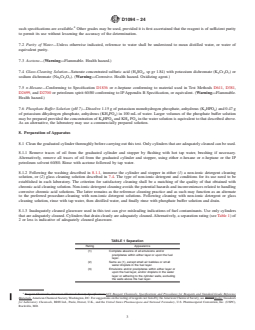
1.1 This test method covers the determination of the presence of water-miscible components in aviation gasoline and turbine fuels, and the effect of these components on volume change and on the fuel-water interface.
1.2 The values stated in SI units are to be regarded as standard. The values given in parentheses after SI units are provided for information only and are not considered standard.
1.3 This standard does not purport to address all of the safety concerns, if any, associated with its use. It is the responsibility of the user of this standard to establish appropriate safety, health, and environmental practices and determine the applicability of regulatory limitations prior to use. This standard involves the use of hazardous chemicals identified in Section 7. Before using this standard, refer to suppliers' safety labels, Material Safety Data Sheets and other technical literature.
1.4 This international standard was developed in accordance with internationally recognized principles on standardization established in the Decision on Principles for the Development of International Standards, Guides and Recommendations issued by the World Trade Organization Technical Barriers to Trade (TBT) Committee.
- Status
- Published
- Publication Date
- 29-Feb-2024
- Technical Committee
- D02 - Petroleum Products, Liquid Fuels, and Lubricants
- Drafting Committee
- D02.J0.05 - Fuel Cleanliness


Overview
ASTM D1094-24: Standard Test Method for Water Reaction of Aviation Fuels is an internationally recognized standard developed by ASTM International for assessing the presence of water-miscible components in aviation gasoline and turbine fuels. This method is crucial for determining how fuels react with water, specifically analyzing the effects on volume change and the fuel-water interface.
Ensuring superior fuel quality is of utmost importance in the aviation industry, where fuel contamination can result in significant operational and safety risks. ASTM D1094-24 supports fuel suppliers, laboratories, and aviation operators in identifying water-soluble additives and other contaminants that may affect flight performance and safety.
Key Topics
- Test Purpose: This test reveals water-soluble components such as alcohols in aviation gasoline and helps detect certain contaminants in aviation turbine fuel.
- Procedure: A sample of aviation fuel is shaken with a phosphate buffer solution using meticulously cleaned glassware. Observations are then made regarding volume change in the aqueous layer and conditions at the interface between fuel and water.
- Interpretation:
- For aviation gasoline, the primary concern is the detection of water-miscible compounds which can impact fuel properties and engine performance.
- For aviation turbine fuels, the method is less reliable for surfactant detection (which affects filter-separators), but it can reveal other types of fuel contamination.
- Safety and Environmental Precautions: The procedure involves hazardous chemicals. Users must follow appropriate safety, health, and environmental practices, including careful review of chemical labels and safety data sheets.
Applications
ASTM D1094-24 is applied in multiple practical contexts within the aviation fuel supply chain, including:
- Fuel Quality Control: Routine use by testing laboratories and fuel suppliers to monitor for the presence of water-miscible additives or contaminants prior to distribution.
- Product Specification Compliance: Ensures conformance of aviation fuels to required specifications, helping avoid risks associated with contaminated or off-spec fuels.
- Equipment and Infrastructure Protection: Detects contaminants that may damage filtration systems or aircraft fuel systems, enhancing operational reliability.
- Regulatory and Safety Audits: Supports meeting international safety and compliance requirements as outlined by ICAO, IATA, and local aviation authorities.
Related Standards
ASTM D1094-24 references and connects with several other standards pertinent to aviation fuel testing and quality assurance, including:
- ASTM D381 - Test for Gum Content in Fuels by Jet Evaporation
- ASTM D611 - Aniline Point and Mixed Aniline Point of Petroleum Products
- ASTM D1836 - Specification for Commercial Hexanes
- ASTM D2699 / D2700 - Research and Motor Octane Number of Spark-Ignition Engine Fuel
- ASTM D3948 - Water Separation Characteristics of Aviation Turbine Fuels
- ASTM D4175 - Terminology for Petroleum Products and Liquid Fuels
These related standards provide complementary methods for comprehensive aviation fuel quality management.
Keywords: ASTM D1094-24, water reaction, aviation fuels, aviation gasoline, aviation turbine fuel, fuel-water interface, water-miscible additives, fuel contaminants, aviation fuel testing, ASTM standards.
Relations
- Effective Date
- 01-Mar-2024
- Effective Date
- 01-Mar-2024
- Effective Date
- 01-Mar-2024
- Effective Date
- 01-Nov-2023
- Refers
ASTM D2699-23b - Standard Test Method for Research Octane Number of Spark-Ignition Engine Fuel - Effective Date
- 01-Nov-2023
- Effective Date
- 01-Mar-2024
- Effective Date
- 01-Mar-2024
- Effective Date
- 01-Mar-2024
- Effective Date
- 01-Mar-2024
- Effective Date
- 01-Mar-2024
- Effective Date
- 01-Mar-2024
- Effective Date
- 01-Mar-2024
Get Certified
Connect with accredited certification bodies for this standard

Element Materials Technology
Materials testing and product certification.

ABS Group Brazil
ABS Group certification services in Brazil.

ABS Quality Evaluations Inc.
American Bureau of Shipping quality certification.
Sponsored listings
Frequently Asked Questions
ASTM D1094-24 is a standard published by ASTM International. Its full title is "Standard Test Method for Water Reaction of Aviation Fuels". This standard covers: SIGNIFICANCE AND USE 5.1 When applied to aviation gasoline, water reaction volume change using the technique reveals the presence of water-soluble components such as alcohols. When applied to aviation turbine fuels, water reaction interface rating using the technique is not reliable in revealing the presence of surfactants which disarm filter-separators quickly and allow free water and particulates to pass; but can reveal the presence of other types of contaminants. Other tests, such as Test Method D3948, are capable of detecting surfactants in aviation fuels. SCOPE 1.1 This test method covers the determination of the presence of water-miscible components in aviation gasoline and turbine fuels, and the effect of these components on volume change and on the fuel-water interface. 1.2 The values stated in SI units are to be regarded as standard. The values given in parentheses after SI units are provided for information only and are not considered standard. 1.3 This standard does not purport to address all of the safety concerns, if any, associated with its use. It is the responsibility of the user of this standard to establish appropriate safety, health, and environmental practices and determine the applicability of regulatory limitations prior to use. This standard involves the use of hazardous chemicals identified in Section 7. Before using this standard, refer to suppliers' safety labels, Material Safety Data Sheets and other technical literature. 1.4 This international standard was developed in accordance with internationally recognized principles on standardization established in the Decision on Principles for the Development of International Standards, Guides and Recommendations issued by the World Trade Organization Technical Barriers to Trade (TBT) Committee.
SIGNIFICANCE AND USE 5.1 When applied to aviation gasoline, water reaction volume change using the technique reveals the presence of water-soluble components such as alcohols. When applied to aviation turbine fuels, water reaction interface rating using the technique is not reliable in revealing the presence of surfactants which disarm filter-separators quickly and allow free water and particulates to pass; but can reveal the presence of other types of contaminants. Other tests, such as Test Method D3948, are capable of detecting surfactants in aviation fuels. SCOPE 1.1 This test method covers the determination of the presence of water-miscible components in aviation gasoline and turbine fuels, and the effect of these components on volume change and on the fuel-water interface. 1.2 The values stated in SI units are to be regarded as standard. The values given in parentheses after SI units are provided for information only and are not considered standard. 1.3 This standard does not purport to address all of the safety concerns, if any, associated with its use. It is the responsibility of the user of this standard to establish appropriate safety, health, and environmental practices and determine the applicability of regulatory limitations prior to use. This standard involves the use of hazardous chemicals identified in Section 7. Before using this standard, refer to suppliers' safety labels, Material Safety Data Sheets and other technical literature. 1.4 This international standard was developed in accordance with internationally recognized principles on standardization established in the Decision on Principles for the Development of International Standards, Guides and Recommendations issued by the World Trade Organization Technical Barriers to Trade (TBT) Committee.
ASTM D1094-24 is classified under the following ICS (International Classification for Standards) categories: 75.160.20 - Liquid fuels. The ICS classification helps identify the subject area and facilitates finding related standards.
ASTM D1094-24 has the following relationships with other standards: It is inter standard links to ASTM D1094-07(2019), ASTM D2699-24, ASTM D2700-24, ASTM D2700-23b, ASTM D2699-23b, ASTM D6615-22, ASTM D910-24, ASTM D7547-23, ASTM D7960-21, ASTM D7826-23b, ASTM D7719-21a, ASTM D8434-21. Understanding these relationships helps ensure you are using the most current and applicable version of the standard.
ASTM D1094-24 is available in PDF format for immediate download after purchase. The document can be added to your cart and obtained through the secure checkout process. Digital delivery ensures instant access to the complete standard document.
Standards Content (Sample)
This international standard was developed in accordance with internationally recognized principles on standardization established in the Decision on Principles for the
Development of International Standards, Guides and Recommendations issued by the World Trade Organization Technical Barriers to Trade (TBT) Committee.
Designation: D1094 − 24
Standard Test Method for
Water Reaction of Aviation Fuels
This standard is issued under the fixed designation D1094; the number immediately following the designation indicates the year of
original adoption or, in the case of revision, the year of last revision. A number in parentheses indicates the year of last reapproval. A
superscript epsilon (´) indicates an editorial change since the last revision or reapproval.
This standard has been approved for use by agencies of the U.S. Department of Defense.
1. Scope* Ignition Engine Fuel
D2700 Test Method for Motor Octane Number of Spark-
1.1 This test method covers the determination of the pres-
Ignition Engine Fuel
ence of water-miscible components in aviation gasoline and
D3948 Test Method for Determining Water Separation Char-
turbine fuels, and the effect of these components on volume
acteristics of Aviation Turbine Fuels by Portable Separom-
change and on the fuel-water interface.
eter
1.2 The values stated in SI units are to be regarded as
D4175 Terminology Relating to Petroleum Products, Liquid
standard. The values given in parentheses after SI units are
Fuels, and Lubricants
provided for information only and are not considered standard. 3
2.2 Energy Institute Standard:
1.3 This standard does not purport to address all of the
IP Standard Test Methods Vol 2, Appendix B, Specification
safety concerns, if any, associated with its use. It is the
for Petroleum Spirits
responsibility of the user of this standard to establish appro-
3. Terminology
priate safety, health, and environmental practices and deter-
mine the applicability of regulatory limitations prior to use.
3.1 Definitions:
This standard involves the use of hazardous chemicals identi-
3.1.1 For definitions of terms used in this test method, refer
fied in Section 7. Before using this standard, refer to suppliers’
to Terminology D4175.
safety labels, Material Safety Data Sheets and other technical
3.2 Definitions of Terms Specific to This Standard:
literature.
3.2.1 film, n—thin, translucent layer that does not adhere to
1.4 This international standard was developed in accor-
the wall of the glass cylinder.
dance with internationally recognized principles on standard-
3.2.2 lace, n—fibers thicker than hairlike shred or of which
ization established in the Decision on Principles for the
more than 10 % are interlocking, or both.
Development of International Standards, Guides and Recom-
3.2.3 loose lace or slight scum, or both (Table 2, Rating 3),
mendations issued by the World Trade Organization Technical
n—an assessment that the fuel/buffer solution interface is
Barriers to Trade (TBT) Committee.
covered with more than 10 % but less than 50 % of lace or
scum that does not extend into either of the two layers.
2. Referenced Documents
3.2.4 scum, n—layer thicker than film or that adheres to the
2.1 ASTM Standards:
wall of the glass cylinder, or both.
D381 Test Method for Gum Content in Fuels by Jet Evapo-
ration 3.2.5 shred, n—hairlike fibers of which less than 10 % are
D611 Test Methods for Aniline Point and Mixed Aniline interlocking.
Point of Petroleum Products and Hydrocarbon Solvents
3.2.6 shred, lace or film at interface (Table 2, Rating 2),
D1836 Specification for Commercial Hexanes
n—an assessment that fuel/buffer solution interface contains
D2699 Test Method for Research Octane Number of Spark-
more than 50 % clear bubbles or some but less than 10 %
shred, lace, film or both.
3.2.7 tight lace or heavy scum, or both (Table 2, Rating 4),
This test method is under the jurisdiction of ASTM Committee D02 on
Petroleum Products, Liquid Fuels, and Lubricantsand is the direct responsibility of n—an assessment that the fuel/buffer solution interface is
Subcommittee D02.J0.05 on Fuel Cleanliness.
covered with more than 50 % of lace or scum, or both, that
Current edition approved March 1, 2024. Published March 2024. Originally
extends into either of the two layers or forms an emulsion, or
approved in 1950. Last previous edition approved in 2019 as D1094 – 07 (2019).
both.
DOI: 10.1520/D1094-24.
For referenced ASTM standards, visit the ASTM website, www.astm.org, or
contact ASTM Customer Service at service@astm.org. For Annual Book of ASTM
Standards volume information, refer to the standard’s Document Summary page on Available from Energy Institute, 61 New Cavendish St., London, WIG 7AR,
the ASTM website. U.K., http://www.energyinst.org.uk.
*A Summary of Changes section appears at the end of this standard
Copyright © ASTM International, 100 Barr Harbor Drive, PO Box C700, West Conshohocken, PA 19428-2959. United States
D1094 − 24
3.2.8 water reaction interface conditions rating, n—a quali- 7.4 Glass-Cleaning Solution—Saturate concentrated sulfu-
tative assessment of the tendency of a mixture of water and ric acid (H SO , sp gr 1.84) with potassium dichromate
2 4
aviation turbine fuel to form interface films or precipitates. (K Cr O ) or sodium dichromate (Na Cr O ). (Warning—
2 2 7 2 2 7
Corrosive. Health hazard. Oxidizing agent.)
3.2.9 water reaction separation rating, n—a qualitative
assessment of the tendency of insufficiently cleaned glassware
7.5 n-Hexane—Conforming to Specification D1836 or
to produce emulsions or precipitates, or both, in separated fuel
n-heptane conforming to material used in Test Methods D611,
and water layers.
D381, D2699, and D2700 or petroleum spirit 60/80 conform-
ing to IP Appendix B Specification, or equivalent. (Warning—
3.2.10 water reaction volume change, n—a qualitative indi-
Flammable. Health hazard.)
cation of the presence in aviation gasoline of water-soluble
components.
7.6 Phosphate Buffer Solution (pH 7)—Dissolve 1.15 g of
potassium monohydrogen phosphate, anhydrous (K HPO )
2 4
4. Summary of Test Method
and 0.47 g of potassium dihydrogen phosphate, anhydrous
(KH PO ) in 100 mL of water. Larger volumes of the phos-
4.1 A sample of the fuel is shaken, using a standardized 2 4
phate buffer solution may be prepared provided the concentra-
technique, at room temperature with a phosphate buffer solu-
tion of K HPO and KH PO in the water solution is
tion in scrupulously cleaned glassware. The cleanliness of the 2 4 2 4
equivalent to that described above. As an alternative, the
glass cylinder is tested. The change in volume of the aqueous
laboratory may use a commercially prepared solution.
layer and the appearance of the interface are taken as the water
reaction of the fuel.
8. Preparation of Apparatus
8.1 Clean the graduated cylinder thoroughly before carrying
5. Significance and Use
out this test. Only cylinders that are adequately cleaned can be
5.1 When applied to aviation gasoline, water reaction vol-
used.
ume change using the technique reveals the presence of
8.1.1 Remove traces of oil from the graduated cylinder and
water-soluble components such as alcohols. When applied to
stopper by flushing with hot tap water, brushing if necessary.
aviation turbine fuels, water reaction interface rating using the
Alternatively, remove all traces of oil from the graduated
technique is not reliable in revealing the presence of surfactants
cylinder and stopper, using either n-hexane or n-heptane or the
which disarm filter-separators quickly and allow free water and
IP petroleum solvent 60/80. Rinse with acetone followed by tap
particulates to pass; but can reveal the presence of other types
water.
of contaminants. Other tests, such as Test Method D3948, are
8.1.2 Following the washing described in 8.1.1, immerse the
capable o
...
This document is not an ASTM standard and is intended only to provide the user of an ASTM standard an indication of what changes have been made to the previous version. Because
it may not be technically possible to adequately depict all changes accurately, ASTM recommends that users consult prior editions as appropriate. In all cases only the current version
of the standard as published by ASTM is to be considered the official document.
Designation: D1094 − 07 (Reapproved 2019) D1094 − 24
Standard Test Method for
Water Reaction of Aviation Fuels
This standard is issued under the fixed designation D1094; the number immediately following the designation indicates the year of
original adoption or, in the case of revision, the year of last revision. A number in parentheses indicates the year of last reapproval. A
superscript epsilon (´) indicates an editorial change since the last revision or reapproval.
This standard has been approved for use by agencies of the U.S. Department of Defense.
1. Scope Scope*
1.1 This test method covers the determination of the presence of water-miscible components in aviation gasoline and turbine fuels,
and the effect of these components on volume change and on the fuel-water interface.
1.2 The values stated in SI units are to be regarded as standard. The values given in parentheses after SI units are provided for
information only and are not considered standard.
1.3 This standard does not purport to address all of the safety concerns, if any, associated with its use. It is the responsibility
of the user of this standard to establish appropriate safety, health, and environmental practices and determine the applicability of
regulatory limitations prior to use. This standard involves the use of hazardous chemicals identified in Section 7. Before using this
standard, refer to suppliers’ safety labels, Material Safety Data Sheets and other technical literature.
1.4 This international standard was developed in accordance with internationally recognized principles on standardization
established in the Decision on Principles for the Development of International Standards, Guides and Recommendations issued
by the World Trade Organization Technical Barriers to Trade (TBT) Committee.
2. Referenced Documents
2.1 ASTM Standards:
D381 Test Method for Gum Content in Fuels by Jet Evaporation
D611 Test Methods for Aniline Point and Mixed Aniline Point of Petroleum Products and Hydrocarbon Solvents
D1836 Specification for Commercial Hexanes
D2699 Test Method for Research Octane Number of Spark-Ignition Engine Fuel
D2700 Test Method for Motor Octane Number of Spark-Ignition Engine Fuel
D3948 Test Method for Determining Water Separation Characteristics of Aviation Turbine Fuels by Portable Separometer
D4175 Terminology Relating to Petroleum Products, Liquid Fuels, and Lubricants
2.2 Energy Institute Standard:
IP Standard Test Methods Vol 2, Appendix B, Specification for Petroleum Spirits
3. Terminology
3.1 Definitions:
This test method is under the jurisdiction of ASTM Committee D02 on Petroleum Products, Liquid Fuels, and Lubricantsand is the direct responsibility of Subcommittee
D02.J0.05 on Fuel Cleanliness.
Current edition approved Feb. 1, 2019March 1, 2024. Published February 2019March 2024. Originally approved in 1950. Last previous edition approved in 20132019
as D1094 – 07 (2013).(2019). DOI: 10.1520/D1094-07R19.10.1520/D1094-24.
For referenced ASTM standards, visit the ASTM website, www.astm.org, or contact ASTM Customer Service at service@astm.org. For Annual Book of ASTM Standards
volume information, refer to the standard’s Document Summary page on the ASTM website.
Available from Energy Institute, 61 New Cavendish St., London, WIG 7AR, U.K., http://www.energyinst.org.uk.
*A Summary of Changes section appears at the end of this standard
Copyright © ASTM International, 100 Barr Harbor Drive, PO Box C700, West Conshohocken, PA 19428-2959. United States
D1094 − 24
3.1.1 For definitions of terms used in this test method, refer to Terminology D4175.
3.2 Definitions of Terms Specific to This Standard:
3.2.1 film, n—thin, translucent layer that does not adhere to the wall of the glass cylinder.
3.2.2 lace, n—fibers thicker than hairlike shred or of which more than 10 % are interlocking, or both.
3.2.3 loose lace or slight scum, or both (Table 2, Rating 3), n—an assessment that the fuel/buffer solution interface is covered with
more than 10 % but less than 50 % of lace or scum that does not extend into either of the two layers.
3.2.4 scum, n—layer thicker than film or that adheres to the wall of the glass cylinder, or both.
3.2.5 shred, n—hairlike fibers of which less than 10 % are interlocking.
3.2.6 shred, lace or film at interface (Table 2, Rating 2), n—an assessment that fuel/buffer solution interface contains more than
50 % clear bubbles or some but less than 10 % shred, lace, film or both.
3.2.7 tight lace or heavy scum, or both (Table 2, Rating 4), n—an assessment that the fuel/buffer solution interface is covered with
more than 50 % of lace or scum, or both, that extends into either of the two layers or forms an emulsion, or both.
3.2.8 water reaction interface conditions rating, n—a qualitative assessment of the tendency of a mixture of water and aviation
turbine fuel to form interface films or precipitates.
3.2.9 water reaction separation rating, n—a qualitative assessment of the tendency of insufficiently cleaned glassware to produce
emulsions or precipitates, or both, in separated fuel and water layers.
3.2.10 water reaction volume change, n—a qualitative indication of the presence in aviation gasoline of water-soluble components.
4. Summary of Test Method
4.1 A sample of the fuel is shaken, using a standardized technique, at room temperature with a phosphate buffer solution in
scrupulously cleaned glassware. The cleanliness of the glass cylinder is tested. The change in volume of the aqueous layer and the
appearance of the interface are taken as the water reaction of the fuel.
5. Significance and Use
5.1 When applied to aviation gasoline, water reaction volume change using the technique reveals the presence of water-soluble
components such as alcohols. When applied to aviation turbine fuels, water reaction interface rating using the technique is not
reliable in revealing the presence of surfactants which disarm filter-separators quickly and allow free water and particulates to pass;
but can reveal the presence of other types of contaminants. Other tests, such as Test Method D3948, are capable of detecting
surfactants in aviation fuels.
6. Apparatus
6.1 Graduated Glass Cylinder, glass-stoppered, 100 mL, with 1 mL graduations. The distance between the 100 mL mark and the
top of the shoulder of the cylinder must be within the range from 50 mm to 60 mm.
7. Reagents
7.1 Purity of Reagents—Reagent grade chemicals shall be used in all tests. Unless otherwise indicated, it is intended that all
reagents shall conform to the specifications of the Committee on Analytical Reagents of the American Chemical Society, where
D1094 − 24
such specifications are available. Other grades may be used, provided it is first ascertained that the reagent is of sufficient purity
to permit its use without lessening the accuracy of the determination.
7.2 Purity of Water—Unless otherwise indicated, reference to water shall be understood to mean distilled water, or water of
equivalent purity.
7.3 Acetone—(Warning—Flammable. Health hazard.)
7.4 Glass-Cleaning Solution—Saturate concentrated sulfuric acid (H SO , sp gr 1.84) with potassium dichromate (K Cr O ) or
2 4 2 2 7
sodium dichromate (Na Cr O ). (Warning—Corrosive. Health hazard. Oxidizing agent.)
2 2 7
7.5 n-Hexane—Conforming to Specification D1836 or n-heptane conforming to material used in Test Methods D611, D381,
D2699, and D2700 or petroleum spirit 60/80 conforming to IP Appendix B Specification, or equivalent. (Warning—Flammable.
Health hazard.)
7.6 Phosphate Buffer Solution (pH 7)—Dissolve
...