

ASTM C1339/C1339M-18
(Test Method)Standard Test Method for Flowability and Bearing Area of Chemical-Resistant Polymer Machinery Grouts
General Information
- Abstract
SIGNIFICANCE AND USE
5.1 Chemical-resistant polymer machinery grouts are used to provide precision support for machinery or equipment.
Note 2: The machinery or equipment or support bases or plates, or combination thereof, are positioned to the precise elevation and location required. The bases or plates are typically placed on prepared foundations and supported on temporary shims or support bolts (jack screws). Forms are installed to contain the flowable grout. The grout is poured around the perimeter in such a manner as to allow the grout to flow around and under the equipment base or plates. The grout subsequently hardens to provide a strong rigid support layer capable of withstanding the stresses transferred by the equipment to the foundation. Although the actual machinery base plate is typically metal and the cover plate in this test uses acrylic glass, different grouts using acrylic glass cover plates has proven useful for comparative purposes as described in this test in laboratory conditions.
5.2 In addition to the required physical properties of the grout, the flow and bearing area achieved are important considerations for effective grout installation. The two characteristics measured by this test method are flow and bearing area.
5.3 The flow test simulates typical application conditions for a flowable polymer machinery grout in a laboratory environment. It may be used to evaluate the suitability of a particular grout for a specific application, to compare the flowability and bearing area of two or more grouts, or to evaluate the effects of formulation changes, temperature, mixing techniques, or other factors on flowability.
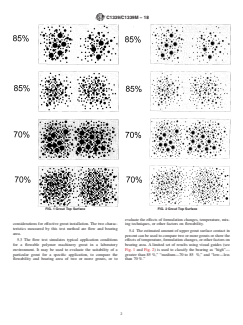
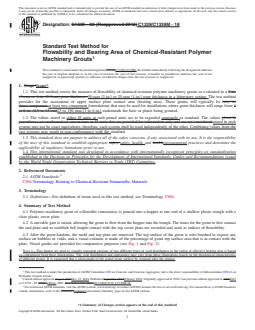
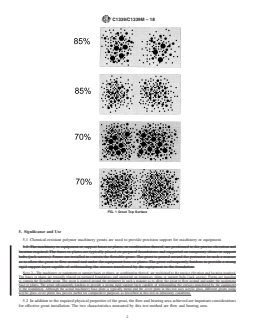
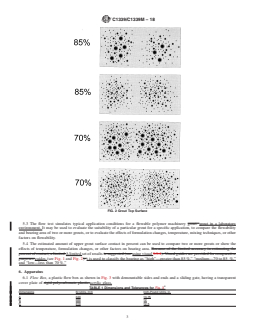
5.4 The estimated amount of upper grout surface contact in percent can be used to compare two or more grouts or show the effects of temperature, formulation changes, or other factors on bearing area. A limited set of results using visual guides (see Fig. 1 and Fig. 2) is used to classify the bearing as “high”—greater than 85 %,” “medium—70 to 85 ...
SCOPE
1.1 This test method covers the measure of flowability of chemical-resistant polymer machinery grouts as evaluated in a 50-mm [2-in.] or 25-mm [1-in.] pour thickness in a laboratory setting. The test method provides for the assessment of upper surface plate contact area (bearing area). These grouts will typically be at least two component formulations that may be used for installations where grout thickness will range from 25 to 150 mm [1 to 6 in.] underneath the base or plates being grouted.
1.2 The values stated in either SI units or inch-pound units are to be regarded separately as standard. The values stated in each system may not be exact equivalents; therefore, each system shall be used independently of the other. Combining values from the two systems may result in non-conformance with the standard.
1.3 This standard does not purport to address all of the safety concerns, if any, associated with its use. It is the responsibility of the user of this standard to establish appropriate safety, health, and environmental practices and determine the applicability of regulatory limitations prior to use.
1.4 This international standard was developed in accordance with internationally recognized principles on standardization established in the Decision on Principles for the Development of International Standards, Guides and Recommendations issued by the World Trade Organization Technical Barriers to Trade (TBT) Committee.
- Status
- Published
- Publication Date
- 14-Dec-2018
- Technical Committee
- C09 - Concrete and Concrete Aggregates
- Drafting Committee
- C09.41 - Hydraulic Cement Grouts
Buy Documents
ASTM C1339/C1339M-18 - Standard Test Method for Flowability and Bearing Area of Chemical-Resistant Polymer Machinery Grouts
REDLINE ASTM C1339/C1339M-18 - Standard Test Method for Flowability and Bearing Area of Chemical-Resistant Polymer Machinery Grouts
Overview
ASTM C1339/C1339M-18 is the Standard Test Method for Flowability and Bearing Area of Chemical-Resistant Polymer Machinery Grouts, developed by ASTM International. This standard specifies laboratory procedures for measuring the flowability and bearing area of chemical-resistant polymer machinery grouts, which are commonly used to provide precision support for machinery and equipment. The test evaluates these properties in grouts with pour thicknesses of 25 mm [1 in.] or 50 mm [2 in.], ensuring reliable performance in both SI and inch-pound units.
The primary focus is on ensuring that grouts used beneath heavy equipment bases or plates achieve proper flow and maximum bearing area for effective installation, durability, and load transfer. Proper assessment of these characteristics is crucial for maintaining alignment and stability of industrial machinery installations.
Key Topics
Flowability Assessment: Measures how well the grout can flow around and beneath machinery bases, simulating real-world installation conditions. A shorter flow time indicates greater flowability, which is important for fully encapsulating equipment bases with minimal voids.
Bearing Area Evaluation: After curing, the surface contact between the grout and cover plate (bearing area) is visually estimated and classified as high (over 85%), medium (70-85%), or low (under 70%). This metric helps ensure that the grout provides adequate support.
Dual Unit Standardization: Test procedures and equipment dimensions are provided in both SI (metric) and inch-pound (imperial) units. Each system should be used independently to avoid non-conformance.
Comparative Testing: The method enables comparison between different grout formulations or the study of effects from temperature, formulation changes, and mixing techniques on both flowability and bearing area.
Safety and Best Practices: The standard emphasizes the importance of appropriate health, safety, and environmental practices during testing and use, in line with international guidelines.
Applications
The ASTM C1339/C1339M-18 test method has practical relevance in a range of industries where chemical-resistant polymer machinery grouts are essential, including:
- Industrial Equipment Foundations: Ensuring reliable support and alignment for pumps, compressors, turbines, and other heavy machinery.
- Power Generation Facilities: Providing a stable and chemically durable grout base for generators and transformers, particularly in corrosive environments.
- Chemical Processing Plants: Supporting equipment where exposure to aggressive chemicals requires grouts with high chemical resistance.
- Refineries and Manufacturing Plants: Used where heavy foundations must withstand dynamic and static loads, and precise support is critical for equipment longevity.
- Quality Control in Grout Manufacturing: Enables manufacturers and end-users to verify and compare product performance under controlled lab conditions, supporting effective material selection and application.
Related Standards
- ASTM C904 - Terminology Relating to Chemical-Resistant Nonmetallic Materials: Provides definitions for technical terms used in this and related standards.
- Other ASTM Cement and Concrete Standards: Many are referenced in projects using polymer and hydraulic cements for machinery grouting.
- International Standards: Developed in line with principles of the World Trade Organization Technical Barriers to Trade (TBT) Committee, facilitating global compatibility and best practices.
Keywords: ASTM C1339, chemical-resistant polymer machinery grouts, flowability test, bearing area, equipment foundation, grout installation, industrial grout standards, flow test, bearing surface, ASTM standards.
Relations
- Effective Date
- 15-Dec-2018
- Refers
ASTM C904-01(2018) - Standard Terminology Relating to Chemical-Resistant Nonmetallic Materials - Effective Date
- 01-Nov-2018
- Refers
ASTM C904-01(2012) - Standard Terminology Relating to Chemical-Resistant Nonmetallic Materials - Effective Date
- 01-Aug-2012
Buy Documents
ASTM C1339/C1339M-18 - Standard Test Method for Flowability and Bearing Area of Chemical-Resistant Polymer Machinery Grouts
REDLINE ASTM C1339/C1339M-18 - Standard Test Method for Flowability and Bearing Area of Chemical-Resistant Polymer Machinery Grouts
Get Certified
Connect with accredited certification bodies for this standard

DIN CERTCO
DIN Group product certification.

Smithers Quality Assessments
US management systems and product certification.
Sponsored listings
Frequently Asked Questions
ASTM C1339/C1339M-18 is a standard published by ASTM International. Its full title is "Standard Test Method for Flowability and Bearing Area of Chemical-Resistant Polymer Machinery Grouts". This standard covers: SIGNIFICANCE AND USE 5.1 Chemical-resistant polymer machinery grouts are used to provide precision support for machinery or equipment. Note 2: The machinery or equipment or support bases or plates, or combination thereof, are positioned to the precise elevation and location required. The bases or plates are typically placed on prepared foundations and supported on temporary shims or support bolts (jack screws). Forms are installed to contain the flowable grout. The grout is poured around the perimeter in such a manner as to allow the grout to flow around and under the equipment base or plates. The grout subsequently hardens to provide a strong rigid support layer capable of withstanding the stresses transferred by the equipment to the foundation. Although the actual machinery base plate is typically metal and the cover plate in this test uses acrylic glass, different grouts using acrylic glass cover plates has proven useful for comparative purposes as described in this test in laboratory conditions. 5.2 In addition to the required physical properties of the grout, the flow and bearing area achieved are important considerations for effective grout installation. The two characteristics measured by this test method are flow and bearing area. 5.3 The flow test simulates typical application conditions for a flowable polymer machinery grout in a laboratory environment. It may be used to evaluate the suitability of a particular grout for a specific application, to compare the flowability and bearing area of two or more grouts, or to evaluate the effects of formulation changes, temperature, mixing techniques, or other factors on flowability. 5.4 The estimated amount of upper grout surface contact in percent can be used to compare two or more grouts or show the effects of temperature, formulation changes, or other factors on bearing area. A limited set of results using visual guides (see Fig. 1 and Fig. 2) is used to classify the bearing as “high”—greater than 85 %,” “medium—70 to 85 ... SCOPE 1.1 This test method covers the measure of flowability of chemical-resistant polymer machinery grouts as evaluated in a 50-mm [2-in.] or 25-mm [1-in.] pour thickness in a laboratory setting. The test method provides for the assessment of upper surface plate contact area (bearing area). These grouts will typically be at least two component formulations that may be used for installations where grout thickness will range from 25 to 150 mm [1 to 6 in.] underneath the base or plates being grouted. 1.2 The values stated in either SI units or inch-pound units are to be regarded separately as standard. The values stated in each system may not be exact equivalents; therefore, each system shall be used independently of the other. Combining values from the two systems may result in non-conformance with the standard. 1.3 This standard does not purport to address all of the safety concerns, if any, associated with its use. It is the responsibility of the user of this standard to establish appropriate safety, health, and environmental practices and determine the applicability of regulatory limitations prior to use. 1.4 This international standard was developed in accordance with internationally recognized principles on standardization established in the Decision on Principles for the Development of International Standards, Guides and Recommendations issued by the World Trade Organization Technical Barriers to Trade (TBT) Committee.
SIGNIFICANCE AND USE 5.1 Chemical-resistant polymer machinery grouts are used to provide precision support for machinery or equipment. Note 2: The machinery or equipment or support bases or plates, or combination thereof, are positioned to the precise elevation and location required. The bases or plates are typically placed on prepared foundations and supported on temporary shims or support bolts (jack screws). Forms are installed to contain the flowable grout. The grout is poured around the perimeter in such a manner as to allow the grout to flow around and under the equipment base or plates. The grout subsequently hardens to provide a strong rigid support layer capable of withstanding the stresses transferred by the equipment to the foundation. Although the actual machinery base plate is typically metal and the cover plate in this test uses acrylic glass, different grouts using acrylic glass cover plates has proven useful for comparative purposes as described in this test in laboratory conditions. 5.2 In addition to the required physical properties of the grout, the flow and bearing area achieved are important considerations for effective grout installation. The two characteristics measured by this test method are flow and bearing area. 5.3 The flow test simulates typical application conditions for a flowable polymer machinery grout in a laboratory environment. It may be used to evaluate the suitability of a particular grout for a specific application, to compare the flowability and bearing area of two or more grouts, or to evaluate the effects of formulation changes, temperature, mixing techniques, or other factors on flowability. 5.4 The estimated amount of upper grout surface contact in percent can be used to compare two or more grouts or show the effects of temperature, formulation changes, or other factors on bearing area. A limited set of results using visual guides (see Fig. 1 and Fig. 2) is used to classify the bearing as “high”—greater than 85 %,” “medium—70 to 85 ... SCOPE 1.1 This test method covers the measure of flowability of chemical-resistant polymer machinery grouts as evaluated in a 50-mm [2-in.] or 25-mm [1-in.] pour thickness in a laboratory setting. The test method provides for the assessment of upper surface plate contact area (bearing area). These grouts will typically be at least two component formulations that may be used for installations where grout thickness will range from 25 to 150 mm [1 to 6 in.] underneath the base or plates being grouted. 1.2 The values stated in either SI units or inch-pound units are to be regarded separately as standard. The values stated in each system may not be exact equivalents; therefore, each system shall be used independently of the other. Combining values from the two systems may result in non-conformance with the standard. 1.3 This standard does not purport to address all of the safety concerns, if any, associated with its use. It is the responsibility of the user of this standard to establish appropriate safety, health, and environmental practices and determine the applicability of regulatory limitations prior to use. 1.4 This international standard was developed in accordance with internationally recognized principles on standardization established in the Decision on Principles for the Development of International Standards, Guides and Recommendations issued by the World Trade Organization Technical Barriers to Trade (TBT) Committee.
ASTM C1339/C1339M-18 is classified under the following ICS (International Classification for Standards) categories: 83.020 - Manufacturing processes in the rubber and plastics industries. The ICS classification helps identify the subject area and facilitates finding related standards.
ASTM C1339/C1339M-18 has the following relationships with other standards: It is inter standard links to ASTM C1339-02(2012), ASTM C904-01(2018), ASTM C904-01(2012). Understanding these relationships helps ensure you are using the most current and applicable version of the standard.
ASTM C1339/C1339M-18 is available in PDF format for immediate download after purchase. The document can be added to your cart and obtained through the secure checkout process. Digital delivery ensures instant access to the complete standard document.
Standards Content (Sample)
This international standard was developed in accordance with internationally recognized principles on standardization established in the Decision on Principles for the
Development of International Standards, Guides and Recommendations issued by the World Trade Organization Technical Barriers to Trade (TBT) Committee.
Designation: C1339/C1339M − 18
Standard Test Method for
Flowability and Bearing Area of Chemical-Resistant Polymer
Machinery Grouts
This standard is issued under the fixed designation C1339/C1339M; the number immediately following the designation indicates the
year of original adoption or, in the case of revision, the year of last revision. A number in parentheses indicates the year of last
reapproval. A superscript epsilon (´) indicates an editorial change since the last revision or reapproval.
1. Scope* 3. Terminology
1.1 This test method covers the measure of flowability of 3.1 Definitions—For definition of terms used in this test
chemical-resistant polymer machinery grouts as evaluated in a method, see Terminology C904.
50-mm [2-in.] or 25-mm [1-in.] pour thickness in a laboratory
setting. The test method provides for the assessment of upper 4. Summary of Test Method
surface plate contact area (bearing area). These grouts will
4.1 Polymer machinery grout of a flowable consistency is
typically be at least two component formulations that may be
pouredintoahopperatoneendofashallowplastictroughwith
used for installations where grout thickness will range from 25
a clear plastic cover plate.
to 150 mm [1 to 6 in.] underneath the base or plates being
4.2 A movable gate is raised, allowing the grout to flow
grouted.
from the hopper into the trough. The times for the grout to first
1.2 The values stated in either SI units or inch-pound units
contact the end plate and to establish full length contact with
are to be regarded separately as standard. The values stated in
the top cover plate are recorded and used as indices of
each system may not be exact equivalents; therefore, each
flowability.
system shall be used independently of the other. Combining
4.3 After the grout hardens, the mold and top plate are
values from the two systems may result in non-conformance
removed.Thetopsurfaceofthegroutiswirebrushedtoexpose
with the standard.
any surface air bubbles or voids, and a visual estimate is made
1.3 This standard does not purport to address all of the
of the percentage of grout top surface area that is in contact
safety concerns, if any, associated with its use. It is the
with the plate. Visual guides are provided for comparative
responsibility of the user of this standard to establish appro-
purposes (see Fig. 1 and Fig. 2).
priate safety, health, and environmental practices and deter-
mine the applicability of regulatory limitations prior to use.
NOTE 1—Two figures are used to visually represent sections of two
different types of void distribution as the rating of effective bearing area
1.4 This international standard was developed in accor-
is based on comparison from these illustrations. The void distribution and
dance with internationally recognized principles on standard-
appearance may vary from these illustrations based on the rheological
ization established in the Decision on Principles for the
characteristics of different grouts. It is suggested that a photograph of the
Development of International Standards, Guides and Recom-
actual grout surface be retained after the testing.
mendations issued by the World Trade Organization Technical
Barriers to Trade (TBT) Committee.
5. Significance and Use
5.1 Chemical-resistant polymer machinery grouts are used
2. Referenced Documents
to provide precision support for machinery or equipment.
2.1 ASTM Standards:
NOTE 2—The machinery or equipment or support bases or plates, or
C904 Terminology Relating to Chemical-Resistant Nonme-
combination thereof, are positioned to the precise elevation and location
tallic Materials required. The bases or plates are typically placed on prepared foundations
and supported on temporary shims or support bolts (jack screws). Forms
are installed to contain the flowable grout. The grout is poured around the
1 perimeter in such a manner as to allow the grout to flow around and under
This test method is under the jurisdiction of ASTM Committee C09 on
the equipment base or plates. The grout subsequently hardens to provide
Concrete and ConcreteAggregates and is the direct responsibility of Subcommittee
a strong rigid support layer capable of withstanding the stresses trans-
C09.41 on Hydraulic Cement Grouts.
ferred by the equipment to the foundation.Although the actual machinery
Current edition approved Dec. 15, 2018. Published February 2019. Originally
approved in 1996. Last previous edition approved in 2012 as C1339 – 02 (2012). base plate is typically metal and the cover plate in this test uses acrylic
DOI: 10.1520/C1339_C1339M-18. glass, different grouts using acrylic glass cover plates has proven useful
For referenced ASTM standards, visit the ASTM website, www.astm.org, or
for comparative purposes as described in this test in laboratory conditions.
contact ASTM Customer Service at service@astm.org. For Annual Book of ASTM
5.2 In addition to the required physical properties of the
Standards volume information, refer to the standard’s Document Summary page on
the ASTM website. grout, the flow and bearing area achieved are important
*A Summary of Changes section appears at the end of this standard
Copyright © ASTM International, 100 Barr Harbor Drive, PO Box C700, West Conshohocken, PA 19428-2959. United States
C1339/C1339M − 18
FIG. 2 Grout Top Surface
FIG. 1 Grout Top Surface
evaluate the effects of formulation changes, temperature, mix-
considerations for effective grout installation. The two charac- ing techniques, or other factors on flowability.
teristics measured by this test method are flow and bearing
5.4 The estimated amount of upper grout surface contact in
area.
percent can be used to compare two or more grouts or show the
5.3 The flow test simulates typical application conditions effects of temperature, formulation changes, or other factors on
for a flowable polymer machinery grout in a laboratory bearing area. A limited set of results using visual guides (see
environment. It may be used to evaluate the suitability of a Fig. 1 and Fig. 2) is used to classify the bearing as “high”—
particular grout for a specific application, to compare the greater than 85 %,” “medium—70 to 85 %,” and “low—less
flowability and bearing area of two or more grouts, or to than 70 %.”
C1339/C1339M − 18
A
TABLE 1 Dimensions and Tolerances for Fig. 3
6. Apparatus
Dimensions SI Units, mm Inch-Pound Units, in.
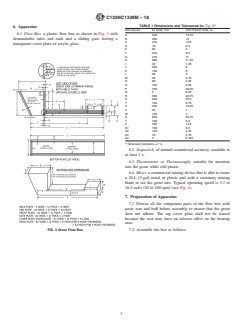
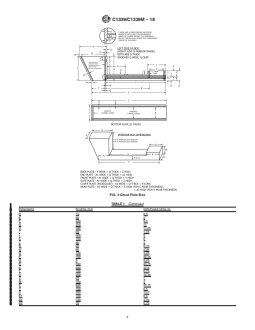
6.1 Flow Box, a plastic flow box as shown in Fig. 3 with
A 340 13.75
B 300 12
demountable sides and ends and a sliding gate, having a
C 310 12.5
transparent cover plate of acrylic glass.
D10 0.5
E50 2
F 240 9.5
G 270 11
H 280 11.25
I 30 1.25
J 200 8
K 150 6
L80 3
M 20 0.75
N 60 2.25
O 100 4.25
P 750 30.25
Q 5 0.25
R 590 23.75
S 930 37.5
T 160 6.75
U 250 10.25
V25 1
W 100 4
X 890 35.75
Y 160 6.5
Z 350 14.0
A1 160 6.5
A2 120 4.75
A3 70 2.75
A4 3 0.125
A
Dimension tolerance ±1 %.
6.2 Stopwatch, of normal commercial accuracy, readable to
at least 1 s.
6.3 Thermometer or Thermocouple, suitable for insertion
into the grout while still plastic.
6.4 Mixer, a commercial mixing device that is able to rotate
a 20-L [5-gal] metal or plastic pail with a stationary mixing
blade to stir the grout mix. Typical operating speed is 3.1 to
10.5 rad/s [30 to 100 rpm] (see Fig. 4).
7. Preparation of Apparatus
7.1 Prewax all the component parts of the flow box with
paste wax and buff before assembly to ensure that the grout
does not adhere. The top cover plate shall not be waxed
because the wax may have an adverse effect on the bearing
area.
FIG. 3 Grout Flow Box 7.2 Assemble the box as follows:
---------------------
...
This document is not an ASTM standard and is intended only to provide the user of an ASTM standard an indication of what changes have been made to the previous version. Because
it may not be technically possible to adequately depict all changes accurately, ASTM recommends that users consult prior editions as appropriate. In all cases only the current version
of the standard as published by ASTM is to be considered the official document.
Designation: C1339 − 02 (Reapproved 2012) C1339/C1339M − 18
Standard Test Method for
Flowability and Bearing Area of Chemical-Resistant Polymer
Machinery Grouts
This standard is issued under the fixed designation C1339;C1339/C1339M; the number immediately following the designation indicates
the year of original adoption or, in the case of revision, the year of last revision. A number in parentheses indicates the year of last
reapproval. A superscript epsilon (´) indicates an editorial change since the last revision or reapproval.
1. Scope Scope*
1.1 This test method covers the measure of flowability of chemical-resistant polymer machinery grouts as evaluated in a 2-in.
(5-cm) or 1-in. (2.5-cm) pour thickness. 50-mm [2-in.] or 25-mm [1-in.] pour thickness in a laboratory setting. The test method
provides for the assessment of upper surface plate contact area (bearing area). These grouts will typically be two- or
three-component at least two component formulations that may be used for installations where grout thickness will range from 1
to 6 in. (2.5 to 15 cm)25 to 150 mm [1 to 6 in.] underneath the base or plates being grouted.
1.2 The values stated in either SI units or inch-pound units are to be regarded separately as standard. The values given in
parentheses are mathematical conversions to SI units that are provided for information only and are not considered stated in each
system may not be exact equivalents; therefore, each system shall be used independently of the other. Combining values from the
two systems may result in non-conformance with the standard.
1.3 This standard does not purport to address all of the safety concerns, if any, associated with its use. It is the responsibility
of the user of this standard to establish appropriate safety safety, health, and healthenvironmental practices and determine the
applicability of regulatory limitations prior to use.
1.4 This international standard was developed in accordance with internationally recognized principles on standardization
established in the Decision on Principles for the Development of International Standards, Guides and Recommendations issued
by the World Trade Organization Technical Barriers to Trade (TBT) Committee.
2. Referenced Documents
2.1 ASTM Standards:
C904 Terminology Relating to Chemical-Resistant Nonmetallic Materials
3. Terminology
3.1 Definitions—For definition of terms used in this test method, see Terminology C904.
4. Summary of Test Method
4.1 Polymer machinery grout of a flowable consistency is poured into a hopper at one end of a shallow plastic trough with a
clear plastic cover plate.
4.2 A movable gate is raised, allowing the grout to flow from the hopper into the trough. The times for the grout to first contact
the end plate and to establish full length contact with the top cover plate are recorded and used as indices of flowability.
4.3 After the grout hardens, the mold and top plate are removed. The top surface of the grout is wire brushed to expose any
surface air bubbles or voids, and a visual estimate is made of the percentage of grout top surface area that is in contact with the
plate. Visual guides are provided for comparative purposes (see Fig. 1 and Fig. 2).
NOTE 1—Two figures are used to visually represent sections of two different types of void distribution as the rating of effective bearing area is based
on comparison from these illustrations. The void distribution and appearance may vary from these illustrations based on the rheological characteristics
of different grouts. It is suggested that a photograph of the actual grout surface be retained after the testing.
This test method is under the jurisdiction of ASTM Committee C09 on Concrete and Concrete Aggregates and is the direct responsibility of Subcommittee C09.41 on
Hydraulic Cement Grouts.
Current edition approved Aug. 1, 2012Dec. 15, 2018. Published September 2012February 2019. Originally approved in 1996. Last previous edition approved in 20082012
as C1339 – 02 (2008).(2012). DOI: 10.1520/C1339-02R12.10.1520/C1339_C1339M-18.
For referenced ASTM standards, visit the ASTM website, www.astm.org, or contact ASTM Customer Service at service@astm.org. For Annual Book of ASTM Standards
volume information, refer to the standard’sstandard’s Document Summary page on the ASTM website.
*A Summary of Changes section appears at the end of this standard
Copyright © ASTM International, 100 Barr Harbor Drive, PO Box C700, West Conshohocken, PA 19428-2959. United States
C1339/C1339M − 18
FIG. 1 Grout Top Surface
5. Significance and Use
5.1 Chemical-resistant polymer machinery grouts are used to provide precision support for machinery or equipment.
5.2 The machinery or equipment or support bases or plates, or combination thereof, are positioned to the precise elevation and
location required. The bases or plates are typically placed on prepared foundations and supported on temporary shims or support
bolts (jack screws). Forms are installed to contain the flowable grout. The grout is poured around the perimeter in such a manner
as to allow the grout to flow around and under the equipment base or plates. The grout subsequently hardens to provide a strong
rigid support layer capable of withstanding the stresses transferred by the equipment to the foundation.
NOTE 2—The machinery or equipment or support bases or plates, or combination thereof, are positioned to the precise elevation and location required.
The bases or plates are typically placed on prepared foundations and supported on temporary shims or support bolts (jack screws). Forms are installed
to contain the flowable grout. The grout is poured around the perimeter in such a manner as to allow the grout to flow around and under the equipment
base or plates. The grout subsequently hardens to provide a strong rigid support layer capable of withstanding the stresses transferred by the equipment
to the foundation. Although the actual machinery base plate is typically metal and the cover plate in this test uses acrylic glass, different grouts using
acrylic glass cover plates has proven useful for comparative purposes as described in this test in laboratory conditions.
5.2 In addition to the required physical properties of the grout, the flow and bearing area achieved are important considerations
for effective grout installation. The two characteristics measured by this test method are flow and bearing area.
C1339/C1339M − 18
FIG. 2 Grout Top Surface
5.3 The flow test simulates typical application conditions for a flowable polymer machinery grout. grout in a laboratory
environment. It may be used to evaluate the suitability of a particular grout for a specific application, to compare the flowability
and bearing area of two or more grouts, or to evaluate the effects of formulation changes, temperature, mixing techniques, or other
factors on flowability.
5.4 The estimated amount of upper grout surface contact in percent can be used to compare two or more grouts or show the
effects of temperature, formulation changes, or other factors on bearing area. Because of the limited accuracy in estimating the
percent of contact, a limited A limited set of results is suggested (see using visual 9.9.1). Visual guides are provided for comparative
purposes guides (see Fig. 1 and Fig. 2). ) is used to classify the bearing as “high”—greater than 85 %,” “medium—70 to 85 %,”
and “low—less than 70 %.”
6. Apparatus
6.1 Flow Box, a plastic flow box as shown in Fig. 3 with demountable sides and ends and a sliding gate, having a transparent
cover plate of rigid polycarbonate plastic.acrylic glass.
A
TABLE 1 Dimensions and Tolerances for Fig. 3
Dimensions SI Units, mm Inch-Pound Units, in.
A 340 13.75
B 300 12
C 310 12.5
C1339/C1339M − 18
FIG. 3 Grout Flow Box
TABLE 1 Continued
Dimensions SI Units, mm Inch-Pound Units, in.
D 10 0.5
E 50 2
F 240 9.5
G 270 11
H 280 11.25
I 30 1.25
J 200 8
K 150 6
L 80 3
M 20 0.75
N 60 2.25
O 100 4.25
P 750 30.25
Q 5 0.25
R 590 23.75
S 930 37.5
T 160 6.75
U 250 10.25
V 25 1
W 100 4
X 890 35.75
Y 160 6.5
Z 350 14.0
A1 160 6.5
A2 120 4.75
A3 70 2.75
C1339/C1339M − 18
TABLE 1 Continued
Dimensions SI Units, mm Inch-Pound Units, in.
A4 3 0.125
A
Dimension tolerance ±1 %.
6.2 Stopwatch, of normal commercial accuracy, readable to at least 1 s.
6.3 Thermometer or Thermocouple , Thermocouple, suitable for insertion into the grout
...