

ASTM D6120-97(2017)e1
(Test Method)Standard Test Method for Electrical Resistivity of Anode and Cathode Carbon Material at Room Temperature
General Information
- Abstract
SIGNIFICANCE AND USE
5.1 The electrical resistivity of anode and cathode carbon material is important for efficient aluminum cell operation. It is a quality parameter that determines the suitability of an anode/cathode for operation in an aluminum cell.
5.2 The electrical resistivity may be selected as a requirement in a customer specification.
SCOPE
1.1 This test method covers the determination of the electrical resistivity at room temperature of solid cylindrical specimens cored from commercial sized carbon anodes and cathodes. This test method also applies to samples from carbon blocks prepared in a laboratory.
1.2 The values stated in SI units are to be regarded as standard. No other units of measurement are included in this standard.
1.3 This standard does not purport to address all of the safety concerns, if any, associated with its use. It is the responsibility of the user of this standard to establish appropriate safety and health practices and determine the applicability of regulatory limitation prior to use. For specific warning information, see .
- Status
- Published
- Publication Date
- 31-Dec-2016
- Technical Committee
- D02 - Petroleum Products, Liquid Fuels, and Lubricants
- Drafting Committee
- D02.05 - Properties of Fuels, Petroleum Coke and Carbon Material


Overview
ASTM D6120-97(2017)e1 is the internationally recognized standard test method for determining the electrical resistivity of anode and cathode carbon materials at room temperature. Published by ASTM International, this standard specifically guides the measurement process for solid cylindrical specimens cored from commercial-sized carbon anodes and cathodes, as well as laboratory-prepared carbon blocks. Electrical resistivity is a crucial quality parameter for these materials, particularly in the context of aluminum production, where it directly impacts cell efficiency and product quality.
Key Topics
- Electrical Resistivity Measurement: The standard test method outlines procedures for both indirect and direct measurement of electrical resistivity in carbon materials at room temperature, ensuring reliable and repeatable results.
- Specimen Preparation and Handling: Detailed requirements are provided for sample coring, preparation, drying, and storage, which are critical steps for obtaining valid test results.
- Instrumentation and Apparatus: The document specifies the characteristics of test apparatus, such as specimen holders, power supplies, voltage and current measuring devices, micrometers, and desiccators, that must be used to achieve accurate resistivity measurements.
- Calculation and Reporting: Instructions are included for calculating electrical resistivity using measured voltage, resistance, current, and physical dimensions. The standard also covers data recording and requirements for reporting results to ensure traceability and consistency.
- Quality and Consistency: By providing guidelines for repeatability and reproducibility, the standard ensures that results are accurate whether performed by the same operator or across different laboratories.
Applications
- Aluminum Industry: The main application of ASTM D6120 is in the evaluation of anode and cathode carbon materials used for aluminum electrolysis. Low electrical resistivity in carbon materials supports efficient cell operation, subsequently reducing energy costs and improving output quality.
- Material Selection and Specification: Electrical resistivity measurements may serve as a key specification when selecting materials for use in high-demand environments, such as aluminum smelters, ensuring only suitably conductive carbon materials are deployed.
- Laboratory Research and Quality Control: This standard is also essential in laboratory settings for research, development, and quality control of new carbon materials or when auditing commercial product batches to ensure they meet the required specifications.
- Customer Specifications: The resistivity values derived from this method can be integrated into customer contracts and purchase requirements, providing an objective basis for material acceptance.
Related Standards
- ASTM C611: Standard Test Method for Electrical Resistivity of Manufactured Carbon and Graphite Articles at Room Temperature - Recommended for more specialized carbon and graphite artifacts not fully covered by D6120.
- ASTM D5502: Standard Test Method for Apparent Density by Physical Measurements of Manufactured Anode and Cathode Carbon Used by the Aluminum Industry - Often used in conjunction with resistivity measurements for comprehensive characterization of carbon products.
- International Guidelines: ASTM D6120 aligns with international principles for standardization, providing global relevance and facilitating compliance in cross-border trade and industry operations.
Practical Value
By adhering to ASTM D6120-97(2017)e1, industries benefit from a consistent and reliable method for assessing the electrical resistivity of carbon materials, which is pivotal for operational efficiency in aluminum cell manufacturing. Implementing this standard aids in material selection, quality control, and meeting customer requirements, ultimately supporting cost-effectiveness and product reliability. The standard’s widespread acceptance reflects its critical role in maintaining high-performance criteria for essential industrial carbon components.
Keywords: electrical resistivity, anode carbon, cathode carbon, aluminum production, ASTM D6120, carbon materials, quality control, test method, conductivity, aluminum cell, standard test.
Relations
- Effective Date
- 01-Jan-2017
- Effective Date
- 01-May-2010
- Effective Date
- 01-May-2010
- Effective Date
- 01-May-2005
- Effective Date
- 01-May-2005
- Effective Date
- 10-Jun-2000
- Effective Date
- 10-Mar-1998
- Effective Date
- 01-Jan-2017
Get Certified
Connect with accredited certification bodies for this standard

ECOCERT
Organic and sustainability certification.

BSMI (Bureau of Standards, Metrology and Inspection)
Taiwan's standards and inspection authority.

Eurofins Food Testing Global
Global leader in food, environment, and pharmaceutical product testing.
Sponsored listings
Frequently Asked Questions
ASTM D6120-97(2017)e1 is a standard published by ASTM International. Its full title is "Standard Test Method for Electrical Resistivity of Anode and Cathode Carbon Material at Room Temperature". This standard covers: SIGNIFICANCE AND USE 5.1 The electrical resistivity of anode and cathode carbon material is important for efficient aluminum cell operation. It is a quality parameter that determines the suitability of an anode/cathode for operation in an aluminum cell. 5.2 The electrical resistivity may be selected as a requirement in a customer specification. SCOPE 1.1 This test method covers the determination of the electrical resistivity at room temperature of solid cylindrical specimens cored from commercial sized carbon anodes and cathodes. This test method also applies to samples from carbon blocks prepared in a laboratory. 1.2 The values stated in SI units are to be regarded as standard. No other units of measurement are included in this standard. 1.3 This standard does not purport to address all of the safety concerns, if any, associated with its use. It is the responsibility of the user of this standard to establish appropriate safety and health practices and determine the applicability of regulatory limitation prior to use. For specific warning information, see .
SIGNIFICANCE AND USE 5.1 The electrical resistivity of anode and cathode carbon material is important for efficient aluminum cell operation. It is a quality parameter that determines the suitability of an anode/cathode for operation in an aluminum cell. 5.2 The electrical resistivity may be selected as a requirement in a customer specification. SCOPE 1.1 This test method covers the determination of the electrical resistivity at room temperature of solid cylindrical specimens cored from commercial sized carbon anodes and cathodes. This test method also applies to samples from carbon blocks prepared in a laboratory. 1.2 The values stated in SI units are to be regarded as standard. No other units of measurement are included in this standard. 1.3 This standard does not purport to address all of the safety concerns, if any, associated with its use. It is the responsibility of the user of this standard to establish appropriate safety and health practices and determine the applicability of regulatory limitation prior to use. For specific warning information, see .
ASTM D6120-97(2017)e1 is classified under the following ICS (International Classification for Standards) categories: 17.220.20 - Measurement of electrical and magnetic quantities; 71.060.10 - Chemical elements. The ICS classification helps identify the subject area and facilitates finding related standards.
ASTM D6120-97(2017)e1 has the following relationships with other standards: It is inter standard links to ASTM D6120-97(2012), ASTM C611-98(2010)e1, ASTM D5502-00(2010), ASTM C611-98(2005)e1, ASTM D5502-00(2005), ASTM D5502-00, ASTM C611-98, ASTM D6353-23. Understanding these relationships helps ensure you are using the most current and applicable version of the standard.
ASTM D6120-97(2017)e1 is available in PDF format for immediate download after purchase. The document can be added to your cart and obtained through the secure checkout process. Digital delivery ensures instant access to the complete standard document.
Standards Content (Sample)
This international standard was developed in accordance with internationally recognized principles on standardization established in the Decision on Principles for the
Development of International Standards, Guides and Recommendations issued by the World Trade Organization Technical Barriers to Trade (TBT) Committee.
´1
Designation: D6120 − 97 (Reapproved 2017)
Standard Test Method for
Electrical Resistivity of Anode and Cathode Carbon Material
at Room Temperature
This standard is issued under the fixed designation D6120; the number immediately following the designation indicates the year of
original adoption or, in the case of revision, the year of last revision. A number in parentheses indicates the year of last reapproval. A
superscript epsilon (´) indicates an editorial change since the last revision or reapproval.
ε NOTE—Units formatting was corrected editorially in February 2017.
1. Scope path, the reciprocal of conductivity. It is also known as
resistivity, or specific resistance.
1.1 This test method covers the determination of the elec-
trical resistivity at room temperature of solid cylindrical
4. Summary of Test Method
specimens cored from commercial sized carbon anodes and
4.1 An electrical current is passed through a carbon cylinder
cathodes.This test method also applies to samples from carbon
and the voltage drop or electrical resistance is measured
blocks prepared in a laboratory.
between two points along its length. The resistivity is calcu-
1.2 The values stated in SI units are to be regarded as
latedbasedonthevoltagedroporelectricalresistance,distance
standard. No other units of measurement are included in this
between the two points, and the cross-sectional area of the
standard.
cylinder.
1.3 This standard does not purport to address all of the
4.2 This test method are used to determine electrical resis-
safety concerns, if any, associated with its use. It is the
tivity for various carbon materials typically found in the
responsibility of the user of this standard to establish appro-
aluminum industry. Electrical resistivity of other carbon arti-
priate safety and health practices and determine the applica-
facts such as graphite and specialty carbons is more appropri-
bility of regulatory limitation prior to use. For specific warning
ately determined by Test Method C611.
information, see .
5. Significance and Use
2. Referenced Documents
5.1 The electrical resistivity of anode and cathode carbon
2.1 ASTM Standards:
material is important for efficient aluminum cell operation. It is
C611 TestMethodforElectricalResistivityofManufactured
a quality parameter that determines the suitability of an
Carbon and Graphite Articles at Room Temperature
anode/cathode for operation in an aluminum cell.
D5502 Test Method for Apparent Density by Physical Mea-
5.2 The electrical resistivity may be selected as a require-
surements of Manufactured Anode and Cathode Carbon
ment in a customer specification.
Used by the Aluminum Industry
6. Apparatus
3. Terminology
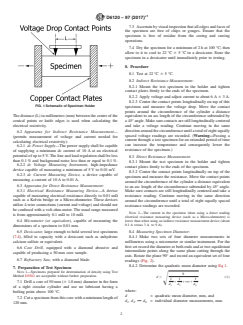
6.1 Specimen Holder (Fig. 1), a device for holding a
3.1 Definitions:
specimen of 50 mm diameter and a minimum of 120 mm in
3.1.1 electrical resistivity, n—the electrical resistance of-
length between two flat copper plates. One of the plates is
fered by a material to the flow of current, times the cross-
swivel mounted to ensure good contact in case the ends of the
sectional area of current flow and per unit length of current
specimen are not perfectly parallel. The plates shall be as large
astheendsofthespecimenandelectricallyinsulatedfromeach
other.
This test method is under the jurisdiction of ASTM Committee D02 on
6.1.1 Voltage Drop Contact Points—The contact points
Petroleum Products, Liquid Fuels, and Lubricants and is the direct responsibility of
shall be conical or knife edge in shape and securely fastened to
SubcommitteeD02.05onPropertiesofFuels,PetroleumCokeandCarbonMaterial.
Current edition approved Jan. 1, 2017. Published February 2017. Originally rigid insulating material with a minimum spacing of 50 mm
approved in 1997. Last previous edition approved in 2012 as D6120 – 97 (2012).
and a maximum spacing of 80 % of the length of the specimen.
DOI: 10.1520/D6120-97R17E01.
For referenced ASTM standards, visit the ASTM website, www.astm.org, or
contact ASTM Customer Service at service@astm.org. For Annual Book of ASTM
Standards volume information, refer to the standard’s Document Summary page on Parker, Sybil P., Ed in Chief, Dictionary of Scientific and Technical Terms,
the ASTM website. McGraw Hill Book Co., Fourth Ed., 1989, p 615.
Copyright © ASTM International, 100 Barr Harbor Drive, PO Box C700, West Conshohocken, PA 19428-2959. United States
´1
D6120 − 97 (2017)
7.3 Ascertainbyvisualinspectionthatalledgesandfacesof
the specimen are free of chips or gouges. Ensure that the
specimen is free of residue from the coring and sawing
operations.
7.4 Dry the specimen for a minimum of 2 h at 100 °C; then
allow to it to cool to 22 °C 6 5 °C in a dessicator. Store the
specimen in a dessicator until immediately prior to testing.
8. Procedure
8.1 Test at 22 °C 6 5 °C.
8.2 Indirect Resistance Measurement:
8.2.1 Mount the test specimen in the holder and tighten
contact plates firmly to the ends of the specimen.
8.2.2 Apply voltage and adjust current to about 6 A 63A.
8.2.3 Center the contact points longitudinally on top of this
FIG. 1 Schematic of Specimen Holder
specimen and measure the voltage drop. Move the contact
points around the circumference of the cylinder a distance
The distance (L) in millimetres (mm) between the center of the
equivalent to an arc length of the circumference subtended by
conical points or knife edges is used when calculating the
a45°angle.Makesurecontactsarestilllongitudinallycentered
electrical resistivity.
and take a voltage reading. Continue moving in the same
directionaroundthecircumferenceuntilatotalofeightequally
6.2 Apparatus for Indirect Resistance Measurement—
spaced voltage readings are recorded. (Warning—Passing a
(permits measurement of voltage and current needed for
current through a test specimen for an extended period of time
calculating electrical resistivity):
can increase the temperature and consequently lower the
6.2.1 dc Power Supply—The power supply shall be capable
resistance of the specimen.)
of supplying a minimum dc current of 10 A at an electrical
potential of up to 5 V.The line and load regulation shall be less
8.3 Direct Resistance Measurement:
than 0.1 % and background noise less than or equal to 0.1 %.
8.3.1 Mount the test specimen in the holder and tighten
6.2.2 dc Voltage Measuring Instrument, high-impedance
contact plates firmly to the ends of the specimen.
device capable of measuring a minimum of
...