

ASTM D7948-20
(Test Method)Standard Test Method for Measurement of Respirable Crystalline Silica in Workplace Air by Infrared Spectrometry
General Information
- Abstract
SIGNIFICANCE AND USE
5.1 Respirable crystalline silica is a hazard to the health of workers in many industries who are at risk through exposure by inhalation. Industrial hygienists and other public health professionals need to determine the effectiveness of measures taken to control workers’ exposure, and this is generally achieved by taking workplace air measurements. This standard has been published in order to make available a method for making valid exposure measurements for crystalline silica exposures in industry. It will be of benefit to: agencies concerned with health and safety at work; industrial hygienists and other public health professionals; analytical laboratories; industrial users of silica-containing products and their workers, etc.
5.2 This standard specifies a generic sampling and analytical method for measurement of the mass concentration of respirable crystalline silica in workplace air using infrared (IR) spectrometric methods. Several different types of sampling apparatus are used to collect respirable dust, according to the occupational hygiene sampling convention. This standard is designed to accommodate a variety of appropriate samplers and sampling materials that are commercially available.
SCOPE
1.1 This standard specifies a test method for collection and analysis of samples of airborne particulate matter for measurement of respirable crystalline silica by infrared (IR) spectrometry.
1.2 This test method is applicable to the analysis of crystalline silica (the polymorphs quartz, cristobalite and tridymite) over a working range of 0.025 to 0.4 mg/m3 for a 400 L air sample or 0.02 to 0.25 mg/m3 for a 1000 L air sample, depending on the analytical method.
1.3 The methodology is applicable to personal sampling of the respirable fraction of airborne particles and to static (area) sampling.
1.4 This test method describes three different procedures for sample preparation and infrared analysis of airborne crystalline silica samples, which are delineated in Annex A1 – Annex A3, respectively: (1) a potassium bromide (KBr) disc IR measurement method, (2) indirect IR analysis after redeposition onto a filter used for measurement, and (3) direct on-filter IR analysis.
1.5 The values stated in SI units are to be regarded as standard. No other units of measurement are included in this standard.
1.6 This standard does not purport to address all of the safety concerns, if any, associated with its use. It is the responsibility of the user of this standard to establish appropriate safety, health, and environmental practices and determine the applicability of regulatory limitations prior to use.
1.7 This international standard was developed in accordance with internationally recognized principles on standardization established in the Decision on Principles for the Development of International Standards, Guides and Recommendations issued by the World Trade Organization Technical Barriers to Trade (TBT) Committee.
- Status
- Published
- Publication Date
- 29-Feb-2020
- Technical Committee
- D22 - Air Quality
- Drafting Committee
- D22.04 - Workplace Air Quality
Buy Documents
ASTM D7948-20 - Standard Test Method for Measurement of Respirable Crystalline Silica in Workplace Air by Infrared Spectrometry
REDLINE ASTM D7948-20 - Standard Test Method for Measurement of Respirable Crystalline Silica in Workplace Air by Infrared Spectrometry
Overview
ASTM D7948-20 is a standardized method established by ASTM International for the measurement of respirable crystalline silica (RCS) in workplace air using infrared (IR) spectrometry. Respirable crystalline silica poses significant health risks to workers across a wide range of industries, including construction, mining, ceramics, and foundries. Accurate assessment of airborne silica is essential for occupational exposure monitoring, regulatory compliance, and the effectiveness of control measures aimed at worker protection. This standard provides a reliable and validated approach for both personal and area sampling of airborne particles, as well as clear guidance on sample preparation and analysis using IR techniques.
Key Topics
- Respirable Crystalline Silica Exposure: Outlines the health hazards associated with inhaled crystalline silica and the need for reliable air monitoring in workplaces.
- Sampling Methods: Describes both personal and static (area) samples for the collection of airborne particulate matter, ensuring exposure data is representative of actual workplace conditions.
- Sample Preparation and IR Analysis: Details three main procedures:
- Potassium bromide (KBr) disc IR measurement
- Indirect IR analysis after sample redeposition onto a filter
- Direct on-filter IR analysis
- Working Range: Defines applicable analysis limits, e.g., 0.025 to 0.4 mg/m³ for a 400 L air sample, or 0.02 to 0.25 mg/m³ for a 1000 L sample, depending on the method.
- Matrix and Mineral Interferences: Addresses common interferences in IR spectrometry, such as the presence of other minerals like kaolinite or calcite, and how to correct for them.
- Occupational Exposure Assessment: Covers best practices for conducting exposure assessments, frequency of sampling, and measurement strategies for comparison with occupational exposure limits (OELs).
- Apparatus and Equipment: Specifies requirements for sampling equipment (e.g., cyclone samplers, filters, pumps), analytical instrumentation (including spectrometers and balances), and necessary ancillary tools.
Applications
ASTM D7948-20 serves a range of practical applications, including:
- Worker Health and Safety: Used by industrial hygienists, safety managers, and regulatory bodies to monitor and control worker exposure to respirable crystalline silica.
- Analytical Laboratories: Provides reference procedures for environmental and occupational health laboratories performing crystalline silica analysis.
- Regulatory Compliance: Supports industries in meeting local, national, and international regulations concerning airborne silica exposure (such as OSHA, NIOSH, and EU directives).
- Effectiveness of Control Measures: Enables evaluation of engineering controls, ventilation systems, and personal protective equipment by providing quantitative data on exposure levels.
- Exposure Investigations: Used during workplace exposure assessments to identify high-risk areas or tasks, inform risk mitigation strategies, and ensure ongoing workplace safety.
Related Standards
ASTM D7948-20 references and aligns with several key standards for airborne particle sampling and analysis, including:
- ASTM D1356: Terminology relating to sampling and analysis of atmospheres.
- ASTM D4532: Methods for measuring respirable dust using cyclone samplers.
- ASTM D6061: Performance evaluation of respirable aerosol samplers.
- ISO 7708: Particle size fraction definitions for health-related sampling.
- ISO/IEC 17025: General quality requirements for testing and calibration laboratories.
- ISO 24095: Guidance for measurement of respirable crystalline silica in workplace air.
By integrating these standards, ASTM D7948-20 ensures consistency, traceability, and international compliance for the measurement of respirable crystalline silica in occupational settings.
Keywords: ASTM D7948-20, respirable crystalline silica, workplace air monitoring, infrared spectrometry, occupational exposure assessment, silica sampling, industrial hygiene, crystalline silica analysis, air quality standards
Relations
- Effective Date
- 01-Mar-2020
- Effective Date
- 01-Sep-2020
- Effective Date
- 15-Mar-2020
- Effective Date
- 01-Dec-2018
- Effective Date
- 15-Aug-2018
- Effective Date
- 15-Oct-2015
- Effective Date
- 01-Jul-2015
- Effective Date
- 01-Dec-2014
- Effective Date
- 01-May-2014
- Effective Date
- 15-Jan-2014
- Effective Date
- 01-Apr-2012
- Effective Date
- 15-Nov-2011
- Effective Date
- 01-Apr-2010
- Effective Date
- 01-Apr-2010
- Effective Date
- 01-Feb-2010
Buy Documents
ASTM D7948-20 - Standard Test Method for Measurement of Respirable Crystalline Silica in Workplace Air by Infrared Spectrometry
REDLINE ASTM D7948-20 - Standard Test Method for Measurement of Respirable Crystalline Silica in Workplace Air by Infrared Spectrometry
Get Certified
Connect with accredited certification bodies for this standard

CIS Institut d.o.o.
Personal Protective Equipment (PPE) certification body. Notified Body NB-2890 for EU Regulation 2016/425 PPE.

Kiwa BDA Testing
Building and construction product certification.
Kmetijski inštitut Slovenije
Agricultural Institute of Slovenia. Soil testing, plant health, agricultural product analysis.
Sponsored listings
Frequently Asked Questions
ASTM D7948-20 is a standard published by ASTM International. Its full title is "Standard Test Method for Measurement of Respirable Crystalline Silica in Workplace Air by Infrared Spectrometry". This standard covers: SIGNIFICANCE AND USE 5.1 Respirable crystalline silica is a hazard to the health of workers in many industries who are at risk through exposure by inhalation. Industrial hygienists and other public health professionals need to determine the effectiveness of measures taken to control workers’ exposure, and this is generally achieved by taking workplace air measurements. This standard has been published in order to make available a method for making valid exposure measurements for crystalline silica exposures in industry. It will be of benefit to: agencies concerned with health and safety at work; industrial hygienists and other public health professionals; analytical laboratories; industrial users of silica-containing products and their workers, etc. 5.2 This standard specifies a generic sampling and analytical method for measurement of the mass concentration of respirable crystalline silica in workplace air using infrared (IR) spectrometric methods. Several different types of sampling apparatus are used to collect respirable dust, according to the occupational hygiene sampling convention. This standard is designed to accommodate a variety of appropriate samplers and sampling materials that are commercially available. SCOPE 1.1 This standard specifies a test method for collection and analysis of samples of airborne particulate matter for measurement of respirable crystalline silica by infrared (IR) spectrometry. 1.2 This test method is applicable to the analysis of crystalline silica (the polymorphs quartz, cristobalite and tridymite) over a working range of 0.025 to 0.4 mg/m3 for a 400 L air sample or 0.02 to 0.25 mg/m3 for a 1000 L air sample, depending on the analytical method. 1.3 The methodology is applicable to personal sampling of the respirable fraction of airborne particles and to static (area) sampling. 1.4 This test method describes three different procedures for sample preparation and infrared analysis of airborne crystalline silica samples, which are delineated in Annex A1 – Annex A3, respectively: (1) a potassium bromide (KBr) disc IR measurement method, (2) indirect IR analysis after redeposition onto a filter used for measurement, and (3) direct on-filter IR analysis. 1.5 The values stated in SI units are to be regarded as standard. No other units of measurement are included in this standard. 1.6 This standard does not purport to address all of the safety concerns, if any, associated with its use. It is the responsibility of the user of this standard to establish appropriate safety, health, and environmental practices and determine the applicability of regulatory limitations prior to use. 1.7 This international standard was developed in accordance with internationally recognized principles on standardization established in the Decision on Principles for the Development of International Standards, Guides and Recommendations issued by the World Trade Organization Technical Barriers to Trade (TBT) Committee.
SIGNIFICANCE AND USE 5.1 Respirable crystalline silica is a hazard to the health of workers in many industries who are at risk through exposure by inhalation. Industrial hygienists and other public health professionals need to determine the effectiveness of measures taken to control workers’ exposure, and this is generally achieved by taking workplace air measurements. This standard has been published in order to make available a method for making valid exposure measurements for crystalline silica exposures in industry. It will be of benefit to: agencies concerned with health and safety at work; industrial hygienists and other public health professionals; analytical laboratories; industrial users of silica-containing products and their workers, etc. 5.2 This standard specifies a generic sampling and analytical method for measurement of the mass concentration of respirable crystalline silica in workplace air using infrared (IR) spectrometric methods. Several different types of sampling apparatus are used to collect respirable dust, according to the occupational hygiene sampling convention. This standard is designed to accommodate a variety of appropriate samplers and sampling materials that are commercially available. SCOPE 1.1 This standard specifies a test method for collection and analysis of samples of airborne particulate matter for measurement of respirable crystalline silica by infrared (IR) spectrometry. 1.2 This test method is applicable to the analysis of crystalline silica (the polymorphs quartz, cristobalite and tridymite) over a working range of 0.025 to 0.4 mg/m3 for a 400 L air sample or 0.02 to 0.25 mg/m3 for a 1000 L air sample, depending on the analytical method. 1.3 The methodology is applicable to personal sampling of the respirable fraction of airborne particles and to static (area) sampling. 1.4 This test method describes three different procedures for sample preparation and infrared analysis of airborne crystalline silica samples, which are delineated in Annex A1 – Annex A3, respectively: (1) a potassium bromide (KBr) disc IR measurement method, (2) indirect IR analysis after redeposition onto a filter used for measurement, and (3) direct on-filter IR analysis. 1.5 The values stated in SI units are to be regarded as standard. No other units of measurement are included in this standard. 1.6 This standard does not purport to address all of the safety concerns, if any, associated with its use. It is the responsibility of the user of this standard to establish appropriate safety, health, and environmental practices and determine the applicability of regulatory limitations prior to use. 1.7 This international standard was developed in accordance with internationally recognized principles on standardization established in the Decision on Principles for the Development of International Standards, Guides and Recommendations issued by the World Trade Organization Technical Barriers to Trade (TBT) Committee.
ASTM D7948-20 is classified under the following ICS (International Classification for Standards) categories: 13.040.30 - Workplace atmospheres. The ICS classification helps identify the subject area and facilitates finding related standards.
ASTM D7948-20 has the following relationships with other standards: It is inter standard links to ASTM D7948-14e1, ASTM D1356-20a, ASTM D1356-20, ASTM D6061-01(2018)e1, ASTM D4840-99(2018)e1, ASTM D1356-15a, ASTM D1356-15, ASTM D1356-14b, ASTM D1356-14a, ASTM D1356-14, ASTM D6061-01(2012)e1, ASTM D5337-11, ASTM D4532-10, ASTM D1356-05(2010), ASTM D4840-99(2010). Understanding these relationships helps ensure you are using the most current and applicable version of the standard.
ASTM D7948-20 is available in PDF format for immediate download after purchase. The document can be added to your cart and obtained through the secure checkout process. Digital delivery ensures instant access to the complete standard document.
Standards Content (Sample)
This international standard was developed in accordance with internationally recognized principles on standardization established in the Decision on Principles for the
Development of International Standards, Guides and Recommendations issued by the World Trade Organization Technical Barriers to Trade (TBT) Committee.
Designation: D7948 − 20
Standard Test Method for
Measurement of Respirable Crystalline Silica in Workplace
Air by Infrared Spectrometry
This standard is issued under the fixed designation D7948; the number immediately following the designation indicates the year of
original adoption or, in the case of revision, the year of last revision. A number in parentheses indicates the year of last reapproval. A
superscript epsilon (´) indicates an editorial change since the last revision or reapproval.
1. Scope 2. Referenced Documents
1.1 This standard specifies a test method for collection and
2.1 ASTM Standards:
analysis of samples of airborne particulate matter for measure-
D1356 Terminology Relating to Sampling and Analysis of
ment of respirable crystalline silica by infrared (IR) spectrom-
Atmospheres
etry.
D4532 Test Method for Respirable Dust in Workplace At-
mospheres Using Cyclone Samplers
1.2 This test method is applicable to the analysis of crystal-
D5337 Practice for Flow RateAdjustment of Personal Sam-
line silica (the polymorphs quartz, cristobalite and tridymite)
pling Pumps
over a working range of 0.025 to 0.4 mg/m for a 400 L air
D4840 Guide for Sample Chain-of-Custody Procedures
sample or 0.02 to 0.25 mg/m for a 1000 L air sample,
D6061 Practice for Evaluating the Performance of Respi-
depending on the analytical method.
rable Aerosol Samplers
1.3 The methodology is applicable to personal sampling of
E1370 Guide for Air Sampling Strategies for Worker and
the respirable fraction of airborne particles and to static (area)
Workplace Protection
sampling.
2.2 ISO Standards:
1.4 This test method describes three different procedures for
ISO 7708 Air quality — Particle size fraction definitions for
samplepreparationandinfraredanalysisofairbornecrystalline
health-related sampling
silica samples, which are delineated in AnnexA1 – AnnexA3,
ISO 3534-1 Statistics — Vocabulary and symbols — Part 1:
respectively: (1) a potassium bromide (KBr) disc IR measure-
Probability and general statistical terms in metrology
ment method, (2) indirect IR analysis after redeposition onto a
ISO 13137 Workplace air — Pumps for personal sampling
filterusedformeasurement,and(3)directon-filterIRanalysis.
of chemical and biological agents — Requirements and
test methods
1.5 The values stated in SI units are to be regarded as
ISO 15767 Workplace atmospheres – Controlling and char-
standard. No other units of measurement are included in this
acterizing errors in weighing collected aerosols
standard.
ISO/IEC 17025 General requirements for the competence of
1.6 This standard does not purport to address all of the
testing and calibration laboratories
safety concerns, if any, associated with its use. It is the
ISO 18158 Workplace air – Terminology
responsibility of the user of this standard to establish appro-
ISO 24095 Workplace air — Guidance for the measurement
priate safety, health, and environmental practices and deter-
of respirable crystalline silica
mine the applicability of regulatory limitations prior to use.
1.7 This international standard was developed in accor-
3. Terminology
dance with internationally recognized principles on standard-
3.1 Definitions:
ization established in the Decision on Principles for the
Development of International Standards, Guides and Recom-
3.1.1 For definitions of terms used in this test method, refer
mendations issued by the World Trade Organization Technical to Terminology D1356.
Barriers to Trade (TBT) Committee. 3.2 Definitions of Terms Specific to This Standard:
1 2
This test method is under the jurisdiction of ASTM Committee D22 on Air For referenced ASTM standards, visit the ASTM website, www.astm.org, or
Quality and is the direct responsibility of Subcommittee D22.04 on Workplace Air contact ASTM Customer Service at service@astm.org. For Annual Book of ASTM
Quality. Standards volume information, refer to the standard’s Document Summary page on
Current edition approved March 1, 2020. Published May 2020. Originally the ASTM website.
ɛ1 3
approved in 2014. Last previous edition approved in 2014 as D7948 – 14 . DOI: Available fromAmerican National Standards Institute (ANSI), 25 W. 43rd St.,
10.1520/D7948-20. 4th Floor, New York, NY 10036, http://www.ansi.org.
Copyright © ASTM International, 100 Barr Harbor Drive, PO Box C700, West Conshohocken, PA 19428-2959. United States
D7948 − 20
3.2.1 limit of quantification (LOQ), n—lowest reliable mass 5.2 This standard specifies a generic sampling and analyti-
ofcrystallinesilicathatisquantifiabletakingintoconsideration cal method for measurement of the mass concentration of
the matrix effects in the sample. ISO 24095 respirable crystalline silica in workplace air using infrared (IR)
spectrometric methods. Several different types of sampling
3.2.2 limit value, n—reference figure for concentration of a
apparatus are used to collect respirable dust, according to the
chemical agent in air. ISO 18158
occupational hygiene sampling convention. This standard is
3.2.3 respirable crystalline silica (RCS), n—inhaled par-
designed to accommodate a variety of appropriate samplers
ticles of crystalline silica that penetrate into the unciliated
and sampling materials that are commercially available.
airways. ISO 24095
6. Interferences
3.2.4 respirable fraction, n—mass fraction of inhaled par-
ticles penetrating to the unciliated airways. ISO 7708
6.1 The applicability and performance of the infrared tech-
3.2.5 samplinginstrument,n—deviceforcollectingairborne nique(s) used to measure respirable crystalline silica (RCS) is
particles, including the sampler, sampling pump and sampling (are) dependent on the ability to address matrix and mineral
medium such as a filter. interferences (ISO 24095). It is necessary to consider the
matrixandmineralinterferencespotentiallypresentinairborne
3.2.6 time-weighted average (TWA) concentration,
samples, and to take action to minimize these interferences in
n—concentration of a chemical agent in the atmosphere,
IR analysis of RCS. Numerous minerals that could be present
averaged over the reference period. E1370
along with crystalline silica in airborne respirable samples
3.2.7 uncertainty (of measurement), n—parameter associ-
absorb infrared radiation in the spectral region of the quartz
ated with the result of a measurement that characterizes the
-1 -1
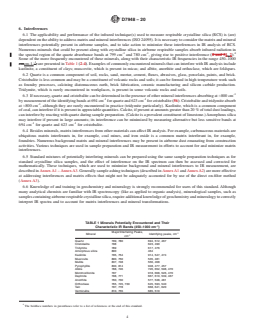
absorbance bands at 799 cm and 780 cm , giving rise to
dispersion of the values that could reasonably be attributed to
positive interference (1, 2). Some of the more frequently
the measurand. ISO 3534-1
encountered of these minerals, along with their characteristic
3.2.8 workplace, n—defined area or areas in which the work
IR frequencies in the range 450–1000 cm-1, are presented in
activities are carried out. ISO 18158
Table 1 (2-4). Examples of commonly encountered minerals
that can interfere with IR analysis include kaolinite, a constitu-
4. Summary of Test Method
ent of clays; muscovite, which is present in micas; and albite,
4.1 Airborne particles are collected by drawing a measured
anorthite and orthoclase, which are feldspars.
volume of air through a collection substratefilter mounted in a
6.2 Quartz is a common component of soil, rocks, sand,
sampler designed to collect the respirable fraction of airborne
mortar, cement, fluxes, abrasives, glass, porcelain, paints, and
particles. After sampling for a specified reference period at a
brick. Cristobalite is less common and may be a constituent of
given air sampling flow rate, the sampling substrate (normally
volcanic rocks and soils; it can be formed in high temperature
a filter) and collected sample are treated to prepare the
work such as foundry processes, calcining diatomaceous earth,
collected crystalline silica particulate matter for subsequent
brick fabrication, ceramic manufacturing and silicon carbide
measurement by infrared (IR) spectrometry. Characteristic IR
production. Tridymite, which is rarely encountered in
peaks for crystalline silica are measured and used to determine
workplaces, is present in some volcanic rocks and soils.
the mass of crystalline silica in the collected air sample. Three
6.3 Ifnecessary,quartzandcristobalitecanbedeterminedin
different procedures for sample preparation and infrared analy-
the presence of other mineral interferences absorbing at ≈800
sis of airborne crystalline silica samples are described: (1)a
-1 -1
cm by measurement of the identifying bands at 694 cm for
potassium bromide (KBr) disc IR measurement method (after
initial filter collection and subsequent sample treatment); (2)
indirect IR analysis after redeposition onto a filter used for 4
The boldface numbers in parentheses refer to a list of references at the end of
measurement; and (3) direct on-filter IR analysis. The mea-
this standard.
surement results can be compared to applicable occupational
limit values (OELs) for crystalline silica in respirable airborne
TABLE 1 Minerals Potentially Encountered and Their
-1
particulate samples. Characteristic IR Bands (450–1000 cm )
Major/Interfering Peaks,
-1
Mineral Identifying peaks, cm
-1
5. Significance and Use
cm
Quartz 799, 780 694, 512, 467
5.1 Respirable crystalline silica is a hazard to the health of
Cristobalite 798 623, 490
workersinmanyindustrieswhoareatriskthroughexposureby
Tridymite 789 617, 476
inhalation. Industrial hygienists and other public health profes- Amorphous silica 800 464
Kaolinite 795, 754 914, 547, 474
sionals need to determine the effectiveness of measures taken
Muscovite 800, 750 535, 481
to control workers’exposure, and this is generally achieved by
Mullite 837, 748 556, 468
taking workplace air measurements. This standard has been Pyrophyllite 830, 814 948, 477, 457
Albite 788, 746 726, 652, 598, 470
publishedinordertomakeavailableamethodformakingvalid
Montmorillonite 797 918, 668, 526, 470
exposure measurements for crystalline silica exposures in
Daphnite 798, 771 667, 610, 539, 467
industry.Itwillbeofbenefitto:agenciesconcernedwithhealth Anorthite 760, 730 577, 538, 481
Orthoclase 765, 745, 730 645, 593, 540
andsafetyatwork;industrialhygienistsandotherpublichealth
Talc 797, 778 668, 641, 620
professionals; analytical laboratories; industrial users of silica-
Vermiculite 810, 755 685, 510
containing products and their workers, etc.
D7948 − 20
-1
quartz and 623 cm for cristobalite (56). Cristobalite and collection efficiency of not less than 99.5 % for particles with
-1
tridymite absorb at ≈800 cm , although they are rarely a 0.3 µm diffusion diameter (ISO 7708).
encountered in practice (tridymite particularly). Kaolinite,
NOTE 3—Besides PVC, filters comprised of other materials may be
which is a common component of coal, can interfere if it is
suitable, such as mixed cellulose ester (MCE).
present in appreciable quantities. Calcite, if present at amounts
NOTE 4—Apart from filters, other types of collection substrates may be
greater than 20 % of total dust loadings, can interfere by
suitable, such as foams.
reacting with quartz during sample preparation. (Calcite is a
7.1.1.3 Filter holders, of appropriate diameter for housing
prevalent constituent of limestone.) Amorphous silica may
the filters used for sample collection, and preferably comprised
interfere if present in large amounts; its interference can be
of static-dissipative material.
minimized by measuring alternative but less sensitive bands at
7.1.1.4 Back-up pads, to support the filters within the filter
-1 -1
694 cm for quartz and 623 cm for cristobalite.
holders.
6.4 Besides minerals, matrix interferences from other mate-
7.1.1.5 Sampling head holder/connector, if required, for
rials can affect IR analysis. For example, carbonaceous mate-
connecting the cyclone to the filter holder.
rials are ubiquitous matrix interferants in, for example, coal
7.1.1.6 Sampling Pumps—Sampling pumps used shall meet
mines, and iron oxide is a common matrix interferant in, for
the requirements of ISO 13137.
example, foundries. Numerous background matrix and mineral
7.1.1.7 Flow Meter, portable, with an accuracy that is
interferences may be present in airborne dust emanating from
sufficient to enable the volumetric flow rate to be measured to
construction activities. Various techniques are used in sample
within 65 %. The flow meter calibration, by a provider
preparation and IR measurement in efforts to account for and
accredited to ISO/IEC 17025 for such calibrations, shall be
minimize matrix interferences.
traceable to national or international standards (see Practice
D5337). Retain the calibration certificate, including the pres-
6.5 Standard mixtures of potentially interfering minerals
sure and temperature at which the calibration was performed,
can be prepared using the same sample preparation techniques
and identifying and performance documentation for the flow
as for standard crystalline silica samples, and the effect of
meter.
interference on the IR spectrum can then be assessed and
correctedformathematically.Thesetechniques,whichareused
NOTE 5—It is advisable that the flow meter used is capable of
to minimize background and mineral interferences to IR
measuring the volumetric flow rate to within 62 % or better.
measurement, are described in Annex A1 – Annex A3. Gen-
7.1.2 Analytical Instrumentation:
erally sample ashing techniques (described in Annex A1 and
7.1.2.1 Details regarding specific analytical instrumentation
Annex A2) are more effective at addressing interferences and
and reagents that are required for three different IR sample
matrix effects that might not be adequately accounted for by
preparation and analysis procedures are provided in AnnexA1
use of the direct on-filter method (Annex A3).
– Annex A3 (KBr disc method, direct on-filter measurement,
6.6 Knowledge of and training in geochemistry and miner-
and indirect redeposition technique, respectively). Use only
alogy is strongly recommended for users of this standard.
reagents of analytical grade.
Although many analytical chemists are familiar with IR
7.1.2.2 Infrared spectrometer, double-beam dispersive or
spectroscopy (like as applied to organic analysis), mineralogi- -1
Fourier transform device, with 4 cm resolution or better.
cal samples, such as samples containing airborne respirable
7.1.2.3 Analytical balance, capable of weighing to the
crystalline silica, require additional knowledge of geochemis-
nearest 0.001 mg.
try and mineralogy to correctly interpret IR spectra and to
7.1.3 Ancillary Equipment:
account for matrix interferences and mineral transformations.
7.1.3.1 Flexible tubing, of a diameter suitable for making a
leak-proof connection from the samplers to the sampling
7. Apparatus
pumps.
7.1 Sampling and Analytical Equipment:
7.1.3.2 Belts or harnesses, to which the sampling pumps
7.1.1 Sampling Equipment:
can conveniently be fixed for personal sampling (except where
the sampling pumps are small enough to fit in workers’
7.1.1.1 Respirable samplers, designed to collect the respi-
rable fraction of airborne particles, for use when the limit pockets).
values for crystalline silica apply to the respirable fraction of 7.1.3.3 Flat-tipped forceps, for loading and unloading filters
airborne particles (Practice D6061). Cyclone-type samplers are
into samplers.
typically used for personal sampling, although impaction
7.1.3.4 Filter transport cassettes or similar, if required, in
devices are also used (7, 8).
which to transport samples to the laboratory
7.1.3.5 Thermometer, 0°C to 50°C minimum range, with
NOTE 1—Cyclone devices typically use sample collection on filters,
resolution of 1°C or less, for measurement of atmospheric
although impaction devices may use filters or foams for sample capture.
temperature, if required.
NOTE 2—As an alternative to cyclones, cascade impactors are often
used to characterize the particle size distribution in static (area) sampling.
7.1.3.6 Barometer,suitableformeasurementofatmospheric
pressure, if required.
7.1.1.2 Filters, normally composed of polyvinyl chloride
7.1.3.7 Laboratory oven, for drying (to 110°C).
(PVC). The filters shall be of a diameter suitable for use with
the samplers (typically 37-mm diameter) and shall have a 7.1.3.8 Desiccator, for dry storage.
D7948 − 20
7.1.3.9 Laboratory glassware, borosilicate—beakers, 8.2.4 Temperature and Pressure Effects—Refertothemanu-
bottles, and flasks (etc.) of appropriate volumes and sizes; with facturer’s instructions to determine if the indicated volumetric
stoppers to fit. flow rate of the flow meter is dependent upon temperature and
7.1.3.10 Wash bottles, plastic (for example, polyethylene). pressure. Consider whether the difference between the atmo-
7.1.3.11 Pipets, borosilicate or plastic; various sizes as spheric temperature and pressure at the time of calibration of
required. theflowmeterandduringsamplingislikelytobegreatenough
7.1.3.12 Magnetic stirring device, and stir bars. to justify making a correction to take this into account, for
7.1.3.13 Tweezers. example, if the error could be greater than 65%.Ifa
7.1.4 Crystalline silica certified reference materials correction is necessary, measure and record the atmospheric
(CRMs)—Quartz; cristobalite (plus others as applicable). temperature and pressure at which the calibration of the flow
meter was checked and measure and record the atmospheric
NOTE 6—Examples include quartz and cristobalite NIST SRMs 1878a,
temperature and pressure at the start and at the end of the
1879a, 2950, 2951, 2958, 2960 and 2957.
sampling period.
8. Sampling Procedure
NOTE 8—An example of temperature and pressure correction for the
indicated volumetric flow rate is given in Appendix X1 for a constant
8.1 Sampling of respirable crystalline silica should be car-
pressure drop, variable area flow meter.
ried out in accordance with Test Method D4532.
NOTE 9—If too great a correction is required, this could affect the
8.2 Preliminary Considerations:
sampler enough to perturb the sampled cut point and penetration curve
away from the “ideal” respirable fraction definition.
8.2.1 Selection and Use of Samplers—Select samplers de-
signed to collect the respirable fraction of airborne particles, as
8.2.5 Handling of Sample Collection Media—To minimize
defined in ISO 7708. If possible, the samplers selected should
the risk of damage or contamination, only handle filters (or
be manufactured from static-dissipative material, since sam-
foams) using flat-tipped forceps, in a clean area, where the
plers manufactured in non-conducting material have electro-
concentration of airborne particles is as low as possible.
static properties that can influence representative sampling.
8.3 Preparation for Sampling:
Use the samplers at their design flow rate, and in accordance
8.3.1 Cleaning of Samplers—Unless disposable samplers
withtheinstructionsprovidedbythemanufacturer,sothatthey
are used, clean the samplers before use. Disassemble the
collect the respirable fraction of airborne particles (Test
samplers, soak in detergent solution, rinse thoroughly with
Method D4532).
water,wipewithabsorptivetissueandallowtothemdrybefore
NOTE 7—Limit values for crystalline silica typically apply to the
reassembly.Alternatively, use a laboratory washing machine to
respirable fraction of airborne particles.
clean the samplers.
8.2.2 Sampling Period—Select a sampling period that is
8.3.2 Loading the Samplers with Filters—Load clean sam-
appropriate for the measurement task, but ensure that it is long
plers with filters (pre-weighed to the nearest 0.01 mg, if
enough to enable crystalline silica to be measured with
desired, for gravimetric analysis of sampled dust). Label each
acceptable uncertainty at levels of industrial hygiene signifi-
sampler so that it can be uniquely identified, and seal with its
cance. For example, consider the applicable limit value, and
protective cover or plug to prevent contamination.
estimate the minimum sampling time required to ensure that
NOTE 10—Alternatively, commercially available pre-loaded filter cas-
the amount collected is above the lower limit of the working
settes may be used.
rangeoftheanalyticalmethodwhencrystallinesilicaispresent
NOTE 11—Samplers containing foam substrate may also be used.
in the test atmosphere at an appropriate multiple of its limit
8.3.3 Attaching the Cyclone to the Sample Substrate
value (for example 0.1 times for an 8 h time-weighted average
Holder—Connect the cyclone to the sample substrate holder so
limit value), using the following equation:
that the sampling head holder keeps the holder, cyclone, and
m
min coupling device together rigidly. Ensure that sampled air will
t 5 (1)
min
q 30.1 3LV
v enter only at the cyclone inlet.
where:
NOTE 12—For impaction devices, this step would not necessarily apply.
t = the minimum sampling time, in minutes,
min
8.3.4 Setting the Volumetric Flow Rate—Perform the fol-
m = the lower limit of the analytical range, in
min
lowing in a clean area, where the concentration of airborne
micrograms, for crystalline silica,
particles is low.
q = the design flow rate of the sampler, in litres per
v
8.3.4.1 Connect each loaded respirable sampling apparatus
minute, and
to a sampling pump using flexible tubing, ensuring that no
LV = the limit value, in milligrams per cubic metre, for
leaks can occur.
crystalline silica.
8.3.4.2 Remove the protective cover or plug from each
8.2.3 When high concentrations of airborne particles are
sampler,switchonthesamplingpump,attachtheflowmeterto
anticipated, select a sampling period that is not so long as to
the sampler so that it measures the flow through the sampler
risk overloading the filter with particulate matter.
inlet orifice(s), and set the required volumetric flow rate to
sample the respirable fraction of the aerosol.
Available from National Institute of Standards and Technology (NIST), 100 NOTE13—Typicalsamplingflowratesare≈2L/minfor“lowflowrate”
Bureau Dr., Stop 1070, Gaithersburg, MD 20899-1070, http://www.nist.gov. personal samplers,≈4 L/min for “higher flow rate” personal samplers, and
D7948 − 20
≈10 L/min for “high flow rate” personal sampling apparatus (9).
8.5.3 Check the malfunction indicator or the reading on the
NOTE 14—If necessary, allow the sampling pump operating conditions
integral timer, if fitted, or both, and consider the sample to be
to stabilize before setting the flow rate.
invalid if there is evidence that the sampling pump was not
8.3.4.3 Switch off the sampling pump and seal the sampler operating properly throughout the sampling period (since last
checked). Measure the volumetric flow rate at the end of the
with its protective cover or plug to prevent contamination
during transport to the sampling position. sampling period using the flow meter, and record the measured
value.Ifappropriate,measuretheatmospherictemperatureand
8.3.4.4 Blanks—Retain as blanks at least one unused loaded
pressure at the end of the sampling period using the thermom-
sampler from each batch of twenty prepared, subject to a
eter and barometer, and record the measured values.
minimum of three. Treat these in the same manner as those
8.5.4 Carefully record the sample identity and all relevant
used for sampling with respect to storage and transport to and
sampling data. Calculate the mean volumetric flow rate by
from the sampling position, but draw no air through the filters.
averaging the volumetric flow rates at the start and at the end
8.4 Sampling Position:
of the sampling period and, if appropriate, calculate the mean
8.4.1 Personal Sampling—The sampler shall be positioned
atmospheric temperature and pressure. Calculate the volume of
in the worker’s breathing zone, as close to the mouth and nose
air sampled, in litres, at atmospheric temperature and pressure,
as is reasonably practicable, for example, fastened to the
by multiplying the mean flow rate in litres per minute by the
worker’s lapel. Attach the sampling pump to the worker in a
duration of the sampling period in minutes.
manner that causes minimum inconvenience, for example, to a
8.6 Sample Transportation:
belt around the waist. Give consideration to whether the nature
8.6.1 For samplers that collect airborne particles on a filter,
of the process is likely to result in a significant difference
remove the filter from each sampler, place in a labelled filter
between the actual exposure of the worker and the concentra-
transport cassette and close with a lid. Take particular care to
tion of airborne particles measured by a sampler mounted on
prevent the collected sample from becoming dislodged from
the lapel. If this is the case, make special arrangements to
heavily loaded filters. Alternatively, transport samples to the
mountthesamplerascloseaspossibletotheworker’snoseand
laboratory in the filter holders in which they were collected.
mouth.When a cyclone is used it needs to remain in an upright
8.6.2 For samplers that have an internal filter cassette,
position during the duration of sampling.
remove the filter cassette from each sampler and fasten with its
8.4.2 Static (Area) Sampling—If static (area) sampling is
lid or transport clip.
carried out to assess the exposure of a worker in a situation
8.6.3 For samplers of the disposable cassette type, transport
where personal sampling is not possible, the sampling position
samples (collected on filters or by using inserts) to the
shall be in the immediate vicinity of the worker and at
laboratory in the samplers in which they were collected.
breathing height. If in doubt as to where to place the sampler,
8.6.4 Transport the samples to the laboratory in a container
the sampling position chosen should be the location where the
which has been designed to prevent damage to the samples in
risk of exposure is considered to be greatest. If static (area)
transit and which has been labelled to assure proper handling.
sampling is carried out to characterize the background level of
8.6.5 Ensure that the documentation which accompanies the
crystalline silica in the workplace, select a sampling position
samples is suitable for a “chain of custody” to be established
that is sufficiently remote from the work processes, such that
(see, for example, Guide D4840).
results will not be directly affected by airborne particles from
emission sources.
9. Analysis
8.5 Collection of Samples:
9.1 To measure crystalline silica in the collected samples,
8.5.1 When ready to begin sampling, remove the protective
choose one or more of the procedures described in Annex A1
cover or plug from the sampler inlet (if applicable) and switch
– AnnexA3 (KBr disc (pellet) technique, indirect redeposition
on the sampling pump. Record the time and volumetric flow
method, or direct on-filter measurement, respectively). Carry
rate at the start of the sampling period. If the sampling pump is
out analysis in accordance with the selected technique(s),
fitted with an integral timer, check that this is reset to zero. If
taking into consideration the suspected interferences that may
appropriate,measuretheatmospherictemperatureandpressure
be present in the samples obtained from the occupational
at the start of the sampling period using the thermometer and setting(s) of interest.
barometer, and record the measured values.
NOTE 16—The infrared signal due to crystalline silica is particle-size
dependent, with smaller particles giving greater signal relative to larger
NOTE 15—If the temperature or pressure at the sampling position is
particles (10, 11). Correction techniques can be applied during analysis in
different from that where the volumetric flow rate was set, the volumetric
efforts to address the particle size dependence of the IR response (11).
flow rate could change and it might need to be re-adjusted before
sampling.
9.2 For further guidance on the applicability of the various
IR techniques, refer to Annex A1 – Annex A3.
8.5.2 At the end of the sampling period, record the time and
calculate the duration of the sampling period. Remove the
10. Precision and Bias
sampler from the workers’lapel, being careful not to invert the
cyclone, so as to avoid dust from the grit pot depositing on the 10.1 KBr Disc (Pellet) Method:
filter. The cyclone needs to remain in an upright position after 10.1.1 A summary of KBr disc (pellet) method parameters
sampling until the filter assembly is removed and capped/ evaluated by various organizations in four countries is pre-
plugged. sented in Table 2. In most cases, filter collection with low-flow
D7948 − 20
TABLE 2 KBr Disc (Pellet) Methods Evaluated
Spain INSHT MTA/MA- France AFNOR
Method US NIOSH 7602 (12) UK MDHS 38 (13) Spain INS IT05 (15)
057/A04 (14) X43–243 (16)
Sampler 10-mm nylon 1.7 L/min; Higgins-Dewell 1.9 10-mm nylon 1.7 L/min Casella 1.9 L/min CIP 10-R 10 L/min
Higgins-Dewell 2.1 L/min
L/min
Sampling medium Filter, 37-mm 0.8-µm Filter, 37-mm 0.8-µm Filter, 37-mm 0.8-µm Filter, 37-mm 5-µm PVC Foam, polyurethane
MCE or 5-µm PVC MCE or 5-µm PVC PVC
Air volume 400–1000 L; total dust $456 L; total dust#0.7 300–500 L; total dust <5 300–500 L; total dust <5 Total dust '0.5 mg
<2 mg mg mg mg
Sample preparation RF Plasma or Muffle Muffle furnace Muffle furnace Muffle furnace Calcination filter or foam
furnace
Calibration Quartz in KBr Generated quartz on Quartz in KBr Quartz in KBr
PVC; then KBr
Range (µg quartz) 10–160 5–700 10–160 3–900
A
Estimated MDL (µg 5 Varies with particle size 5 1
quartz)
B B B B
Precision CV =15%at30µg CV =5%at50µg CV <15%at30µg CV <15%at30µg
A
Method detection limit.
B
Coefficient of variation.
(≈2 L/min) respirable samplers was carried out, with sampling 10.2.1 A summary of redeposition IR method parameters
volumes ranging from 300 to 1 000 L. After sample ashing evaluated by four organizations in three countries is presented
with a plasma asher or muffle furnace, the remaining material in Table 3.After sample collection onto filters (or foams) using
was homogenized with potassium bromide and pressed into a low-flow respirable samplers, samples were usually subjected
KBr pellet (Annex A1). IR spectrophotometric measurements to ashing in a plasma asher or in a muffle furnace to remove
were then performed on the as-prepared KBr discs. By com-
potential interferences; one laboratory employed a calcination
paring sample IR responses to the signals from similarly- protocol.After sample preparation, all laboratories redeposited
prepared quartz standards (with interference correction), the
the remaining particulate matter onto 0.45-µm acrylic copoly-
contents of respirable quartz were measured. Applicable ana-
mer filters prior to subsequent IR analysis (Annex A2). IR
lytical ranges were from 3 to 900 µg quartz per sample, with
spectrophotometric measurements were then performed on the
estimated method detection limits (MDLs) of 5 µg or less.
as-prepared filters. By comparing sample IR responses at (800
-1
Reported precision estimates, in terms of coefficients of varia-
and 780 cm ) to the IR signals from similarly-prepared quartz
tion (CVs), were 15% or less at quartz masses of 30 µg per
standards (with interference correction), the contents of respi-
sample.
rable quartz were measured. For laboratories that employed
10.1.2 In at least one published method (16), a correction
filter-based sampling, applicable analytical ranges were from
technique has been applied in an effort to minimize the bias
20 to 400 µg quartz per sample, with estimated method
inducedbytheparticlesizedependenceoftheIRresponse.The
detection limits (MDLs) of 10 µg or less. Reported precision
KBr disc method has been used to measure silica in samples of
estimates for these sampling and laboratory methods, in terms
respirable dusts collected from various airborne environments,
of coefficients of variation (CVs), were 10 % or less at quartz
for example coal mines (17), construction sites (18), granite
masses of 50–500 µg per sample.
quarries (19), and gold mines (20). Laboratories using the KBr
10.2.2 The redeposition IR method has been used exten-
disc method have performed successfully in inter-laboratory
sively to measure respirable quartz in samples of coal mine
proficiency analytical testing programs (21, 22).
dust (26-29); generally quartz is the only polymorph of
10.2 Redeposition Method (Indirect IR Filter Measure- crystalline silica that is found in coal. The filter redeposition
ment): technique has also been applied to the determination of
TABLE 3 Redeposition Methods Evaluated
Method US NIOSH 7603 (23) US MSHA P-7 (24) Canada RSST 78 (25) France AFNOR X43–243 (16)
Sampler 10-mm nylon 1.7 L/min; 10-mm nylon 1.7 L/min (+ 10-mm nylon 1.7 L/min 10-mm nylon ('2 L/min)
Higgins-Dewell 2.1 L/min correction factor)
Sampling medium Filter, 37-mm 0.8-µm MCE or Filter, 37-mm pre-weighted Filter, 37-mm 5-µm PVC Foam, polyurethane
5-µm PVC 0.8-µm MCE or 5-µm PVC
Air volume 300–1000 L; total dust <2 mg 800 L Total dust <0.5 mg
Filter preparation RF Plasma or Muffle furnace RF Plasma RF Plasma Calcination filter or foam
Calibration Liquid deposit in 2-PrOH on Liquid deposit in 2-PrOH on Liquid deposit in 2-PrOH on
0.45-µm acrylic copolymer 0.45-µm vinyl/acrylic 0.45-µm acrylic copolymer
filter copolymer filter filter
Range (µg quartz) 30–250 25–250 20–400
A
Estimated MDL (µg quartz) 10 3 6
B B B
Precision CV = 9.8 % at 100–500 µg CV = 5–10 % at 100–500 µg CV < 10 % at 100–500 µg
A
Method detection limit.
B
Coefficient of variation.
D7948 − 20
airbornerespirablequartzinafoundry (30).Laboratoriesusing materials (4, 36), etc. Bias due to re-radiation effects observed
the redeposition method have performed successfully in an in heavily loaded samples when using older dispersive IR
inter-laboratory proficiency analytical testing program (22). devices can be corrected for (38); alternatively, the use of an
The redeposition IR technique has been shown to be effective FTIR instrument, which is not so affected, is recommended
for quartz measurement using high-flow as well as low-flow (34). Laboratories using the direct on-filter IR method have
respirable samplers (31). performed successfully in an inter-laboratory proficiency ana-
10.2.3 The sensitivity of infrared analysis is limited by the lytical testing program (22).
effects of other sampled components. The limit of detection of
crystalline silica is approximately1%ofthe sampled mass,
11. Records
whatever the mass. This has implications for the conclusions
11.1 Sampling Information:
that can be drawn from the procedure with respect to compli-
11.1.1 At a minimum, the following information on the
ance with OELs. For example, if an OEL is 0.025 mg/m , and
sampling protocol shall be recorded:
the concentration of other particulates is greater than 2.5
11.1.1.1 A statement to indicate the confidentiality of the
mg/m , it will not be possible to assume compliance with the
information supplied, if appropriate;
OEL no matter how much sample is collected, because
11.1.1.2 Acomplete identification of the air sample, includ-
crystalline silica cannot be detected at that proportion.
ing the date of sampling, the place of sampling, the type of
Therefore,itmaybevaluabletopre-andpost-weighthefilterto
sample (personal or static), either the identity of the individual
determine the respirable dust level, in order to properly
whose breathing zone was sampled (or other personal identi-
constrain the limitations of assessment in the case of a
fier) or the location at which the general occupational environ-
“non-detect” result.
ment was sampled (for a static sample), a brief description of
NOTE 17—This limitation applies equally to analysis of crystalline
the work activities that were carried out during the sampling
silica by X-ray diffraction.
period, and a unique sample identification code;
10.3 Direct On-Filter Method:
11.1.1.3 The make, type, and diameter of filter (or other
10.3.1 An overall summary of the evaluation of the direct
sampling media) used;
on-filterIRmeasurementofrespirablecrystallinesilica(Annex
11.1.1.4 The make and type of sampler used, including
A3) is presented in Table 4. After sampling onto PVC filters
information about the target size fraction of airborne particles
(normally) using low-flow rate cyclones, direct on-filter mea-
that the sampler is designed to collect;
surementsofcrystallinesilicainthefilterdepositswerecarried
11.1.1.5 The make and type of sampling pump used, and its
out over a range of sample loadings. Calibration was per-
identification;
formed using filters prepared with generated atmospheres of
11.1.1.6 The make and type of flow meter used, the primary
quartzinanaerosolchamber.Softwaretechniqueswereusedto
standard against which the calibration of the flow meter was
subtractinterferingbandsfromtheIRspectrumofthesamples.
checked, the range of flow rates over which the calibration of
While reported method detection limits (MDLs) of ≈3µgper
the flow meter was checked, and the atmospheric temperature
sample compare favorably with MDLs of indirect IR methods
and pressure at which the calibration of the flow meter was
(see 10.1 and 10.2), it is noted that matrix and mineral
checked, if appropriate;
interferences can be substantial, especially with highly-loaded
11.1.1.7 The time at the start and at the end of the sampling
samplesofvariableparticlesize (32).Reportedprecisionasthe
period, and the duration of the sampling period in minutes;
coefficient of variation (CV) is5%or less for respirable quartz
11.1.1.8 The mean flow rate during the sampling period, in
masses of 50–200 µg per sample.
litres per minute;
10.3.2 The direct on-filter technique has been used to
11.1.1.9 The mean atmospheric temperature and pressure
measure quartz in samples from a variety of worksites and
during the sampling period, if appropriate;
activitiesincludingfoundries (4, 35),mining (36-32),construc-
11.1.1.10 The volume of air sampled, in litres, at ambient
tion (36), ceramics operations (4, 35), fabrication of building
conditions; and
11.1.1.11 The name of the person who collected the sample.
TABLE 4 Direct On-Filter Methods Evaluated
11.2 Analytical Information:
Method UK MDHS 37 (33) UK MDHS 101 (34)
11.2.1 At a minimum, the following information about the
Sampler Higgins Dewell 2.2 Higgins Dewell 2.2
analytical method shall be recorded:
L/min L/min
11.2.1.1 The unique sample identification code(s);
Sampling filter 37-mm, 0.8 µm MCE or 37-mm 5-µm PVC
5-µm PVC
11.2.1.2 Thetype(s)offilter/samplingmediumpreparedand
Air volume $456 L; total dust <1 500 L
analyzed;
mg
Calibration Generated quartz dust Generated quartz dust 11.2.1.3 The type of sample preparation method used (ash-
on PVC filter on PVC filter
ing technique, if applicable);
Range (µg quartz) 10–1000 10–1000
A
11.2.1.4 The IR method used for analysis (KBr disc
Estimated MDL Varies with particle size 3 µg
B B
Precision CV =5%at50µg CV <5%at 50–200
technique, redeposition method, or direct on-filter technique);
µg
11.2.1.5 The IR instrument used (make/model, dispersive or
A
Method detection limit.
FTIR device);
B
Coefficient of variation.
11.2.1.6 Quality control protocols that were followed; and
D7948 − 20
11.2.1.7 Analyticalresultsforrespirablecrystallinesilica,in 12.1.11 The volume of air sampled, in litres, at ambient
desired (for example, mg/m or % by weight). conditions;
12.1.12 The name of the person who collected the sample;
12. Report
12.1.13 The time-weighted average mass concentration of
12.1 The test report shall contain the following information:
RCS found in the air sample (in mg/m ), at ambient tempera-
12.1.1 A statement to indicate the confidentiality of the
ture and pressure, or, if appropriate, adjusted to reference
information supplied, if appropriate;
conditions;
12.1.2 Acompleteidentificationoftheairsample,including
12.1.14 The analytical variables used to calculate the result,
the date of sampling, the place of sampling, the type of sample
including the concentrations of RCS in the sample and blank
(personal or static (area)), either the identity of the individual
solutions, the volumes of the sample and blank solutions, and
whose breathing zone was sampled (or other personal identi-
the dilution factor, if applicable;
fier) or the location at which the general occupational environ-
NOTE 18—If necessary data (for example, the volume of air sampled)
ment was sampled (for a static (area) sample), a brief descrip-
are not available to the laboratory for the above calculations to be carried
tion of the work activities that were carried out during the
out, the laboratory report may contain the analytical result in micrograms
sampling period, and a unique sample identification code;
of RCS per filter sample.
12.1.3 A reference to this test method;
12.1.15 The type(s) of instrument(s) used for sample prepa-
12.1.4 The make, type and diameter of collection substrate
ration and analysis, and unique identifier(s);
used;
12.1.5 The make and type of sampler used;
12.1.16 The estimated detection limit under the working
12.1.6 The make and type of sampling pump used, and its analytical conditions;
identification;
12.1.17 Any operation not specified in this standard, or
12.1.7 The make and type of flowmeter used, the primary
regarded as optional;
standard against which the calibration of the flowmeter was
12.1.18 The name of the analyst(s) (or other unique identi-
checked, the range of flow rates over which the calibration of
fier(s));
the flowmeter was checked, and the atmospheric temperature
12.1.19 The date of the analysis; and
and pressure at which the calibration of the flowmeter was
12.1.20 Any inadvertent deviations, unusual occurrences, or
checked, if appropriate;
other notable observations.
12.1.8 The time at the start and at the end of the sampling
period, and the duration of the sampling period in minutes;
13. Keywords
12.1.9 The mean flow rate during the sampling period, in
litres per minute; 13.1 air monitoring; infrared; quartz; respirable crystalline
12.1.10 The mean atmospheric temperature and pressure silica; samplers; sampling and analysis; workplace atmo-
during the sampling period, if appropriate; spheres
ANNEXES
(Mandatory Information)
A1. MEASUREMENT OF CRYSTALLINE SILICA BY IR SPECTROMETRY – KBr DISC (PELLET) METHOD
A1.1 Scope A1.1.3 The method is suitable for the measurement of
crystalline silica over the range5gto700g (0.025 to 0.4
A1.1.1 Annex A1 specifies a method for the measurement
mg/m ) for a 400-L air sample.
of crystalline silica in samples of respirable airborne dust,
whereby the collected particulate matter is removed from the
A1.2 Principle
filter and introduced into a potassium bromide (KBr) matrix.
A1.2.1 Samples of particulate matter collected onto filters
The KBr matrix containing the collected particles is then
using respirable sampling devices are removed from the filters
pressed into a disc (pellet) under high pressure. Crystalline
and ashed to remove interferences such as iron oxide and
silica within the KBr disc is then measured using IR spectrom-
carbonaceous materials. This ashed material is then introduced
etry.
into a KBr matrix and pressed into a disc using a high-pressure
NOTE A1.1—This procedure is also applicable to samples collected on
press. Each KBr disc is then placed into the sample beam of an
foams.
infrared spectrometer, and the IR absorbance is measured at
characteristic frequencies for crystalline silica. The measured
A1.1.2 Interferences from amorphous silica, kaolinite and
other silicates are minimized to the extent possible in the magnitude of each absorbance is compared with measurements
at the same wavenumbers on certified reference material
sample preparation and analysis procedure. A technique for
removing calcite interference is also described. (CRM) crystalline silica samples of similar particle size.
D7948 − 20
NOTE A1.2—The procedure described is also amenable to samples
loading), wash the filters with 9 % HCl and proceed to
collected using foams.
A1.4.2.2.1. Otherwise skip and proceed to A1.4.2.2.2.
A1.4.2.2.1 Place a 37-mm diameter, 5-µm pore size polyvi-
A1.3 Analytical Reagents and Equipment
nyl chloride (PVC) filter in the membrane filtration apparatus.
A1.3.1 Reagents and Materials:
Removethesamplefilterfromthesamplerandplaceitatopthe
A1.3.1.1 Potassium bromide (KBr), infrared quality.
PVC filtration filter. Clamp the filtration funnel so as to
A1.3.1.2 Hydrochloric acid (HCl), 9 % w/w. Add 25 mL
completely expose the dust deposit on the sample
...
This document is not an ASTM standard and is intended only to provide the user of an ASTM standard an indication of what changes have been made to the previous version. Because
it may not be technically possible to adequately depict all changes accurately, ASTM recommends that users consult prior editions as appropriate. In all cases only the current version
of the standard as published by ASTM is to be considered the official document.
´1
Designation: D7948 − 14 D7948 − 20
Standard Test Method for
Measurement of Respirable Crystalline Silica in Workplace
Air by Infrared Spectrometry
This standard is issued under the fixed designation D7948; the number immediately following the designation indicates the year of
original adoption or, in the case of revision, the year of last revision. A number in parentheses indicates the year of last reapproval. A
superscript epsilon (´) indicates an editorial change since the last revision or reapproval.
ε NOTE—Editorial corrections made throughout in July 2016.
1. Scope
1.1 This standard specifies a test method for collection and analysis of samples of airborne particulate matter for measurement
of respirable crystalline silica by infrared (IR) spectrometry.
1.2 This test method is applicable to the analysis of crystalline silica (the polymorphs quartz, cristobalite and tridymite) over
3 3
a working range of 0.025 to 0.4 mg/m for a 400 L air sample or 0.02 to 0.25 mg/m for a 1000 L air sample, depending on the
analytical method.
1.3 The methodology is applicable to personal sampling of the respirable fraction of airborne particles and to static (area)
sampling.
1.4 This test method describes three different procedures for sample preparation and infrared analysis of airborne crystalline
silica samples, which are delineated in Annex A1 – Annex A3, respectively: (1) a potassium bromide (KBr) disc IR measurement
method, (2) indirect IR analysis after redeposition onto a filter used for measurement, and (3) direct on-filter IR analysis.
1.5 The values stated in SI units are to be regarded as standard. No other units of measurement are included in this standard.
1.6 This standard does not purport to address all of the safety concerns, if any, associated with its use. It is the responsibility
of the user of this standard to establish appropriate safety safety, health, and healthenvironmental practices and determine the
applicability of regulatory limitations prior to use.
1.7 This international standard was developed in accordance with internationally recognized principles on standardization
established in the Decision on Principles for the Development of International Standards, Guides and Recommendations issued
by the World Trade Organization Technical Barriers to Trade (TBT) Committee.
2. Referenced Documents
2.1 ASTM Standards:
D1356 Terminology Relating to Sampling and Analysis of Atmospheres
D4532 Test Method for Respirable Dust in Workplace Atmospheres Using Cyclone Samplers
D5337 Practice for Flow Rate Adjustment of Personal Sampling Pumps
D4840 Guide for Sample Chain-of-Custody Procedures
D6061 Practice for Evaluating the Performance of Respirable Aerosol Samplers
E1370 Guide for Air Sampling Strategies for Worker and Workplace Protection
2.2 ISO Standards:
ISO 7708 Air quality — Particle size fraction definitions for health-related sampling
ISO 3534-1 Statistics — Vocabulary and symbols — Part 1: Probability and general statistical terms in metrology
ISO 6879 Air quality — Performance characteristics and related concepts for air quality measuring methods
ISO 13137 Workplace air — Pumps for personal sampling of chemical and biological agents — Requirements and test methods
ISO 15202-1 Workplace air — Determination of metals and metalloids in airborne particulate matter by inductively coupled
plasma atomic emission spectrometry — Part 1: Sampling
This test method is under the jurisdiction of ASTM Committee D22 on Air Quality and is the direct responsibility of Subcommittee D22.04 on Workplace Air Quality.
Current edition approved Oct. 15, 2014March 1, 2020. Published February 2015May 2020. Originally approved in 2014. Last previous edition approved in 2014 as D7948
ɛ1
– 14 . DOI: 10.1520/D7948-14E01.10.1520/D7948-20.
For referenced ASTM standards, visit the ASTM website, www.astm.org, or contact ASTM Customer Service at service@astm.org. For Annual Book of ASTM Standards
volume information, refer to the standard’sstandard’s Document Summary page on the ASTM website.
Available from American National Standards Institute (ANSI), 25 W. 43rd St., 4th Floor, New York, NY 10036, http://www.ansi.org.
Copyright © ASTM International, 100 Barr Harbor Drive, PO Box C700, West Conshohocken, PA 19428-2959. United States
D7948 − 20
ISO 15767 Workplace atmospheres – Controlling and characterizing errors in weighing collected aerosols
ISO/IEC 17025 General requirements for the competence of testing and calibration laboratories
ISO 18158 Workplace air – Terminology
ISO 24095 Workplace air — Guidance for the measurement of respirable crystalline silica
3. Terminology
3.1 Definitions:
3.1.1 For definitions of terms used in this test method, refer to Terminology D1356.
3.2 Definitions of General Terms Specific to This Standard:
3.2.1 respirable crystalline silica (RCS), n—inhaled particles of crystalline silica that penetrate into the unciliated airways. ISO
3.2.2 chemical agent, n—any chemical element or compound, on its own or admixed as it occurs in the natural state or as
produced by any work activity, whether or not produced intentionally and whether or not commercially available.
3.2.3 breathing zone, n—(general definition) space around the worker’s face from where he or she takes his or her breath. EN
1540 (1)
(technical definition) hemisphere (generally accepted to be 0.3 m in radius) extending in front of the human face, centred on the
midpoint of a line joining the ears; the base of the hemisphere is a plane through this line, the top of the head and the larynx. ISO
15202-1
3.2.4 exposure (by inhalation), n—situation in which a chemical agent is present in air which is inhaled by a person. EN 1540
(1)
3.2.5 limit value, n—reference figure for concentration of a chemical agent in air. EN 1540 (1)
3.2.6 measurement procedure, n—set of operations, described specifically, for the sampling and analysis of chemical agents in
air. EN 1540 (1)
3.2.6.1 Discussion—
A measurement procedure usually includes preparation for sampling, sampling, transportation and storage, preparation of samples
for analysis and analysis.
3.2.7 reference period, n—specified period of time for which the (occupational exposure) limit value of a chemical agent
applies. EN 1540 (1)
3.2.8 time-weighted average (TWA) concentration, n—concentration of a chemical agent in the atmosphere, averaged over the
reference period. E1370; ISO 15202-1
3.2.9 workplace, n—defined area or areas in which the work activities are carried out. EN 1540 (1)
3.3 Definitions of Particle Size Fraction Terms Specific to This Standard:
3.3.1 respirable convention, n—target specification for sampling instruments when the respirable fraction is of interest. ISO
3.3.2 respirable fraction, n— mass fraction of inhaled particles penetrating to the unciliated airways. ISO 7708
3.4 Definitions of Sampling Terms Specific to This Standard:
3.4.1 operating time, n—period during which a sampling pump can be operated at specified flow rate and back pressure without
recharging or replacing the battery. ISO 13137
3.4.2 personal sampler, n—sampling device, attached to a person, which collects airborne particles in the breathing zone.
3.4.3 personal sampling, n—process of sample collection carried out using a personal sampler.
3.4.4 (air) sampler, n—device for collecting chemical agents from the surrounding air.
3.4.4.1 Discussion—
Air samplers are generally designed for a particular purpose, for example, for sampling airborne particles.
3.4.5 sampling instrument, n—device for collecting airborne particles, including the sampler, sampling pump and sampling
medium such as a filter.
3.4.6 sampling train, n—apparatus for collecting airborne particles including sampling pump, connecting tubing, respirable size
selector, and collection medium (for example, a filter).
3.4.7 static (area) sampler, n—sampler, not attached to a person, which collects airborne particles at a particular location. EN
1540 (1)
D7948 − 20
3.4.8 static (area) sampling, n—process of (air) sampling carried out using a static sampler. EN 1540 (1)
3.5 Definitions of Analytical Terms Specific to This Standard:
3.5.1 sample preparation, n— operations carried out on a sample, after transportation and storage, to prepare it for analysis,
including transformation of the sample into a measurable state. ISO 24095
3.5.2 limit of detection (LOD), n—lowest reliable mass of crystalline silica that is detected taking into consideration the matrix
effects in the sample. ISO 24095
3.5.3 limit of quantification (LOQ), n—lowest reliable mass of crystalline silica that is quantifiable taking into consideration the
matrix effects in the sample. ISO 24095
3.2 Definitions of Statistical Terms Specific to This Standard:
3.2.1 accuracy, limit of quantification (LOQ), n—closeness of agreement between a test result and the accepted reference
value.lowest reliable mass of crystalline silica that is quantifiable taking into consideration the matrix effects in the sample. ISO
24095 ISO 3534-1
3.2.2 analytical recovery,limit value, n—ratio of the mass of analyte measured in a sample to the known mass of analyte in that
sample.reference figure for concentration of a chemical agent in air. ISO 18158 EN 1540 (1)
3.2.3 bias, respirable crystalline silica (RCS), n—consistent deviation of the results of a measurement process from the true
value of the air quality characteristic itself.inhaled particles of crystalline silica that penetrate into the unciliated airways. ISO 6879
3.6.3.1 Discussion—
Bias is the total systematic error as contrasted to random error. There may be one or more systematic error components contributing
to the bias. ISO 24095
3.2.4 respirable fraction, n—mass fraction of inhaled particles penetrating to the unciliated airways. ISO 7708
3.2.5 precision, sampling instrument, n—the closeness of agreement of results obtained by applying the method several times
under prescribed condition.device for collecting airborne particles, including the sampler, sampling pump and sampling medium
such as a filter. ISO 6879
3.2.6 time-weighted average (TWA) concentration, n—concentration of a chemical agent in the atmosphere, averaged over the
reference period. E1370
3.2.7 uncertainty (of measurement), n—parameter associated with the result of a measurement that characterizes the dispersion
of the values that could reasonably be attributed to the measurand. ISO 3534-1
3.2.8 workplace, n—defined area or areas in which the work activities are carried out. ISO 18158
4. Summary of Test Method
4.1 Airborne particles are collected by drawing a measured volume of air through a filter collection substratefilter mounted in
a sampler designed to collect the respirable fraction of airborne particles. After sampling for a specified reference period at a given
air sampling flow rate, the sampling substrate (normally a filter) and collected sample are treated to prepare the collected crystalline
silica particulate matter for subsequent measurement by infrared (IR) spectrometry. Characteristic IR peaks for crystalline silica
are measured and used to determine the mass of crystalline silica in the collected air sample. Three different procedures for sample
preparation and infrared analysis of airborne crystalline silica samples are described: (1) a potassium bromide (KBr) disc IR
measurement method (after initial filter collection and subsequent sample treatment); (2) indirect IR analysis after redeposition
onto a filter used for measurement; and (3) direct on-filter IR analysis. The measurement results can be compared to applicable
occupational limit values (OELs) for crystalline silica in respirable airborne particulate samples.
5. Significance and Use
5.1 Respirable crystalline silica is a hazard to the health of workers in many industries who are at risk through exposure by
inhalation. Industrial hygienists and other public health professionals need to determine the effectiveness of measures taken to
control workers’ exposure, and this is generally achieved by taking workplace air measurements. This standard has been published
in order to make available a method for making valid exposure measurements for crystalline silica exposures in industry. It will
be of benefit to: agencies concerned with health and safety at work; industrial hygienists and other public health professionals;
analytical laboratories; industrial users of silica-containing products and their workers, etc.
5.2 This standard specifies a generic sampling and analytical method for measurement of the mass concentration of respirable
crystalline silica in workplace air using infrared (IR) spectrometric methods. Several different types of sampling apparatus are used
to collect respirable dust, according to the occupational hygiene sampling convention. This standard is designed to accommodate
a variety of appropriate samplers and sampling materials that are commercially available.
D7948 − 20
6. Interferences
6.1 The applicability and performance of the infrared technique(s) used to measure respirable crystalline silica (RCS) is (are)
dependent on the ability to address matrix and mineral interferences (ISO 24095). It is necessary to consider the matrix and mineral
interferences potentially present in airborne samples, and to take action to minimize these interferences in IR analysis of RCS.
Numerous minerals that could be present along with crystalline silica in airborne respirable samples absorb infrared radiation in
-1 -1 4
the spectral region of the quartz absorbance bands at 799 cm and 780 cm , giving rise to positive interference (2 and 31, 2).
Some of the more frequently encountered of these minerals, along with their characteristic IR frequencies in the range 450–1000
-1
cmcm-1, , are presented in Table 1 (2-4). Examples of commonly encountered minerals that can interfere with IR analysis include
kaolinite, a constituent of clays; muscovite, which is present in micas; and albite, anorthite and orthoclase, which are feldspars.
6.2 Quartz is a common component of soil, rocks, sand, mortar, cement, fluxes, abrasives, glass, porcelain, paints, and brick.
Cristobalite is less common and may be a constituent of volcanic rocks and soils; it can be formed in high temperature work such
as foundry processes, calcining diatomaceous earth, brick fabrication, ceramic manufacturing and silicon carbide production.
Tridymite, which is rarely encountered in workplaces, is present in some volcanic rocks and soils.
-1
6.3 If necessary, quartz and cristobalite can be determined in the presence of other mineral interferences absorbing at ≈800 cm
-1 -1
by measurement of the identifying bands at 694 cm for quartz and 623 cm for cristobalite (56). Cristobalite and tridymite absorb
-1
at ≈800 cm , although they are rarely encountered in practice (tridymite particularly). Kaolinite, which is a common component
of coal, can interfere if it is present in appreciable quantities. Calcite, if present at amounts greater than 20 % of total dust loadings,
can interfere by reacting with quartz during sample preparation. (Calcite is a prevalent constituent of limestone.) Amorphous silica
may interfere if present in large amounts; its interference can be minimized by measuring alternative but less sensitive bands at
-1 -1
694 cm for quartz and 623 cm for cristobalite.
6.4 Besides minerals, matrix interferences from other materials can affect IR analysis. For example, carbonaceous materials are
ubiquitous matrix interferants in, for example, coal mines, and iron oxide is a common matrix interferant in, for example,
foundries. Numerous background matrix and mineral interferences may be present in airborne dust emanating from construction
activities. Various techniques are used in sample preparation and IR measurement in efforts to account for and minimize matrix
interferences.
6.5 Standard mixtures of potentially interfering minerals can be prepared using the same sample preparation techniques as for
standard crystalline silica samples, and the effect of interference on the IR spectrum can then be assessed and corrected for
mathematically. These techniques, which are used to minimize background and mineral interferences to IR measurement, are
described in Annex A1 – Annex A3. Generally sample ashing techniques (described in Annex A1 and Annex A2) are more effective
at addressing interferences and matrix effects that might not be adequately accounted for by use of the direct on-filter method
(Annex A3).
6.6 Knowledge of and training in geochemistry and mineralogy is strongly recommended for users of this standard. Although
many analytical chemists are familiar with IR spectroscopy (like as applied to organic analysis), mineralogical samples, such as
samples containing airborne respirable crystalline silica, require additional knowledge of geochemistry and mineralogy to correctly
interpret IR spectra and to account for matrix interferences and mineral transformations.
TABLE 1 Minerals Potentially Encountered and Their
-1
Characteristic IR Bands (450–1000 cm )
Major/Interfering Peaks,
-1
Mineral Identifying peaks, cm
-1
cm
Quartz 799, 780 694, 512, 467
Cristobalite 798 623, 490
Tridymite 789 617, 476
Amorphous silica 800 464
Kaolinite 795, 754 914, 547, 474
Muscovite 800, 750 535, 481
Mullite 837, 748 556, 468
Pyrophyllite 830, 814 948, 477, 457
Albite 788, 746 726, 652, 598, 470
Montmorillonite 797 918, 668, 526, 470
Daphnite 798, 771 667, 610, 539, 467
Anorthite 760, 730 577, 538, 481
Orthoclase 765, 745, 730 645, 593, 540
Talc 797, 778 668, 641, 620
Vermiculite 810, 755 685, 510
The boldface numbers in parentheses refer to a list of references at the end of this standard.
D7948 − 20
7. Occupational Exposure Assessment
7.1 The scope of this section pertains to the taking of personal and static (area) samples. Refer to relevant International,
European or National Standards (for example, Guide E1370, Ref. (7)) for guidance on how to develop an appropriate assessment
strategy and for general guidance on measurement strategy.
7.2 Personal Sampling—Exposure of workers to crystalline silica shall normally be determined by personal sampling, since the
concentration of crystalline silica in the breathing zone is usually higher than their background levels in the workplace.
7.3 Static (Area) Sampling—Static (area) sampling may be carried out, if appropriate, to assess the exposure of workers in a
situation where personal sampling is not possible; to characterize the background levels of crystalline silica in the workplace in
order to give an indication of the efficiency of ventilation; or to provide information on the location and intensity of an emission
source.
7.4 Selection of Measurement Conditions and Measurement Pattern:
7.4.1 Sampling shall be carried out in such a way as to cause the least possible interference with the worker and the normal
performance of the job, and to provide samples that are representative of normal working conditions and that are compatible with
the analytical method. The pattern of sampling shall take into consideration practical issues, such as the nature of the measurement
task and the frequency and duration of particular work activities.
7.4.2 Screening Measurements of Variation of Concentration in Time or Space, or Both—Screening measurements of variation
of concentration in time/and or space may be performed to provide information on the likely pattern of concentration of chemical
agents. They can be used to identify locations and periods of elevated exposure and to set the duration and frequency of sampling
for measurements for comparison with limit values. Emission sources can be located and the effectiveness of ventilation or other
technical measures can be estimated (see, for example, Guide E1370; Ref. (8)).
7.4.3 Screening Measurements of Time-Weighted Average Concentration and Worst-Case Measurements—Screening measure-
ments of time-weighted average concentration may be performed to obtain relatively qualitative information on the exposure level
in order to decide whether an exposure problem exists at all and, if so, to appraise its possible seriousness. Such measurements
can also be used to determine if the exposure is well below or well above the limit value (see, for example, Guide E1370; Refs.(8
and 9)). Screening measurements of time-weighted average concentration are typically carried out in the initial stages of an
investigation to assess the effectiveness of control measures. Sampling may be carried out during representative work episodes to
obtain clear information about the level and pattern of exposure, or worst-case measurements may be made.
NOTE 1—Screening measurements of time-weighted average concentration made to clearly identify work episodes during which highest exposure
occurs are typically referred to as “worst-case measurements” (see Guide E1370).
7.4.4 Measurements Near an Emission Source—Measurements may be performed near an emission source to provide
information on the location and intensity of the source. In association with other information, they can allow the elimination of
a suspected source as a significant contributor to exposure (see Guide E1370; Refs. (7 and 8)).
7.4.5 Measurements for Comparison with Limit Values and Periodic Measurements—Measurements for comparison with limit
values are performed to provide accurate and reliable information on, or allow the prediction of, the time-weighted average
concentration of crystalline silica in the air that could be inhaled (see E1370; Refs. (7 and 8)). Periodic measurements are
performed to determine whether exposure conditions have changed since measurements for comparison with limit values were
made, or whether control measures remain effective (see Guide E1370).
NOTE 2—The best estimate of long-term exposure is obtained by taking samples for the entire working period, but this might not be practicable (for
instance, because of the possibility of overloading the sampler).
7. Apparatus
7.1 Sampling and Analytical Equipment:
7.1.1 Sampling Equipment:
7.1.1.1 Respirable samplers, designed to collect the respirable fraction of airborne particles, for use when the limit values for
crystalline silica apply to the respirable fraction of airborne particles (Practice D6061). Cyclone-type samplers are typically used
for personal sampling, although impaction devices are also used (10 and 117, 8).
NOTE 1—Cyclone devices typically use sample collection on filters, although impaction devices may use filters or foams for sample capture.
NOTE 2—As an alternative to cyclones, cascade impactors are often used to characterize the particle size distribution in static (area) sampling.
7.1.1.2 Filters, normally composed of polyvinyl chloride (PVC). The filters shall be of a diameter suitable for use with the
samplers (typically 37-mm diameter) and shall have a collection efficiency of not less than 99.5 % for particles with a 0.3 μm
diffusion diameter (ISO 7708).
NOTE 3—Besides PVC, filters comprised of other materials (see ISO 15202-1) may be suitable, such as mixed cellulose ester (MCE).
NOTE 4—Apart from filters, other types of collection substrates may be suitable, such as foams.
7.1.1.3 Filter holders, of appropriate diameter for housing the filters used for sample collection, and preferably comprised of
static-dissipative material.
D7948 − 20
7.1.1.4 Back-up pads, to support the filters within the filter holders.
7.1.1.5 Sampling head holder/connector, if required, for connecting the cyclone to the filter holder.
7.1.1.6 Sampling Pumps—Sampling pumps used shouldshall meet the requirements of ISO 13137. Pumps shall have an
adjustable flow rate and be capable of maintaining the selected flow rate (from ≈2 L/min and ≈10 L/min for personal sampling
pumps, and between ≈5 L/min and ≈40 L/min for high-volume static (area) sampling pumps) to within 65 % of the nominal value
throughout the sampling period. For personal sampling, the pumps shall be capable of being worn by the worker without impeding
normal work activity. The pump should have, as a minimum, the following features (12):
(1) an automatic control that keeps the volumetric flow rate constant (to within 60.1 L/min) in the case of a changing back
pressure;
(2) Either a malfunction indicator which, following completion of sampling, indicates that the air flow has been reduced or
interrupted during sampling; or an automatic cut-out, which stops the pump if the flow rate is reduced or interrupted;
(3) A facility for the adjustment of flow rate, such that it can only be actuated with the aid of a tool (such as a screwdriver)
or requires special knowledge for operation (for instance via software), so as to preclude inadvertent readjustment of the flow rate
during use;
(4) The pulsation of the flow rate does not exceed 25 %;
(5) A flow rate set within the nominal range does not deviate by more than 65 % from the initial value under increasing back
pressure;
(6) Within the range of ambient temperatures from 5°C to 40°C, the flow rate measured under operating conditions does not
deviate by more than 65 % from the flow rate at 20°C; and
(7) The operating time is at least 2 h, and preferably 8 h; the flow rate does not deviate by more than 65 % from the initial
value during the operating time.
NOTE 7—An integral timer is a highly desirable additional feature.
NOTE 8—A flow-stabilized pump may be required to maintain the flow rate within the specified limits.
7.1.1.7 Flow Meter,—The flow meter shall be portable and have portable, with an accuracy that is sufficient to enable the
volumetric flow rate to be measured to within 65 %. The calibration of the flow meter shall be checked against a primary standard,
that is, a flow meter whose accuracy is flow meter calibration, by a provider accredited to ISO/IEC 17025 for such calibrations,
shall be traceable to national standards. If appropriate, record or international standards (see Practice D5337the atmospheric
temperature and pressure). Retain the calibration certificate, including the pressure and temperature at which the calibration of the
flow meter was checked. It is advisable that the flow meter used is capable of measuring the volumetric flow rate to within 62
% or better.was performed, and identifying and performance documentation for the flow meter.
NOTE 5—It is advisable that the flow meter used is capable of measuring the volumetric flow rate to within 62 % or better.
7.1.2 Analytical Instrumentation:
7.1.2.1 Details regarding specific analytical instrumentation and reagents that are required for three different IR sample
preparation and analysis procedures are provided in Annex A1 – Annex A3 (KBr disc method, direct on-filter measurement, and
indirect redeposition technique, respectively). Use only reagents of analytical grade.
-1
7.1.2.2 Infrared spectrometer, double-beam dispersive or Fourier transform device, with 4 cm resolution or better.
7.1.2.3 Analytical balance, capable of weighing to the nearest 0.001 mg.
7.1.3 Ancillary Equipment:
7.1.3.1 Flexible tubing, of a diameter suitable for making a leak-proof connection from the samplers to the sampling pumps.
7.1.3.2 Belts or harnesses, to which the sampling pumps can conveniently be fixed for personal sampling (except where the
sampling pumps are small enough to fit in workers’ pockets).
7.1.3.3 Flat-tipped forceps, for loading and unloading filters into samplers.
7.1.3.4 Filter transport cassettes or similar, if required, in which to transport samples to the laboratory
7.1.3.5 Thermometer, 0°C to 50°C minimum range, graduated in divisions with resolution of 1°C or less, for measurement of
atmospheric temperature, if required.
7.1.3.6 Barometer, suitable for measurement of atmospheric pressure, if required.
7.1.3.7 Laboratory oven, for drying (to 110°C).
7.1.3.8 Desiccator, for dry storage.
7.1.3.9 Laboratory glassware, borosilicate—beakers, bottles, and flasks (etc.) of appropriate volumes and sizes; with stoppers
to fit.
7.1.3.10 Wash bottles, plastic (for example, polyethylene).
7.1.3.11 Pipets, borosilicate or plastic; various sizes as required.
7.1.3.12 Magnetic stirring device, and stir bars.
7.1.3.13 Tweezers.
7.1.4 Crystalline silica certified reference materials (CRMs)—Quartz; cristobalite (plus others as applicable).
D7948 − 20
NOTE 6—Examples include quartz and cristobalite NIST SRMs 1878a, 1879a, 2950, 2951, 2958, 2960 and 2957.
8. Sampling Procedure
8.1 Sampling of respirable crystalline silica should be carried out in accordance with Test Method D4532.
8.2 Preliminary Considerations:
8.2.1 Selection and Use of Samplers—Select samplers designed to collect the respirable fraction of airborne particles, as defined
in ISO 7708. If possible, the samplers selected should be manufactured from static-dissipative material, since samplers
manufactured in non-conducting material have electrostatic properties that can influence representative sampling. Use the samplers
at their design flow rate, and in accordance with the instructions provided by the manufacturer, so that they collect the respirable
fraction of airborne particles (Test Method D4532).
NOTE 7—Limit values for crystalline silica typically apply to the respirable fraction of airborne particles.
8.2.2 Sampling Period—Select a sampling period that is appropriate for the measurement task, but ensure that it is long enough
to enable crystalline silica to be measured with acceptable uncertainty at levels of industrial hygiene significance. For example,
consider the applicable limit value, and estimate the minimum sampling time required to ensure that the amount collected is above
the lower limit of the working range of the analytical method when crystalline silica is present in the test atmosphere at an
appropriate multiple of its limit value (for example 0.1 times for an 8 h 8 h time-weighted average limit value), using the following
equation:
m
min
t 5 (1)
min
q 30.1 3LV
v
m
min
t 5 (1)
min
q 30.1 3LV
v
where:
t = the minimum sampling time, in minutes,
min
m = the lower limit of the analytical range, in micrograms, for crystalline silica,
min
q = the design flow rate of the sampler, in litres per minute, and
v
LV = the limit value, in milligrams per cubic metre, for crystalline silica.
where:
t = the minimum sampling time, in minutes;
min
m = the lower limit of the analytical range, in micrograms, for crystalline silica;
min
q = the design flow rate of the sampler, in litres per minute; and
v
LV = the limit value, in milligrams per cubic metre, for crystalline silica.
8.2.3 When high concentrations of airborne particles are anticipated, select a sampling period that is not so long as to risk
overloading the filter with particulate matter.
8.2.4 Temperature and Pressure Effects—Refer to the manufacturer’s instructions to determine if the indicated volumetric flow
rate of the flow meter is dependent upon temperature and pressure. Consider whether the difference between the atmospheric
temperature and pressure at the time of calibration of the flow meter and during sampling is likely to be great enough to justify
making a correction to take this into account, for example, if the error could be greater than 65 %. If a correction is necessary,
measure and record the atmospheric temperature and pressure at which the calibration of the flow meter was checked and measure
and record the atmospheric temperature and pressure at the start and at the end of the sampling period.
NOTE 8—An example of temperature and pressure correction for the indicated volumetric flow rate is given in Appendix X1 for a constant pressure
drop, variable area flow meter.
NOTE 9—If too great a correction is required, this could affect the sampler enough to perturb the sampled cut point and penetration curve away from
the “ideal” respirable fraction definition.
8.2.5 Handling of Sample Collection Media—To minimize the risk of damage or contamination, only handle filters (or foams)
using flat-tipped forceps, in a clean area, where the concentration of airborne particles is as low as possible.
8.3 Preparation for Sampling:
8.3.1 Cleaning of Samplers—Unless disposable samplers are used, clean the samplers before use. Disassemble the samplers,
soak in detergent solution, rinse thoroughly with water, wipe with absorptive tissue and allow to them dry before reassembly.
Alternatively, use a laboratory washing machine to clean the samplers.
8.3.2 Loading the Samplers with Filters—Load clean samplers with filters (pre-weighed to the nearest 0.01 mg, if desired, for
gravimetric analysis of sampled dust). Label each sampler so that it can be uniquely identified, and seal with its protective cover
or plug to prevent contamination.
Available from National Institute of Standards and Technology (NIST), 100 Bureau Dr., Stop 1070, Gaithersburg, MD 20899-1070, http://www.nist.gov.
D7948 − 20
NOTE 10—Alternatively, commercially available pre-loaded filter cassettes may be used.
NOTE 11—Samplers containing foam substrate may also be used.
8.3.3 Attaching the Cyclone to the Sample Substrate Holder—Connect the cyclone to the sample substrate holder so that the
sampling head holder keeps the holder, cyclone, and coupling device together rigidly. Ensure that sampled air will enter only at
the cyclone inlet.
NOTE 12—For impaction devices, this step would not necessarily apply.
8.3.4 Setting the Volumetric Flow Rate—Perform the following in a clean area, where the concentration of airborne particles is
low.
8.3.4.1 Connect each loaded respirable sampling apparatus to a sampling pump using flexible tubing, ensuring that no leaks can
occur.
8.3.4.2 Remove the protective cover or plug from each sampler, switch on the sampling pump, attach the flow meter to the
sampler so that it measures the flow through the sampler inlet orifice(s), and set the required volumetric flow rate to sample the
respirable fraction of the aerosol.
NOTE 13—Typical sampling flow rates are ≈2 L/min for “low flow rate” personal samplers, ≈4 L/min for “higher flow rate” personal samplers, and
≈10 L/min for “high flow rate” personal sampling apparatus (129).
NOTE 14—If necessary, allow the sampling pump operating conditions to stabilize before setting the flow rate.
8.3.4.3 Switch off the sampling pump and seal the sampler with its protective cover or plug to prevent contamination during
transport to the sampling position.
8.3.4.4 Blanks—Retain as blanks at least one unused loaded sampler from each batch of twenty prepared, subject to a minimum
of three. Treat these in the same manner as those used for sampling with respect to storage and transport to and from the sampling
position, but draw no air through the filters.
8.4 Sampling Position:
8.4.1 Personal Sampling—The sampler shall be positioned in the worker’sworker’s breathing zone, as close to the mouth and
nose as is reasonably practicable, for example, fastened to the worker’sworker’s lapel. Attach the sampling pump to the worker
in a manner that causes minimum inconvenience, for example, to a belt around the waist. Give consideration to whether the nature
of the process is likely to result in a significant difference between the actual exposure of the worker and the concentration of
airborne particles measured by a sampler mounted on the lapel. If this is the case, make special arrangements to mount the sampler
as close as possible to the worker’sworker’s nose and mouth. When a cyclone is used it needs to remain in an upright position
during the duration of sampling.
8.4.2 Static (Area) Sampling—If static (area) sampling is carried out to assess the exposure of a worker in a situation where
personal sampling is not possible, the sampling position shall be in the immediate vicinity of the worker and at breathing height.
If in doubt as to where to place the sampler, the sampling position chosen should be the location where the risk of exposure is
considered to be greatest. If static (area) sampling is carried out to characterize the background level of crystalline silica in the
workplace, select a sampling position that is sufficiently remote from the work processes, such that results will not be directly
affected by airborne particles from emission sources.
8.5 Collection of Samples:
8.5.1 When ready to begin sampling, remove the protective cover or plug from the sampler inlet (if applicable) and switch on
the sampling pump. Record the time and volumetric flow rate at the start of the sampling period. If the sampling pump is fitted
with an integral timer, check that this is reset to zero. If appropriate, measure the atmospheric temperature and pressure at the start
of the sampling period using the thermometer and barometer, and record the measured values.
NOTE 15—If the temperature or pressure at the sampling position is different from that where the volumetric flow rate was set, the volumetric flow
rate could change and it might need to be re-adjusted before sampling.
8.5.2 At the end of the sampling period, record the time and calculate the duration of the sampling period. Remove the sampler
from the workers’ lapel, being careful not to invert the cyclone, so as to avoid dust from the grit pot depositing on the filter. The
cyclone needs to remain in an upright position after sampling until the filter assembly is removed and capped/plugged.
8.5.3 Check the malfunction indicator or the reading on the integral timer, if fitted, or both, and consider the sample to be invalid
if there is evidence that the sampling pump was not operating properly throughout the sampling period (since last checked).
Measure the volumetric flow rate at the end of the sampling period using the flow meter, and record the measured value. If
appropriate, measure the atmospheric temperature and pressure at the end of the sampling period using the thermometer and
barometer, and record the measured values.
8.5.4 Carefully record the sample identity and all relevant sampling data. Calculate the mean volumetric flow rate by averaging
the volumetric flow rates at the start and at the end of the sampling period and, if appropriate, calculate the mean atmospheric
temperature and pressure. Calculate the volume of air sampled, in litres, at atmospheric temperature and pressure, by multiplying
the mean flow rate in litres per minute by the duration of the sampling period in minutes.
8.6 Sample Transportation:
D7948 − 20
8.6.1 For samplers that collect airborne particles on a filter, remove the filter from each sampler, place in a labelled filter
transport cassette and close with a lid. Take particular care to prevent the collected sample from becoming dislodged from heavily
loaded filters. Alternatively, transport samples to the laboratory in the filter holders in which they were collected.
8.6.2 For samplers that have an internal filter cassette, remove the filter cassette from each sampler and fasten with its lid or
transport clip.
8.6.3 For samplers of the disposable cassette type, transport samples (collected on filters or by using inserts) to the laboratory
in the samplers in which they were collected.
8.6.4 Transport the samples to the laboratory in a container which has been designed to prevent damage to the samples in transit
and which has been labelled to assure proper handling.
8.6.5 Ensure that the documentation which accompanies the samples is suitable for a “chain of custody” to be established (see,
for example, Guide D4840).
9. Analysis
9.1 To measure crystalline silica in the collected samples, choose one or more of the procedures described in Annex A1 – Annex
A3 (KBr disc (pellet) technique, indirect redeposition method, or direct on-filter measurement, respectively). Carry out analysis
in accordance with the selected technique(s), taking into consideration the suspected interferences that may be present in the
samples obtained from the occupational setting(s) of interest.
NOTE 16—The infrared signal due to crystalline silica is particle-size dependent, with smaller particles giving greater signal relative to larger particles
(13 and 1410, 11). Correction techniques can be applied during analysis in efforts to address the particle size dependence of the IR response (1411).
9.2 For further guidance on the applicability of the various IR techniques, refer to Annex A1 – Annex A3.
10. Precision and Bias
10.1 KBr Disc (Pellet) Method:
10.1.1 A summary of KBr disc (pellet) method parameters evaluated by various organizations in four countries is presented in
Table 2Table 2. . In most cases, filter collection with low-flow (≈2 L/min) respirable samplers was carried out, with sampling
volumes ranging from 300 to 1 000 L. After sample ashing with a plasma asher or muffle furnace, the remaining material was
homogenized with potassium bromide and pressed into a KBr pellet (Annex A1). IR spectrophotometric measurements were then
performed on the as-prepared KBr discs. By comparing sample IR responses to the signals from similarly-prepared quartz
standards (with interference correction), the contents of respirable quartz were measured. Applicable analytical ranges were from
3 to 900 μg quartz per sample, with estimated method detection limits (MDLs) of 5 μg or less. Reported precision estimates, in
terms of coefficients of variation (CVs), were 15% or less at quartz masses of 30 μg per sample.
10.1.2 In at least one published method (1516), a correction technique has been applied in an effort to minimize the bias induced
by the particle size dependence of the IR response. The KBr disc method has been used to measure silica in samples of respirable
dusts collected from various airborne environments, for example coal mines (1617), construction sites (1718), granite quarries
(1819), and gold mines (1920). Laboratories using the KBr disc method have performed successfully in inter-laboratory
proficiency analytical testing programs (20 and 2121, 22).
10.2 Redeposition Method (Indirect IR Filter Measurement):
TABLE 2 KBr Disc (Pellet) Methods Evaluated
Spain INSHT MTA/MA- France AFNOR
Method US NIOSH 7602 (2212) UK MDHS 38 (2313) Spain INS IT05 (2515)
057/A04 (2414) X43–243 (1516)
Sampler 10-mm nylon 1.7 L/min; Higgins-Dewell 1.9 10-mm nylon 1.7 L/min Casella 1.9 L/min CIP 10-R 10 L/min
Higgins-Dewell 2.1 L/min
L/min
Sampling medium Filter, 37-mm 0.8-μm Filter, 37-mm 0.8-μm Filter, 37-mm 0.8-μm Filter, 37-mm 5-μm PVC Foam, polyurethane
MCE or 5-μm PVC MCE or 5-μm PVC PVC
Air volume 400–1000 L; total dust $456 L; total dust #0.7 300–500 L; total dust <5 300–500 L; total dust <5 Total dust '0.5 mg
<2 mg mg mg mg
Sample preparation RF Plasma or Muffle Muffle furnace Muffle furnace Muffle furnace Calcination filter or foam
furnace
Calibration Quartz in KBr Generated quartz on Quartz in KBr Quartz in KBr
PVC; then KBr
Range (μg quartz)† 10–160 5–700 10–160 3–900
Range (μg quartz) 10–160 5–700 10–160 3–900
A
Estimated MDL (μg 5 Varies with particle size 5 1
quartz)
B B B B
Precision CV = 15 % at 30 μg CV = 5 % at 50 μg CV < 15 % at 30 μg CV < 15 % at 30 μg
† Editorially corrected.
A
Method detection limit.
B
Coefficient of variation.
D7948 − 20
10.2.1 A summary of redeposition IR method parameters evaluated by four organizations in three countries is presented in Table
3. After sample collection onto filters (or foams) using low-flow respirable samplers, samples were usually subjected to ashing in
a plasma asher or in a muffle furnace to remove potential interferences; one laboratory employed a calcination protocol. After
sample preparation, all laboratories redeposited the remaining particulate matter onto 0.45-μm acrylic copolymer filters prior to
subsequent IR analysis (Annex A2). IR spectrophotometric measurements were then performed on the as-prepared filters. By
-1
comparing sample IR responses at (800 and 780 cm ) to the IR signals from similarly-prepared quartz standards (with interference
correction), the contents of respirable quartz were measured. For laboratories that employed filter-based sampling, applicable
analytical ranges were from 20 to 400 μg quartz per sample, with estimated method detection limits (MDLs) of 10 μg or less.
Reported precision estimates for these
...