

ASTM D6061-01(2018)e1
(Practice)Standard Practice for Evaluating the Performance of Respirable Aerosol Samplers
General Information
- Abstract
SIGNIFICANCE AND USE
5.1 This practice is significant for determining performance relative to ideal sampling conventions. The purposes are multifold:
5.1.1 The conventions have a recognized tie to health effects and can easily be adjusted to accommodate new findings.
5.1.2 Performance criteria permit instrument designers to seek practical sampler improvements.
5.1.3 Performance criteria promote continued experimental testing of the samplers in use with the result that the significant variables (such as wind speed, particle charge, etc.) affecting sampler operation become understood.
5.2 One specific use of the performance tests is in determining the efficacy of a given candidate sampler for application in regulatory sampling. The accuracy of the candidate sampler is measured in accordance with the evaluation tests given here. A sampler may then be adopted for a specific application if the accuracy is better than a specific value.
Note 1: In some instances, a sampler so selected for use in compliance determinations is specified within an exposure standard. This is done so as to eliminate differences among similar samplers. Sampler specification then replaces the respirable sampling convention, eliminating bias (3.2.6), which then does not appear in the uncertainty budget.
5.3 Although the criteria are presented in terms of accepted sampling conventions geared mainly to compliance sampling, other applications exist as well. For example, suppose that a specific aerosol diameter-dependent health effect is under investigation. Then for the purpose of an epidemiological study an aerosol sampler that reflects the diameter dependence of interest is required. Sampler accuracy may then be determined relative to a modified sampling convention.
SCOPE
1.1 This practice covers the evaluation of the performance of personal samplers of non-fibrous respirable aerosol. The samplers are assessed relative to a specific respirable sampling convention. The convention is one of several that identify specific particle size fractions for assessing health effects of airborne particles. When a health effects assessment has been based on a specific convention it is appropriate to use that same convention for setting permissible exposure limits in the workplace and ambient environment and for monitoring compliance. The conventions, which define inhalable, thoracic, and respirable aerosol sampler ideals, have now been adopted by the International Standards Organization (ISO 7708), the Comité Européen de Normalisation (CEN Standard EN 481), and the American Conference of Governmental Industrial Hygienists (ACGIH, Ref (1)),2 developed (2) in part from health-effects studies reviewed in Ref (3) and in part as a compromise between definitions proposed in Refs (3, 4).
1.2 This practice is complementary to Test Method D4532, which specifies a particular instrument, the 10-mm cyclone.3 The sampler evaluation procedures presented in this practice have been applied in the testing of the 10-mm cyclone as well as the Higgins-Dewell cyclone.3 ,4 Details on the evaluation have been published (5-7) and can be incorporated into revisions of Test Method D4532.
1.3 A central aim of this practice is to provide information required for characterizing the uncertainty of concentration estimates from samples taken by candidate samplers. For this purpose, sampling accuracy data from the performance tests given here can be combined with information as to analytical and sampling pump uncertainty obtained externally. The practice applies principles of ISO GUM, expanded to cover situations common in occupational hygiene measurement, where the measurand varies markedly in both time and space. A general approach (8) for dealing with this situation relates to the theory of tolerance intervals and may be summarized as follows: Sampling/analytical methods undergo extensive evaluations and are subsequently applied without re-evaluation at each meas...
- Status
- Published
- Publication Date
- 30-Nov-2018
- Technical Committee
- D22 - Air Quality
- Drafting Committee
- D22.04 - Workplace Air Quality
Overview
ASTM D6061-01(2018)e1 is an international standard practice developed by ASTM International for evaluating the performance of personal samplers of non-fibrous respirable aerosols. This standard provides a systematic approach for assessing how well respirable aerosol samplers perform compared to established size-selective sampling conventions. These conventions are significant due to their strong linkage to health effects, underpinning global regulatory standards concerning air quality and workplace environments.
Adherence to this standard ensures reliable and comparable data on airborne particle concentrations, which is vital for occupational hygiene, regulatory compliance, and epidemiological research. The performance of aerosol samplers evaluated under this practice contributes to setting permissible exposure limits and monitoring workplace atmospheres for health-related particle size fractions.
Key Topics
- Respirable Aerosol Sampling Conventions
The standard emphasizes the use of internationally recognized conventions (such as those defined by ISO 7708 and CEN EN 481) which identify specific particle size fractions for evaluating health effects of airborne particles. - Performance Evaluation Process
The standard details how to measure sampler efficiency, bias, and precision by comparing candidate samplers to “ideal” conventions, across a range of particle sizes and flow rates. - Measurement Uncertainty
A central objective is to characterize the uncertainty of aerosol concentration estimates. This involves both systematic deviation (bias) and random variations, using methodologies aligned with ISO GUM (Guide to the Expression of Uncertainty in Measurement). - Continual Improvement
By establishing performance criteria, the standard encourages instrument designers to improve sampler accuracy and ensures ongoing experimental testing against significant variables such as wind speed, particle charge, and sampler design.
Applications
ASTM D6061-01(2018)e1 is widely applicable in the following areas:
- Regulatory Compliance Monitoring
Industries use this practice to determine if personal samplers are suitable for regulatory sampling, supporting compliance with occupational exposure limits for respirable dust and particulates. - Workplace Exposure Assessment
Industrial hygienists and environmental professionals evaluate samplers to ensure accurate measurement of respirable aerosols in various workplace atmospheres, aiding risk assessment and mitigation strategies. - Epidemiological and Health Studies
The practice is valuable for research into health effects associated with airborne particulate matter where accurate and size-selective aerosol sampling is required. - Instrument Validation and Selection
Manufacturers and laboratories use this standard to benchmark new or existing sampler models, optimizing performance and reducing measurement uncertainty.
Related Standards
This standard is closely associated with several other international documents and test methods:
- ISO 7708 - Air Quality: Particle Size Fraction Definitions for Health-Related Sampling
Provides size fraction definitions widely adopted in standards for air quality measurement. - CEN EN 481 - Workplace Atmospheres: Size Fraction Definitions
European standard for airborne particle measurement in the workplace. - ASTM D4532 - Test Method for Respirable Dust in Workplace Atmospheres Using Cyclone Samplers
Complements ASTM D6061 by providing specific test methods for cyclone samplers. - ISO GUM - Guide to the Expression of Uncertainty in Measurement
Framework for addressing measurement uncertainty, referenced in characterization procedures. - NIOSH Manual of Analytical Methods (NMAM)
Provides sampling and analytical methodologies consistent with the evaluation procedures in this standard.
Practical Value
Implementing ASTM D6061-01(2018)e1 ensures that respirable aerosol samplers are rigorously evaluated for accuracy and reliability, aligning with international best practices for occupational health. The standard supports regulatory compliance, enhances data integrity in workplace exposure monitoring, and provides a foundation for continual improvement in aerosol sampling instrumentation.
Keywords: respirable aerosol sampler, performance evaluation, air quality, workplace atmospheres, measurement uncertainty, bias, sampling efficiency, particle size fraction, occupational hygiene, regulatory compliance
Relations
- Effective Date
- 01-Dec-2018
- Effective Date
- 15-Mar-2020
- Effective Date
- 01-Apr-2019
- Effective Date
- 15-Oct-2015
- Effective Date
- 01-Jul-2015
- Effective Date
- 01-Dec-2014
- Effective Date
- 01-May-2014
- Effective Date
- 15-Jan-2014
- Refers
ASTM D6062-07(2012) - Standard Guide for Personal Samplers of Health-Related Aerosol Fractions - Effective Date
- 01-Apr-2012
- Effective Date
- 01-Oct-2011
- Effective Date
- 01-Apr-2010
- Effective Date
- 01-Apr-2010
- Effective Date
- 01-Apr-2007
- Effective Date
- 01-Apr-2006
- Effective Date
- 01-May-2005
Get Certified
Connect with accredited certification bodies for this standard

CIS Institut d.o.o.
Personal Protective Equipment (PPE) certification body. Notified Body NB-2890 for EU Regulation 2016/425 PPE.

Kiwa BDA Testing
Building and construction product certification.
Kmetijski inštitut Slovenije
Agricultural Institute of Slovenia. Soil testing, plant health, agricultural product analysis.
Sponsored listings
Frequently Asked Questions
ASTM D6061-01(2018)e1 is a standard published by ASTM International. Its full title is "Standard Practice for Evaluating the Performance of Respirable Aerosol Samplers". This standard covers: SIGNIFICANCE AND USE 5.1 This practice is significant for determining performance relative to ideal sampling conventions. The purposes are multifold: 5.1.1 The conventions have a recognized tie to health effects and can easily be adjusted to accommodate new findings. 5.1.2 Performance criteria permit instrument designers to seek practical sampler improvements. 5.1.3 Performance criteria promote continued experimental testing of the samplers in use with the result that the significant variables (such as wind speed, particle charge, etc.) affecting sampler operation become understood. 5.2 One specific use of the performance tests is in determining the efficacy of a given candidate sampler for application in regulatory sampling. The accuracy of the candidate sampler is measured in accordance with the evaluation tests given here. A sampler may then be adopted for a specific application if the accuracy is better than a specific value. Note 1: In some instances, a sampler so selected for use in compliance determinations is specified within an exposure standard. This is done so as to eliminate differences among similar samplers. Sampler specification then replaces the respirable sampling convention, eliminating bias (3.2.6), which then does not appear in the uncertainty budget. 5.3 Although the criteria are presented in terms of accepted sampling conventions geared mainly to compliance sampling, other applications exist as well. For example, suppose that a specific aerosol diameter-dependent health effect is under investigation. Then for the purpose of an epidemiological study an aerosol sampler that reflects the diameter dependence of interest is required. Sampler accuracy may then be determined relative to a modified sampling convention. SCOPE 1.1 This practice covers the evaluation of the performance of personal samplers of non-fibrous respirable aerosol. The samplers are assessed relative to a specific respirable sampling convention. The convention is one of several that identify specific particle size fractions for assessing health effects of airborne particles. When a health effects assessment has been based on a specific convention it is appropriate to use that same convention for setting permissible exposure limits in the workplace and ambient environment and for monitoring compliance. The conventions, which define inhalable, thoracic, and respirable aerosol sampler ideals, have now been adopted by the International Standards Organization (ISO 7708), the Comité Européen de Normalisation (CEN Standard EN 481), and the American Conference of Governmental Industrial Hygienists (ACGIH, Ref (1)),2 developed (2) in part from health-effects studies reviewed in Ref (3) and in part as a compromise between definitions proposed in Refs (3, 4). 1.2 This practice is complementary to Test Method D4532, which specifies a particular instrument, the 10-mm cyclone.3 The sampler evaluation procedures presented in this practice have been applied in the testing of the 10-mm cyclone as well as the Higgins-Dewell cyclone.3 ,4 Details on the evaluation have been published (5-7) and can be incorporated into revisions of Test Method D4532. 1.3 A central aim of this practice is to provide information required for characterizing the uncertainty of concentration estimates from samples taken by candidate samplers. For this purpose, sampling accuracy data from the performance tests given here can be combined with information as to analytical and sampling pump uncertainty obtained externally. The practice applies principles of ISO GUM, expanded to cover situations common in occupational hygiene measurement, where the measurand varies markedly in both time and space. A general approach (8) for dealing with this situation relates to the theory of tolerance intervals and may be summarized as follows: Sampling/analytical methods undergo extensive evaluations and are subsequently applied without re-evaluation at each meas...
SIGNIFICANCE AND USE 5.1 This practice is significant for determining performance relative to ideal sampling conventions. The purposes are multifold: 5.1.1 The conventions have a recognized tie to health effects and can easily be adjusted to accommodate new findings. 5.1.2 Performance criteria permit instrument designers to seek practical sampler improvements. 5.1.3 Performance criteria promote continued experimental testing of the samplers in use with the result that the significant variables (such as wind speed, particle charge, etc.) affecting sampler operation become understood. 5.2 One specific use of the performance tests is in determining the efficacy of a given candidate sampler for application in regulatory sampling. The accuracy of the candidate sampler is measured in accordance with the evaluation tests given here. A sampler may then be adopted for a specific application if the accuracy is better than a specific value. Note 1: In some instances, a sampler so selected for use in compliance determinations is specified within an exposure standard. This is done so as to eliminate differences among similar samplers. Sampler specification then replaces the respirable sampling convention, eliminating bias (3.2.6), which then does not appear in the uncertainty budget. 5.3 Although the criteria are presented in terms of accepted sampling conventions geared mainly to compliance sampling, other applications exist as well. For example, suppose that a specific aerosol diameter-dependent health effect is under investigation. Then for the purpose of an epidemiological study an aerosol sampler that reflects the diameter dependence of interest is required. Sampler accuracy may then be determined relative to a modified sampling convention. SCOPE 1.1 This practice covers the evaluation of the performance of personal samplers of non-fibrous respirable aerosol. The samplers are assessed relative to a specific respirable sampling convention. The convention is one of several that identify specific particle size fractions for assessing health effects of airborne particles. When a health effects assessment has been based on a specific convention it is appropriate to use that same convention for setting permissible exposure limits in the workplace and ambient environment and for monitoring compliance. The conventions, which define inhalable, thoracic, and respirable aerosol sampler ideals, have now been adopted by the International Standards Organization (ISO 7708), the Comité Européen de Normalisation (CEN Standard EN 481), and the American Conference of Governmental Industrial Hygienists (ACGIH, Ref (1)),2 developed (2) in part from health-effects studies reviewed in Ref (3) and in part as a compromise between definitions proposed in Refs (3, 4). 1.2 This practice is complementary to Test Method D4532, which specifies a particular instrument, the 10-mm cyclone.3 The sampler evaluation procedures presented in this practice have been applied in the testing of the 10-mm cyclone as well as the Higgins-Dewell cyclone.3 ,4 Details on the evaluation have been published (5-7) and can be incorporated into revisions of Test Method D4532. 1.3 A central aim of this practice is to provide information required for characterizing the uncertainty of concentration estimates from samples taken by candidate samplers. For this purpose, sampling accuracy data from the performance tests given here can be combined with information as to analytical and sampling pump uncertainty obtained externally. The practice applies principles of ISO GUM, expanded to cover situations common in occupational hygiene measurement, where the measurand varies markedly in both time and space. A general approach (8) for dealing with this situation relates to the theory of tolerance intervals and may be summarized as follows: Sampling/analytical methods undergo extensive evaluations and are subsequently applied without re-evaluation at each meas...
ASTM D6061-01(2018)e1 is classified under the following ICS (International Classification for Standards) categories: 13.040.99 - Other standards related to air quality. The ICS classification helps identify the subject area and facilitates finding related standards.
ASTM D6061-01(2018)e1 has the following relationships with other standards: It is inter standard links to ASTM D6061-01(2012)e1, ASTM D1356-20, ASTM D6062-19, ASTM D1356-15a, ASTM D1356-15, ASTM D1356-14b, ASTM D1356-14a, ASTM D1356-14, ASTM D6062-07(2012), ASTM D6552-06(2011), ASTM D1356-05(2010), ASTM D4532-10, ASTM D6062-07, ASTM D6552-06, ASTM D1356-05. Understanding these relationships helps ensure you are using the most current and applicable version of the standard.
ASTM D6061-01(2018)e1 is available in PDF format for immediate download after purchase. The document can be added to your cart and obtained through the secure checkout process. Digital delivery ensures instant access to the complete standard document.
Standards Content (Sample)
This international standard was developed in accordance with internationally recognized principles on standardization established in the Decision on Principles for the
Development of International Standards, Guides and Recommendations issued by the World Trade Organization Technical Barriers to Trade (TBT) Committee.
´1
Designation: D6061 − 01 (Reapproved 2018)
Standard Practice for
Evaluating the Performance of Respirable Aerosol
Samplers
This standard is issued under the fixed designation D6061; the number immediately following the designation indicates the year of
original adoption or, in the case of revision, the year of last revision.Anumber in parentheses indicates the year of last reapproval.A
superscript epsilon (´) indicates an editorial change since the last revision or reapproval.
ε NOTE—Reapproved with editorial changes in December 2018.
1. Scope given here can be combined with information as to analytical
and sampling pump uncertainty obtained externally. The prac-
1.1 This practice covers the evaluation of the performance
tice applies principles of ISO GUM, expanded to cover
of personal samplers of non-fibrous respirable aerosol. The
situations common in occupational hygiene measurement,
samplers are assessed relative to a specific respirable sampling
where the measurand varies markedly in both time and space.
convention. The convention is one of several that identify
Ageneral approach (8) for dealing with this situation relates to
specific particle size fractions for assessing health effects of
the theory of tolerance intervals and may be summarized as
airborne particles. When a health effects assessment has been
basedonaspecificconventionitisappropriatetousethatsame follows: Sampling/analytical methods undergo extensive
convention for setting permissible exposure limits in the evaluationsandaresubsequentlyappliedwithoutre-evaluation
workplace and ambient environment and for monitoring com-
at each measurement, while taking precautions (for example,
pliance.Theconventions,whichdefineinhalable,thoracic,and
through a quality assurance program) that the method remains
respirable aerosol sampler ideals, have now been adopted by
stable. Measurement uncertainty is then characterized by
the International Standards Organization (ISO7708), the Co-
specifying the evaluation confidence (for example, 95%) that
mité Européen de Normalisation (CEN Standard EN 481), and
confidence intervals determined by measurements bracket
theAmerican Conference of Governmental Industrial Hygien-
measurand values at better than a given rate (for example,
ists (ACGIH, Ref (1)), developed (2) in part from health-
95%). Moreover, the systematic difference between candidate
effectsstudiesreviewedinRef (3)andinpartasacompromise
and idealized aerosol samplers can be expressed as a relative
between definitions proposed in Refs (3, 4).
bias, which has proven to be a useful concept and is included
1.2 This practice is complementary to Test Method D4532,
in the specification of accuracy (3.2.13, 3.2.13.1, 3.2.13.3).
which specifies a particular instrument, the 10-mm cyclone.
1.4 The values stated in SI units are to be regarded as
The sampler evaluation procedures presented in this practice
standard. No other units of measurement are included in this
have been applied in the testing of the 10-mm cyclone as well
3,4
standard.
as the Higgins-Dewell cyclone. Details on the evaluation
have been published (5-7) and can be incorporated into
1.5 This standard does not purport to address all of the
revisions of Test Method D4532.
safety concerns, if any, associated with its use. It is the
responsibility of the user of this standard to establish appro-
1.3 A central aim of this practice is to provide information
required for characterizing the uncertainty of concentration priate safety, health, and environmental practices and deter-
estimates from samples taken by candidate samplers. For this mine the applicability of regulatory limitations prior to use.
purpose, sampling accuracy data from the performance tests
1.6 This international standard was developed in accor-
dance with internationally recognized principles on standard-
1 ization established in the Decision on Principles for the
ThispracticeisunderthejurisdictionofASTMCommitteeD22onAirQuality
and is the direct responsibility of Subcommittee D22.04 on WorkplaceAir Quality.
Development of International Standards, Guides and Recom-
Current edition approved Dec. 1, 2018. Published January 2019. Originally
mendations issued by the World Trade Organization Technical
ε1
approved in 1996. Last previous edition approved in 2012 as D6061–01 (2012) .
Barriers to Trade (TBT) Committee.
DOI: 10.1520/D6061-01R18E01.
The boldface numbers in parentheses refer to a list of references at the end of
this practice.
If you are aware of alternative suppliers, please provide this information to
ASTMHeadquarters.Yourcommentswillreceivecarefulconsiderationatameeting
of the responsible technical committee, which you may attend.
The sole source of supply of the Higgins-Dewell cyclone known to the
committee at this time is BGI Inc., 58 Guinan Street, Waltham, MA 02154.
Copyright © ASTM International, 100 Barr Harbor Drive, PO Box C700, West Conshohocken, PA 19428-2959. United States
´1
D6061 − 01 (2018)
2. Referenced Documents 3.2.2.1 Discussion—Note that samples are often taken over
5 an extended time period (for example, 8 h), so that dC/dD of
2.1 ASTM Standards:
Eq 1 represents a time-averaged, rather than instantaneous,
D1356Terminology Relating to Sampling and Analysis of
size-distribution.
Atmospheres
3.2.3 flow number F—the number (for example, 4) of
D4532Test Method for Respirable Dust in Workplace At-
sampler flow rates Q tested.
mospheres Using Cyclone Samplers
D6062GuideforPersonalSamplersofHealth-RelatedAero-
3.2.4 flow rate Q (L/min)—the average flow rate of air
sol Fractions
sampled by a given sampler over the duration of the sampling
D6552Practice for Controlling and Characterizing Errors in
period.
Weighing Collected Aerosols
3.2.5 mean concentration c—the population mean of c .
s
2.2 International Standards:
3.2.6 mean relative bias∆—ofmeasurement crelativetothe
ISO7708Air Quality—Particle Size Fraction Definitions
conventional respirable concentration c , defined as follows:
R
for Health-Related Sampling, Brussels, 1993
∆[~c 2 c !/c (2)
ISO GUM Guide to the Expression of Uncertainty in R R
Measurement, Brussels, 1993
3.2.7 mean sampled concentration c —the concentration
s
that sampler s would give, averaged over sampling pump and
2.3 European Standards:
analytical fluctuations, in sampling aerosol of size-distribution
CEN EN 481Standard on Workplace Atmospheres—Size
–1
C dC/dD is given as follows:
Fraction Definitions for the Measurement of Airborne
`
Particles in the Workplace, Brussels, 1993
c 5 dD E dC/dD (3)
*
s s
CENEN 13205Workplace Atmospheres—Assessment of
Performance of Instruments for Measurement ofAirborne 3.2.8 replication number n (for example, 4)—the number of
Particle Concentrations, 2001 replicate measurements for evaluating a given sampler at
specific flow rate and aerodynamic diameter.
2.4 NIOSH Documents:
NIOSHCriteriaforaRecommendedStandard,Occupational
3.2.9 respirable sampling convention, E —defined explic-
R
Exposure to Respirable Coal Mine Dust1995 itly at aerodynamic diameter D (µm) as a fraction of total
NIOSH Manual of Analytical Methods (NMAM) 5th
airborneaerosolintermsofthecumulativenormalfunction (9)
Edition, Ashley, K., and O’Connor, P., eds., 2017 Φ as follows:
E 5 0.50 11exp 20.06 D Φ ln D /D /σ (4)
~ @ #! @ @ # #
R R R
3. Terminology
where the indicated constants are D =4.25 µm and
R
3.1 Definitions:
σ =ln[1.5].
R
3.1.1 For definitions of terms used in this practice, refer to
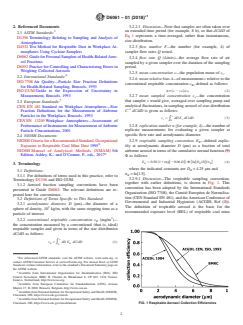
3.2.9.1 Discussion—The respirable sampling convention,
Terminology D1356 and ISOGUM.
together with earlier definitions, is shown in Fig. 1. This
3.1.2 Aerosol fraction sampling conventions have been
convention has been adopted by the International Standards
presented in Guide D6062. The relevant definitions are re-
Organization (ISO7708), the Comité Européen de Normalisa-
peated here for convenience.
tion (CEN Standard EN 481), and theAmerican Conference of
3.2 Definitions of Terms Specific to This Standard:
Governmental and Industrial Hygienists (ACGIH, Ref (1)).
3.2.1 aerodynamic diameter, D (µm)—the diameter of a
3 The definition of respirable aerosol is the basis for the
sphere of density, 10 kg/m, with the same stopping time as a
recommended exposure level (REL) of respirable coal mine
particle of interest.
3.2.2 conventional respirable concentration c (mg/m )—
R
the concentration measured by a conventional (that is, ideal)
respirable sampler and given in terms of the size distribution
dC/dD as follows:
`
c 5 dD E dC/dD (1)
*
R R
For referenced ASTM standards, visit the ASTM website, www.astm.org, or
contact ASTM Customer Service at service@astm.org. For Annual Book of ASTM
Standards volume information, refer to the standard’s Document Summary page on
the ASTM website.
Available from International Organization for Standardization (ISO), ISO
Central Secretariat, BIBC II, Chemin de Blandonnet 8, CP 401, 1214 Vernier,
Geneva, Switzerland, http://www.iso.org.
Available from European Committee for Standardization (CEN), Avenue
Marnix 17, B-1000, Brussels, Belgium, http://www.cen.eu.
AvailablefromNationalInstituteforOccupationalSafetyandHealth(NIOSH),
Cincinnati, OH, https://www.cdc.gov/niosh.
AvailablefromNationalInstituteforOccupationalSafetyandHealth(NIOSH),
Cincinnati, OH, https://www.cdc.gov/niosh/nmam. FIG. 1 Respirable Aerosol Collection Efficiencies
´1
D6061 − 01 (2018)
dust as promulgated by NIOSH (NIOSH Criteria for a Rec- cov —covariance matrix for sampler s and efficiency
s ij
ommended Standard, Occupational Exposure to Respirable parameters θ and θ.
i j
Coal Mine Dust) and also forms the basis of the NIOSH
c (mg/m ) —concentration measured by a conventional
R
sampling method for particulates not otherwise regulated,
(that is, ideal) respirable sampler.
respirable (NIOSH Manual of Analytical Methods).
D (µm)—aerosol aerodynamic diameter.
3.2.10 sampler number s = 1, ., S—a number identifying a D —sampling efficiency model parameter.
particular sampler under evaluation.
D (µm)—respirable sampling convention parameter equal
R
to 4.25 µm in the case of healthy adults, or 2.5 µm for the sick
3.2.10.1 sampling effıciency E (D, Q)—the modeled sam-
s
or infirm or children.
pling efficiency of sampler s as a function of aerodynamic
E—sampling convention in general.
diameter D and flow rate Q (9.1).
E —respirable sampling convention.
R
3.2.10.2 model parameters θ , where p = 1, ., P (for
p
E —sampling efficiency of sampler s.
example, 4)—parameters that specify the function E (D, Q). s
s
F—number of flow rates evaluated.
–1 –1
3.2.11 size-distribution C dC/dD (µm )—of a given air-
GSD—geometricstandarddeviationofalognormalaerosol
borne aerosol, the mass concentration of aerosol per unit
size distribution.
aerodynamic diameter range per total concentration C.
MMD—mass median diameter of a lognormal aerosol size
3.2.11.1 lognormal size distribution—an idealized distribu-
distribution.
tion characterized by two parameters: the geometric standard
MSE —mean square element for sampler in application
c
deviation (GSD) and mass median diameter (MMD). The
(see 10.4).
distribution is given explicitly as follows:
MSE—meansquareelementforevaluationdata(seeA1.5).
1 1
21 2 2
n—number of replicate measurements.
C dC/dD 5 exp 2 ln D/MMD /ln GSD
F @ # @ # G
=
2π Dln@GSD#
P—number of sampling efficiency parameters.
(5)
RSD—relativestandarddeviation(relativetoconcentration
c as estimated by an ideal sampler following the respirable
R
where C is the total mass concentration.
sampling convention).
3.2.12 symmetric-range accuracy A—the fractional range,
RSD —relative standard deviation component char-
analytical
symmetric about the conventional concentration c , within
R
acterizing analytical random variation.
which95%ofsamplermeasurementsaretobefound(8, 10-13
RSD —relative standard deviation component character-
eval
and the NIOSH Manual of Analytical Methods).
izing uncertainty from the evaluation experiment itself (Annex
3.2.13 uncertainty components:
A1).
3.2.13.1 analytical relative standard deviation
RSD —relativestandarddeviationcomponentcharacter-
inter
RSD —the standard deviation relative to the true respi-
analytical
izing random inter-sampler variation.
rable concentration c associated with mass analysis, for
R
RSD —relative standard deviation component charac-
pump
example, the weighing of filters, analysis of α-quartz, and so
terizing the effect of random sampling pump variation.
forth.
s—sampler number.
3.2.13.2 inter-sampler relative standard deviation
S—number of samplers evaluated.
RSD —the inter-sampler standard deviation (varying sam-
inter
t—sampling time (for example, 8 h).
pler s) relative to the respirable concentration c and taken as
R
U—expanded uncertainty.
primarilyassociatedwithphysicalvariationsinsamplerdimen-
u —combined uncertainty.
c
sions.
v (m/s)—wind speed.
3.2.13.3 pump-induced relative standard deviation
∆—bias relative to an ideal sampler following the respi-
RSD —the intra-sampler standard deviation relative to the
pump
rable sampling convention.
respirable concentration c associated with both drift and
R
ε —random variable contribution to evaluation experi-
eval s
variability in the setting of the sampling pump.
mental error in a concentration estimate.
3.3 Symbols and Abbreviations:
ε —random variable contribution to inter-sampler error in
s
A—symmetric-range accuracy as defined in terms of bias
a concentration estimate.
and precision (see 3.2.12).
θ—sampling efficiency model parameter.
—estimated accuracy A.
σ —sampling efficiency model parameter.
Discussion—Hats,asin A, refer to estimates, both in
σ —evaluation experimental standard deviation in a
eval
sampler application and sampler evaluation.
concentration estimate.
A—95 % confidence limit on the symmetric-range
95 %
σ —inter-sampler standard deviation in a concentration
inter
accuracy A.
estimate.
c (mg/m )—expected value of the sampler-averaged con-
σ —respirable sampling convention parameter equal to
centration estimates c . R
s
ln[1.5].
c (mg/m )—expected value (averaged over sampling
s
σ —weighing imprecision in mass collected on a filter.
pump and analytical variations) of the concentration estimate
mass
from sampler s. Φ[x]—cumulative normal function given for argument x.
´1
D6061 − 01 (2018)
4. Summary of Practice 6.1.3 Air speed uniformity: 63% over 250 by 250-mm
central cross-sectional area.
4.1 The sampling efficiency from D=0 to 10 µm and its
6.1.4 Turbulence <3%.
variability are measured in calm air (<0.5 m/s) for several
6.1.5 Test Aerosol Generation System:
candidate samplers operated at a variety of flow rates. This
information is then used to compute concentration estimates 6.1.5.1 Generation system: ultrasonic nebulizer.
expected in sampling representative lognormal aerosol size
6.1.5.2 Static discharging nozzle.
distributions. Random variations (10.2) as well as systematic
6.1.5.3 Mixing with tunnel air by turbulence created by 100
deviation (10.1) are specified relative to a conventional sam-
by 100-mm rectangular plate 10 cm downstream of the
pler. Overall performance in calm air can then be assessed by
nebulizer and perpendicular to the tunnel’s airflow.
computing a confidence limit A on the symmetric-range
95 %
6.1.5.4 Concentration: 5000 aerosol particles/L.
accuracy (3.2.12), accounting for uncertainty in the evaluation
6.1.5.5 Sizedistribution:countmediandiameter=4µmand
experiment, given estimated bias and imprecision at each
geometric standard deviation=2.2.
lognormal aerosol size distribution of interest. The symmetric-
3,10
range accuracy confidence limit A provides conservative 6.2 Aerodynamic Particle Sizer (APS).
95 %
confidence intervals bracketing the conventional concentration
6.3 Tube-Mounted Hot-Wire Anemometer Probe, or
at given confidence in the method evaluation, analogous to the
equivalent, ac voltmeter or oscilloscope.
use of the expanded uncertainty U in ISO GUM (see Eq 16).
This performance evaluation has evolved from work described
7. Reagents and Materials
in Refs (8, 14-21).
7.1 Reagents:
5. Significance and Use
7.1.1 Potassium Sodium Tartrate, A.C.S.-certified reagent
grade, for generating solid spherical aerosol particles.
5.1 This practice is significant for determining performance
7.1.2 Standard Polystyrene Latex Spheres for calibrating
relative to ideal sampling conventions. The purposes are
multifold: APS (6.2).
5.1.1 Theconventionshavearecognizedtietohealtheffects
7.2 Materials:
and can easily be adjusted to accommodate new findings.
7.2.1 Five-micrometre PVC Membrane Filters and Conduc-
5.1.2 Performance criteria permit instrument designers to
3,11
tive Filter Cassettes.
seek practical sampler improvements.
5.1.3 Performance criteria promote continued experimental
8. Data Representation through Sampling Efficiency
testingofthesamplersinusewiththeresultthatthesignificant
Model
variables (such as wind speed, particle charge, etc.) affecting
sampler operation become understood. 8.1 Determine a sampling efficiency curve for each of the S
(for example, eight) samplers by least squares fit to the data
5.2 Onespecificuseoftheperformancetestsisindetermin-
taken in four replicates at the four flow rates. Thus eight
ing the efficacy of a given candidate sampler for application in
functions of aerodynamic diameter D and flow rate Q are
regulatory sampling. The accuracy of the candidate sampler is
determined. Use the following model (5) or equivalent for
measuredinaccordancewiththeevaluationtestsgivenhere.A
characterizing the candidate cyclones:
sampler may then be adopted for a specific application if the
1 D
accuracy is better than a specific value.
E D; Q 5Φ ln (6)
~ ! F S DG
s
σ D
NOTE1—Insomeinstances,asamplersoselectedforuseincompliance
determinationsisspecifiedwithinanexposurestandard.Thisisdonesoas
where Φ is the cumulative normal function (9), easily
to eliminate differences among similar samplers. Sampler specification
computed within most statistical software packages. The indi-
then replaces the respirable sampling convention, eliminating bias (3.2.6),
cated constants are defined in terms of model parameters θ ,
p
which then does not appear in the uncertainty budget.
determined by the least squares fit to the data using a standard
5.3 Although the criteria are presented in terms of accepted
nonlinear regression routine:
sampling conventions geared mainly to compliance sampling,
2θ
D 5θ 3 Q/2.0 L/min (7)
~ !
0 1
other applications exist as well. For example, suppose that a
specific aerosol diameter-dependent health effect is under
2θ
exp σ 5θ 3 Q/2.0 L/min
@ # ~ !
0 3
investigation.Thenforthepurposeofanepidemiologicalstudy
an aerosol sampler that reflects the diameter dependence of
Inthiscase,thecurvefittingwoulddetermineeightsets(one
interest is required. Sampler accuracy may then be determined
for each sampler) of four parameters each.
relative to a modified sampling convention.
6. Apparatus
TheTSIAerodynamic Particle Sizer 3300 fromTSI, Inc., P.O. Box 64394, St.
Paul, MN 55164 is the sole aerodynamic particle sizer presently available suitable
6.1 Small Single-Pass Wind Tunnel(or,equivalently,astatic
for this purpose.
exposure chamber). The following dimensions are nominal:
The sole source of supply of conductive cassettes known to the committee at
6.1.1 Cross section: 500 by 500 mm; length: 6 m.
this time is Omega Specialty Instrument Co., 4 Kidder Road, Chelmsford, MA
6.1.2 Air speed: <0.5 m/s. 01824.
´1
D6061 − 01 (2018)
9. Procedure Note that the variety of environments in which respirable
aerosolmeasurementsaretakenprecludesasimpleelimination
9.1 General procedures for evaluating respirable aerosol
of this bias in the mean through calibration, with associated
samplers are presented in this practice. For other details on the
imprecision from variation of influence parameters (ISO
experimental procedures, see Refs (5, 6, 22-24).
GUM). For example, assuming a lognormal size-distribution,
9.2 Set up the APS (6.2) for operation in the small wind
the aerosol size distribution parameters, MMD and GSD may
tunnel (6.1). Check the APS calibration using (nominally) 3
be regarded as influence parameters. It is simplest to explicitly
and 7-µm standard polystyrene latex spheres (7.1.2) by com-
account for the bias in the development of confidence intervals
paring measured and known particle sizes. Set up the potas-
about the measurand values (the conventional concentrations
sium sodium tartrate (7.1.1) aerosol generator (6.1.5.1) with
c ).
R
charge neutralizer (6.1.5.2) and adjust to achieve about 5000
10.1.2 Bias Estimate—Computetheestimatedconcentration
aerosol particles/Lin the test region of the wind tunnel.Adjust
ĉ numerically for each sampler s at each lognormal size
s
the nebulizer aperture and aerosol solution concentration to
distribution (MMD, GSD) of interest, as indicated in (3.2.7).
achieve a test size distribution with count median diameter ≈4
Estimate the constant c by the sampler average:
µm and geometric standard deviation ≈2.2, covering the
aerodynamic diameter region of interest. Test the aerosol
cˆ 5 cˆ (8)
( s
S
s
concentration for stability in time by taking a series of size
distribution measurements. Variation should be <1% over ˆ
then compute the bias estimate ∆ as in Eq 2.
2-min periods.
10.2 Random Variations—In the sampling of aerosol, sev-
9.3 Determine the sampler sampling efficiency from D=0
eral sources of random variation have been found (5) signifi-
to 10 µm by measuring the aerosol size distribution before and
cant. These include inter-sampler variability (RSD
inter
after the samplers with 1-min exposures in accordance with an
(3.2.13.2)), caused by physical variations in the samplers;
experimental design similar to the following:
intra-sampler variability, from inaccuracy in the setting and
maintenance of required airflow (RSD (3.2.13.3)), and
pump
F = 4 sampler flow rates: distributed between 50 and 200%
analytical error (RSD (3.2.13.1)), for example, from
analytical
of the presumed optimal sampler flow rate,
variations in the weighing of filters, or, as another example, in
S = 8 samplers, numbered s=1, ., S, and
the measurement of collected α-quartz mass. Like the relative
n = 4 replicates, numbered r=1, ., n.
bias,therelativestandarddeviations, RSD and RSD are
inter pump
roughly constant, whereas RSD may depend on the
10. Measurement Uncertainty
analytical
conventional concentration c . For example, a recent assess-
R
10.1 Systematic Deviation Relative to Convention:
ment (25) by the Mine Safety and Health Administration
10.1.1 Background—As no real sampler follows the aerosol
(MSHA)indicatedanuncertaintyσ inmeasuringfiltermass
mass
fraction conventions exactly, bias always exists between real
changes equal to 9.1 µg. From such an estimate RSD
analytical
and conventional (ideal) samplers with sampling efficiency
canbecomputed,giventheflowrateQ(L/min),samplingtime
given by Eq 4.With minimal loading effects, this bias depends
t (for example, 8·60 min), and conventional respirable con-
only on the particle size-distribution of the aerosol sampled,
centration c of interest:
R
and is therefore a constant when expressed as a fraction of the
RSD 5σ ·1000 L/m /~c ·Q·t! (9)
conventionalconcentration c .Thelargestvaluesofbiasoccur
analytical mass R
R
in the sampling of monodisperse aerosol.
...