

ASTM F2907-22
(Specification)Standard Consumer Safety Specification for Sling Carriers
General Information
- Abstract
ABSTRACT
This consumer safety specification establishes performance requirements, test methods and marking requirements to promote safe use of sling carriers. It indicates the performance requirements and test methods of sling carriers; these tests are the static load test, dynamic load test, adhesion test, occupant retention test, and restraint system. This specification also identifies the proper markings and labels that should be placed on the sling carriers.
SCOPE
1.1 This consumer safety specification establishes performance requirements, test methods and marking requirements to promote safe use of sling carriers.
1.2 This consumer safety specification is intended to minimize the risk of injury to an occupant from the normal use and reasonably foreseeable misuse of products.
1.3 For purposes of definition, a sling carrier is a product of fabric or sewn fabric construction, which is designed to contain up to two (2) children in an upright or reclined position while being supported by the caregiver’s torso. Sling carriers are normally used from full-term birth to 35 lb (15.9 kg) unless the manufacturer indicates that a higher weight limit is allowed.
Note 1: Slings consist of a variety of unstructured designs ranging from a hammock-shaped product suspended on the caregiver’s upper torso to a long length of material wrapped around the caregiver’s body.
1.4 The sling carrier is normally “worn” by the caregiver, and thus the child is supported from one or both shoulders of the caregiver. These products are worn on the front, hip or back of the caregiver, with the child either facing towards or away from the caregiver or reclined on the front only of the caregiver.
1.5 No sling carrier produced after the approval date of this consumer safety specification shall, either by label or other means, indicate compliance with the specification unless it complies with all of the requirements contained herein.
1.6 This consumer safety specification is not intended to address incidents and injuries resulting from the interaction of other persons or objects with the caregiver and child while the sling carrier is in use.
1.7 The values stated in inch-pound units are to be regarded as standard. The values given in parentheses are mathematical conversions to SI units that are provided for information only and are not considered standard.
1.8 The following precautionary caveat pertains only to the test methods portion, Section 7, of this specification: This standard does not purport to address all of the safety concerns, if any, associated with its use. It is the responsibility of the user of this standard to establish appropriate safety, health, and environmental practices and determine the applicability of regulatory limitations prior to use.
1.9 This international standard was developed in accordance with internationally recognized principles on standardization established in the Decision on Principles for the Development of International Standards, Guides and Recommendations issued by the World Trade Organization Technical Barriers to Trade (TBT) Committee.
- Status
- Published
- Publication Date
- 31-Mar-2022
- Technical Committee
- F15 - Consumer Products
- Drafting Committee
- F15.21 - Infant Carriers, Bouncers and Baby Swings
Overview
ASTM F2907-22: Standard Consumer Safety Specification for Sling Carriers is developed by ASTM International to establish minimum safety, performance, testing, and labeling requirements for sling carriers. Sling carriers are fabric-based products designed to hold up to two children, in upright or reclined positions, while supported on the caregiver’s torso. This specification aims to minimize risks such as falls, suffocation, and improper use by enforcing stringent safety standards and supporting educational requirements for both manufacturers and consumers.
Key Topics
Scope and Definitions
- Applies to fabric or sewn-fabric sling carriers designed for children from full-term birth to 35 lb (15.9 kg), unless a greater weight is stated by the manufacturer.
- The sling is worn by the caregiver, usually on the front, hip, or back, supporting the child from one or both shoulders.
- Covers both structured and unstructured designs, such as ring slings or wrap carriers.
Performance Requirements
- Includes comprehensive performance tests such as:
- Static load test
- Dynamic load test
- Adhesion test for labeling
- Occupant retention test
- Restraint system integrity
- Ensures structural integrity, secure attachment systems, and prevention of hazardous conditions.
- Includes comprehensive performance tests such as:
Marking and Labeling
- Requires clear, permanent labeling on both the product and its packaging, including manufacturer details, date of manufacture, and child weight limits.
- Warning labels must address suffocation and fall hazards, use clear language, and include pictograms.
- Labels must be tested for permanence and compliance with ANSI safety labeling standards.
Instructional Literature
- Detailed instructions must accompany each sling carrier, outlining assembly, adjustment, maintenance, cleaning, and safe use practices.
- Warnings must be prominent, clear, and compliant with ANSI standards.
- Instructions should include images or diagrams of correct carrying positions and emphasize critical safety checks and practices.
Applications
- Manufacturers: Ensures that all sling carriers entering the market meet rigorous safety, functionality, and labeling criteria, reducing the likelihood of injuries and recalls.
- Regulatory Authorities: Provides a benchmark for consumer product safety inspections and aids in enforcement activities.
- Retailers: Assists in selecting compliant sling carriers for sale, demonstrating a commitment to consumer safety.
- Consumers and Caregivers: Informs users about product safety features, correct adjustment and use, and critical warnings to prevent common hazards.
Related Standards
- ASTM D3359: Test methods for rating adhesion by tape test, relevant to label permanence.
- ASTM F963: Consumer safety specification for toy safety, referenced for flammability testing.
- 16 CFR 1303: Federal regulation on lead content in paints and surface coatings.
- 16 CFR 1500.3, 1500.48, 1500.49, 1501, 1610: Federal requirements addressing sharp points, sharp edges, small parts, and flammability of textiles.
- ANSI Z535.1, Z535.4, Z535.6: Standards for safety colors, product safety labels, and safety information in manuals.
Practical Value
ASTM F2907-22 supports safer use of sling carriers by providing a thorough framework for physical performance, labeling, and user education. Compliance with this consumer safety specification helps mitigate major hazards such as falls and suffocation, enhances consumer confidence, and supports market access for manufacturers and retailers. By adhering to these requirements, all stakeholders-from manufacturers to caregivers-actively contribute to the overall safety and well-being of infants and young children transported in sling carriers.
Keywords: ASTM F2907-22, sling carrier safety, infant carrier standards, consumer product testing, caregiver baby sling, child safety labeling, sling carrier performance requirements, ASTM standards for baby products
Relations
- Effective Date
- 01-Aug-2023
- Effective Date
- 01-Aug-2016
- Effective Date
- 01-Dec-2011
- Effective Date
- 01-Jun-2009
- Effective Date
- 01-Dec-2008
- Effective Date
- 01-Nov-2007
- Effective Date
- 15-Mar-2007
- Effective Date
- 01-Oct-2003
- Effective Date
- 10-Aug-2002
- Effective Date
- 10-Nov-1996
- Effective Date
- 10-Nov-1996
- Effective Date
- 10-Nov-1996
Frequently Asked Questions
ASTM F2907-22 is a technical specification published by ASTM International. Its full title is "Standard Consumer Safety Specification for Sling Carriers". This standard covers: ABSTRACT This consumer safety specification establishes performance requirements, test methods and marking requirements to promote safe use of sling carriers. It indicates the performance requirements and test methods of sling carriers; these tests are the static load test, dynamic load test, adhesion test, occupant retention test, and restraint system. This specification also identifies the proper markings and labels that should be placed on the sling carriers. SCOPE 1.1 This consumer safety specification establishes performance requirements, test methods and marking requirements to promote safe use of sling carriers. 1.2 This consumer safety specification is intended to minimize the risk of injury to an occupant from the normal use and reasonably foreseeable misuse of products. 1.3 For purposes of definition, a sling carrier is a product of fabric or sewn fabric construction, which is designed to contain up to two (2) children in an upright or reclined position while being supported by the caregiver’s torso. Sling carriers are normally used from full-term birth to 35 lb (15.9 kg) unless the manufacturer indicates that a higher weight limit is allowed. Note 1: Slings consist of a variety of unstructured designs ranging from a hammock-shaped product suspended on the caregiver’s upper torso to a long length of material wrapped around the caregiver’s body. 1.4 The sling carrier is normally “worn” by the caregiver, and thus the child is supported from one or both shoulders of the caregiver. These products are worn on the front, hip or back of the caregiver, with the child either facing towards or away from the caregiver or reclined on the front only of the caregiver. 1.5 No sling carrier produced after the approval date of this consumer safety specification shall, either by label or other means, indicate compliance with the specification unless it complies with all of the requirements contained herein. 1.6 This consumer safety specification is not intended to address incidents and injuries resulting from the interaction of other persons or objects with the caregiver and child while the sling carrier is in use. 1.7 The values stated in inch-pound units are to be regarded as standard. The values given in parentheses are mathematical conversions to SI units that are provided for information only and are not considered standard. 1.8 The following precautionary caveat pertains only to the test methods portion, Section 7, of this specification: This standard does not purport to address all of the safety concerns, if any, associated with its use. It is the responsibility of the user of this standard to establish appropriate safety, health, and environmental practices and determine the applicability of regulatory limitations prior to use. 1.9 This international standard was developed in accordance with internationally recognized principles on standardization established in the Decision on Principles for the Development of International Standards, Guides and Recommendations issued by the World Trade Organization Technical Barriers to Trade (TBT) Committee.
ABSTRACT This consumer safety specification establishes performance requirements, test methods and marking requirements to promote safe use of sling carriers. It indicates the performance requirements and test methods of sling carriers; these tests are the static load test, dynamic load test, adhesion test, occupant retention test, and restraint system. This specification also identifies the proper markings and labels that should be placed on the sling carriers. SCOPE 1.1 This consumer safety specification establishes performance requirements, test methods and marking requirements to promote safe use of sling carriers. 1.2 This consumer safety specification is intended to minimize the risk of injury to an occupant from the normal use and reasonably foreseeable misuse of products. 1.3 For purposes of definition, a sling carrier is a product of fabric or sewn fabric construction, which is designed to contain up to two (2) children in an upright or reclined position while being supported by the caregiver’s torso. Sling carriers are normally used from full-term birth to 35 lb (15.9 kg) unless the manufacturer indicates that a higher weight limit is allowed. Note 1: Slings consist of a variety of unstructured designs ranging from a hammock-shaped product suspended on the caregiver’s upper torso to a long length of material wrapped around the caregiver’s body. 1.4 The sling carrier is normally “worn” by the caregiver, and thus the child is supported from one or both shoulders of the caregiver. These products are worn on the front, hip or back of the caregiver, with the child either facing towards or away from the caregiver or reclined on the front only of the caregiver. 1.5 No sling carrier produced after the approval date of this consumer safety specification shall, either by label or other means, indicate compliance with the specification unless it complies with all of the requirements contained herein. 1.6 This consumer safety specification is not intended to address incidents and injuries resulting from the interaction of other persons or objects with the caregiver and child while the sling carrier is in use. 1.7 The values stated in inch-pound units are to be regarded as standard. The values given in parentheses are mathematical conversions to SI units that are provided for information only and are not considered standard. 1.8 The following precautionary caveat pertains only to the test methods portion, Section 7, of this specification: This standard does not purport to address all of the safety concerns, if any, associated with its use. It is the responsibility of the user of this standard to establish appropriate safety, health, and environmental practices and determine the applicability of regulatory limitations prior to use. 1.9 This international standard was developed in accordance with internationally recognized principles on standardization established in the Decision on Principles for the Development of International Standards, Guides and Recommendations issued by the World Trade Organization Technical Barriers to Trade (TBT) Committee.
ASTM F2907-22 is classified under the following ICS (International Classification for Standards) categories: 97.190 - Equipment for children. The ICS classification helps identify the subject area and facilitates finding related standards.
ASTM F2907-22 has the following relationships with other standards: It is inter standard links to ASTM F963-23, ASTM F963-16, ASTM F963-11, ASTM D3359-09e1, ASTM F963-08, ASTM D3359-07, ASTM F963-07e1, ASTM F963-03, ASTM D3359-02, ASTM F963-96ae2, ASTM F963-96ae1, ASTM F963-96a. Understanding these relationships helps ensure you are using the most current and applicable version of the standard.
ASTM F2907-22 is available in PDF format for immediate download after purchase. The document can be added to your cart and obtained through the secure checkout process. Digital delivery ensures instant access to the complete standard document.
Standards Content (Sample)
This international standard was developed in accordance with internationally recognized principles on standardization established in the Decision on Principles for the
Development of International Standards, Guides and Recommendations issued by the World Trade Organization Technical Barriers to Trade (TBT) Committee.
Designation:F2907 −22
Standard Consumer Safety Specification for
Sling Carriers
This standard is issued under the fixed designation F2907; the number immediately following the designation indicates the year of
original adoption or, in the case of revision, the year of last revision. A number in parentheses indicates the year of last reapproval. A
superscript epsilon (´) indicates an editorial change since the last revision or reapproval.
INTRODUCTION
Thisconsumersafetyspecificationaddressesincidentsassociatedwithslingcarriersasidentifiedby
the U.S. Consumer Product Safety Commission (CPSC). In response to incident data compiled by the
CPSC,thisspecificationattemptstominimizethefollowinghazards:fallhazards,suffocationhazards,
and deficiency of consumer education regarding product use. This specification is intended to cover
normal use and reasonably foreseeable misuse or abuse of the product(s).
This specification is written within the current state-of-the-art of sling carrier technology and will
be updated whenever substantive information becomes available that necessitates additional require-
ments or justifies the revision of existing requirements.
1. Scope means, indicate compliance with the specification unless it
complies with all of the requirements contained herein.
1.1 This consumer safety specification establishes perfor-
1.6 This consumer safety specification is not intended to
mancerequirements,testmethodsandmarkingrequirementsto
address incidents and injuries resulting from the interaction of
promote safe use of sling carriers.
other persons or objects with the caregiver and child while the
1.2 This consumer safety specification is intended to mini-
sling carrier is in use.
mize the risk of injury to an occupant from the normal use and
1.7 The values stated in inch-pound units are to be regarded
reasonably foreseeable misuse of products.
as standard. The values given in parentheses are mathematical
1.3 For purposes of definition, a sling carrier is a product of
conversions to SI units that are provided for information only
fabricorsewnfabricconstruction,whichisdesignedtocontain
and are not considered standard.
up to two (2) children in an upright or reclined position while
1.8 The following precautionary caveat pertains only to the
being supported by the caregiver’s torso. Sling carriers are
test methods portion, Section 7, of this specification: This
normally used from full-term birth to 35 lb (15.9 kg) unless the
standard does not purport to address all of the safety concerns,
manufacturer indicates that a higher weight limit is allowed.
if any, associated with its use. It is the responsibility of the user
NOTE 1—Slings consist of a variety of unstructured designs ranging
of this standard to establish appropriate safety, health, and
fromahammock-shapedproductsuspendedonthecaregiver’suppertorso
environmental practices and determine the applicability of
to a long length of material wrapped around the caregiver’s body.
regulatory limitations prior to use.
1.4 The sling carrier is normally “worn” by the caregiver,
1.9 This international standard was developed in accor-
and thus the child is supported from one or both shoulders of
dance with internationally recognized principles on standard-
thecaregiver.Theseproductsarewornonthefront,hiporback
ization established in the Decision on Principles for the
of the caregiver, with the child either facing towards or away
Development of International Standards, Guides and Recom-
from the caregiver or reclined on the front only of the
mendations issued by the World Trade Organization Technical
caregiver.
Barriers to Trade (TBT) Committee.
1.5 No sling carrier produced after the approval date of this
2. Referenced Documents
consumer safety specification shall, either by label or other
2.1 ASTM Standards:
D3359 Test Methods for Rating Adhesion by Tape Test
This consumer safety specification is under the jurisdiction ofASTM Commit-
tee F15 on Consumer Products and is the direct responsibility of Subcommittee
F15.21 on Infant Carriers, Bouncers and Baby Swings. For referenced ASTM standards, visit the ASTM website, www.astm.org, or
Current edition approved April 1, 2022. Published May 2022. Originally contact ASTM Customer Service at service@astm.org. For Annual Book of ASTM
approved in 2012. Last previous edition approved in 2021 as F2907 – 21. DOI: Standards volume information, refer to the standard’s Document Summary page on
10.1520/F2907-22. the ASTM website.
Copyright © ASTM International, 100 Barr Harbor Drive, PO Box C700, West Conshohocken, PA 19428-2959. United States
F2907−22
F963 Consumer Safety Specification for Toy Safety 3.1.9 paper label, n—any label material which tears without
2.2 Federal Regulations: the aid of tools and leaves a fibrous edge.
16 CFR 1303 Ban of Lead-Containing Paint and Certain
3.1.10 reclined, n—any position other than upright.
Consumer Product Bearing Lead-Containing Paint
3.1.11 restraint system, n—a means of securing the occu-
16 CFR 1500.3(c)(6)(vi) Definition of “Flammable Solid”
pant in any of manufacturer’s recommended carrying posi-
16 CFR 1500.48 Technical Requirements for Determining a
tions.
Sharp Point inToys or OtherArticles Intended for Use By
3.1.12 ring sling, n—a sling carrier constructed of a long,
Children Under Eight Years of Age
rectangular, oblong, or similarly shaped piece of fabric with
16 CFR 1500.49 Technical Requirements for Determining a
two rings (usually either nylon or metal) attached to one end.
Sharp Metal or Glass Edge in Toys or Other Articles
3.1.12.1 Discussion—The end of the fabric without rings is
Intended for Use By Children Under Eight Years of Age
threaded through and between rings to make a pouch for the
16 CFR 1501 Method for Identifying Toys and Other Ar-
baby and a tail of fabric. The rings bear the weight of the baby
ticles Intended for Use by Children Under Three Years of
in the sling, and the caregiver can adjust the sling through the
Age Which Present Choking, Aspiration or Ingestion
rings.
Hazards Because of Small Parts
16 CFR 1610 Standard for the Flammability of Clothing
3.1.13 seam, n—a place where fabric components are
Textiles
joined, by means such as sewing, welding, heat sealing, or
2.3 ANSI Standards:
gluing.
ANSI Z535.1 Safety Colors
3.1.14 static load, n—vertically downward load applied by
ANSI Z535.4 Product Safety Signs and Labels
weights or other means.
ANSI Z535.6 Product Safety Information in Product
3.1.15 substantially similar carrying position, n—carrying
Manuals, Instructions, and Other Collateral Materials
positions where the sling fabric orientation does not vary
3. Terminology
regardless of the direction the baby is facing relative to the
wearer, or regardless of the positioning of the product to the
3.1 Definitions of Terms Specific to This Standard:
wearer.
3.1.1 attachment system, n—fastenings, straps, hoops,
buckles, or similar parts which are fitted to the sling carrier for 3.1.16 support area(s), n—the area(s) in the sling carrier
the purpose of securing the article to the caregiver’s torso. where the occupant’s weight rests in the product.
3.1.2 conspicuous, adj—visible when the product is in the
4. Calibration and Standardization
manufacturer’s recommended carrying position to a caregiver
who is placing the occupant in the sling carrier or when the
4.1 The product shall be completely assembled in accor-
caregiver places the product on his or her body.
dance with the manufacturer’s instructions.
3.1.3 dynamic load, n—application of impulsive force
4.2 No testing shall be conducted within 48 h of manufac-
through free fall of a weight.
ture.
3.1.4 fabric, n—any woven, knit, coated, laminated,
4.3 The product to be tested shall be at an ambient tempera-
extruded, or calendered flexible material that is intended to be
ture of 73°F 6 9°F (23°C 6 5°C) for at least one hour before
sewn, welded, heat sealed, or glued together as an assembly.
testing.Alltestingshallbeconductedinthistemperaturerange.
3.1.5 full term infant, n—a baby born 38+ weeks after
4.4 All testing required by this consumer safety specifica-
conception.
tion shall be conducted on the same unit in the order presented
3.1.6 manufacturer’s recommended carrying position(s),
in this specification, except where directly indicated.
n—any carrying position that is presented as a normal,
allowable,oracceptableconfigurationforuseoftheproductby
5. General Requirements
the manufacturer in any descriptive or instructional literature.
5.1 Laundering—The sling shall be washed and dried twice
3.1.6.1 Discussion—This specifically excludes positions
in accordance with the manufacturer’s instructions.Any result-
that the manufacturer shows in a like manner in its literature to
ingshrinkageshallnotpreventanyremovablepartsfrombeing
be unacceptable, unsafe, or not recommended.
refitted without damaging the seams of the fabric and shall not
3.1.7 non-paper label, n—any label material (such as plastic
impairtheperformanceanduseofthearticle.*Thistestwillbe
or metal) that either will not tear without the aid of tools or
the first test conducted on the fabric.*
tears, leaving a sharply defined edge.
5.2 Hazardous Sharp Points or Edges—There shall be no
3.1.8 occupant,n—individualwhoisplacedorcarriedinthe
sharp points or edges as defined by 16 CFR 1500.48 and 16
sling carrier in one of the manufacturer’s recommended carry-
CFR 1500.49 before and after testing.
ing positions in accordance with 1.4.
5.3 Small Parts—Thereshallbenosmallpartsasdefinedby
16 CFR 1501 before testing or liberated as a result of testing to
AvailablefromU.S.GovernmentPrintingOfficeSuperintendentofDocuments,
732 N. Capitol St., NW, Mail Stop: SDE, Washington, DC 20401, http:// this specification.
www.access.gpo.gov.
5.4 Lead in Paint—The paint or surface coating on the
Available fromAmerican National Standards Institute (ANSI), 25 W. 43rd St.,
4th Floor, New York, NY 10036, http://www.ansi.org. product shall comply with 16 CFR 1303.
F2907−22
5.5 Wood Parts—Prior to testing, any wooden parts shall be limited in depth to 0.375 in. (9.53 mm) maximum by another
smooth and free of splinters. rigidsurfaceshallbepermissible(seeFig.1).Theproductshall
be evaluated in all manufacturers’ recommended carrying
5.6 Locking and Latching—Any product designed with a
positions.
locking or latching attachment system must remain in the
manufacturer’s recommended carrying position before and 5.9 Scissoring, Shearing, and Pinching—The product, when
after completion of all tests in this standard. in a manufacturer’s recommended use position(s), shall be
designed and constructed so as to prevent injury to the
5.7 Labeling—Warning labels (whether paper or non-paper)
occupant from any scissoring, shearing, or pinching when
shall be permanent when tested in accordance with 7.3.
members or components rotate about a common axis or
5.7.1 Warning statements applied directly onto the surface
fastening point, slide, pivot, fold, or otherwise move relative to
of the product by hot stamping, heat transfer, printing, wood
one another. Scissoring, shearing, or pinching that may cause
burning, and so forth shall be permanent when tested in
injury exists when the edges of any rigid parts admit a probe
accordance with 7.4.
greater than 0.210 in. (5.33 mm) and less than 0.375 in. (9.53
5.7.2 Non-paper labels shall not liberate small parts when
mm) diameter at any accessible point throughout the range of
tested in accordance with 7.4.
motion of such parts.
5.8 Openings—Holes or slots that extend entirely through a
5.10 Monofilament Threads—Monofilament threads shall
wallsectionofanyrigidmateriallessthan0.375-in.(9.53-mm)
not be used.
thick and admit a 0.210-in. (5.33-mm) diameter rod shall also
admit a 0.375-in. (9.53-mm) diameter rod. Holes or slots that 5.11 Flammability—There shall be no Class 2 or 3 fabrics
are between 0.210 in. (5.33 mm) and 0.375 in. (9.53 mm) and used in the construction of a sling carrier when the product is
have a wall thickness less than 0.375 in. (9.53 mm), but are evaluated against the requirements of 16 CFR 1610.
FIG. 1Opening Example
F2907−22
5.11.1 Ifaslingcarrierisincapableofbeingevaluatedtothe
requirements of 16 CFR 1610 due to construction
characteristics, the product shall not be flammable as defined
under 16 CFR 1500.3(c)(6)(vi) when tested in accordance with
Consumer Safety Specification F963, Annex 5.
6. Performance Requirements
6.1 Structural Integrity—At the conclusion of each test,
there shall be no failures such as seam separation, fabric tears,
permanent deformation, breakage or disengagement of attach-
ment systems, or a hazardous condition as defined in 5.2 – 5.5,
5.8,or 5.9. Adjustable attachment systems of the sling carrier
shall not slip more than 1 in. (25.44 mm) per element.
6.1.1 Static Load—The sling carrier shall meet the criteria
in 6.1 when tested in accordance with 7.1.
6.1.2 Dynamic Load—The sling carrier shall meet the cri-
teria in 6.1 when tested in accordance with 7.2.
6.2 Restraint System—If the manufacturer includes a re-
straint system on the product, each separate restraint system
shall comply with the following:
6.2.1 The restraint system shall include both waist and
crotch restraint, where the crotch restraint’s use is mandatory
when the waist restraint system is in use.
6.2.2 The anchorages for the restraint system shall not
separatefromtheirattachmentpointsthroughnormalusewhen
tested in accordance with 7.6.
6.3 Occupant Retention:
6.3.1 Ring Slings—When tested in accordance with 7.5,
after 100 cycles the maximum slippage of the attachment
system shall be 3 in. (76.2 mm) and no part of the test mass
shall pass below the bottom of the test torso.
6.3.2 Products Other Than Ring Slings—When tested in
accordance with 7.5, after 100 cycles the maximum slippage of
the attachment system and the restraint system (if applicable)
shall be 1 in. (25 mm) and no part of the test mass shall pass
below the bottom of the test torso.
FIG. 2Test Torso
6.3.3 When tested in accordance with 7.5, after the comple-
tion of each phase of the test, the attachment system and the
restraint system (if applicable) shall not be released, there shall
be no failures (as defined in 6.1), and no part of the test mass
shall pass below the bottom of the test torso.
7. Test Methods
7.1 Static Load Test:
7.1.1 Fasten the sling carrier to a test torso (see Fig. 2)as
directed in the instruction manual supplied with the product. If
the sling carrier is manufactured in multiple sizes, the size that
fitsthetesttorsoistherequiredsizeforthesamplesubmission.
7.1.2 By some appropriate means, mark the position of the
FIG. 3Standard 6-in. (150-mm) Weld Cap
attachment system. If sling does not have any hardware and is
fastened by means of fabric, mark the position on the fabric.
This will be the start point for the remainder of the test.
7.1.3 Usinga6-in.(150-mm)standardweldcap(seeFig.3), 7.1.4 Mark and measure the amount of slippage in the
center a weight equal to three times the manufacturer’s attachment system. Evaluate results per requirements of 6.1.
recommended maximum weight, or 60 lb (27.2 kg), whichever 7.1.5 If two occupants can be carried in any carrying
is greater, in the support area of the sling carrier. Include the position according to the manufacturer’s instructions, the
weight of the weld cap in the total. Gradually apply the weight applicableweightin7.1.3shallbeappliedinbothsupportareas
within a 5-s period and maintain for an additional 1 min. of the sling carrier concurrently.
F2907−22
7.1.6 Repeat 7.1.1 – 7.1.5 for all manufacturer’s recom- 7.3.2 A non-paper label (excluding labels attached by a
mended carrying positions. seam) shall be considered permanent if, during an attempt to
remove it without the aid of tools or solvents, it cannot be
7.2 Dynamic Load Test:
removed or such action damages the surface to which it is
7.2.1 Fasten the sling carrier to a test torso (see Fig. 2)as
attached.
directed in the instruction manual supplied with the product. If
7.3.3 A warning label attached by a seam shall be consid-
the sling carrier is manufactured in multiple sizes, the size that
ered permanent if it does not detach when subjected to a 15 lbf
fitsthetesttorsoistherequiredsizeforthesamplesubmission.
(67 N) pull force applied in any direction most likely to cause
7.2.2 Single Occupant Products:
failure using a 0.75 in. (19 mm) diameter clamp surface (see
7.2.2.1 Determine the appropriate number of test cycles
Fig. 4). Gradually apply the force over 5 s and maintain for an
using Table 1 based on the number of separate manufacturer’s
additional 10 s.
recommended carrying positions.
7.2.2.2 Position a 6 in. to 8 in. diameter shot bag weighing 7.4 Adhesion Test for Warnings Applied Directly onto the
35 lb (15.9 kg) or a mass equal to the manufacturer’s Surface of the Product:
recommended maximum weight for the specific carrying 7.4.1 Apply the tape test defined in Test Method B of Test
position of the product, whichever is greater, a distance of 1 in. Methods D3359, eliminating parallel cuts.
(25 mm) above the support area of the sling carrier. 7.4.2 Perform this test once in each different location where
7.2.2.3 Drop the weight onto the support area ten times with warnings are applied.
a cycle time of 4 s 6 1 s per cycle to preset the attachment 7.4.3 The warning statements will be considered permanent
system. iftheprintingi
...
This document is not an ASTM standard and is intended only to provide the user of an ASTM standard an indication of what changes have been made to the previous version. Because
it may not be technically possible to adequately depict all changes accurately, ASTM recommends that users consult prior editions as appropriate. In all cases only the current version
of the standard as published by ASTM is to be considered the official document.
Designation: F2907 − 21 F2907 − 22
Standard Consumer Safety Specification for
Sling Carriers
This standard is issued under the fixed designation F2907; the number immediately following the designation indicates the year of
original adoption or, in the case of revision, the year of last revision. A number in parentheses indicates the year of last reapproval. A
superscript epsilon (´) indicates an editorial change since the last revision or reapproval.
INTRODUCTION
This consumer safety specification addresses incidents associated with sling carriers as identified by
the U.S. Consumer Product Safety Commission (CPSC). In response to incident data compiled by the
CPSC, this specification attempts to minimize the following hazards: fall hazards, suffocation hazards,
and deficiency of consumer education regarding product use. This specification is intended to cover
normal use and reasonably foreseeable misuse or abuse of the product(s).
This specification is written within the current state-of-the-art of sling carrier technology and will
be updated whenever substantive information becomes available that necessitates additional require-
ments or justifies the revision of existing requirements.
1. Scope
1.1 This consumer safety specification establishes performance requirements, test methods and marking requirements to promote
safe use of sling carriers.
1.2 This consumer safety specification is intended to minimize the risk of injury to an occupant from the normal use and
reasonably foreseeable misuse of products.
1.3 For purposes of definition, a sling carrier is a product of fabric or sewn fabric construction, which is designed to contain up
to two (2) children in an upright or reclined position while being supported by the caregiver’s torso. Sling carriers are normally
used from full-term birth to 35 lb (15.9 kg) unless the manufacturer indicates that a higher weight limit is allowed.
NOTE 1—Slings consist of a variety of unstructured designs ranging from a hammock-shaped product suspended on the caregiver’s upper torso to a long
length of material wrapped around the caregiver’s body.
1.4 The sling carrier is normally “worn” by the caregiver, and thus the child is supported from one or both shoulders of the
caregiver. These products are worn on the front, hip or back of the caregiver, with the child either facing towards or away from
the caregiver or reclined on the front only of the caregiver.
1.5 No sling carrier produced after the approval date of this consumer safety specification shall, either by label or other means,
indicate compliance with the specification unless it complies with all of the requirements contained herein.
This consumer safety specification is under the jurisdiction of ASTM Committee F15 on Consumer Products and is the direct responsibility of Subcommittee F15.21
on Infant Carriers, Bouncers and Baby Swings.
Current edition approved Nov. 15, 2021April 1, 2022. Published January 2022May 2022. Originally approved in 2012. Last previous edition approved in 20192021 as
F2907 – 19.F2907 – 21. DOI: 10.1520/F2907-21.10.1520/F2907-22.
Copyright © ASTM International, 100 Barr Harbor Drive, PO Box C700, West Conshohocken, PA 19428-2959. United States
F2907 − 22
1.6 This consumer safety specification is not intended to address incidents and injuries resulting from the interaction of other
persons or objects with the caregiver and child while the sling carrier is in use.
1.7 The values stated in inch-pound units are to be regarded as standard. The values given in parentheses are mathematical
conversions to SI units that are provided for information only and are not considered standard.
1.8 The following precautionary caveat pertains only to the test methods portion, Section 7, of this specification: This standard
does not purport to address all of the safety concerns, if any, associated with its use. It is the responsibility of the user of this
standard to establish appropriate safety, health, and environmental practices and determine the applicability of regulatory
limitations prior to use.
1.9 This international standard was developed in accordance with internationally recognized principles on standardization
established in the Decision on Principles for the Development of International Standards, Guides and Recommendations issued
by the World Trade Organization Technical Barriers to Trade (TBT) Committee.
2. Referenced Documents
2.1 ASTM Standards:
D3359 Test Methods for Rating Adhesion by Tape Test
F963 Consumer Safety Specification for Toy Safety
2.2 Federal Regulations:
16 CFR 1303 Ban of Lead-Containing Paint and Certain Consumer Product Bearing Lead-Containing Paint
16 CFR 1500.3(c)(6)(vi) Definition of “Flammable Solid”
16 CFR 1500.48 Technical Requirements for Determining a Sharp Point in Toys or Other Articles Intended for Use By Children
Under Eight Years of Age
16 CFR 1500.49 Technical Requirements for Determining a Sharp Metal or Glass Edge in Toys or Other Articles Intended for
Use By Children Under Eight Years of Age
16 CFR 1501 Method for Identifying Toys and Other Articles Intended for Use by Children Under Three Years of Age Which
Present Choking, Aspiration or Ingestion Hazards Because of Small Parts
16 CFR 1610 Standard for the Flammability of Clothing Textiles
2.3 ANSI Standards:
ANSI Z535.1 Safety Colors
ANSI Z535.4 Product Safety Signs and Labels
ANSI Z535.6 Product Safety Information in Product Manuals, Instructions, and Other Collateral Materials
3. Terminology
3.1 Definitions of Terms Specific to This Standard:
3.1.1 attachment system, n—fastenings, straps, hoops, buckles, or similar parts which are fitted to the sling carrier for the purpose
of securing the article to the caregiver’s torso.
3.1.2 conspicuous, adj—visible when the product is in the manufacturer’s recommended carrying position to a caregiver who is
placing the occupant in the sling carrier or when the caregiver places the product on his or her body.
3.1.3 dynamic load, n—application of impulsive force through free fall of a weight.
3.1.4 fabric, n—any woven, knit, coated, laminated, extruded, or calendered flexible material that is intended to be sewn, welded,
heat sealed, or glued together as an assembly.
3.1.5 full term infant, n—a baby born 38+ weeks after conception.
For referenced ASTM standards, visit the ASTM website, www.astm.org, or contact ASTM Customer Service at service@astm.org. For Annual Book of ASTM Standards
volume information, refer to the standard’s Document Summary page on the ASTM website.
Available from U.S. Government Printing Office Superintendent of Documents, 732 N. Capitol St., NW, Mail Stop: SDE, Washington, DC 20401, http://
www.access.gpo.gov.
Available from American National Standards Institute (ANSI), 25 W. 43rd St., 4th Floor, New York, NY 10036, http://www.ansi.org.
F2907 − 22
3.1.6 manufacturer’s recommended carrying position(s), n—any carrying position that is presented as a normal, allowable, or
acceptable configuration for use of the product by the manufacturer in any descriptive or instructional literature.
3.1.6.1 Discussion—
This specifically excludes positions that the manufacturer shows in a like manner in its literature to be unacceptable, unsafe, or
not recommended.
3.1.7 non-paper label, n—any label material (such as plastic or metal) that either will not tear without the aid of tools or tears,
leaving a sharply defined edge.
3.1.8 occupant, n—individual who is placed or carried in the sling carrier in one of the manufacturer’s recommended carrying
positions in accordance with 1.4.
3.1.9 paper label, n—any label material which tears without the aid of tools and leaves a fibrous edge.
3.1.10 reclined, n—any position other than upright.
3.1.11 restraint system, n—a means of securing the occupant in any of manufacturer’s recommended carrying positions.
3.1.12 ring sling, n—a sling carrier constructed of a long, rectangular, oblong, or similarly shaped piece of fabric with two rings
(usually either nylon or metal) attached to one end.
3.1.12.1 Discussion—
The end of the fabric without rings is threaded through and between rings to make a pouch for the baby and a tail of fabric. The
rings bear the weight of the baby in the sling, and the caregiver can adjust the sling through the rings.
3.1.13 seam, n—a place where fabric components are joined, by means such as sewing, welding, heat sealing, or gluing.
3.1.14 static load, n—vertically downward load applied by weights or other means.
3.1.15 substantially similar carrying position, n—carrying positions where the sling fabric orientation does not vary regardless of
the direction the baby is facing relative to the wearer, or regardless of the positioning of the product to the wearer.
3.1.16 support area(s), n—the area(s) in the sling carrier where the occupant’s weight rests in the product.
4. Calibration and Standardization
4.1 The product shall be completely assembled in accordance with the manufacturer’s instructions.
4.2 No testing shall be conducted within 48 h of manufacture.
4.3 The product to be tested shall be at an ambient temperature of 73°F 6 9°F (23°C 6 5°C) for at least one hour before testing.
All testing shall be conducted in this temperature range.
4.4 All testing required by this consumer safety specification shall be conducted on the same unit in the order presented in this
specification, except where directly indicated.
5. General Requirements
5.1 Laundering—The sling shall be washed and dried twice in accordance with the manufacturer’s instructions. Any resulting
shrinkage shall not prevent any removable parts from being refitted without damaging the seams of the fabric and shall not impair
the performance and use of the article. *This test will be the first test conducted on the fabric.*
5.2 Hazardous Sharp Points or Edges—There shall be no sharp points or edges as defined by 16 CFR 1500.48 and 16 CFR
1500.49 before and after testing.
F2907 − 22
5.3 Small Parts—There shall be no small parts as defined by 16 CFR 1501 before testing or liberated as a result of testing to this
specification.
5.4 Lead in Paint—The paint or surface coating on the product shall comply with 16 CFR 1303.
5.5 Wood Parts—Prior to testing, any wooden parts shall be smooth and free of splinters.
5.6 Locking and Latching—Any product designed with a locking or latching attachment system must remain in the manufacturer’s
recommended carrying position before and after completion of all tests in this standard.
5.7 Labeling—Warning labels (whether paper or non-paper) shall be permanent when tested in accordance with 7.3.
5.7.1 Warning statements applied directly onto the surface of the product by hot stamping, heat transfer, printing, wood burning,
and so forth shall be permanent when tested in accordance with 7.4.
5.7.2 Non-paper labels shall not liberate small parts when tested in accordance with 7.4.
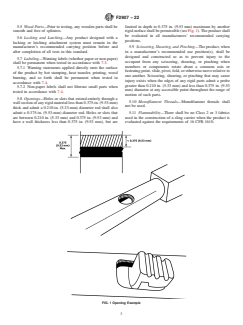
5.8 Openings—Holes or slots that extend entirely through a wall section of any rigid material less than 0.375-in. (9.53-mm) thick
and admit a 0.210-in. (5.33-mm) diameter rod shall also admit a 0.375-in. (9.53-mm) diameter rod. Holes or slots that are between
0.210 in. (5.33 mm) and 0.375 in. (9.53 mm) and have a wall thickness less than 0.375 in. (9.53 mm), but are limited in depth
to 0.375 in. (9.53 mm) maximum by another rigid surface shall be permissible (see Fig. 1). The product shall be evaluated in all
manufacturers’ recommended carrying positions.
5.9 Scissoring, Shearing, and Pinching—The product, when in a manufacturer’s recommended use position(s), shall be designed
and constructed so as to prevent injury to the occupant from any scissoring, shearing, or pinching when members or components
rotate about a common axis or fastening point, slide, pivot, fold, or otherwise move relative to one another. Scissoring, shearing,
or pinching that may cause injury exists when the edges of any rigid parts admit a probe greater than 0.210 in. (5.33 mm) and less
than 0.375 in. (9.53 mm) diameter at any accessible point throughout the range of motion of such parts.
5.10 Monofilament Threads—Monofilament threads shall not be used.
5.11 Flammability—There shall be no Class 2 or 3 fabrics used in the construction of a sling carrier when the product is evaluated
against the requirements of 16 CFR 1610.
5.11.1 If a sling carrier is incapable of being evaluated to the requirements of 16 CFR 1610 due to construction characteristics,
the product shall not be flammable as defined under 16 CFR 1500.3(c)(6)(vi) when tested in accordance with Consumer Safety
Specification F963, Annex 5.
6. Performance Requirements
6.1 Structural Integrity—At the conclusion of each test, there shall be no failures such as seam separation, fabric tears, permanent
deformation, breakage or disengagement of attachment systems, or a hazardous condition as defined in 5.2 – 5.5, 5.8, or 5.9.
Adjustable attachment systems of the sling carrier shall not slip more than 1 in. (25.44 mm) per element.
6.1.1 Static Load—The sling carrier shall meet the criteria in 6.1 when tested in accordance with 7.1.
6.1.2 Dynamic Load—The sling carrier shall meet the criteria in 6.1 when tested in accordance with 7.2.
6.2 Restraint System—If the manufacturer includes a restraint system on the product, each separate restraint system shall comply
with the following:
6.2.1 The restraint system shall include both waist and crotch restraint, where the crotch restraint’s use is mandatory when the
waist restraint system is in use.
F2907 − 22
FIG. 1 Opening Example
6.2.2 The anchorages for the restraint system shall not separate from their attachment points through normal use when tested in
accordance with 7.6.
6.3 Occupant Retention:
6.3.1 Ring Slings—When tested in accordance with 7.5, after 100 cycles the maximum slippage of the attachment system shall
be 3 in. (76.2 mm) and no part of the test mass shall pass below the bottom of the test torso.
6.3.2 Products Other Than Ring Slings—When tested in accordance with 7.5, after 100 cycles the maximum slippage of the
attachment system and the restraint system (if applicable) shall be 1 in. (25 mm) and no part of the test mass shall pass below the
bottom of the test torso.
6.3.3 When tested in accordance with 7.5, after the completion of each phase of the test, the attachment system and the restraint
system (if applicable) shall not be released, there shall be no failures (as defined in 6.1), and no part of the test mass shall pass
below the bottom of the test torso.
7. Test Methods
7.1 Static Load Test:
F2907 − 22
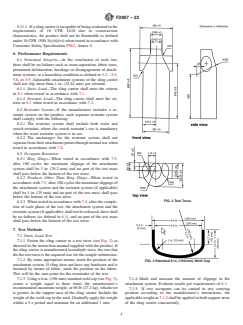
7.1.1 Fasten the sling carrier to a test torso (see Fig. 2) as directed in the instruction manual supplied with the product. If the sling
carrier is manufactured in multiple sizes, the size that fits the test torso is the required size for the sample submission.
7.1.2 By some appropriate means, mark the position of the attachment system. If sling does not have any hardware and is fastened
by means of fabric, mark the position on the fabric. This will be the start point for the remainder of the test.
7.1.3 Using a 6-in. (150-mm) standard weld cap (see Fig. 3), center a weight equal to three times the manufacturer’s recommended
maximum weight, or 60 lb (27.2 kg), whichever is greater, in the support area of the sling carrier. Include the weight of the weld
cap in the total. Gradually apply the weight within a 5-s period and maintain for an additional 1 min.
7.1.4 Mark and measure the amount of slippage in the attachment system. Evaluate results per requirements of 6.1.
7.1.5 If two occupants can be carried in any carrying position according to the manufacturer’s instructions, the applicable weight
in 7.1.3 shall be applied in both support areas of the sling carrier concurrently.
7.1.6 Repeat 7.1.1 – 7.1.5 for all manufacturer’s recommended carrying positions.
7.2 Dynamic Load Test:
FIG. 2 Test Torso
F2907 − 22
FIG. 3 Standard 6-in. (150-mm) Weld Cap
7.2.1 Fasten the sling carrier to a test torso (see Fig. 2) as directed in the instruction manual supplied with the product. If the sling
carrier is manufactured in multiple sizes, the size that fits the test torso is the required size for the sample submission.
7.2.2 Single Occupant Products:
7.2.2.1 Determine the appropriate number of test cycles using Table 1 based on the number of separate manufacturer’s
recommended carrying positions.
7.2.2.2 Position a 6 in. to 8 in. diameter shot bag weighing 35 lb (15.9 kg) or a mass equal to the manufacturer’s recommended
maximum weight for the specific carrying position of the product, whichever is greater, a distance of 1 in. (25 mm) above the
support area of the sling carrier.
7.2.2.3 Drop the weight onto the support area ten times with a cycle time of 4 s 6 1 s per cycle to preset the attachment system.
7.2.2.4 By some appropriate means, mark the position of the attachment system. If the sling does not have any hardware and is
fastened by means of fabric, mark the position of the fabric. This will be the start point for the remainder of the test.
7.2.2.5 Drop the weight onto the support area an additional X times with a cycle time of 4 s 6 1 s per cycle.
7.2.2.6 Mark and measure the amount of slippage in the attachment system. Evaluate results per requirements of 6.1.
7.2.2.7 Repeat 7.2.2.2 – 7.2.2.6 for each separate carrying position.
7.2.3 Two Occupant Products:
7.2.3.1 If two occupants can be carried in any carrying position according to the manufacturer’s instructions, load one support
area with the applicable static load as determined in 7.1.2. Repeat steps 7.2.2.1 – 7.2.2.6 in the other support area.
7.2.3.2 Repeat 7.2.3
...