

ASTM G174-22
(Test Method)Standard Test Method for Measuring Abrasion Resistance of Materials by Abrasive Loop Contact
General Information
- Abstract
SIGNIFICANCE AND USE
5.1 This test is useful for screening materials for use in tools that are subjected to abrasion from the material that is being machined, worked, or formed. It has been used to screen tool steels for punch press dies, hard-facings for earth-moving machinery, and wear coatings. This test apparatus is simpler to build and use than those used in the Test Method G132 abrasion test which, like this test, uses a fixed abrasive counterface to abrade a test material.
5.2 The one-hour test is intended for metals and materials that are softer than hardened steel (67 HRC), but may be applied to harder materials.
SCOPE
1.1 This test method covers ranking rigid engineering materials for abrasion resistance in rubbing against aluminum oxide abrasive finishing tape. Though most solids can be tested, this test method addresses its use for metals, and coatings applied to metals.
1.2 The values stated in SI units are to be regarded as standard. No other units of measurement are included in this standard.
1.3 This standard does not purport to address all of the safety concerns, if any, associated with its use. It is the responsibility of the user of this standard to establish appropriate safety, health, and environmental practices and determine the applicability of regulatory limitations prior to use.
1.4 This international standard was developed in accordance with internationally recognized principles on standardization established in the Decision on Principles for the Development of International Standards, Guides and Recommendations issued by the World Trade Organization Technical Barriers to Trade (TBT) Committee.
- Status
- Published
- Publication Date
- 31-Oct-2022
- Technical Committee
- G02 - Wear and Erosion
- Drafting Committee
- G02.30 - Abrasive Wear
Buy Documents
ASTM G174-22 - Standard Test Method for Measuring Abrasion Resistance of Materials by Abrasive Loop Contact
REDLINE ASTM G174-22 - Standard Test Method for Measuring Abrasion Resistance of Materials by Abrasive Loop Contact
Overview
ASTM G174-22: Standard Test Method for Measuring Abrasion Resistance of Materials by Abrasive Loop Contact is a key standard developed by ASTM International for evaluating and ranking the abrasion resistance of rigid engineering materials. The method involves rubbing a test specimen against a loop of aluminum oxide abrasive finishing tape, making it particularly applicable to metals and coatings applied to metals. This abrasion test offers a practical and reliable way to assess wear performance where materials are subjected to abrasive contact-such as in tools or components that experience heavy friction during machining, forming, or operation.
This standard outlines procedures, apparatus requirements, and options for evaluating both bulk metals and thin coatings. It is widely used in industry to benchmark and select materials for wear-critical applications.
Key Topics
- Test Methodology: The standard defines a process where materials are abraded using a continuously moving loop of fixed abrasive tape under a controlled load and speed. Wear is measured by evaluating the volume of material removed, either by direct mass change or geometric analysis of the abrasion scar.
- Applicability: Primarily designed for metals and metal coatings, the test is suitable for materials with hardness less than hardened steel (67 HRC), but may also be adapted for harder materials and specific surface treatments.
- Apparatus Simplicity: Compared to other abrasion test methods like ASTM G132, the abrasion loop contact apparatus is easier to construct and use, making it accessible for laboratories and production settings.
- Reporting: Guidelines are provided for documenting test conditions, specimen details, abrasive type and size, and measured wear volumes, ensuring meaningful comparisons between materials.
- Precision and Repeatability: The standard discusses factors affecting test consistency such as material homogeneity, alignment, and environmental conditions, with documented metrics for repeatability and reproducibility.
Applications
- Material Screening: Frequently used to screen candidate materials for abrasion resistance, making it invaluable in selecting tool steels, coatings, or surface treatments for wear applications.
- Tool and Machine Part Evaluation: Applied in the evaluation of punch press dies, earth-moving machine components, and wear protection coatings.
- Quality Control and Material Development: Useful as a quality control method in manufacturing and during R&D to evaluate new alloys, coatings, or thermal spray technologies.
- Comparative Analysis: Enables side-by-side comparison of uncoated metals, hard coatings, and treated surfaces to select the optimal material for specific abrasive environments.
- Specialized Coatings: Includes options for testing thin and thick hard coatings, thermal sprays, and plated surfaces to determine breakthrough resistance and wear performance.
Related Standards
ASTM G174-22 complements other abrasive wear and material test standards:
- ASTM G132: Standard Test Method for Pin Abrasion Testing-another widely used method for assessing abrasive wear using fixed abrasives.
- ASTM G40: Terminology Relating to Wear and Erosion-defines wear terms used in the field.
- ASTM E177, E178, E691: Guide practices for statistical evaluation, interlaboratory studies, and dealing with outlying observations in testing.
- ASTM G117: Guide for Calculating and Reporting Measures of Precision Using Data from Interlaboratory Wear or Erosion Tests.
These referenced documents help ensure standardized procedures, precise definitions, and accurate reporting for abrasion resistance testing across various industries.
Keywords: abrasion resistance, ASTM G174, abrasive loop contact, wear testing, metals, coatings, aluminum oxide tape, tribology, tool steels, hard coatings, material screening, quality control
Relations
- Effective Date
- 01-Dec-2018
- Effective Date
- 01-Jun-2016
- Effective Date
- 01-Nov-2015
- Effective Date
- 01-May-2014
- Effective Date
- 15-Nov-2013
- Effective Date
- 01-Aug-2013
- Effective Date
- 01-Jun-2013
- Effective Date
- 01-May-2013
- Effective Date
- 01-May-2013
- Effective Date
- 01-May-2012
- Effective Date
- 01-Nov-2011
- Effective Date
- 01-Dec-2010
- Effective Date
- 01-Oct-2010
- Effective Date
- 01-Jul-2010
- Effective Date
- 01-Jan-2010
Buy Documents
ASTM G174-22 - Standard Test Method for Measuring Abrasion Resistance of Materials by Abrasive Loop Contact
REDLINE ASTM G174-22 - Standard Test Method for Measuring Abrasion Resistance of Materials by Abrasive Loop Contact
Get Certified
Connect with accredited certification bodies for this standard

DVS-ZERT GmbH
German welding certification society.
CARES (UK Certification Authority for Reinforcing Steels)
UK certification for reinforcing steels and construction.
EWF/IIW (European/International Welding Federation)
International welding personnel certification.
Sponsored listings
Frequently Asked Questions
ASTM G174-22 is a standard published by ASTM International. Its full title is "Standard Test Method for Measuring Abrasion Resistance of Materials by Abrasive Loop Contact". This standard covers: SIGNIFICANCE AND USE 5.1 This test is useful for screening materials for use in tools that are subjected to abrasion from the material that is being machined, worked, or formed. It has been used to screen tool steels for punch press dies, hard-facings for earth-moving machinery, and wear coatings. This test apparatus is simpler to build and use than those used in the Test Method G132 abrasion test which, like this test, uses a fixed abrasive counterface to abrade a test material. 5.2 The one-hour test is intended for metals and materials that are softer than hardened steel (67 HRC), but may be applied to harder materials. SCOPE 1.1 This test method covers ranking rigid engineering materials for abrasion resistance in rubbing against aluminum oxide abrasive finishing tape. Though most solids can be tested, this test method addresses its use for metals, and coatings applied to metals. 1.2 The values stated in SI units are to be regarded as standard. No other units of measurement are included in this standard. 1.3 This standard does not purport to address all of the safety concerns, if any, associated with its use. It is the responsibility of the user of this standard to establish appropriate safety, health, and environmental practices and determine the applicability of regulatory limitations prior to use. 1.4 This international standard was developed in accordance with internationally recognized principles on standardization established in the Decision on Principles for the Development of International Standards, Guides and Recommendations issued by the World Trade Organization Technical Barriers to Trade (TBT) Committee.
SIGNIFICANCE AND USE 5.1 This test is useful for screening materials for use in tools that are subjected to abrasion from the material that is being machined, worked, or formed. It has been used to screen tool steels for punch press dies, hard-facings for earth-moving machinery, and wear coatings. This test apparatus is simpler to build and use than those used in the Test Method G132 abrasion test which, like this test, uses a fixed abrasive counterface to abrade a test material. 5.2 The one-hour test is intended for metals and materials that are softer than hardened steel (67 HRC), but may be applied to harder materials. SCOPE 1.1 This test method covers ranking rigid engineering materials for abrasion resistance in rubbing against aluminum oxide abrasive finishing tape. Though most solids can be tested, this test method addresses its use for metals, and coatings applied to metals. 1.2 The values stated in SI units are to be regarded as standard. No other units of measurement are included in this standard. 1.3 This standard does not purport to address all of the safety concerns, if any, associated with its use. It is the responsibility of the user of this standard to establish appropriate safety, health, and environmental practices and determine the applicability of regulatory limitations prior to use. 1.4 This international standard was developed in accordance with internationally recognized principles on standardization established in the Decision on Principles for the Development of International Standards, Guides and Recommendations issued by the World Trade Organization Technical Barriers to Trade (TBT) Committee.
ASTM G174-22 is classified under the following ICS (International Classification for Standards) categories: 25.100.70 - Abrasives. The ICS classification helps identify the subject area and facilitates finding related standards.
ASTM G174-22 has the following relationships with other standards: It is inter standard links to ASTM G132-96(2018), ASTM E178-16, ASTM G40-15, ASTM E177-14, ASTM G132-96(2013), ASTM G117-13, ASTM G40-13, ASTM E691-13, ASTM E177-13, ASTM G40-12, ASTM E691-11, ASTM G40-10b, ASTM E177-10, ASTM G40-10a, ASTM G40-10. Understanding these relationships helps ensure you are using the most current and applicable version of the standard.
ASTM G174-22 is available in PDF format for immediate download after purchase. The document can be added to your cart and obtained through the secure checkout process. Digital delivery ensures instant access to the complete standard document.
Standards Content (Sample)
This international standard was developed in accordance with internationally recognized principles on standardization established in the Decision on Principles for the
Development of International Standards, Guides and Recommendations issued by the World Trade Organization Technical Barriers to Trade (TBT) Committee.
Designation: G174 − 22
Standard Test Method for
Measuring Abrasion Resistance of Materials by Abrasive
Loop Contact
This standard is issued under the fixed designation G174; the number immediately following the designation indicates the year of
original adoption or, in the case of revision, the year of last revision. A number in parentheses indicates the year of last reapproval. A
superscript epsilon (´) indicates an editorial change since the last revision or reapproval.
1. Scope sion Tests (Withdrawn 2016)
G132 Test Method for Pin Abrasion Testing
1.1 This test method covers ranking rigid engineering ma-
terials for abrasion resistance in rubbing against aluminum
3. Terminology
oxide abrasive finishing tape. Though most solids can be
3.1 Definitions from Terminology G40:
tested, this test method addresses its use for metals, and
3.1.1 abrasive wear, n—wear due to hard particles or hard
coatings applied to metals.
protuberances forced against, and moving along, a solid
1.2 The values stated in SI units are to be regarded as
surface.
standard. No other units of measurement are included in this
3.2 Definitions of Terms Specific to This Standard:
standard.
3.2.1 abrasion resistance, n—in tribology, the ability of a
1.3 This standard does not purport to address all of the
material to resist damage or attrition by abrasion.
safety concerns, if any, associated with its use. It is the
3.2.2 fixed abrasive tape, n—hard particles or grains bonded
responsibility of the user of this standard to establish appro-
(fixed) to one side of a flexible web with a resin or similar
priate safety, health, and environmental practices and deter-
binder. The particles can be of any hard material and vary in
mine the applicability of regulatory limitations prior to use.
size. (This abrasive medium is also known as “finishing tape,”
1.4 This international standard was developed in accor-
“microfinishing tape,” “microfinishing film,” or “finishing
dance with internationally recognized principles on standard-
film.”)
ization established in the Decision on Principles for the
Development of International Standards, Guides and Recom-
3.2.3 flexible web, n—plastic, paper, rubber, or other mate-
mendations issued by the World Trade Organization Technical
rial that is thin enough to conform to a 180° wrap around a
Barriers to Trade (TBT) Committee.
16 mm diameter cylinder under a tension of less than
1.8 kg⁄cm width.
2. Referenced Documents
3.2.4 pass, n—abrasion distance equivalent to one circum-
2.1 ASTM Standards:
ference of the abrading loop.
E177 Practice for Use of the Terms Precision and Bias in
ASTM Test Methods
4. Summary of Test Method
E178 Practice for Dealing With Outlying Observations
4.1 This test involves rubbing an abrasive tape loop initially
E691 Practice for Conducting an Interlaboratory Study to
in line-contact with a solid surface.The tape abrasion produces
Determine the Precision of a Test Method
a groove in the test surface, and the volume of material
G40 Terminology Relating to Wear and Erosion
removed in a designated amount of abrasive rubbing is
G117 Guide for Calculating and Reporting Measures of
measured by mass loss or by calculation from the groove
Precision Using Data from Interlaboratory Wear or Ero-
geometry. The continuous loop of abrasive is used for a
specified number of passes and then discarded.
This test method is under the jurisdiction of ASTM Committee G02 on Wear
4.2 The wear volume produced in this test provides a
and Erosion and is the direct responsibility of Subcommittee G02.30 on Abrasive
measure of the ability of a surface to resist wear damage from
Wear.
Current edition approved Nov. 1, 2022. Published December 2022. Originally
abrasive substances. The smaller the wear volume in this test,
approved in 2003. Last previous edition approved in 2017 as G174 – 04 (2017).
the better the abrasion resistance.
DOI: 10.1520/G0174-22.
For referenced ASTM standards, visit the ASTM website, www.astm.org, or
contact ASTM Customer Service at service@astm.org. For Annual Book of ASTM
Standards volume information, refer to the standard’s Document Summary page on The last approved version of this historical standard is referenced on
the ASTM website. www.astm.org.
Copyright © ASTM International, 100 Barr Harbor Drive, PO Box C700, West Conshohocken, PA 19428-2959. United States
G174 − 22
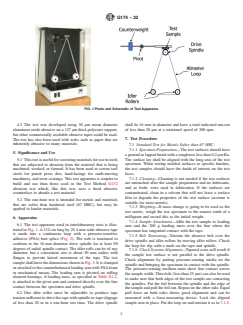
FIG. 1 Photo and Schematic of Test Apparatus
4.3 The test was developed using 30 µm mean diameter shall be 16 mm in diameter and have a total indicated run-out
aluminum oxide abrasive on a 127 µm thick polyester support, of less than 20 µm at a rotational speed of 300 rpm.
but other commercially available abrasive tapes could be used.
7. Test Procedure
The test has also been used with webs such as paper that are
inherently abrasive to many materials.
7.1 Standard Test for Metals Softer than 67 HRC:
7.1.1 Specimen Preparation—The test surfaces should have
5. Significance and Use
agroundorlappedfinishwitharoughnesslessthan0.2µmRa.
The surface lay shall be aligned with the long axis of the test
5.1 Thistestisusefulforscreeningmaterialsforuseintools
specimen. When testing molded surfaces or specific finishes,
that are subjected to abrasion from the material that is being
the test samples should have the finish of interest on the test
machined, worked, or formed. It has been used to screen tool
faces.
steels for punch press dies, hard-facings for earth-moving
machinery, and wear coatings. This test apparatus is simpler to 7.1.2 Cleaning—Cleaning is not needed if the test surfaces
are untouched after the sample preparation and no lubricants,
build and use than those used in the Test Method G132
abrasion test which, like this test, uses a fixed abrasive and so forth, were used in fabrication. If the surfaces are
contaminated, clean in a solvent that will not leave a surface
counterface to abrade a test material.
film or degrade the properties of the test surface (acetone is
5.2 The one-hour test is intended for metals and materials
suitable for most metals).
that are softer than hardened steel (67 HRC), but may be
7.1.3 Weighing—If mass change is going to be used as the
applied to harder materials.
test metric, weigh the test specimen to the nearest tenth of a
milligram and record this as the initial weight.
6. Apparatus
7.1.4 Sample Attachment—Affix the test sample to loading
6.1 The test apparatus used in interlaboratory tests is illus-
arm and the 200 g loading mass over the line where the
trated in Fig. 1.A132 cm long by 25.4 mm wide abrasive tape
specimen has tangential contact with the tape.
is made into a continuous loop with a pressure-sensitive
7.1.5 Belt Tensioning—Tension the abrasive belt over the
adhesive (PSA) butt splice (Fig. 2). The web is tensioned to
drive spindle and idler rollers by moving idler rollers. Check
conform to the 16 mm diameter drive spindle for at least 90
the loop for slip with a mark on the tape and spindle.
degrees of radial spindle contact. The idler rolls can be of any
7.1.6 Check Systems Alignment—Tapered scars will result if
diameter, but a convenient size is about 50 mm radius with
the sample test surface is not parallel to the drive spindle.
flanges to prevent lateral movement of the tape. The test
Check alignment by putting pressure-sensing media on the
sampleshallhavethedimensionsshowninFig.3.Itisclamped
spindle and bringing the specimen in contact with the spindle.
or attached to the counterbalanced loading arm with PSAfoam
The pressure-sensing medium must show line contact across
or mechanical means. The loading arm is pivoted on rolling
the sample width.Thin foils (less than 25 µm) can also be used
element bearings. A loading mass, as specified in Table X1.2,
to make sure that both edges of the test sample are contacting
is attached to the pivot arm and centered directly over the line
the spindles. Put the foil between the spindle and the edge of
contact between the specimen and drive spindle.
thesampleandpullthefoilout.Repeatontheotherside.Equal
6.2 One idler roller must be adjustable to produce tape pull force on both sides shows good alignment and can be
tensionsufficienttodrivethetapewithspindle-to-tapeslippage measured with a force-measuring device. Lock the aligned
of less than 20 m in a one-hour test time. The drive spindle sample arm in place. Put the loop on and tension it as in 7.1.5.
G174 − 22
1—127 µm thick microfinishing film was used in interlaboratory tests. It was purchased at:
3M Corporation
Imperial Lapping Film 262L
Grade 30 MIC, Mineral A/O
Backing 127 µm Size 25.4 mm wide, roll length is a purchasing option
2—Scotch Magic Tape (3M Corp.) was used in interlaboratory tests
3—3M Corp.
3M Center, Building 251-2A-08
St. Paul, MN 55144–1000 USA
NOTE 1—Some tapes may have a release agent or traction coating on the back that must be removed by abrasion followed by solvent wipe.
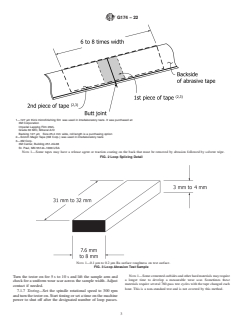
FIG. 2 Loop Splicing Detail
NOTE 1—0.1 µm to 0.2 µm Ra surface roughness on test surface.
FIG. 3 Loop Abrasion Test Sample
NOTE1—Somecementedcarbidesandotherhardmaterialsmayrequire
Turn the tester on for 5 s to 10 s and lift the sample arm and
a longer time to develop a measurable wear scar. Sometimes these
check for a uniform wear scar across the sample width.Adjust
materials require several 760-pass test cycles with the tape changed each
contact if needed.
hour. This is a non-standard test and is not covered by this method.
7.1.7 Testing—Set the spindle r
...
This document is not an ASTM standard and is intended only to provide the user of an ASTM standard an indication of what changes have been made to the previous version. Because
it may not be technically possible to adequately depict all changes accurately, ASTM recommends that users consult prior editions as appropriate. In all cases only the current version
of the standard as published by ASTM is to be considered the official document.
Designation: G174 − 04 (Reapproved 2017) G174 − 22
Standard Test Method for
Measuring Abrasion Resistance of Materials by Abrasive
Loop Contact
This standard is issued under the fixed designation G174; the number immediately following the designation indicates the year of
original adoption or, in the case of revision, the year of last revision. A number in parentheses indicates the year of last reapproval. A
superscript epsilon (´) indicates an editorial change since the last revision or reapproval.
1. Scope
1.1 This test method covers ranking rigid engineering materials for abrasion resistance in rubbing against aluminum oxide abrasive
finishing tape. Though most solids can be tested, this test method addresses its use for metals, and coatings applied to metals.
1.2 The values stated in SI units are to be regarded as standard. No other units of measurement are included in this standard.
1.3 This standard does not purport to address all of the safety concerns, if any, associated with its use. It is the responsibility
of the user of this standard to establish appropriate safety safety, health, and healthenvironmental practices and determine the
applicability of regulatory limitations prior to use.
1.4 This international standard was developed in accordance with internationally recognized principles on standardization
established in the Decision on Principles for the Development of International Standards, Guides and Recommendations issued
by the World Trade Organization Technical Barriers to Trade (TBT) Committee.
2. Referenced Documents
2.1 ASTM Standards:
E177 Practice for Use of the Terms Precision and Bias in ASTM Test Methods
E178 Practice for Dealing With Outlying Observations
E691 Practice for Conducting an Interlaboratory Study to Determine the Precision of a Test Method
G40 Terminology Relating to Wear and Erosion
G117 Guide for Calculating and Reporting Measures of Precision Using Data from Interlaboratory Wear or Erosion Tests
(Withdrawn 2016)
G132 Test Method for Pin Abrasion Testing
3. Terminology
3.1 Definitions:Definitions from Terminology G40:
3.1.1 abrasive wear, n—wear due to hard particles or hard protuberances forced against, and moving along, a solid surface.
3.2 Definitions of Terms Specific to This Standard:
3.2.1 abrasion, n—the process of abrasive wear.
This test method is under the jurisdiction of ASTM Committee G02 on Wear and Erosion and is the direct responsibility of Subcommittee G02.30 on Abrasive Wear.
Current edition approved July 15, 2017Nov. 1, 2022. Published August 2017December 2022. Originally approved in 2003. Last previous edition approved in 20092017
ɛ1
as G174 – 04 (2009)(2017). . DOI: 10.1520/G0174-04R17.10.1520/G0174-22.
For referenced ASTM standards, visit the ASTM website, www.astm.org, or contact ASTM Customer Service at service@astm.org. For Annual Book of ASTM Standards
volume information, refer to the standard’sstandard’s Document Summary page on the ASTM website.
The last approved version of this historical standard is referenced on www.astm.org.
Copyright © ASTM International, 100 Barr Harbor Drive, PO Box C700, West Conshohocken, PA 19428-2959. United States
G174 − 22
3.2.1.1 Discussion—
Terminology G40 does not define abrasion.
3.2.1 abrasion resistance, n—in tribology, the ability of a material to resist damage or attrition by abrasion.
3.2.2 fixed abrasive tape, n—hard particles or grains bonded (fixed) to one side of a flexible web with a resin or similar binder.
The particles can be of any hard material and vary in size. (This abrasive medium is also known as “finishing tape,” “microfinishing
tape,” “microfinishing film,” or “finishing film.”)
3.2.3 flexible web, n—plastic, paper, rubber, or other material that is thin enough to conform to a 180° wrap around a 16-mm16 mm
diameter cylinder under a tension of less than 1.8 kg ⁄cm width.
3.2.4 pass, n—abrasion distance equivalent to one circumference of the abrading loop.
4. Summary of Test Method
4.1 This test involves rubbing an abrasive tape loop initially in line-contact with a solid surface. The tape abrasion produces a
groove in the test surface, and the volume of material removed in a designated amount of abrasive rubbing is measured by mass
loss or by calculation from the groove geometry. The continuous loop of abrasive is used for the duration of the test a specified
number of passes and then discarded. A fresh loop is used for each one-hour test.
4.2 The wear volume produced in this test provides a measure of the ability of a surface to resist wear damage from abrasive
substances. The smaller the wear volume in this test, the better the abrasion resistance.
G174 − 22
FIG. 1 Photo and Schematic of Test RigApparatus
4.3 The test was developed using 30 μm-mean μm mean diameter aluminum oxide abrasive on a 127 μm-thickμm thick polyester
support, but other commercially available abrasive tapes could be used. The test has also been used with webs such as paper that
are inherently abrasive to many materials.
5. Significance and Use
5.1 This test is useful for screening materials for use in tools that are subjected to abrasion from the material that is being
machined, worked, or formed. It has been used to screen tool steels for punch press dies, hardfacingshard-facings for earth-moving
machinery, and wear coatings. This test apparatus is simpler to build and use than those used in the Test Method G132 abrasion
test which, like this test, uses a fixed abrasive counterface to abrade a test material.
5.2 The one-hour test is intended for metals and materials that are softer than hardened steel (67 HRC), but may be applied to
harder materials (see materials.7.1.7).
6. Apparatus
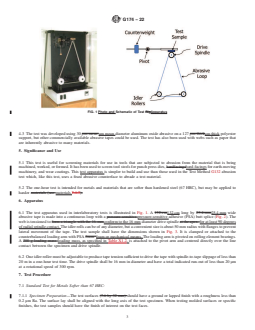
6.1 The test apparatus used in interlaboratory tests is illustrated in Fig. 1. A 132-cm132 cm long by 25.4-mm25.4 mm wide
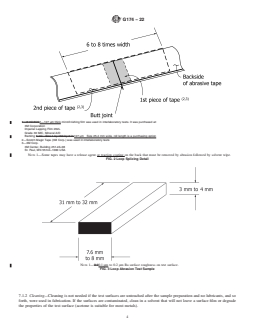
abrasive tape is made into a continuous loop with a pressure sensitive pressure-sensitive adhesive (PSA) butt splice (Fig. 2). The
web is tensioned to form a triangle with the 16-mmconform to the 16 mm diameter drive spindle at the apex. for at least 90 degrees
of radial spindle contact. The idler rolls can be of any diameter, but a convenient size is about 50 mm radius with flanges to prevent
lateral movement of the tape. The test sample shall have the dimensions shown in Fig. 3. It is clamped or attached to the
counterbalanced loading arm with PSA foam. foam or mechanical means. The loading arm is pivoted on rolling element bearings.
A 200 g loading mass loading mass, as specified in Table X1.2, is attached to the pivot arm and centered directly over the line
contact between the specimen and drive spindle.
6.2 One idler roller must be adjustable to produce tape tension sufficient to drive the tape with spindle-to-tape slippage of less than
20 m in a one-hour test time. The drive spindle shall be 16 mm in diameter and have a total indicated run-out of less than 20 μm
at a rotational speed of 300 rpm.
7. Test Procedure
7.1 Standard Test for Metals Softer than 67 HRC:
7.1.1 Specimen Preparation—The test surfaces (7.6 by 32 mm) should have a ground or lapped finish with a roughness less than
0.2 μm Ra. The surface lay shall be aligned with the long axis of the test specimen. When testing molded surfaces or specific
finishes, the test samples should have the finish of interest on the test faces.
G174 − 22
1—8 mil-thick1—127 μm thick microfinishing film was used in interlaboratory tests. It was purchased at:
3M Corporation
Imperial Lapping Film 262L
Grade 30 MIC, Mineral A/O
Backing 5 mil Size 1 by 150 by 3 in.127 μm Size 25.4 mm wide, roll length is a purchasing option
2—Scotch Magic Tape (3M Corp.) was used in interlaboratory tests
3—3M Corp.
3M Center, Building 251-2A-08
St. Paul, MN 55144–1000 USA
NOTE 1—Some tapes may have a release agent or traction coating on the back that must be removed by abrasion followed by solvent wipe.
FIG. 2 Loop Splicing Detail
NOTE 1—0.10.1 μm to 0.2 μm Ra surface roughness on test surface.
FIG. 3 Loop Abrasion Test Sample
7.1.2 Cleaning—Cleaning is not needed if the test surfaces are untouched after the sample preparation and no lubricants, and so
forth, were used in fabrication. If the surfaces are contaminated, clean in a solvent that will not leave a surface film or degrade
the properties of the test surface (acetone is suitable for most metals).
G174 − 22
7.1.3 Weighing—If mass change is going to be used as the test metric, weigh the test specimen to the nearest tenth of a milligram
and record this as the initial weight.
7.1.4 Sample Attachment—Affix the test sample to loading arm and the 200 g-loading g loading mass over the line where the
specimen has tangential contact with the tape.
7.1.5 Belt Tensioning—Tension the abrasive belt over the drive spindle and idler rollers by moving idler rollers. Check the loop
for slip with a mark on the tape and spindle. Loops are used only once for one hour.
7.1.6 Check Systems Alignment—Tapered scars will result if the sample test surface is not parallel to the drive spindle. Check
alignment by putting pressure sensing pressure-sensing media on the spindle and bringbringing the specimen in contact with the
spindle. The pressure-sensing medium must show line contact across the sample width. Thin foils (less than 25 μm) can also be
used to make sure that both edges of the test sample are contacting the spindles. Put the foil between the spindle and the edge of
the sample and pull the foil out. Repeat on the other side. Equal pull force on both sides shows good alignment,alignment and can
be measured with a force measuring force-measuring device. Lock the aligned sample arm in place. Put the loop on and tension
it as in 7.1.5. Turn the tester on for 55 s to 10 s and lift the sample arm and check for a uniform wear scar across the sample width.
Adjust contact if needed.
7.1.7 Testing—Set the spindle rotational speed to 300 rpm and turn the tester on. Start timing or set a time on the machine power
to shut off after one hour.the designated
G174 − 22
number of loop passes.
NOTE 1—Some cemented carbides and other hard materials may require a longer time to develop a measurable wear scar. Sometimes
...