

ASTM C1931-23
(Test Method)Standard Test Method for Determination of Uranium Isotopic Composition by Gamma-Ray Spectrometry
General Information
- Abstract
SIGNIFICANCE AND USE
4.1 The determination of uranium isotopic composition by gamma-ray spectrometry is a nondestructive technique and when used with other nondestructive techniques that quantify a single isotope, such as Test Methods C1133 (Segmented Gamma Scanning), C1221 (Solution Assay), C1455 (Holdup),and C1718 (Tomographic Gamma Scanning), can provide a wholly nondestructive assay of uranium mass necessary for material accountancy and safeguards needs. This method can be used with calorimetry (Test Method C1458) for kilogram quantities of high-enriched uranium and is also used to convert an Active-Well Coincidence Counter (4) measurement of 235U mass to total uranium mass.
4.2 Because gamma-ray spectrometry systems are typically automated, the routine use of the test method is fast, reliable, and is not labor intensive. The test method is nondestructive, requires no sample preparation, and does not create waste disposal problems.
4.3 The test method does not require that the system be calibrated to a specific geometry.
4.4 The test method assumes that all uranium in the measured item has the same isotopic distribution. This is often termed isotopic homogeneity.
4.5 The application of the test method does not depend upon the physical or chemical form of the material being analyzed.
4.6 The 236U abundance is not measured by this test method and must be estimated from isotopic correlation techniques, stream averages, historical information, or other measurement techniques.
4.7 The isotopic composition of a given item of uranium is an attribute of that item and, once determined, can be used in subsequent inventory measurements to verify the identity of an item within the measurement uncertainties.
4.8 The method can also measure the ratio of other gamma-emitting isotopes in the measured item to uranium assuming they have the same spatial distribution as the uranium in the item. Some of these “other” gamma-emitting isotopes include daughter isotopes of uranium, ces...
SCOPE
1.1 This test method applies to the nondestructive determination of the isotopic abundances of uranium, typically 234U, 235U, 236U, and 238U, in isotopically homogeneous uranium-bearing materials using gamma spectrometry. The material is commonly inside a container and is measured without specimen preparation.
1.2 This test method is applicable to items containing sub-gram quantities of uranium to the maximum uranium mass allowed by criticality considerations.
1.3 Measurable gamma ray emissions from uranium cover the energy range from below 80 keV to above 1000 keV. K-X-ray emissions from the isotopes of uranium and their daughters are found in the energy region around 100 keV. This test method has been applied to all portions of this energy range.
1.4 The isotopic abundance of 236U is usually not directly determined because its low-energy gamma rays are too weak (1)2 to be detected under normal measurement conditions. Isotopic correlation techniques have been used to estimate its relative abundance (2).
1.5 This test method has been demonstrated in routine use for isotopic amount fraction (atom %) of 235U from 0.2 % to 97 %.
1.6 This test method requires decay equilibrium (160 days for 99 %) between 238U and its 24.1 d half-life 234Th daughter. Corrections can be made if the date of chemical separation of the 234Th daughter is known.
1.7 The values stated in SI units are to be regarded as standard. No other units of measurement are included in this standard.
1.8 This standard does not purport to address all of the safety concerns, if any, associated with its use. It is the responsibility of the user of this standard to establish appropriate safety, health, and environmental practices and determine the applicability of regulatory limitations prior to use.
1.9 This international standard was developed in accordance with internationally recognized principles on standardization established in the Dec...
- Status
- Published
- Publication Date
- 31-May-2023
- Technical Committee
- C26 - Nuclear Fuel Cycle
- Drafting Committee
- C26.10 - Non Destructive Assay
Overview
ASTM C1931-23, titled Standard Test Method for Determination of Uranium Isotopic Composition by Gamma-Ray Spectrometry, specifies a nondestructive method for accurately determining the isotopic abundances of uranium isotopes-most notably 234U, 235U, 236U, and 238U-present in homogeneous uranium-bearing materials. Developed by ASTM, this international standard is widely used in nuclear fuel cycle operations, safeguards, and material accountancy to support quality assurance and regulatory compliance.
Gamma-ray spectrometry is advantageous for uranium assay because it does not require sample preparation, does not generate radioactive waste, and is suitable for bulk and containerized materials. The method efficiently enables high-throughput and reliable analysis through automation, making it a cornerstone technique for nuclear facilities and laboratories worldwide.
Key Topics
- Nondestructive Uranium Assay: The method uses gamma-ray spectra to determine uranium isotope ratios without altering or consuming the material, preserving sample integrity.
- Applicability: Suitable for a broad range of uranium masses, from sub-gram samples up to quantities constrained by criticality safety considerations, and for various physical and chemical forms, as long as the uranium is isotopically homogeneous.
- Energy Range: The gamma-ray emissions measured span from below 80 keV to above 1000 keV, covering both K-X-rays (around 100 keV) and higher-energy gamma peaks.
- No Need for Geometry Calibration: Accurate results are achievable without calibrating the system for a specific measurement geometry-facilitating flexible, on-site applications.
- Use with Other Methods: This standard can be combined with other nondestructive techniques-such as calorimetry, segmented gamma scanning, solution assay, and tomographic gamma scanning-providing a comprehensive solution for uranium mass and isotope determination.
- Isotopic Homogeneity: The technique assumes all uranium within the measured item shares the same isotopic distribution, a key consideration for procedural validity.
- Limits: Measurement of 236U is indirect and typically relies on supplemental isotopic correlation or historical data.
Applications
- Nuclear Material Safeguards: Vital for verifying declared compositions, preventing diversion or misuse, and performing inventory checks in fuel cycle facilities.
- Quality Control: Supports product specification validation and verification of isotopic homogeneity in uranium-bearing materials used in fuel fabrication, enrichment, and recycling.
- Nuclear Waste Management: Provides nondestructive isotope-specific analysis for waste characterization, ensuring compliance with disposal and storage regulations.
- Regulatory Compliance and Reporting: Used for meeting international and national standards on nuclear material accountancy, as required by agencies and treaties.
- Research and Development: Essential for laboratories studying uranium isotopic distribution and gamma spectrometry instrumentation.
Related Standards
For comprehensive uranium assay and to ensure full compliance and methodological rigor, reference the following complementary standards:
- ASTM C1133: Nondestructive assay of special nuclear material using segmented passive gamma-ray scanning.
- ASTM C1221: Nondestructive analysis of special nuclear materials in homogeneous solutions by gamma-ray spectrometry.
- ASTM C1455: Nondestructive holdup measurements using gamma-ray spectroscopic methods.
- ASTM C1718: Tomographic gamma scanning for radioactive material assay.
- ASTM C1458: Assay of plutonium and uranium by calorimetric measurement.
- ANSI/IEEE Std 325-1996: Test procedures for germanium gamma-ray detectors.
- ANSI N15.36: Nondestructive assay measurement control and assurance.
ASTM C1931-23 plays a critical role in advancing safe, efficient, and regulatory-compliant management of uranium materials, underpinning global nonproliferation and industry best practices in nuclear safeguards and material management.
Frequently Asked Questions
ASTM C1931-23 is a standard published by ASTM International. Its full title is "Standard Test Method for Determination of Uranium Isotopic Composition by Gamma-Ray Spectrometry". This standard covers: SIGNIFICANCE AND USE 4.1 The determination of uranium isotopic composition by gamma-ray spectrometry is a nondestructive technique and when used with other nondestructive techniques that quantify a single isotope, such as Test Methods C1133 (Segmented Gamma Scanning), C1221 (Solution Assay), C1455 (Holdup),and C1718 (Tomographic Gamma Scanning), can provide a wholly nondestructive assay of uranium mass necessary for material accountancy and safeguards needs. This method can be used with calorimetry (Test Method C1458) for kilogram quantities of high-enriched uranium and is also used to convert an Active-Well Coincidence Counter (4) measurement of 235U mass to total uranium mass. 4.2 Because gamma-ray spectrometry systems are typically automated, the routine use of the test method is fast, reliable, and is not labor intensive. The test method is nondestructive, requires no sample preparation, and does not create waste disposal problems. 4.3 The test method does not require that the system be calibrated to a specific geometry. 4.4 The test method assumes that all uranium in the measured item has the same isotopic distribution. This is often termed isotopic homogeneity. 4.5 The application of the test method does not depend upon the physical or chemical form of the material being analyzed. 4.6 The 236U abundance is not measured by this test method and must be estimated from isotopic correlation techniques, stream averages, historical information, or other measurement techniques. 4.7 The isotopic composition of a given item of uranium is an attribute of that item and, once determined, can be used in subsequent inventory measurements to verify the identity of an item within the measurement uncertainties. 4.8 The method can also measure the ratio of other gamma-emitting isotopes in the measured item to uranium assuming they have the same spatial distribution as the uranium in the item. Some of these “other” gamma-emitting isotopes include daughter isotopes of uranium, ces... SCOPE 1.1 This test method applies to the nondestructive determination of the isotopic abundances of uranium, typically 234U, 235U, 236U, and 238U, in isotopically homogeneous uranium-bearing materials using gamma spectrometry. The material is commonly inside a container and is measured without specimen preparation. 1.2 This test method is applicable to items containing sub-gram quantities of uranium to the maximum uranium mass allowed by criticality considerations. 1.3 Measurable gamma ray emissions from uranium cover the energy range from below 80 keV to above 1000 keV. K-X-ray emissions from the isotopes of uranium and their daughters are found in the energy region around 100 keV. This test method has been applied to all portions of this energy range. 1.4 The isotopic abundance of 236U is usually not directly determined because its low-energy gamma rays are too weak (1)2 to be detected under normal measurement conditions. Isotopic correlation techniques have been used to estimate its relative abundance (2). 1.5 This test method has been demonstrated in routine use for isotopic amount fraction (atom %) of 235U from 0.2 % to 97 %. 1.6 This test method requires decay equilibrium (160 days for 99 %) between 238U and its 24.1 d half-life 234Th daughter. Corrections can be made if the date of chemical separation of the 234Th daughter is known. 1.7 The values stated in SI units are to be regarded as standard. No other units of measurement are included in this standard. 1.8 This standard does not purport to address all of the safety concerns, if any, associated with its use. It is the responsibility of the user of this standard to establish appropriate safety, health, and environmental practices and determine the applicability of regulatory limitations prior to use. 1.9 This international standard was developed in accordance with internationally recognized principles on standardization established in the Dec...
SIGNIFICANCE AND USE 4.1 The determination of uranium isotopic composition by gamma-ray spectrometry is a nondestructive technique and when used with other nondestructive techniques that quantify a single isotope, such as Test Methods C1133 (Segmented Gamma Scanning), C1221 (Solution Assay), C1455 (Holdup),and C1718 (Tomographic Gamma Scanning), can provide a wholly nondestructive assay of uranium mass necessary for material accountancy and safeguards needs. This method can be used with calorimetry (Test Method C1458) for kilogram quantities of high-enriched uranium and is also used to convert an Active-Well Coincidence Counter (4) measurement of 235U mass to total uranium mass. 4.2 Because gamma-ray spectrometry systems are typically automated, the routine use of the test method is fast, reliable, and is not labor intensive. The test method is nondestructive, requires no sample preparation, and does not create waste disposal problems. 4.3 The test method does not require that the system be calibrated to a specific geometry. 4.4 The test method assumes that all uranium in the measured item has the same isotopic distribution. This is often termed isotopic homogeneity. 4.5 The application of the test method does not depend upon the physical or chemical form of the material being analyzed. 4.6 The 236U abundance is not measured by this test method and must be estimated from isotopic correlation techniques, stream averages, historical information, or other measurement techniques. 4.7 The isotopic composition of a given item of uranium is an attribute of that item and, once determined, can be used in subsequent inventory measurements to verify the identity of an item within the measurement uncertainties. 4.8 The method can also measure the ratio of other gamma-emitting isotopes in the measured item to uranium assuming they have the same spatial distribution as the uranium in the item. Some of these “other” gamma-emitting isotopes include daughter isotopes of uranium, ces... SCOPE 1.1 This test method applies to the nondestructive determination of the isotopic abundances of uranium, typically 234U, 235U, 236U, and 238U, in isotopically homogeneous uranium-bearing materials using gamma spectrometry. The material is commonly inside a container and is measured without specimen preparation. 1.2 This test method is applicable to items containing sub-gram quantities of uranium to the maximum uranium mass allowed by criticality considerations. 1.3 Measurable gamma ray emissions from uranium cover the energy range from below 80 keV to above 1000 keV. K-X-ray emissions from the isotopes of uranium and their daughters are found in the energy region around 100 keV. This test method has been applied to all portions of this energy range. 1.4 The isotopic abundance of 236U is usually not directly determined because its low-energy gamma rays are too weak (1)2 to be detected under normal measurement conditions. Isotopic correlation techniques have been used to estimate its relative abundance (2). 1.5 This test method has been demonstrated in routine use for isotopic amount fraction (atom %) of 235U from 0.2 % to 97 %. 1.6 This test method requires decay equilibrium (160 days for 99 %) between 238U and its 24.1 d half-life 234Th daughter. Corrections can be made if the date of chemical separation of the 234Th daughter is known. 1.7 The values stated in SI units are to be regarded as standard. No other units of measurement are included in this standard. 1.8 This standard does not purport to address all of the safety concerns, if any, associated with its use. It is the responsibility of the user of this standard to establish appropriate safety, health, and environmental practices and determine the applicability of regulatory limitations prior to use. 1.9 This international standard was developed in accordance with internationally recognized principles on standardization established in the Dec...
ASTM C1931-23 is available in PDF format for immediate download after purchase. The document can be added to your cart and obtained through the secure checkout process. Digital delivery ensures instant access to the complete standard document.
Standards Content (Sample)
This international standard was developed in accordance with internationally recognized principles on standardization established in the Decision on Principles for the
Development of International Standards, Guides and Recommendations issued by the World Trade Organization Technical Barriers to Trade (TBT) Committee.
Designation: C1931 − 23
Standard Test Method for
Determination of Uranium Isotopic Composition by Gamma-
Ray Spectrometry
This standard is issued under the fixed designation C1931; the number immediately following the designation indicates the year of
original adoption or, in the case of revision, the year of last revision. A number in parentheses indicates the year of last reapproval. A
superscript epsilon (´) indicates an editorial change since the last revision or reapproval.
1. Scope responsibility of the user of this standard to establish appro-
priate safety, health, and environmental practices and deter-
1.1 This test method applies to the nondestructive determi-
234 mine the applicability of regulatory limitations prior to use.
nation of the isotopic abundances of uranium, typically U,
235 236 238 1.9 This international standard was developed in accor-
U, U, and U, in isotopically homogeneous uranium-
dance with internationally recognized principles on standard-
bearing materials using gamma spectrometry. The material is
ization established in the Decision on Principles for the
commonly inside a container and is measured without speci-
Development of International Standards, Guides and Recom-
men preparation.
mendations issued by the World Trade Organization Technical
1.2 This test method is applicable to items containing
Barriers to Trade (TBT) Committee.
sub-gram quantities of uranium to the maximum uranium mass
allowed by criticality considerations.
2. Referenced Documents
1.3 Measurable gamma ray emissions from uranium cover 2.1 ASTM Standards:
the energy range from below 80 keV to above 1000 keV.
C698 Test Methods for Chemical, Mass Spectrometric, and
K-X-ray emissions from the isotopes of uranium and their Spectrochemical Analysis of Nuclear-Grade Mixed Ox-
daughters are found in the energy region around 100 keV. This
ides ((U, Pu)O )
test method has been applied to all portions of this energy C1030 Test Method for Determination of Plutonium Isotopic
range.
Composition by Gamma-Ray Spectrometry
C1133 Test Method for Nondestructive Assay of Special
1.4 The isotopic abundance of U is usually not directly
Nuclear Material in Low-Density Scrap and Waste by
determined because its low-energy gamma rays are too weak
Segmented Passive Gamma-Ray Scanning
(1) to be detected under normal measurement conditions.
C1221 Test Method for Nondestructive Analysis of Special
Isotopic correlation techniques have been used to estimate its
Nuclear Materials in Homogeneous Solutions by Gamma-
relative abundance (2).
Ray Spectrometry
1.5 This test method has been demonstrated in routine use
C1316 Test Method for Nondestructive Assay of Nuclear
for isotopic amount fraction (atom %) of U from 0.2 % to
Material in Scrap and Waste by Passive-Active Neutron
97 %. 252
Counting Using Cf Shuffler
1.6 This test method requires decay equilibrium (160 days C1455 Test Method for Nondestructive Assay of Special
238 234
for 99 %) between U and its 24.1 d half-life Th daughter. Nuclear Material Holdup Using Gamma-Ray Spectro-
Corrections can be made if the date of chemical separation of scopic Methods
the Th daughter is known. C1458 Test Method for Nondestructive Assay of Plutonium,
Tritium and Am by Calorimetric Assay
1.7 The values stated in SI units are to be regarded as
C1493 Test Method for Non-Destructive Assay of Nuclear
standard. No other units of measurement are included in this
Material in Waste by Passive and Active Neutron Count-
standard.
ing Using a Differential Die-Away System
1.8 This standard does not purport to address all of the 235
C1514 Test Method for Measurement of U Fraction Using
safety concerns, if any, associated with its use. It is the
Enrichment Meter Principle
C1673 Terminology of C26.10 Nondestructive Assay Meth-
ods
This test method is under the jurisdiction of ASTM Committee C26 on Nuclear
Fuel Cycle and is the direct responsibility of Subcommittee C26.10 on Non
Destructive Assay.
Current edition approved June 1, 2023. Published November 2023. DOI: For referenced ASTM standards, visit the ASTM website, www.astm.org, or
10.1520/C1931-23. contact ASTM Customer Service at service@astm.org. For Annual Book of ASTM
The boldface numbers in parentheses refer to the list of references at the end Standards volume information, refer to the standard’s Document Summary page on
of this standard. the ASTM website.
Copyright © ASTM International, 100 Barr Harbor Drive, PO Box C700, West Conshohocken, PA 19428-2959. United States
C1931 − 23
C1718 Test Method for Nondestructive Assay of Radioac- Relative efficiency data from different isotopes may be used
tive Material by Tomographic Gamma Scanning to extend the relative efficiency curve. Data from different
E181 Guide for Detector Calibration and Analysis of Radio- isotopes have the same shape but different normalization
nuclides in Radiation Metrology for Reactor Dosimetry constants. It is customary to fit all the relative efficiency data to
E267 Test Method for Uranium and Plutonium Concentra- a mathematical function. The mathematical function is often
tions and Isotopic Abundances chosen to represent the physical processes present in the
2.2 ANSI Standards: measurement although simple polynomial functions have also
ANSI/IEEE Std 325-1996 IEEE Standard Test Procedures been used. This process relies on the assumption that only a
for Germanium Gamma-Ray Detectors single isotopic composition is present.
ANSI N15.36 Measurement Control Program – Nondestruc-
3.5 All factors in Eq 1 are either determined from the
tive Assay Measurement Control and Assurance
gamma-ray spectrum of the measured item or are known,
published nuclear constants. The isotope amount ratios are
3. Summary of Test Method
determined without recourse to standards or calibration by this
3.1 The full-energy peak intensities of gamma-rays emitted
so-called Intrinsic Calibration technique.
from an uranium-bearing item are determined from a single
3.6 The measured isotope amount ratios can be converted to
gamma-ray spectrum obtained with a High-Purity Germanium
isotope amount fractions when the isotope amount ratios of all
(HPGe) detector. The method has also been developed for use
isotopes are measured with respect to a common isotope.
with LaBr (Ce) and CZT detectors (3).
3.6.1 Example—Measuring isotope amount ratios (Eq 1)
3.2 3.2 For isotopically homogeneous uranium the isotope
with respect to U. Measure f /f , f /f , .f /f ,
i k 234 238 235 238 i 238
amount ratio, N /N , for isotopes i and k is related to the net
where f is the isotope amount fraction of isotope i in the
i
i
counts in the full energy peaks of interest, C (E ), for gamma
j
measured item.
k
ray j with energy E emitted from isotope i and C (E ) for
j l
3.6.2 All isotope amount fractions must sum to unity.
gamma ray l with energy E from isotope k by:
l
1.0 5 f 1f 1f 1f (3)
234 235 236 238
i i i k
N C E T BR RE E
~ ! ~ !
j 1⁄2 l l
5 · · · (1)
k k k i
3.6.3 Dividing Eq 3 by the common isotope amount
N C E T BR RE E
~ ! ~ !
l 1⁄2 j j
fraction, f , and rearranging gives an expression for the
where: 238
isotope amount fraction of the common isotope, U here, in
RE(E ) = relative detection efficiency for a gamma-ray of
terms of the directly measured isotope amount ratios (see
i
energy E ,
i 3.6.1).
i
T = half-life of isotope i, and
1⁄2
f f f
i
234 235 236
BR = gamma-ray branching ratio or branching intensity
j f 5 1 1 11 (4)
F S D G
f f f
238 238 238
(usually expressed as gamma-rays per disintegra-
tion) of gamma ray j from isotope i.
3.6.4 Compute the other isotope amount fractions from the
measured isotope amount ratios and Eq 4.
Eq 1 applies to isotopically homogeneous uranium where the
relative efficiency is only dependent on energy.
f
i
f 5 × f ,ifi236 (5)
i 238
f
3.3 The half-lives T and the branching ratios BR are
1/2
known, published nuclear data. The full energy peak counting
3.6.5 Compute f from an isotopic correlation or accept-
intensity C(E) is determined from the gamma-ray spectrum of
able knowledge. (See 1.4 and Refs (1 and 2).)
the measured item.
3.6.6 Renormalize, if needed, so all isotope amount frac-
3.4 The relative detection efficiency, RE(E), is a function of
tions sum to unity.
gamma-ray energy and arises from the combined effects of
3.6.7 The directly measured isotope amount fractions may
detector response, attenuation due to absorbers and container
be converted to isotope mass fractions, if desired, using:
walls, and self-absorption within the measured item for gamma
f ·A
xxx xxx
rays of differing energies. The relative detection efficiencies are m 5 (6)
xxx
f · A 1 f · A 1 f · A 1 f · A
~ !
234 234 235 235 236 236 238 238
determined for each measured item from the observed gamma-
where:
ray spectrum by considering a series of gamma rays from a
single isotope. The quotient of the photopeak counting inten-
m = isotope mass fraction of isotope xxx,
xxx
sity for gamma ray j with energy E emitted from isotope i and A = atomic mass of isotope xxx, and
j
xxx
the branching ratio of gamma ray j from isotope i is propor- f = directly measured isotope amount fraction of isotope
xxx
tional to the relative detection efficiency at energy E . This xxx.
j
quotient defines the shape of the relative efficiency as a
function of energy. 4. Significance and Use
i i
C~E ! N
4.1 The determination of uranium isotopic composition by
j
} ·RE~E ! (2)
i S i D
j
BR T
gamma-ray spectrometry is a nondestructive technique and
j 1⁄2
when used with other nondestructive techniques that quantify a
single isotope, such as Test Methods C1133 (Segmented
Available from American National Standards Institute (ANSI), 25 W. 43rd St.,
4th Floor, New York, NY 10036, http://www.ansi.org. Gamma Scanning), C1221 (Solution Assay), C1455 (Holdup),
C1931 − 23
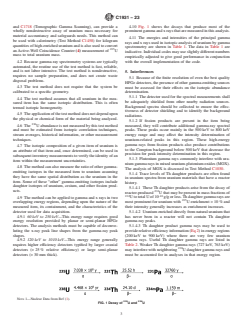
and C1718 (Tomographic Gamma Scanning), can provide a 4.10 Fig. 1 shows the decays that produce most of the
wholly nondestructive assay of uranium mass necessary for prominent gamma and x rays that are measured in this analysis.
material accountancy and safeguards needs. This method can
4.11 The energies and intensities of the principal gamma
be used with calorimetry (Test Method C1458) for kilogram
rays and x rays used in isotopic analysis of uranium by gamma
quantities of high-enriched uranium and is also used to convert
spectrometry are shown in Table 1. The data in Table 1 are
an Active-Well Coincidence Counter (4) measurement of U
indicative. Individual codes may use slightly different numbers
mass to total uranium mass.
empirically adjusted to give good performance in conjunction
4.2 Because gamma-ray spectrometry systems are typically with the overall implementation of the code.
automated, the routine use of the test method is fast, reliable,
and is not labor intensive. The test method is nondestructive, 5. Interferences
requires no sample preparation, and does not create waste
5.1 Because of the finite resolution of even the best quality
disposal problems.
HPGe detectors, the presence of other gamma-emitting sources
4.3 The test method does not require that the system be must be assessed for their effects on the isotopic abundance
calibrated to a specific geometry.
determination.
5.1.1 The detector used for the spectral measurements shall
4.4 The test method assumes that all uranium in the mea-
be adequately shielded from other nearby radiation sources.
sured item has the same isotopic distribution. This is often
Background spectra should be collected to ensure the effec-
termed isotopic homogeneity.
tiveness of detector shielding and to identify the background
4.5 The application of the test method does not depend upon
radiations.
the physical or chemical form of the material being analyzed.
5.1.2 If fission products are present in the item being
4.6 The U abundance is not measured by this test method measured, they will contribute additional gamma-ray spectral
and must be estimated from isotopic correlation techniques, peaks. These peaks occur mainly in the 500 keV to 800 keV
stream averages, historical information, or other measurement energy range and may affect the intensity determination of
techniques. uranium-related peaks in this region. These high-energy
gamma rays from fission products also produce contributions
4.7 The isotopic composition of a given item of uranium is
to the Compton background below 500 keV that decrease the
an attribute of that item and, once determined, can be used in
precision for peak intensity determination in this region.
subsequent inventory measurements to verify the identity of an
5.1.3 Plutonium gamma rays commonly interfere with ura-
item within the measurement uncertainties.
nium gamma rays in mixed uranium-plutonium oxides (MOX).
4.8 The method can also measure the ratio of other gamma-
The analysis of MOX is discussed in Test Method C1030.
emitting isotopes in the measured item to uranium assuming
5.1.4 Trace levels of Th daughter products are often found
they have the same spatial distribution as the uranium in the
in uranium spectra from uranium materials that have a reactor
item. Some of these “other” gamma-emitting isotopes include
history.
daughter isotopes of uranium, cesium, and other fission prod-
5.1.4.1 These Th daughter products arise from the decay of
ucts. 232
reactor-produced U that may be present in mass fractions of
232 -10
4.9 The method can be applied to gamma and x rays in two U to total U of 10 g/g or less. Th daughter gamma rays are
overlapping energy regions, depending upon the nature of the most prominent for uranium with U enrichment > 10 % and
measured item, its containment, and the characteristics of the their intensity generally increases as enrichment increases.
detector used for data acquisition. 5.1.4.2 Uranium enriched directly from natural uranium that
4.9.1 60 keV to 250 keV—This energy range requires good has never been in a reactor will not contain Th daughter
energy resolution provided by planar or semi-planar HPGe gamma-ray peaks.
detectors. The analysis methods must be capable of deconvo- 5.1.4.3 Th daughter product gamma rays may be used to
luting the x-ray peak line shapes from the gamma-ray peak provide relative efficiency information (Eq 2) in energy regions
shapes. (200 keV to 900 keV) where there are very few uranium
4.9.2 120 keV to 1010 keV—This energy range generally gamma rays. Useful Th daughter gamma rays are listed in
requires higher efficiency detectors typified by larger coaxial Table 2. Weaker Th daughter gamma rays (727 keV, 763 keV)
detectors (> 25 % relative efficiency) or large semi-planar may interfere with neighboring U daughter gamma rays and
detectors (> 30 mm thick). must be accounted for in analyses in that energy region.
NOTE 1—Nuclear Data from Ref (1).
235 238
FIG. 1 Decay of U and U
C1931 − 23
TABLE 1 Energies and Branching Intensities of Principal X- and
5.2.2.1 These effects can be corrected (5) and current
Gamma-Ray Peaks Used in Gamma-Ray Isotopic Analysis of
generation analysis software (2) applies these corrections in a
A
Uranium
transparent fashion.
Isotope Energy (keV) Branching Intensity
5.2.3 True coincidence summing effects are also observed
(photons/disintegration,
%) for analyses in the 60 keV to 250 keV region for an analysis
231 B
Th 81.2280 (14) 0.90 (5)
code using the ThKα1 and ThK x-ray peaks for U analysis
α2
Th 84.2140 (13) 6.6 (4)
(6). These effects bias the results by 5 % to 8 % for detector-
ThKa2 89.957 3.43 (9)
PaKa2 92.282 0.35 (4)
sample contact and essentially vanish at sample-detector dis-
Th 92.38 (1) 2.13 (20)
tance of 10 cm.
Th 92.80 (2) 2.10 (20)
5.2.3.1 Analysis software that minimizes the use of Th x
ThKa1 93.350 5.54 (14)
C
UKa2 94.654 0.626 rays for U analysis does not exhibit this effect for analysis in
PaKa1 95.863 0.57 (6)
the 60 keV to 250 keV region.
C
UKa1 98.434 1.000
234 5.2.4 Random summing and pileup can affect measurements
U 120.90 (2) 0.035 (5)
U 143.76 (2) 10.96 (14)
in the 120 keV to 1010 keV energy range and also the 60 keV
U 163.356 (3) 5.08 (6)
to 250 keV energy range.
U 185.715 (5) 57.0 (6)
5.2.4.1 The 163.36 keV U gamma ray can sum with UK
U 202.12 (1) 1.080 (23) α
235 238
U 205.316 (10) 5.02 (6)
x rays to produce interferences around the 258.3 keV U
234m
Pa 258.227 (3) 0.0764 (21)
daughter peak which is important in 120 keV to 1010 keV
234m
Pa 742.813 (5) 0.1066 (23)
234m
energy-range analyses. The software of Ref (2) corrects for this
Pa 766.42 (10) 0.317 (5)
234m
Pa 786.28 (10) 0.0544 (8)
effect.
234m
Pa 1001.03 (10) 0.842 (8) 235
5.2.4.2 The 143.76 keV U gamma ray can sum with UK
α
A
Energies and Branching Intensities from Ref (1).
x rays to produce interferences around the Th daughter gamma
B
Uncertainties in parentheses are absolute 1σ values.
C ray at 238.6 keV which can be used for relative efficiency
Relative values from unweighted mean of plutonium decay data from Ref (1).
determination in 120 keV to 1010 keV energy range analysis.
The software of Ref (2) corrects for this effect.
228 A
TABLE 2 Useful Th Daughter Gamma Rays
5.2.4.3 Lead K x rays (72.8 keV, 75.0 keV) produced in Pb
α
Energy (keV) Source Branching Fraction shielding around the detector, can sum with the strong U
238.632 (2) Pb 0.436 (5)
gamma ray at 185.72 keV to produce interferences in the
240.986 (6) Ra 0.0410 (5)
208 258 keV region. This effect can be removed by properly
277.371 (5) Tl 0.0237 (11)
300.087 (10) Pb 0.0330 (4)
shielding the detector from Pb x rays with a graded-Z filter that
583.187 (2) Tl 0.3055 (11)
lines the inside of the Pb detector shield.
722.04 (12) Tl 8.6 (14) E-04
5.2.4.4 Lead K x rays around 84.8 keV and 87.5 keV can
727.330 (9) Bi β- 0.0667 (9) β
763.13 (8) Tl 6.43 (11) E-03
interfere with the 84.22 keV Th peak possibly affecting
785.37 (8) Bi β- 0.01102 (13)
analysis in the 60 keV to 250 keV energy range. This effect can
860.557 (4) Tl 0.04493 (36)
be removed by properly shielding the detector from Pb x-rays
A
Branching Fraction and Energy from Ref (1).
(typically from Pb shielding around the detector) with a
graded-Z filter lining the Pb shielding.
5.1.5 Samples with Th mixed with U would contribute
6. Apparatus
additional x-ray fluorescence from Th which must be ac-
6.1 Cooled High-Purity Germanium Detector,
counted for in analyses in the 60 keV to 250 keV region.
5.1.6 Uranium ore samples produce many gamma rays and Preamplifier—Cooling of the HPGe crystal may come from
214 214
x rays from Pb, Bi, and other decay products that can liquid nitrogen (LN ) or from electric or electro-mechanical
interfere with the uranium analysis peaks. coolers that do not use LN . The configuration of the HPGe
– 234m
5.1.7 Bremsstrahlung from the β decay of Pa contrib- detector may be planar, semi-planar, or coaxial with the type,
utes greatly to the background continuum for items with high size and energy resolution of the detector chosen to accommo-
concentrations of U. This adversely affects the signal-to- date the energy range of analysis for the desired measurements.
background ratio, especially for gamma ray peaks below Planar or semiplanar detectors with energy resolution (full-
500 keV. width at half-maximum) at 122 keV better than 700 eV are best
for analysis of spectra in the 60 keV to 250 keV region. Larger
5.2 Count rate and coincidence summing effects may also
volume coaxial detectors with relative efficiencies > 25 %
affect the isotopic abundance determination.
(ANSI/IEEE Std 325-1996) or large volume semi-planar de-
5.2.1 True coincidence summing effects increase as sample-
tectors (4.9.2) are used for analysis in the 120 keV to 1010 keV
to-detector distance decreases and also increase as the detector
energy region. Resolution of 2 keV or better at 1332 keV is
diameter increases.
preferred.
5.2.2 True coincidence summing affects measurements in
the 120 keV to 1010 keV range for measured-item to detector 6.2 High Voltage Supply, Linear Amplifier, Analog-to-
distances <~12 cm using a ~55 mm diameter coaxial detector. Digital Converter (ADC), Multichannel Pulse-Height Analyzer
235 238
These effects can bias the U/ U amount ratio by as much (MCA)—Systems may consist of these individual components,
as 15 % (5). or a preferred and more convenient choice is an integrated
C1931 − 23
digital spectroscopy system containing all components in a adequate laboratory facilities and safe operating procedures in
single unit with a high speed computer interface. Analysis of handling items containing these materials. Follow all safe
spectra in the 100 keV region requires at least 4096 channels of operating procedures and protocols specific to the facility or
data. Analysis that also includes higher energy regions requires location where the measurements are being made.
a minimum of 8192 channels of data with 16 384 data channels
7.2 Technical Precautions:
widely used.
7.2.1 Preclude or rectify counting conditions that may
6.2.1 Recommended Gain Settings—0.075 keV ⁄channel, for
produce spectral distortions. Use pulse pile-up rejection tech-
low energy analysis (60 keV to 250 keV) with a planar or
niques if high count rates are encountered. Use absorbers and
semi-planar detector; 0.125 keV ⁄channel to maximum of
filters when appropriate to reduce the intensity of K x rays from
0.25 keV ⁄channel, if necessary, for higher energy analysis
lead shielding (see 5.2.4). Temperature and humidity fluctua-
(120 keV to 1010 keV) with a coaxial detector or a large
tions in the measurement environment may cause gain and
semi-planar detector are commonly used. Other gain settings
zero-level shifts in the gamma-ray spectrum. Employ environ-
may be used if accommodated by the analysis software.
mental controls, digital gain stabilization, or both, in this case.
Recommended peak FWHM of 8 to 12 channels usually gives
Failure to isolate the electronic components from other elec-
best peak fitting results.
trical equipment or the presence of noise in the AC power may
6.3 High count rate applications require the use of pile-up
also produce spectral distortions.
rejection circuitry. Digital gain stabilization may be desirable
7.2.2 Thick-walled containers and/or extra shielding placed
for long count times under conditions of poor environmental
around the uranium-bearing container may absorb the majority
control to ensure the quality of the spectral data. High quality
of useful gamma rays in the 100 keV region and invalidate
digital spectroscopy systems fulfill all of these requirements
measurements in the 60 keV to 250 keV region.
and have been shown to have minimal degradation in similar
7.2.2.1 As little as 10 mm of steel may reduce the 100 keV
applications at input counting rates as high as 100 kHz (7).
region intensity enough to make measurements unreliable in
this region. Uranium in UF cylinders with 13 mm or 16 mm
6.4 Because of the complexity of uranium spectra, data
walls cannot be measu
...