

ASTM E2880-16b
(Terminology)Standard Terminology Related to Biorationals
General Information
- Abstract
SCOPE
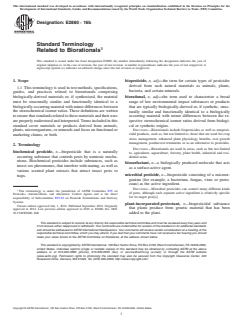
1.1 This terminology is used in test methods, specifications, guides, and practices related to biorationals comprising biologically-derived materials or, if synthesized, the material must be structurally similar and functionally identical to a biologically occurring material with minor differences between the stereochemical isomer ratios. These definitions are written to ensure that standards related to these materials and their uses are properly understood and interpreted. Terms included in this standard cover materials or products derived from animals, plants, microorganisms, or minerals and focus on functional or marketing claims, or both.
- Status
- Published
- Publication Date
- 30-Jun-2016
- Technical Committee
- E35 - Pesticides, Antimicrobials, and Alternative Control Agents
- Drafting Committee
- E35.22 - Pesticide Formulations and Delivery Systems




Overview
ASTM E2880-16b: Standard Terminology Related to Biorationals establishes a clear and uniform vocabulary for the field of biorational products. Published by ASTM International, this terminology standard supports the accurate interpretation and application of test methods, specifications, and guides related to biorationals. The definitions included apply to substances mainly derived from biological sources, such as animals, plants, microorganisms, or minerals, as well as structurally similar synthetic materials. The primary aim is to promote consistent understanding in industries where biorationals are used, thereby enhancing communication and compliance in product development, regulatory submission, and marketing.
Key Topics
- Biorationals: Defined as a broad range of low environmental impact materials, generally biologically-derived, or if synthetic, they are structurally and functionally akin to natural substances, with only minor stereochemical differences.
- Biopesticides: Pesticides sourced from natural materials, such as animals, plants, bacteria, or certain minerals, utilized for pest control.
- Biochemical Pesticides: These are naturally occurring substances that control pests through non-toxic modes of action, for example, by interfering with pest mating or attracting pests to traps.
- Microbial Pesticides: A type of biopesticide where microorganisms like bacteria, fungi, viruses, or protozoa play the role of the active ingredient.
- Plant-Incorporated Protectants (PIPs): Biopesticidal substances produced by plants from inserted genetic material, providing inherent protection.
- Biosurfactants: Biologically produced molecules that act as surface-active agents and can be used in various formulations.
Applications
The terminology standard is crucial across several sectors that rely on biorational products for their environmental, agricultural, or industrial benefits:
- Agriculture: For crop protection, integrated pest management, root growth stimulation, and postharvest solutions.
- Forestry and Plant Health: Biorationals play a role in managing forest health and enhancing plant physiology.
- Aquaculture: Used to manage environmental impact and improve aquatic farming systems.
- Industrial and Residential Use: In non-agricultural settings, biorational products offer alternatives to synthetic chemicals, supporting more sustainable practices.
By standardizing terminology, ASTM E2880-16b facilitates accurate labeling and helps stakeholders-such as regulators, manufacturers, and end-users-understand product claims and compliance requirements.
Related Standards
- ASTM Committee E35 on Pesticides, Antimicrobials, and Alternative Control Agents oversees this and other standards for safe and effective use of alternative agents.
- Guides and Practices Referencing Biorationals: Many ASTM methods reference this terminology to ensure consistency.
- Regulatory Definitions: While not a regulatory document, E2880-16b aligns with federal and international regulatory language concerning biopesticides and environmentally friendly formulations.
- Other ASTM Standards: For specifics on formulation, testing, and safety of biopesticides and related products, consult other ASTM standards under the E35 committee.
Conclusion
ASTM E2880-16b enhances clarity and precision in communicating about biorationals and their uses. Adopting these standardized definitions supports effective regulation, product development, and market representation, fostering innovation and sustainability across agriculture, industry, and environmental management. For those working with biopesticides, biosurfactants, or other biorational products, familiarity and compliance with this terminology standard are essential for regulatory acceptance and market success.
Relations
- Effective Date
- 01-Jul-2016
Get Certified
Connect with accredited certification bodies for this standard

BSI Group
BSI (British Standards Institution) is the business standards company that helps organizations make excellence a habit.

Bureau Veritas
Bureau Veritas is a world leader in laboratory testing, inspection and certification services.

DNV
DNV is an independent assurance and risk management provider.
Sponsored listings
Frequently Asked Questions
ASTM E2880-16b is a standard published by ASTM International. Its full title is "Standard Terminology Related to Biorationals". This standard covers: SCOPE 1.1 This terminology is used in test methods, specifications, guides, and practices related to biorationals comprising biologically-derived materials or, if synthesized, the material must be structurally similar and functionally identical to a biologically occurring material with minor differences between the stereochemical isomer ratios. These definitions are written to ensure that standards related to these materials and their uses are properly understood and interpreted. Terms included in this standard cover materials or products derived from animals, plants, microorganisms, or minerals and focus on functional or marketing claims, or both.
SCOPE 1.1 This terminology is used in test methods, specifications, guides, and practices related to biorationals comprising biologically-derived materials or, if synthesized, the material must be structurally similar and functionally identical to a biologically occurring material with minor differences between the stereochemical isomer ratios. These definitions are written to ensure that standards related to these materials and their uses are properly understood and interpreted. Terms included in this standard cover materials or products derived from animals, plants, microorganisms, or minerals and focus on functional or marketing claims, or both.
ASTM E2880-16b is classified under the following ICS (International Classification for Standards) categories: 01.040.13 - Environment. Health protection. Safety (Vocabularies); 13.020.60 - Product life-cycles. The ICS classification helps identify the subject area and facilitates finding related standards.
ASTM E2880-16b has the following relationships with other standards: It is inter standard links to ASTM E2880-16a. Understanding these relationships helps ensure you are using the most current and applicable version of the standard.
ASTM E2880-16b is available in PDF format for immediate download after purchase. The document can be added to your cart and obtained through the secure checkout process. Digital delivery ensures instant access to the complete standard document.
Standards Content (Sample)
This international standard was developed in accordance with internationally recognized principles on standardization established in the Decision on Principles for the
Development of International Standards, Guides and Recommendations issued by the World Trade Organization Technical Barriers to Trade (TBT) Committee.
Designation:E2880 −16b
Standard Terminology
Related to Biorationals
This standard is issued under the fixed designation E2880; the number immediately following the designation indicates the year of
original adoption or, in the case of revision, the year of last revision. A number in parentheses indicates the year of last reapproval. A
superscript epsilon (´) indicates an editorial change since the last revision or reapproval.
1. Scope biopesticide, n, adj—the term for certain types of pesticides
derived from such natural materials as animals, plants,
1.1 This terminology is used in test methods, specifications,
bacteria, and certain minerals.
guides, and practices related to biorationals comprising
biologically-derived materials or, if synthesized, the material
biorational, n, adj—the term used to characterize a broad
must be structurally similar and functionally identical to a range of low environmental impact substances or products
biologically occurring material with minor differences between
that are typically biologically-derived or, if synthetic, struc-
the stereochemical isomer ratios. These definitions are written turally similar and functionally identical to a biologically
to ensure that standards related to these materials and their uses
occurring material with minor differences between the re-
are properly understood and interpreted. Terms included in this spective stereochemical isomer ratios derived from biologi-
standard cover materials or products derived from animals,
cal or synthetic origins.
DISCUSSION—Biorationals include biopesticides as well as nonpesti-
plants, microorganisms, or minerals and focus on functional or
cidal products, such as, but not limited to, those that are used for crop
marketing claims, or both.
stress management, enhanced plant physiology benefits, root growth
management, postharvest treatments or as an alternative to pesticides.
2. Terminology
DISCUSSION—Biorationals are used in areas, such as but not limited
biochemical pesticide, n—biopesticide that is a naturally
to, agriculture, aquaculture, forestry, plant health, industrial and resi-
occurring substance that controls pests by non
...
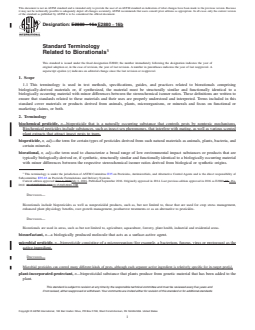
This document is not an ASTM standard and is intended only to provide the user of an ASTM standard an indication of what changes have been made to the previous version. Because
it may not be technically possible to adequately depict all changes accurately, ASTM recommends that users consult prior editions as appropriate. In all cases only the current version
of the standard as published by ASTM is to be considered the official document.
Designation: E2880 − 16a E2880 − 16b
Standard Terminology
Related to Biorationals
This standard is issued under the fixed designation E2880; the number immediately following the designation indicates the year of
original adoption or, in the case of revision, the year of last revision. A number in parentheses indicates the year of last reapproval. A
superscript epsilon (´) indicates an editorial change since the last revision or reapproval.
1. Scope
1.1 This terminology is used in test methods, specifications, guides, and practices related to biorationals comprising
biologically-derived materials or, if synthesized, the material must be structurally similar and functionally identical to a
biologically occurring material with minor differences between the stereochemical isomer ratios. These definitions are written to
ensure that standards related to these materials and their uses are properly understood and interpreted. Terms included in this
standard cover materials or products derived from animals, plants, microorganisms, or minerals and focus on functional or
marketing claims, or both.
2. Terminology
biochemical pesticide, n—biopesticide that is a naturally occurring substance that controls pests by nontoxic mechanisms.
Biochemical pesticides include substances, such as insect sex pheromones, that interfere with mating, as well as various scented
plant extracts that attract insect pests to traps.
biopesticide, n, adj—the term for certain types of pesticides derived from such natural materials as animals, plants, bacteria, and
certain minerals.
biorational, n, adj—the term used to characterize a broad range of low environmental impact substances or products that are
typically biologically-derived or, if synthetic, structurally similar and functionally identical to a biologically occurring material
with minor differences between the respective stereochemical isomer ratios derived from biological or synthetic origins.
This terminology is under the jurisdiction of ASTM Committee E35 on Pesticides, Antimicrobials, and Alternative Control Agents and is the direct responsibility of
Subcommittee E35.22 on Pesticide Formulations and De
...