

ASTM A749/A749M-14(2021)
(Specification)Standard Specification for Steel, Strip, Carbon and High-Strength, Low-Alloy, Hot-Rolled, General Requirements for
General Information
- Abstract
ABSTRACT
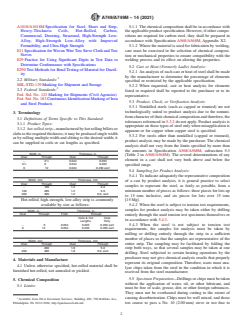
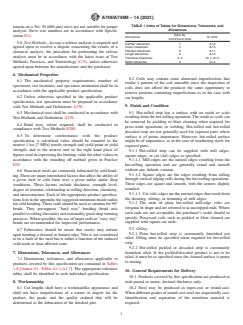
This specification covers the general requirements for hot-rolled steel strip in coils and cut lengths. It applies to carbon steel and high-strength, low-alloy steel furnished as hot-rolled. Hot-rolled material shall be furnished hot-rolled, not annealed, or pickled. The chemical composition shall be in accordance with the applicable product specification. Where the material is used for fabrication by welding, care must be exercised in the selection of chemical composition or mechanical properties to ensure compatibility with the welding process and its effect on altering the properties. A heat analysis shall be conducted to determine the percentage of elements specified or restricted by the applicable specification. The specimens shall be subjected to bend and tension tests.
SCOPE
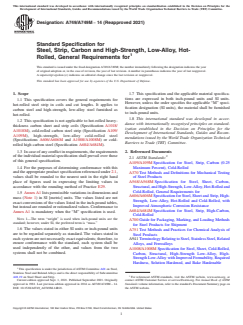
1.1 This specification covers the general requirements for hot-rolled steel strip in coils and cut lengths. It applies to carbon steel and high-strength, low-alloy steel furnished as hot-rolled.
1.2 This specification is not applicable to hot-rolled heavy-thickness carbon sheet and strip coils (Specification A1018/A1018M), cold-rolled carbon steel strip (Specification A109/A109M), high-strength, low-alloy cold-rolled steel (Specifications A606/A606M and A1008/A1008M) or cold-rolled high carbon steel (Specification A684/A684M).
1.3 In case of any conflict in requirements, the requirements of the individual material specification shall prevail over those of this general specification.
1.4 For the purposes of determining conformance with this and the appropriate product specification referenced under 2.1, values shall be rounded to the nearest unit in the right hand place of figures used in expressing the limiting values in accordance with the rounding method of Practice E29.
1.5 Annex A1 lists permissible variations in dimensions and mass (Note 1) in SI [metric] units. The values listed are not exact conversions of the values listed in the inch-pound tables, but instead are rounded or rationalized values. Conformance to Annex A1 is mandatory when the “M” specification is used.
Note 1: The term “weight” is used when inch-pound units are the standard; however, under SI, the preferred term is “mass.”
1.6 The values stated in either SI units or inch-pound units are to be regarded separately as standard. The values stated in each system are not necessarily exact equivalents; therefore, to ensure conformance with the standard, each system shall be used independently of the other, and values from the two systems shall not be combined.
1.7 This specification and the applicable material specifications are expressed in both inch-pound units and SI units. However, unless the order specifies the applicable “M” specification designation (SI units), the material shall be furnished to inch-pound units.
1.8 This international standard was developed in accordance with internationally recognized principles on standardization established in the Decision on Principles for the Development of International Standards, Guides and Recommendations issued by the World Trade Organization Technical Barriers to Trade (TBT) Committee.
- Status
- Published
- Publication Date
- 31-Aug-2021
- Technical Committee
- A01 - Steel, Stainless Steel and Related Alloys
- Drafting Committee
- A01.19 - Steel Sheet and Strip
Overview
ASTM A749/A749M-14(2021): Standard Specification for Steel, Strip, Carbon and High-Strength, Low-Alloy, Hot-Rolled, General Requirements for sets forth the general requirements for the manufacture, testing, and certification of hot-rolled steel strip in coils or cut lengths. Developed and maintained by ASTM International, this specification applies to both carbon steel and high-strength, low-alloy steel strips supplied in the hot-rolled condition. The standard addresses key aspects such as dimensional tolerances, mechanical and chemical properties, and applicable testing methods, providing essential guidelines for ensuring product quality, consistency, and safety in a wide range of manufacturing and fabrication processes.
Key Topics
- Scope and Applicability: Covers hot-rolled steel strip in coils and cut lengths, including both carbon and high-strength, low-alloy grades. Excludes heavy-thickness carbon sheet and other specific cold-rolled products.
- Unit Systems: Standard expressed in both inch-pound and SI units, with each set treated independently.
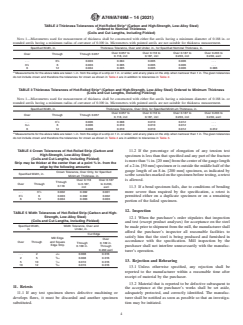
- Dimensional tolerances: Permissible variations in thickness, width, length, camber, and crown are detailed to ensure dimensional accuracy.
- Chemical Composition: Requires verification and reporting of chemical elements as specified by the relevant material standard; includes procedures for heat and product analysis.
- Mechanical Properties: Addresses requirements for tensile, bend, and other mechanical tests, referencing applicable ASTM methods.
- Surface Condition and Edges: Specifies finish types (mill, square, or slit), typical surface oxide, and the need for pickling or oiling as appropriate.
- Identification, Marking, and Packaging: Outlines minimum marking, labeling, and packaging standards to ensure traceability and safe shipment.
Applications
Hot-rolled steel strips produced according to ASTM A749/A749M are widely used across various industries for their versatility and strength. Typical applications include:
- Automotive Manufacturing: Used for underbody components, reinforcement parts, and structural members.
- Fabrication and Welding: The hot-rolled strip is suitable for welded assemblies, with guidance on compatibility of chemical composition and mechanical properties.
- Construction: Applied in the production of framing, supports, and sheet piles due to its high strength and formability.
- Machinery and Equipment: Essential for creating brackets, braces, and formed parts requiring robust mechanical properties.
- Metal Service Centers: Supplies cut-length strips or coils for further processing, shearing, or slitting.
The standard establishes the requirements necessary for consumers and producers to achieve reliable performance in end-use scenarios, ensuring safety, durability, and compliance with international best practices.
Related Standards
ASTM A749/A749M is closely integrated with other ASTM specifications and standards relevant to steel strip products. Key related standards include:
- ASTM A568/A568M: General requirements for sheet and strip, both hot-rolled and cold-rolled.
- ASTM A370: Test methods for mechanical testing of steel products.
- ASTM A700: Guide for packaging, marking, and loading steel products for shipment.
- ASTM A109/A109M, A606/A606M, A684/A684M, A1008/A1008M, A1018/A1018M: Specifications detailing material requirements for specific types of carbon and high-strength, low-alloy sheet and strip steel products.
- E29, E11, E290, A751, A941: Standards covering rounding methods, sieve specifications, bend testing, chemical analysis, and steel terminology.
By following ASTM A749/A749M and understanding its context within the broader family of steel standards, manufacturers, fabricators, and purchasers can ensure compliance with recognized industry benchmarks for hot-rolled steel strip products.
Keywords: ASTM A749, hot-rolled steel strip, carbon steel, high-strength low-alloy, general requirements, steel coil, dimensional tolerances, mechanical properties, steel standards.
Relations
- Effective Date
- 01-Mar-2024
- Effective Date
- 01-Mar-2024
- Effective Date
- 01-Mar-2024
- Effective Date
- 01-Nov-2023
- Effective Date
- 01-Nov-2023
- Effective Date
- 01-Nov-2023
- Effective Date
- 01-Nov-2019
- Effective Date
- 01-Nov-2019
- Effective Date
- 01-Jul-2019
- Effective Date
- 01-Nov-2018
- Effective Date
- 01-Sep-2018
- Refers
ASTM A370-17a - Standard Test Methods and Definitions for Mechanical Testing of Steel Products - Effective Date
- 15-Nov-2017
- Effective Date
- 01-Nov-2017
- Effective Date
- 01-Sep-2017
- Effective Date
- 01-Sep-2017
Get Certified
Connect with accredited certification bodies for this standard

Element Materials Technology
Materials testing and product certification.

Inštitut za kovinske materiale in tehnologije
Institute of Metals and Technology. Materials testing, metallurgical analysis, NDT.
Sponsored listings
Frequently Asked Questions
ASTM A749/A749M-14(2021) is a technical specification published by ASTM International. Its full title is "Standard Specification for Steel, Strip, Carbon and High-Strength, Low-Alloy, Hot-Rolled, General Requirements for". This standard covers: ABSTRACT This specification covers the general requirements for hot-rolled steel strip in coils and cut lengths. It applies to carbon steel and high-strength, low-alloy steel furnished as hot-rolled. Hot-rolled material shall be furnished hot-rolled, not annealed, or pickled. The chemical composition shall be in accordance with the applicable product specification. Where the material is used for fabrication by welding, care must be exercised in the selection of chemical composition or mechanical properties to ensure compatibility with the welding process and its effect on altering the properties. A heat analysis shall be conducted to determine the percentage of elements specified or restricted by the applicable specification. The specimens shall be subjected to bend and tension tests. SCOPE 1.1 This specification covers the general requirements for hot-rolled steel strip in coils and cut lengths. It applies to carbon steel and high-strength, low-alloy steel furnished as hot-rolled. 1.2 This specification is not applicable to hot-rolled heavy-thickness carbon sheet and strip coils (Specification A1018/A1018M), cold-rolled carbon steel strip (Specification A109/A109M), high-strength, low-alloy cold-rolled steel (Specifications A606/A606M and A1008/A1008M) or cold-rolled high carbon steel (Specification A684/A684M). 1.3 In case of any conflict in requirements, the requirements of the individual material specification shall prevail over those of this general specification. 1.4 For the purposes of determining conformance with this and the appropriate product specification referenced under 2.1, values shall be rounded to the nearest unit in the right hand place of figures used in expressing the limiting values in accordance with the rounding method of Practice E29. 1.5 Annex A1 lists permissible variations in dimensions and mass (Note 1) in SI [metric] units. The values listed are not exact conversions of the values listed in the inch-pound tables, but instead are rounded or rationalized values. Conformance to Annex A1 is mandatory when the “M” specification is used. Note 1: The term “weight” is used when inch-pound units are the standard; however, under SI, the preferred term is “mass.” 1.6 The values stated in either SI units or inch-pound units are to be regarded separately as standard. The values stated in each system are not necessarily exact equivalents; therefore, to ensure conformance with the standard, each system shall be used independently of the other, and values from the two systems shall not be combined. 1.7 This specification and the applicable material specifications are expressed in both inch-pound units and SI units. However, unless the order specifies the applicable “M” specification designation (SI units), the material shall be furnished to inch-pound units. 1.8 This international standard was developed in accordance with internationally recognized principles on standardization established in the Decision on Principles for the Development of International Standards, Guides and Recommendations issued by the World Trade Organization Technical Barriers to Trade (TBT) Committee.
ABSTRACT This specification covers the general requirements for hot-rolled steel strip in coils and cut lengths. It applies to carbon steel and high-strength, low-alloy steel furnished as hot-rolled. Hot-rolled material shall be furnished hot-rolled, not annealed, or pickled. The chemical composition shall be in accordance with the applicable product specification. Where the material is used for fabrication by welding, care must be exercised in the selection of chemical composition or mechanical properties to ensure compatibility with the welding process and its effect on altering the properties. A heat analysis shall be conducted to determine the percentage of elements specified or restricted by the applicable specification. The specimens shall be subjected to bend and tension tests. SCOPE 1.1 This specification covers the general requirements for hot-rolled steel strip in coils and cut lengths. It applies to carbon steel and high-strength, low-alloy steel furnished as hot-rolled. 1.2 This specification is not applicable to hot-rolled heavy-thickness carbon sheet and strip coils (Specification A1018/A1018M), cold-rolled carbon steel strip (Specification A109/A109M), high-strength, low-alloy cold-rolled steel (Specifications A606/A606M and A1008/A1008M) or cold-rolled high carbon steel (Specification A684/A684M). 1.3 In case of any conflict in requirements, the requirements of the individual material specification shall prevail over those of this general specification. 1.4 For the purposes of determining conformance with this and the appropriate product specification referenced under 2.1, values shall be rounded to the nearest unit in the right hand place of figures used in expressing the limiting values in accordance with the rounding method of Practice E29. 1.5 Annex A1 lists permissible variations in dimensions and mass (Note 1) in SI [metric] units. The values listed are not exact conversions of the values listed in the inch-pound tables, but instead are rounded or rationalized values. Conformance to Annex A1 is mandatory when the “M” specification is used. Note 1: The term “weight” is used when inch-pound units are the standard; however, under SI, the preferred term is “mass.” 1.6 The values stated in either SI units or inch-pound units are to be regarded separately as standard. The values stated in each system are not necessarily exact equivalents; therefore, to ensure conformance with the standard, each system shall be used independently of the other, and values from the two systems shall not be combined. 1.7 This specification and the applicable material specifications are expressed in both inch-pound units and SI units. However, unless the order specifies the applicable “M” specification designation (SI units), the material shall be furnished to inch-pound units. 1.8 This international standard was developed in accordance with internationally recognized principles on standardization established in the Decision on Principles for the Development of International Standards, Guides and Recommendations issued by the World Trade Organization Technical Barriers to Trade (TBT) Committee.
ASTM A749/A749M-14(2021) is classified under the following ICS (International Classification for Standards) categories: 77.140.50 - Flat steel products and semi-products. The ICS classification helps identify the subject area and facilitates finding related standards.
ASTM A749/A749M-14(2021) has the following relationships with other standards: It is inter standard links to ASTM A109/A109M-24, ASTM A370-24, ASTM A941-24, ASTM A1018/A1018M-23a, ASTM A1008/A1008M-23e1, ASTM A1008/A1008M-23, ASTM A700-14(2019), ASTM A568/A568M-19a, ASTM A370-19, ASTM A109/A109M-16(2018), ASTM A1008/A1008M-18, ASTM A370-17a, ASTM A568/A568M-17a, ASTM A941-17, ASTM A568/A568M-17. Understanding these relationships helps ensure you are using the most current and applicable version of the standard.
ASTM A749/A749M-14(2021) is available in PDF format for immediate download after purchase. The document can be added to your cart and obtained through the secure checkout process. Digital delivery ensures instant access to the complete standard document.
Standards Content (Sample)
This international standard was developed in accordance with internationally recognized principles on standardization established in the Decision on Principles for the
Development of International Standards, Guides and Recommendations issued by the World Trade Organization Technical Barriers to Trade (TBT) Committee.
Designation:A749/A749M −14 (Reapproved 2021)
Standard Specification for
Steel, Strip, Carbon and High-Strength, Low-Alloy, Hot-
Rolled, General Requirements for
This standard is issued under the fixed designationA749/A749M; the number immediately following the designation indicates the year
of original adoption or, in the case of revision, the year of last revision. A number in parentheses indicates the year of last reapproval.
A superscript epsilon (´) indicates an editorial change since the last revision or reapproval.
This standard has been approved for use by agencies of the U.S. Department of Defense.
1. Scope 1.7 This specification and the applicable material specifica-
tions are expressed in both inch-pound units and SI units.
1.1 This specification covers the general requirements for
However, unless the order specifies the applicable “M” speci-
hot-rolled steel strip in coils and cut lengths. It applies to
fication designation (SI units), the material shall be furnished
carbon steel and high-strength, low-alloy steel furnished as
to inch-pound units.
hot-rolled.
1.8 This international standard was developed in accor-
1.2 This specification is not applicable to hot-rolled heavy-
dance with internationally recognized principles on standard-
thickness carbon sheet and strip coils (Specification A1018/
ization established in the Decision on Principles for the
A1018M), cold-rolled carbon steel strip (Specification A109/
Development of International Standards, Guides and Recom-
A109M), high-strength, low-alloy cold-rolled steel
mendations issued by the World Trade Organization Technical
(Specifications A606/A606M and A1008/A1008M) or cold-
Barriers to Trade (TBT) Committee.
rolled high carbon steel (Specification A684/A684M).
1.3 In case of any conflict in requirements, the requirements
2. Referenced Documents
of the individual material specification shall prevail over those 2
2.1 ASTM Standards:
of this general specification.
A109/A109M Specification for Steel, Strip, Carbon (0.25
1.4 For the purposes of determining conformance with this Maximum Percent), Cold-Rolled
and the appropriate product specification referenced under 2.1,
A370 Test Methods and Definitions for Mechanical Testing
values shall be rounded to the nearest unit in the right hand of Steel Products
place of figures used in expressing the limiting values in
A568/A568M Specification for Steel, Sheet, Carbon,
accordance with the rounding method of Practice E29. Structural,andHigh-Strength,Low-Alloy,Hot-Rolledand
Cold-Rolled, General Requirements for
1.5 AnnexA1 lists permissible variations in dimensions and
A606/A606M Specification for Steel, Sheet and Strip, High-
mass (Note 1) in SI [metric] units. The values listed are not
Strength, Low-Alloy, Hot-Rolled and Cold-Rolled, with
exact conversions of the values listed in the inch-pound tables,
Improved Atmospheric Corrosion Resistance
but instead are rounded or rationalized values. Conformance to
A684/A684M Specification for Steel, Strip, High-Carbon,
Annex A1 is mandatory when the “M” specification is used.
Cold-Rolled
NOTE 1—The term “weight” is used when inch-pound units are the
A700 Guide for Packaging, Marking, and Loading Methods
standard; however, under SI, the preferred term is “mass.”
for Steel Products for Shipment
1.6 The values stated in either SI units or inch-pound units
A751 Test Methods and Practices for Chemical Analysis of
are to be regarded separately as standard. The values stated in
Steel Products
each system are not necessarily exact equivalents; therefore, to
A941 TerminologyRelatingtoSteel,StainlessSteel,Related
ensure conformance with the standard, each system shall be
Alloys, and Ferroalloys
used independently of the other, and values from the two
A1008/A1008M Specification for Steel, Sheet, Cold-Rolled,
systems shall not be combined.
Carbon, Structural, High-Strength Low-Alloy, High-
Strength Low-Alloy with Improved Formability, Required
Hardness, Solution Hardened, and Bake Hardenable
This specification is under the jurisdiction of ASTM Committee A01 on Steel,
Stainless Steel and Related Alloys and is the direct responsibility of Subcommittee
A01.19 on Steel Sheet and Strip. For referenced ASTM standards, visit the ASTM website, www.astm.org, or
Current edition approved Sept. 1, 2021. Published September 2021. Originally contact ASTM Customer Service at service@astm.org. For Annual Book of ASTM
approved in 1981. Last previous edition approved in 2014 as A0749/A749M – 14. Standards volume information, refer to the standard’s Document Summary page on
DOI: 10.1520/A0749_A0749M-14R21. the ASTM website.
Copyright © ASTM International, 100 Barr Harbor Drive, PO Box C700, West Conshohocken, PA 19428-2959. United States
A749/A749M−14 (2021)
A1018/A1018M Specification for Steel, Sheet and Strip, 5.1.1 The chemical composition shall be in accordance with
Heavy-Thickness Coils, Hot-Rolled, Carbon, the applicable product specification. However, if other compo-
Commercial, Drawing, Structural, High-Strength Low- sitions are required for carbon steel, they shall be prepared in
Alloy, High-Strength Low-Alloy with Improved accordance with Specification A568/A568M, Appendix X2.
Formability, and Ultra-High Strength
5.1.2 Where the material is used for fabrication by welding,
E11 Specification for Woven Wire Test Sieve Cloth and Test care must be exercised in the selection of chemical composi-
Sieves
tion or mechanical properties to ensure compatibility with the
E29 Practice for Using Significant Digits in Test Data to welding process and its effect on altering the properties.
Determine Conformance with Specifications
5.2 Cast or Heat (Formerly Ladle) Analysis:
E290 Test Methods for Bend Testing of Material for Ductil-
5.2.1 An analysis of each cast or heat of steel shall be made
ity
by the manufacturer to determine the percentage of elements
2.2 Military Standards:
specified or restricted by the applicable specification.
MIL-STD-129 Marking for Shipment and Storage
5.2.2 When requested, cast or heat analysis for elements
2.3 Federal Standards:
listed or required shall be reported to the purchaser or to its
Fed. Std. No. 123 Marking for Shipments (Civil Agencies)
representative.
Fed. Std. No. 183 Continuous Identification Marking of Iron
5.3 Product, Check, or Verification Analysis:
and Steel Products
5.3.1 Nonkilled steels (such as capped or rimmed) are not
technologically suited to product analysis due to the nonuni-
3. Terminology
formcharacteroftheirchemicalcompositionandtherefore,the
3.1 Definitions of Terms Specific to This Standard:
tolerances referenced in 5.3.2 do not apply. Product analysis is
3.1.1 Product Types:
appropriate on these types of steel only when misapplication is
3.1.2 hot-rolled strip—manufacturedbyhotrollingbilletsor
apparent or for copper when copper steel is specified.
slabstotherequiredthickness;itmaybeproducedsinglewidth
5.3.2 For steels other than nonkilled (capped or rimmed),
or by rolling multiple width and slitting to the desired width; it
product analysis may be made by the purchaser. The chemical
can be supplied in coils or cut lengths as specified.
analysis shall not vary from the limits specified by more than
the amounts in Specification A568/A568M, subsection 5.3
Width, in. Thickness, in.
(Table 2 in A568/A568M). The several determinations of any
Over Through Over Through
1 element in a cast shall not vary both above and below the
... 3 ⁄2 0.044 0.203
3 ⁄2 6 0.044 0.203
specified range.
6 12 0.044 0.230 excl
5.4 Sampling for Product Analysis:
5.4.1 To indicate adequately the representative composition
Width, mm Thickness, mm
of a cast by product analysis, it is general practice to select
Over Through Over Through
samples to represent the steel, as fairly as possible, from a
... 100 1.2 5.0
100 200 1.2 5.0 minimum number of pieces as follows: three pieces for lots up
200 300 1.2 6.0, excl
to 15 tons inclusive, and six pieces for lots over 15 tons
Hot-rolled, high-strength, low-alloy strip is commonly
[15 Mg].
available by size as follows:
5.4.2 When the steel is subject to tension test requirements,
samples for product analysis may be taken either by drilling
Width, in. Thickness, in.
Over Through From Through
entirely through the used tension test specimens themselves or
Coils & Cut Coils
in accordance with 5.4.3.
Lengths Only
... 6 0.054 0.203 0.230 excl 5.4.3 When the steel is not subject to tension test
6 12 0.054 0.230 0.230 excl
requirements, the samples for analysis must be taken by
milling or drilling entirely through the strip in a sufficient
number of places so that the samples are representative of the
Width, mm Thickness, mm
entire strip. The sampling may be facilitated by folding the
Over Through Over Through
... 200 1.8 5.0
strip both ways, so that several samples may be taken at one
200 300 1.8 6.0, excl
drilling. Steel subjected to certain heating operations by the
purchaser may not give chemical analysis results that properly
4. Materials and Manufacture
represent its original composition. Therefore, users must ana-
4.1 Unless otherwise specified, hot-rolled material shall be
lyze chips taken from the steel in the condition in which it is
furnished hot-rolled, not annealed or pickled.
received from the steel manufacturer.
5.5 Specimen Preparation—Drillingsorchipsmustbetaken
5. Chemical Composition
without the application of water, oil, or other lubricant, and
5.1 Limits:
must be free of scale, grease, dirt, or other foreign substances.
They must not be overheated during cutting to the extent of
causing decarburization. Chips must be well mixed, and those
Available from DLA Document Services, Building 4/D, 700 Robbins Ave.,
Philadelphia, PA 19111-5094, http://quicksearch.dla.mil. too coarse to pass a No. 10 (2.00 mm) sieve or too fine to
A749/A749M−14 (2021)
TABLE 1 Index of Tables for Dimensions, Tolerances, and
remain on a No. 30 (600-µm) sieve are not suitable for proper
Allowances
analysis. Sieve size numbers are in accordance with Specifi-
Table No.
cation E11.
Dimensions SI Units
Inch-Pound Units
5.6 Test Methods—In case a referee analysis is required and
Camber tolerances 7 A1.6
agreed upon to resolve a dispute concerning the results of a Crown tolerances 4 A1.3
Flatness tolerances 8 A1.7
chemical analysis, the procedure for performing the referee
Length tolerances 6 A1.5
analysis must be in accordance with the latest issue of Test
Thickness tolerances 2, 3 A1.1, A1.2
Width tolerances 5 A1.4
Methods, Practices, and Terminology A751, unless otherwise
agreed upon between the manufacturer and the purchaser.
6. Mechanical Properties
8.2 Coils may contain some abnormal imperfections that
6.1 The mechanical property requirements, number of
render a portion of the coil unusable since the inspection of
specimens, test locations, and specimen orientation shall be in
coils does not afford the producer the same opportunity to
accordance with the applicable product specification.
remove portions containing imperfections as in the case with
6.2 Unless otherwise specified in the applicable product
cut lengths.
specification, test specimens must be prepared in accordance
9. Finish and Condition
with Test Methods and Definitions A370.
9.1 Hot-rolled strip has a surface with an oxide or scale
6.3 Mechanical tests shall be conducted in accordance with
resulting from the hot-rolling operation. The oxide or scale can
Test Methods and Definitions A370.
be removed by pickling or blast cleaning when required for
6.4 Bend tests, where required, shall be conducted in
press-work operations or welding. Hot-rolled and hot-rolled
compliance with Test Methods E290.
descaled strip are not generally used for exposed parts where
6.5 To determine conformance with the product
surface is of prime importance. However, hot-rolled surface
specification, a calculated value should be rounded to the
might be of importance, as in the case of weathering steels for
nearest 1 ksi [7 MPa] tensile strength and yield point or yield
exposed parts.
strength, and to the nearest unit in the right hand place of
9.1.1 Hot-rolled strip can be supplied with mill edges,
figures used in expressing the limiting value for other values in
square edges, or cut (slit) edges as specified.
accordance with the rounding off method given in Practice
9.1.1.1 Mill edges are the natural edges resulting from the
E29.
hot-rolling operation and are generally round and smooth
without any definite contour.
6.6 Structural steels are commonly fabricated by cold bend-
9.1.1.2 Square edges are the edges resulting from rolling
ing.Therearemanyinterrelatedfactorsthataffecttheabilityof
through vertical edging rolls during the hot-rolling operations.
a given steel to cold form over a given radius under shop
These edges are square and smooth, with the corners slightly
conditions. These factors include thickness, strength level,
rounded.
degree of restraint, relationship to rolling direction, chemistry,
9.1.1.3 Cut (slit) edges are the normal edges that result from
and microstructure. Each of the appropriate product specifica-
the shearing, slitting, or trimming of mill edges.
tions lists in the appendix the suggested minimum inside radius
9.1.2 The ends of plain hot-rolled mill-edge coils are
for cold bending.These radii should be used as minima for 90°
irregularinshapeandarereferredtoasuncroppedends.Where
bends. They presuppose “hard way” bending (bend axis
such ends are not acceptable, the purchaser’s order should so
parallel to rolling direction) and reasonably good shop forming
specify. Processed coils such as pickled or blast cleaned are
practices. Where possible, the use of larger radii or “easy way”
supplied with square-cut ends.
bends are recommended for improved performance.
9.2 Oiling:
6.7 Fabricators should be aware that cracks may initiate
9.2.1 Plain hot-rolled strip is customarily furnished not
upon bending a sheared or burned edge. This is not considered
oiled. Oiling must be specified when required for hot-rolled
to be a fault of the steel but is rather a function of the induced
strip.
cold-work or heat-affected zone.
9.2.2 Hot-rolled pickled or descaled strip is customarily
7. Dimensions, Tolerances, and Allowances furnished oiled. If the pickled/descaled product is not to be
oiled, it must be so specified since the cleaned surface is prone
7.1 Dimensions, tolerances, and allowances applicable to
to rusting.
products covered by this specification are contained in Tables
1-8 [Annex A1, Tables A1.1-A1.7]. The appropriate tolerance
10. General Requirements for Delivery
tables shall be identified in each individual specification.
10.1 Products covered by this specification are produced to
8. Workmanship inch-pound or metric decimal thickness only.
8.1 Cut lengths shall have a workmanlike appearance and 10.2 Steel may be produced as ingot-cast or strand-cast.
shall not have imperfections of a nature or degree for the When different grades of strand-cast steel are sequentially cast,
product, the grade, and the quality ordered that will be identification and separation of the transition material is
detrimental to the fabrication of the finished part. required.
A749/A749M−14 (2021)
A
TABLE 2 Thickness Tolerances of Hot-Rolled Strip (Carbon and High-Strength, Low-Alloy Steel)
Ordered to Nominal Thickness
(Coils and Cut Lengths, Including Pickled)
NOTE 1—Micrometres used for measurement of thickness shall be constructed with either flat anvils having a minimum diameter of
...