

ASTM F1092-19
(Specification)Standard Specification for Fiberglass (GRP) Pultruded Open-Weather Storm and Guard, Square Railing Systems
General Information
- Abstract
ABSTRACT
This specification provides the material requirements, construction, installation, and testing requirements for open-weather deck, storm-and-guard, fiberglass square railing systems. Components are to be manufactured by the pultrusion process. Handrails and stanchions shall be fiberglass pultruded square tube available in the following two types: Type 1F and Type 2F. Test at least one end stanchion and one other stanchion of each platform or deck by application of a load horizontally in accordance with the specification.
SCOPE
1.1 This specification provides the material requirements, construction, installation, and testing requirements for open-weather deck, storm-and-guard, fiberglass square railing systems. Components are to be manufactured by the pultrusion process.
1.2 The values stated in inch-pound units are to be regarded as standard. The values given in parentheses are mathematical conversions to SI units that are provided for information only and are not considered standard.
1.3 The following safety hazards caveat pertains only to the test methods portion, Section 9, of this specification: This standard does not purport to address all of the safety concerns, if any, associated with its use. It is the responsibility of the user of this standard to establish appropriate safety, health, and environmental practices and determine the applicability of regulatory limitations prior to use.
1.4 This international standard was developed in accordance with internationally recognized principles on standardization established in the Decision on Principles for the Development of International Standards, Guides and Recommendations issued by the World Trade Organization Technical Barriers to Trade (TBT) Committee.
- Status
- Published
- Publication Date
- 30-Nov-2019
- Technical Committee
- F25 - Ships and Marine Technology
- Drafting Committee
- F25.03 - Outfitting and Deck Machinery
Buy Documents
ASTM F1092-19 - Standard Specification for Fiberglass (GRP) Pultruded Open-Weather Storm and Guard, Square Railing Systems
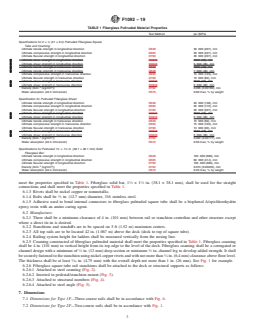
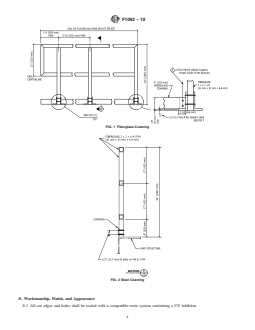
REDLINE ASTM F1092-19 - Standard Specification for Fiberglass (GRP) Pultruded Open-Weather Storm and Guard, Square Railing Systems
Overview
ASTM F1092-19 is the standard specification for fiberglass (Glass-Reinforced Plastic/GRP) pultruded open-weather storm and guard square railing systems. Published by ASTM International, this standard defines the material, construction, installation, and testing requirements necessary for railing systems designed for exposed environments, particularly on ships, marine structures, and industrial platforms. Components covered under this specification are manufactured using the pultrusion process, ensuring high strength and durability with resistance to weather, moisture, and UV exposure.
Key Topics
Material Requirements:
- Railings, handrails, and stanchions must be made from fiberglass square tubes produced via the pultrusion process.
- Two types: Type 1F (three-course railing systems for peripheries of freeboards and decks) and Type 2F (two-course for walkways, platforms, and bridges).
- Use of flame-retarded isophthalic polyester or vinyl ester resin with added UV inhibitors.
- All components must have a polyurethane protective coating and synthetic surface veil for enhanced weather resistance.
Design and Construction:
- Standardizes dimensions and spacing (e.g., 2x2 inch square tubes, stanchion spacing max 5 feet, top rails 42 inches above deck).
- Coaming must meet specified profile and dimensional requirements for strength and durability.
- Requires sealed cut edges and holes to prevent degradation and ensure long service life.
Assembly and Connections:
- All joints and connections require solid internal connectors bonded with epoxy adhesive and secured by rivets or bolts.
- Only nickel-copper rivets and stainless steel bolts are permitted for attachments to maximize corrosion resistance.
- Various connection types and mounting methods are defined for different structural needs.
Testing and Performance:
- Mandatory load testing of stanchions, simulating expected service conditions.
- Material properties verified by reference to ASTM test methods, ensuring verified strength, density, and water absorption limits.
Safety and Compliance:
- Flame spread and smoke developed indices restricted to meet rigorous fire safety standards.
- Adhering to international standardization principles and compatible with global regulatory requirements.
Applications
Adoption of ASTM F1092-19 offers practical advantages for a range of sectors requiring reliable weather-resistant guardrails:
- Marine and Offshore: Protecting peripheries of decks, superstructures, and walkways from falls and environmental exposure.
- Industrial Facilities: Used on platforms, bridges, and elevated walkways where lightweight, corrosion-resistant guardrails are essential.
- Transportation Infrastructure: Ideal for accessways, maintenance platforms, and stairs in harsh or coastal environments.
- Public Safety: Suitable for utility plants and commercial installations seeking durable storm and guard railing systems with minimal maintenance.
Related Standards
Several other ASTM standards are referenced in ASTM F1092-19 for testing and material specifics:
- ASTM D570: Test Method for Water Absorption of Plastics
- ASTM D638: Test Method for Tensile Properties of Plastics
- ASTM D695: Test Method for Compressive Properties of Rigid Plastics
- ASTM D790: Test Methods for Flexural Properties of Plastics
- ASTM D792: Test Methods for Density of Plastics by Displacement
- ASTM D3846: Test Method for In-plane Shear Strength of Reinforced Plastics
- ASTM D3917: Specification for Dimensional Tolerances of Pultruded Shapes
- ASTM E84: Test Method for Surface Burning Characteristics of Building Materials
These references ensure all fiberglass pultruded railing systems conform to established quality, safety, and performance benchmarks.
Keywords: ASTM F1092-19, fiberglass railing systems, pultruded GRP, open-weather guardrails, marine safety railings, storm-and-guard railings, industrial railing system standards, ASTM International, corrosion-resistant guardrails
Relations
- Effective Date
- 01-Dec-2019
- Effective Date
- 01-Dec-2023
- Effective Date
- 01-Nov-2023
- Effective Date
- 01-Sep-2023
- Effective Date
- 01-Jul-2019
- Effective Date
- 15-Apr-2019
- Effective Date
- 01-Mar-2019
- Effective Date
- 01-Oct-2018
- Effective Date
- 01-Jul-2018
- Effective Date
- 01-Mar-2018
- Effective Date
- 01-Nov-2017
- Effective Date
- 01-Aug-2017
- Effective Date
- 01-Jul-2017
- Effective Date
- 01-Jul-2016
- Effective Date
- 15-Dec-2015
Buy Documents
ASTM F1092-19 - Standard Specification for Fiberglass (GRP) Pultruded Open-Weather Storm and Guard, Square Railing Systems
REDLINE ASTM F1092-19 - Standard Specification for Fiberglass (GRP) Pultruded Open-Weather Storm and Guard, Square Railing Systems
Get Certified
Connect with accredited certification bodies for this standard

DNV
DNV is an independent assurance and risk management provider.

Lloyd's Register
Lloyd's Register is a global professional services organisation specialising in engineering and technology.

FSC International
Forest Stewardship Council certification.
Sponsored listings
Frequently Asked Questions
ASTM F1092-19 is a technical specification published by ASTM International. Its full title is "Standard Specification for Fiberglass (GRP) Pultruded Open-Weather Storm and Guard, Square Railing Systems". This standard covers: ABSTRACT This specification provides the material requirements, construction, installation, and testing requirements for open-weather deck, storm-and-guard, fiberglass square railing systems. Components are to be manufactured by the pultrusion process. Handrails and stanchions shall be fiberglass pultruded square tube available in the following two types: Type 1F and Type 2F. Test at least one end stanchion and one other stanchion of each platform or deck by application of a load horizontally in accordance with the specification. SCOPE 1.1 This specification provides the material requirements, construction, installation, and testing requirements for open-weather deck, storm-and-guard, fiberglass square railing systems. Components are to be manufactured by the pultrusion process. 1.2 The values stated in inch-pound units are to be regarded as standard. The values given in parentheses are mathematical conversions to SI units that are provided for information only and are not considered standard. 1.3 The following safety hazards caveat pertains only to the test methods portion, Section 9, of this specification: This standard does not purport to address all of the safety concerns, if any, associated with its use. It is the responsibility of the user of this standard to establish appropriate safety, health, and environmental practices and determine the applicability of regulatory limitations prior to use. 1.4 This international standard was developed in accordance with internationally recognized principles on standardization established in the Decision on Principles for the Development of International Standards, Guides and Recommendations issued by the World Trade Organization Technical Barriers to Trade (TBT) Committee.
ABSTRACT This specification provides the material requirements, construction, installation, and testing requirements for open-weather deck, storm-and-guard, fiberglass square railing systems. Components are to be manufactured by the pultrusion process. Handrails and stanchions shall be fiberglass pultruded square tube available in the following two types: Type 1F and Type 2F. Test at least one end stanchion and one other stanchion of each platform or deck by application of a load horizontally in accordance with the specification. SCOPE 1.1 This specification provides the material requirements, construction, installation, and testing requirements for open-weather deck, storm-and-guard, fiberglass square railing systems. Components are to be manufactured by the pultrusion process. 1.2 The values stated in inch-pound units are to be regarded as standard. The values given in parentheses are mathematical conversions to SI units that are provided for information only and are not considered standard. 1.3 The following safety hazards caveat pertains only to the test methods portion, Section 9, of this specification: This standard does not purport to address all of the safety concerns, if any, associated with its use. It is the responsibility of the user of this standard to establish appropriate safety, health, and environmental practices and determine the applicability of regulatory limitations prior to use. 1.4 This international standard was developed in accordance with internationally recognized principles on standardization established in the Decision on Principles for the Development of International Standards, Guides and Recommendations issued by the World Trade Organization Technical Barriers to Trade (TBT) Committee.
ASTM F1092-19 is classified under the following ICS (International Classification for Standards) categories: 47.020.10 - Hulls and their structure elements. The ICS classification helps identify the subject area and facilitates finding related standards.
ASTM F1092-19 has the following relationships with other standards: It is inter standard links to ASTM F1092-14, ASTM E84-23d, ASTM D3917-23, ASTM E84-23c, ASTM E84-19b, ASTM E84-19a, ASTM E84-19, ASTM E84-18b, ASTM E84-18a, ASTM E84-18, ASTM E84-17a, ASTM E84-17, ASTM D790-17, ASTM E84-16, ASTM E84-15b. Understanding these relationships helps ensure you are using the most current and applicable version of the standard.
ASTM F1092-19 is available in PDF format for immediate download after purchase. The document can be added to your cart and obtained through the secure checkout process. Digital delivery ensures instant access to the complete standard document.
Standards Content (Sample)
This international standard was developed in accordance with internationally recognized principles on standardization established in the Decision on Principles for the
Development of International Standards, Guides and Recommendations issued by the World Trade Organization Technical Barriers to Trade (TBT) Committee.
Designation:F1092 −19 An American National Standard
Standard Specification for
Fiberglass (GRP) Pultruded Open-Weather Storm and
Guard, Square Railing Systems
This standard is issued under the fixed designation F1092; the number immediately following the designation indicates the year of
original adoption or, in the case of revision, the year of last revision.Anumber in parentheses indicates the year of last reapproval.A
superscript epsilon (´) indicates an editorial change since the last revision or reapproval.
1. Scope D790Test Methods for Flexural Properties of Unreinforced
and Reinforced Plastics and Electrical Insulating Materi-
1.1 This specification provides the material requirements,
als
construction, installation, and testing requirements for open-
D792Test Methods for Density and Specific Gravity (Rela-
weather deck, storm-and-guard, fiberglass square railing sys-
tive Density) of Plastics by Displacement
tems. Components are to be manufactured by the pultrusion
D3846Test Method for In-Plane Shear Strength of Rein-
process.
forced Plastics
1.2 The values stated in inch-pound units are to be regarded
D3917Specification for Dimensional Tolerance of Thermo-
as standard. The values given in parentheses are mathematical
setting Glass-Reinforced Plastic Pultruded Shapes
conversions to SI units that are provided for information only
E84Test Method for Surface Burning Characteristics of
and are not considered standard.
Building Materials
1.3 The following safety hazards caveat pertains only to the
test methods portion, Section 9, of this specification: This
3. Terminology
standard does not purport to address all of the safety concerns,
3.1 Definitions:
if any, associated with its use. It is the responsibility of the user
3.1.1 pultrusion, n—process of pulling fiberglass rovings
of this standard to establish appropriate safety, health, and
(strands), mats, and other forms of reinforcements such as
environmental practices and determine the applicability of
woven fiberglass through baths of thermosetting liquid resin,
regulatory limitations prior to use.
and then through a heated forming die (made of steel) to form
1.4 This international standard was developed in accor-
a completed composite fiberglass structural shape.
dance with internationally recognized principles on standard-
3.1.1.1 Discussion—The heated die causes a chemical reac-
ization established in the Decision on Principles for the
tion to be initiated in the resin.The liquid resin molecules will
Development of International Standards, Guides and Recom-
cross-linkanddevelopintoahardenedplasticthatisreinforced
mendations issued by the World Trade Organization Technical
with the fiberglass.
Barriers to Trade (TBT) Committee.
4. Classification
2. Referenced Documents
4.1 Handrails and stanchions shall be fiberglass pultruded
2.1 ASTM Standards:
square tube available in the following two types:
D570Test Method for Water Absorption of Plastics
4.1.1 Type 1F—Three-course railing systems, for use along
D638Test Method for Tensile Properties of Plastics
the exposed peripheries of freeboards, weather decks, and
D695Test Method for Compressive Properties of Rigid
superstructure decks.
Plastics
4.1.2 Type 2F—Two-course railing systems, for use on
bridges, platforms, walkways, and elsewhere as needed.
5. Ordering Information
This specification is under the jurisdiction ofASTM Committee F25 on Ships
5.1 Orders for materials under this specification shall in-
and Marine Technology and is the direct responsibility of Subcommittee F25.03 on
clude the following information:
Outfitting and Deck Machinery.
5.1.1 Quantity (lineal feet (metres) of railing system).
Current edition approved Dec. 1, 2019. Published December 2019. Originally
5.1.2 Name of material (fiberglass pultruded square railing
approved in 1987. Last previous edition approved in 2014 as F1092– 14. DOI:
10.1520/F1092-19.
system).
For referenced ASTM standards, visit the ASTM website, www.astm.org, or
5.1.3 Type (see 4.1).
contact ASTM Customer Service at service@astm.org. For Annual Book of ASTM
5.1.4 Fiberglass coaming, if specified (lineal feet (metres)).
Standards volume information, refer to the standard’s Document Summary page on
the ASTM website. (See 6.2.5.)
Copyright © ASTM International, 100 Barr Harbor Drive, PO Box C700, West Conshohocken, PA 19428-2959. United States
F1092−19
5.1.5 Attachment method for stanchions (see 6.2.6). connection. Angular connections shall be fabricated from
5.1.6 ASTM designation and year of issue. fiberglass sheet bonded together using a bisphenol
A/epichlorohydrin epoxy resin with an amine curing agent to
6. Materials and Manufacture
give a minimum thickness of 1 ⁄2 in. (38.1 mm). The angular
connectionswillbefabricatedtotheproperdimensionfromthe
6.1 Materials:
6.1.1 The fiberglass (GRP) pultruded square tube shall be 2 fiberglass sheets that have been bonded together. Fiberglass
sheet used for angular connections shall meet the properties
×2× ⁄4 in. (50 × 50 × 6.4 mm) with the outside corner radius
1 1
⁄32 in. (4 mm).Asynthetic surface veil shall be the outermost specified in Table 1. Fiberglass solid bar, 1 ⁄2×1 ⁄2 in. (38.1 ×
38.1 mm), shall be used for the straight connections and shall
layerofreinforcementcoveringtheentireexteriorsurface.The
resin used throughout the part shall be either a flame retarded meet the properties specified in Table 1.
isophthalic polyester or a flame retarded vinyl ester resin, 6.1.3 Rivets shall be nickel copper or nonmetallic.
meeting the requirements of 6.1.1.1, and containing an ultra-
6.1.4 Bolts shall be ⁄2 in. (12.7 mm) diameter, 316 stainless
violet radiation (UV) inhibitor. The exterior of the pultruded
steel.
square tubing shall have a 1 mil (0.025 mm) minimum
6.1.5 Adhesive used to bond internal connectors to fiber-
polyurethane protective coating for added ultraviolet protec-
glass pultruded square tube shall be a bisphenol
tion. The fiberglass pultruded square tubing shall meet the
A/epichlorohydrin epoxy resin with an amine curing agent.
propertiesspecifiedinTable1anddimensionaltolerancesshall
6.2 Manufacture:
be in accordance with Specification D3917.
6.2.1 Thereshallbeaminimumclearanceof4in.(101mm)
6.1.1.1 Thematerialusedforthefiberglasspultrudedsquare
between rail or stanchion centerline and other structure except
tube shall achieve a flame spread index not exceeding 25 and
where a direct tie-in is desired.
a smoke developed index not exceeding 450 when tested in
6.2.2 Stanchionsandstandoffsaretobespacedon5ft(1.52
accordance withTest Method E84.The test specimen (consist-
m) maximum centers.
ingofoneormultiplesections)shallhaveawidthof20–24in.
6.2.3 All top rails are to be located 42 in. (1.067 m) above
(508–610mm),alengthof24ft+12in.–6in.,andamaximum
the deck (deck to top of square tube).
thickness of 4 in. (101 mm), to cover the full width of the test
6.2.4 Railing system height for ladders shall be measured
apparatus, as required by section 6.3 of Test Method E84.
vertically from the nosing line.
...
This document is not an ASTM standard and is intended only to provide the user of an ASTM standard an indication of what changes have been made to the previous version. Because
it may not be technically possible to adequately depict all changes accurately, ASTM recommends that users consult prior editions as appropriate. In all cases only the current version
of the standard as published by ASTM is to be considered the official document.
Designation: F1092 − 14 F1092 − 19 An American National Standard
Standard Specification for
Fiberglass (GRP) Pultruded Open-Weather Storm and
Guard, Square Railing Systems
This standard is issued under the fixed designation F1092; the number immediately following the designation indicates the year of
original adoption or, in the case of revision, the year of last revision. A number in parentheses indicates the year of last reapproval. A
superscript epsilon (´) indicates an editorial change since the last revision or reapproval.
1. Scope
1.1 This specification provides the material requirements, construction, installation, and testing requirements for open-weather
deck, storm-and-guard, fiberglass square railing systems. Components are to be manufactured by the pultrusion process.
1.2 The values stated in inch-pound units are to be regarded as standard. The values given in parentheses are mathematical
conversions to SI units that are provided for information only and are not considered standard.
1.3 The following safety hazards caveat pertains only to the test methods portion, Section 9, of this specification: This standard
does not purport to address all of the safety concerns, if any, associated with its use. It is the responsibility of the user of this
standard to establish appropriate safety, health, and environmental practices and determine the applicability of regulatory
limitations prior to use.
1.4 This international standard was developed in accordance with internationally recognized principles on standardization
established in the Decision on Principles for the Development of International Standards, Guides and Recommendations issued
by the World Trade Organization Technical Barriers to Trade (TBT) Committee.
2. Referenced Documents
2.1 ASTM Standards:
D570 Test Method for Water Absorption of Plastics
D638 Test Method for Tensile Properties of Plastics
D695 Test Method for Compressive Properties of Rigid Plastics
This specification is under the jurisdiction of ASTM Committee F25 on Ships and Marine Technology and is the direct responsibility of Subcommittee F25.03 on
Outfitting and Deck Machinery.
Current edition approved Nov. 1, 2014Dec. 1, 2019. Published November 2014December 2019. Originally approved in 1987. Last previous edition approved in 20102014
as F1092 – 04 (2010).F1092 – 14. DOI: 10.1520/F1092-14.10.1520/F1092-19.
For referenced ASTM standards, visit the ASTM website, www.astm.org, or contact ASTM Customer Service at service@astm.org. For Annual Book of ASTM Standards
volume information, refer to the standard’s Document Summary page on the ASTM website.
Copyright © ASTM International, 100 Barr Harbor Drive, PO Box C700, West Conshohocken, PA 19428-2959. United States
F1092 − 19
D790 Test Methods for Flexural Properties of Unreinforced and Reinforced Plastics and Electrical Insulating Materials
D792 Test Methods for Density and Specific Gravity (Relative Density) of Plastics by Displacement
D3846 Test Method for In-Plane Shear Strength of Reinforced Plastics
D3917 Specification for Dimensional Tolerance of Thermosetting Glass-Reinforced Plastic Pultruded Shapes
E84 Test Method for Surface Burning Characteristics of Building Materials
3. Terminology
3.1 pultrusion—process of pulling fiberglass rovings (strands), mats, and other forms of reinforcements such as woven fiberglass
through baths of thermosetting liquid resin, and then through a heated forming die (made of steel) to form a completed composite
fiberglass structural shape.
3.1.1 Discussion—
The heated die causes a chemical reaction to be initiated in the resin. The liquid resin molecules will cross-link and develop into
a hardened plastic that is reinforced with the fiberglass.
3.1 Definitions:
3.1.1 pultrusion, n—process of pulling fiberglass rovings (strands), mats, and other forms of reinforcements such as woven
fiberglass through baths of thermosetting liquid resin, and then through a heated forming die (made of steel) to form a completed
composite fiberglass structural shape.
3.1.1.1 Discussion—
The heated die causes a chemical reaction to be initiated in the resin. The liquid resin molecules will cross-link and develop into
a hardened plastic that is reinforced with the fiberglass.
4. Classification
4.1 Handrails and stanchions shall be fiberglass pultruded square tube available in the following two types:
4.1.1 Type 1F—Three-course railing systems, for use along the exposed peripheries of freeboards, weather decks, and
superstructure decks.
4.1.2 Type 2F—Two-course railing systems, for use on bridges, platforms, walkways, and elsewhere as needed.
5. Ordering Information
5.1 Orders for materials under this specification shall include the following information:
5.1.1 Quantity (lineal feet (metres) of railing system).
5.1.2 Name of material (fiberglass pultruded square railing system).
5.1.3 Type (see 4.1).
5.1.4 Fiberglass coaming, if specified (lineal feet (metres)). (See 6.2.5.)
5.1.5 Attachment method for stanchions (see 6.2.6).
5.1.6 ASTM designation and year of issue.
6. Materials and Manufacture
6.1 Materials:
1 5
6.1.1 The fiberglass (GRP) pultruded square tube shall be 2 × 2 × ⁄4 in. (50 × 50 × 6.4 mm) with the outside corner radius ⁄32
in. (4 mm). A synthetic surface veil shall be the outermost layer of reinforcement covering the entire exterior surface. The resin
used throughout the part shall be either a flame retarded isophthalic polyester or a flame retarded vinyl ester resin, meeting the
requirements of 6.1.1.1, and containing an ultra-violet radiation (UV) inhibitor. The exterior of the pultruded square tubing shall
have a 1 mil (0.025 mm) minimum polyurethane protective coating for added ultraviolet protection. The fiberglass pultruded square
tubing shall meet the properties specified in Table 1 and dimensional tolerances shall be in accordance with Specification D3917.
6.1.1.1 The material used for the fiberglass pultruded square tube shall achieve a flame spread index not exceeding 25 and a
smoke developed index not exceeding 450 when tested in accordance with Test Method E84. The test specimen (consisting of one
or multiple sections) shall have a width of 20–24 in. (508–610 mm), a length of 24 ft +12 in. –6 in., and a maximum thickness
of 4 in. (101 mm), to cover the full width of the test apparatus, as required by section 6.3 of Test Method E84.
6.1.2 Fiberglass sheet or solid fiberglass bar shall be used to fabricate the internal connectors for the square tube. The internal
1 1
connectors will be 1 ⁄2 × 1 ⁄2 in. (38.1 × 38.1 mm) with length and angularity variable to meet the requirements of each connection.
Angular connections shall be fabricated from fiberglass sheet bonded together using a bisphenol A/epichlorohydrin epoxy resin
with an amine curing agent to give a minimum thickness of 1 ⁄2 in. (38.1 mm). The angular connections will be fabricated to the
proper dimension from the fiberglass sheets that have been bonded together. Fiberglass sheet used for angular connections shall
F1092 − 19
TABLE 1 Fiberglass Pultruded Material Properties
Test Method psi (MPa)
Specifications for 2 × ¼ (51 × 6.4) Pultruded Fiberglass Square
Tube and Coaming:
Ultimate tensile strength in longitudinal direction D638 30 000 (207), min
Ultimate compressive strength in longitudinal direction D695 30 000 (207), min
Ultimate flexural strength in longitudinal direction D790 30 000 (207), min
Ultimate shear strength in longitudinal direction D3846 5500 (38), min
Ultimate shea
...