

ASTM E777-23
(Test Method)Standard Test Method for Carbon and Hydrogen in the Analysis Sample of Refuse-Derived Fuel
General Information
- Abstract
SIGNIFICANCE AND USE
5.1 This standard is intended to provide a method for determining the weight percent of carbon and hydrogen in an RDF analysis sample.
5.2 Carbon and hydrogen are components of RDF and, when determined, can be used for calculating RDF combustion characteristics.
SCOPE
1.1 This test method is for the determination of total carbon and hydrogen in a sample of refuse-derived fuel (RDF). Both carbon and hydrogen are determined in one analysis. This test method yields the total percentages of carbon and hydrogen in RDF as analyzed and the results include not only carbon and hydrogen in the organic matter, but also the carbon present in mineral carbonates and the hydrogen present in the free moisture accompanying the analysis sample as well as hydrogen present as water of hydration.
Note 1: It is recognized that certain technical applications of the data derived from this test procedure may justify additional corrections. These corrections could involve compensation for the carbon present as carbonates, the hydrogen of free moisture accompanying the analysis sample, and the calculated hydrogen present as water of hydration.
1.2 This test method may be applicable to any waste material from which a laboratory analysis sample can be prepared.
1.3 The values stated in SI units are to be regarded as standard. No other units of measurement are included in this standard.
1.4 This standard does not purport to address all of the safety concerns, if any, associated with its use. It is the responsibility of the user of this standard to establish appropriate safety, health, and environmental practices and determine the applicability of regulatory limitations prior to use. For specific precautionary statements, see Section 8.
1.5 This international standard was developed in accordance with internationally recognized principles on standardization established in the Decision on Principles for the Development of International Standards, Guides and Recommendations issued by the World Trade Organization Technical Barriers to Trade (TBT) Committee.
- Status
- Published
- Publication Date
- 31-Mar-2023
- Technical Committee
- D34 - Waste Management
- Drafting Committee
- D34.03 - Treatment, Recovery and Reuse
Buy Documents
ASTM E777-23 - Standard Test Method for Carbon and Hydrogen in the Analysis Sample of Refuse-Derived Fuel
REDLINE ASTM E777-23 - Standard Test Method for Carbon and Hydrogen in the Analysis Sample of Refuse-Derived Fuel
Overview
ASTM E777-23: Standard Test Method for Carbon and Hydrogen in the Analysis Sample of Refuse-Derived Fuel (RDF) provides a reliable laboratory procedure for determining the total weight percent of carbon and hydrogen in RDF samples. This test method is essential for accurately assessing the combustion characteristics of RDF, a key consideration in waste-to-energy operations and alternative fuel analysis. By measuring both carbon and hydrogen in a single analysis, the method ensures comprehensive data that includes all forms of these elements present in both organic and inorganic fractions of the sample, as well as associated moisture.
Keywords: ASTM E777-23, carbon analysis, hydrogen analysis, refuse-derived fuel, RDF testing, alternative fuels, combustion characteristics, waste sample analysis.
Key Topics
- Purpose: The standard details a laboratory method for measuring the total percentages of carbon and hydrogen in refuse-derived fuel, including all forms present in the sample.
- Scope: Applicable to any waste material amenable to laboratory sampling, not limited strictly to RDF, making it a versatile approach within waste management and fuel analysis.
- Comprehensive Measurement: The method captures carbon and hydrogen in organic matter, mineral carbonates, free moisture, and water of hydration, ensuring that combustion characteristics are based on total element content.
- Result Use: Reliable carbon and hydrogen content data can be applied to the calculation of RDF combustion parameters, supporting energy yield estimations and compliance with performance and regulatory requirements.
- Safety Considerations: The standard advises implementing appropriate safety, health, and environmental practices, particularly due to the variable and potentially hazardous origins of municipal waste-derived samples.
Applications
- Waste-to-Energy Facilities: Calculating the energy content and combustion efficiency of RDF fuels, supporting plant operations and emissions management.
- Environmental Compliance: Providing reproducible measurements for reporting and ensuring compliance with emissions and fuel quality regulations.
- Alternative Fuel Production: Quality control in manufacturing processes where RDF is utilized or blended, ensuring consistent product composition.
- Research and Development: Supporting R&D requirements in developing new processes for RDF refinement, analysis of alternative waste materials, and process optimizations.
- Municipal and Industrial Waste Management: Assisting organizations in characterizing fuel products derived from waste streams and evaluating their suitability for energy recovery applications.
Related Standards
ASTM E777-23 aligns with several other standards to enhance waste sample analysis and data reporting:
- ASTM D1193: Specification for Reagent Water - Ensures consistent water quality in analytic processes.
- ASTM D5681: Terminology for Waste and Waste Management - Provides standardized language for waste-related standards.
- ASTM E790: Test Method for Residual Moisture in Refuse-Derived Fuel Analysis Samples - Complements E777-23 for moisture determination.
- ASTM E791: Test Method for Calculating Refuse-Derived Fuel Analysis Data from As-Determined to Different Bases - Supports conversion of data for reporting consistency.
- ASTM E829: Practice for Preparing Refuse-Derived Fuel (RDF) Laboratory Samples for Analysis - Outlines preparation steps to ensure representative sampling.
Practical Value
By following ASTM E777-23, laboratories and facilities gain a validated approach to accurately quantifying the carbon and hydrogen content in RDF. This supports essential decision-making in energy production, compliance reporting, and waste management practices. Adhering to an internationally recognized standard enhances data comparability, facility credibility, and process optimization in sectors utilizing refuse-derived fuel or alternative waste-based materials.
Relations
- Effective Date
- 01-Nov-2023
- Effective Date
- 01-Nov-2018
- Effective Date
- 01-Sep-2017
- Effective Date
- 01-Nov-2016
- Effective Date
- 01-Feb-2016
- Effective Date
- 01-Feb-2013
- Effective Date
- 01-Jul-2009
- Effective Date
- 01-Sep-2008
- Refers
ASTM E790-08 - Standard Test Method for Residual Moisture in a Refuse-Derived Fuel Analysis Sample - Effective Date
- 01-Sep-2008
- Effective Date
- 01-Sep-2008
- Effective Date
- 01-Mar-2006
- Effective Date
- 01-Sep-2004
- Effective Date
- 01-Sep-2004
- Effective Date
- 10-Feb-1999
- Effective Date
- 10-Feb-1999
Buy Documents
ASTM E777-23 - Standard Test Method for Carbon and Hydrogen in the Analysis Sample of Refuse-Derived Fuel
REDLINE ASTM E777-23 - Standard Test Method for Carbon and Hydrogen in the Analysis Sample of Refuse-Derived Fuel
Get Certified
Connect with accredited certification bodies for this standard

Element Materials Technology
Materials testing and product certification.

ABS Group Brazil
ABS Group certification services in Brazil.

ABS Quality Evaluations Inc.
American Bureau of Shipping quality certification.
Sponsored listings
Frequently Asked Questions
ASTM E777-23 is a standard published by ASTM International. Its full title is "Standard Test Method for Carbon and Hydrogen in the Analysis Sample of Refuse-Derived Fuel". This standard covers: SIGNIFICANCE AND USE 5.1 This standard is intended to provide a method for determining the weight percent of carbon and hydrogen in an RDF analysis sample. 5.2 Carbon and hydrogen are components of RDF and, when determined, can be used for calculating RDF combustion characteristics. SCOPE 1.1 This test method is for the determination of total carbon and hydrogen in a sample of refuse-derived fuel (RDF). Both carbon and hydrogen are determined in one analysis. This test method yields the total percentages of carbon and hydrogen in RDF as analyzed and the results include not only carbon and hydrogen in the organic matter, but also the carbon present in mineral carbonates and the hydrogen present in the free moisture accompanying the analysis sample as well as hydrogen present as water of hydration. Note 1: It is recognized that certain technical applications of the data derived from this test procedure may justify additional corrections. These corrections could involve compensation for the carbon present as carbonates, the hydrogen of free moisture accompanying the analysis sample, and the calculated hydrogen present as water of hydration. 1.2 This test method may be applicable to any waste material from which a laboratory analysis sample can be prepared. 1.3 The values stated in SI units are to be regarded as standard. No other units of measurement are included in this standard. 1.4 This standard does not purport to address all of the safety concerns, if any, associated with its use. It is the responsibility of the user of this standard to establish appropriate safety, health, and environmental practices and determine the applicability of regulatory limitations prior to use. For specific precautionary statements, see Section 8. 1.5 This international standard was developed in accordance with internationally recognized principles on standardization established in the Decision on Principles for the Development of International Standards, Guides and Recommendations issued by the World Trade Organization Technical Barriers to Trade (TBT) Committee.
SIGNIFICANCE AND USE 5.1 This standard is intended to provide a method for determining the weight percent of carbon and hydrogen in an RDF analysis sample. 5.2 Carbon and hydrogen are components of RDF and, when determined, can be used for calculating RDF combustion characteristics. SCOPE 1.1 This test method is for the determination of total carbon and hydrogen in a sample of refuse-derived fuel (RDF). Both carbon and hydrogen are determined in one analysis. This test method yields the total percentages of carbon and hydrogen in RDF as analyzed and the results include not only carbon and hydrogen in the organic matter, but also the carbon present in mineral carbonates and the hydrogen present in the free moisture accompanying the analysis sample as well as hydrogen present as water of hydration. Note 1: It is recognized that certain technical applications of the data derived from this test procedure may justify additional corrections. These corrections could involve compensation for the carbon present as carbonates, the hydrogen of free moisture accompanying the analysis sample, and the calculated hydrogen present as water of hydration. 1.2 This test method may be applicable to any waste material from which a laboratory analysis sample can be prepared. 1.3 The values stated in SI units are to be regarded as standard. No other units of measurement are included in this standard. 1.4 This standard does not purport to address all of the safety concerns, if any, associated with its use. It is the responsibility of the user of this standard to establish appropriate safety, health, and environmental practices and determine the applicability of regulatory limitations prior to use. For specific precautionary statements, see Section 8. 1.5 This international standard was developed in accordance with internationally recognized principles on standardization established in the Decision on Principles for the Development of International Standards, Guides and Recommendations issued by the World Trade Organization Technical Barriers to Trade (TBT) Committee.
ASTM E777-23 is classified under the following ICS (International Classification for Standards) categories: 75.160.10 - Solid fuels. The ICS classification helps identify the subject area and facilitates finding related standards.
ASTM E777-23 has the following relationships with other standards: It is inter standard links to ASTM D5681-23, ASTM D5681-18, ASTM D5681-17, ASTM D5681-16a, ASTM D5681-16, ASTM D5681-13, ASTM D5681-09, ASTM E791-08, ASTM E790-08, ASTM D5681-08, ASTM D1193-06, ASTM D5681-98a(2004)e1, ASTM D5681-98a(2004), ASTM D1193-99e1, ASTM D1193-99. Understanding these relationships helps ensure you are using the most current and applicable version of the standard.
ASTM E777-23 is available in PDF format for immediate download after purchase. The document can be added to your cart and obtained through the secure checkout process. Digital delivery ensures instant access to the complete standard document.
Standards Content (Sample)
This international standard was developed in accordance with internationally recognized principles on standardization established in the Decision on Principles for the
Development of International Standards, Guides and Recommendations issued by the World Trade Organization Technical Barriers to Trade (TBT) Committee.
Designation: E777 − 23
Standard Test Method for
Carbon and Hydrogen in the Analysis Sample of Refuse-
Derived Fuel
This standard is issued under the fixed designation E777; the number immediately following the designation indicates the year of
original adoption or, in the case of revision, the year of last revision. A number in parentheses indicates the year of last reapproval. A
superscript epsilon (´) indicates an editorial change since the last revision or reapproval.
1. Scope 2. Referenced Documents
2.1 ASTM Standards:
1.1 This test method is for the determination of total carbon
D1193 Specification for Reagent Water
and hydrogen in a sample of refuse-derived fuel (RDF). Both
D5681 Terminology for Waste and Waste Management
carbon and hydrogen are determined in one analysis. This test
E790 Test Method for Residual Moisture in Refuse-Derived
method yields the total percentages of carbon and hydrogen in
Fuel Analysis Samples
RDF as analyzed and the results include not only carbon and
E791 Test Method for Calculating Refuse-Derived Fuel
hydrogen in the organic matter, but also the carbon present in
Analysis Data from As-Determined to Different Bases
mineral carbonates and the hydrogen present in the free
E829 Practice for Preparing Refuse-Derived Fuel (RDF)
moisture accompanying the analysis sample as well as hydro-
Laboratory Samples for Analysis
gen present as water of hydration.
3. Terminology
NOTE 1—It is recognized that certain technical applications of the data
derived from this test procedure may justify additional corrections. These
3.1 For definitions of terms used in this test method, refer to
corrections could involve compensation for the carbon present as
Terminology D5681.
carbonates, the hydrogen of free moisture accompanying the analysis
sample, and the calculated hydrogen present as water of hydration.
4. Summary of Test Method
1.2 This test method may be applicable to any waste
4.1 The determination is made by burning the sample to
material from which a laboratory analysis sample can be
convert carbon to carbon dioxide and hydrogen to water. The
prepared.
combustion is carried out using high-purity oxygen that has
been passed through a purifying train. The carbon dioxide and
1.3 The values stated in SI units are to be regarded as
water are recovered in an absorption train. Combustion tube
standard. No other units of measurement are included in this
packing is used to remove interfering substances. This test
standard.
method gives the total percentage of carbon and hydrogen in
1.4 This standard does not purport to address all of the
the RDF as analyzed, including the carbon in carbonates and
safety concerns, if any, associated with its use. It is the
the hydrogen in water.
responsibility of the user of this standard to establish appro-
priate safety, health, and environmental practices and deter- 5. Significance and Use
mine the applicability of regulatory limitations prior to use.
5.1 This standard is intended to provide a method for
For specific precautionary statements, see Section 8.
determining the weight percent of carbon and hydrogen in an
1.5 This international standard was developed in accor-
RDF analysis sample.
dance with internationally recognized principles on standard-
5.2 Carbon and hydrogen are components of RDF and,
ization established in the Decision on Principles for the
when determined, can be used for calculating RDF combustion
Development of International Standards, Guides and Recom-
characteristics.
mendations issued by the World Trade Organization Technical
Barriers to Trade (TBT) Committee.
6. Apparatus
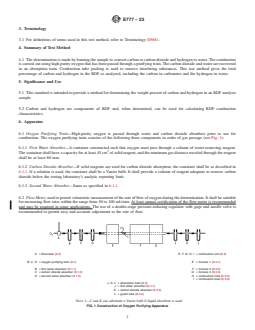
6.1 Oxygen Purifying Train—High-purity oxygen is passed
through water and carbon dioxide absorbers prior to use for
This test method is under the jurisdiction of ASTM Committee D34 on Waste
Management and is the direct responsibility of Subcommittee D34.03 on Treatment,
Recovery and Reuse. For referenced ASTM standards, visit the ASTM website, www.astm.org, or
Current edition approved April 1, 2023. Published April 2023. Originally contact ASTM Customer Service at service@astm.org. For Annual Book of ASTM
approved in 1987. Last previous edition approved in 2017 as E777 – 17a. DOI: Standards volume information, refer to the standard’s Document Summary page on
10.1520/E0777-23. the ASTM website.
Copyright © ASTM International, 100 Barr Harbor Drive, PO Box C700, West Conshohocken, PA 19428-2959. United States
E777 − 23
combustion. The oxygen purifying train consists of the follow- 6.3.2 Furnace Section 2—Furnace 2 shall be approximately
ing three components in order of gas passage (see Fig. 1): 330 mm in length and used to heat that portion of the tube filled
with cupric oxide. The operating temperature shall be 850 6
6.1.1 First Water Absorber—A container constructed such
20 °C (see Note 2).
that oxygen must pass through a column of water-removing
6.3.3 Furnace Section 3—Furnace 3 shall be approximately
reagent. The container shall have a capacity for at least 45 cm
230 mm long, and used to heat that portion of the tube filled
of solid reagent, and the minimum gas distance traveled
with lead chromate or silver. The operating temperature shall
through the reagent shall be at least 80 mm.
be 500 6 50 °C.
6.1.2 Carbon Dioxide Absorber—If solid reagents are used
6.3.4 Combustion Tube, made of fused quartz or high-silica
for carbon dioxide absorption, the container shall be as
glass, and having a nominal inside diameter which may vary
described in 6.1.1. If a solution is used, the container shall be
within the limits of 19 to 22 mm and a minimum total length
a Vanier bulb. It shall provide a column of reagent adequate to
of 970 mm. The exit shall be tapered to provide a tubulated
remove carbon dioxide below the testing laboratory’s analytic
section for connection to the absorption train. The tubulated
reporting limit.
section shall have a length of 20 to 25 mm, an internal diameter
6.1.3 Second Water Absorber—Same as specified in 6.1.1.
of not less than 3 mm, and an external diameter of approxi-
6.2 Flow Meter, used to permit volumetric measurement of
mately 7 mm. The total length of the reduced end shall not
the rate of flow of oxygen during the determination. It shall be
exceed 60 mm. If a translucent fused quartz tube is used, a
suitable for measuring flow rates within the range from 50 to
transparent section 190 mm long, located 250 mm from the
100 mL/min. At least annual certification of the flow meter is
oxygen inlet end of the tube, will be found convenient (see Fig.
recommended and may be required in some applications. The
2).
use of a double-stage pressure-reducing regulator with gage
6.3.5 Combustion Boat, made of glazed porcelain, fused
and needle valve is recommended to permit easy and accurate
silica, or platinum. Boats with internal dimensions of approxi-
adjustment to the rate of flow.
mately 70 by 8 by 8 mm have been found convenient to use in
this analysis.
6.3 Combustion Unit, consisting of three electrically heated
furnace sections, individually controlled, which may be
6.4 Absorption Train, identical to the oxygen absorption
mounted on rails for easy movement. The upper part of each
train described in 6.1. The absorption train shall consist of the
furnace may be hinged so that it can be opened for inspection
following components arranged as listed which corresponds to
of the combustion tube. The three furnace sections shall be as
the order of oxygen passage through the apparatus (see Fig. 1):
follows (see Fig. 1):
6.4.1 First Water Absorber, as described in 6.1.1.
6.3.1 Furnace Section 1—Furnace 1 is nearest the oxygen
6.4.2 Carbon Dioxide Absorber, as described in 6.1.2.
inlet of the combustion tube, approximately 130 mm long and
6.4.3 Second Water Absorber, as described in 6.1.3. The
used to heat the inlet of the combustion tube and the sample. It
second water absorber is also known as a guard tube.
shall be capable of rapidly attaining an operating temperature
7. Reagents
of 875 6 25 °C.
7.1 Purity of Reagents—Reagent-grade chemicals shall be
NOTE 2—Combustion tube temperature shall be measured by means of
used in all tests. Unless otherwise indicated, it is intended that
a calibrated thermocouple placed immediately adjacent to the tube near
the center of the appropriate tube section.
all reagents shall conform to the specifications of the American
A = flowmeter (6.2) E, F, G, H, I = combustion unit (6.3)
B, C, D = oxygen purifying train (6.1) E = furnace 1 (6.3.1)
B = first water absorber (6.1.1) F = furnace 2 (6.3.2)
C = carbon dioxide absorber (6.1.2) G = furnace 3 (6.3.3)
D = second water absorber (6.1.3) H = combustion tube (6.3.4)
I = combustion boat (6.3.5)
J, K, L = absorption train (6.4)
J = first water absorber (6.4.1)
K = carbon dioxide absorber (6.4.2)
L = guard tube (6.4.3)
NOTE 1—C and K can substitute a Vanier bulb if liquid absorbent is used.
FIG. 1 Construction of Oxygen Purifying Apparatus
E777 − 23
A = clear fused quartz section (optional when a translucent quartz tube is used)
B = cupric oxide filling
C = lead chromate or silver gauze filling
P , P , P = oxidized copper gauze plugs
1 2 3
NOTE 1—When furnace sections longer than those specified in 6.3 are to be used, changes in the above dimensions shall be in accordance with
provisions of Note 5.
FIG. 2 Arrangement of Tube Filling for Combustion Tube
or potassium hydroxide are sold under the trade name Ascarite. If soda
Chemical Society, where such specifications are available.
lime is used in admixture with any of the foregoing, it should not exceed
Other grades may be used, provided it is first determined that
30 weight % of the total reagent. In using Ascarite it may be necessary to
the reagent is of sufficiently high purity to permit its use
add a few drops of water to this reagent to ensure complete absorption of
without lessening the accuracy of the determination.
carbon dioxide.
7.2 Purity of Water—Unless otherwise indicated, references
8. Precautions
to water shall be understood to mean reagent water, Type III,
conforming to Specification D1193. 8.1 Due to the origins of RDF in municipal waste, safety
precautions should be taken when conducting tests on samples.
7.3 Oxygen, with minimum acceptable purity 99.5 %.
Safety practices include use of gloves for handling RDF
NOTE 3—If the blank tests for flow (see 10.3.2) indicate interfering
samples; wearing NIOSH-approved type dust masks, espe-
impurities in the oxygen supply by consistent weight gain in the absorbers,
cially while milling RDF samples; conducting tests under a
eliminate these impurities by using a preheater furnace and tube, filled
negative pressure hood; and washing hands with soap and
with cupric oxide. Operate this preheater at 850 6 20 °C and insert in
series between the supply tank of oxygen and the purification train. water after completing the analysis.
7.4 Combustion Tube Reagents:
9. Sampling
7.4.1 Cupric Oxide (CuO), wire form, dust-free.
9.1 RDF products are frequently inhomogeneous. For this
7.4.2 Fused Lead Chromate (PbCrO ), approximately 2.38
to 0.84 mm in size. reason, care should be exercised to ensure that a representative
laboratory sample from the RDF lot to be characterized is
7.4.3 Silver Gauze, 99.9 % silver minimum purity, 0.84 mm,
made from approximately No. 27 B&S gage wire. obtained.
7.4.4 Copper Gauze, 99.0 % copper minimum purity,
9.2 The sampling method for this procedure should be based
0.84 mm, made from approximat
...
This document is not an ASTM standard and is intended only to provide the user of an ASTM standard an indication of what changes have been made to the previous version. Because
it may not be technically possible to adequately depict all changes accurately, ASTM recommends that users consult prior editions as appropriate. In all cases only the current version
of the standard as published by ASTM is to be considered the official document.
Designation: E777 − 17a E777 − 23
Standard Test Method for
Carbon and Hydrogen in the Analysis Sample of Refuse-
Derived Fuel
This standard is issued under the fixed designation E777; the number immediately following the designation indicates the year of
original adoption or, in the case of revision, the year of last revision. A number in parentheses indicates the year of last reapproval. A
superscript epsilon (´) indicates an editorial change since the last revision or reapproval.
1. Scope
1.1 This test method is for the determination of total carbon and hydrogen in a sample of refuse-derived fuel (RDF). Both carbon
and hydrogen are determined in one analysis. This test method yields the total percentages of carbon and hydrogen in RDF as
analyzed and the results include not only carbon and hydrogen in the organic matter, but also the carbon present in mineral
carbonates and the hydrogen present in the free moisture accompanying the analysis sample as well as hydrogen present as water
of hydration.
NOTE 1—It is recognized that certain technical applications of the data derived from this test procedure may justify additional corrections. These
corrections could involve compensation for the carbon present as carbonates, the hydrogen of free moisture accompanying the analysis sample, and the
calculated hydrogen present as water of hydration.
1.2 This test method may be applicable to any waste material from which a laboratory analysis sample can be prepared.
1.3 The values stated in SI units are to be regarded as standard. No other units of measurement are included in this standard.
1.4 This standard does not purport to address all of the safety concerns, if any, associated with its use. It is the responsibility
of the user of this standard to establish appropriate safety, health, and environmental practices and determine the applicability of
regulatory limitations prior to use. For specific precautionary statements, see Section 8.
1.5 This international standard was developed in accordance with internationally recognized principles on standardization
established in the Decision on Principles for the Development of International Standards, Guides and Recommendations issued
by the World Trade Organization Technical Barriers to Trade (TBT) Committee.
2. Referenced Documents
2.1 ASTM Standards:
D1193 Specification for Reagent Water
D5681 Terminology for Waste and Waste Management
E790 Test Method for Residual Moisture in Refuse-Derived Fuel Analysis Samples
E791 Test Method for Calculating Refuse-Derived Fuel Analysis Data from As-Determined to Different Bases
E829 Practice for Preparing Refuse-Derived Fuel (RDF) Laboratory Samples for Analysis
This test method is under the jurisdiction of ASTM Committee D34 on Waste Management and is the direct responsibility of Subcommittee D34.03 on Treatment,
Recovery and Reuse.
Current edition approved Dec. 1, 2017April 1, 2023. Published December 2017April 2023. Originally approved in 1987. Last previous edition approved in 2017 as
E777 – 17.E777 – 17a. DOI: 10.1520/E0777-17A.10.1520/E0777-23.
For referenced ASTM standards, visit the ASTM website, www.astm.org, or contact ASTM Customer Service at service@astm.org. For Annual Book of ASTM Standards
volume information, refer to the standard’s Document Summary page on the ASTM website.
Copyright © ASTM International, 100 Barr Harbor Drive, PO Box C700, West Conshohocken, PA 19428-2959. United States
E777 − 23
3. Terminology
3.1 For definitions of terms used in this test method, refer to Terminology D5681.
4. Summary of Test Method
4.1 The determination is made by burning the sample to convert carbon to carbon dioxide and hydrogen to water. The combustion
is carried out using high-purity oxygen that has been passed through a purifying train. The carbon dioxide and water are recovered
in an absorption train. Combustion tube packing is used to remove interfering substances. This test method gives the total
percentage of carbon and hydrogen in the RDF as analyzed, including the carbon in carbonates and the hydrogen in water.
5. Significance and Use
5.1 This standard is intended to provide a method for determining the weight percent of carbon and hydrogen in an RDF analysis
sample.
5.2 Carbon and hydrogen are components of RDF and, when determined, can be used for calculating RDF combustion
characteristics.
6. Apparatus
6.1 Oxygen Purifying Train—High-purity oxygen is passed through water and carbon dioxide absorbers prior to use for
combustion. The oxygen purifying train consists of the following three components in order of gas passage (see Fig. 1):
6.1.1 First Water Absorber—A container constructed such that oxygen must pass through a column of water-removing reagent.
The container shall have a capacity for at least 45 cm of solid reagent, and the minimum gas distance traveled through the reagent
shall be at least 80 mm.
6.1.2 Carbon Dioxide Absorber—If solid reagents are used for carbon dioxide absorption, the container shall be as described in
6.1.1. If a solution is used, the container shall be a Vanier bulb. It shall provide a column of reagent adequate to remove carbon
dioxide below the testing laboratory’s analytic reporting limit.
6.1.3 Second Water Absorber—Same as specified in 6.1.1.
6.2 Flow Meter, used to permit volumetric measurement of the rate of flow of oxygen during the determination. It shall be suitable
for measuring flow rates within the range from 50 to 100 mL/min. At least annual certification of the flow meter is recommended
and may be required in some applications. The use of a double-stage pressure-reducing regulator with gage and needle valve is
recommended to permit easy and accurate adjustment to the rate of flow.
A = flowmeter (6.2) E, F, G, H, I = combustion unit (6.3)
B, C, D = oxygen purifying train (6.1) E = furnace 1 (6.3.1)
B = first water absorber (6.1.1) F = furnace 2 (6.3.2)
C = carbon dioxide absorber (6.1.2) G = furnace 3 (6.3.3)
D = second water absorber (6.1.3) H = combustion tube (6.3.4)
I = combustion boat (6.3.5)
J, K, L = absorption train (6.4)
J = first water absorber (6.4.1)
K = carbon dioxide absorber (6.4.2)
L = guard tube (6.4.3)
NOTE 1—C and K can substitute a Vanier bulb if liquid absorbent is used.
FIG. 1 Construction of Oxygen Purifying Apparatus
E777 − 23
6.3 Combustion Unit, consisting of three electrically heated furnace sections, individually controlled, which may be mounted on
rails for easy movement. The upper part of each furnace may be hinged so that it can be opened for inspection of the combustion
tube. The three furnace sections shall be as follows (see Fig. 1):
6.3.1 Furnace Section 1—Furnace 1 is nearest the oxygen inlet of the combustion tube, approximately 130 mm long and used to
heat the inlet of the combustion tube and the sample. It shall be capable of rapidly attaining an operating temperature of 875 6
25 °C.
NOTE 2—Combustion tube temperature shall be measured by means of a calibrated thermocouple placed immediately adjacent to the tube near the center
of the appropriate tube section.
6.3.2 Furnace Section 2—Furnace 2 shall be approximately 330 mm in length and used to heat that portion of the tube filled with
cupric oxide. The operating temperature shall be 850 6 20 °C (see Note 2).
6.3.3 Furnace Section 3—Furnace 3 shall be approximately 230 mm long, and used to heat that portion of the tube filled with lead
chromate or silver. The operating temperature shall be 500 6 50 °C.
6.3.4 Combustion Tube, made of fused quartz,quartz or high-silica glass, and having a nominal inside diameter which may vary
within the limits of 19 to 22 mm and a minimum total length of 970 mm. The exit shall be tapered to provide a tubulated section
for connection to the absorption train. The tubulated section shall have a length of 20 to 25 mm, an internal diameter of not less
than 3 mm, and an external diameter of approximately 7 mm. The total length of the reduced end shall not exceed 60 mm. If a
translucent fused quartz tube is used, a transparent section 190 mm long, located 250 mm from the oxygen inlet end of the tube,
will be found convenient (see Fig. 2).
6.3.5 Combustion Boat, made of glazed porcelain, fused silica, or platinum. Boats with internal dimensions of approximately 70
by 8 by 8 mm have been found convenient to use in this analysis.
6.4 Absorption Train, identical to the oxygen absorption train described in 6.1. The absorption train shall consist of the following
components arranged as listed which corresponds to the order of oxygen passage through the apparatus (see Fig. 1):
6.4.1 First Water Absorber, as described in 6.1.1.
6.4.2 Carbon Dioxide Absorber, as described in 6.1.2.
6.4.3 Second Water Absorber, as described in 6.1.3. The second water absorber is also known as a guard tube.
7. Reagents
7.1 Purity of Reagents—Reagent-grade chemicals shall be used in all tests. Unless otherwise indicated, it is intended that all
A = clear fused quartz section (optional when a translucent quartz tube is used)
B = cupric oxide filling
C = lead chromate or silver gauze filling
P , P , P = oxidized copper gauze plugs
1 2 3
NOTE 1—When furnace sections longer than those specified in 6.3 are to be used, changes in the above dimensions shall be in accordance with
provisions of Note 5.
FIG. 2 Arrangement of Tube Filling for Combustion Tube
E777 − 23
reagents shall conform to the specifications of the American Chemical Society, where such specifications are available. Other
grades may be used, provided it is first determined that the reagent is of sufficiently high purity to permit its use without lessening
the accuracy of the determination.
7.2 Purity of Water—Unless otherwise indicated, references to water shall be understood to mean reagent water, Type III,
conforming to Specification D1193.
7.3 Oxygen, with minimum acceptable purity 99.5 %.
NOTE 3—If the blank tests for flow (see 10.3.2) indicate interfering impurities in the oxygen supply by consistent weight gain in the absorbers, eliminate
these impurities by using a preheater furnace and tube, filled with cupric oxide. Operate this preheater at 850 6 20 °C and insert in series between the
supply tank of oxygen and the purification train.
7.4 Combustion Tube Reagents:
7.4.1 Cupric Oxide (CuO), wire form, dust-free.
7.4.2 Fused Lead Chromate (PbCrO ), approximately 2.38 to 0.84 mm in size.
7.4.3 Silver Gauze, 99.9 % silver minimum purity, 0.84 mm, made from approximately No. 27 B&S gage wire.
7.4.4 Copper Gauze, 99.0 % copper minimum purity, 0.84 mm, made from approximately No. 26 B&S gage wire.
7.5 Purification and Absorption Train Reagents:
7.5.1 Water Absorbent—Anhydrous magnesium perchlorate (Mg(ClO ) ) approximately 2.38 to 0.35 mm in size.
4 2
7.5.2 Carbon Dioxide Absorbent—If a solid reagent is used, it shall consist of either sodium or potassium hydroxide (NaOH or
KOH) impregnated in an inert carrier of approximately 2.38 to 0.84 mm in size. Use of soda lime in place of the above or in
admixture with them is permissible (Note 4). If a solution is used, it shall consist of 30 weight % potassium hydroxide (KOH).
NOTE 4—Acceptable carbon dioxide absorbing reagents using sodium or potassium hydroxide are sold under the trade name Ascarite. If soda lime is used
in admixture with any of the foregoing, it should not exceed 30 weight % of the total reagent. In using Ascarite it may be necessary to add a few drops
of water to this reagent to ensure complete ab
...