


ASTM E329-23
(Specification)Standard Specification for Agencies Engaged in Construction Inspection, Testing, or Special Inspection
Standard Specification for Agencies Engaged in Construction Inspection, Testing, or Special Inspection
ABSTRACT
This specification defines the minimum requirements for inspection agency personnel or testing agency laboratory personnel, or both, and the minimum technical requirements for equipment and procedures utilized in the testing and inspection of construction and materials used in construction. Criteria provided herein shall be used for evaluating the capability of the agency to properly perform designated tests on construction materials, as well as establishing essential characteristics pertaining to the organization, personnel, facilities, and quality systems of the agency.
SIGNIFICANCE AND USE
4.1 The inspection and testing of construction activities and the materials used in construction are important elements in obtaining quality construction in general compliance with the contract documents. An agency providing construction inspection, testing, or Special Inspection, must be selected with care after a comprehensive evaluation of their competency to perform the services properly and in compliance with the approved project plans and specifications.
4.2 This specification provides minimum criteria for use in assessing the qualifications of construction inspection, testing, and Special Inspection agencies. The criteria may be supplemented by more specific criteria and requirements for particular classes of testing or types of inspection agencies. An individual user can also use it to judge the competency of an agency.
4.3 The intent of this specification is to provide a standardized basis for requirements for a technically oriented construction inspection, testing, or Special Inspection agency, with respect to the agency's capability to objectively and competently provide the specific services without prejudice.
4.4 Typically, assessing an agency involves the following three essential sequential phases:
4.4.1 Submittal of basic information in accordance with the criteria of this specification to the accreditation body by an agency desiring to be accredited to this specification,
4.4.2 Assessment of the agency-submitted information by the accreditation body, and
4.4.3 On-site assessment of the agency by the accreditation body.
SCOPE
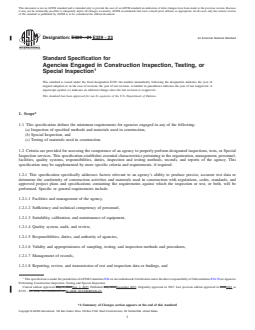
1.1 This specification defines the minimum requirements for agencies engaged in any of the following:
(a) Inspection of specified methods and materials used in construction,
(b) Special Inspection, and
(c) Testing of materials used in construction.
1.2 Criteria are provided for assessing the competence of an agency to properly perform designated inspections, tests, or Special Inspection services. This specification establishes essential characteristics pertaining to the organization, management, personnel, facilities, quality systems, responsibilities, duties, inspection and testing methods, records, and reports of the agency. This specification may be supplemented by more specific criteria and requirements, if required.
1.2.1 This specification specifically addresses factors relevant to an agency’s ability to produce precise, accurate test data or determine the conformity of construction activities and materials used in construction with regulations, codes, standards, and approved project plans and specifications containing the requirements against which the inspection or test, or both, will be performed. Specific or general requirements include:
1.2.1.1 Facilities and management of the agency,
1.2.1.2 Sufficiency and technical competency of personnel,
1.2.1.3 Suitability, calibration, and maintenance of equipment,
1.2.1.4 Quality system, audit, and review,
1.2.1.5 Responsibilities, duties, and authority of agencies,
1.2.1.6 Validity and appropriateness of sampling, testing, and inspection methods and procedures,
1.2.1.7 Management of records,
1.2.1.8 Reporting, review, and transmission of test and inspection data or findings, and
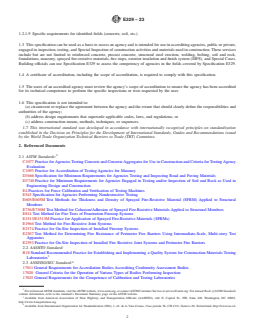
1.2.1.9 Specific requirements for identified fields (concrete, soil, etc.).
1.3 This specific...
General Information
- Status
- Published
- Publication Date
- 31-Oct-2023
- Technical Committee
- E36 - Accreditation & Certification
Relations
- Effective Date
- 01-Nov-2023
- Effective Date
- 01-Jan-2024
- Effective Date
- 01-Nov-2023
- Effective Date
- 01-Nov-2023
- Effective Date
- 01-Jul-2023
- Effective Date
- 01-Oct-2019
- Effective Date
- 01-Nov-2023
- Effective Date
- 01-Nov-2023
- Effective Date
- 01-Nov-2023
- Effective Date
- 01-Nov-2023
- Effective Date
- 01-Nov-2023
- Effective Date
- 01-Nov-2023
- Effective Date
- 01-Nov-2023
Overview
ASTM E329-23: Standard Specification for Agencies Engaged in Construction Inspection, Testing, or Special Inspection outlines the minimum requirements for organizations and personnel performing inspection and testing services for construction projects. Developed by ASTM International, this standard helps ensure consistency, reliability, and technical competence in the evaluation of construction materials and activities. ASTM E329-23 plays a crucial role in safeguarding construction quality by providing a framework for evaluating agencies’ capabilities, qualifications, procedures, and quality management systems.
Key Topics
ASTM E329-23 addresses core aspects of agencies involved in construction materials testing, inspection, and Special Inspection, including:
Organizational Requirements
- Agencies must be legally identifiable and have a clear management structure.
- Key responsibilities include independence, authority, confidentiality, and resource management.
Personnel Qualifications
- Requirements for education, training, certification, and experience of managers, supervisors, technicians, and inspectors.
- Special considerations for professional engineers and certified Special Inspectors.
Equipment and Facilities
- Provision, maintenance, calibration, and documentation of testing and inspection equipment.
- Permanent and temporary facility operations, including traceability and recordkeeping.
Quality System
- Mandatory establishment of a comprehensive quality system with documented quality manual and operational procedures.
- Implementation of internal audits, corrective actions, proficiency testing, and periodic management reviews.
Inspection and Testing Methods
- Use of appropriate, standardized methods aligned with relevant codes and project specifications.
- Procedures for sampling, data analysis, reporting, and safeguarding result integrity.
Applications
ASTM E329-23 is widely used across the construction industry for:
Agency Accreditation
- Serving as a baseline for public and private accrediting bodies to assess agencies’ competence in construction inspection and testing.
- Applicable to a range of activities including materials testing (concrete, soil, steel, masonry), Special Inspections, and field quality assurance.
Qualification of Agencies and Personnel
- Helping project owners, contractors, and building officials verify that chosen inspection and testing agencies meet a recognized, standardized competency threshold.
- Ensuring personnel certification and ongoing training meet industry demands.
Project Compliance
- Supporting compliance with regulations, building codes, and contract documents by confirming competent testing and inspection practices.
- Enhancing quality assurance in reinforced concrete, structural steel, fireproofing, masonry, foundations, and more.
Continuous Improvement
- Driving ongoing quality through required audits, periodic proficiency evaluations, and feedback mechanisms.
Related Standards
Agencies and professionals referencing ASTM E329-23 often consult associated standards and best practices, such as:
- ASTM C1077 - Agencies Testing Concrete and Concrete Aggregates
- ASTM C1093 - Accreditation for Masonry Testing Agencies
- ASTM D3666 - Agencies Testing and Inspecting Road and Paving Materials
- ASTM D3740 - Agencies Testing Soil and Rock in Engineering
- ASTM E543 - Agencies Performing Nondestructive Testing
- ANSI/ISO/IEC 17025 - Competence of Testing Laboratories
- ANSI/ISO/IEC 17020 - Criteria for Inspection Bodies
- AASHTO R18 - Quality Systems for Construction Materials Testing Laboratories
- Current Building Codes such as the International Building Code (IBC)
Practical Value
By utilizing ASTM E329-23, construction stakeholders gain confidence in the objectivity, accuracy, and independence of inspection and testing agencies. This standard minimizes project risk, supports legal and regulatory compliance, and helps ensure construction materials and practices meet or exceed required specifications. Building officials and project owners can rely on it to select and evaluate agencies that deliver high-quality, dependable results throughout the construction process.
Buy Documents
ASTM E329-23 - Standard Specification for Agencies Engaged in Construction Inspection, Testing, or Special Inspection
REDLINE ASTM E329-23 - Standard Specification for Agencies Engaged in Construction Inspection, Testing, or Special Inspection
Get Certified
Connect with accredited certification bodies for this standard

ICC Evaluation Service
Building products evaluation and certification.

QAI Laboratories
Building and construction product testing and certification.

Aboma Certification B.V.
Specialized in construction, metal, and transport sectors.
Sponsored listings
Frequently Asked Questions
ASTM E329-23 is a technical specification published by ASTM International. Its full title is "Standard Specification for Agencies Engaged in Construction Inspection, Testing, or Special Inspection". This standard covers: ABSTRACT This specification defines the minimum requirements for inspection agency personnel or testing agency laboratory personnel, or both, and the minimum technical requirements for equipment and procedures utilized in the testing and inspection of construction and materials used in construction. Criteria provided herein shall be used for evaluating the capability of the agency to properly perform designated tests on construction materials, as well as establishing essential characteristics pertaining to the organization, personnel, facilities, and quality systems of the agency. SIGNIFICANCE AND USE 4.1 The inspection and testing of construction activities and the materials used in construction are important elements in obtaining quality construction in general compliance with the contract documents. An agency providing construction inspection, testing, or Special Inspection, must be selected with care after a comprehensive evaluation of their competency to perform the services properly and in compliance with the approved project plans and specifications. 4.2 This specification provides minimum criteria for use in assessing the qualifications of construction inspection, testing, and Special Inspection agencies. The criteria may be supplemented by more specific criteria and requirements for particular classes of testing or types of inspection agencies. An individual user can also use it to judge the competency of an agency. 4.3 The intent of this specification is to provide a standardized basis for requirements for a technically oriented construction inspection, testing, or Special Inspection agency, with respect to the agency's capability to objectively and competently provide the specific services without prejudice. 4.4 Typically, assessing an agency involves the following three essential sequential phases: 4.4.1 Submittal of basic information in accordance with the criteria of this specification to the accreditation body by an agency desiring to be accredited to this specification, 4.4.2 Assessment of the agency-submitted information by the accreditation body, and 4.4.3 On-site assessment of the agency by the accreditation body. SCOPE 1.1 This specification defines the minimum requirements for agencies engaged in any of the following: (a) Inspection of specified methods and materials used in construction, (b) Special Inspection, and (c) Testing of materials used in construction. 1.2 Criteria are provided for assessing the competence of an agency to properly perform designated inspections, tests, or Special Inspection services. This specification establishes essential characteristics pertaining to the organization, management, personnel, facilities, quality systems, responsibilities, duties, inspection and testing methods, records, and reports of the agency. This specification may be supplemented by more specific criteria and requirements, if required. 1.2.1 This specification specifically addresses factors relevant to an agency’s ability to produce precise, accurate test data or determine the conformity of construction activities and materials used in construction with regulations, codes, standards, and approved project plans and specifications containing the requirements against which the inspection or test, or both, will be performed. Specific or general requirements include: 1.2.1.1 Facilities and management of the agency, 1.2.1.2 Sufficiency and technical competency of personnel, 1.2.1.3 Suitability, calibration, and maintenance of equipment, 1.2.1.4 Quality system, audit, and review, 1.2.1.5 Responsibilities, duties, and authority of agencies, 1.2.1.6 Validity and appropriateness of sampling, testing, and inspection methods and procedures, 1.2.1.7 Management of records, 1.2.1.8 Reporting, review, and transmission of test and inspection data or findings, and 1.2.1.9 Specific requirements for identified fields (concrete, soil, etc.). 1.3 This specific...
ABSTRACT This specification defines the minimum requirements for inspection agency personnel or testing agency laboratory personnel, or both, and the minimum technical requirements for equipment and procedures utilized in the testing and inspection of construction and materials used in construction. Criteria provided herein shall be used for evaluating the capability of the agency to properly perform designated tests on construction materials, as well as establishing essential characteristics pertaining to the organization, personnel, facilities, and quality systems of the agency. SIGNIFICANCE AND USE 4.1 The inspection and testing of construction activities and the materials used in construction are important elements in obtaining quality construction in general compliance with the contract documents. An agency providing construction inspection, testing, or Special Inspection, must be selected with care after a comprehensive evaluation of their competency to perform the services properly and in compliance with the approved project plans and specifications. 4.2 This specification provides minimum criteria for use in assessing the qualifications of construction inspection, testing, and Special Inspection agencies. The criteria may be supplemented by more specific criteria and requirements for particular classes of testing or types of inspection agencies. An individual user can also use it to judge the competency of an agency. 4.3 The intent of this specification is to provide a standardized basis for requirements for a technically oriented construction inspection, testing, or Special Inspection agency, with respect to the agency's capability to objectively and competently provide the specific services without prejudice. 4.4 Typically, assessing an agency involves the following three essential sequential phases: 4.4.1 Submittal of basic information in accordance with the criteria of this specification to the accreditation body by an agency desiring to be accredited to this specification, 4.4.2 Assessment of the agency-submitted information by the accreditation body, and 4.4.3 On-site assessment of the agency by the accreditation body. SCOPE 1.1 This specification defines the minimum requirements for agencies engaged in any of the following: (a) Inspection of specified methods and materials used in construction, (b) Special Inspection, and (c) Testing of materials used in construction. 1.2 Criteria are provided for assessing the competence of an agency to properly perform designated inspections, tests, or Special Inspection services. This specification establishes essential characteristics pertaining to the organization, management, personnel, facilities, quality systems, responsibilities, duties, inspection and testing methods, records, and reports of the agency. This specification may be supplemented by more specific criteria and requirements, if required. 1.2.1 This specification specifically addresses factors relevant to an agency’s ability to produce precise, accurate test data or determine the conformity of construction activities and materials used in construction with regulations, codes, standards, and approved project plans and specifications containing the requirements against which the inspection or test, or both, will be performed. Specific or general requirements include: 1.2.1.1 Facilities and management of the agency, 1.2.1.2 Sufficiency and technical competency of personnel, 1.2.1.3 Suitability, calibration, and maintenance of equipment, 1.2.1.4 Quality system, audit, and review, 1.2.1.5 Responsibilities, duties, and authority of agencies, 1.2.1.6 Validity and appropriateness of sampling, testing, and inspection methods and procedures, 1.2.1.7 Management of records, 1.2.1.8 Reporting, review, and transmission of test and inspection data or findings, and 1.2.1.9 Specific requirements for identified fields (concrete, soil, etc.). 1.3 This specific...
ASTM E329-23 is classified under the following ICS (International Classification for Standards) categories: 91.100.01 - Construction materials in general. The ICS classification helps identify the subject area and facilitates finding related standards.
ASTM E329-23 has the following relationships with other standards: It is inter standard links to ASTM E329-21, ASTM C1077-24, ASTM D3740-23, ASTM E2307-23b, ASTM E2307-23a, ASTM D3740-19, ASTM E2833-12(2018), ASTM E699-16, ASTM A627-03(2019), ASTM D3666-16, ASTM C1077-17, ASTM E543-21, ASTM E2353-21. Understanding these relationships helps ensure you are using the most current and applicable version of the standard.
ASTM E329-23 is available in PDF format for immediate download after purchase. The document can be added to your cart and obtained through the secure checkout process. Digital delivery ensures instant access to the complete standard document.
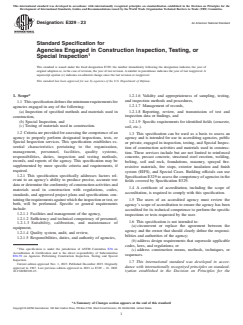
Standards Content (Sample)
This international standard was developed in accordance with internationally recognized principles on standardization established in the Decision on Principles for the
Development of International Standards, Guides and Recommendations issued by the World Trade Organization Technical Barriers to Trade (TBT) Committee.
Designation: E329 − 23 An American National Standard
Standard Specification for
Agencies Engaged in Construction Inspection, Testing, or
Special Inspection
This standard is issued under the fixed designation E329; the number immediately following the designation indicates the year of
original adoption or, in the case of revision, the year of last revision. A number in parentheses indicates the year of last reapproval. A
superscript epsilon (´) indicates an editorial change since the last revision or reapproval.
This standard has been approved for use by agencies of the U.S. Department of Defense.
1. Scope* 1.2.1.6 Validity and appropriateness of sampling, testing,
and inspection methods and procedures,
1.1 This specification defines the minimum requirements for
1.2.1.7 Management of records,
agencies engaged in any of the following:
1.2.1.8 Reporting, review, and transmission of test and
(a) Inspection of specified methods and materials used in
inspection data or findings, and
construction,
(b) Special Inspection, and
1.2.1.9 Specific requirements for identified fields (concrete,
(c) Testing of materials used in construction. soil, etc.).
1.2 Criteria are provided for assessing the competence of an
1.3 This specification can be used as a basis to assess an
agency to properly perform designated inspections, tests, or
agency and is intended for use in accrediting agencies, public
Special Inspection services. This specification establishes es-
or private, engaged in inspection, testing, and Special Inspec-
sential characteristics pertaining to the organization,
tion of construction activities and materials used in construc-
management, personnel, facilities, quality systems,
tion. These services include but are not limited to reinforced
responsibilities, duties, inspection and testing methods,
concrete, precast concrete, structural steel erection, welding,
records, and reports of the agency. This specification may be
bolting, soil and rock, foundations, masonry, sprayed fire-
supplemented by more specific criteria and requirements, if
resistive materials, fire stops, exterior insulation and finish
required.
system (EIFS), and Special Cases. Building officials can use
1.2.1 This specification specifically addresses factors rel-
Specification E329 to assess the competency of agencies in the
evant to an agency’s ability to produce precise, accurate test
fields covered by Specification E329.
data or determine the conformity of construction activities and
1.4 A certificate of accreditation, including the scope of
materials used in construction with regulations, codes,
accreditation, is required to comply with this specification.
standards, and approved project plans and specifications con-
taining the requirements against which the inspection or test, or
1.5 The users of an accredited agency must review the
both, will be performed. Specific or general requirements
agency’s scope of accreditation to ensure the agency has been
include:
accredited for its technical competence to perform the specific
1.2.1.1 Facilities and management of the agency,
inspections or tests requested by the user.
1.2.1.2 Sufficiency and technical competency of personnel,
1.6 This specification is not intended to:
1.2.1.3 Suitability, calibration, and maintenance of
(a) circumvent or replace the agreement between the
equipment,
agency and the owner that should clearly define the responsi-
1.2.1.4 Quality system, audit, and review,
bilities and authorities of the agency;
1.2.1.5 Responsibilities, duties, and authority of agencies,
(b) address design requirements that supersede applicable
codes, laws, and regulations; or
This specification is under the jurisdiction of ASTM Committee E36 on
(c) address construction means, methods, techniques, or
Accreditation & Certification and is the direct responsibility of Subcommittee
sequences.
E36.70 on Agencies Performing Construction Inspection, Testing and Special
Inspection.
1.7 This international standard was developed in accor-
Current edition approved Nov. 1, 2023. Published December 2023. Originally
dance with internationally recognized principles on standard-
approved in 1967. Last previous edition approved in 2021 as E329 – 21. DOI:
ization established in the Decision on Principles for the
10.1520/E0329-23.
*A Summary of Changes section appears at the end of this standard
Copyright © ASTM International, 100 Barr Harbor Drive, PO Box C700, West Conshohocken, PA 19428-2959. United States
E329 − 23
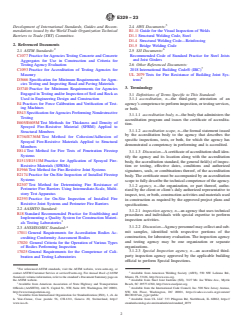
Development of International Standards, Guides and Recom- 2.4 AWS Documents:
mendations issued by the World Trade Organization Technical B1.11 Guide for the Visual Inspection of Welds
Barriers to Trade (TBT) Committee. D1.1 Structural Welding Code, Steel
D1.4 Structural Welding Code—Reinforcing
2. Referenced Documents
D1.5 Bridge Welding Code
2.5 SJI Documents:
2.1 ASTM Standards:
C1077 Practice for Agencies Testing Concrete and Concrete Recommended Code of Standard Practice for Steel Joists
and Joist Girders
Aggregates for Use in Construction and Criteria for
Testing Agency Evaluation
2.6 Other Referenced Documents:
C1093 Practice for Accreditation of Testing Agencies for 2018 International Building Code® (IBC)
Masonry UL 2079 Tests for Fire Resistance of Building Joint Sys-
D3666 Specification for Minimum Requirements for Agen- tems
cies Testing and Inspecting Road and Paving Materials
3. Terminology
D3740 Practice for Minimum Requirements for Agencies
Engaged in Testing and/or Inspection of Soil and Rock as
3.1 Definitions of Terms Specific to This Standard:
Used in Engineering Design and Construction
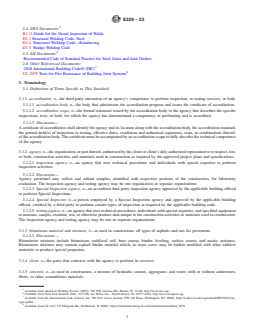
3.1.1 accreditation, n—the third-party attestation of an
E4 Practices for Force Calibration and Verification of Test-
agency’s competence to perform inspection, or testing services,
ing Machines
or both.
E543 Specification for Agencies Performing Nondestructive
3.1.1.1 accreditation body, n—the body that administers the
Testing
accreditation program and issues the certificate of accredita-
E605/E605M Test Methods for Thickness and Density of
tion.
Sprayed Fire-Resistive Material (SFRM) Applied to
3.1.1.2 accreditation scope, n—the formal statement issued
Structural Members
by the accreditation body to the agency that describes the
E736/E736M Test Method for Cohesion/Adhesion of
specific inspections, tests, or both, for which the agency has
Sprayed Fire-Resistive Materials Applied to Structural
demonstrated a competency in performing and is accredited.
Members
E814 Test Method for Fire Tests of Penetration Firestop
3.1.1.3 Discussion—A certificate of accreditation shall iden-
Systems
tify the agency and its location along with the accreditation
E1513/E1513M Practice for Application of Sprayed Fire-
body, the accreditation standard, the general field(s) of inspec-
Resistive Materials (SFRMs)
tion or testing, effective dates, conditions and authorized
E1966 Test Method for Fire-Resistive Joint Systems
signatures, seals, or combinations thereof, of the accreditation
E2174 Practice for On-Site Inspection of Installed Firestop
body. The certificate must be accompanied by an accreditation
Systems
scope to fully describe the technical competence of the agency.
E2307 Test Method for Determining Fire Resistance of
3.1.2 agency, n—the organization, or part thereof, autho-
Perimeter Fire Barriers Using Intermediate-Scale, Multi-
rized by the client or client’s duly authorized representative to
story Test Apparatus
inspect, test, or both, construction activities and materials used
E2393 Practice for On-Site Inspection of Installed Fire
in construction as required by the approved project plans and
Resistive Joint Systems and Perimeter Fire Barriers
specifications.
2.2 AASHTO Standard:
3.1.2.1 inspection agency, n—an agency that uses technical
R18 Standard Recommended Practice for Establishing and
procedures and individuals with special expertise to perform
Implementing a Quality System for Construction Materi-
inspection activities.
als Testing Laboratories
3.1.2.2 Discussion—Agency personnel may collect and sub-
2.3 ANSI/ISO/IEC Standard:
mit samples, identified with respective portions of the
17011 General Requirements for Accrediation Bodies Ac-
construction, for laboratory evaluation. The inspection agency
crediting Conformity Assessment Bodies
and testing agency may be one organization or separate
17020 General Criteria for the Operation of Various Types
organizations.
of Bodies Performing Inspection
3.1.2.3 Special Inspection agency, n—an accredited third-
17025 General Requirements for the Competence of Cali-
party inspection agency approved by the applicable building
bration and Testing Laboratories
official to perform Special Inspections.
For referenced ASTM standards, visit the ASTM website, www.astm.org, or
contact ASTM Customer Service at service@astm.org. For Annual Book of ASTM Available from American Welding Society (AWS), 550 NW LeJeune Rd.,
Standards volume information, refer to the standard’s Document Summary page on Miami, FL 33126, http://www.aws.org.
the ASTM website. Available from Steel Joist Institute (SJI), 3127 Mr. Joe White Ave., Myrtle
Available from American Association of State Highway and Transportation Beach, SC 29577-6760, http://www.steeljoist.org.
Officials (AASHTO), 444 N. Capitol St., NW, Suite 249, Washington, DC 20001, Available from the International Code Council, Inc. 500 New Jersey Avenue,
http://www.transportation.org. NW, 6th Floor, Washington, DC 20001, https://codes.iccsafe.org/content/
Available from International Organization for Standardization (ISO), 1, ch. de IBC2018?site_type=public
la Voie-Creuse, Case postale 56, CH-1211, Geneva 20, Switzerland, http:// Available from UL LLC 333 Pfingsten Rd, Northbrook, IL 60062, https://
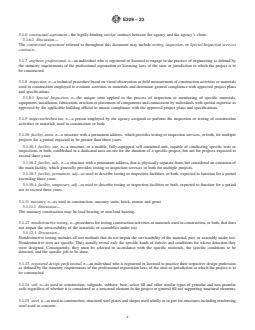
www.iso.ch. standardscatalog.ul.com/standards/en/standard_2079
E329 − 23
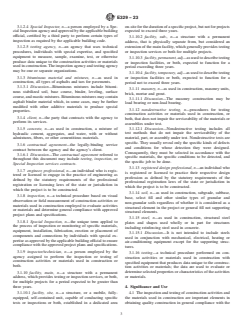
3.1.2.4 Special Inspector, n—a person employed by a Spe- on-site for the duration of a specific project, but not for projects
cial Inspection agency and approved by the applicable building expected to exceed three years.
official, certified by a third party to perform certain types of
3.1.10.2 facility, sub-, n—a structure with a permanent
inspection as required by the applicable building code.
address, that is physically separate from, but considered an
extension of the main facility, which generally provides testing
3.1.2.5 testing agency, n—an agency that uses technical
procedures, individuals with special expertise, and specified or inspection services or both for multiple projects.
equipment to measure, sample, examine, test, or otherwise
3.1.10.3 facility, permanent, adj—as used to describe testing
produce data unique to the construction activities or materials
or inspection facilities, or both, expected to function for a
used in construction. The inspection agency and testing agency
period exceeding three years.
may be one or separate organizations.
3.1.10.4 facility, temporary, adj—as used to describe testing
3.1.3 bituminous material and mixtures, n—as used in
or inspection facilities or both, expected to function for a
construction, all types of asphalts and tars for pavements.
period not to exceed three years.
3.1.3.1 Discussion—Bituminous mixtures include bitumi-
3.1.11 masonry, n—as used in construction, masonry units,
nous stabilized soil, base course, binder, leveling, surface
brick, mortar and grout.
course, and mastic mixtures. Bituminous mixtures may contain
3.1.11.1 Discussion—The masonry construction may be
asphalt binder material which, in some cases, may be further
load bearing or non-load bearing.
modified with other additive materials to produce special
3.1.12 nondestructive testing, n—procedures for testing
properties.
construction activities or materials used in construction, or
3.1.4 client, n—the party that contracts with the agency to
both, that does not impair the serviceability of the materials or
perform its services.
assemblies under test.
3.1.12.1 Discussion—Nondestructive testing includes all
3.1.5 concrete, n—as used in construction, a mixture of
hydraulic cement, aggregates, and water, with or without test methods that do not impair the serviceability of the
material, part, or assembly under test. Nondestructive tests are
admixtures, fibers, or other cementitious materials.
specific. They usually reveal only the specific kinds of defects
3.1.6 contractual agreement—the legally-binding service
and conditions for whose detection they were designed.
contract between the agency and the agency’s client.
Consequently, they must be selected in accordance with the
3.1.6.1 Discussion—The contractual agreement referred to
specific materials, the specific conditions to be detected, and
throughout this document may include testing, inspection, or
the specific job to be done.
Special Inspection services contracts.
3.1.13 registered design professional, n—an individual who
3.1.7 engineer, professional, n—an individual who is regis-
is registered or licensed to practice their respective design
tered or licensed to engage in the practice of engineering as
profession as defined by the statutory requirements of the
defined by the statutory requirements of the professional
professional registration laws of the state or jurisdiction in
registration or licensing laws of the state or jurisdiction in
which the project is to be constructed.
which the project is to be constructed.
3.1.14 soil, n—as used in construction, subgrade, subbase,
3.1.8 inspection, n—a technical procedure based on visual
base, select fill and other similar types of granular and
observation or field measurement of construction activities or
non-granular soils regardless of whether it is considered as a
materials used in construction employed to evaluate activities
structural element in the project or general fill not supporting
or materials and determine general compliance with approved
structural elements.
project plans and specifications.
3.1.15 steel, n—as used in construction, structural steel
3.1.8.1 Special Inspection, n—the unique term applied to
plates and shapes used wholly or in part for structures
the process of inspection or monitoring of specific materials,
including reinforcing steel used in concrete.
equipment, installation, fabrication, erection or placement of
3.1.15.1 Discussion—It is not intended to include steels
components and connections by individuals with special ex-
used in conjunction with mechanical, electrical, heating or
pertise as approved by the applicable building official to ensure
air-conditioning equipment except for the supporting struc-
compliance with the approved project plans and specifications.
tures.
3.1.9 inspector/technician, n—a person employed by the
3.1.16 testing—a technical procedure performed on con-
agency assigned to perform the inspection or testing of
struction activities or materials used in construction with
construction activities or materials used in construction or
specified equipment that produces data unique to the construc-
both.
tion activities or materials; the data are used to evaluate or
3.1.10 facility, main, n—a structure with a permanent determine selected properties or characteristics of the activities
or materials.
address, which provides testing or inspection services, or both,
for multiple projects for a period expected to be greater than
three years. 4. Significance and Use
3.1.10.1 facility, site, n—a structure, or a mobile, fully- 4.1 The inspection and testing of construction activities and
equipped, self-contained unit, capable of conducting specific the materials used in construction are important elements in
tests or inspections or both, established in a dedicated area obtaining quality construction in general compliance with the
E329 − 23
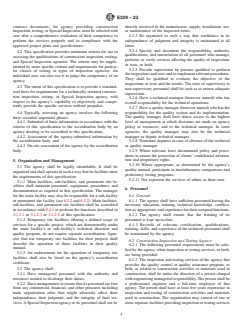
contract documents. An agency providing construction directly involved in the manufacture, supply, installation, use,
inspection, testing, or Special Inspection, must be selected with or maintenance of the inspected items.
care after a comprehensive evaluation of their competency to 5.2.3 Be organized in such a way that confidence in its
perform the services properly and in compliance with the independence of judgment and integrity is maintained at all
approved project plans and specifications. times.
5.2.4 Specify and document the responsibility, authority,
4.2 This specification provides minimum criteria for use in
qualifications, and interrelation of all personnel who manage,
assessing the qualifications of construction inspection, testing,
perform, or verify services affecting the quality of inspections
and Special Inspection agencies. The criteria may be supple-
or tests, or both.
mented by more specific criteria and requirements for particu-
5.2.5 Provide supervision by persons qualified to perform
lar classes of testing or types of inspection agencies. An
the inspections and tests and to implement relevant procedures.
individual user can also use it to judge the competency of an
They shall be qualified to evaluate the objective of the
agency.
inspections or tests and the results. The ratio of supervisory to
4.3 The intent of this specification is to provide a standard-
non-supervisory personnel shall be such as to ensure adequate
ized basis for requirements for a technically oriented construc-
supervision.
tion inspection, testing, or Special Inspection agency, with
5.2.6 Have a technical manager (however named) who has
respect to the agency’s capability to objectively and compe-
overall responsibility for the technical operations.
tently provide the specific services without prejudice.
5.2.7 Have a quality manager (however named) who has the
4.4 Typically, assessing an agency involves the following responsibility for the quality system and its implementation.
The quality manager shall have direct access to the highest
three essential sequential phases:
4.4.1 Submittal of basic information in accordance with the level of management at which decisions are made on agency
policy or resources, and to the technical manager. In some
criteria of this specification to the accreditation body by an
agency desiring to be accredited to this specification, agencies, the quality manager may also be the technical
manager or deputy technical manager.
4.4.2 Assessment of the agency-submitted information by
the accreditation body, and 5.2.8 Nominate deputies in case of absence of the technical
or quality manager.
4.4.3 On-site assessment of the agency by the accreditation
body. 5.2.9 Where relevant, have documented policy and proce-
dures to ensure the protection of clients’ confidential informa-
tion and proprietary rights.
5. Organization and Management
5.2.10 Where appropriate, as determined by the agency’s
5.1 The agency shall be legally identifiable. It shall be
quality manual, participate in interlaboratory comparisons and
organized and shall operate in such a way that its facilities meet
proficiency testing programs.
the requirements of this specification.
5.2.11 Not represent the services of others as their own.
5.1.1 Main facilities, sub-facilities, and permanent site fa-
cilities shall maintain personnel, equipment, procedures, and
6. Personnel
documentation as required in this specification. The manager
for the main facility may also be responsible for a sub-facility 6.1 General:
or permanent site facility (see 6.2.2 and 6.3.2). Main facilities, 6.1.1 The agency shall have sufficient personnel having the
sub-facilities, and permanent site facilities shall be accredited necessary education, training, technical knowledge, certifica-
in accordance with 9.4.1 to perform the functions described in tion as appropriate, and experience for their assigned functions.
3.1.2.1 or 3.1.2.3 or 3.1.2.5 of this specification. 6.1.2 The agency shall ensure that the training of its
5.1.2 Temporary site facilities offering a defined scope of personnel is kept up-to-date.
services for a specific project, which are demonstrably under 6.1.3 Records of relevant certification, qualifications,
the main facility’s or sub-facility’s technical direction and training, skills, and experience of the technical personnel shall
quality program, do not require separate accreditation. Agen- be maintained by the agency.
cies that use temporary site facilities for their projects shall
6.2 Construction Inspection and Testing Agency:
describe the operation of these facilities in their quality
6.2.1 The following personnel requirements must be satis-
manual.
fied by the agency when inspection or testing services, or both,
5.1.3 An endorsement for the operation of temporary site
are being provided:
facilities shall also be listed on the agency’s accreditation
6.2.2 The inspection and testing services of the agency that
certificate.
provides the quality control or quality assurance program, or
5.2 The agency shall: both, as related to construction activities or materials used in
5.2.1 Have managerial personnel with the authority and construction, shall be under the direction of a person charged
resources needed to discharge their duties. with engineering managerial responsibility. The person shall be
5.2.2 Have arrangements to ensure that its personnel are free a professional engineer and a full-time employee of that
from any commercial, financial, and other pressures including agency. The person shall have at least five years experience in
trade organization rules that might adversely affect their inspection and testing of construction activities and materials
independence, their judgment, and the integrity of their ser- used in construction. The organization may consist of one or
vices. A Special Inspection agency or its personnel shall not be more separate facilities providing inspection or testing services
E329 − 23
or both. A professional engineer may have engineering mana- 6.3.1 The following personnel requirements must be satis-
gerial responsibility for one or more facilities within the fied by an agency that provides Special Inspection services:
organization.
6.3.2 The Special Inspection services of the agency shall be
6.2.3 When a producer’s or manufacturer’s laboratory only
under the direction of a registered design professional and a
serves as a quality control laboratory and does not produce
full-time employee of that agency. The person shall have at
tests for acceptance, payment, or the official record, a quality
least two years experience in Special Inspections. The organi-
control manager who is not a professional engineer is permitted
zation can consist of one or more separate facilities providing
to provide managerial responsibility to the laboratory replacing
Special Inspection. A registered design professional can have
the requirements in 6.2.2. The quality control manager shall
managerial responsibility for one or more facilities within the
have at least five years experience in testing of that particular
organization as defined by Section 5.
construction material, and be a full time employee of the
6.3.3 The qualifications of the field supervisor shall be
organization. The quality control manager shall have the
determined by the applicable building official. If no require-
authority to make changes in production to ensure that quality
ments have been set forth, the field supervisor of Special
material is produced. The quality control manager may have
Inspection shall have at least two years Special Inspection
managerial responsibility for several materials production
experience in the type of work being supervised. This person
facilities. The quality control manager shall have the certifica-
shall be certified in the areas he or she is supervising.
tions appropriate to the testing of the materials supervised.
6.3.4 The qualifications of the Special Inspector shall be
6.2.4 A laboratory supervisor shall have at least three years
determined by the applicable building official. If no require-
experience performing tests in relevant construction activities
ments have been set forth, the Special Inspector shall be
and materials used in construction. This person shall be able to
certified by a third party. This certification exam shall include;
demonstrate either by oral or written examination, or both,
a written examination that shall include; reading plans as a
their ability to perform the tests normally required in the
performance element. The examination shall demonstrate the
manner stipulated under ASTM or other governing test proce-
candidate’s ability to correctly perform the required duties and
dures and shall be capable of evaluating the test results in terms
evaluate the inspection results for specification and code
of specification compliance. Certification by qualified national,
compliance.
regional, or state authorities as appropriate to the services is
6.3.5 The registered design professional according to 6.3.2,
required.
in addition to the requirements of 6.3.4 shall document the
6.2.5 A field supervisor shall have at least three years
experience and job training of each Special Inspector being
inspection experience in the type of services being supervised.
supervised. The Special Inspection agency shall maintain such
This person shall be able to demonstrate, either by oral or
documentation for a minimum of three years after the indi-
written examination, or both, their ability to perform correctly
vidual(s) have left their employment.
the required duties and shall be capable of evaluating the
6.3.6 A person can fill one or more of the levels of
inspection or test results in terms of specification compliance.
management, supervision, inspector, or technician positions in
Certification by qualified national, regional, or state authorities
accordance with 6.3.2 – 6.3.4, provided the person qualifies for
as appropriate to the services is required.
the highest level worked.
6.2.6 Inspector or Technician—This person shall have suf-
ficient education and on-the-job training or trade school
7. Equipment
training to properly perform the inspection or test to which the
person is assigned. This person must be able to demonstrate
7.1 The agency shall furnish all items of equipment, includ-
competence for the test or inspection that is being conducted
ing reference materials, required for the correct performance of
either by oral or written examination, or both. Certification as
inspections and tests. In those cases where the agency needs to
appropriate for the services being performed, or certification by
use equipment outside its permanent control, it shall ensure
other qualified national authorities as appropriate to the
that the relevant requirements of this specification are met.
service, shall be considered as one means of documenting
7.2 All equipment shall be properly maintained. Mainte-
competency. The inspector or technician shall work under the
nance procedures shall be documented and shall include a
direct supervision of personnel meeting the requirements of
schedule for future maintenance.
6.2.4 or 6.2.5.
7.2.1 Any equipment that has been subjected to overloading
6.2.7 It is satisfactory for a person to fill one or more of the
or mishandling, or that gives suspect results, or has been shown
levels of management, supervision, inspector, or technician
by verification or otherwise to be defective, shall be taken out
positions in accordance with 6.2.2, 6.2.3, 6.2.4, and 6.2.5,
of service, clearly identified, and wherever possible, stored at a
provided the person qualifies for the highest level worked. It is
specified place until it has been repaired and shown by
also recognized that frequently some tests and inspections are
calibration, verification, or test to perform satisfactorily.
conducted at small field or peripheral locations; it is not the
7.2.1.1 The agency shall examine the effect of this defect on
intent of this specification that the supervisory personnel be
previous inspections or tests.
directly present at such locations at all times. If the qualified
person in 6.2.2 performs as a supervisor, they do not have to
7.3 Each item of equipment including reference materials
comply with the certification requirements.
shall, when appropriate, be labeled, marked or otherwise
6.3 Special Inspection Agency:
...
This document is not an ASTM standard and is intended only to provide the user of an ASTM standard an indication of what changes have been made to the previous version. Because
it may not be technically possible to adequately depict all changes accurately, ASTM recommends that users consult prior editions as appropriate. In all cases only the current version
of the standard as published by ASTM is to be considered the official document.
Designation: E329 − 21 E329 − 23 An American National Standard
Standard Specification for
Agencies Engaged in Construction Inspection, Testing, or
Special Inspection
This standard is issued under the fixed designation E329; the number immediately following the designation indicates the year of
original adoption or, in the case of revision, the year of last revision. A number in parentheses indicates the year of last reapproval. A
superscript epsilon (´) indicates an editorial change since the last revision or reapproval.
This standard has been approved for use by agencies of the U.S. Department of Defense.
1. Scope*
1.1 This specification defines the minimum requirements for agencies engaged in any of the following:
(a) Inspection of specified methods and materials used in construction,
(b) Special Inspection, and
(c) Testing of materials used in construction.
1.2 Criteria are provided for assessing the competence of an agency to properly perform designated inspections, tests, or Special
Inspection services. This specification establishes essential characteristics pertaining to the organization, management, personnel,
facilities, quality systems, responsibilities, duties, inspection and testing methods, records, and reports of the agency. This
specification may be supplemented by more specific criteria and requirements, if required.
1.2.1 This specification specifically addresses factors relevant to an agency’s ability to produce precise, accurate test data or
determine the conformity of construction activities and materials used in construction with regulations, codes, standards, and
approved project plans and specifications containing the requirements against which the inspection or test, or both, will be
performed. Specific or general requirements include:
1.2.1.1 Facilities and management of the agency,
1.2.1.2 Sufficiency and technical competency of personnel,
1.2.1.3 Suitability, calibration, and maintenance of equipment,
1.2.1.4 Quality system, audit, and review,
1.2.1.5 Responsibilities, duties, and authority of agencies,
1.2.1.6 Validity and appropriateness of sampling, testing, and inspection methods and procedures,
1.2.1.7 Management of records,
1.2.1.8 Reporting, review, and transmission of test and inspection data or findings, and
This specification is under the jurisdiction of ASTM Committee E36 on Accreditation & Certification and is the direct responsibility of Subcommittee E36.70 on Agencies
Performing Construction Inspection, Testing and Special Inspection.
Current edition approved May 1, 2021Nov. 1, 2023. Published July 2021December 2023. Originally approved in 1967. Last previous edition approved in 20202021 as
E329 – 20. DOI: 10.1520/E0329-21.21. DOI: 10.1520/E0329-23.
*A Summary of Changes section appears at the end of this standard
Copyright © ASTM International, 100 Barr Harbor Drive, PO Box C700, West Conshohocken, PA 19428-2959. United States
E329 − 23
1.2.1.9 Specific requirements for identified fields (concrete, soil, etc.).
1.3 This specification can be used as a basis to assess an agency and is intended for use in accrediting agencies, public or private,
engaged in inspection, testing, and Special Inspection of construction activities and materials used in construction. These services
include but are not limited to reinforced concrete, precast concrete, structural steel erection, welding, bolting, soil and rock,
foundations, masonry, sprayed fire-resistive materials, fire stops, exterior insulation and finish system (EIFS), and Special Cases.
Building officials can use Specification E329 to assess the competency of agencies in the fields covered by Specification E329.
1.4 A certificate of accreditation, including the scope of accreditation, is required to comply with this specification.
1.5 The users of an accredited agency must review the agency’s scope of accreditation to ensure the agency has been accredited
for its technical competence to perform the specific inspections or tests requested by the user.
1.6 This specification is not intended to:
(a) circumvent or replace the agreement between the agency and the owner that should clearly define the responsibilities and
authorities of the agency;
(b) address design requirements that supersede applicable codes, laws, and regulations; or
(c) address construction means, methods, techniques, or sequences.
1.7 This international standard was developed in accordance with internationally recognized principles on standardization
established in the Decision on Principles for the Development of International Standards, Guides and Recommendations issued
by the World Trade Organization Technical Barriers to Trade (TBT) Committee.
2. Referenced Documents
2.1 ASTM Standards:
C1077 Practice for Agencies Testing Concrete and Concrete Aggregates for Use in Construction and Criteria for Testing Agency
Evaluation
C1093 Practice for Accreditation of Testing Agencies for Masonry
D3666 Specification for Minimum Requirements for Agencies Testing and Inspecting Road and Paving Materials
D3740 Practice for Minimum Requirements for Agencies Engaged in Testing and/or Inspection of Soil and Rock as Used in
Engineering Design and Construction
E4 Practices for Force Calibration and Verification of Testing Machines
E543 Specification for Agencies Performing Nondestructive Testing
E605/E605M Test Methods for Thickness and Density of Sprayed Fire-Resistive Material (SFRM) Applied to Structural
Members
E736/E736M Test Method for Cohesion/Adhesion of Sprayed Fire-Resistive Materials Applied to Structural Members
E814 Test Method for Fire Tests of Penetration Firestop Systems
E1513/E1513M Practice for Application of Sprayed Fire-Resistive Materials (SFRMs)
E1966 Test Method for Fire-Resistive Joint Systems
E2174 Practice for On-Site Inspection of Installed Firestop Systems
E2307 Test Method for Determining Fire Resistance of Perimeter Fire Barriers Using Intermediate-Scale, Multi-story Test
Apparatus
E2393 Practice for On-Site Inspection of Installed Fire Resistive Joint Systems and Perimeter Fire Barriers
2.2 AASHTO Standard:
R18 Standard Recommended Practice for Establishing and Implementing a Quality System for Construction Materials Testing
Laboratories
2.3 ANSI/ISO/IEC Standard:
17011 General Requirements for Accrediation Bodies Accrediting Conformity Assessment Bodies
17020 General Criteria for the Operation of Various Types of Bodies Performing Inspection
17025 General Requirements for the Competence of Calibration and Testing Laboratories
For referenced ASTM standards, visit the ASTM website, www.astm.org, or contact ASTM Customer Service at service@astm.org. For Annual Book of ASTM Standards
volume information, refer to the standard’s Document Summary page on the ASTM website.
Available from American Association of State Highway and Transportation Officials (AASHTO), 444 N. Capitol St., NW, Suite 249, Washington, DC 20001,
http://www.transportation.org.
Available from International Organization for Standardization (ISO), 1, ch. de la Voie-Creuse, Case postale 56, CH-1211, Geneva 20, Switzerland, http://www.iso.ch.
E329 − 23
2.4 AWS Documents:
B1.11 Guide for the Visual Inspection of Welds
D1.1 Structural Welding Code, Steel
D1.4 Structural Welding Code—Reinforcing
D1.5 Bridge Welding Code
2.5 SJI Documents:
Recommended Code of Standard Practice for Steel Joists and Joist Girders
2.6 Other Referenced Documents:
2018 International Building Code® (IBC)
UL 2079 Tests for Fire Resistance of Building Joint Systems
3. Terminology
3.1 Definitions of Terms Specific to This Standard:
3.1.1 accreditation, n—the third-party attestation of an agency’s competence to perform inspection, or testing services, or both.
3.1.1.1 accreditation body, n—the body that administers the accreditation program and issues the certificate of accreditation.
3.1.1.2 accreditation scope, n—the formal statement issued by the accreditation body to the agency that describes the specific
inspections, tests, or both, for which the agency has demonstrated a competency in performing and is accredited.
3.1.1.3 Discussion—
A certificate of accreditation shall identify the agency and its location along with the accreditation body, the accreditation standard,
the general field(s) of inspection or testing, effective dates, conditions and authorized signatures, seals, or combinations thereof,
of the accreditation body. The certificate must be accompanied by an accreditation scope to fully describe the technical competence
of the agency.
3.1.2 agency, n—the organization, or part thereof, authorized by the client or client’s duly authorized representative to inspect, test,
or both, construction activities and materials used in construction as required by the approved project plans and specifications.
3.1.2.1 inspection agency, n—an agency that uses technical procedures and individuals with special expertise to perform
inspection activities.
3.1.2.2 Discussion—
Agency personnel may collect and submit samples, identified with respective portions of the construction, for laboratory
evaluation. The inspection agency and testing agency may be one organization or separate organizations.
3.1.2.3 Special Inspection agency, n—an accredited third-party inspection agency approved by the applicable building official
to perform Special Inspections.
3.1.2.4 Special Inspector, n—a person employed by a Special Inspection agency and approved by the applicable building
official, certified by a third party to perform certain types of inspection as required by the applicable building code.
3.1.2.5 testing agency, n—an agency that uses technical procedures, individuals with special expertise, and specified equipment
to measure, sample, examine, test, or otherwise produce data unique to the construction activities or materials used in construction.
The inspection agency and testing agency may be one or separate organizations.
3.1.3 bituminous material and mixtures, n—as used in construction, all types of asphalts and tars for pavements.
3.1.3.1 Discussion—
Bituminous mixtures include bituminous stabilized soil, base course, binder, leveling, surface course, and mastic mixtures.
Bituminous mixtures may contain asphalt binder material which, in some cases, may be further modified with other additive
materials to produce special properties.
3.1.4 client, n—the party that contracts with the agency to perform its services.
3.1.5 concrete, n—as used in construction, a mixture of hydraulic cement, aggregates, and water, with or without admixtures,
fibers, or other cementitious materials.
Available from American Welding Society (AWS), 550 NW LeJeune Rd., Miami, FL 33126, http://www.aws.org.
Available from Steel Joist Institute (SJI), 3127 Mr. Joe White Ave., Myrtle Beach, SC 29577-6760, http://www.steeljoist.org.
Available from the International Code Council, Inc. 500 New Jersey Avenue, NW, 6th Floor, Washington, DC 20001, https://codes.iccsafe.org/content/IBC2018?site_
type=public
Available from UL LLC 333 Pfingsten Rd, Northbrook, IL 60062, https://standardscatalog.ul.com/standards/en/standard_2079
E329 − 23
3.1.6 contractual agreement—the legally-binding service contract between the agency and the agency’s client.
3.1.6.1 Discussion—
The contractual agreement referred to throughout this document may include testing, inspection, or Special Inspection services
contracts.
3.1.7 engineer, professional, n—an individual who is registered or licensed to engage in the practice of engineering as defined by
the statutory requirements of the professional registration or licensing laws of the state or jurisdiction in which the project is to
be constructed.
3.1.8 inspection, n—a technical procedure based on visual observation or field measurement of construction activities or materials
used in construction employed to evaluate activities or materials and determine general compliance with approved project plans
and specifications.
3.1.8.1 Special Inspection, n—the unique term applied to the process of inspection or monitoring of specific materials,
equipment, installation, fabrication, erection or placement of components and connections by individuals with special expertise as
approved by the applicable building official to ensure compliance with the approved project plans and specifications.
3.1.9 inspector/technician, n—a person employed by the agency assigned to perform the inspection or testing of construction
activities or materials used in construction or both.
3.1.10 facility, main, n—a structure with a permanent address, which provides testing or inspection services, or both, for multiple
projects for a period expected to be greater than three years.
3.1.10.1 facility, site, n—a structure, or a mobile, fully-equipped, self-contained unit, capable of conducting specific tests or
inspections or both, established in a dedicated area on-site for the duration of a specific project, but not for projects expected to
exceed three years.
3.1.10.2 facility, sub-, n—a structure with a permanent address, that is physically separate from, but considered an extension of
the main facility, which generally provides testing or inspection services or both for multiple projects.
3.1.10.3 facility, permanent, adj—as used to describe testing or inspection facilities, or both, expected to function for a period
exceeding three years.
3.1.10.4 facility, temporary, adj—as used to describe testing or inspection facilities or both, expected to function for a period
not to exceed three years.
3.1.11 masonry, n—as used in construction, masonry units, brick, mortar and grout.
3.1.11.1 Discussion—
The masonry construction may be load bearing or non-load bearing.
3.1.12 nondestructive testing, n—procedures for testing construction activities or materials used in construction, or both, that does
not impair the serviceability of the materials or assemblies under test.
3.1.12.1 Discussion—
Nondestructive testing includes all test methods that do not impair the serviceability of the material, part, or assembly under test.
Nondestructive tests are specific. They usually reveal only the specific kinds of defects and conditions for whose detection they
were designed. Consequently, they must be selected in accordance with the specific materials, the specific conditions to be
detected, and the specific job to be done.
3.1.13 registered design professional, n—an individual who is registered or licensed to practice their respective design profession
as defined by the statutory requirements of the professional registration laws of the state or jurisdiction in which the project is to
be constructed.
3.1.14 soil, n—as used in construction, subgrade, subbase, base, select fill and other similar types of granular and non-granular
soils regardless of whether it is considered as a structural element in the project or general fill not supporting structural elements.
3.1.15 steel, n—as used in construction, structural steel plates and shapes used wholly or in part for structures including reinforcing
steel used in concrete.
E329 − 23
3.1.15.1 Discussion—
It is not intended to include steels used in conjunction with mechanical, electrical, heating or air-conditioning equipment except
for the supporting structures.
3.1.16 testing—a technical procedure performed on construction activities or materials used in construction with specified
equipment that produces data unique to the construction activities or materials; the data are used to evaluate or determine selected
properties or characteristics of the activities or materials.
4. Significance and Use
4.1 The inspection and testing of construction activities and the materials used in construction are important elements in obtaining
quality construction in general compliance with the contract documents. An agency providing construction inspection, testing, or
Special Inspection, must be selected with care after a comprehensive evaluation of their competency to perform the services
properly and in compliance with the approved project plans and specifications.
4.2 This specification provides minimum criteria for use in assessing the qualifications of construction inspection, testing, and
Special Inspection agencies. The criteria may be supplemented by more specific criteria and requirements for particular classes of
testing or types of inspection agencies. An individual user can also use it to judge the competency of an agency.
4.3 The intent of this specification is to provide a standardized basis for requirements for a technically oriented construction
inspection, testing, or Special Inspection agency, with respect to the agency’s capability to objectively and competently provide
the specific services without prejudice.
4.4 Typically, assessing an agency involves the following three essential sequential phases:
4.4.1 Submittal of basic information in accordance with the criteria of this specification to the accreditation body by an agency
desiring to be accredited to this specification,
4.4.2 Assessment of the agency-submitted information by the accreditation body, and
4.4.3 On-site assessment of the agency by the accreditation body.
5. Organization and Management
5.1 The agency shall be legally identifiable. It shall be organized and shall operate in such a way that its facilities meet the
requirements of this specification.
5.1.1 Main facilities, sub-facilities, and permanent site facilities shall maintain personnel, equipment, procedures, and
documentation as required in this specification. The manager for the main facility may also be responsible for a sub-facility or
permanent site facility (see 6.2.2 and 6.3.2). Main facilities, sub-facilities, and permanent site facilities shall be accredited in
accordance with 9.4.1 to perform the functions described in 3.1.2.1 or 3.1.2.3 or 3.1.2.5 of this specification.
5.1.2 Temporary site facilities offering a defined scope of services for a specific project, which are demonstrably under the main
facility’s or sub-facility’s technical direction and quality program, do not require separate accreditation. Agencies that use
temporary site facilities for their projects shall describe the operation of these facilities in their quality manual.
5.1.3 An endorsement for the operation of temporary site facilities shall also be listed on the agency’s accreditation certificate.
5.2 The agency shall:
5.2.1 Have managerial personnel with the authority and resources needed to discharge their duties.
5.2.2 Have arrangements to ensure that its personnel are free from any commercial, financial, and other pressures including trade
organization rules that might adversely affect their independence, their judgment, and the integrity of their services. A Special
Inspection agency or its personnel shall not be directly involved in the manufacture, supply, installation, use, or maintenance of
the inspected items.
E329 − 23
5.2.3 Be organized in such a way that confidence in its independence of judgment and integrity is maintained at all times.
5.2.4 Specify and document the responsibility, authority, qualifications, and interrelation of all personnel who manage, perform,
or verify services affecting the quality of inspections or tests, or both.
5.2.5 Provide supervision by persons qualified to perform the inspections and tests and to implement relevant procedures. They
shall be qualified to evaluate the objective of the inspections or tests and the results. The ratio of supervisory to non-supervisory
personnel shall be such as to ensure adequate supervision.
5.2.6 Have a technical manager (however named) who has overall responsibility for the technical operations.
5.2.7 Have a quality manager (however named) who has the responsibility for the quality system and its implementation. The
quality manager shall have direct access to the highest level of management at which decisions are made on agency policy or
resources, and to the technical manager. In some agencies, the quality manager may also be the technical manager or deputy
technical manager.
5.2.8 Nominate deputies in case of absence of the technical or quality manager.
5.2.9 Where relevant, have documented policy and procedures to ensure the protection of clients’ confidential information and
proprietary rights.
5.2.10 Where appropriate, as determined by the agency’s quality manual, participate in interlaboratory comparisons and
proficiency testing programs.
5.2.11 Not represent the services of others as their own.
6. Personnel
6.1 General:
6.1.1 The agency shall have sufficient personnel having the necessary education, training, technical knowledge, certification as
appropriate, and experience for their assigned functions.
6.1.2 The agency shall ensure that the training of its personnel is kept up-to-date.
6.1.3 Records of relevant certification, qualifications, training, skills, and experience of the technical personnel shall be maintained
by the agency.
6.2 Construction Inspection and Testing Agency:
6.2.1 The following personnel requirements must be satisfied by the agency when inspection or testing services, or both, are being
provided:
6.2.2 The inspection and testing services of the agency that provides the quality control or quality assurance program, or both, as
related to construction activities or materials used in construction, shall be under the direction of a person charged with engineering
managerial responsibility. The person shall be a professional engineer and a full-time employee of that agency. The person shall
have at least five years experience in inspection and testing of construction activities and materials used in construction. The
organization may consist of one or more separate facilities providing inspection or testing services or both. A professional engineer
may have engineering managerial responsibility for one or more facilities within the organization.
6.2.3 When a producer’s or manufacturer’sproducer’s or manufacturer’s laboratory only serves as a quality control laboratory and
does not produce tests for acceptance, payment, or the official record, the requirement for a quality control manager who is not
a professional engineer is waived. However, the laboratory function of the organization shallpermitted to provide managerial
responsibility to the laboratory replacing the requirements in 6.2.2be supervised by a quality control manager. . The quality control
manager shall have at least five years experience in testing of that particular construction material, and be a full time employee
of the organization. The quality control manager willshall have the authority to make changes in production to ensure that quality
E329 − 23
material is produced. He may serve as the quality control managerThe quality control manager may have managerial responsibility
for several materials production facilities. The quality control manager shall have the certifications appropriate to the testing of the
materials supervised.
6.2.4 A laboratory supervisor shall have at least three years experience performing tests in relevant construction activities and
materials used in construction. This person shall be able to demonstrate either by oral or written examination, or both, their ability
to perform the tests normally required in the manner stipulated under ASTM or other governing test procedures and shall be
capable of evaluating the test results in terms of specification compliance. Certification by qualified national, regional, or state
authorities as appropriate to the services is required.
6.2.5 A field supervisor shall have at least three years inspection experience in the type of services being supervised. This person
shall be able to demonstrate, either by oral or written examination, or both, their ability to perform correctly the required duties
and shall be capable of evaluating the inspection or test results in terms of specification compliance. Certification by qualified
national, regional, or state authorities as appropriate to the services is required.
6.2.6 Inspector or Technician—This person shall have sufficient education and on-the-job training or trade school training to
properly perform the inspection or test to which the person is assigned. This person must be able to demonstrate competence for
the test or inspection that is being conducted either by oral or written examination, or both. Certification as appropriate for the
services being performed, or certification by other qualified national authorities as appropriate to the service, shall be considered
as one means of documenting competency. The inspector or technician shall work under the direct supervision of personnel
meeting the requirements of 6.2.4 or 6.2.5.
6.2.7 It is satisfactory for a person to fill one or more of the levels of management, supervision, inspector, or technician positions
in accordance with 6.2.2, 6.2.3, 6.2.4, and 6.2.5, provided the person qualifies for the highest level worked. It is also recognized
that frequently some tests and inspections are conducted at small field or peripheral locations; it is not the intent of this specification
that the supervisory personnel be directly present at such locations at all times. If the qualified person in 6.2.2 performs as a
supervisor, they do not have to comply with the certification requirements.
6.3 Special Inspection Agency:
6.3.1 The following personnel requirements must be satisfied by an agency that provides Special Inspection services:
6.3.2 The Special Inspection services of the agency shall be under the direction of a registered design professional and a full-time
employee of that agency. The person shall have at least two years experience in Special Inspections. The organization can consist
of one or more separate facilities providing Special Inspection. A registered design professional can have managerial responsibility
for one or more facilities within the organization as defined by Section 5.
6.3.3 The qualifications of the field supervisor shall be determined by the applicable building official. If no requirements have been
set forth, the field supervisor of Special Inspection shall have at least two years Special Inspection experience in the type of work
being supervised. This person shall be certified in the areas he or she is supervising.
6.3.4 The qualifications of the Special Inspector shall be determined by the applicable building official. If no requirements have
been set forth, the Special Inspector shall be certified by a third party. This certification exam shall include; a written examination
that shall include; reading plans as a performance element. The examination shall demonstrate the candidate’s ability to correctly
perform the required duties and evaluate the inspection results for specification and code compliance.
6.3.5 The registered design professional according to 6.3.2, in addition to the requirements of 6.3.4 shall document the experience
and job training of each Special Inspector being supervised. The Special Inspection agency shall maintain such documentation for
a minimum of three years after the individual(s) have left their employment.
6.3.6 A person can fill one or more of the levels of management, supervision, inspector, or technician positions in accordance with
6.3.2 – 6.3.4, provided the person qualifies for the highest level worked.
7. Equipment
7.1 The agency shall furnish all items of equipment, including reference materials, required for the correct performance of
inspections and tests. In those cases where the agency needs to use equipment outside its permanent control, it shall ensure that
the relevant requirements of this specification are met.
E329 − 23
7.2 All equipment shall be properly maintained. Maintenance procedures shall be documented and shall include a schedule for
future maintenance.
7.2.1 Any equipment that has been subjected to overloading or mishandling, or that gives suspect results, or has been shown by
verification or otherwise to be defective, shall be taken out of service, clearly identified, and wherever possible, stored at a specified
place until it has been repaired and shown by calibration, verification, or test to perform satisfactorily.
7.2.1.1 The agency shall examine the effect of this defect on previous inspections or tests.
7.3 Each item of equipment including reference materials shall, when appropriate, be labeled, marked or otherwise identified to
indicate its calibration status.
7.4 Records shall be maintained for each item of equipment and all reference materials significant to the inspections or tests
performed. The records shall include:
7.4.1 The name of the item of equipment,
7.4.2 The manufacturer’s name, t
...
Questions, Comments and Discussion
Ask us and Technical Secretary will try to provide an answer. You can facilitate discussion about the standard in here.
Loading comments...