


ASTM E1970-11
(Practice)Standard Practice for Statistical Treatment of Thermoanalytical Data
Standard Practice for Statistical Treatment of Thermoanalytical Data
SIGNIFICANCE AND USE
The standard deviation, or one of its derivatives, such as relative standard deviation or pooled standard deviation, derived from this practice, provides an estimate of precision in a measured value. Such results are ordinarily expressed as the mean value ± the standard deviation, that is, X ± s.
If the measured values are, in the statistical sense, “normally” distributed about their mean, then the meaning of the standard deviation is that there is a 67 % chance, that is 2 in 3, that a given value will lie within the range of ± one standard deviation of the mean value. Similarly, there is a 95 % chance, that is 19 in 20, that a given value will lie within the range of ± two standard deviations of the mean. The two standard deviation range is sometimes used as a test for outlying measurements.
The calculation of precision in the slope and intercept of a line, derived from experimental data, commonly is required in the determination of kinetic parameters, vapor pressure or enthalpy of vaporization. This practice describes how to obtain these and other statistically derived values associated with measurements by thermal analysis.
SCOPE
1.1 This practice details the statistical data treatment used in some thermal analysis methods.
1.2 The method describes the commonly encountered statistical tools of the mean, standard derivation, relative standard deviation, pooled standard deviation, pooled relative standard deviation and the best fit to a straight line, all calculations encountered in thermal analysis methods.
1.3 Some thermal analysis methods derive the analytical value from the slope or intercept of a best fit straight line assigned to three or more sets of data pairs. Such methods may require an estimation of the precision in the determined slope or intercept. The determination of this precision is not a common statistical tool. This practice details the process for obtaining such information about precision.
1.4 There are no ISO methods equivalent to this practice.
General Information
Relations
Buy Standard
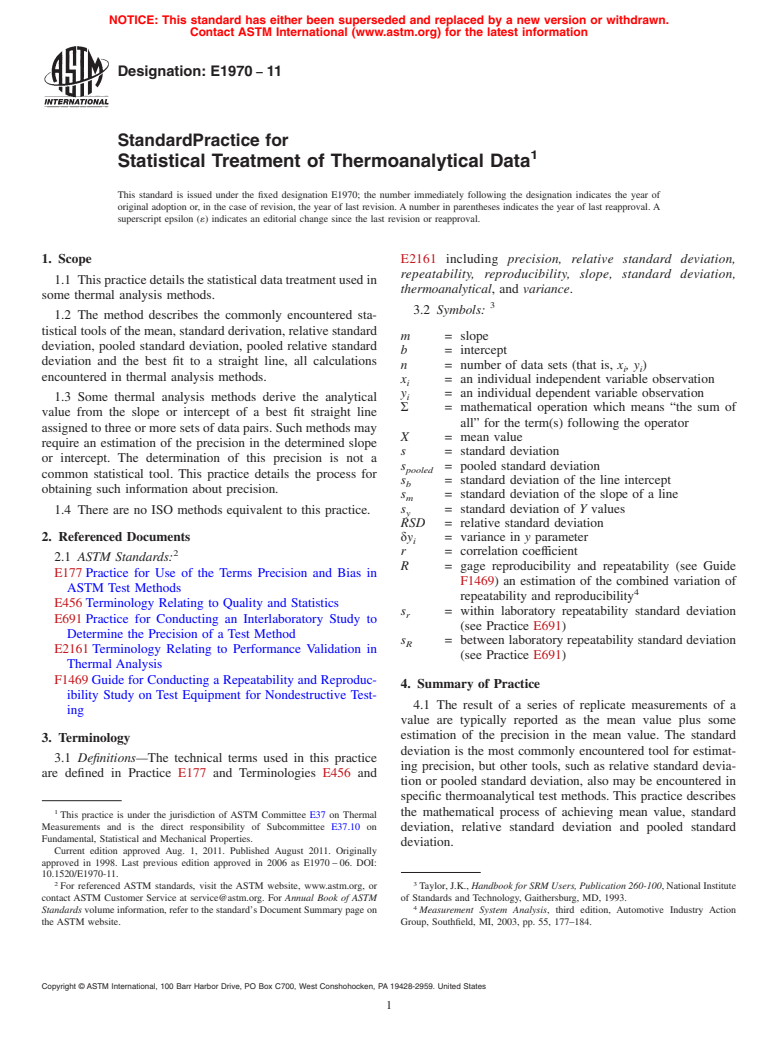


Standards Content (Sample)
NOTICE: This standard has either been superseded and replaced by a new version or withdrawn.
Contact ASTM International (www.astm.org) for the latest information
Designation: E1970 − 11
StandardPractice for
1
Statistical Treatment of Thermoanalytical Data
This standard is issued under the fixed designation E1970; the number immediately following the designation indicates the year of
original adoption or, in the case of revision, the year of last revision. A number in parentheses indicates the year of last reapproval. A
superscript epsilon (´) indicates an editorial change since the last revision or reapproval.
1. Scope E2161 including precision, relative standard deviation,
repeatability, reproducibility, slope, standard deviation,
1.1 This practice details the statistical data treatment used in
thermoanalytical, and variance.
some thermal analysis methods.
3
3.2 Symbols:
1.2 The method describes the commonly encountered sta-
tistical tools of the mean, standard derivation, relative standard
m = slope
deviation, pooled standard deviation, pooled relative standard
b = intercept
deviation and the best fit to a straight line, all calculations
n = number of data sets (that is, x,y)
i i
encountered in thermal analysis methods.
x = an individual independent variable observation
i
y = an individual dependent variable observation
i
1.3 Some thermal analysis methods derive the analytical
Σ = mathematical operation which means “the sum of
value from the slope or intercept of a best fit straight line
all” for the term(s) following the operator
assigned to three or more sets of data pairs. Such methods may
X = mean value
require an estimation of the precision in the determined slope
s = standard deviation
or intercept. The determination of this precision is not a
s = pooled standard deviation
pooled
common statistical tool. This practice details the process for
s = standard deviation of the line intercept
b
obtaining such information about precision.
s = standard deviation of the slope of a line
m
s = standard deviation of Y values
1.4 There are no ISO methods equivalent to this practice.
y
RSD = relative standard deviation
2. Referenced Documents δy = variance in y parameter
i
2 r = correlation coefficient
2.1 ASTM Standards:
R = gage reproducibility and repeatability (see Guide
E177 Practice for Use of the Terms Precision and Bias in
F1469) an estimation of the combined variation of
ASTM Test Methods
4
repeatability and reproducibility
E456 Terminology Relating to Quality and Statistics
s = within laboratory repeatability standard deviation
r
E691 Practice for Conducting an Interlaboratory Study to
(see Practice E691)
Determine the Precision of a Test Method
s = between laboratory repeatability standard deviation
R
E2161 Terminology Relating to Performance Validation in
(see Practice E691)
Thermal Analysis
F1469 Guide for Conducting a Repeatability and Reproduc-
4. Summary of Practice
ibility Study on Test Equipment for Nondestructive Test-
4.1 The result of a series of replicate measurements of a
ing
value are typically reported as the mean value plus some
estimation of the precision in the mean value. The standard
3. Terminology
deviation is the most commonly encountered tool for estimat-
3.1 Definitions—The technical terms used in this practice
ing precision, but other tools, such as relative standard devia-
are defined in Practice E177 and Terminologies E456 and
tion or pooled standard deviation, also may be encountered in
specific thermoanalytical test methods. This practice describes
1
the mathematical process of achieving mean value, standard
This practice is under the jurisdiction of ASTM Committee E37 on Thermal
Measurements and is the direct responsibility of Subcommittee E37.10 on
deviation, relative standard deviation and pooled standard
Fundamental, Statistical and Mechanical Properties.
deviation.
Current edition approved Aug. 1, 2011. Published August 2011. Originally
approved in 1998. Last previous edition approved in 2006 as E1970 – 06. DOI:
10.1520/E1970-11.
2 3
For referenced ASTM standards, visit the ASTM website, www.astm.org, or Taylor, J.K., Handbook for SRM Users, Publication 260-100, National Institute
contact ASTM Customer Service at service@astm.org. For Annual Book of ASTM of Standards and Technology, Gaithersburg, MD, 1993.
4
Standards volume information, refer to the standard’s Document Summary page on Measurement System Analysis, third edition, Automotive Industry Action
the ASTM website. Group, Southfield, MI, 2003, pp. 55, 177–184.
Copyright © ASTM International, 100 Barr Harbor Drive, PO Box C700, West Conshohocken, PA 19428-2959. United States
1
---------------------- Page: 1 ----------------------
E1970 − 11
NOTE 2—In the calculation of intermediate or final results, all available
4.2 In some thermal analysis experiments, a linear or a
figures shall be retained with any rounding to take place only at the
straight line, response is assumed and desired values are
expression of the final r
...
This document is not anASTM standard and is intended only to provide the user of anASTM standard an indication of what changes have been made to the previous version. Because
it may not be technically possible to adequately depict all changes accurately, ASTM recommends that users consult prior editions as appropriate. In all cases only the current version
of the standard as published by ASTM is to be considered the official document.
Designation:E1970–06 Designation: E1970 – 11
Standard Practice for
1
Statistical Treatment of Thermoanalytical Data
This standard is issued under the fixed designation E1970; the number immediately following the designation indicates the year of
original adoption or, in the case of revision, the year of last revision. A number in parentheses indicates the year of last reapproval. A
superscript epsilon (´) indicates an editorial change since the last revision or reapproval.
1. Scope
1.1 This practice details the statistical data treatment used in some thermal analysis methods.
1.2 The method describes the commonly encountered statistical tools of the mean, standard derivation, relative standard
deviation, pooled standard deviation, pooled relative standard deviation and the best fit to a straight line, all calculations
encountered in thermal analysis methods.
1.3 Some thermal analysis methods derive the analytical value from the slope or intercept of a best fit straight line assigned to
three or more sets of data pairs. Such methods may require an estimation of the precision in the determined slope or intercept.The
determination of this precision is not a common statistical tool. This practice details the process for obtaining such information
about precision.
1.4SI units are the standard.
1.5There are no ISO methods equivalent to this practice.
1.4 There are no ISO methods equivalent to this practice.
2. Referenced Documents
2
2.1 ASTM Standards:
E177 Practice for Use of the Terms Precision and Bias in ASTM Test Methods
E456 Terminology Relating to Quality and Statistics
E691 Practice for Conducting an Interlaboratory Study to Determine the Precision of a Test Method
E2161 Terminology Relating to Performance Validation in Thermal Analysis
F1469 Guide for Conducting a Repeatability and Reproducibility Study on Test Equipment for Nondestructive Testing
3. Terminology
3.1 Definitions—The technical terms used in this practice are defined in Practice E177 and Terminology and Terminologies
E456 .
1
This practice is under the jurisdiction of ASTM Committee E37 on Thermal Measurements and is the direct responsibility of Subcommittee E37.10 on Fundamental,
Statistical and Mechanical Properties.
Current edition approved MarchAug. 1, 2006.2011. Published April 2006.August 2011. Originally approved in 1998. Last previous edition approved in 20012006 as
E1970 – 016. DOI: 10.1520/E1970-06.10.1520/E1970-11.
2
For referencedASTM standards, visit theASTM website, www.astm.org, or contactASTM Customer Service at service@astm.org. For Annual Book of ASTM Standards
volume information, refer to the standard’s Document Summary page on the ASTM website.
Copyright © ASTM International, 100 Barr Harbor Drive, PO Box C700, West Conshohocken, PA 19428-2959, United States.
1
---------------------- Page: 1 ----------------------
E1970 – 11
and E2161 including precision, relative standard deviation, repeatability, reproducibility, slope, standard deviation, thermoana-
lytical, and variance.
3
3.2 Symbols:
m = slope
b = intercept
n = number of data sets (that is, x,y)
i i
x = an individual independent variable observation
i
y = an individual dependent variable observation
i
S = mathematical operation which means “the sum of all” for the term(s) following the operator
X = mean value
s = standard deviation
s = pooled standard deviation
pooled
s = standard deviation of the line intercept
b
s = standard deviation of the slope of a line
m
s = standard deviation of Y values
y
RSD = relative standard deviation
dy = variance in y parameter
i
r = correlation coefficient
R = gagereproducibilityandrepeatability(seeGuideF1469)anestimationofthecombinedvariationofrepeatabilityand
4
reproducibility
s = within laboratory repeatability standard deviation (see Practice E691)
r
s = between laboratory repeatability standard deviation (see Practice E691)
R
4. Summary of Practice
4.1 The result of a series of replicate measurements of a value are typically reported as the mean value plus some estimation
of the precision in the mean value. The standard deviation is the most commonly encountered tool for estimating precision, but
other tools, such as relative standard deviation or pooled standard deviation, also may be encountered in specific thermoanalytical
test methods. This practice describes the mathematical process of achieving mean value, standard deviation, relative standard
deviation and pooled standard deviation.
4.2 In some thermal analysis experiments, a linear or a straight line, response is assumed and desired values
...
Questions, Comments and Discussion
Ask us and Technical Secretary will try to provide an answer. You can facilitate discussion about the standard in here.