

ASTM F1967-19
(Specification)Standard Consumer Safety Specification for Infant Bath Seats
General Information
- Abstract
SCOPE
1.1 This consumer safety specification establishes performance requirements, test methods, and labeling requirements to promote the safe use of infant bath seats. Products commonly referred to as bath rings also are included in the scope of this specification. Traditional infant bath tubs that are used to bathe an infant are not within the scope of this standard.
1.2 This consumer safety specification is intended to reduce the risk of death and minimize injury to infants resulting from use and reasonably foreseeable abuse of infant bath seats.
1.3 No infant bath seat produced after the approval date of this consumer safety specification shall, either by label or other means, indicate compliance with this specification unless it conforms to all requirements contained herein.
1.4 The values stated in inch-pound units are to be regarded as standard. The values given in parentheses are mathematical conversions to SI units that are provided for information only and are not considered standard.
1.5 The following precautionary caveat pertains only to the test methods portion, Section 7, of this specification: This standard does not purport to address all of the safety concerns, if any, associated with its use. It is the responsibility of the user of this standard to establish appropriate safety, health, and environmental practices and determine the applicability of regulatory limitations prior to use.
1.6 This international standard was developed in accordance with internationally recognized principles on standardization established in the Decision on Principles for the Development of International Standards, Guides and Recommendations issued by the World Trade Organization Technical Barriers to Trade (TBT) Committee.
- Status
- Published
- Publication Date
- 30-Apr-2019
- Technical Committee
- F15 - Consumer Products
- Drafting Committee
- F15.20 - Bath Seats
Overview
ASTM F1967-19: Standard Consumer Safety Specification for Infant Bath Seats was developed by ASTM International to promote the safe design, testing, and labeling of infant bath seats. This standard aims to reduce the risk of drowning, injury, and product failures associated with these products, including those commonly referred to as bath rings. The specification details clear performance, labeling, and instruction requirements to ensure caregivers are fully aware of safety concerns and use limitations. Note that traditional infant bathtubs are not within the scope-only seats intended to support infants while being bathed are covered.
Key Topics
ASTM F1967-19 covers several critical areas essential for manufacturers and regulators aiming to produce, import, or market compliant infant bath seats:
- Performance Requirements: The standard mandates rigorous evaluation of stability, resistance to collapse, and prevention of hazardous points or edges to minimize injury risks.
- Test Methods: Clear protocols, including load testing, suction cup effectiveness, and component durability, ensure products meet safety benchmarks.
- Labeling Requirements: Comprehensive labeling ensures that critical warnings (such as drowning risks and age limitations) are very visible, permanent, and meet legibility standards aligned with ANSI Z535.4.
- Installation Components: All vital installation elements-such as clamps, arms, and suction cups-must be permanently attached before shipment to prevent accidental detachment.
- Small Parts and Paint: Adherence to federal regulations concerning small parts (to prevent choking hazards) and lead content in paints is required.
- Instructional Literature: Manufacturers must provide clear instructions for safe assembly and use, as well as maintenance and warnings.
- Consumer Product Safety: The specification is in alignment with relevant US federal regulations, including the Consumer Product Safety Improvement Act.
Applications
ASTM F1967-19 applies to:
- Manufacturers: Those who design, fabricate, and distribute infant bath seats must utilize this standard to guide product development and ensure regulatory compliance.
- Importers and Retailers: Compliance with ASTM F1967-19 is essential for supply chain partners to confirm products meet North American safety expectations and avoid recalls or import refusals.
- Product Safety Assessors: Regulations and in-house quality assurance teams use these criteria to benchmark safety before products reach consumers.
- Consumer Education: Through standardized labeling and warnings, caregivers are better informed about safe usage - crucial in preventing accidents stemming from misuse or lack of supervision.
- Testing Laboratories: The specified test methods provide detailed, repeatable instructions for product safety testing, including static load, stability, and the effectiveness of suction-cup attachments.
Adoption or referencing of ASTM F1967-19 can be required for legal compliance in many jurisdictions or as part of private-label certification programs emphasizing child product safety.
Related Standards
Several other key safety and labeling standards are referenced in ASTM F1967-19 or closely related:
- ASTM F404: Consumer Safety Specification for High Chairs, shares test and labeling methodologies for children's seating products.
- ASTM F963: Standard Consumer Safety Specification for Toy Safety, particularly for attached toys or accessories.
- ASTM F977: Safety requirements for infant walkers.
- ANSI Z535.1, Z535.4, Z535.6: Standards governing product safety colors, warning sign design, and instructions.
- 16 CFR (Federal Regulations):
- Part 1303: Ban of Lead-Containing Paint
- Part 1500: Hazardous Substances Act (sharp edges/points, cautionary labeling)
- Part 1501: Small Parts Regulations
- Consumer Product Safety Improvement Act (CPSIA): General child product safety rules applicable in the US.
Manufacturers, importers, and safety professionals are encouraged to review ASTM F1967-19 alongside these related standards for holistic compliance and product safety. For full details, refer directly to the official ASTM documents.
Relations
- Effective Date
- 01-May-2019
- Effective Date
- 01-Aug-2023
- Effective Date
- 15-Feb-2018
- Effective Date
- 01-Oct-2017
- Effective Date
- 01-Feb-2017
- Effective Date
- 01-Aug-2016
- Effective Date
- 01-Jul-2016
- Effective Date
- 15-Jan-2016
- Effective Date
- 15-May-2015
- Effective Date
- 01-Sep-2014
- Effective Date
- 01-Jan-2014
- Effective Date
- 01-Nov-2013
- Effective Date
- 01-Jul-2013
- Effective Date
- 01-May-2012
- Effective Date
- 01-Dec-2011
Frequently Asked Questions
ASTM F1967-19 is a technical specification published by ASTM International. Its full title is "Standard Consumer Safety Specification for Infant Bath Seats". This standard covers: SCOPE 1.1 This consumer safety specification establishes performance requirements, test methods, and labeling requirements to promote the safe use of infant bath seats. Products commonly referred to as bath rings also are included in the scope of this specification. Traditional infant bath tubs that are used to bathe an infant are not within the scope of this standard. 1.2 This consumer safety specification is intended to reduce the risk of death and minimize injury to infants resulting from use and reasonably foreseeable abuse of infant bath seats. 1.3 No infant bath seat produced after the approval date of this consumer safety specification shall, either by label or other means, indicate compliance with this specification unless it conforms to all requirements contained herein. 1.4 The values stated in inch-pound units are to be regarded as standard. The values given in parentheses are mathematical conversions to SI units that are provided for information only and are not considered standard. 1.5 The following precautionary caveat pertains only to the test methods portion, Section 7, of this specification: This standard does not purport to address all of the safety concerns, if any, associated with its use. It is the responsibility of the user of this standard to establish appropriate safety, health, and environmental practices and determine the applicability of regulatory limitations prior to use. 1.6 This international standard was developed in accordance with internationally recognized principles on standardization established in the Decision on Principles for the Development of International Standards, Guides and Recommendations issued by the World Trade Organization Technical Barriers to Trade (TBT) Committee.
SCOPE 1.1 This consumer safety specification establishes performance requirements, test methods, and labeling requirements to promote the safe use of infant bath seats. Products commonly referred to as bath rings also are included in the scope of this specification. Traditional infant bath tubs that are used to bathe an infant are not within the scope of this standard. 1.2 This consumer safety specification is intended to reduce the risk of death and minimize injury to infants resulting from use and reasonably foreseeable abuse of infant bath seats. 1.3 No infant bath seat produced after the approval date of this consumer safety specification shall, either by label or other means, indicate compliance with this specification unless it conforms to all requirements contained herein. 1.4 The values stated in inch-pound units are to be regarded as standard. The values given in parentheses are mathematical conversions to SI units that are provided for information only and are not considered standard. 1.5 The following precautionary caveat pertains only to the test methods portion, Section 7, of this specification: This standard does not purport to address all of the safety concerns, if any, associated with its use. It is the responsibility of the user of this standard to establish appropriate safety, health, and environmental practices and determine the applicability of regulatory limitations prior to use. 1.6 This international standard was developed in accordance with internationally recognized principles on standardization established in the Decision on Principles for the Development of International Standards, Guides and Recommendations issued by the World Trade Organization Technical Barriers to Trade (TBT) Committee.
ASTM F1967-19 is classified under the following ICS (International Classification for Standards) categories: 97.190 - Equipment for children. The ICS classification helps identify the subject area and facilitates finding related standards.
ASTM F1967-19 has the following relationships with other standards: It is inter standard links to ASTM F1967-18, ASTM F963-23, ASTM F404-18, ASTM F404-17a, ASTM F404-17, ASTM F963-16, ASTM F404-16a, ASTM F404-16, ASTM F404-15, ASTM F404-14a, ASTM F404-14, ASTM F404-13a, ASTM F404-13, ASTM F977-12, ASTM F963-11. Understanding these relationships helps ensure you are using the most current and applicable version of the standard.
ASTM F1967-19 is available in PDF format for immediate download after purchase. The document can be added to your cart and obtained through the secure checkout process. Digital delivery ensures instant access to the complete standard document.
Standards Content (Sample)
This international standard was developed in accordance with internationally recognized principles on standardization established in the Decision on Principles for the
Development of International Standards, Guides and Recommendations issued by the World Trade Organization Technical Barriers to Trade (TBT) Committee.
Designation:F1967 −19
Standard Consumer Safety Specification for
Infant Bath Seats
This standard is issued under the fixed designation F1967; the number immediately following the designation indicates the year of
original adoption or, in the case of revision, the year of last revision.Anumber in parentheses indicates the year of last reapproval.A
superscript epsilon (´) indicates an editorial change since the last revision or reapproval.
INTRODUCTION
This consumer safety specification is intended to address certain incidents associated with the use
of bath seats, bath rings, and other similar devices.
The U.S. Consumer Product Safety Commission (CPSC) identified drowning incidents which
generally involved infants either tipping over, climbing out of, or sliding through the product after
being left unattended by their caregiver.
Thisspecificationdoesnotaddressincidentsinwhichbathseatsareunreasonablymisused,areused
inacarelessmannerthatdisregardsthewarningsandinstructionsthatareprovidedwitheachproduct,
or those instances where the caregiver leaves the infant unattended in the product.
This consumer safety specification is written within the current state-of-the-art product technology.
It is intended that this specification will be updated whenever substantive information becomes
available and known toASTM which necessitates additional requirements or justifies the revision of
existing requirements.
1. Scope if any, associated with its use. It is the responsibility of the user
of this standard to establish appropriate safety, health, and
1.1 This consumer safety specification establishes perfor-
environmental practices and determine the applicability of
mance requirements, test methods, and labeling requirements
regulatory limitations prior to use.
to promote the safe use of infant bath seats. Products com-
1.6 This international standard was developed in accor-
monly referred to as bath rings also are included in the scope
dance with internationally recognized principles on standard-
of this specification. Traditional infant bath tubs that are used
ization established in the Decision on Principles for the
to bathe an infant are not within the scope of this standard.
Development of International Standards, Guides and Recom-
1.2 This consumer safety specification is intended to reduce
mendations issued by the World Trade Organization Technical
the risk of death and minimize injury to infants resulting from
Barriers to Trade (TBT) Committee.
use and reasonably foreseeable abuse of infant bath seats.
2. Referenced Documents
1.3 No infant bath seat produced after the approval date of
thisconsumersafetyspecificationshall,eitherbylabelorother
2.1 ASTM Standards:
means, indicate compliance with this specification unless it
D3359Test Methods for Rating Adhesion by Tape Test
conforms to all requirements contained herein.
F404Consumer Safety Specification for High Chairs
F963Consumer Safety Specification for Toy Safety
1.4 The values stated in inch-pound units are to be regarded
F977Consumer Safety Specification for Infant Walkers
as standard. The values given in parentheses are mathematical
conversions to SI units that are provided for information only
2.2 Federal Regulations:
and are not considered standard.
16 CFR 1303Ban of Lead-Containing Paint and Certain
Consumer Products Bearing Lead Containing Paint
1.5 The following precautionary caveat pertains only to the
16 CFR 1500 Federal Hazardous Substances Act
test methods portion, Section 7, of this specification: This
Regulations, including sections:
standard does not purport to address all of the safety concerns,
1 2
This consumer safety specification is under the jurisdiction ofASTM Commit- For referenced ASTM standards, visit the ASTM website, www.astm.org, or
tee F15 on Consumer Products and is the direct responsibility of Subcommittee contact ASTM Customer Service at service@astm.org. For Annual Book of ASTM
F15.20 on Bath Seats. Standardsvolume information, refer to the standard’s Document Summary page on
Current edition approved May 1, 2019. Published May 2019. Originally the ASTM website.
approved in 1999. Last previous edition approved in 2018 as F1967–18. DOI: AvailablefromU.S.GovernmentPrintingOfficeSuperintendentofDocuments,
10.1520/F1967-19. 732 N. Capitol St., NW, Mail Stop: SDE, Washington, DC 20401.
Copyright © ASTM International, 100 Barr Harbor Drive, PO Box C700, West Conshohocken, PA 19428-2959. United States
F1967−19
16 CFR 1500.48Technical Requirements for Determining a 3.1.10 principal display panel, n—that part of the product’s
Sharp Point in Toys and Other Articles Intended for Use packagethatismostlikelytobedisplayed,presented,shownor
by Children Under 8 Years of Age examined under normal or customary conditions of display for
16 CFR 1500.49Technical Requirements for Determining a retail sale.
Sharp Metal or Glass Edge in Toys and Other Articles
3.1.11 protective component, n—any component used for
Intended for Use by Children Under 8 Years of Age
protectionfromsharpedges,points,orentrapmentoffingersor
16 CFR 1501Method for Identifying Toys and Other Ar-
toes.
ticles Intended for Use by Children Under 3Years ofAge
3.1.11.1 Discussion—Examples of protective components
Which Present Choking,Aspiration, or Ingestion Hazards
include caps, sleeves, and plugs.
Because of Small Parts
3.1.12 stability, n—abilityofabathseattoremainuprightin
Consumer Product Safety Improvement Act
all of the manufacturer’s recommended use positions.
2.3 ANSI Standards:
3.1.13 static load, n—vertically downward load applied by
ANSI Z535.1Safety Colors
weights or other means.
ANSI Z535.4Product Safety Signs and Labels
ANSI Z535.6 Product Safety Information in Product
4. Calibration and Standardization
Manuals, Instructions, and Other Collateral Materials
4.1 Unless otherwise noted, the bath seat shall be com-
pletely assembled in accordance with the manufacturer’s
3. Terminology
instructions.
3.1 Definitions of Terms Specific to This Standard:
4.2 The product to be tested shall be in a room with an
3.1.1 bath seat, n—an article that is used in a bath tub, sink,
ambient temperature of 73 6 9°F (23 6 5°C) for at least 1 h
or similar bathing enclosure and that provides support, at a
prior to testing. Testing then shall be conducted within this
minimum, to the front and back of a seated infant during
temperature range.
bathing by a caregiver. This does not include products that are
designed or intended to retain water for bathing.
4.3 All testing required by this specification shall be con-
ducted on the same unit.
3.1.2 conspicuous, adj—visible, when the product is in all
manufacturer’s recommended use positions and an occupant is
5. General Requirements
sitting in the product, to an adult caregiver near the product at
5.1 Hazardous Sharp Edges or Points—There shall be no
any one position around the product but not necessarily visible
hazardous sharp points or edges as defined in 16 CFR 1500.48
from all positions.
and16CFR1500.49beforeoraftertheproducthasbeentested
3.1.3 double action release system, n—a mechanism requir-
to this consumer safety specification.
ing either two consecutive actions, the first of which must be
maintainedwhilethesecondiscarriedout,ortwoseparateand 5.2 Small Parts—There shall be no small parts as defined in
independent simultaneous actions to fully release. 16CFR1501beforetestingorliberatedasaresultoftestingto
this consumer safety specification.
3.1.4 installation components, n—components of the infant
bathseatthatprovidethemeansofinstallationtotheadultbath
5.3 Lead in Paints—All paint and surface coatings on the
tub, including, but not limited to, clamps, arms, suction cups,
product shall comply with the requirements of 16 CFR 1303.
and pads.
5.4 Latching and Locking Mechanisms:
3.1.5 locking and latching mechanism, n—method of pre-
5.4.1 Products that fold shall have a latching and locking
venting a bath seat from folding or collapsing during use.
mechanism or other means to prevent collapse of the product
when it is installed in any manufacturer’s recommended use
3.1.6 manufacturer’s recommended use position(s), n—any
position that is presented as a normal, allowable, or acceptable position(s).
5.4.2 During and upon completion of the test in accordance
configuration for the use of the product by the manufacturer in
any descriptive or instructional literature. This specifically with 7.1.1, the product shall remain in the manufacturer’s
recommended use position, and the latching and locking
excludes positions which the manufacturer shows in a like
mechanism shall remain engaged and operative.
manner in its literature to be unacceptable, unsafe or not
5.4.3 Products designed with a latching and locking mecha-
recommended.
nism shall comply with either 5.4.3.1 or 5.4.3.2.
3.1.7 nonpaper label, n—any label material, such as plastic
5.4.3.1 Product shall be designed with a single action
or metal, that either will not tear without the aid of tools or
release mechanism that shall not release when tested in
tears leaving a sharply defined edge or labels made of fabric.
accordance with 7.1.2.
3.1.8 occupant, n—infantthatisinaninfantbathseatinany
5.4.3.2 Product shall be designed with a double action
manufacturer’s recommended use position(s).
release system.
3.1.9 paper label, n—any label material that tears without
5.4.4 Latching and locking mechanisms shall also comply
the aid of tools and leaves a fibrous edge.
withallrequirementsin5.4aftercyclinghasbeenconductedin
accordance with 7.1.3.
5.5 Scissoring, Shearing, and Pinching—Theproduct,when
Available fromAmerican National Standards Institute (ANSI), 25 W. 43rd St.,
4th Floor, New York, NY 10036, http://www.ansi.org. in the manufacturer’s recommended use position(s), shall be
F1967−19
designed and constructed to prevent injury to the occupant 5.7 Protective Components—If the child can grasp protec-
from any scissoring, shearing, or pinching when members or tivecomponentsbetweenthethumbandforefinger,orteeth,or
components rotate about a common axis or fastening point, if there is at least a 0.04 in. (1.0 mm) gap between the
slide, pivot, fold or otherwise move relative to one another. componentanditsadjacentparentcomponent,suchcomponent
Scissoring, shearing, or pinching that may cause injury exists shall not be removed when tested in accordance with 7.2.
when the edges of the rigid parts admit a probe greater than
5.8 Requirements for Toys—Toy accessories attached to,
0.210 in. (5.33 mm) and less than 0.375 in. (9.53 mm) in
removable from, or sold with infant bath seats, as well as their
diameter at any accessible point throughout the range of
meansofattachment,shallcomplywiththeapplicablerequire-
motion of such parts.
ments of Standard Consumer Safety Specification F963.
5.6 Openings—Holes or slots that extend entirely through a
5.9 Labeling:
wallsectionofanyrigidmateriallessthan0.375-in.(9.53-mm)
5.9.1 Warning labels, whether paper or nonpaper, shall be
thick and admit a 0.210-in. (5.33-mm) diameter rod shall also
permanent when tested in accordance with 7.3.1 – 7.3.4.
admit a 0.375-in. (9.53-mm) diameter rod. Holes or slots that
5.9.2 Warning statements applied directly onto the surface
are between 0.210 in. (5.33 mm) and 0.375 in. (9.53 mm) and
of the product by hot stamping, heat transfer, printing, wood
have a wall thickness less than 0.375 in. (9.53 mm) but are
burning, etc. shall be permanent when tested in accordance
limited in depth to 0.375 in. (9.53 mm) maximum by another
with 7.3.1 and 7.3.5.
rigidsurfaceshallbepermissible(seeFig.1forexamples).The
product shall be evaluated in all manufacturer’s recommended 5.9.3 Nonpaper labels shall not liberate small parts when
use positions. tested in accordance with 7.3.6.
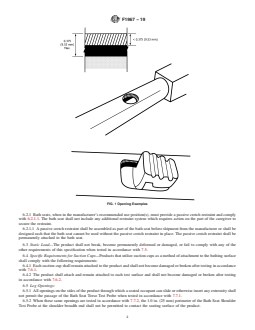
FIG. 1Opening Examples
F1967−19
5.10 Infant bath seats must comply with the applicable 6.6 Installation Components—Priortoshipment,allcompo-
requirements of the Consumer Product Safety Improvement nentsrequiredfortheproperinstallationanduseoftheproduct
Act. according to the manufacturer’s instructions in all manufactur-
er’s recommended use positions shall be permanently attached
to the product. Permanently attached shall mean that such
6. Performance Requirements
components cannot be removed from the product without the
6.1 Stability:
use of a tool.
6.1.1 The stability test shall be conducted after the Mecha-
nisms Durability test in 7.1.3.
7. Test Methods
6.1.2 During and after testing in accordance with 7.4, the
7.1 Latching and Locking Mechanism Tests:
product shall comply with the following:
7.1.1 Resistance to Collapse:
6.1.2.1 Nopartsoftheproductshallbecomeseparatedfrom
7.1.1.1 Install the product with the latching and locking
it.
mechanism(s) engaged in one of the manufacturer’s recom-
6.1.2.2 The product shall not sustain permanent damage.
mendedusepositionsonTestSurface#2orTestSurface#3,or
6.1.2.3 The product shall not tip over. If the product would
both, depending on the manufacturer’s installation instructions
continue to tip over under the application of force, but it is
(refer to Stability Test Method for test surface specification).
prevented from doing so by the test platform interior side
Secure the product to the test surface(s) so that any collapsing
walls, it shall be considered a tip over.
motion is not impeded.
6.1.2.4 No attachment point shall disengage from (is no
7.1.1.2 Graduallyapplya45lbf(200N)forcetotheproduct
longer in contact with) the test platform and then fail to return
in the direction normally associated with collapsing the prod-
to its manufacturer’s recommended use position.
uct.
6.1.2.5 At all time during the application of force, the seat
7.1.1.3 Repeat this procedure four additional times within a
shall remain in its initial position and shall not be tilted at an
2-min period.
angle of 12° or more from its initial position.
7.1.1.4 Submerge the product in enough clear water to fully
6.2 Restraint System:
coverthelatchingandlockingmechanism.Watershallbeatan
6.2.1 Bath seats, when in the manufacturer’s recommended
initial temperature of 100 to 105°F (37.8 to 40.6°C).
use position(s), must provide a passive crotch restraint and
7.1.1.5 Repeat7.1.1.1through7.1.1.3whilemaintainingthe
comply with 6.2.1.1. The bath seat shall not include any
product in its submerged position.
additional restraint system which requires action on the part of
7.1.1.6 Repeatthetestinginboththedryandthesubmerged
the caregiver to secure the restraint.
conditions for all other manufacturer’s recommended use
6.2.1.1 Apassive crotch restraint shall be assembled as part positions.
ofthebathseatbeforeshipmentfromthemanufacturerorshall
7.1.2 Single Action Release Mechanism Test:
be designed such that the bath seat cannot be used without the 7.1.2.1 Install the product in one of the manufacturer’s
passive crotch restraint in place. The passive crotch restraint
recommended use positions onTest Surface #2 orTest Surface
shall be permanently attached to the bath seat. #3, or both (refer to Stability Test Method for test surface
specification).Securetheproductsothatanycollapsingmotion
6.3 Static Load—The product shall not break, become
is not impeded.
permanently deformed or damaged, or fail to comply with any
7.1.2.2 Gradually apply a 10 lbf (45 N) force to the locking
of the other requirements of this specification when tested in
and latching mechanism in the direction tending to release it.
accordance with 7.5.
7.1.2.3 Repeat 7.1.2.1 and 7.1.2.2 for all other manufactur-
6.4 Specific Requirements for Suction Cups—Products that
er’s recommended use positions.
utilize suction cups as a method of attachment to the bathing
7.1.3 Latching and Locking Mechanism Durability Test—
surface shall comply with the following requirements:
All latching and locking mechanism(s) shall be cycled through
6.4.1 Each suction cup shall remain attached to the product
their normal operation a total of 2000 cycles. Each cycle shall
and shall not become damaged or broken after testing in
consist of opening and closing the mechanism(s) and erecting/
accordance with 7.6.1.
folding the product. Cycling shall be conducted on a continu-
6.4.2 The product shall attach and remain attached to each
ous basis.
test surface and shall not become damaged or broken after
7.2 Removal of Protective Components Test:
testing in accordance with 7.6.2.
7.2.1 Prior to conducting the following tests, first com-
6.5 Leg Openings:
pletely submerge the testable components for 20 min in clear
6.5.1 Allopeningsonthesidesoftheproductthroughwhich
water that is at an initial temperature of 100 to 105°F (37.8 to
a seated occupant can slide or otherwise insert any extremity 40.6°C). Conduct the following tests within 10 min after
shall not permit the passage of the Bath Seat Torso Test Probe removal from the water.
when tested in accordance with 7.7.1.
7.2.2 Any protective component shall be tested in accor-
6.5.2 When these same openings are tested in accordance dance with each of the following methods in the sequence
with 7.7.2, the 1.0 in. (25 mm) perimeter of the Bath Seat listed.
Shoulder Test Probe at the shoulder breadth end shall not be 7.2.3 Secure the product so that the product cannot move
permitted to contact the seating surface of the product. during the performance of the following tests:
F1967−19
7.2.4 Torque Test—Graduallyapplyatorqueof4lbf-in.(0.4 7.3.2 A paper label (excluding labels attached by a seam)
N-m) over a period of5sina clockwise direction until a shall be considered permanent if, during an attempt to remove
rotation of 180° from the original position has been attained or it without the aid of tools or solvents, it cannot be removed, it
4 lbf-in. has been exceeded. The torque or maximum rotation tears into pieces upon removal or such action damages the
shallbemaintainedforanadditional10s.Thetorqueshallthen surface to which it is attached.
be removed and the test components permitted to return to a 7.3.3 A nonpaper label (excluding labels attached by a
relaxed condition. This procedure shall then be repeated in the seam) shall be considered permanent if, during an attempt to
counter-clockwise direction. remove it without the aid of tools or solvents, it cannot be
7.2.5 Tension Test: removed or such action damages the surface to which it is
7.2.5.1 Attachaforcegaugetotheprotectivecomponentby attached.
means of any suitable device. For components that cannot 7.3.4 A warning label attached by a seam shall be consid-
reasonably be expected to be grasped between thumb and eredpermanentifitdoesnotdetachwhensubjectedtoa15-lbf
forefinger, or teeth, on their outer diameter but have a gap of (67-N) pull force applied in any direction using a ⁄4-in.
0.04 in. (1.0 mm) or more between the rear surface of the diameter clamp surface.
component and the structural member of the product to which 7.3.5 Adhesion test for warnings applied directly onto the
they are attached, a clamp such as shown in Fig. 2 may be a surface of the product.
suitable device. 7.3.5.1 Apply the tape test defined in Test Method B,
7.2.5.2 Be sure that the attachment device does not com- Cross-Cut Tape Test of Test Methods D3359, eliminating
press or expand the component hindering any possible re- parallel cuts.
moval. 7.3.5.2 Perform this test once in each different location
7.2.5.3 Gradually apply a 15 lbf (67 N) force over a period where warnings are applied.
of5sinthe direction that would normally be associated with 7.3.5.3 The warning statements will be considered perma-
the removal of the protective component. Hold for an addi- nentiftheprintingintheareatestedisstilllegibleandattached
tional 10 s. after being subjected to this test.
7.3.6 A nonpaper label, during an attempt to remove it
7.3 Permanence of Labels and Warnings:
without the aid of tools or solvents, shall not be removed or
7.3.1 To determine the permanence of a label or printing
shall not fit entirely within the small parts cylinder defined in
appliedtothesurfaceoftheproduct,firstcompletelysubmerge
16 CFR 1501 if it can be removed.
the label or printed area for 20 min in clear water that is at an
initial temperature of 100 to 105°F (37.8 to 40.6°C). Drain off 7.4 Stability Test:
the excess water and let the label or printed area air dry for 24 7.4.1 Test Equipment:
hat73 6 9°F (23 6 5°C), 20to 70 % RH, prior to conducting 7.4.1.1 Test Platform—Refer to Fig. 3, Fig. 4, and Fig. 5 for
any permanency tests. the specifications of an adult bath tub to be used as the test
platform. All surfaces of this tub shall be smooth porcelain
enamel.Thesideledgeofthetubshallbeofuniformthickness
of 4 6 0.5 in. (10.2 6 0.6 cm) for at least 24 in. (60.0 cm)
along the length of the tub.
7.4.1.2 Test Surface Usage—The test surface(s) described
below to be used for required tests shall be determined by
considering all of the attachment configurations and contact
locations a given product utilizes to provide support and
stabilityfortheproductinoronanadultbathtub.Thestability
testshallbeconductedusingallrelevantsurfaces,andmultiple
surfaces may be used either separately or simultaneously for
testing, depending upon the manufacturer’s recommended
installation instructions and use position(s).
(1) Test Surface #1—Anyareaonthebottomsurfaceofthe
test platform where safety tread strips are applied as described
below.
(2) Test Surface #2—Anyareaonthebottomsurfaceofthe
test platform where safety tread strips are not applied.
(3) Test Surface #3—Any area on the side(s) of the test
platform (for example, inside surface, outside surface, and top
ledge), where safety tread strips are not applied.
NOTE1—Onetestplatformmaybeusedforalltestsurfacesifsufficient
Atthetimeoforiginalpublicationofthisstandard,thesolesourceofsupplyof
the apparatus known to the committee wasAmerican Standard, 1 Centennial Plaza,
FIG. 2Tension Test Adapter/Clamp Piscataway, NJ 08855-6820.
F1967−19
FIG. 3Test Platform Top View
space allows for the use of all coverage areas as specified below.
7.4.1.7 Test Bar—A 1 in. by ⁄4 in. (25 mm by 6 mm) rigid
aluminum flat bar. The length of the test bar shall be such that
7.4.1.3 Coverage Area—Any area where the product can be
itextendsbeyondtheuppermostedgeorsurfaceoftheproduct
installed per the manufacturer’s instructions on Test Surfaces
at least as far as the maximum distance D as calculated below
#1, #2 and #3, and that is at least 1 in. (25 mm) larger in all
plus enough additional length to accommodate the attachment
directions than the perimeter outlined by any part of the
of the inclinometer as described below.
product that is designed to contact any of these surfaces.
7.4.2 Test Surface #1 Preparation:
NOTE 2—Each test surface requires an adequate coverage area.
7.4.2.1 Determine the coverage area for a product that
7.4.1.4 Safety Tread Strips—Commercially available adhe-
contacts or attaches to the bottom surface of an adult bath tub
sive backed safety tread strips for bath tub use that are
for its support and stability. Clean the coverage area with any
rectangular,approximately0.75in.(19mm)wideby7in.(180
commercial cleaner intended for bath tubs, following the
mm) or greater in length. The corners may be filleted with a
cleaner’s instructions. Then wipe the coverage area with
radius that does not exceed ⁄2 the width.
alcohol and allow to dry.
7.4.1.5 Baby Wash Test Solution—Any of the following
7.4.2.2 Apply the safety tread strips evenly onto the cover-
products diluted ina1to25 ratio of distilled water, and
age area at a distance of 0.375 6 0.125 in. (9.5 6 3 mm) apart
contained in a spray bottle:
from edge to edge.
(a)Solution comprised of ingredients as shown in Table 1,
7.4.2.3 Safety tread strips shall be replaced if they become
or
damaged or dislodged from their specified position(s).
(b)Johnson’s baby head-to-toe baby wash, or
(c)Aveeno baby wash and shampoo. NOTE 3—The installation of the safety tread strips for Test Surface #1
will most likely need to be done only during the initial setup of this test
7.4.1.6 Inclinometer with a measurement tolerance of less
surface, except for replacements that may be necessary from time to time.
thanorequalto0.5°.Themaximumweightoftheinclinometer
and the fastening method shall be ≤2.2 lb (1 kg). 7.4.3 Test Protocol for Test Surface #1:
F1967−19
FIG. 4Test Platform A-A Sectional View
7.4.3.1 Clean the coverage area with any commercial 7.4.3.6 Calculate the distance D for a force to be applied to
cleaner intended for adult bath tubs following the cleaner’s the test bar using the following formula:
instructions. Then wipe the coverage area with alcohol and
D 5 20.4in. 2 H /2 518mm 2 H /2 (1)
~ ! @~ ! #
allow to dry.
where:
7.4.3.2 Use the spray bottle with the baby wash solution to
thoroughly saturate the coverage area that is above the water H = the height of the uppermost edge or surface above the
level specified in 7.4.3.3. lowest point of the occupant seating surface.
7.4.3.3 Fill the test platform with clear water that is at an
7.4.3.7 Securely install the inclinometer to the test bar
initial temperature of 100 to 105°F (37.8 to 40.6°C) to a depth
above the location where the force in 7.4.3.6 is to be applied.
of 2 in. (51 mm) above the estimated highest point of the
Measure and record the pre-test angle of the test bar.
occupant seating surface when the product is installed.
7.4.3.8 Apply a 17.0 lbf (76.5 N) force to the test bar at
7.4.3.4 Install the product according to the manufacturer’s
distance D above the height H. Apply the force perpendicular
instructions onto the test surface. If the product has more than
to the test bar and outward from the center of the product over
one manufacturer’s recommended use position, select one
aperiodof5s(seeFig.6).Maintainthisforceforanadditional
position for the initial test.
10 s. If the product begins to release from the test surface,
continue to maintain this force perpendicular to the test bar
NOTE 4—If necessary, adjust the water level to the 2-in. (51-mm)
requirement by either adding or removing water from the test platform.
until the product either tips over or the 10 s time limit is
attained.
7.4.3.5 Securely attach the test bar to the inside edge of the
occupant seating space in a vertical orientation at the position
NOTE 5—If necessary, to prevent the product from sliding horizontally
that is
...
This document is not an ASTM standard and is intended only to provide the user of an ASTM standard an indication of what changes have been made to the previous version. Because
it may not be technically possible to adequately depict all changes accurately, ASTM recommends that users consult prior editions as appropriate. In all cases only the current version
of the standard as published by ASTM is to be considered the official document.
Designation: F1967 − 18 F1967 − 19
Standard Consumer Safety Specification for
Infant Bath Seats
This standard is issued under the fixed designation F1967; the number immediately following the designation indicates the year of
original adoption or, in the case of revision, the year of last revision. A number in parentheses indicates the year of last reapproval. A
superscript epsilon (´) indicates an editorial change since the last revision or reapproval.
INTRODUCTION
This consumer safety specification is intended to address certain incidents associated with the use
of bath seats, bath rings, and other similar devices.
The U.S. Consumer Product Safety Commission (CPSC) identified drowning incidents which
generally involved infants either tipping over, climbing out of, or sliding through the product after
being left unattended by their caregiver.
This specification does not address incidents in which bath seats are unreasonably misused, are used
in a careless manner that disregards the warnings and instructions that are provided with each product,
or those instances where the caregiver leaves the infant unattended in the product.
This consumer safety specification is written within the current state-of-the-art product technology.
It is intended that this specification will be updated whenever substantive information becomes
available and known to ASTM which necessitates additional requirements or justifies the revision of
existing requirements.
1. Scope
1.1 This consumer safety specification establishes performance requirements, test methods, and labeling requirements to
promote the safe use of infant bath seats. Products commonly referred to as bath rings also are included in the scope of this
specification. Traditional infant bath tubs that are used to bathe an infant are not within the scope of this standard.
1.2 This consumer safety specification is intended to reduce the risk of death and minimize injury to infants resulting from use
and reasonably foreseeable abuse of infant bath seats.
1.3 No infant bath seat produced after the approval date of this consumer safety specification shall, either by label or other
means, indicate compliance with this specification unless it conforms to all requirements contained herein.
1.4 The values stated in inch-pound units are to be regarded as standard. The values given in parentheses are mathematical
conversions to SI units that are provided for information only and are not considered standard.
1.5 The following precautionary caveat pertains only to the test methods portion, Section 7, of this specification: This standard
does not purport to address all of the safety concerns, if any, associated with its use. It is the responsibility of the user of this
standard to establish appropriate safety, health, and environmental practices and determine the applicability of regulatory
limitations prior to use.
1.6 This international standard was developed in accordance with internationally recognized principles on standardization
established in the Decision on Principles for the Development of International Standards, Guides and Recommendations issued
by the World Trade Organization Technical Barriers to Trade (TBT) Committee.
2. Referenced Documents
2.1 ASTM Standards:
D3359 Test Methods for Rating Adhesion by Tape Test
F404 Consumer Safety Specification for High Chairs
This consumer safety specification is under the jurisdiction of ASTM Committee F15 on Consumer Products and is the direct responsibility of Subcommittee F15.20
on Bath Seats.
Current edition approved Dec. 15, 2018May 1, 2019. Published December 2018May 2019. Originally approved in 1999. Last previous edition approved in 20132018 as
F1967 – 13.F1967 – 18. DOI: 10.1520/F1967-18.10.1520/F1967-19.
For referenced ASTM standards, visit the ASTM website, www.astm.org, or contact ASTM Customer Service at service@astm.org. For Annual Book of ASTM
Standardsvolume information, refer to the standard’s Document Summary page on the ASTM website.
Copyright © ASTM International, 100 Barr Harbor Drive, PO Box C700, West Conshohocken, PA 19428-2959. United States
F1967 − 19
F963 Consumer Safety Specification for Toy Safety
F977 Consumer Safety Specification for Infant Walkers
2.2 Federal Regulations:
16 CFR 1303 Ban of Lead-Containing Paint and Certain Consumer Products Bearing Lead Containing Paint
16 CFR 1500 Federal Hazardous Substances Act Regulations, including sections:
16 CFR 1500.48 Technical Requirements for Determining a Sharp Point in Toys and Other Articles Intended for Use by Children
Under 8 Years of Age
16 CFR 1500.49 Technical Requirements for Determining a Sharp Metal or Glass Edge in Toys and Other Articles Intended for
Use by Children Under 8 Years of Age
16 CFR 1501 Method for Identifying Toys and Other Articles Intended for Use by Children Under 3 Years of Age Which Present
Choking, Aspiration, or Ingestion Hazards Because of Small Parts
Consumer Product Safety Improvement Act
2.3 ANSI Standards:
ANSI Z535.1 Safety Colors
ANSI Z535.4 Product Safety Signs and Labels
ANSI Z535.6 Product Safety Information in Product Manuals, Instructions, and Other Collateral Materials
3. Terminology
3.1 Definitions of Terms Specific to This Standard:
3.1.1 bath seat, n—an article that is used in a bath tub, sink, or similar bathing enclosure and that provides support, at a
minimum, to the front and back of a seated infant during bathing by a caregiver. This does not include products that are designed
or intended to retain water for bathing.
3.1.2 conspicuous, adj—visible, when the product is in all manufacturer’s recommended use positions and an occupant is sitting
in the product, to an adult caregiver near the product at any one position around the product but not necessarily visible from all
positions.
3.1.3 double action release system, n—a mechanism requiring either two consecutive actions, the first of which must be
maintained while the second is carried out, or two separate and independent simultaneous actions to fully release.
3.1.4 installation components, n—components of the infant bath seat that provide the means of installation to the adult bath tub,
including, but not limited to, clamps, arms, suction cups, and pads.
3.1.5 locking and latching mechanism, n—method of preventing a bath seat from folding or collapsing during use.
3.1.6 manufacturer’s recommended use position(s), n—any position that is presented as a normal, allowable, or acceptable
configuration for the use of the product by the manufacturer in any descriptive or instructional literature. This specifically excludes
positions which the manufacturer shows in a like manner in its literature to be unacceptable, unsafe or not recommended.
3.1.7 nonpaper label, n—any label material, such as plastic or metal, that either will not tear without the aid of tools or tears
leaving a sharply defined edge or labels made of fabric.
3.1.8 occupant, n—infant that is in an infant bath seat in any manufacturer’s recommended use position(s).
3.1.9 paper label, n—any label material that tears without the aid of tools and leaves a fibrous edge.
3.1.10 principal display panel, n—that part of the product’s package that is most likely to be displayed, presented, shown or
examined under normal or customary conditions of display for retail sale.
3.1.11 protective component, n—any component used for protection from sharp edges, points, or entrapment of fingers or toes.
3.1.11.1 Discussion—
Examples of protective components include caps, sleeves, and plugs.
3.1.12 stability, n—ability of a bath seat to remain upright in all of the manufacturer’s recommended use positions.
3.1.13 static load, n—vertically downward load applied by weights or other means.
4. Calibration and Standardization
4.1 Unless otherwise noted, the bath seat shall be completely assembled in accordance with the manufacturer’s instructions.
4.2 The product to be tested shall be in a room with an ambient temperature of 73 6 9°F (23 6 5°C) for at least 1 h prior to
testing. Testing then shall be conducted within this temperature range.
Available from U.S. Government Printing Office Superintendent of Documents, 732 N. Capitol St., NW, Mail Stop: SDE, Washington, DC 20401.
Available from American National Standards Institute (ANSI), 25 W. 43rd St., 4th Floor, New York, NY 10036, http://www.ansi.org.
F1967 − 19
4.3 All testing required by this specification shall be conducted on the same unit.
5. General Requirements
5.1 Hazardous Sharp Edges or Points—There shall be no hazardous sharp points or edges as defined in 16 CFR 1500.48 and
16 CFR 1500.49 before or after the product has been tested to this consumer safety specification.
5.2 Small Parts—There shall be no small parts as defined in 16 CFR 1501 before testing or liberated as a result of testing to
this consumer safety specification.
5.3 Lead in Paints—All paint and surface coatings on the product shall comply with the requirements of 16 CFR 1303.
5.4 Latching and Locking Mechanisms:
5.4.1 Products that fold shall have a latching and locking mechanism or other means to prevent collapse of the product when
it is installed in any manufacturer’s recommended use position(s).
5.4.2 During and upon completion of the test in accordance with 7.1.1, the product shall remain in the manufacturer’s
recommended use position, and the latching and locking mechanism shall remain engaged and operative.
5.4.3 Products designed with a latching and locking mechanism shall comply with either 5.4.3.1 or 5.4.3.2.
5.4.3.1 Product shall be designed with a single action release mechanism that shall not release when tested in accordance with
7.1.2.
5.4.3.2 Product shall be designed with a double action release system.
5.4.4 Latching and locking mechanisms shall also comply with all requirements in 5.4 after cycling has been conducted in
accordance with 7.1.3.
5.5 Scissoring, Shearing, and Pinching—The product, when in the manufacturer’s recommended use position(s), shall be
designed and constructed to prevent injury to the occupant from any scissoring, shearing, or pinching when members or
components rotate about a common axis or fastening point, slide, pivot, fold or otherwise move relative to one another. Scissoring,
shearing, or pinching that may cause injury exists when the edges of the rigid parts admit a probe greater than 0.210 in. (5.33 mm)
and less than 0.375 in. (9.53 mm) in diameter at any accessible point throughout the range of motion of such parts.
5.6 Openings—Holes or slots that extend entirely through a wall section of any rigid material less than 0.375-in. (9.53-mm)
thick and admit a 0.210-in. (5.33-mm) diameter rod shall also admit a 0.375-in. (9.53-mm) diameter rod. Holes or slots that are
between 0.210 in. (5.33 mm) and 0.375 in. (9.53 mm) and have a wall thickness less than 0.375 in. (9.53 mm) but are limited in
depth to 0.375 in. (9.53 mm) maximum by another rigid surface shall be permissible (see Fig. 1 for examples). The product shall
be evaluated in all manufacturer’s recommended use positions.
5.7 Protective Components—If the child can grasp protective components between the thumb and forefinger, or teeth, or if there
is at least a 0.04 in. (1.0 mm) gap between the component and its adjacent parent component, such component shall not be removed
when tested in accordance with 7.2.
5.8 Requirements for Toys—Toy accessories attached to, removable from, or sold with infant bath seats, as well as their means
of attachment, shall comply with the applicable requirements of Standard Consumer Safety Specification F963.
5.9 Labeling:
5.9.1 Warning labels, whether paper or nonpaper, shall be permanent when tested in accordance with 7.3.1 – 7.3.4.
5.9.2 Warning statements applied directly onto the surface of the product by hot stamping, heat transfer, printing, wood burning,
etc. shall be permanent when tested in accordance with 7.3.1 and 7.3.5.
5.9.3 Nonpaper labels shall not liberate small parts when tested in accordance with 7.3.6.
5.10 Infant bath seats must comply with the applicable requirements of the Consumer Product Safety Improvement Act.
6. Performance Requirements
6.1 Stability:
6.1.1 The stability test shall be conducted after the Mechanisms Durability test in 7.1.3.
6.1.2 During and after testing in accordance with 7.4, the product shall comply with the following:
6.1.2.1 No parts of the product shall become separated from it.
6.1.2.2 The product shall not sustain permanent damage.
6.1.2.3 The product shall not tip over. If the product would continue to tip over under the application of force, but it is prevented
from doing so by the test platform interior side walls, it shall be considered a tip over.
6.1.2.4 No attachment point shall disengage from (is no longer in contact with) the test platform and then fail to return to its
manufacturer’s recommended use position.
6.1.2.5 At all time during the application of force, the seat shall remain in its initial position and shall not be tilted at an angle
of 12° or more from its initial position.
6.2 Restraint System:
F1967 − 19
FIG. 1 Opening Examples
6.2.1 Bath seats, when in the manufacturer’s recommended use position(s), must provide a passive crotch restraint and comply
with 6.2.1.1. The bath seat shall not include any additional restraint system which requires action on the part of the caregiver to
secure the restraint.
6.2.1.1 A passive crotch restraint shall be assembled as part of the bath seat before shipment from the manufacturer or shall be
designed such that the bath seat cannot be used without the passive crotch restraint in place. The passive crotch restraint shall be
permanently attached to the bath seat.
6.3 Static Load—The product shall not break, become permanently deformed or damaged, or fail to comply with any of the
other requirements of this specification when tested in accordance with 7.5.
6.4 Specific Requirements for Suction Cups—Products that utilize suction cups as a method of attachment to the bathing surface
shall comply with the following requirements:
6.4.1 Each suction cup shall remain attached to the product and shall not become damaged or broken after testing in accordance
with 7.6.1.
6.4.2 The product shall attach and remain attached to each test surface and shall not become damaged or broken after testing
in accordance with 7.6.2.
6.5 Leg Openings:
6.5.1 All openings on the sides of the product through which a seated occupant can slide or otherwise insert any extremity shall
not permit the passage of the Bath Seat Torso Test Probe when tested in accordance with 7.7.1.
6.5.2 When these same openings are tested in accordance with 7.7.2, the 1.0 in. (25 mm) perimeter of the Bath Seat Shoulder
Test Probe at the shoulder breadth end shall not be permitted to contact the seating surface of the product.
F1967 − 19
6.6 Installation Components—Prior to shipment, all components required for the proper installation and use of the product
according to the manufacturer’s instructions in all manufacturer’s recommended use positions shall be permanently attached to the
product. Permanently attached shall mean that such components cannot be removed from the product without the use of a tool.
7. Test Methods
7.1 Latching and Locking Mechanism Tests:
7.1.1 Resistance to Collapse:
7.1.1.1 Install the product with the latching and locking mechanism(s) engaged in one of the manufacturer’s recommended use
positions on Test Surface #2 or Test Surface #3, or both, depending on the manufacturer’s installation instructions (refer to Stability
Test Method for test surface specification). Secure the product to the test surface(s) so that any collapsing motion is not impeded.
7.1.1.2 Gradually apply a 45 lbf (200 N) force to the product in the direction normally associated with collapsing the product.
7.1.1.3 Repeat this procedure four additional times within a 2-min period.
7.1.1.4 Submerge the product in enough clear water to fully cover the latching and locking mechanism. Water shall be at an
initial temperature of 100 to 105°F (37.8 to 40.6°C).
7.1.1.5 Repeat 7.1.1.1 through 7.1.1.3 while maintaining the product in its submerged position.
7.1.1.6 Repeat the testing in both the dry and the submerged conditions for all other manufacturer’s recommended use positions.
7.1.2 Single Action Release Mechanism Test:
7.1.2.1 Install the product in one of the manufacturer’s recommended use positions on Test Surface #2 or Test Surface #3, or
both (refer to Stability Test Method for test surface specification). Secure the product so that any collapsing motion is not impeded.
7.1.2.2 Gradually apply a 10 lbf (45 N) force to the locking and latching mechanism in the direction tending to release it.
7.1.2.3 Repeat 7.1.2.1 and 7.1.2.2 for all other manufacturer’s recommended use positions.
7.1.3 Latching and Locking Mechanism Durability Test—All latching and locking mechanism(s) shall be cycled through their
normal operation a total of 2000 cycles. Each cycle shall consist of opening and closing the mechanism(s) and erecting/folding
the product. Cycling shall be conducted on a continuous basis.
7.2 Removal of Protective Components Test:
7.2.1 Prior to conducting the following tests, first completely submerge the testable components for 20 min in clear water that
is at an initial temperature of 100 to 105°F (37.8 to 40.6°C). Conduct the following tests within 10 min after removal from the
water.
7.2.2 Any protective component shall be tested in accordance with each of the following methods in the sequence listed.
7.2.3 Secure the product so that the product cannot move during the performance of the following tests:
7.2.4 Torque Test—Gradually apply a torque of 4 lbf-in. (0.4 N-m) over a period of 5 s in a clockwise direction until a rotation
of 180° from the original position has been attained or 4 lbf-in. has been exceeded. The torque or maximum rotation shall be
maintained for an additional 10 s. The torque shall then be removed and the test components permitted to return to a relaxed
condition. This procedure shall then be repeated in the counter-clockwise direction.
7.2.5 Tension Test:
7.2.5.1 Attach a force gauge to the protective component by means of any suitable device. For components that cannot
reasonably be expected to be grasped between thumb and forefinger, or teeth, on their outer diameter but have a gap of 0.04 in.
(1.0 mm) or more between the rear surface of the component and the structural member of the product to which they are attached,
a clamp such as shown in Fig. 2 may be a suitable device.
7.2.5.2 Be sure that the attachment device does not compress or expand the component hindering any possible removal.
7.2.5.3 Gradually apply a 15 lbf (67 N) force over a period of 5 s in the direction that would normally be associated with the
removal of the protective component. Hold for an additional 10 s.
7.3 Permanence of Labels and Warnings:
7.3.1 To determine the permanence of a label or printing applied to the surface of the product, first completely submerge the
label or printed area for 20 min in clear water that is at an initial temperature of 100 to 105°F (37.8 to 40.6°C). Drain off the excess
water and let the label or printed area air dry for 24 h at 73 6 9°F (23 6 5°C), 20 to 70 % RH, prior to conducting any permanency
tests.
7.3.2 A paper label (excluding labels attached by a seam) shall be considered permanent if, during an attempt to remove it
without the aid of tools or solvents, it cannot be removed, it tears into pieces upon removal or such action damages the surface
to which it is attached.
7.3.3 A nonpaper label (excluding labels attached by a seam) shall be considered permanent if, during an attempt to remove it
without the aid of tools or solvents, it cannot be removed or such action damages the surface to which it is attached.
7.3.4 A warning label attached by a seam shall be considered permanent if it does not detach when subjected to a 15-lbf (67-N)
pull force applied in any direction using a ⁄4-in. diameter clamp surface.
7.3.5 Adhesion test for warnings applied directly onto the surface of the product.
7.3.5.1 Apply the tape test defined in Test Method B, Cross-Cut Tape Test of Test Methods D3359, eliminating parallel cuts.
7.3.5.2 Perform this test once in each different location where warnings are applied.
F1967 − 19
FIG. 2 Tension Test Adapter/Clamp
7.3.5.3 The warning statements will be considered permanent if the printing in the area tested is still legible and attached after
being subjected to this test.
7.3.6 A nonpaper label, during an attempt to remove it without the aid of tools or solvents, shall not be removed or shall not
fit entirely within the small parts cylinder defined in 16 CFR 1501 if it can be removed.
7.4 Stability Test:
7.4.1 Test Equipment:
7.4.1.1 Test Platform—Refer to Fig. 3, Fig. 4, and Fig. 5 for the specifications of an adult bath tub to be used as the test platform.
All surfaces of this tub shall be smooth porcelain enamel. The side ledge of the tub shall be of uniform thickness of 4 6 0.5 in.
(10.2 6 0.6 cm) for at least 24 in. (60.0 cm) along the length of the tub.
7.4.1.2 Test Surface Usage—The test surface(s) described below to be used for required tests shall be determined by considering
all of the attachment configurations and contact locations a given product utilizes to provide support and stability for the product
in or on an adult bath tub. The stability test shall be conducted using all relevant surfaces, and multiple surfaces may be used either
separately or simultaneously for testing, depending upon the manufacturer’s recommended installation instructions and use
position(s).
(1) Test Surface #1—Any area on the bottom surface of the test platform where safety tread strips are applied as described
below.
(2) Test Surface #2—Any area on the bottom surface of the test platform where safety tread strips are not applied.
(3) Test Surface #3—Any area on the side(s) of the test platform (for example, inside surface, outside surface, and top ledge),
where safety tread strips are not applied.
NOTE 1—One test platform may be used for all test surfaces if sufficient space allows for the use of all coverage areas as specified below.
7.4.1.3 Coverage Area—Any area where the product can be installed per the manufacturer’s instructions on Test Surfaces #1,
#2 and #3, and that is at least 1 in. (25 mm) larger in all directions than the perimeter outlined by any part of the product that is
designed to contact any of these surfaces.
NOTE 2—Each test surface requires an adequate coverage area.
7.4.1.4 Safety Tread Strips—Commercially available adhesive backed safety tread strips for bath tub use that are rectangular,
approximately 0.75 in. (19 mm) wide by 7 in. (180 mm) or greater in length. The corners may be filleted with a radius that does
not exceed ⁄2 the width.
At the time of original publication of this standard, the sole source of supply of the apparatus known to the committee was American Standard, 1 Centennial Plaza,
Piscataway, NJ 08855-6820.
F1967 − 19
FIG. 3 Test Platform Top View
7.4.1.5 Baby Wash Test Solution—Any of the following products diluted in a 1 to 25 ratio of distilled water, and contained in
a spray bottle:
(a) Solution comprised of ingredients as shown in Table 1, or
(b) Johnson’s baby head-to-toe baby wash, or
(c) Aveeno baby wash and shampoo.
7.4.1.6 Inclinometer with a measurement tolerance of less than or equal to 0.5°. The maximum weight of the inclinometer and
the fastening method shall be ≤2.2 lb (1 kg).
7.4.1.7 Test Bar—A 1 in. by ⁄4 in. (25 mm by 6 mm) rigid aluminum flat bar. The length of the test bar shall be such that it
extends beyond the uppermost edge or surface of the product at least as far as the maximum distance D as calculated below plus
enough additional length to accommodate the attachment of the inclinometer as described below.
7.4.2 Test Surface #1 Preparation:
7.4.2.1 Determine the coverage area for a product that contacts or attaches to the bottom surface of an adult bath tub for its
support and stability. Clean the coverage area with any commercial cleaner intended for bath tubs, following the cleaner’s
instructions. Then wipe the coverage area with alcohol and allow to dry.
7.4.2.2 Apply the safety tread strips evenly onto the coverage area at a distance of 0.375 6 0.125 in. (9.5 6 3 mm) apart from
edge to edge.
7.4.2.3 Safety tread strips shall be replaced if they become damaged or dislodged from their specified position(s).
NOTE 3—The installation of the safety tread strips for Test Surface #1 will most likely need to be done only during the initial setup of this test surface,
except for replacements that may be necessary from time to time.
7.4.3 Test Protocol for Test Surface #1:
7.4.3.1 Clean the coverage area with any commercial cleaner intended for adult bath tubs following the cleaner’s instructions.
Then wipe the coverage area with alcohol and allow to dry.
7.4.3.2 Use the spray bottle with the baby wash solution to thoroughly saturate the coverage area that is above the water level
specified in 7.4.3.3.
F1967 − 19
FIG. 4 Test Platform A-A Sectional View
7.4.3.3 Fill the test platform with clear water that is at an initial temperature of 100 to 105°F (37.8 to 40.6°C) to a depth of 2
in. (51 mm) above the estimated highest point of the occupant seating surface when the product is installed.
7.4.3.4 Install the product according to the manufacturer’s instructions onto the test surface. If the product has more than one
manufacturer’s recommended use position, select one position for the initial test.
NOTE 4—If necessary, adjust the water level to the 2-in. (51-mm) requirement by either adding or removing water from the test platform.
7.4.3.5 Securely attach the test bar to the inside edge of the occupant seating space in a vertical orientation at the position that
is most likely to cause the bath seat to tip over, with the widest surface of the test bar facing outward from the product.
7.4.3.6 Calculate the distance D for a force to be applied to the test bar using the following formula:
D 5 ~20.4 in. 2 H!/2 @~518 mm 2 H!/2# (1)
where:
H = the height of the uppermost edge or surface above the lowest point of the occupant seating surface.
7.4.3.7 Securely install the inclinometer to the test bar above the location where the force in 7.4.3.6 is to be applied. Measure
and record the pre-test angle of the test bar.
7.4.3.8 Apply a 17.0 lbf (76.5 N) force to the test bar at distance D above the height H. Apply the force perpendicular to the
test bar and outward from the center of the product over a period of 5 s (see Fig. 6). Maintain this force for an additional 10 s.
If the product begins to release from the test surface, continue to maintain this force perpendicular to the test bar until the product
either tips over or the 10 s time limit is attain
...