

ASTM D6296-22
(Test Method)Standard Test Method for Total Olefins in Spark-ignition Engine Fuels by Multidimensional Gas Chromatography
General Information
- Abstract
SIGNIFICANCE AND USE
5.1 The quantitative determination of olefins in spark-ignition engine fuels is required to comply with government regulations.
5.2 Knowledge of the total olefin content provides a means to monitor the efficiency of catalytic cracking processes.
5.3 This test method provides better precision for olefin content than Test Method D1319. It also provides data in a much shorter time, approximately 20 min following calibration, and maximizes automation to reduce operator labor.
5.4 This test method is not applicable to M85 or E85 fuels, which contain 85 % methanol and ethanol, respectively.
SCOPE
1.1 This test method provides for the quantitative determination of total olefins in the C4 to C10 range in spark-ignition engine fuels or related hydrocarbon streams, such as naphthas and cracked naphthas. Olefin concentrations in the range from 0.2 % by liquid-volume or mass to 5.0 % by liquid-volume or mass, or both, can be determined directly on the as-received sample whereas olefins in samples containing higher concentrations are determined after appropriate sample dilution prior to analysis.
1.2 This test method is applicable to samples containing alcohols and ethers; however, samples containing greater than 15 % alcohol must be diluted. Samples containing greater than 5.0 % ether must also be diluted to the 5.0 % or less level, prior to analysis. When ethyl-tert-butylether is present, only olefins in the C4 to C9 range can be determined.
1.3 This test method can not be used to determine individual olefin components.
1.4 This test method can not be used to determine olefins having higher carbon numbers than C10.
Note 1: Precision was determined only on samples containing MTBE and ethanol.
1.5 The values stated in SI units are to be regarded as standard. No other units of measurement are included in this standard.
1.6 This standard does not purport to address all of the safety concerns, if any, associated with its use. It is the responsibility of the user of this standard to establish appropriate safety, health, and environmental practices and determine the applicability of regulatory limitations prior to use.
1.7 This international standard was developed in accordance with internationally recognized principles on standardization established in the Decision on Principles for the Development of International Standards, Guides and Recommendations issued by the World Trade Organization Technical Barriers to Trade (TBT) Committee.
- Status
- Published
- Publication Date
- 31-Mar-2022
- Technical Committee
- D02 - Petroleum Products, Liquid Fuels, and Lubricants
- Drafting Committee
- D02.04.0L - Gas Chromatography Methods
Buy Documents
ASTM D6296-22 - Standard Test Method for Total Olefins in Spark-ignition Engine Fuels by Multidimensional Gas Chromatography
REDLINE ASTM D6296-22 - Standard Test Method for Total Olefins in Spark-ignition Engine Fuels by Multidimensional Gas Chromatography
Overview
ASTM D6296-22 is the internationally recognized standard test method for determining the total olefins content in spark-ignition engine fuels-such as gasoline, naphthas, and cracked naphthas-using multidimensional gas chromatography. Developed by ASTM International, this standard provides a rapid, automated, and precise approach to quantifying total olefins in the C4 to C10 carbon range, helping fuel producers and laboratories comply with regulatory requirements and optimize production processes. The method is widely used in petroleum analysis, fuel quality control, and regulatory compliance testing.
Key Topics
- Scope and Applicability:
- Determines total olefins in the C4 to C10 range in spark-ignition engine fuels and hydrocarbon streams.
- Applicable for samples with alcohols (≤15%) or ethers (≤5%); higher concentrations require dilution.
- Not suitable for M85 or E85 fuels (85% methanol or ethanol content).
- Does not allow identification of individual olefin components or olefins above C10.
- Significance and Use:
- Essential for compliance with government fuel regulations.
- Enables monitoring of catalytic cracking process efficiency via olefin content.
- Provides improved precision and reduced analysis time compared to legacy methods such as ASTM D1319.
- Test Method Highlights:
- Utilizes a sophisticated computer-controlled gas chromatographic system with multidimensional separation and flame ionization detection.
- Capable of analyzing samples in approximately 20 minutes after calibration.
- Delivers automated analysis to minimize operator labor and maximize throughput.
Applications
ASTM D6296-22 offers practical benefits across several sectors within the petroleum and fuels industry:
- Regulatory Compliance:
- Ensures conformance with mandated limits on olefin content in commercial gasoline and related fuels.
- Supports reporting to environmental and governmental agencies.
- Process Monitoring and Quality Control:
- Monitors catalytic cracking and reforming operations in refineries.
- Enables routine quality checks during fuel blending and production.
- Laboratory Efficiency:
- Automation reduces operator involvement, increases analytical capacity, and supports high-throughput testing environments.
- Results are available quickly, facilitating timely decision-making.
- Product Development:
- Assists in developing cleaner-burning fuels by providing precise data on olefin concentrations.
Industry Sectors
- Oil refineries and petrochemical plants
- Pipeline and fuel terminal laboratories
- Regulatory and compliance testing agencies
- Fuel additive developers and blenders
Related Standards
- ASTM D1319: Test Method for Hydrocarbon Types in Liquid Petroleum Products by Fluorescent Indicator Adsorption
(Alternative legacy method; less precise and requires more labor.) - ASTM D4052: Test Method for Density, Relative Density, and API Gravity of Liquids by Digital Density Meter
- ASTM D4175: Terminology Relating to Petroleum Products, Liquid Fuels, and Lubricants
- ASTM D4307: Practice for Preparation of Liquid Blends for Use as Analytical Standards
- ASTM D4815: Test Method for Determination of MTBE, ETBE, TAME, DIPE, Tertiary-Amyl Alcohol, and C1-C4 Alcohols in Gasoline by Gas Chromatography
- ASTM D5599: Test Method for Determination of Oxygenates in Gasoline by Gas Chromatography and Oxygen Selective Flame Ionization Detection
- ASTM E355 and E594: Practices and terms for gas chromatography and flame ionization detectors
Practical Value
By providing a fast, automated, and highly precise test method, ASTM D6296-22 enhances the reliability of total olefin measurements in spark-ignition fuels. This supports regulatory compliance, process optimization, and product quality assurance, making it a vital tool for fuel producers, laboratories, and regulatory bodies worldwide. The standard’s compatibility with samples containing oxygenates allows its use with most modern fuel blends, ensuring relevance as fuels and fuel regulations evolve.
Keywords: ASTM D6296-22, total olefins, gas chromatography, gasoline, spark-ignition engine fuels, fuel testing, petroleum analysis, regulatory compliance, automotive fuel standards
Relations
- Refers
ASTM D4175-23a - Standard Terminology Relating to Petroleum Products, Liquid Fuels, and Lubricants - Effective Date
- 15-Dec-2023
- Refers
ASTM D4175-23e1 - Standard Terminology Relating to Petroleum Products, Liquid Fuels, and Lubricants - Effective Date
- 01-Jul-2023
- Effective Date
- 01-Sep-2019
- Effective Date
- 01-May-2017
- Effective Date
- 01-Oct-2015
- Effective Date
- 01-Jun-2015
- Effective Date
- 01-Oct-2014
- Effective Date
- 01-May-2013
- Effective Date
- 01-Nov-2011
- Effective Date
- 01-Oct-2010
- Effective Date
- 01-May-2010
- Effective Date
- 01-Oct-2009
- Effective Date
- 15-Oct-2008
- Effective Date
- 01-Mar-2007
- Effective Date
- 01-Mar-2006
Buy Documents
ASTM D6296-22 - Standard Test Method for Total Olefins in Spark-ignition Engine Fuels by Multidimensional Gas Chromatography
REDLINE ASTM D6296-22 - Standard Test Method for Total Olefins in Spark-ignition Engine Fuels by Multidimensional Gas Chromatography
Get Certified
Connect with accredited certification bodies for this standard

ECOCERT
Organic and sustainability certification.

Element Materials Technology
Materials testing and product certification.

ABS Group Brazil
ABS Group certification services in Brazil.
Sponsored listings
Frequently Asked Questions
ASTM D6296-22 is a standard published by ASTM International. Its full title is "Standard Test Method for Total Olefins in Spark-ignition Engine Fuels by Multidimensional Gas Chromatography". This standard covers: SIGNIFICANCE AND USE 5.1 The quantitative determination of olefins in spark-ignition engine fuels is required to comply with government regulations. 5.2 Knowledge of the total olefin content provides a means to monitor the efficiency of catalytic cracking processes. 5.3 This test method provides better precision for olefin content than Test Method D1319. It also provides data in a much shorter time, approximately 20 min following calibration, and maximizes automation to reduce operator labor. 5.4 This test method is not applicable to M85 or E85 fuels, which contain 85 % methanol and ethanol, respectively. SCOPE 1.1 This test method provides for the quantitative determination of total olefins in the C4 to C10 range in spark-ignition engine fuels or related hydrocarbon streams, such as naphthas and cracked naphthas. Olefin concentrations in the range from 0.2 % by liquid-volume or mass to 5.0 % by liquid-volume or mass, or both, can be determined directly on the as-received sample whereas olefins in samples containing higher concentrations are determined after appropriate sample dilution prior to analysis. 1.2 This test method is applicable to samples containing alcohols and ethers; however, samples containing greater than 15 % alcohol must be diluted. Samples containing greater than 5.0 % ether must also be diluted to the 5.0 % or less level, prior to analysis. When ethyl-tert-butylether is present, only olefins in the C4 to C9 range can be determined. 1.3 This test method can not be used to determine individual olefin components. 1.4 This test method can not be used to determine olefins having higher carbon numbers than C10. Note 1: Precision was determined only on samples containing MTBE and ethanol. 1.5 The values stated in SI units are to be regarded as standard. No other units of measurement are included in this standard. 1.6 This standard does not purport to address all of the safety concerns, if any, associated with its use. It is the responsibility of the user of this standard to establish appropriate safety, health, and environmental practices and determine the applicability of regulatory limitations prior to use. 1.7 This international standard was developed in accordance with internationally recognized principles on standardization established in the Decision on Principles for the Development of International Standards, Guides and Recommendations issued by the World Trade Organization Technical Barriers to Trade (TBT) Committee.
SIGNIFICANCE AND USE 5.1 The quantitative determination of olefins in spark-ignition engine fuels is required to comply with government regulations. 5.2 Knowledge of the total olefin content provides a means to monitor the efficiency of catalytic cracking processes. 5.3 This test method provides better precision for olefin content than Test Method D1319. It also provides data in a much shorter time, approximately 20 min following calibration, and maximizes automation to reduce operator labor. 5.4 This test method is not applicable to M85 or E85 fuels, which contain 85 % methanol and ethanol, respectively. SCOPE 1.1 This test method provides for the quantitative determination of total olefins in the C4 to C10 range in spark-ignition engine fuels or related hydrocarbon streams, such as naphthas and cracked naphthas. Olefin concentrations in the range from 0.2 % by liquid-volume or mass to 5.0 % by liquid-volume or mass, or both, can be determined directly on the as-received sample whereas olefins in samples containing higher concentrations are determined after appropriate sample dilution prior to analysis. 1.2 This test method is applicable to samples containing alcohols and ethers; however, samples containing greater than 15 % alcohol must be diluted. Samples containing greater than 5.0 % ether must also be diluted to the 5.0 % or less level, prior to analysis. When ethyl-tert-butylether is present, only olefins in the C4 to C9 range can be determined. 1.3 This test method can not be used to determine individual olefin components. 1.4 This test method can not be used to determine olefins having higher carbon numbers than C10. Note 1: Precision was determined only on samples containing MTBE and ethanol. 1.5 The values stated in SI units are to be regarded as standard. No other units of measurement are included in this standard. 1.6 This standard does not purport to address all of the safety concerns, if any, associated with its use. It is the responsibility of the user of this standard to establish appropriate safety, health, and environmental practices and determine the applicability of regulatory limitations prior to use. 1.7 This international standard was developed in accordance with internationally recognized principles on standardization established in the Decision on Principles for the Development of International Standards, Guides and Recommendations issued by the World Trade Organization Technical Barriers to Trade (TBT) Committee.
ASTM D6296-22 is classified under the following ICS (International Classification for Standards) categories: 71.040.50 - Physicochemical methods of analysis; 75.160.20 - Liquid fuels. The ICS classification helps identify the subject area and facilitates finding related standards.
ASTM D6296-22 has the following relationships with other standards: It is inter standard links to ASTM D4175-23a, ASTM D4175-23e1, ASTM E594-96(2019), ASTM D5599-17, ASTM D4307-99(2015), ASTM D5599-15, ASTM D1319-14, ASTM D1319-13, ASTM E594-96(2011), ASTM D5599-00(2010), ASTM D4307-99(2010), ASTM D4815-09, ASTM D1319-08, ASTM E355-96(2007), ASTM E594-96(2006). Understanding these relationships helps ensure you are using the most current and applicable version of the standard.
ASTM D6296-22 is available in PDF format for immediate download after purchase. The document can be added to your cart and obtained through the secure checkout process. Digital delivery ensures instant access to the complete standard document.
Standards Content (Sample)
This international standard was developed in accordance with internationally recognized principles on standardization established in the Decision on Principles for the
Development of International Standards, Guides and Recommendations issued by the World Trade Organization Technical Barriers to Trade (TBT) Committee.
Designation:D6296 −22
Standard Test Method for
Total Olefins in Spark-ignition Engine Fuels by
Multidimensional Gas Chromatography
This standard is issued under the fixed designation D6296; the number immediately following the designation indicates the year of
original adoption or, in the case of revision, the year of last revision. A number in parentheses indicates the year of last reapproval. A
superscript epsilon (´) indicates an editorial change since the last revision or reapproval.
1. Scope* mendations issued by the World Trade Organization Technical
Barriers to Trade (TBT) Committee.
1.1 This test method provides for the quantitative determi-
nation of total olefins in the C to C range in spark-ignition
4 10
2. Referenced Documents
engine fuels or related hydrocarbon streams, such as naphthas
2.1 ASTM Standards:
and cracked naphthas. Olefin concentrations in the range from
D1319 Test Method for Hydrocarbon Types in Liquid Petro-
0.2 % by liquid-volume or mass to 5.0 % by liquid-volume or
leum Products by Fluorescent Indicator Adsorption
mass, or both, can be determined directly on the as-received
D4052 Test Method for Density, Relative Density, and API
sample whereas olefins in samples containing higher concen-
Gravity of Liquids by Digital Density Meter
trations are determined after appropriate sample dilution prior
D4175 Terminology Relating to Petroleum Products, Liquid
to analysis.
Fuels, and Lubricants
1.2 This test method is applicable to samples containing
D4307 Practice for Preparation of Liquid Blends for Use as
alcohols and ethers; however, samples containing greater than
Analytical Standards
15 % alcohol must be diluted. Samples containing greater than
D4815 Test Method for Determination of MTBE, ETBE,
5.0 %ethermustalsobedilutedtothe5.0 %orlesslevel,prior
TAME, DIPE, tertiary-Amyl Alcohol and C to C Alco-
1 4
to analysis. When ethyl-tert-butylether is present, only olefins
hols in Gasoline by Gas Chromatography
in the C to C range can be determined.
4 9
D5599 Test Method for Determination of Oxygenates in
1.3 Thistestmethodcannotbeusedtodetermineindividual Gasoline by Gas Chromatography and Oxygen Selective
olefin components. Flame Ionization Detection
E355 Practice for Gas ChromatographyTerms and Relation-
1.4 This test method can not be used to determine olefins
ships
having higher carbon numbers than C .
E594 Practice for Testing Flame Ionization Detectors Used
NOTE 1—Precision was determined only on samples containing MTBE
in Gas or Supercritical Fluid Chromatography
and ethanol.
3. Terminology
1.5 The values stated in SI units are to be regarded as
standard. No other units of measurement are included in this
3.1 This test method makes reference to common gas
standard.
chromatographicprocedures,terms,andrelationships.Detailed
1.6 This standard does not purport to address all of the definitions of these can be found in Practices E355 and E594
safety concerns, if any, associated with its use. It is the and Terminology D4175.
responsibility of the user of this standard to establish appro-
3.2 Definitions of Terms Specific to This Standard:
priate safety, health, and environmental practices and deter-
3.2.1 trap, n—a device utilized to selectively retain specific
mine the applicability of regulatory limitations prior to use.
portions (individual or groups of hydrocarbons or oxygenates)
1.7 This international standard was developed in accor-
of the test sample and to release the retained components by
dance with internationally recognized principles on standard-
increasing the trap temperature.
ization established in the Decision on Principles for the
3.3 Acronyms:
Development of International Standards, Guides and Recom-
3.3.1 ETBE—ethyl-tert-butylether.
3.3.2 MTBE—methyl-tert–butylether.
This test method is under the jurisdiction of ASTM Committee D02 on
Petroleum Products, Liquid Fuels, and Lubricantsand is the direct responsibility of
Subcommittee D02.04.0L on Gas Chromatography Methods. For referenced ASTM standards, visit the ASTM website, www.astm.org, or
Current edition approved April 1, 2022. Published May 2022. Originally contact ASTM Customer Service at service@astm.org. For Annual Book of ASTM
approved in 1998. Last previous edition approved in 2017 as D6296 – 98 (2017). Standards volume information, refer to the standard’s Document Summary page on
DOI: 10.1520/D6296-22. the ASTM website.
*A Summary of Changes section appears at the end of this standard
Copyright © ASTM International, 100 Barr Harbor Drive, PO Box C700, West Conshohocken, PA 19428-2959. United States
D6296−22
4. Summary of Test Method 6. Interferences
4.1 A reproducible 0.2 µL volume of a representative 6.1 Some types of sulfur-containing compounds are irre-
versibly absorbed in the olefin and oxygenate traps ultimately
sample, or a dilution thereof, is introduced into a computer
controlled gas chromatographic system consisting of a series reducingthetrapcapacity.However,avarietyofspark-ignition
engine fuels have been analyzed without significant perfor-
of columns, traps, and switching valves operating at various
temperatures. The valves are actuated at predetermined times mance deterioration of these traps.
to direct portions of the sample to appropriate columns and
6.2 Commercial dyes used to distinguish between grades
traps. The sample first passes through a polar column that
and types of spark-ignition engine fuels have not been found to
retains C + hydrocarbons, all aromatics, C + olefins, and
12 11
interfere with this test method.
some alcohols, all of which are subsequently backflushed to
6.3 Commercial detergent additives utilized in spark-
vent. The fraction eluting from the polar column, which
ignition engine fuels have not been found to interfere with this
contains C and lower boiling saturated hydrocarbons as well
test method.
asdeceneandlowerboilingolefins,entersanether/alcoholtrap
where the ethers and alcohols are selectively retained and also 6.4 Dissolved water in spark-ignition engine fuels has not
been found to interfere with this test method. Free water must
subsequently backflushed. The fraction eluting from the ether/
alcohol trap, which consists of C and lower boiling saturated be removed using anhydrous sodium sulfate or other drying
agent to permit injection of accurate sample volumes.
hydrocarbons and the olefins, enters an olefin trap. The olefins
are selectively retained while the saturated hydrocarbons elute,
7. Apparatus
pass through a nonpolar column, and are detected by a flame
ionization detector (FID). When the saturated hydrocarbons
7.1 Thecompletesystemusedtoobtaintheprecisiondatais
have completely eluted to the FID, the nonpolar column oven
comprised of a computer controlled gas chromatograph, auto-
is cooled and the olefins, which have been retained on the mated sample injector, computer software, and specific hard-
olefin trap, are desorbed by heating.The desorbed olefins enter
ware modifications. These modifications include columns,
and elute from the nonpolar column, which is temperature traps, and valves which are described as follows and in Section
programmed to separate the olefins by boiling point, and are
8. Fig. 1 illustrates a typical flow diagram and component
detected by the FID. configuration. Other configurations, components, or conditions
may be utilized provided they are capable of separating the
NOTE 2—Separation of olefins by boiling point is necessary for the
olefins and producing a precision that is equivalent, or better,
calculation of the volume percent of the olefins because the density of low
than that shown in the table of precision data.
boiling olefins differs from that of high boiling olefins and, therefore, a
density correction must be applied.
7.2 Gas Chromatograph, dual column, temperature pro-
4.2 Quantitation of the detected olefin peak areas to provide
grammable over a range from 60 °C to 160 °C at approxi-
volume percent or mass percent, or both, is accomplished
mately 20 °C⁄min, equipped with heated flash vaporization
through the use of an external standard followed by the
sampleinlets,asingleflameionizationdetector,necessaryflow
application of flame ionization detector response factors. The
controllers, and computer control.
quantitation also takes into consideration the baseline
7.3 Sample Introduction System, manual or automatic, ca-
compensation, sample dilution, and density corrections.
pable of injecting a reproducible 0.2 µL injection volume of
liquid. The total injected sample must be introduced to the
5. Significance and Use
chromatographic system, thus excluding the use of split injec-
5.1 The quantitative determination of olefins in spark-
tionsorcarriergaspurgingoftheinletseptum.Anautoinjector
ignition engine fuels is required to comply with government is recommended but optional. The precision data was obtained
regulations. using an automated sample injector.
5.2 Knowledge of the total olefin content provides a means 7.4 Gas Flow and Pressure Controllers, with adequate
precision to provide reproducible flow and pressure of helium
to monitor the efficiency of catalytic cracking processes.
to the chromatographic system, and hydrogen and air for the
5.3 This test method provides better precision for olefin
flame ionization detector. Control of air flow for rapid cooling
content than Test Method D1319. It also provides data in a
of specific system components and for automated valve opera-
much shorter time, approximately 20 min following
tion is also required.
calibration, and maximizes automation to reduce operator
7.5 Electronic Data Acquisition System, must meet or ex-
labor.
ceed the following specifications (see Note 3):
5.4 This test method is not applicable to M85 or E85 fuels,
7.5.1 Capacity for 150 peaks for each analysis,
which contain 85 % methanol and ethanol, respectively.
7.5.2 External standard calculation of selected peaks with
response factors and background correction,
7.5.3 Noise and spike rejection capability,
The sole source of supply of apparatus known to the committee at this time, the
7.5.4 Samplingrateforfast(<4.0s)peaks(>5Hztogive20
AC FTO Analyzer, is AC Analytical Controls, Inc., 3494 Progress Dr., Bensalem,
points across peak),
PA19020. If you are aware of alternative suppliers, please provide this information
7.5.5 Peak width detection for narrow and broad peaks, and
to ASTM Headquarters. Your comments will receive careful consideration at a
meeting of the responsible technical committee, which you may attend. 7.5.6 Perpendicular drop.
D6296−22
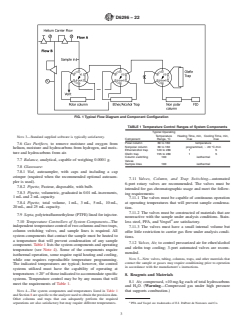
FIG. 1Typical Flow Diagram and Component Configuration
TABLE 1 Temperature Control Ranges of System Components
Typical Operating
Temperature Heating Time, min, Cooling Time, min,
NOTE 3—Standard supplied software is typically satisfactory.
Component Range, °C max max
Polar column 60 to 160 temperature
7.6 Gas Purifiers, to remove moisture and oxygen from
Nonpolar column 60 to 160 programmed, ; 20 °C ⁄min
helium, moisture and hydrocarbons from hydrogen, and mois-
Ether/alcohol trap 120 to 280 1 5
ture and hydrocarbons from air.
Olefin trap 155 to 280 1 5
Column switching 100 isothermal
7.7 Balance, analytical, capable of weighing 0.0001 g.
Valves
Sample lines 100 isothermal
7.8 Glassware:
7.8.1 Vial, autosampler, with caps and including a cap
crimper (required when the recommended optional autosam-
7.11 Valves, Column, and Trap Switching—automated
pler is used).
6-port rotary valves are recommended. The valves must be
7.8.2 Pipette, Pasteur, disposable, with bulb.
intended for gas chromatographic usage and meet the follow-
7.8.3 Pipette, volumetric, graduated in 0.01 mLincrements,
ing requirements:
1 mL and 2 mL capacity.
7.11.1 The valves must be capable of continuous operation
7.8.4 Pipette, total volume, 1 mL, 3 mL, 5 mL, 10 mL,
at operating temperatures that will prevent sample condensa-
20 mL, and 25 mL capacity.
tion.
7.11.2 The valves must be constructed of materials that are
7.9 Septa, polytetrafluoroethylene (PTFE) lined for injector.
nonreactive with the sample under analysis conditions. Stain-
7.10 Temperature Controllers of System Components—The
less steel, PFA, and Vespel are satisfactory.
independenttemperaturecontroloftwocolumnsandtwotraps,
7.11.3 The valves must have a small internal volume but
column switching valves, and sample lines is required. All
offer little restriction to carrier gas flow under analysis condi-
system components that contact the sample must be heated to
tions.
a temperature that will prevent condensation of any sample
7.12 Valves, Air, to control pressurized air for ether/alcohol
component. Table 1 lists the system components and operating
and olefin trap cooling; 3-port automated valves are recom-
temperature (see Note 4). Some of the components require
mended.
isothermal operation, some require rapid heating and cooling,
while one requires reproducible temperature programming. NOTE 5—New valves, tubing, columns, traps, and other materials that
contact the sample or gasses may require conditioning prior to operation
The indicated temperatures are typical; however, the control
in accordance with the manufacturer’s instructions.
systems utilized must have the capability of operating at
temperatures 620° of those indicated to accommodate specific
8. Reagents and Materials
systems. Temperature control may be by any means that will
8.1 Air, compressed, <10 mg⁄kg each of total hydrocarbons
meet the requirements of Table 1.
and H O. (Warning—Compressed gas under high pressure
NOTE 4—The system components and temperatures listed in Table 1 that supports combustion.)
andSection8arespecifictotheanalyzerusedtoobtaintheprecisiondata.
Other columns and traps that can adequately perform the required
separations are also satisfactory but may require different temperatures. PFA and Vespel are trademarks of E.I. DuPont de Nemours and Co.
D6296−22
TABLE 2 Set Up Mixtures TABLE 3 Calibration Standard 1 Containing MTBE
Mixture Approximate Component Density, kg/L Mass Percent Volume Percent
No. Component Concentrations, Pentene 0.6452 1.00 1.09
mass percent Hexene 0.6763 1.00 1.04
1 methyl-tert-butylether (MTBE) 5 Heptene 0.7009 1.00 1.00
isooctane 95 Octene 0.7186 1.00 0.98
Nonene 0.7329 1.00 0.96
2 ethyl-tert-butylether (ETBE) 5 Decene 0.7440 1.00 0.94
isooctane 95 Undecane 0.7438 1.00 0.94
Dodecane 0.7521 1.00 0.93
Isooctane 0.6985 87.00 87.41
MTBE 0.7451 5.00 4.71
Total 100.00 100.00
8.2 Helium, 99.999 % pure, <0.1 mg⁄kg HO(Warning—
Compressed gas under high pressure.)
8.3 Hydrogen, 99.999 % pure, <0.1 mg⁄kg H O
8.7 Calibration Standards—Quantitative synthetic mixtures
(Warning—Extremely flammable gas under high pressure.)
of pure hydrocarbons and ethers (Warning—Flammable.
8.4 2,2,4-trimethylpenane (isooctane), 99.99 % pure
Harmful if inhaled) are required to verify that the required
(Warning—Flammable. Harmful if inhaled.)
component separation is being achieved, to determine the
retention time of the olefins by carbon number, and to
8.5 Columns and Traps (System Components)—This test
determine the response factor on the FID for the olefins.
method requires the use of two chromatographic columns and
Examples of two mixtures, including densities of individual
two traps (see Note 4). Each system component is indepen-
components, are shown in Table 3 and Table 4. Calibration
dently temperature controlled as described in 7.10 and Table 1.
Standard 1 is used for all samples except those that contain
Refer to Fig. 1 for the location of the components in the
ETBE and Calibration Standard 2 is used for samples contain-
system. The following list of columns and traps contains
ing ETBE. When the oxygenate composition of samples is
guidelines that are to be used to judge suitability.
unknown, it can be determined using Test Method D4815,
8.5.1 Polar Column—At a temperature of 160 °C, this
D5599, or other test methods. Mixtures may be purchased or
column must retain all aromatic components in the sample and
prepared according to Practice D4307. The actual concentra-
eluteallnonaromaticcomponentsboilingbelow200 °C,which
tion levels are not critical but must be accurately known.
includes decene and lower boiling olefins, within 2 min after
Determine the density of the calibration standard by Test
sample injection.
Method D4052 or other test method.
8.5.1.1 This column must elute all aromatics and other
components retained from 8.5.1 within 8 min of when it is
8.8 Quality Control Sample, used to routinely monitor the
backflushed.
operation of the chromatographic system and to verify that
8.5.2 Ether/Alcohol Trap—At a temperature of 140 °C, this
reported concentrations are within the precision of the test
trap must retain alcohols and ethers and elute all non-
method.Asam
...
This document is not an ASTM standard and is intended only to provide the user of an ASTM standard an indication of what changes have been made to the previous version. Because
it may not be technically possible to adequately depict all changes accurately, ASTM recommends that users consult prior editions as appropriate. In all cases only the current version
of the standard as published by ASTM is to be considered the official document.
Designation: D6296 − 98 (Reapproved 2017) D6296 − 22
Standard Test Method for
Total Olefins in Spark-ignition Engine Fuels by
Multidimensional Gas Chromatography
This standard is issued under the fixed designation D6296; the number immediately following the designation indicates the year of
original adoption or, in the case of revision, the year of last revision. A number in parentheses indicates the year of last reapproval. A
superscript epsilon (´) indicates an editorial change since the last revision or reapproval.
1. Scope Scope*
1.1 This test method provides for the quantitative determination of total olefins in the C to C range in spark-ignition engine fuels
4 10
or related hydrocarbon streams, such as naphthas and cracked naphthas. Olefin concentrations in the range from 0.2 liquid-volume
%0.2 % by liquid-volume or mass % to 5.0 liquid-volume % or mass %, to 5.0 % by liquid-volume or mass, or both, can be
determined directly on the as-received sample whereas olefins in samples containing higher concentrations are determined after
appropriate sample dilution prior to analysis.
1.2 This test method is applicable to samples containing alcohols and ethers; however, samples containing greater than 15 %
alcohol must be diluted. Samples containing greater than 5.0 % ether must also be diluted to the 5.0 % or less level, prior to
analysis. When ethyl-tert-butylether is present, only olefins in the C to C range can be determined.
4 9
1.3 This test method can not be used to determine individual olefin components.
1.4 This test method can not be used to determine olefins having higher carbon numbers than C .
NOTE 1—Precision was determined only on samples containing MTBE and ethanol.
1.5 The values stated in SI units are to be regarded as standard. No other units of measurement are included in this standard.
1.6 This standard does not purport to address all of the safety concerns, if any, associated with its use. It is the responsibility
of the user of this standard to establish appropriate safety, health, and environmental practices and determine the applicability of
regulatory limitations prior to use.
1.7 This international standard was developed in accordance with internationally recognized principles on standardization
established in the Decision on Principles for the Development of International Standards, Guides and Recommendations issued
by the World Trade Organization Technical Barriers to Trade (TBT) Committee.
2. Referenced Documents
2.1 ASTM Standards:
D1319 Test Method for Hydrocarbon Types in Liquid Petroleum Products by Fluorescent Indicator Adsorption
This test method is under the jurisdiction of ASTM Committee D02 on Petroleum Products, Liquid Fuels, and Lubricantsand is the direct responsibility of Subcommittee
D02.04.0L on Gas Chromatography Methods.
Current edition approved Oct. 1, 2017April 1, 2022. Published November 2017May 2022. Originally approved in 1998. Last previous edition approved in 20132017 as
D6296 – 98 (2017).(2013). DOI: 10.1520/D6296-98R17.10.1520/D6296-22.
For referenced ASTM standards, visit the ASTM website, www.astm.org, or contact ASTM Customer Service at service@astm.org. For Annual Book of ASTM Standards
volume information, refer to the standard’s Document Summary page on the ASTM website.
*A Summary of Changes section appears at the end of this standard
Copyright © ASTM International, 100 Barr Harbor Drive, PO Box C700, West Conshohocken, PA 19428-2959. United States
D6296 − 22
D4052 Test Method for Density, Relative Density, and API Gravity of Liquids by Digital Density Meter
D4175 Terminology Relating to Petroleum Products, Liquid Fuels, and Lubricants
D4307 Practice for Preparation of Liquid Blends for Use as Analytical Standards
D4815 Test Method for Determination of MTBE, ETBE, TAME, DIPE, tertiary-Amyl Alcohol and C to C Alcohols in
1 4
Gasoline by Gas Chromatography
D5599 Test Method for Determination of Oxygenates in Gasoline by Gas Chromatography and Oxygen Selective Flame
Ionization Detection
E355 Practice for Gas Chromatography Terms and Relationships
E594 Practice for Testing Flame Ionization Detectors Used in Gas or Supercritical Fluid Chromatography
3. Terminology
3.1 This test method makes reference to common gas chromatographic procedures, terms, and relationships. Detailed definitions
of these can be found in Practices E355 and E594 and Terminology D4175.
3.2 Definitions of Terms Specific to This Standard:
3.2.1 trap, n—a device utilized to selectively retain specific portions (individual or groups of hydrocarbons or oxygenates) of the
test sample and to release the retained components by increasing the trap temperature.
3.3 Acronyms:
3.3.1 ETBE—ethyl-tert-butylether.
3.3.2 MTBE—methyl-tert–butylether.
4. Summary of Test Method
4.1 A reproducible 0.2 μL volume of a representative sample, or a dilution thereof, is introduced into a computer controlled gas
chromatographic system consisting of a series of columns, traps, and switching valves operating at various temperatures. The
valves are actuated at predetermined times to direct portions of the sample to appropriate columns and traps. The sample first
passes through a polar column that retains C + hydrocarbons, all aromatics, C + olefins, and some alcohols, all of which are
12 11
subsequently backflushed to vent. The fraction eluting from the polar column, which contains C and lower boiling saturated
hydrocarbons as well as decene and lower boiling olefins, enters an ether/alcohol trap where the ethers and alcohols are selectively
retained and also subsequently backflushed. The fraction eluting from the ether/alcohol trap, which consists of C and lower
boiling saturated hydrocarbons and the olefins, enters an olefin trap. The olefins are selectively retained while the saturated
hydrocarbons elute, pass through a nonpolar column, and are detected by a flame ionization detector (FID). When the saturated
hydrocarbons have completely eluted to the FID, the nonpolar column oven is cooled and the olefins, which have been retained
on the olefin trap, are desorbed by heating. The desorbed olefins enter and elute from the nonpolar column, which is temperature
programmed to separate the olefins by boiling point, and are detected by the FID.
NOTE 2—Separation of olefins by boiling point is necessary for the calculation of the volume %percent of the olefins because the density of low boiling
olefins differs from that of high boiling olefins and, therefore, a density correction must be applied.
4.2 Quantitation of the detected olefin peak areas to provide volume %percent or mass %,percent, or both, is accomplished through
the use of an external standard followed by the application of flame ionization detector response factors. The quantitation also takes
into consideration the baseline compensation, sample dilution, and density corrections.
5. Significance and Use
5.1 The quantitative determination of olefins in spark-ignition engine fuels is required to comply with government regulations.
5.2 Knowledge of the total olefin content provides a means to monitor the efficiency of catalytic cracking processes.
The sole source of supply of apparatus known to the committee at this time, the AC FTO Analyzer, is AC Analytical Controls, Inc., 3494 Progress Dr., Bensalem, PA
19020. If you are aware of alternative suppliers, please provide this information to ASTM Headquarters. Your comments will receive careful consideration at a meeting of
the responsible technical committee, which you may attend.
D6296 − 22
FIG. 1 Typical Flow Diagram and Component Configuration
5.3 This test method provides better precision for olefin content than Test Method D1319. It also provides data in a much shorter
time, approximately 20 min following calibration, and maximizes automation to reduce operator labor.
5.4 This test method is not applicable to M85 or E85 fuels, which contain 85 % methanol and ethanol, respectively.
6. Interferences
6.1 Some types of sulfur-containing compounds are irreversibly absorbed in the olefin and oxygenate traps ultimately reducing
the trap capacity. However, a variety of spark-ignition engine fuels have been analyzed without significant performance
deterioration of these traps.
6.2 Commercial dyes used to distinguish between grades and types of spark-ignition engine fuels have not been found to interfere
with this test method.
6.3 Commercial detergent additives utilized in spark-ignition engine fuels have not been found to interfere with this test method.
6.4 Dissolved water in spark-ignition engine fuels has not been found to interfere with this test method. Free water must be
removed using anhydrous sodium sulfate or other drying agent to permit injection of accurate sample volumes.
7. Apparatus
7.1 The complete system used to obtain the precision data is comprised of a computer controlled gas chromatograph, automated
sample injector, computer software, and specific hardware modifications. These modifications include columns, traps, and valves
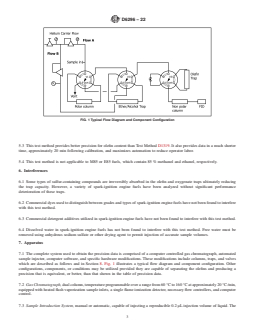
which are described as follows and in Section 8. Fig. 1 illustrates a typical flow diagram and component configuration. Other
configurations, components, or conditions may be utilized provided they are capable of separating the olefins and producing a
precision that is equivalent, or better, than that shown in the table of precision data.
7.2 Gas Chromatograph, dual column, temperature programmable over a range from 60 °C to 160 °C at approximately 20 °C ⁄min,
equipped with heated flash vaporization sample inlets, a single flame ionization detector, necessary flow controllers, and computer
control.
7.3 Sample Introduction System, manual or automatic, capable of injecting a reproducible 0.2 μL injection volume of liquid. The
D6296 − 22
TABLE 1 Temperature Control Ranges of System Components
Typical Operating
Temperature Heating Time, min, Cooling Time, min,
Component Range, °C max max
Polar column 60 to 160 temperature
Nonpolar column 60 to 160 programmed, ; 20 °C ⁄min
Ether/alcohol trap 120 to 280 1 5
Olefin trap 155 to 280 1 5
Column switching 100 isothermal
Valves
Sample lines 100 isothermal
total injected sample must be introduced to the chromatographic system, thus excluding the use of split injections or carrier gas
purging of the inlet septum. An auto injector is recommended but optional. The precision data was obtained using an automated
sample injector.
7.4 Gas Flow and Pressure Controllers, with adequate precision to provide reproducible flow and pressure of helium to the
chromatographic system, and hydrogen and air for the flame ionization detector. Control of air flow for rapid cooling of specific
system components and for automated valve operation is also required.
7.5 Electronic Data Acquisition System, must meet or exceed the following specifications (see Note 3):
7.5.1 Capacity for 150 peaks for each analysis,
7.5.2 External standard calculation of selected peaks with response factors and background correction,
7.5.3 Noise and spike rejection capability,
7.5.4 Sampling rate for fast (<4.0 s) peaks (>5 Hz to give 20 points across peak),
7.5.5 Peak width detection for narrow and broad peaks, and
7.5.6 Perpendicular drop.
NOTE 3—Standard supplied software is typically satisfactory.
7.6 Gas Purifiers, to remove moisture and oxygen from helium, moisture and hydrocarbons from hydrogen, and moisture and
hydrocarbons from air.
7.7 Balance, analytical, capable of weighing 0.0001 g.
7.8 Glassware:
7.8.1 Vial, autosampler, with caps and including a cap crimper (required when the recommended optional autosampler is used).
7.8.2 Pipette, Pasteur, disposable, with bulb.
7.8.3 Pipette, volumetric, graduated in 0.01 mL increments, 1 mL and 2 mL capacity.
7.8.4 Pipette, total volume, 1 mL, 3 mL, 5 mL, 10 mL, 20 mL, and 25 mL capacity.
7.9 Septa, polytetrafluoroethylene (PTFE) lined for injector.
7.10 Temperature Controllers of System Components—The independent temperature control of two columns and two traps,
column switching valves, and sample lines is required. All system components that contact the sample must be heated to a
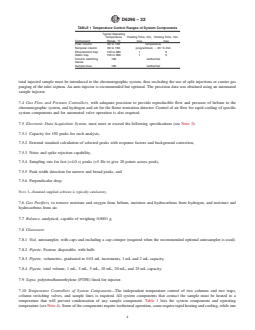
temperature that will prevent condensation of any sample component. Table 1 lists the system components and operating
temperature (see Note 4). Some of the components require isothermal operation, some require rapid heating and cooling, while one
D6296 − 22
requires reproducible temperature programming. The indicated temperatures are typical; however, the control systems utilized
must have the capability of operating at temperatures 620° of those indicated to accommodate specific systems. Temperature
control may be by any means that will meet the requirements of Table 1.
NOTE 4—The system components and temperatures listed in Table 1 and Section 8 are specific to the analyzer used to obtain the precision data. Other
columns and traps that can adequately perform the required separations are also satisfactory but may require different temperatures.
7.11 Valves, Column, and Trap Switching—automated 6-port rotary valves are recommended. The valves must be intended for gas
chromatographic usage and meet the following requirements:
7.11.1 The valves must be capable of continuous operation at operating temperatures that will prevent sample condensation.
7.11.2 The valves must be constructed of materials that are nonreactive with the sample under analysis conditions. Stainless steel,
PFA, and Vespel are satisfactory.
7.11.3 The valves must have a small internal volume but offer little restriction to carrier gas flow under analysis conditions.
7.12 Valves, Air, to control pressurized air for ether/alcohol and olefin trap cooling; 3-port automated valves are recommended.
NOTE 5—New valves, tubing, columns, traps, and other materials that contact the sample or gasses may require conditioning prior to operation in
accordance with the manufacturer’s instructions.
8. Reagents and Materials
8.1 Air, compressed, <10 mg ⁄kg each of total hydrocarbons and H O. (Warning—Compressed gas under high pressure that
supports combustion.)
8.2 Helium, 99.999 % pure, <0.1 mg ⁄kg H O (Warning—Compressed gas under high pressure.)
8.3 Hydrogen, 99.999 % pure, <0.1 mg ⁄kg H O (Warning—Extremely flammable gas under high pressure.)
8.4 2,2,4-trimethylpenane (isooctane), 99.99 % pure (Warning—Flammable. Harmful if inhaled.)
8.5 Columns and Traps (System Components)—This test method requires the use of two chromatographic columns and two traps
(see Note 4). Each system component is independently temperature controlled as described in 7.10 and Table 1. Refer to Fig. 1
for the location of the components in the system. The following list of columns and traps contains guidelines that are to be used
to judge suitability.
8.5.1 Polar Column—At a temperature of 160 °C, this column must retain all aromatic components in the sample and elute all
nonaromatic components boiling below 200 °C, which includes decene and lower boiling olefins, within 2 min after sample
injection.
8.5.1.1 This column must elute all aromatics and other components retained from 8.5.1 within 8 min of when it is backflushed.
8.5.2 Ether/Alcohol Trap—At a temperature of 140 °C, this trap must retain alcohols and ethers and elute all non-oxygenates
boiling below 200 °C within 4.5 min to 5.0 min after sample injection.
8.5.2.1 At a temperature of 280 °C, this trap must elute all retained components.
8.5.3 Olefin Trap—Within a temperature range from 140 °C to 165 °C, this trap must quantitatively retain (trap) all olefins in the
C to C range for at least 10 min after sample injection while eluting all non-olefin components boiling below 200 °C.
4 10
8.5.3.1 At a temperature of 280 °C, this trap must quantitatively elute all trapped olefins.
PFA and Vespel are trademarks of E.I. DuPont de Nemours and Co.
D6296 − 22
TABLE 2 Set Up Mixtures
Mixture Approximate
No. Component Concentrations,
mass %
No. Component Concentrations,
mass percent
1 methyl-tert-butylether (MTBE) 5
isooctane 95
2 ethyl-tert-butylether (ETBE) 5
isooctane 95
8.5.4 Nonpolar Column—At a temperature of 160 °C, this column must elute paraffins and naphthenes through C within 2 min.
8.5.4.1 This column must distribute the C through C olefins by carbon number when temperature programmed from 60 °C to
4 10
160 °C at approximately 20 °C ⁄min.
8.6 Set Up Mixtures—Two qualitative synthetic mixtures containing isooctane and ethers are required to verify that all instrument
components, temperatures, and cut times are satisfactory to produce accurate analyses and to aid in making operating adjustments
as columns and traps age. The composition of these mixtures and approximate component concentrations are shown in Table 2.
The mixtures may be purchased or prepared according to Practice D4307. (Warning—Flammable. Harmful if inhaled.)
8.7 Calibration Standards—Quantitative synthetic mixtures of pure hydrocarbons and ethers (Warning—Flammable. Harmful if
inhaled) are required to verify that the required component separation is being achieved, to determine the retention time of the
olefins by carbon number, and to determine the response factor on the FID for the olefins. Examples of two mixtures, including
densities of individual components, are shown in Table 3
...