

ASTM E2618-13(2019)
(Test Method)Standard Test Method for Measurement of Particulate Emissions and Heating Efficiency of Solid Fuel-Fired Hydronic Heating Appliances
General Information
- Abstract
SIGNIFICANCE AND USE
5.1 The measurement of particulate matter emission rates is an important test method widely used in the practice of air pollution control.
5.1.1 These measurements, when approved by federal or state agencies, are often required for the purpose of determining compliance with regulations and statutes.
5.1.2 The measurements made before and after design modifications are necessary to demonstrate the effectiveness of design changes in reducing emissions and make this standard an important tool in manufacturer’s research and development programs.
5.2 Measurement of heating efficiency provides a uniform basis for comparison of product performance that is useful to the consumer. It is also required to relate emissions produced to the useful heat production.
5.3 This is a laboratory method and is not intended to be fully representative of all actual field use. It is recognized that users of hand-fired wood burning equipment have a great deal of influence over the performance of any wood-burning appliance. Some compromises in realism have been made in the interest of providing a reliable and repeatable test method.
SCOPE
1.1 This test method applies to wood-fired or automatically fed biomass burning hydronic heating appliances. These appliances transfer heat to the indoor environment through circulation of a liquid heat exchange media such as water or a water-antifreeze mixture.
1.2 The test method simulates hand loading of seasoned cordwood or fueling with a specified biomass fuel and measures particulate emissions and delivered heating efficiency at specified heat output rates based on the appliance’s rated heating capacity.
1.3 Particulate emissions are measured by the dilution tunnel method as specified in Test Method E2515. Delivered efficiency is determined by measurement of the usable heat output (determined through measurement of the flow rate and temperature change of water circulated through a heat exchanger external to the appliance) and the heat input (determined from the mass of dry fuel burned and its higher heating value). Delivered efficiency does not attempt to account for pipeline loss.
1.4 Products covered by this test method include both pressurized and non-pressurized heating appliances intended to be fired with wood or automatically fed biomass fuels. These products are hydronic heating appliances which the manufacturer specifies for outdoor or indoor installation. They are often connected to a heat exchanger by insulated pipes and normally include a pump to circulate heated liquid. They are used to heat structures such as homes, barns, and greenhouses and can heat domestic hot water, spas, or swimming pools.
1.4.1 Hydronic heating systems that incorporate a high mass heat storage system that is capable of storing the entire heat output of a standard fuel load are tested by the procedure specified in Annex A1. Systems that incorporate high mass heat storage capable of storing a portion of the output from a standard fuel load are tested by the procedure specified in Annex A2.
1.5 Distinguishing features of products covered by this standard include:
1.5.1 Manufacturers specify indoor or outdoor installation.
1.5.2 A firebox with an access door for hand loading of fuel or a hopper and automated feed system for delivery of particulate fuel such as wood pellets or solid biomass fuel to a burn pot or combustion chamber.
1.5.3 Typically a thermostatic control device that controls combustion air supply or fuel delivery, or both, to maintain the liquid in the appliance within a predetermined temperature range provided sufficient fuel is available in the firebox or hopper.
1.5.4 A chimney or vent that exhausts combustion products from the appliance.
1.6 The values stated in inch-pound units are to be regarded as standard. The values given in parentheses are mathematical conversions to SI units that are provided for information only and are not con...
- Status
- Published
- Publication Date
- 30-Jun-2019
- Technical Committee
- E06 - Performance of Buildings
- Drafting Committee
- E06.54 - Solid Fuel Burning Appliances
Overview
ASTM E2618-13(2019) provides a standardized laboratory test method for measuring particulate emissions and heating efficiency of solid fuel-fired hydronic heating appliances. Developed by ASTM International, this standard applies to both wood-fired and automatically fed biomass-burning appliances that transfer heat to indoor spaces via the circulation of a liquid heat exchange medium, such as water or a water-antifreeze mixture. The primary objectives are to quantify the particulate matter emissions and delivered heating efficiency, supporting regulatory compliance, product development, and consumer information needs connected with hydronic heating systems.
Key Topics
- Particulate Emissions Testing: The standard outlines procedures for measuring particulate emissions using the dilution tunnel method. This approach is consistent with air pollution control practices and is referenced by other recognized standards such as ASTM E2515.
- Heating Efficiency Measurement: Efficiency is determined by monitoring the usable heat output delivered via circulated water and comparing it to the energy content of the fuel burned, measured on a dry basis. This allows for a direct comparison of appliance performance, which is especially valuable for consumers comparing different makes and models.
- Applicability: The method applies to both pressurized and non-pressurized appliances fueled by wood or biomass, suitable for indoor or outdoor installations. It accounts for systems with and without high mass heat storage capability.
- Uniform Test Basis: The procedure simulates typical operating cycles, including hand-loading with seasoned cordwood or automatic fueling, to reflect real-world operation within a controlled and repeatable laboratory environment.
- Regulatory Support: The results generated using this standard are often required by federal and state agencies for compliance with emissions regulations and statutes-vital for manufacturers and regulatory agencies.
Applications
ASTM E2618-13(2019) is widely used in the following practical contexts:
- Air Pollution Control: Regulatory agencies and third-party testing labs rely on this method to assess compliance with emissions standards for residential and commercial hydronic heating systems, helping to minimize environmental impact.
- Product Certification: Manufacturers employ the standard during research and development to evaluate the effects of design modifications on particulate emissions and efficiency, supporting certification and eco-labeling programs.
- Consumer Information: By providing a consistent measure of heating efficiency, the standard enables end-users to make informed purchase decisions based on clear, comparative data.
- System Optimization: The data produced helps engineers and installers match appliance capacity and performance to building requirements-important for optimizing system design for homes, barns, greenhouses, and domestic hot water heating applications.
- Quality Assurance and Design Improvements: The repeatable nature of the test supports continuous improvement processes within manufacturing environments.
Related Standards
ASTM E2618-13(2019) references and is complemented by several other key standards:
- ASTM E2515 - Test Method for Determination of Particulate Matter Emissions Collected by a Dilution Tunnel, which defines critical aspects of particulate measurement.
- CAN/CSA-B415.1-2010 - Performance Testing of Solid-Fuel-Burning Heating Appliances, referenced for certain measurement and equipment calibration procedures.
- ASME Pressure Vessel Code and EN303-5 - Pertinent for aspects of system pressurization and vessel safety requirements.
- ASTM D4442 - Methods for measuring wood moisture content, important for fuel preparation.
- ASTM E711 - Test Method for Gross Calorific Value of Refuse-Derived Fuel (for higher heating value determination).
- ASTM E631 - Terminology of Building Constructions, ensuring consistent technical language.
These referenced standards ensure that all testing and measurements align with internationally recognized principles, as established by the World Trade Organization’s Technical Barriers to Trade (TBT) Committee.
Keywords: ASTM E2618, hydronic heating appliances, particulate emissions testing, heating efficiency, biomass heating, wood-fired heating, air pollution control, standard test methods, heating appliance certification, regulatory compliance.
Relations
- Effective Date
- 01-Jul-2019
- Effective Date
- 01-Mar-2020
- Effective Date
- 01-Sep-2017
- Effective Date
- 15-Nov-2016
- Effective Date
- 01-Jun-2015
- Effective Date
- 01-Mar-2015
- Effective Date
- 01-Nov-2014
- Effective Date
- 01-Nov-2011
- Effective Date
- 01-Sep-2010
- Effective Date
- 01-May-2009
- Effective Date
- 15-Nov-2007
- Effective Date
- 01-May-2007
- Effective Date
- 01-Jun-2006
- Effective Date
- 28-Jul-2000
- Effective Date
- 10-Mar-1997
Get Certified
Connect with accredited certification bodies for this standard

DIBt (Deutsches Institut für Bautechnik)
German Institute for Building Technology.
DIN CERTCO
DIN Group product certification.

Aboma Certification B.V.
Specialized in construction, metal, and transport sectors.
Sponsored listings
Frequently Asked Questions
ASTM E2618-13(2019) is a standard published by ASTM International. Its full title is "Standard Test Method for Measurement of Particulate Emissions and Heating Efficiency of Solid Fuel-Fired Hydronic Heating Appliances". This standard covers: SIGNIFICANCE AND USE 5.1 The measurement of particulate matter emission rates is an important test method widely used in the practice of air pollution control. 5.1.1 These measurements, when approved by federal or state agencies, are often required for the purpose of determining compliance with regulations and statutes. 5.1.2 The measurements made before and after design modifications are necessary to demonstrate the effectiveness of design changes in reducing emissions and make this standard an important tool in manufacturer’s research and development programs. 5.2 Measurement of heating efficiency provides a uniform basis for comparison of product performance that is useful to the consumer. It is also required to relate emissions produced to the useful heat production. 5.3 This is a laboratory method and is not intended to be fully representative of all actual field use. It is recognized that users of hand-fired wood burning equipment have a great deal of influence over the performance of any wood-burning appliance. Some compromises in realism have been made in the interest of providing a reliable and repeatable test method. SCOPE 1.1 This test method applies to wood-fired or automatically fed biomass burning hydronic heating appliances. These appliances transfer heat to the indoor environment through circulation of a liquid heat exchange media such as water or a water-antifreeze mixture. 1.2 The test method simulates hand loading of seasoned cordwood or fueling with a specified biomass fuel and measures particulate emissions and delivered heating efficiency at specified heat output rates based on the appliance’s rated heating capacity. 1.3 Particulate emissions are measured by the dilution tunnel method as specified in Test Method E2515. Delivered efficiency is determined by measurement of the usable heat output (determined through measurement of the flow rate and temperature change of water circulated through a heat exchanger external to the appliance) and the heat input (determined from the mass of dry fuel burned and its higher heating value). Delivered efficiency does not attempt to account for pipeline loss. 1.4 Products covered by this test method include both pressurized and non-pressurized heating appliances intended to be fired with wood or automatically fed biomass fuels. These products are hydronic heating appliances which the manufacturer specifies for outdoor or indoor installation. They are often connected to a heat exchanger by insulated pipes and normally include a pump to circulate heated liquid. They are used to heat structures such as homes, barns, and greenhouses and can heat domestic hot water, spas, or swimming pools. 1.4.1 Hydronic heating systems that incorporate a high mass heat storage system that is capable of storing the entire heat output of a standard fuel load are tested by the procedure specified in Annex A1. Systems that incorporate high mass heat storage capable of storing a portion of the output from a standard fuel load are tested by the procedure specified in Annex A2. 1.5 Distinguishing features of products covered by this standard include: 1.5.1 Manufacturers specify indoor or outdoor installation. 1.5.2 A firebox with an access door for hand loading of fuel or a hopper and automated feed system for delivery of particulate fuel such as wood pellets or solid biomass fuel to a burn pot or combustion chamber. 1.5.3 Typically a thermostatic control device that controls combustion air supply or fuel delivery, or both, to maintain the liquid in the appliance within a predetermined temperature range provided sufficient fuel is available in the firebox or hopper. 1.5.4 A chimney or vent that exhausts combustion products from the appliance. 1.6 The values stated in inch-pound units are to be regarded as standard. The values given in parentheses are mathematical conversions to SI units that are provided for information only and are not con...
SIGNIFICANCE AND USE 5.1 The measurement of particulate matter emission rates is an important test method widely used in the practice of air pollution control. 5.1.1 These measurements, when approved by federal or state agencies, are often required for the purpose of determining compliance with regulations and statutes. 5.1.2 The measurements made before and after design modifications are necessary to demonstrate the effectiveness of design changes in reducing emissions and make this standard an important tool in manufacturer’s research and development programs. 5.2 Measurement of heating efficiency provides a uniform basis for comparison of product performance that is useful to the consumer. It is also required to relate emissions produced to the useful heat production. 5.3 This is a laboratory method and is not intended to be fully representative of all actual field use. It is recognized that users of hand-fired wood burning equipment have a great deal of influence over the performance of any wood-burning appliance. Some compromises in realism have been made in the interest of providing a reliable and repeatable test method. SCOPE 1.1 This test method applies to wood-fired or automatically fed biomass burning hydronic heating appliances. These appliances transfer heat to the indoor environment through circulation of a liquid heat exchange media such as water or a water-antifreeze mixture. 1.2 The test method simulates hand loading of seasoned cordwood or fueling with a specified biomass fuel and measures particulate emissions and delivered heating efficiency at specified heat output rates based on the appliance’s rated heating capacity. 1.3 Particulate emissions are measured by the dilution tunnel method as specified in Test Method E2515. Delivered efficiency is determined by measurement of the usable heat output (determined through measurement of the flow rate and temperature change of water circulated through a heat exchanger external to the appliance) and the heat input (determined from the mass of dry fuel burned and its higher heating value). Delivered efficiency does not attempt to account for pipeline loss. 1.4 Products covered by this test method include both pressurized and non-pressurized heating appliances intended to be fired with wood or automatically fed biomass fuels. These products are hydronic heating appliances which the manufacturer specifies for outdoor or indoor installation. They are often connected to a heat exchanger by insulated pipes and normally include a pump to circulate heated liquid. They are used to heat structures such as homes, barns, and greenhouses and can heat domestic hot water, spas, or swimming pools. 1.4.1 Hydronic heating systems that incorporate a high mass heat storage system that is capable of storing the entire heat output of a standard fuel load are tested by the procedure specified in Annex A1. Systems that incorporate high mass heat storage capable of storing a portion of the output from a standard fuel load are tested by the procedure specified in Annex A2. 1.5 Distinguishing features of products covered by this standard include: 1.5.1 Manufacturers specify indoor or outdoor installation. 1.5.2 A firebox with an access door for hand loading of fuel or a hopper and automated feed system for delivery of particulate fuel such as wood pellets or solid biomass fuel to a burn pot or combustion chamber. 1.5.3 Typically a thermostatic control device that controls combustion air supply or fuel delivery, or both, to maintain the liquid in the appliance within a predetermined temperature range provided sufficient fuel is available in the firebox or hopper. 1.5.4 A chimney or vent that exhausts combustion products from the appliance. 1.6 The values stated in inch-pound units are to be regarded as standard. The values given in parentheses are mathematical conversions to SI units that are provided for information only and are not con...
ASTM E2618-13(2019) is classified under the following ICS (International Classification for Standards) categories: 91.140.10 - Central heating systems. The ICS classification helps identify the subject area and facilitates finding related standards.
ASTM E2618-13(2019) has the following relationships with other standards: It is inter standard links to ASTM E2618-13, ASTM D4442-20, ASTM E2515-11(2017), ASTM D4442-16, ASTM D4442-15, ASTM E631-15, ASTM E631-14, ASTM E2515-11, ASTM E2515-10, ASTM E2515-09, ASTM D4442-07, ASTM E2515-07, ASTM E631-06, ASTM E631-93a(1998)e1, ASTM D4442-92(1997)e1. Understanding these relationships helps ensure you are using the most current and applicable version of the standard.
ASTM E2618-13(2019) is available in PDF format for immediate download after purchase. The document can be added to your cart and obtained through the secure checkout process. Digital delivery ensures instant access to the complete standard document.
Standards Content (Sample)
This international standard was developed in accordance with internationally recognized principles on standardization established in the Decision on Principles for the
Development of International Standards, Guides and Recommendations issued by the World Trade Organization Technical Barriers to Trade (TBT) Committee.
Designation: E2618 − 13 (Reapproved 2019)
Standard Test Method for
Measurement of Particulate Emissions and Heating
Efficiency of Solid Fuel-Fired Hydronic Heating Appliances
This standard is issued under the fixed designation E2618; the number immediately following the designation indicates the year of
original adoption or, in the case of revision, the year of last revision. A number in parentheses indicates the year of last reapproval. A
superscript epsilon (´) indicates an editorial change since the last revision or reapproval.
1. Scope output of a standard fuel load are tested by the procedure
specified in Annex A1. Systems that incorporate high mass
1.1 This test method applies to wood-fired or automatically
heat storage capable of storing a portion of the output from a
fed biomass burning hydronic heating appliances. These appli-
standard fuel load are tested by the procedure specified in
ances transfer heat to the indoor environment through circula-
Annex A2.
tion of a liquid heat exchange media such as water or a
water-antifreeze mixture.
1.5 Distinguishing features of products covered by this
standard include:
1.2 The test method simulates hand loading of seasoned
cordwood or fueling with a specified biomass fuel and mea-
1.5.1 Manufacturers specify indoor or outdoor installation.
sures particulate emissions and delivered heating efficiency at
1.5.2 Afirebox with an access door for hand loading of fuel
specified heat output rates based on the appliance’s rated
or a hopper and automated feed system for delivery of
heating capacity.
particulate fuel such as wood pellets or solid biomass fuel to a
burn pot or combustion chamber.
1.3 Particulate emissions are measured by the dilution
tunnel method as specified in Test Method E2515. Delivered
1.5.3 Typically a thermostatic control device that controls
efficiency is determined by measurement of the usable heat
combustion air supply or fuel delivery, or both, to maintain the
output (determined through measurement of the flow rate and
liquid in the appliance within a predetermined temperature
temperature change of water circulated through a heat ex-
range provided sufficient fuel is available in the firebox or
changer external to the appliance) and the heat input (deter-
hopper.
mined from the mass of dry fuel burned and its higher heating
1.5.4 Achimney or vent that exhausts combustion products
value). Delivered efficiency does not attempt to account for
from the appliance.
pipeline loss.
1.6 The values stated in inch-pound units are to be regarded
1.4 Products covered by this test method include both
as standard. The values given in parentheses are mathematical
pressurizedandnon-pressurizedheatingappliancesintendedto
conversions to SI units that are provided for information only
be fired with wood or automatically fed biomass fuels. These
and are not considered standard.
products are hydronic heating appliances which the manufac-
1.6.1 Exception—Metric units are used in 13.1, 13.4.3,
turerspecifiesforoutdoororindoorinstallation.Theyareoften
Tables 4-6, and A1.11.6.
connected to a heat exchanger by insulated pipes and normally
includeapumptocirculateheatedliquid.Theyareusedtoheat
1.7 This standard does not purport to address all of the
structures such as homes, barns, and greenhouses and can heat
safety concerns, if any, associated with its use. It is the
domestic hot water, spas, or swimming pools.
responsibility of the user of this standard to establish appro-
1.4.1 Hydronicheatingsystemsthatincorporateahighmass
priate safety, health, and environmental practices and deter-
heat storage system that is capable of storing the entire heat
mine the applicability of regulatory limitations prior to use.
1.8 This international standard was developed in accor-
dance with internationally recognized principles on standard-
This test method is under the jurisdiction of ASTM Committee E06 on
Performance of Buildings and is the direct responsibility of Subcommittee E06.54
ization established in the Decision on Principles for the
on Solid Fuel Burning Appliances.
Development of International Standards, Guides and Recom-
Current edition approved July 1, 2019. Published July 2019. Originally approved
mendations issued by the World Trade Organization Technical
in 2008. Last previous edition approved in 2013 as E2618–13. DOI: 10.1520/
E2618–13R19. Barriers to Trade (TBT) Committee.
Copyright © ASTM International, 100 Barr Harbor Drive, PO Box C700, West Conshohocken, PA 19428-2959. United States
E2618 − 13 (2019)
2. Referenced Documents 3.2.6 overall effıciency, also known as stack loss
2 effıciency—The efficiency for each test run as determined using
2.1 ASTM Standards:
the CSA B415.1-2010 Stack Loss Method (SLM)
D4442 Test Methods for Direct Moisture Content Measure-
ment of Wood and Wood-Based Materials 3.2.7 test fuel charge—a full load of fuel as specified in
E631 Terminology of Building Constructions Section 12 placed in the appliance at the start of the emission
E711 Test Method for Gross Calorific Value of Refuse- test run or the mass of fuel consumed by automatically fed
Derived Fuel by the Bomb Calorimeter (Withdrawn appliance during a test run.
2011)
3.2.8 test run—an individual emission test which encom-
E2515 Test Method for Determination of Particulate Matter
passes the time required to consume the mass of the test fuel
Emissions Collected by a Dilution Tunnel
charge.
2.2 Other Standards:
3.2.9 thermostatic control—a control device that opens,
CAN/CSA-B415.1-2010 PerformanceTestingofSolid-Fuel-
closes or modulates a circuit to control the rate of fuel
Burning Heating Appliances
consumption in response to the temperature of the heating
ASME Pressure Vessel Code
media in the heating appliance.
EN303–5 Pressure Vessel Code
NIST Traceable Methods
4. Summary of Test Method
2.3 Other Document:
Monograph 175 Temperature-Electromotive Force Refer-
4.1 Dilution Tunnel—Emissions are determined using the
ence Functions and Tables for the Letter-Designated
“dilution tunnel” method specified in Test Method E2515. The
Thermocouple Types Based on the ITS-90
flow rate in the dilution tunnel is maintained at a constant level
throughout the test cycle and accurately measured. Samples of
3. Terminology
the dilution tunnel flow stream are extracted at a constant flow
3.1 Definitions—Definitions are in accordance with Termi-
rate and drawn through high efficiency filters. The filters are
nology E631, unless otherwise indicated.
dried and weighed before and after the test to determine the
particulate emissions catch and this value is multiplied by the
3.2 Definitions of Terms Specific to This Standard:
ratio of tunnel flow to filter flow to determine the total
3.2.1 burn rate—the rate at which test fuel is consumed in
emissions produced in the test cycle.
an appliance measured in kilograms or pounds of fuel (dry
basis) per hour.
4.2 Effıciency:
3.2.2 delivered effıciency—the percentage of heat available
4.2.1 Delivered Effıciency—The efficiency test procedure
inatestfuelchargethatisdeliveredtoasimulatedheatingload
takes advantage of the fact that this type of appliance delivers
as specified in this test method. This test does not account for
heat through circulation of the heated liquid (water) from the
jacket losses or for transfer line losses which will vary with
appliance to a remote heat exchanger and back to the appli-
actual application.
ance. Measurements of the water temperature difference as it
enters and exits the heat exchanger along with the measured
3.2.3 firebox—thechamberintheapplianceinwhichthetest
flow rate allow for an accurate determination of the useful heat
fuel charge is placed and combusted.
output of the appliance. The input is determined by weight of
3.2.4 hydronic heating—a heating system in which a heat
the test fuel charge, adjusted for moisture content, multiplied
source supplies energy to a liquid heat exchange media such as
by the higher heating value. Additional measurements of the
water that is circulated to a heating load and returned to the
appliance weight and temperature at the beginning and end of
heat source through pipes.
a test cycle are used to correct for heat stored in the appliance.
3.2.5 manufacturer’s rated heat output capacity—the value
4.2.2 Overall Effıciency—OverallEfficiency(SLM)isdeter-
in Btu/h (MJ/h) that the manufacturer specifies a particular
minedusingtheCSAB415.1-2010StackLossMethodfordata
model of hydronic heating appliance is capable of supplying at
quality assurance purposes.
its design capacity as verified by testing, in accordance with
Section 12. 4.3 Operation—Appliance operation is conducted on a hot-
to-hot test cycle meaning that the appliance is brought to
operating temperature and a coal bed is established prior to the
For referenced ASTM standards, visit the ASTM website, www.astm.org, or
contact ASTM Customer Service at service@astm.org. For Annual Book of ASTM addition of the test fuel charge and measurements are made for
Standards volume information, refer to the standard’s Document Summary page on
each test fuel charge cycle. The measurements are made under
the ASTM website.
constantheatdrawconditionswithinpredeterminedranges.No
The last approved version of this historical standard is referenced on
attempt is made to modulate the heat demand to simulate an
www.astm.org.
Available from Canadian Standards Association (CSA), 178 Rexdale Blvd.,
indoor thermostat cycling on and off in response to changes in
Toronto, ON M9W 1R3, Canada, http://www.csagroup.org.
the indoor environment. Four test categories are used. These
Available from American Society of Mechanical Engineers (ASME), ASME
are:
International Headquarters, Two Park Ave., New York, NY 10016-5990, http://
www.asme.org. 4.3.1 Category I—A heat output of 15 % or less of Manu-
Available from European Committee for Standardization (CEN), Avenue
facturer’s Rated Heat Output Capacity.
Marnix 17, B-1000, Brussels, Belgium, http://www.cen.eu.
4.3.2 Category II—A heat output of 16 to 24 % of Manu-
Available from National Institute of Standards and Technology (NIST), 100
Bureau Dr., Stop 1070, Gaithersburg, MD 20899-1070, http://www.nist.gov. facturer’s Rated Heat Output Capacity.
E2618 − 13 (2019)
4.3.3 Category III—A heat output of 25 to 50 % of Manu- 6.6 Water Temperature Measurement—Thermocouples or
facturer’s Rated Heat Output Capacity. other temperature sensors to measure the water temperature at
4.3.4 Category IV—Manufacturer’s Rated Heat Output Ca- the inlet and outlet of the load side of the heat exchanger. Must
pacity. meet the calibration requirements specified in 10.1.
6.7 Wood Moisture Meter—Calibrated electrical resistance
5. Significance and Use
meter capable of measuring test fuel moisture to within 2 %
5.1 The measurement of particulate matter emission rates is
moisture content. Must meet the calibration requirements
an important test method widely used in the practice of air
specified in 10.4.
pollution control.
6.8 Flue Gas Temperature Measurement—Must meet the
5.1.1 These measurements, when approved by federal or
requirements of CSA B415.1-2010, Clause 6.2.2.
state agencies, are often required for the purpose of determin-
ing compliance with regulations and statutes.
6.9 Test Room Temperature Measurement—Must meet the
5.1.2 The measurements made before and after design
requirements of CSA B415.1-2010, Clause 6.2.1.
modifications are necessary to demonstrate the effectiveness of
6.10 Flue Gas Composition Measurement—Must meet the
design changes in reducing emissions and make this standard
requirements of CSA B415.1-2010, Clauses 6.3.1 through
an important tool in manufacturer’s research and development
6.3.3.
programs.
7. Hazards
5.2 Measurement of heating efficiency provides a uniform
basis for comparison of product performance that is useful to
7.1 These tests involve combustion of solid fuel and sub-
theconsumer.Itisalsorequiredtorelateemissionsproducedto
stantial release of heat and products of combustion. The
the useful heat production.
heating system also produces large quantities of very hot water
and the potential for steam production and system pressuriza-
5.3 This is a laboratory method and is not intended to be
tion. Pressurized (closed system) appliances must include an
fully representative of all actual field use. It is recognized that
appropriately ratedAmerican Society of Mechanical Engineers
users of hand-fired wood burning equipment have a great deal
(ASME) pressure relief device and a pressure vessel that
of influence over the performance of any wood-burning appli-
complies with the ASME Pressure Vessel Code or EN303-5
ance. Some compromises in realism have been made in the
pressure vessel code. Alternatively, a pressure vessel may be
interest of providing a reliable and repeatable test method.
installedopentotheatmospherewithastandpipeifallowedby
6. Apparatus
the manufacturer’s installation instructions. Appropriate pre-
cautions must be taken to protect personnel from burn hazards
6.1 Scale—A platform scale capable of weighing the appli-
and respiration of products of combustion.
ance under test and associated parts and accessories when
completely filled with water to an accuracy of 61.0 lb (60.5
8. Sampling, Test Specimens, and Test Appliances
kg).
8.1 Test specimens shall be supplied as complete appliances
6.2 Heat Exchanger—A water-to-water heat exchanger ca-
including all controls and accessories necessary for installation
pable of dissipating the expected heat output from the system
in the test facility. A full set of specifications and design and
under test.
assembly drawings shall be provided when the product is to be
6.3 Water Temperature Difference Measurement—AType-T
placed under certification of a third-party agency. The manu-
“special limits” thermopile with a minimum of five pairs of
facturer’s written installation and operating instructions are to
junctionsshallbeusedtomeasurethetemperaturedifferencein
be used as a guide in the set up and testing of the appliance.
waterenteringandleavingtheheatexchanger.Thetemperature
9. Preparation of Apparatus
difference measurement uncertainty of this type of thermopile
is equal to or less than 60.50 °F (60.25 °C). Other tempera-
9.1 The appliance is to be placed on a scale capable of
ture measurement methods may be used if the temperature
weighing the appliance fully loaded with a resolution of 61.0
difference measurement uncertainty is equal to or less than
lb (60.5 kg).
60.50 °F (60.25 °C).
9.2 The appliance shall be fitted with the type of chimney
6.4 Load Side Water Flow Meter—Awater flow meter shall
recommendedorprovidedbythemanufactureandextendingto
be installed in the inlet to the load side of the heat exchanger.
15 6 0.5 ft (4.6 6 0.15 m) from the upper surface of the scale.
The flow meter shall have an accuracy of 61 % of measured
If no flue or chimney system is recommended or provided
flow.
connect the appliance to a flue of a diameter equal to the flue
6.4.1 Optional Appliance Side Water Flow Meter—A water
outlet of the appliance and extending 15 6 0.5 ft (4.6 6 0.15
flow meter with an accuracy of 61 % of the flow rate is
m) from the top of the scale. For flue systems not provided by
recommended but not required to monitor appliance side water
themanufacturer,thefluesectionfromtheappliancefluecollar
flow rate to the heat exchanger.
to 8 6 0.5 ft (2.44 6 0.15 m) above the scale shall be single
6.5 Recirculation Pump—Optional circulating pump used wall stove pipe and the remainder of the flue shall be double
during test to prevent stratification of liquid being heated. wall insulated Class A chimney.
E2618 − 13 (2019)
9.3 Optional Equipment Installation: 9.5.5 Place the heat exchanger in a box with 2 in. (51 mm)
9.3.1 The manufacturer may request that a recirculation of expanded polystyrene (EPS) foam insulation surrounding it
pump be installed between connections at the top and bottom to minimize heat losses from the heat exchanger.
of the appliance to minimize thermal stratification. The pump 9.5.6 The reported efficiency and heat output rate shall be
shall not be installed in such a way as to change or affect the
based on measurements made on the load side of the heat
flow rate between the appliance and the heat exchanger. exchanger. (See Fig. 1.)
9.3.2 If the manufacturer specifies that a thermal control
9.6 Temperature instrumentation shall be installed in the
valve or other device be installed and set to control the return
output and return lines from the appliance (supply side). The
water temperature to a specific set point, the valve or other
average of the outlet and return water temperature on the
device shall be installed and set per the manufacturer’s written
supply side of the system shall be considered the average
instructions.
appliance temperature for calculation of heat storage in the
9.4 Prior to filling the tank, weigh and record the appliance
appliance (TF and TI ). Installation of a water flow meter
avg avg
mass.
in the appliance (supply) side of the system is optional.
9.5 Heat Exchanger Temperature, Differential Temperature
9.7 Fillthesystemwithwater.Determinethetotalweightof
and Water Flow Instrumentation:
the water in the appliance when the water is circulating. Verify
9.5.1 Plumb the unit to a water-to-water heat exchanger
that the scale indicates a stable weight under operating condi-
with sufficient capacity to draw off heat at the maximum rate
tions. Make sure air is purged properly.
anticipated. Route hoses and electrical cables and instrument
wires in a manner that does not influence the weighing
10. Calibration and Standardization
accuracy of the scale as indicated by placing dead weights on
10.1 Temperature Sensors—Temperature measuring equip-
the platform and verifying the scale’s accuracy.
ment shall be calibrated before initial use and at least semi-
9.5.2 Locate thermocouples to measure the water tempera-
annually thereafter. Calibrations shall be in compliance with
ture at the inlet and outlet of the load side of the heat
National Institute of Standards and Technology (NIST) Mono-
exchanger.
graph 175, Temperature-Electromotive Force Reference Func-
9.5.3 Install a thermopile meeting the requirements of 6.3 to
tions and Tables for the Letter-Designated Thermocouple
measurethewatertemperaturedifferencebetweentheinletand
Types Based on the ITS-90.
outlet of the load side of the heat exchanger.
9.5.4 Install a calibrated water flow meter in the heat 10.2 Water Flow Meter—The heat exchanger load side
exchanger load side supply line. The water flow meter is to be water flow meter shall be calibrated within the flow range used
installed on the cooling water inlet side of the heat exchanger for the test run using NIST Traceable Methods. Verify the
so that it will operate at the temperature at which it is calibration of the water flow meter before and after each test
calibrated. run by comparing the water flow rate indicated by the flow
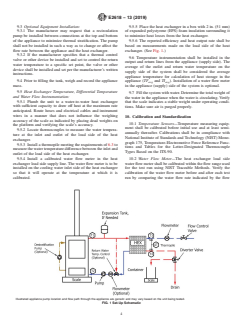
Illustrated appliance pump location and flow path through the appliance are generic and may vary based on the unit being tested.
FIG. 1 Set-Up Schematic
E2618 − 13 (2019)
meter to the mass of water collected from the outlet of the heat 12.2.1.2 Test Fuel Moisture—Usingafuelmoisturemeteras
exchanger over a timed interval. Volume of the collected water specified in 6.7 of the test method, determine the fuel moisture
shall be determined based on the water density calculated from for each test fuel piece used for the test fuel load by averaging
Eq 10, using the water temperature measured at the flow meter. at least five fuel moisture meter readings measured parallel to
The uncertainty in the verification procedure used shall be 1 % the wood grain. Penetration of the moisture meter insulated
or less. The water flow rate determined by the collection and electrodes for all readings shall be ⁄4 the thickness of the fuel
weighing method shall be within 1 % of the flow rate indicated piece or ⁄4 in. (19 mm), whichever is greater. One measure-
by the water flow meter. ment from each of three sides shall be made at approximately
3 in. from each end and the center. Two additional measure-
10.3 Scales—The scales used to weigh the appliance and
ments at approximately ⁄3 of the fuel piece thickness shall be
test fuel charge shall be calibrated using NIST Traceable
made centered between the other three locations. Each indi-
Methods at least once every six months.
vidual moisture content reading shall be in the range of 18 to
10.4 Moisture Meter—The moisture meter shall be cali-
28 % on a dry basis. The average moisture content of each
brated per the manufacturer’s instructions and checked before
piece of test fuel shall be in the range of 19 to 25 %. Moisture
each use.
shall not be added to previously dried fuel pieces except by
storage under high humidity conditions and temperature up to
11. Conditioning
100 °F.Fuelmoistureshallbemeasuredwithin4hofusingthe
11.1 Prior to testing, the appliance is to be operated for a
fuel for a test.
minimum of 48 h using a medium heat draw rate.The pre-burn
NOTE1—Once split cordwood pieces have dried to an averagemoisture
for the first test can be included as part of the conditioning
content that is near the top of the allowable moisture content range, it has
requirement. If conditioning is included in pre-burn, then the
been found that to maintain the fuel pieces within the allowable moisture
appliance shall be aged with fuel meeting the specifications
content range, storage at a relative humidity of 95 % or higher and
temperature of 90 to 100 °F is necessary. In addition, storage at these
outlined in 12.2 with a moisture content between 18 and 28 %
conditions for a period of several months helps achieve a more uniform
on a dry basis. Record and report hourly flue gas exit
moisture content throughout the fuel pieces and thus improves the
temperature data and the hours of operation. It is acceptable
accuracy of the moisture content measurement.
that the conditioning procedure may be conducted and docu-
12.2.2 Firebox Volume—Determine the firebox volume in
mented by the manufacturer prior to submission of the test
cubic feet. Firebox volume shall include all areas accessible
appliance to a testing laboratory or it may be conducted and
through the fuel loading door where firewood could reasonably
documented by the testing laboratory.
be placed up to the horizontal plane defined by the top of the
loading door.Adrawing of the firebox showing front, side and
12. Procedure
plan views or an isometric view with interior dimensions shall
12.1 Appliance Installation—Assemble the appliance and
beprovidedbythemanufacturerandverifiedbythelaboratory.
parts in conformance with the manufacturer’s written installa-
Calculations for firebox volume from computer aided design
tion instructions. Clean the flue with an appropriately sized,
(CAD) software programs are acceptable and shall be included
wire chimney brush before each certification test series.
in the test report if used. If the firebox volume is calculated by
12.2 Cordwood Fueled Appliances:
the laboratory the firebox drawings and calculations shall be
12.2.1 Fuel Properties:
included in the test report.
12.2.1.1 Fuel Species and Properties—The test fuel charge
12.2.3 Test Fuel Charge—Test fuel charges shall be deter-
shall be comprised of any species of cordwood with a specific
mined by multiplying the firebox volume by 10 lb (4.54 kg), or
gravity in the range of 0.60 to 0.73 based on oven dry weight
a higher load density as recommended by the manufacturer’s
andvolume.RefertoTable1forexamplesofsomefuelspecies
printed operating instructions, of wood (as used wet weight)
that typically meet the specific gravity requirement. Other fuel
per cubic foot. Select the number of pieces of fuel that most
species may be used if they meet the specific gravity require-
nearly match this target weight using Table 2 and Fig. 2 as a
ment. Only cordwood pieces that are free of decay, fungus and
guide. When the manufacturer’s printed instructions specify
loose bark shall be used.
fuel loading to a specific level, the firebox shall be loaded with
fuel as specified in 12.2.1 to the level indicated and the weight
of the fuel load recorded. This weight shall then be divided by
TABLE 1 Specific Gravity of Commercially Important Species of
the firebox volume as determined in accordance with 12.2.3
Wood Based on Oven-Dry Weight and Oven-Dry Volume
and the resulting loading density shall be reported. If this
3 3
Species Specific Gravity
loading density is less than 10 lb/ft (160 kg⁄m ), all tests shall
Ash, white 0.63 3 3
be run with fuel load densities of 10 lb/ft (160 kg/m ) even
Beech 0.67
though this could require loading to a level higher than
Birch, sweet 0.71
Birch, yellow 0.65
indicated in the manufacturer’s instructions.
Elm, rock 0.67
12.2.4 Sampling Equipment—Prepare the sampling equip-
Maple, hard (black) 0.60
ment as defined by Test Method E2515.
Maple, hard (sugar) 0.67
Oak, red 0.66
12.2.5 Appliance Start-Up—The appliance shall be fired
Oak, white 0.71
with wood fuel of any species, size and moisture content at the
Pine, Southern, longleaf 0.64
laboratories discretion to bring it up to operating temperature.
E2618 − 13 (2019)
TABLE 2 Correlation of Cordwood Wood Pieces with Appliance Firebox Volume
Cross-section of piece
Minimum weight Maximum weight 80 % piece weight
Firebox Volume
in. (mm)
of piece of piece range Number of pieces
3 3
ft (m )
lb (kg) lb (kg) lb (kg)
Minimum Maximum
<4 (<0.11) 2 (51) 6 (152) 2.2 (1) 13.2 (6) 3 to 11 (1.5 to 5) 4 to 7
4 to <10 (0.11 to <0.28) 2.5 (64) 8 (203) 4.4 (2) 17.6 (8) 6.6 to 15.4 (3 to 7) 5 to 10
10 to <20 (0.28 to <0.56) 3 (76) 10 (254) 6.6 (3) 22 (10) 8.8 to 19.8 (4 to 9) 8 to 15
$20 ($0.56) 3 (77) 12 (305) 8.8 (4) 26.5 (12) 8.8 to 22 (4 to 10) >12
12.2.9 Test Cycle—For all test runs, the return water tem-
perature to the hydronic heater must be equal to or greater than
120 °F. Aquastat or other heater output control device settings
that are adjustable shall be set using manufacturer
specifications, either as factory set or in accordance with the
owner’s manual, and shall remain the same for all burn
categories. Complete a test run in each heat output rate
category, as follows:
12.2.9.1 Test Run Start—Once the appliance is operating
normally and the pretest coal bed weight has reached the target
value in accordance with 12.2.8, tare the scale, start all
sampling systems and load the full test charge into the
appliance. Time for loading shall not exceed 5 min. The actual
weight of the test fuel charge shall be measured and recorded
within 30 min prior to loading.
(1) Record all water temperatures, differential water tem-
peraturesandwaterflowratesattimeintervalsof1minorless.
FIG. 2 Cordwood Fuel
(2) Record particulate emissions data per the requirements
of Test Method E2515.
Operate the appliance until the water is heated to the upper
(3) Record data needed to determine Overall Efficiency
operating control limit and has cycled at least two times. Then
(SLM) per the requirements of CSA B415.1-2010 Clauses
remove all unburned fuel, zero the scale, and verify the scales
6.2.1, 6.2.2, 6.3, 8.5.7, 10.4.3 (a), 10.4.3 (f), and 13.7.9.3
accuracy using dead weights.
(a) Measure and record the test room air temperature in
12.2.6 Pretest Burn Cycle—Reload appliance with fuel
accordance with the requirements of Clauses 6.2.1, 8.5.7 and
wood meeting the requirements of 12.2.1 and allow it to burn
10.4.3 (g).
down to the specified coal bed weight. Pretest burn cycle fuel
(b) Measure and record the flue gas temperature in
charge weight shall be within 610 % of the test fuel charge
accordance with the requirements of Clauses 6.2.2, 8.5.7 and
weight. At least 1 h prior to starting the test run, adjust water
10.4.3 (f).
flow to the heat exchanger to establish the target heat draw for
(c) Determine and record the Carbon Monoxide (CO) and
the test. For the first test run the heat draw rate shall be equal
Carbon Dioxide (CO ) concentrations in the flue gas in
to the manufacturer’s rated heat output capacity.
accordance with Clauses 6.3, 8.5.7 and 10.4.3 (i) and (j).
12.2.7 Allowable Adjustments—Fuel addition or
(d) Measure and record the test fuel weight per the
subtractions, and coal bed raking shall be kept to a minimum
requirements of Clauses 8.5.7 and 10.4.3 (h).
but are allowed up to 15 min prior to the start of the test run.
(e) Record the test run time per the requirements of
For the purposes of this method, coal bed raking is the use of
Clause 10.4.3 (a).
a metal tool (poker) to stir coals, break burning fuel into
(4) Record water flow and temperature data and monitor
smaller pieces and dislodge fuel pieces from positions of poor
the average heat output rate. If the heat output rate gets close
combustion. Record all adjustments to and additions or sub-
totheupperorlowerlimitofthetargetrange(65 %)adjustthe
tractions of fuel, and any other changes to the appliance
water flow through the heat exchanger to compensate. Make
operations that occur during pretest ignition period. During the
changes as infrequently as possible while maintaining the
15-min period prior to the start of the test run, the appliance
target heat output rate. The first test run shall be conducted at
loading door shall not be open more than a total of 1 min. Coal
the Category IV heat output rate to validate that the appliance
bed raking is the only adjustment allowed during this period.
is capable of producing the manufacturer’s rated heat output
12.2.8 Coal Bed Weight—Theapplianceistobeloadedwith
capacity.
thetestfuelchargewhenthecoalbedweightisbetween10and
20 % of the test fuel charge weight. Coals may be raked as 12.2.9.2 Test Fuel Charge Adjustment—It is acceptable to
adjustthetestfuelcharge(thatis,reposition)onceduringatest
necessary to level the coal bed or position coals as recom-
mended in the manufacturer’s printed operating instructions run if more than 60 % of the initial test fuel charge weight has
but may only be raked and stirred once between 15 to 20 min been consumed and more than 10 min have elapsed without a
prior to the addition of the test fuel charge. measurable (1 lb (0.5 kg) or 1 % of the test fuel load weight,
E2618 − 13 (2019)
whichever is greater) weight change while the operating temperature limit of a safety control device (independent from
control is in the demand mode. The time used to make this the operating control), boiling water in a non-pressurized
adjustment shall be less than 60 s. systemoractivationofapressureortemperaturereliefvalvein
a pressurized system.
12.2.9.3 Test Run Completion—The test run is completed
12.2.15 Additional Test Runs—The testing laboratory may
when the remaining weight of the test fuel charge is 0.0 lb (0.0
conduct more than one test run in each of the heat output
kg). End the test run when the scale has indicated a test fuel
categories specified in 4.3. If more than one test run is
charge weight of 0.0 lb (0.0 kg) or less for 30 s. At the end of
conducted at a specified heat output rate, the results from at
the test run, stop the particulate sampling and record the run
least two thirds of the test runs in that heat output rate category
time and all final measurement values.
shall be used in calculating the weighted average emission rate
12.2.10 Heat Output Capacity Validation—The first test run
(see 14.1.14).The measurement data and results of all test runs
must produce a heat output rate that is within 10 % of the
shall be reported regardless of which values are used in
manufacturer’s rated heat output capacity (Category IV). If the
calculating the weighted average emission rate.
applianceisnotcapableofproducingaheatoutputwithinthese
limits, the manufacturer’s rated heat output capacity is consid-
12.3 Automatically Fueled Appliances:
erednotvalidatedandtestingistobeterminated.Insuchcases,
12.3.1 Appliances designed to burn automatically fed fuels
the tests may be continued using the heat output capacity as
such as wood pellets, shelled corn, wood chips or other
measured as the Manufacturer’s Rated Heat Output Capacity if
biomass shall be tested using the fuel or fuels specified in the
requested by the manufacturer.
manufacturer’s operating instructions.
12.2.11 Additional Test Runs—Using the Manufacturer’s
12.3.2 Operation—The fuel used shall have representative
Rated Heat Output Capacity as a basis, conduct a test for
samples taken and tested for higher heating value in accor-
additional heat output categories as specified in 4.3.Itisnot
dance with Test Method E711 and for moisture content by the
required to run these tests in any particular order.
oven drying method (Test Methods D4442, Method A or B).
Sufficient fuel for the tests shall be placed in a hopper on a
12.2.12 Alternative Heat Output Rate for Category I—If an
scale that allows for measurement of the mass of fuel con-
appliance cannot be operated in the Category I heat output
sumed during the test runs to an accuracy of 61lb(60.5 kg).
range due to stopped combustion two test runs shall be
The unit shall be set up and operated in accordance with the
conducted at heat output rates within Category II. When this is
manufacturer’s instructions. A heat exchanger as specified in
the case, the weightings for the weighted averages indicated in
Section 9 shall be used to draw heat from the appliance at the
14.1.14shallbetheaverageoftheCategoryIandIIweightings
rates specified for the categories specified in 4.3.The unit shall
andshallbeappliedtobothCategoryIIresults.Appliancesthat
are not capable of operation within Category II (<25 % of be operated for a minimum of2hatthe specified heat output
rate prior to starting the measurement phase of the test.
maximum) cannot be evaluated by this test method.
12.3.3 Measurement Phase—Record the weight of the fuel
12.2.13 Stopped Fuel Combustion—Evidence that an appli-
in the hopper after the unit has been in operation at the
ance cannot be operated at a Category I heat output rate due to
specified heat draw rate for 1 h. Start the emissions measure-
stopped fuel combustion shall include documentation of two or
ment sampling train and data collection as required in Test
more attempts to operate the appliance in burn rate Category I
Method E2515. Continue operation for a minimum of 4 h. At
and fuel combustion has stopped prior to complete consump-
theendofthetestperiod,stopthesamplingtrainandrecordthe
tion of the test fuel charge. Stopped fuel combustion is
final weight of the fuel in the hopper. Calculate the emissions,
evidenced when an elapsed time of 60 min or more has
efficiency and heat output rate as specified in Section 13 using
occurred without a measurable (1 lb (0.5 kg) or 1 % of the test
the mass of fuel consumed and the higher heating value for the
load weight, whichever is greater) weight change in the test
fuel. Repeat this procedure for each heat output rate category.
fuel charge while the appliance operating control is in the
If more than one fuel type is specified, repeat the entire rating
demand mode. Report the evidence and the reasoning used to
procedure for each fuel type.
determine that a test in burn rate Category I cannot be
achieved. For example, two unsuccessful attempts to operate at
13. Calculation of Results
an output rate of 10 % of the rated output capacity are not
sufficient evidence that burn rate Category I cannot be
13.1 Symbols:
achieved.
E = total particulate emissions measured dur-
12.2.14 Appliance Overheating—Appliances shall be ca-
T
ing a full test cycle, grams (from Test
pable of operating in all heat output categories without
Method E2515 Eq. 10)
overheating to be rated by this test method. Appliance over-
E = emission rate in grams per mega joule of
g/MJ
heating occurs when the rate of heat withdrawal from the
heat output
appliance is lower than the rate of heat production when the
E = emissions rate in pounds per million Btu
lb/MMBtu Output
unit control is in the idle mode. This condition results in the
of heat output
water in the appliance continuing to increase in temperature
E = emissions rate in pounds per million Btu
lb/MMBtu Input
well above the upper limit setting of the operating control.
of heat input
Evidence of overheating includes:1hor more of appliance
E = emissions factor in grams per kilogram of
g/kg
water temperature greater than 15 °F (8 °C) above the upper
dry fuel burned
temperature set-point of the operating control, exceeding the
E2618 − 13 (2019)
13.2 Determine Average Fuel Load Moisture Content:
E = emission rate in grams per hour
g/h
E = weighted average emissions in pounds per
avg
@ W ·MC #
i i
(
MC 5 (3)
million Btu of heat output
Ave
W
( i
HHV = higher heating value of fuel = 8600 Btu/lb
13.3 Determine Heat Input:
(19 990 MJ/kg)
LHV = lower heating value of fuel = 7988 Btu/lb
Q 5 W □/ 11 MC □/100 3 HHV (4)
~ ~ ~ !!!
in fuel ave
(18 567 MJ/kg)
Q 5 ~W □/~11~MC □/100!!! 3 LHV (5)
in LHV fuel ave
∆T = temperature difference between water en-
13.4 Determine Heat Output and Effıciency:
tering and exiting the heat exchanger
Q = total heat output in Btu (MJ) 13.4.1 Determine heat output as:
out
Q = total heat input available in test fuel
in
Q 5 @Heat output determined for each sampling time interval#
out (
charge in Btu (MJ)
1Change in heat stored in the appliance (6)
M = mass flow rate of water lb/min (kg/min)
v = volume of water indicated by a totalizing
˙
i
Q 5 @ ~C ·∆T ·M ·t !#1 W ·C 1C ·W
~ !
out pi i i i app steel pa water
th (
flow meter at the i reading in gallons
□□□□□□□·~TF 2 TI !, Btu ~MJ! (7)
avg avg
(litres)
v = volumetric flow rate of water in heat
f where:
exchange system in gallons per minute
= parameter value for sampling time interval t
i i
(litres per minute)
M 5Mass flow rate 5
t = data sampling interval in minutes
i
i
Θ = total length of test run in hours
gal/min 3Density of Water ~lb/gal! 5 lb/min (8)
η = delivered heating efficiency in percent
del
M 5 V ·σ , lb/min. (9)
i f i
i
η = overall efficiency determined using the
SLM
σ 5 62.561 2.0003413·T3 1 2.00006225·T3
CSA B415.1-2010 stack loss method in ~ ~ ! ~ !!
i i i
percent
□□□□□□□□□□□□·0.1337, lbs/gal. (10)
η = weighted average delivered efficiency in
avg
C 5 1.00141~2 .000003485 · T 3 !,Btu/lb-°F (11)
p i
percent
C 5 0.1 Btu/lb-°F (12)
F = weighting factor for heat output category i
Steel
i
T1 = temperature of water at the inlet on the
C 5 1.0014 1 2.000003485· TI 1 TF ⁄2 !,Btu/lb-°F
~ ~ !
pa avg avg
supply side of the heat exchanger, °F
(13)
T2 = temperature of the water at the outlet on
V 5 ~V 2 V !/~t 2 t !, gal/min. (14)
f i i21 i i21
the supply side of the heat exchanger, °F i
T3 = temperature of water at the inlet to the
where:
load side of the heat exchanger, °F
V = total water volume at the end of interval i
i
TI = average temperature of the appliance and
avg
V = total water volume at the beginning of the time
i-1
water at start of the test
interval. This calculation is necessary when a totaliz-
TI =
avg
T 1 1 T 2 ⁄2□at the end of the test,°F (1)
~ !
ing type water meter is used.
13.4.2 Determine heat output rate as:
TF = average temperature of the appliance and
avg
water at the end of the test
Heat Output Rate 5 Q □⁄Θ, Btu/h ~MJ/h! (15)
out
TF =
avg
~T 1 1 T 2!⁄2□at the end of the test,°F (2)
13.4.3 Determine emission rates and emission factors as:
E 5 E □/~Q 30.001055!, g/MJ (16)
g/MJ T out
MC = fuel moisture content in percent based on
dry fuel weight
E 5 ~E □/453.59!/~Q 310 !, lbs/MMBtu Out(17)
lbs/MM Btu output T out
MC = average moisture content of individual
i
E 5 E □/ W □/ 11MC/100 , g/dry kg (18)
~ ~ !!
g/kg T fuel
fuel pieces on a dry weight basis
E 5 E □⁄Θ,g/h (19)
σ = density of water (lb/gal) g/h T
C = specific heat of water in Btu per pound °F
p
13.4.4 Determine delivered efficiency as:
C = specific heat of steel (0.1 Btu/lb·°F)
steel
η 5 ~Q □/Q ! 3100 (20)
W = fuel charge weight in pounds (kilograms) del out in
fuel
W = weight of individual fuel pieces in pounds
η 5 Q □/Q 3100 (21)
i
~ !
del LHV out in LHV
(kilograms)
13.4.5 Determine η - Overall Efficiency, also known as
SLM
W = weight of empty appliance in pounds
app
Stack Loss Efficiency, using Stack Loss Method (SLM). For
W = weight of water in supply side of the
water
determination of the average overall thermal efficiency (η )
system in pounds SLM
for the test run, use the data collected over the full test run and
NOTE 2—After the test is completed, determine the particulate emis-
the calculations in accordance with CSAB415.1-2010, Clause
sions in accordance with Test Method E2515 Eq. 10 (E ).
T
13.7
E2618 − 13 (2019)
13.4.5.1 Whenever the overall efficiency (η ) is found to 13.5.2.5 Determine the data point that has the nearest
SLM
be lower than the delivered efficiency (η ), as determined by duration less than 8 h.
del
Eq 20 of this method, 14.1.7 of the test report must include a
X2 = Actual total input,Y2 = Test Duration and η = Average Delivered
del2
Efficiency for this data point
discussion of the reasons for this result.
13.5.2.6 Example:
13.5 Weighted Average Emissions and Effıciency:
13.5.1 Determine the weighted average emission rate and Actual Load Duration Total Input
Category η %
del
(Btu/h) (h) (Btu)
delivered efficiency from the individual tests in the specified
1 15 000 14 70.0 300 000
heat output categories. The weighting factors (F) are derived
i 2 26 000 -8.56 75.5 290 000
fromananalysisofAmericanSocietyofHeating,Refrigerating 3 50 000 -4.73 80.1 295 500
4 100 000 2.46 80.9 305 000
and Air-Conditioning Engineers (ASHRAE) Bin Data which
provides details of normal building heating requirements in
Category 2 Duration is just above 8 h, therefore:
X1 = 290 000 Btu, η = 75.5 % and Y1=8.56h
terms of percent of design capacity and time in a particular
del1
Category 3 Duration is just below 8 h, therefore:
capacity range (or “bin”) over the course of a heating season.
X2 = 295 500 Btu, η = 80.1 % and Y2=4.73h
del2
The values used in this method represent an average of data
η = 75.5 + {(8 - 8.456) x [(80.1 – 75.5)/(4.73 - 8.456)]} = 76.41%
avg-8h
Q = [(76.1/100) · {(290 000 + 295 500)/2}]/8 = 27 848 Btu/h
from several cities located in the northern United States.
out-8h
η 5 η ·F ,% (22)
avg ( i i
14. Report
E 5 E ·F , lb/mmBTU (23)
avg i i Output
(
14.1 The report shall include the following:
13.5.2 Estimated Average Heat Output (Q ) and Effi- 14.1.1 Name and location of the laboratory conducting the
out-8 h
test.
ciency (η for 8 h burn time (does not apply to particulate
avg-8 h)
fueled appliances):
14.1.2 A description of the appliance tested and its
13.5.2.1 Units tested under this standard typically require condition, date of receipt and dates of tests.
infrequent fuelling, 8 to 12 h intervals being typical. Rating
14.1.3 A statement that the test results apply only to the
unit’s based on an Average Output sustainable over an 8 h
specific appliance tested.
duration will assist consumers in appropriately sizing units to
14.1.4 A statement that the test report shall not be repro-
match the theoretical heat demand of their application.
duced except in full, without the written approval of the
13.5.2.2 Calculations:
laboratory.
η 5 η 1 8 2 Y 1 3 η 2 η ⁄ Y 2 14.1.5 A description of the test procedures and test equip-
$~ ! @~ ! ~
avg-8h del1 del2 del1
ment including a schematic or other drawing showing the
2 Y 1 # ,% (24)
! %
location of all required test equipment. Also, a description of
Q @~η □ ⁄ 100! · $~X 1 1 X 2!⁄2%#⁄8, Btu/h (25)
out-8h5 avg-8h
test fuel sourcing, handling and storage practices shall be
included.
where:
14.1.6 Details of deviations from, additions to or exclusions
Y1 = test duration just above 8 h,
from the test method, and their data quality implications on the
Y2 = test duration just below 8 h,
X1 = total heat input for duration Y1 test results (if any), as well as information on specific test
X2 = total heat input for duration Y2
conditions, such as environmental conditions.
η = average delivered efficiency for duration Y1, and
del1
14.1.7 A list of participants and observers present for the
η = average delivered efficiency for duration Y2
del2
tests.
13.5.2.3 Determine the test durations and actual load for 14.1.8 Data and drawings indicating the fire box size and
each catego
...