


ASTM F1235-18
(Specification)Standard Consumer Safety Specification for Portable Hook-On Chairs
Standard Consumer Safety Specification for Portable Hook-On Chairs
ABSTRACT
This consumer safety specification covers the performance requirements and test methods designed to ensure the satisfactory performance, and hence, minimize injuries to children resulting from normal use and reasonably foreseeable misuse or abuse of portable hook-on chairs. Chairs that conform to this specification shall pass the following performance tests: chair drop test; static load test; seat and seat back disengagement test; chair bounce test; chair pull/push test; restraint system integrity and retention tests; chair assembly test for the latching mechanism to prevent unintentional folding; torque test; tension test; and labeling test. Instructional literature detailing information such as assembly, maintenance, cleaning, operating, folding, and warnings, where applicable, must be included.
SCOPE
1.1 This specification covers the performance requirements and test methods designed to ensure the satisfactory performance of the portable hook-on chair.
1.2 This specification is intended to minimize injuries to children resulting from normal use and reasonably foreseeable misuse or abuse of chairs.
1.3 For the purposes of this specification a chair is:
1.3.1 A seat made for the express purpose of seating and holding a child who can remain in a sitting position due to his or her own coordination.
1.3.2 Usually a legless seat constructed to locate the occupant at a table in such a position and elevation so that the surface of the table can be used as the feeding surface for the occupant.
1.3.3 Supported solely by the table on which it is mounted. These chairs are intended for use by children between the ages of six months and three years and who weigh no more than 37 lb (16.8 kg) (95th percentile male at three years).
1.4 No chair produced after the approval date of this consumer safety specification shall, either by label or other means, indicate compliance with this specification unless it conforms to all applicable requirements contained herein.
1.5 The values stated in inch-pound units are to be regarded as standard. The values given in parentheses are mathematical conversions to SI units that are provided for information only and are not considered standard.
1.6 The following precautionary caveat pertains to the test methods portion only, Section 7, of this specification: This standard does not purport to address all of the safety concerns, if any, associated with its use. It is the responsibility of the user of this standard to establish appropriate safety, health, and environmental practices and determine the applicability of regulatory limitations prior to use.
1.7 This international standard was developed in accordance with internationally recognized principles on standardization established in the Decision on Principles for the Development of International Standards, Guides and Recommendations issued by the World Trade Organization Technical Barriers to Trade (TBT) Committee.
General Information
- Status
- Published
- Publication Date
- 30-Apr-2018
- Technical Committee
- F15 - Consumer Products
- Drafting Committee
- F15.16 - Highchairs and Hook-On Chairs
Relations
- Effective Date
- 01-May-2018
- Effective Date
- 01-Jun-2009
- Effective Date
- 01-Nov-2007
- Effective Date
- 10-Aug-2002
Overview
ASTM F1235-18: Standard Consumer Safety Specification for Portable Hook-On Chairs is a critical standard developed by ASTM International to enhance child safety in the design, construction, and use of portable hook-on chairs. These chairs are specifically designed for children who can sit up unaided, typically from six months up to three years old, and weighing no more than 37 lbs (16.8 kg). The standard establishes robust performance and testing requirements to minimize injuries associated with normal use and reasonably foreseeable misuse or abuse of hook-on chairs. Products that claim compliance with ASTM F1235-18 must meet all applicable requirements.
Key Topics
- Performance Requirements: The standard outlines comprehensive physical and mechanical requirements for portable hook-on chairs. Key areas include resistance to hazardous sharp points and edges, minimization of small parts that could pose choking hazards, and ensuring paint or surface coatings are non-toxic and compliant with federal regulations.
- Stability and Strength: Chairs must pass a series of rigorous physical performance tests, including chair drop tests, static load tests, seat and seat back disengagement, bounce, and push/pull tests. These ensure the chair can safely support the child and remain attached to tables as intended.
- Restraint Systems: ASTM F1235-18 requires a secure restraint system, featuring both waist and crotch restraints, to prevent falls and ejection. The effectiveness of these systems is tested for retention and strength.
- Design for Injury Prevention: To avoid risks like scissoring, shearing, or pinching injuries, the design must limit dangerous movement between chair components while in use. Exposed coil springs, sharp edges, and hazardous openings are not permitted.
- Labeling and Instruction Requirements: Clear, permanent warning labels and instructional literature must be included. Information covers proper assembly, maintenance, cleaning, and explicit warnings on unacceptable uses (e.g., glass tables, loose or card tables).
Applications
- Childcare and Home Use: ASTM F1235-18 helps parents and caregivers select portable hook-on chairs that meet stringent child safety standards, reducing the risk of injury during feeding or tabletop sitting.
- Manufacturing and Product Development: Manufacturers of children’s furniture use ASTM F1235-18 to design, produce, and test portable hook-on chairs that meet or exceed industry safety benchmarks.
- Retail and Regulatory Compliance: Retailers and regulatory bodies depend on this standard for product certification, ensuring only compliant products reach the market and are accompanied by the appropriate labeling and instructions.
- Import/Export and Global Markets: Compliance with ASTM F1235-18 can assist companies in meeting international trade requirements and demonstrate conformity with recognized safety principles, supporting access to wider markets.
Related Standards
- ASTM D3359 - Test Methods for Rating Adhesion by Tape Test (used for label durability)
- 16 CFR 1303 - Ban of Lead-Containing Paint and Certain Consumer Products
- 16 CFR 1500 and 1501 - Regulations addressing hazardous substances and choking hazards
- CPSC Regulations - Various child safety standards relevant to children’s products
By adhering to ASTM F1235-18, manufacturers, regulators, and consumers help ensure that portable hook-on chairs are both reliable and safe, significantly minimizing the risks of injury and supporting the wellbeing of children during everyday use. For ongoing compliance, refer to the most current edition of the standard published by ASTM International.
Buy Documents
ASTM F1235-18 - Standard Consumer Safety Specification for Portable Hook-On Chairs
REDLINE ASTM F1235-18 - Standard Consumer Safety Specification for Portable Hook-On Chairs
Frequently Asked Questions
ASTM F1235-18 is a technical specification published by ASTM International. Its full title is "Standard Consumer Safety Specification for Portable Hook-On Chairs". This standard covers: ABSTRACT This consumer safety specification covers the performance requirements and test methods designed to ensure the satisfactory performance, and hence, minimize injuries to children resulting from normal use and reasonably foreseeable misuse or abuse of portable hook-on chairs. Chairs that conform to this specification shall pass the following performance tests: chair drop test; static load test; seat and seat back disengagement test; chair bounce test; chair pull/push test; restraint system integrity and retention tests; chair assembly test for the latching mechanism to prevent unintentional folding; torque test; tension test; and labeling test. Instructional literature detailing information such as assembly, maintenance, cleaning, operating, folding, and warnings, where applicable, must be included. SCOPE 1.1 This specification covers the performance requirements and test methods designed to ensure the satisfactory performance of the portable hook-on chair. 1.2 This specification is intended to minimize injuries to children resulting from normal use and reasonably foreseeable misuse or abuse of chairs. 1.3 For the purposes of this specification a chair is: 1.3.1 A seat made for the express purpose of seating and holding a child who can remain in a sitting position due to his or her own coordination. 1.3.2 Usually a legless seat constructed to locate the occupant at a table in such a position and elevation so that the surface of the table can be used as the feeding surface for the occupant. 1.3.3 Supported solely by the table on which it is mounted. These chairs are intended for use by children between the ages of six months and three years and who weigh no more than 37 lb (16.8 kg) (95th percentile male at three years). 1.4 No chair produced after the approval date of this consumer safety specification shall, either by label or other means, indicate compliance with this specification unless it conforms to all applicable requirements contained herein. 1.5 The values stated in inch-pound units are to be regarded as standard. The values given in parentheses are mathematical conversions to SI units that are provided for information only and are not considered standard. 1.6 The following precautionary caveat pertains to the test methods portion only, Section 7, of this specification: This standard does not purport to address all of the safety concerns, if any, associated with its use. It is the responsibility of the user of this standard to establish appropriate safety, health, and environmental practices and determine the applicability of regulatory limitations prior to use. 1.7 This international standard was developed in accordance with internationally recognized principles on standardization established in the Decision on Principles for the Development of International Standards, Guides and Recommendations issued by the World Trade Organization Technical Barriers to Trade (TBT) Committee.
ABSTRACT This consumer safety specification covers the performance requirements and test methods designed to ensure the satisfactory performance, and hence, minimize injuries to children resulting from normal use and reasonably foreseeable misuse or abuse of portable hook-on chairs. Chairs that conform to this specification shall pass the following performance tests: chair drop test; static load test; seat and seat back disengagement test; chair bounce test; chair pull/push test; restraint system integrity and retention tests; chair assembly test for the latching mechanism to prevent unintentional folding; torque test; tension test; and labeling test. Instructional literature detailing information such as assembly, maintenance, cleaning, operating, folding, and warnings, where applicable, must be included. SCOPE 1.1 This specification covers the performance requirements and test methods designed to ensure the satisfactory performance of the portable hook-on chair. 1.2 This specification is intended to minimize injuries to children resulting from normal use and reasonably foreseeable misuse or abuse of chairs. 1.3 For the purposes of this specification a chair is: 1.3.1 A seat made for the express purpose of seating and holding a child who can remain in a sitting position due to his or her own coordination. 1.3.2 Usually a legless seat constructed to locate the occupant at a table in such a position and elevation so that the surface of the table can be used as the feeding surface for the occupant. 1.3.3 Supported solely by the table on which it is mounted. These chairs are intended for use by children between the ages of six months and three years and who weigh no more than 37 lb (16.8 kg) (95th percentile male at three years). 1.4 No chair produced after the approval date of this consumer safety specification shall, either by label or other means, indicate compliance with this specification unless it conforms to all applicable requirements contained herein. 1.5 The values stated in inch-pound units are to be regarded as standard. The values given in parentheses are mathematical conversions to SI units that are provided for information only and are not considered standard. 1.6 The following precautionary caveat pertains to the test methods portion only, Section 7, of this specification: This standard does not purport to address all of the safety concerns, if any, associated with its use. It is the responsibility of the user of this standard to establish appropriate safety, health, and environmental practices and determine the applicability of regulatory limitations prior to use. 1.7 This international standard was developed in accordance with internationally recognized principles on standardization established in the Decision on Principles for the Development of International Standards, Guides and Recommendations issued by the World Trade Organization Technical Barriers to Trade (TBT) Committee.
ASTM F1235-18 is classified under the following ICS (International Classification for Standards) categories: 97.190 - Equipment for children. The ICS classification helps identify the subject area and facilitates finding related standards.
ASTM F1235-18 has the following relationships with other standards: It is inter standard links to ASTM F1235-15, ASTM D3359-09e1, ASTM D3359-07, ASTM D3359-02. Understanding these relationships helps ensure you are using the most current and applicable version of the standard.
ASTM F1235-18 is available in PDF format for immediate download after purchase. The document can be added to your cart and obtained through the secure checkout process. Digital delivery ensures instant access to the complete standard document.
Standards Content (Sample)
This international standard was developed in accordance with internationally recognized principles on standardization established in the Decision on Principles for the
Development of International Standards, Guides and Recommendations issued by the World Trade Organization Technical Barriers to Trade (TBT) Committee.
Designation:F1235 −18
Standard Consumer Safety Specification for
Portable Hook-On Chairs
This standard is issued under the fixed designation F1235; the number immediately following the designation indicates the year of
original adoption or, in the case of revision, the year of last revision.Anumber in parentheses indicates the year of last reapproval.A
superscript epsilon (´) indicates an editorial change since the last revision or reapproval.
INTRODUCTION
This consumer safety specification addresses incidents associated with portable hook-on chairs
(chairs) that were identified by the United States Consumer Product Safety Commission (CPSC).
CPSChasidentifiedinjurieswhichoccurredwhenchairsfellbecausethechildpushedoffthetable,
components of the chair became detached or broke, and, to a lesser extent, when the table to which
the chair was attached tipped over. In response to a review of the data received by the CPSC, this
specification attempts to minimize the following: falls due to detachment of the chair from the table
or due to breakage or detachment of components; a child falling out of the chair; and chair and table
tipping over.
This specification does not cover chairs that are either blatantly misused or are used in a careless
manner that disregards the warning statements and safety instructions provided with each chair. This
specification is written within the current state-of-the-art of chair technology. It is intended that this
specification will be updated whenever substantive information becomes available that necessitates
additional requirements or justifies revising the existing requirements.
1. Scope means, indicate compliance with this specification unless it
conforms to all applicable requirements contained herein.
1.1 This specification covers the performance requirements
and test methods designed to ensure the satisfactory perfor- 1.5 The values stated in inch-pound units are to be regarded
mance of the portable hook-on chair. as standard. The values given in parentheses are mathematical
conversions to SI units that are provided for information only
1.2 This specification is intended to minimize injuries to
and are not considered standard.
children resulting from normal use and reasonably foreseeable
1.6 The following precautionary caveat pertains to the test
misuse or abuse of chairs.
methods portion only, Section 7, of this specification: This
1.3 For the purposes of this specification a chair is:
standard does not purport to address all of the safety concerns,
1.3.1 A seat made for the express purpose of seating and
if any, associated with its use. It is the responsibility of the user
holding a child who can remain in a sitting position due to his
of this standard to establish appropriate safety, health, and
or her own coordination.
environmental practices and determine the applicability of
1.3.2 Usually a legless seat constructed to locate the occu-
regulatory limitations prior to use.
pant at a table in such a position and elevation so that the
1.7 This international standard was developed in accor-
surface of the table can be used as the feeding surface for the
dance with internationally recognized principles on standard-
occupant.
ization established in the Decision on Principles for the
1.3.3 Supported solely by the table on which it is mounted.
Development of International Standards, Guides and Recom-
These chairs are intended for use by children between the ages
mendations issued by the World Trade Organization Technical
of six months and three years and who weigh no more than 37
Barriers to Trade (TBT) Committee.
lb (16.8 kg) (95th percentile male at three years).
2. Referenced Documents
1.4 No chair produced after the approval date of this
consumer safety specification shall, either by label or other
2.1 ASTM Standards:
D3359Test Methods for Rating Adhesion by Tape Test
This specification is under the jurisdiction of ASTM Committee F15 on
Consumer Products and is the direct responsibility of Subcommittee F15.16 on
Highchairs, Hook-On Chairs and Expandable Gates. For referenced ASTM standards, visit the ASTM website, www.astm.org, or
Current edition approved May 1, 2018. Published June 2018. Originally contact ASTM Customer Service at service@astm.org. For Annual Book of ASTM
approved in 1989. Last previous edition approved in 2015 as F1235–15. DOI: Standards volume information, refer to the standard’s Document Summary page on
10.1520/F1235-18. the ASTM website.
Copyright © ASTM International, 100 Barr Harbor Drive, PO Box C700, West Conshohocken, PA 19428-2959. United States
F1235−18
2.2 Federal Regulations: 4. Calibration and Standardization
16 CFR 1303Ban of Lead-Containing Paint, and Certain
4.1 All testing shall be conducted on a concrete floor that
Consumer Products Bearing Lead-Containing Paint
may be covered with ⁄8 in. (3 mm) thick vinyl flooring
16CFR1500HazardousSubstancesActRegulationsinclud-
covering, unless test instructs differently.
ing sections:
1500.48Technical Requirements for Determining a Sharp 4.2 The product shall be completely assembled, unless
Point in Toys or Other Articles Intended for Use By otherwise noted, in accordance with the manufacturer’s in-
Children Under Eight Years of Age structions.
1500.49Technical Requirements for Determining a Sharp
4.3 No testing shall be conducted within 48 h of manufac-
MetalorGlassEdgeinToysorOtherArticlesIntendedfor
turing.
Use By Children Under Eight Years of Age
1500.50.52Test Methods for Simulating Use and Abuse of 4.4 Theproducttobetestedshallbeinaroomwithambient
Toys and Other Articles Intended for Use by Children
temperature of 73 6 9°F (23 6 5°C) for at least 1 h prior to
16 CFR 1501Method for Identifying Toys and Other Ar- testing.Testingshallthenbeconductedwithinthistemperature
ticles Intended for Use by Children Under ThreeYears of
range.
Age Which Present Choking, Aspiration, or Ingestion
4.5 All testing required by this specification shall be con-
Hazards Because of Small Parts
ducted on the same unit.
3. Terminology
5. General Requirements
3.1 Definitions of Terms Specific to This Standard:
5.1 There shall be no hazardous sharp points or edges as
3.1.1 conspicuous—a label that is visible when the portable
defined by 16 CFR 1500.48 and 16 CFR 1500.49 before and
hook-on chair is in a manufacturer’s recommended use posi-
after testing to this consumer safety specification.
tion to a person standing near the chair at any one position but
not necessarily visible from all positions. 5.2 Thereshallbenosmallpartsasdefinedby16CFR1501
before testing or liberated as a result of testing to this
3.1.2 fabric—any woven, knit, coated, laminated, extruded
specification.
or calendered flexible material that is intended to be sewn,
welded, heat sealed or glued together as an assembly.
5.3 The paint and surface-coatings on the product shall
comply with 16 CFR 1303.
3.1.3 manufacturer’s recommended use position—any posi-
tion that is presented as a normal, allowable, or acceptable
5.4 Priortotesting,anyexposedwoodpartsshallbesmooth
configuration for the use of the product by the manufacturer in
and free from splinters.
any descriptive or instructional literature. This specifically
5.5 Latching or Locking Mechanisms—Any unit that folds
excludes positions that the manufacturer shows in a like
shallhavealatchingorlockingdeviceorotherprovisioninthe
manner in its literature to be unacceptable, unsafe, or not
design that will prevent the unit from unintentionally folding
recommended.
when properly placed in the manufacturer’s recommended use
3.1.4 nonpaper label—any label material (such as plastic or
position. The unit shall remain in its manufacturer’s recom-
metal) which either will not tear without the aid of tools, or
mended use position during and upon completion of the test in
tears leaving a sharply defined edge.
accordance with 7.3. If a unit is designed with a latching or
locking device, that device shall remain engaged and operative
3.1.5 occupant—that individual who is in a product that is
after testing.
set up in one of the manufacturer’s recommended use posi-
tions.
5.6 Scissoring, Shearing, and Pinching:
3.1.6 passive crotch restraint—a component that separates
5.6.1 A portable hook-on chair, when in a manufacturer’s
the openings for the legs of the occupant into two separate
recommended use position installed per the manufacturer’s
bounded openings and requires no action on the part of the
instructionsontheminimumtestsurfacedescribedin7.1.16.4,
caregiver to use, except to position one leg into each opening
shall be designed and constructed so as to prevent injury to the
created by the component.
occupant from any scissoring, shearing, or pinching when
members or components rotate about a common axis or
3.1.7 paper label—any label material that tears without the
fasteningpoint,slide,pivot,fold,orotherwisemoverelativeto
aid of tools and leaves a fibrous edge.
one another. Scissoring, shearing, or pinching that may cause
3.1.8 seam—a means of joining fabric components such as
injury shall not be permissible when the edges of any rigid
sewing, welding, heat sealing or gluing.
parts admit a probe greater than 0.210 in. (5.33 mm) and less
3.1.9 static load—a vertically downward force applied by a than 0.375 in. (9.53 mm) diameter at any accessible point
calibrated force gage or by dead weights. throughout the range of motion of such parts.
5.6.2 Disengagement from Table Support Surface—
Scissoring, shearing, or pinching that may cause injury shall
not be permissible when an opening in the spaces described
AvailablefromU.S.GovernmentPrintingOffice,N.CapitalandHStreets,NW,
Washington, DC 20401. belowadmitsaprobegreaterthan0.210in.(5.33mm)andless
F1235−18
than 0.375 in. (9.53 mm) in diameter at any accessible point 6.6.1 A restraint system shall be provided to secure a child
throughout the range of motion that occurs during the test in the seated position in each of the manufacturer’s recom-
outlined in 7.13. mended use positions.
(1)between the edges of any rigid part of the product and 6.6.1.1 The restraint system shall include both waist and
the test surface, or crotchrestraint.Thecrotchrestraintshallbedesignedsuchthat
(2)betweentheedgesofanytworigidpartsontheproduct its use is mandatory when the restraint system is in use.
that rotate about a common axis or fastening point.
NOTE 1—It should be noted that this test applies to all designs of
restraining systems, whether they be of the traditional “active” or of the
5.7 Exposed Coil Springs—Any exposed coil spring that is
“passive” type.
accessible to the occupant, having or capable of generating a
6.6.2 The restraint system and its closing means (for
space between coils of 0.210 in. (5.30 mm) or greater during
static load testing in accordance with 7.6, shall be covered or example,buckle)shallnotbreak,separateorpermitremovalof
the CAMI test dummy (see Fig. 2) from the chair when tested
otherwise designed to prevent injury from entrapment.
in accordance with 7.10.
5.8 Openings—Holes or slots that extend entirely through a
6.6.2.1 If during the tests in 7.10 the posterior of the test
wallsectionofanyrigidmateriallessthan0.375-in.(9.53-mm)
dummy, with the force applied, is pulled past the front edge of
thick and admit a 0.210-in. (5.33-mm) diameter rod shall also
the seat, the dummy shall be considered removed.
admit a 0.375-in. (9.53-mm) diameter rod. Holes or slots that
6.6.2.2 After the tests in 7.10.6 and 7.10.7, the CAMI
are between 0.210-in. (5.33-mm) and 0.375-in. (9.53-mm) and
dummy shall not be fully released.
have a wall thickness less than 0.375-in. (9.53-mm) but are
6.6.3 Thewaistrestraintshallbecapableofadjustmentwith
limited in depth to 0.375-in. (9.53-mm) maximum by another
a positive self-locking mechanism that is capable, when
rigidsurfaceshallbepermissible(seeFig.1).Theproductshall
locked, of withstanding the forces of tests in 7.10 without
beevaluatedinallmanufacturer’srecommendedusepositions.
allowingrestraintmovementorslippageofmorethan1in.(25
5.9 Labeling:
mm).
5.9.1 Warning labels (whether paper or non paper) shall be
6.6.4 A connecting means and adjustment means for the
permanent when tested in accordance with 7.11.
waist restraint shall be capable of usage independent of one
5.9.2 Warning statements applied directly onto the surface
another. The connecting means shall not be an adjustment
of the product by hot stamping, heat transfer, printing, wood
means, but may have one integrally attached to it.
burning, and so forth shall be permanent when tested in
6.6.5 Before shipment, the restraining system must be
accordance with 7.11.
attached to the chair in such a manner as to not become
5.9.3 Nonpaper labels shall not liberate small parts when
detached through normal use. For chairs requiring consumer
tested in accordance with 7.11.
assembly, buckles must be completely threaded and the re-
straining system must be attached to a component that would
5.10 Protective Components—If a child can grasp compo-
render the chair unusable if not properly assembled.
nentsbetweenthethumbandforefinger,orteeth,(suchascaps,
sleeves, or plugs used for protection from sharp edges, points,
6.7 Openings and Passive Crotch Restraint System:
or entrapment of fingers or toes), or if there is at least a 0.040
NOTE 2—A passive crotch restraint required by this section does not
in. (1.00 mm) gap between the component and its adjacent
meet the restraint system requirement of 6.6.1.1, which requires a crotch
parentcomponent,suchcomponentshallnotberemovedwhen
restraint as part of the restraint system.
tested in accordance with 7.4.
6.7.1 Thehook-onchairshallhaveapassivecrotchrestraint
that meets the following:
6. Performance Requirements
6.7.1.1 The passive crotch restraint shall be installed on the
6.1 Chair Drop Test—The chair shall permit subsequent
product at the time of shipment in a manner such that it cannot
tests and exhibit no mechanical hazards (sharp points, sharp be removed without the use of a tool.
edges, or small parts) when tested in accordance with 7.5.
6.7.1.2 The leg openings on each side of the passive crotch
restraint shall not allow complete passage of the wedge block
6.2 StaticLoadTest—Thechairshallsupportastaticloadon
when tested in accordance with 7.12.
theseatwithoutcausinganyhazardousconditionsasidentified
6.7.2 Completely bounded openings in the surfaces that act
within this specification when tested in accordance with 7.6.
asthesidesoftheseatingareashallnotallowcompletepassage
6.3 Seat and Seat Back Disengagement Test—The seat back
of the wedge block when tested in accordance with 7.12.
and seat shall remain fully attached to the frame of the chair
6.7.3 Completely bounded openings that are located for-
when forces are applied in accordance with 7.7.
ward of the occupant shall not allow complete passage of the
wedge block when tested in accordance with 7.12 (see Fig. 3).
6.4 Chair Bounce Test—The chair shall remain attached to
6.7.3.1 Openings in the attachment structure of the product
the standard test surface as described in 7.1.16 and allow no
located under the standard test surface are exempt from this
movement greater than 1 in. (25 mm) when forces are applied
requirement (see Fig. 4).
in accordance with 7.8.
6.5 Chair Pull/Push Test—The chair shall remain attached 7. Test Methods
tothestandardtestsurfacewhentestedinaccordancewith7.9.
7.1 Test Equipment:
6.6 Restraint Systems: 7.1.1 A push-pull gage.
F1235−18
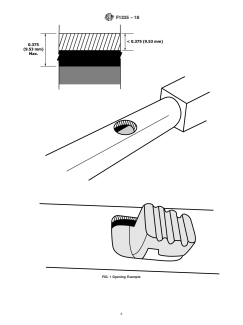
FIG. 1Opening Example
F1235−18
7.1.14 Webbing tension pull device (see Fig. 7).
7.1.15 A clamp with ⁄4 in. (19 mm) diameter clamping
surfaces.
7.1.16 Standard Test Surface, Underlayment, and Thick-
ness:
7.1.16.1 Thestandardtestsurfaceshouldbeasmoothfinish,
impregnated high pressure, high gloss laminate.
7.1.16.2 The underlayment should be clean particle board,
smooth side down.
7.1.16.3 Two standard test surface thicknesses are required.
7.1.16.4 The minimum test surface shall be equal to or to
the nearest ⁄4 in. (6 mm) greater than the minimum surface
thickness stated by the manufacturer on the retail package.
7.1.16.5 The maximum test surface shall be equal to or to
the nearest ⁄4 in. (6 mm) less than the maximum thickness
stated by the manufacturer on the retail package.
7.2 Chair Assembly—Assemble the chair in accordance
with the manufacturer’s instructions.
FIG. 2 CAMI Infant Dummy, Mark II
7.3 Latching Mechanisms for Prevention of Unintentional
Folding:
7.3.1 Securely affix the chair according to the manufactur-
er’s directions to the maximum test surface so that the normal
folding motion is not impeded.
7.3.2 Gradually apply a force of 45 lbf (200 N) within 5 s
and maintain for an additional 10 s. Apply the force in the
direction normally associated with folding or disassembly of
thechairatapositionmostlikelytocausefailure.Repeattwice
for a total of three times within a 2 min period.
7.4 Removal of Protective Components From Chairs:
7.4.1 Any protective component which a child may reason-
ablybeexpectedtograspbetweenthethumbandforefinger,or
teeth, or that has at least a 0.040 in. (1.00 mm) gap between
itself and its adjacent parent component shall be tested in
accordancewitheachofthefollowingmethodsinthesequence
FIG. 3Hook-On Chair Openings Evaluation
listed.
7.4.2 Secure the chair so that it cannot move during the
7.1.2 A CAMI Infant Dummy Mark II (see Fig. 2).
performance of the following tests.
7.1.3 Tension test adapter/clamp (see Fig. 5).
7.4.3 Torque Test—A torque of 3 lbf-in. (0.3 N·m) shall be
7.1.4 A 0.040 in. (1.00 mm) feeler gage.
applied evenly within a period of5sina clockwise direction
7.1.5 Awoodblock6by6by ⁄4in.thick(150by150by19
until a rotation of 180° from the original position has been
mm). In all cases where there is a hammock type seat, use the
attained or 3 lbf-in. (0.3 N·m) has been exceeded. The torque
weld cap as described in 7.1.6.
or 180° displacement shall be maintained for an additional 10
7.1.6 A6 in. (150 mm) weld cap, as identified in Fig. 6, for
s. The torque shall then be removed and the test components
use with a hammock type seat.
permitted to return to a relaxed condition.This procedure shall
NOTE 3—If using a weld cap, subtract the weight of the cap from the
then be repeated in a counterclockwise direction.
indicated test weight.
7.4.4 Tension Test:
7.1.7 Awood block 2 by 2 by ⁄4 in. thick, (50 by 50 by 19
7.4.4.1 Attach a force gage to the protective component by
mm).
means of any suitable device. For components that cannot
7.1.8 A 100 lb (45.5 kg) weight.
reasonably be expected to be grasped between thumb and
7.1.9 A 30 lb (13.6 kg) weight.
forefinger, or teeth, on their outer diameter, but have at least a
7.1.10 A 20 lb (9.1 kg) weight.
0.040 in. (1.00 mm) gap or more behind the rear surface of the
7.1.11 A 12 lb (5.4 kg) weight.
components and the structural member of the chair to which
7.1.12 A 10 lb (4.5 kg) weight.
they are attached, a clamp such as shown in Fig. 5 may be a
7.1.13 A 5 lb (2.2 kg) weight.
suitable device.
CAMI Infant Dummy (Mark II), Department of Transportation, Federal
Aviation Administration, Cami Infant Dummy, Drawing No. SA-100I, Memoran- Formica, a registered trademark of Formica Corp., has been found suitable for
dum Report AAC-119-74-14, Revision II, by Richard F. Chandler, July 2, 1974. this purpose.
F1235−18
FIG. 4Example of Exempt Openings Area
NOTE 1—Caps furnished toANSI standards unless otherwise specified.
Weldingcapsareformedfromsteelplateandareellipsoidalinshape.The
minoraxisbeingequaltoonehalfthemajoraxisradii“R”and“r”closely
approximate the actual semi-ellipsoidal shape. All dimensions in inches
and are in accordance with ANSI B16.9.
FIG. 6 Nominal Weld 6 in. Weld Cap—Weight (Approximately) 6.4
lb
FIG. 5 Tension Test Adapter/Clamp
7.5.3 Drop a chair that does fold, from a height of 36 in.
(910 mm). Drop the chair once on each of six different planes,
both in the folded and erect configurations.
7.4.4.2 Be sure that the attachment device does not com-
7.5.4 Conductallfurthertestsonchairsthathavepassedthis
press or expand the component so that it hinders any possible
drop test.
removal of the component.
7.4.4.3 Gradually apply a 15 lbf (67 N) force in a direction 7.6 Static Load Test:
that would normally be associated with the removal of the 7.6.1 Securely affix the chair according to manufacturer’s
protectivecomponent.Graduallyapplytheforcewithin5sand directions to the minimum standard test surface.
maintain for an additional 10 s. 7.6.2 Place a weight of 100 lb (45.5 kg) on the center of the
seat and distribute it upon the 6 by 6 in. wood block.
7.5 Chair Drop Test:
7.6.3 Maintain this load for 60 s.
7.5.1 Conductalldroptestingonaconcretefloor,with ⁄8in.
7.6.4 Repeat this procedure on the maximum standard test
(3 mm) thick vinyl flooring cover.
surface.
7.5.2 Dropachairthatdoesnotfold,fromaheightof36in.
(910mm).Dropthechairtwiceoneachofsixdifferentplanes. 7.7 Seat and Seat Back Disengagement Test:
F1235−18
7.7.2.6 Gradually apply a force of 35 lbf (156 N) within 5 s
away from the test surface on the middle of the seat back.
Repeat this step on the left and right corner of the top and
bottom of the seat back. Make sure that the wood block does
not extend beyond the edge of the seat back.
7.7.3 Step 2:
7.7.3.1 Securely affix the chair according to the manufac-
turer’s directions to the maximum test surface.
7.7.3.2 Gradually apply a force of 35 lbf (156 N) within 5 s
downward on the middle of the seat. Repeat this step on each
corner of the seat. Make sure the wood block does not extend
beyond the edge of the seat.
7.7.3.3 Gradually apply a force of 35 lbf (156 N) within 5 s
away from the test surface on the middle of the front edge of
theseat.Repeatthissteponeachcornerofthefrontedgeofthe
seatbeingsurethatthewoodblockdoesnotextendbeyondthe
side edge of the seat.
7.7.3.4 Gradually apply a force of 35 lbf (156 N) within 5 s
toward the test surface on the middle of the back edge of the
seat. Repeat this step on each corner of the back edge of the
seatbeingsurethatthewoodblockdoesnotextendbeyondthe
side edge of the seat.
7.7.4 Step 3:
7.7.4.1 Invert the chair and support it so the seat is parallel
to the test floor.
7.7.4.2 Gradually apply a force of 35 lbf (156 N) within 5 s
downward on the middle of the seat. Repeat this step on each
corner of the seat. Make sure the wood block does not extend
over the edge of the seat.
7.8 Chair Bounce Test:
NOTE 1—Dimension A—Width of webbing plus ⁄8 in. (3 mm).
7.8.1 Securely affix the chair according to the manufactur-
NOTE 2—Dimension B—One half of Dimension A.
er’s directions to the minimum test surface.
FIG. 7Webbing Tension Pull Device
7.8.2 Place a weight of 12 lb (5.4 kg) on the center of the
seat and distribute it upon the 6 by 6 in. wood block.
7.8.3 Gradually apply a force of 15 lbf (67 N) within 5 s
away from the test surface from a point in the middle of the
7.7.1 All forces in this section shall be gradually applied
seat back along the same plane of the test surface. Apply the
over 5 s through the 2 by 2 in. wood block and maintained for
force using a strap or belt.
an additional 10 s.
7.8.4 Dropaweightof24lb(10.9kg)fromaheightof1in.
7.7.2 Step 1:
(25 mm) onto the center of the seat.
7.7.2.1 Securely affix the chair according to the manufac-
7.8.5 Repeat for a total of 50 drop cycles.
turer’s directions to the maximum test surface.
7.8.6 Securely affix the chair according to the manufactur-
7.7.2.2 Place a weight of 20 lb (9.1 kg) on the center of the
er’s directions to the maximum test surface, and repeat 7.8.1 –
seat and distribute it upon the 6 by 6 in. wood block.
7.8.5.
7.7.2.3 Gradually apply a force of 35 lbf (156 N) within 5 s
7.9 Chair Pull/Push Test:
downward on the middle of the top edge of the seat back.
7.9.1 Step 1:
Repeat this step on the left and right top edge of the seat back.
7.9.1.1 Securely affix the chair according to the manufac-
Make sure the wood block does not extend beyond the side
turer’s directions to the minimum test surface.
edge of the seat back.
7.9.1.2 PlacetheweightindicatedinTable1onthecenterof
7.7.2.4 Gradually apply a force of 35 lbf (156 N) within 5 s
the seat, distributed evenly on the 6 by 6 in. wood block.
upward on the middle of the bottom edge of the seat back.
Repeat this step on the left and right bottom edge of the seat
back. Make sure the wood block does not extend beyond the
side
...
This document is not an ASTM standard and is intended only to provide the user of an ASTM standard an indication of what changes have been made to the previous version. Because
it may not be technically possible to adequately depict all changes accurately, ASTM recommends that users consult prior editions as appropriate. In all cases only the current version
of the standard as published by ASTM is to be considered the official document.
Designation: F1235 − 15 F1235 − 18
Standard Consumer Safety Specification for
Portable Hook-On Chairs
This standard is issued under the fixed designation F1235; the number immediately following the designation indicates the year of
original adoption or, in the case of revision, the year of last revision. A number in parentheses indicates the year of last reapproval. A
superscript epsilon (´) indicates an editorial change since the last revision or reapproval.
INTRODUCTION
This consumer safety specification addresses incidents associated with portable hook-on chairs
(chairs) that were identified by the United States Consumer Product Safety Commission (CPSC).
CPSC has identified injuries which occurred when chairs fell because the child pushed off the table,
components of the chair became detached or broke, and, to a lesser extent, when the table to which
the chair was attached tipped over. In response to a review of the data received by the CPSC, this
specification attempts to minimize the following: falls due to detachment of the chair from the table
or due to breakage or detachment of components; a child falling out of the chair; and chair and table
tipping over.
This specification does not cover chairs that are either blatantly misused or are used in a careless
manner that disregards the warning statements and safety instructions provided with each chair. This
specification is written within the current state-of-the-art of chair technology. It is intended that this
specification will be updated whenever substantive information becomes available that necessitates
additional requirements or justifies revising the existing requirements.
1. Scope
1.1 This specification covers the performance requirements and test methods designed to ensure the satisfactory performance
of the portable hook-on chair.
1.2 This specification is intended to minimize injuries to children resulting from normal use and reasonably foreseeable misuse
or abuse of chairs.
1.3 For the purposes of this specification a chair is:
1.3.1 A seat made for the express purpose of seating and holding a child who can remain in a sitting position due to his or her
own coordination.
1.3.2 Usually a legless seat constructed to locate the occupant at a table in such a position and elevation so that the surface of
the table can be used as the feeding surface for the occupant.
1.3.3 Supported solely by the table on which it is mounted. These chairs are intended for use by children between the ages of
six months and three years and who weigh no more than 37 lb (16.8 kg) (95th percentile male at three years).
1.4 No chair produced after the approval date of this consumer safety specification shall, either by label or other means, indicate
compliance with this specification unless it conforms to all applicable requirements contained herein.
1.5 The values stated in inch-pound units are to be regarded as standard. The values given in parentheses are mathematical
conversions to SI units that are provided for information only and are not considered standard.
1.6 The following precautionary caveat pertains to the test methods portion only, Section 7, of this specification: This standard
does not purport to address all of the safety concerns, if any, associated with its use. It is the responsibility of the user of this
standard to establish appropriate safety safety, health, and healthenvironmental practices and determine the applicability of
regulatory limitations prior to use.
1.7 This international standard was developed in accordance with internationally recognized principles on standardization
established in the Decision on Principles for the Development of International Standards, Guides and Recommendations issued
by the World Trade Organization Technical Barriers to Trade (TBT) Committee.
This specification is under the jurisdiction of ASTM Committee F15 on Consumer Products and is the direct responsibility of Subcommittee F15.16 on Highchairs,
Hook-On Chairs and Expandable Gates.
Current edition approved May 1, 2015May 1, 2018. Published June 2015June 2018. Originally approved in 1989. Last previous edition approved in 20142015 as
F1235 – 14a.F1235 – 15. DOI: 10.1520/F1235-15.10.1520/F1235-18.
Copyright © ASTM International, 100 Barr Harbor Drive, PO Box C700, West Conshohocken, PA 19428-2959. United States
F1235 − 18
2. Referenced Documents
2.1 ASTM Standards:
D3359 Test Methods for Rating Adhesion by Tape Test
2.2 Federal Regulations:
16 CFR 1303 Ban of Lead-Containing Paint, and Certain Consumer Products Bearing Lead-Containing Paint
16 CFR 1500 Hazardous Substances Act Regulations including sections:
1500.48 Technical Requirements for Determining a Sharp Point in Toys or Other Articles Intended for Use By Children Under
Eight Years of Age
1500.49 Technical Requirements for Determining a Sharp Metal or Glass Edge in Toys or Other Articles Intended for Use By
Children Under Eight Years of Age
1500.50.52 Test Methods for Simulating Use and Abuse of Toys and Other Articles Intended for Use by Children
16 CFR 1501 Method for Identifying Toys and Other Articles Intended for Use by Children Under Three Years of Age Which
Present Choking, Aspiration, or Ingestion Hazards Because of Small Parts
3. Terminology
3.1 Definitions of Terms Specific to This Standard:
3.1.1 conspicuous—a label that is visible when the portable hook-on chair is in a manufacturer’s recommended use position to
a person standing near the chair at any one position but not necessarily visible from all positions.
3.1.2 fabric—any woven, knit, coated, laminated, extruded or calendered flexible material that is intended to be sewn, welded,
heat sealed or glued together as an assembly.
3.1.3 manufacturer’s recommended use position—any position that is presented as a normal, allowable, or acceptable
configuration for the use of the product by the manufacturer in any descriptive or instructional literature. This specifically excludes
positions that the manufacturer shows in a like manner in its literature to be unacceptable, unsafe, or not recommended.
3.1.4 nonpaper label—any label material (such as plastic or metal) which either will not tear without the aid of tools, or tears
leaving a sharply defined edge.
3.1.5 occupant—that individual who is in a product that is set up in one of the manufacturer’s recommended use positions.
3.1.6 passive crotch restraint—a component that separates the openings for the legs of the occupant into two separate bounded
openings and requires no action on the part of the caregiver to use, except to position one leg into each opening created by the
component.
3.1.7 paper label—any label material that tears without the aid of tools and leaves a fibrous edge.
3.1.8 seam—a means of joining fabric components such as sewing, welding, heat sealing or gluing.
3.1.9 static load—a vertically downward force applied by a calibrated force gage or by dead weights.
4. Calibration and Standardization
4.1 All testing shall be conducted on a concrete floor that may be covered with ⁄8 in. (3 mm) thick vinyl flooring covering,
unless test instructs differently.
4.2 The product shall be completely assembled, unless otherwise noted, in accordance with the manufacturer’s instructions.
4.3 No testing shall be conducted within 48 h of manufacturing.
4.4 The product to be tested shall be in a room with ambient temperature of 73 6 9°F (23 6 5°C) for at least 1 h prior to testing.
Testing shall then be conducted within this temperature range.
4.5 All testing required by this specification shall be conducted on the same unit.
5. General Requirements
5.1 There shall be no hazardous sharp points or edges as defined by 16 CFR 1500.48 and 16 CFR 1500.49 before and after
testing to this consumer safety specification.
5.2 There shall be no small parts as defined by 16 CFR 1501 before testing or liberated as a result of testing to this specification.
5.3 The paint and surface-coatings on the product shall comply with 16 CFR 1303.
5.4 Prior to testing, any exposed wood parts shall be smooth and free from splinters.
For referenced ASTM standards, visit the ASTM website, www.astm.org, or contact ASTM Customer Service at service@astm.org. For Annual Book of ASTM Standards
volume information, refer to the standard’s Document Summary page on the ASTM website.
Available from U.S. Government Printing Office, N. Capital and H Streets, NW, Washington, DC 20401.
F1235 − 18
5.5 Latching or Locking Mechanisms—Any unit that folds shall have a latching or locking device or other provision in the
design that will prevent the unit from unintentionally folding when properly placed in the manufacturer’s recommended use
position. The unit shall remain in its manufacturer’s recommended use position during and upon completion of the test in
accordance with 7.3. If a unit is designed with a latching or locking device, that device shall remain engaged and operative after
testing.
5.6 Scissoring, Shearing, and Pinching:
5.6.1 A portable hook-on chair, when in a manufacturer’s recommended use position installed per the manufacturer’s
instructions on the minimum test surface described in 7.1.16.4, shall be designed and constructed so as to prevent injury to the
occupant from any scissoring, shearing, or pinching when members or components rotate about a common axis or fastening point,
slide, pivot, fold, or otherwise move relative to one another. Scissoring, shearing, or pinching that may cause injury shall not be
permissible when the edges of any rigid parts admit a probe greater than 0.210 in. (5.33 mm) and less than 0.375 in. (9.53 mm)
diameter at any accessible point throughout the range of motion of such parts.
5.6.2 Disengagement from Table Support Surface—Scissoring, shearing, or pinching that may cause injury shall not be
permissible when an opening in the spaces described below admits a probe greater than 0.210 in. (5.33 mm) and less than 0.375
in. (9.53 mm) in diameter at any accessible point throughout the range of motion that occurs during the test outlined in 7.13.
(1) between the edges of any rigid part of the product and the test surface, or
(2) between the edges of any two rigid parts on the product that rotate about a common axis or fastening point.
5.7 Exposed Coil Springs—Any exposed coil spring that is accessible to the occupant, having or capable of generating a space
between coils of 0.210 in. (5.30 mm) or greater during static load testing in accordance with 7.6, shall be covered or otherwise
designed to prevent injury from entrapment.
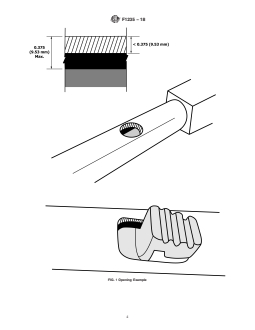
5.8 Openings—Holes or slots that extend entirely through a wall section of any rigid material less than 0.375-in. (9.53-mm)
thick and admit a 0.210-in. (5.33-mm) diameter rod shall also admit a 0.375-in. (9.53-mm) diameter rod. Holes or slots that are
between 0.210-in. (5.33-mm) and 0.375-in. (9.53-mm) and have a wall thickness less than 0.375-in. (9.53-mm) but are limited in
depth to 0.375-in. (9.53-mm) maximum by another rigid surface shall be permissible (see Fig. 1). The product shall be evaluated
in all manufacturer’s recommended use positions.
5.9 Labeling:
5.9.1 Warning labels (whether paper or non paper) shall be permanent when tested in accordance with 7.11.
5.9.2 Warning statements applied directly onto the surface of the product by hot stamping, heat transfer, printing, wood burning,
and so forth shall be permanent when tested in accordance with 7.11.
5.9.3 Nonpaper labels shall not liberate small parts when tested in accordance with 7.11.
5.10 Protective Components—If a child can grasp components between the thumb and forefinger, or teeth, (such as caps,
sleeves, or plugs used for protection from sharp edges, points, or entrapment of fingers or toes), or if there is at least a 0.040 in.
(1.00 mm) gap between the component and its adjacent parent component, such component shall not be removed when tested in
accordance with 7.4.
6. Performance Requirements
6.1 Chair Drop Test—The chair shall permit subsequent tests and exhibit no mechanical hazards (sharp points, sharp edges, or
small parts) when tested in accordance with 7.5.
6.2 Static Load Test—The chair shall support a static load on the seat without causing any hazardous conditions as identified
within this specification when tested in accordance with 7.6.
6.3 Seat and Seat Back Disengagement Test—The seat back and seat shall remain fully attached to the frame of the chair when
forces are applied in accordance with 7.7.
6.4 Chair Bounce Test—The chair shall remain attached to the standard test surface as described in 7.1.16 and allow no
movement greater than 1 in. (25 mm) when forces are applied in accordance with 7.8.
6.5 Chair Pull/Push Test—The chair shall remain attached to the standard test surface when tested in accordance with 7.9.
6.6 Restraint Systems:
6.6.1 A restraint system shall be provided to secure a child in the seated position in each of the manufacturer’s recommended
use positions.
6.6.1.1 The restraint system shall include both waist and crotch restraint. The crotch restraint shall be designed such that its use
is mandatory when the restraint system is in use.
NOTE 1—It should be noted that this test applies to all designs of restraining systems, whether they be of the traditional “active” or of the“ passive”the
“passive” type.
6.6.2 The restraint system and its closing means (for example, buckle) shall not break, separate or permit removal of the CAMI
test dummy (see Fig. 2) from the chair when tested in accordance with 7.10.
F1235 − 18
FIG. 1 Opening Example
F1235 − 18
FIG. 2 CAMI Infant Dummy, Mark II
6.6.2.1 If during the tests in 7.10 the posterior of the test dummy, with the force applied, is pulled past the front edge of the
seat, the dummy shall be considered removed.
6.6.2.2 After the tests in 7.10.6 and 7.10.7, the CAMI dummy shall not be fully released.
6.6.3 The waist restraint shall be capable of adjustment with a positive self-locking mechanism that is capable, when locked,
of withstanding the forces of tests in 7.10 without allowing restraint movement or slippage of more than 1 in. (25 mm).
6.6.4 A connecting means and adjustment means for the waist restraint shall be capable of usage independent of one another.
The connecting means shall not be an adjustment means, but may have one integrally attached to it.
6.6.5 Before shipment, the restraining system must be attached to the chair in such a manner as to not become detached through
normal use. For chairs requiring consumer assembly, buckles must be completely threaded and the restraining system must be
attached to a component that would render the chair unusable if not properly assembled.
6.7 Openings and Passive Crotch Restraint System:
NOTE 2—A passive crotch restraint required by this section does not meet the restraint system requirement of 6.6.1.1, which requires a crotch restraint
as part of the restraint system.
6.7.1 The hook-on chair shall have a passive crotch restraint that meets the following:
6.7.1.1 The passive crotch restraint shall be installed on the product at the time of shipment.shipment in a manner such that it
cannot be removed without the use of a tool.
6.7.1.2 The leg openings on each side of the passive crotch restraint shall not allow complete passage of the wedge block when
tested in accordance with 7.12.
6.7.2 Completely bounded openings in the surfaces that act as the sides of the seating area shall not allow complete passage
of the wedge block when tested in accordance with 7.12.
6.7.3 Completely bounded openings that are located forward of the occupant shall not allow complete passage of the wedge
block when tested in accordance with 7.12 (see Fig. 3).
6.7.3.1 Openings in the attachment structure of the product located under the standard test surface are exempt from this
requirement (see Fig. 4).
7. Test Methods
7.1 Test Equipment:
7.1.1 A push-pull gage.
7.1.2 A CAMI Infant Dummy Mark II (see Fig. 2).
7.1.3 Tension test adapter/clamp (see Fig. 5).
7.1.4 A 0.040 in. (1.00 mm) feeler gage.
7.1.5 A wood block 6 by 6 by ⁄4 in. thick (150 by 150 by 19 mm). In all cases where there is a hammock type seat, use the
weld cap as described in 7.1.6.
7.1.6 A6A 6 in. (150 mm) weld cap, as identified in Fig. 6, for use with a hammock type seat.
CAMI Infant Dummy (Mark II), Department of Transportation, Federal Aviation Administration, Cami Infant Dummy, Drawing No. SA-100I, Memorandum Report
AAC-119-74-14, Revision II, by Richard F. Chandler, July 2, 1974.
F1235 − 18
FIG. 3 Hook-On Chair Openings Evaluation
NOTE 3—If using a weld cap, subtract the weight of the cap from the indicated test weight.
7.1.7 A wood block 2 by 2 by ⁄4 in. thick, (50 by 50 by 19 mm).
7.1.8 A100A 100 lb (45.5 kg) weight.
7.1.9 A30A 30 lb (13.6 kg) weight.
7.1.10 A20A 20 lb (9.1 kg) weight.
7.1.11 A12A 12 lb (5.4 kg) weight.
7.1.12 A10A 10 lb (4.5 kg) weight.
7.1.13 A5A 5 lb (2.2 kg) weight.
7.1.14 Webbing tension pull device (see Fig. 7).
7.1.15 A clamp with ⁄4 in. (19 mm) diameter clamping surfaces.
7.1.16 Standard Test Surface, Underlayment, and Thickness:
7.1.16.1 The standard test surface should be a smooth finish, impregnated high pressure, high gloss laminate.
7.1.16.2 The underlayment should be clean particle board, smooth side down.
7.1.16.3 Two standard test surface thicknesses are required.
7.1.16.4 The minimum test surface shall be equal to or to the nearest ⁄4 in. (6 mm) greater than the minimum surface thickness
stated by the manufacturer on the retail package.
7.1.16.5 The maximum test surface shall be equal to or to the nearest ⁄4 in. (6 mm) less than the maximum thickness stated by
the manufacturer on the retail package.
7.2 Chair Assembly—Assemble the chair in accordance with the manufacturer’s instructions.
7.3 Latching Mechanisms for Prevention of Unintentional Folding:
7.3.1 Securely affix the chair according to the manufacturer’s directions to the maximum test surface so that the normal folding
motion is not impeded.
7.3.2 Gradually apply a force of 45 lbf (200 N) within 5 s and maintain for an additional 10 s. Apply the force in the direction
normally associated with folding or disassembly of the chair at a position most likely to cause failure. Repeat twice for a total of
three times within a 2 min period.
7.4 Removal of Protective Components From Chairs:
7.4.1 Any protective component which a child may reasonably be expected to grasp between the thumb and forefinger, or teeth,
or that has at least a 0.040 in. (1.00 mm) gap between itself and its adjacent parent component shall be tested in accordance with
each of the following methods in the sequence listed.
7.4.2 Secure the chair so that it cannot move during the performance of the following tests.
7.4.3 Torque Test—A torque of 3 lbf-in. (0.3 N·m) shall be applied evenly within a period of 5 s in a clockwise direction until
a rotation of 180° from the original position has been attained or 3 lbf-in. (0.3 N·m) has been exceeded. The torque or 180°
displacement shall be maintained for an additional 10 s. The torque shall then be removed and the test components permitted to
return to a relaxed condition. This procedure shall then be repeated in a counterclockwise direction.
7.4.4 Tension Test:
7.4.4.1 Attach a force gage to the protective component by means of any suitable device. For components that cannot reasonably
be expected to be grasped between thumb and forefinger, or teeth, on their outer diameter, but have at least a 0.040 in. (1.00 mm)
Formica, a registered trademark of Formica Corp., has been found suitable for this purpose.
F1235 − 18
FIG. 4 Example of Exempt Openings Area
FIG. 5 Tension Test Adapter/Clamp
gap or more behind the rear surface of the components and the structural member of the chair to which they are attached, a clamp
such as shown in Fig. 5 may be a suitable device.
7.4.4.2 Be sure that the attachment device does not compress or expand the component so that it hinders any possible removal
of the component.
7.4.4.3 Gradually apply a 15 lbf (67 N) force in a direction that would normally be associated with the removal of the protective
component. Gradually apply the force within 5 s and maintain for an additional 10 s.
7.5 Chair Drop Test:
7.5.1 Conduct all drop testing on a concrete floor, with ⁄8 in. (3 mm) thick vinyl flooring cover.
7.5.2 Drop a chair that does not fold, from a height of 36 in. (910 mm). Drop the chair twice on each of six different planes.
7.5.3 Drop a chair that does fold, from a height of 36 in. (910 mm). Drop the chair once on each of six different planes, both
in the folded and erect configurations.
7.5.4 Conduct all further tests on chairs that have passed this drop test.
7.6 Static Load Test:
F1235 − 18
NOTE 1—Caps furnished to ANSI standards unless otherwise specified. Welding caps are formed from steel plate and are ellipsoidal in shape. The minor
axis being equal to one half the major axis radii “R” and “r” closely approximate the actual semi-ellipsoidal shape. All dimensions in inches and are in
accordance with ANSI B16.9.
FIG. 6 Nominal Weld 6 in. Weld Cap—Weight (Approximately) 6.4 lb
NOTE 1—Dimension A—Width of webbing plus ⁄8 in. (3 mm).
NOTE 2—Dimension B—One half of Dimension A.
FIG. 7 Webbing Tension Pull Device
7.6.1 Securely affix the chair according to manufacturersmanufacturer’s directions to the minimum standard test surface.
7.6.2 Place a weight of 100 lb (45.5 kg) on the center of the seat and distribute it upon the 6 by 6 in. wood block.
7.6.3 Maintain this load for 60 s.
7.6.4 Repeat this procedure on the maximum standard test surface.
7.7 Seat and Seat Back Disengagement Test:
F1235 − 18
7.7.1 All forces in this section shall be gradually applied over 5 s through the 2 by 2 in. wood block and maintained for an
additional 10 s.
7.7.2 Step 1:
7.7.2.1 Securely affix the chair according to the manufacturer’s directions to the maximum test surface.
7.7.2.2 Place a weight of 20 lb (9.1 kg) on the center of the seat and distribute it upon the 6 by 6 in. wood block.
7.7.2.3 Gradually apply a force of 35 lbf (156 N) within 5 s downward on the middle of the top edge of the seat back. Repeat
this step on the left and right top edge of the seat back. Make sure the wood block does not extend beyond the side edge of the
seat back.
7.7.2.4 Gradually apply a force of 35 lbf (156 N) within 5 s upward on the middle of the bottom edge of the seat back. Repeat
this step on the left and right bottom edge of the seat back. Make sure the wood block does not extend beyond the side edge of
the seat back.
7.7.2.5 Gradually apply a force of 35 lbf (156 N) within 5 s toward the test surface on the middle of the seat back. Repeat this
step on the left and right corner of the top and bottom of the seat back. Make sure that the wood block does not extend beyond
the edge of the seat back.
7.7.2.6 Gradually apply a force of 35 lbf (156 N) within 5 s away from the test surface on the middle of the seat back. Repeat
this step on the left and right corner of the top and bottom of the seat back. Make sure that the wood block does not extend beyond
the edge of the seat back.
7.7.3 Step 2:
7.7.3.1 Securely affix the chair according to the manufacturer’s directions to the maximum test surface.
7.7.3.2 Gradually apply a force of 35 lbf (156 N) within 5 s downward on the middle of the seat. Repeat this step on each corner
of the seat. Make sure the wood block does not extend beyond the edge of the seat.
7.7.3.3 Gradually apply a force of 35 lbf (156 N) within 5 s away from the test surface on the middle of the front edge of the
seat. Repeat this step on each corner of the front edge of the seat being sure that the wood block does not extend beyond the side
edge of the seat.
7.7.3.4 Gradually apply a force of 35 lbf (156 N) within 5 s toward the test surface on the middle of the back edge of the seat.
Repeat this step on each corner of the back edge of the seat being sure that the wood block does not extend beyond the side edge
of the seat.
7.7.4 Step 3:
7.7.4.1 Invert the chair and support it so the seat is parallel to the test floor.
7.7.4.2 Gradually apply a force of 35 lbf (156 N) within 5 s downward on the middle of the seat. Repeat this step on each corner
of the seat. Make sure the wood block does not extend over the edge of the seat.
7.8 Chair Bounce Test:
7.8.1 Securely affix the chair according to the manufacturer’s directions to the minimum test surface.
7.8.2 Place a weight of 12 lb (5.4 kg) on the center of the seat and distribute it upon the 6 by 6 in. wood block.
7.8.3 Gradually apply a force of 15 lbf (67 N) within 5 s away from the test surface from a point in the middle of the seat back
along the same plane of the test surface. Apply the force using a strap or belt.
7.8.4 Drop a weight of 24 lb (10.9 kg) from a height of 1 in. (25 mm) onto the center of the seat.
7.8.5 Repeat for a total of 50 drop cycles.
7.8.6 Securely affix the chair according to the manufacturer’s directions to the maximum test surface, and repeat 7.8.1 – 7.8.5.
7.9 Chair Pull/Push Test:
7.9.1 Step 1:
7.9.1.1 Securely affix the chair according to the manufacturer’s directions to the minimum test surface.
7.9.1.2 Place the weight indicated in Table 1 on the center of the seat, distributed evenly on the 6 by 6 in. wood block.
7.9.1.3 Apply a force as i
...
Questions, Comments and Discussion
Ask us and Technical Secretary will try to provide an answer. You can facilitate discussion about the standard in here.
Loading comments...