

ASTM D8427-21
(Specification)Standard Specification for Rigid Poly Vinyl Chloride (PVC) Exterior Profiles Used for Sheet Piling
General Information
- Abstract
SCOPE
1.1 This specification establishes requirements for the material properties and physical properties, including dimensional tolerances, of rigid poly(vinyl chloride) (PVC) exterior profiles used for heavy construction, geotechnical, commercial, and residential sheet piling. Methods for testing and for identifying exterior profile extrusions that comply with this specification are also provided.
1.2 The material used in these exterior profiles is limited to rigid PVC compounds in a single homogeneous extrusion or in a coextrusion of two or more PVC compounds in distinct layers.
1.3 The values stated in inch-pound units are to be regarded as the standard.
1.4 This standard does not purport to address all of the safety concerns, if any, associated with its use. It is the responsibility of the user of this standard to establish appropriate safety, health, and environmental practices and determine the applicability of regulatory limitations prior to use.
1.5 This international standard was developed in accordance with internationally recognized principles on standardization established in the Decision on Principles for the Development of International Standards, Guides and Recommendations issued by the World Trade Organization Technical Barriers to Trade (TBT) Committee.
- Status
- Published
- Publication Date
- 30-Nov-2021
- Technical Committee
- D35 - Geosynthetics
- Drafting Committee
- D35.06 - Geosynthetic Specifications
Overview
ASTM D8427-21 is the international standard specification developed by ASTM International for rigid poly(vinyl chloride) (PVC) exterior profiles used for sheet piling. This standard sets requirements surrounding the material and physical properties-including dimensional tolerances-of rigid PVC profiles used in heavy construction, geotechnical, commercial, and residential sheet piling. It also provides recognized methods for testing and verifying compliance, ensuring quality, consistency, and safety for both manufacturers and end-users globally.
PVC sheet piling is a vital component in retaining walls, flood protection, soil stabilization, and shoreline reinforcement due to its resistance to environmental degradation and ease of installation. ASTM D8427-21 provides a benchmark for product manufacturing and performance.
Key Topics
- Material Requirements: Specifies the use of rigid PVC compounds, either in single homogeneous extrusions (monoextrusion) or coextruded profiles with distinct layers. The PVC compounds must meet cell classification requirements as outlined in referenced materials standards.
- Dimensional Tolerances: Defines strict tolerances for length, depth, width, and thickness of exterior profiles to ensure installation accuracy and system reliability.
- Physical and Mechanical Properties: Profiles must meet established criteria for tensile strength, modulus of elasticity, capstock thickness, impact resistance, and the integrity of layer bonding (for coextrusions).
- Testing and Sampling: Outlines procedures for sampling, specimen preparation, and statistical testing of properties such as tensile and impact strength to ensure compliance and product consistency.
- Workmanship and Appearance: Stipulates standards for external surface color uniformity, finish quality, and freedom from major blemishes or defects.
- Packaging and Marking: Details requirements for secure bundling, labeling of products and bundles, and traceability through product marking.
Applications
The ASTM D8427-21 standard is applied across a wide range of sectors including:
- Heavy Construction: Used in the creation of retaining walls, cut-off walls, and other critical support structures where durability, corrosion resistance, and precision are essential.
- Geotechnical Engineering: Provides effective barrier systems for earth retention, groundwater control, and soil stabilization.
- Commercial and Residential Projects: Ideal for waterfront properties, landscaping, and flood prevention, where reliable long-term performance and ease of installation are valued.
- Environmental Protection: Employs durable, weather-resistant PVC profiles for shoreline protection, erosion control, and remediation projects.
Adhering to ASTM D8427-21 ensures that PVC sheet piling products offer reliable performance, are suitable for structurally demanding environments, and meet internationally recognized safety and quality principles.
Related Standards
The performance and specifications defined in ASTM D8427-21 are supported and referenced by the following standards:
- ASTM D618 - Practice for Conditioning Plastics for Testing
- ASTM D638 - Test Method for Tensile Properties of Plastics
- ASTM D4216 - Specification for Rigid Poly(Vinyl Chloride) (PVC) and Related PVC and Chlorinated Poly(Vinyl Chloride) (CPVC) Building Products Compounds
- ASTM D4226 - Test Methods for Impact Resistance of Rigid Poly(Vinyl Chloride) (PVC) Building Products
- ASTM D883 & D1600 - Terminology relating to plastics and abbreviated terms
Manufacturers and engineers are encouraged to consult these standards for additional guidance on material properties, testing methodologies, and product performance. By aligning with ASTM D8427-21 and its referenced standards, stakeholders can ensure effective design, high-quality production, and safe installation of rigid PVC sheet piling systems.
Relations
- Effective Date
- 01-Feb-2024
- Effective Date
- 01-Nov-2023
- Effective Date
- 01-Jan-2020
- Effective Date
- 01-Nov-2019
- Effective Date
- 01-Nov-2019
- Effective Date
- 01-Aug-2019
- Effective Date
- 15-Apr-2019
- Effective Date
- 01-Feb-2019
- Effective Date
- 01-Dec-2018
- Effective Date
- 01-Nov-2018
- Refers
ASTM D1600-18 - Standard Terminology for Abbreviated Terms Relating to Plastics (Withdrawn 2024) - Effective Date
- 01-Jan-2018
- Effective Date
- 15-Aug-2017
- Effective Date
- 01-May-2016
- Effective Date
- 01-Feb-2014
- Effective Date
- 01-Nov-2013
Get Certified
Connect with accredited certification bodies for this standard

DIN CERTCO
DIN Group product certification.

Smithers Quality Assessments
US management systems and product certification.
Sponsored listings
Frequently Asked Questions
ASTM D8427-21 is a technical specification published by ASTM International. Its full title is "Standard Specification for Rigid Poly Vinyl Chloride (PVC) Exterior Profiles Used for Sheet Piling". This standard covers: SCOPE 1.1 This specification establishes requirements for the material properties and physical properties, including dimensional tolerances, of rigid poly(vinyl chloride) (PVC) exterior profiles used for heavy construction, geotechnical, commercial, and residential sheet piling. Methods for testing and for identifying exterior profile extrusions that comply with this specification are also provided. 1.2 The material used in these exterior profiles is limited to rigid PVC compounds in a single homogeneous extrusion or in a coextrusion of two or more PVC compounds in distinct layers. 1.3 The values stated in inch-pound units are to be regarded as the standard. 1.4 This standard does not purport to address all of the safety concerns, if any, associated with its use. It is the responsibility of the user of this standard to establish appropriate safety, health, and environmental practices and determine the applicability of regulatory limitations prior to use. 1.5 This international standard was developed in accordance with internationally recognized principles on standardization established in the Decision on Principles for the Development of International Standards, Guides and Recommendations issued by the World Trade Organization Technical Barriers to Trade (TBT) Committee.
SCOPE 1.1 This specification establishes requirements for the material properties and physical properties, including dimensional tolerances, of rigid poly(vinyl chloride) (PVC) exterior profiles used for heavy construction, geotechnical, commercial, and residential sheet piling. Methods for testing and for identifying exterior profile extrusions that comply with this specification are also provided. 1.2 The material used in these exterior profiles is limited to rigid PVC compounds in a single homogeneous extrusion or in a coextrusion of two or more PVC compounds in distinct layers. 1.3 The values stated in inch-pound units are to be regarded as the standard. 1.4 This standard does not purport to address all of the safety concerns, if any, associated with its use. It is the responsibility of the user of this standard to establish appropriate safety, health, and environmental practices and determine the applicability of regulatory limitations prior to use. 1.5 This international standard was developed in accordance with internationally recognized principles on standardization established in the Decision on Principles for the Development of International Standards, Guides and Recommendations issued by the World Trade Organization Technical Barriers to Trade (TBT) Committee.
ASTM D8427-21 is classified under the following ICS (International Classification for Standards) categories: 83.140.99 - Other rubber and plastics products. The ICS classification helps identify the subject area and facilitates finding related standards.
ASTM D8427-21 has the following relationships with other standards: It is inter standard links to ASTM D883-24, ASTM D883-23, ASTM D883-20, ASTM D4226-19e1, ASTM D4226-19, ASTM D883-19c, ASTM D883-19a, ASTM D883-19, ASTM D883-18a, ASTM D883-18, ASTM D1600-18, ASTM D883-17, ASTM D4226-16, ASTM D1600-14, ASTM D4216-13. Understanding these relationships helps ensure you are using the most current and applicable version of the standard.
ASTM D8427-21 is available in PDF format for immediate download after purchase. The document can be added to your cart and obtained through the secure checkout process. Digital delivery ensures instant access to the complete standard document.
Standards Content (Sample)
This international standard was developed in accordance with internationally recognized principles on standardization established in the Decision on Principles for the
Development of International Standards, Guides and Recommendations issued by the World Trade Organization Technical Barriers to Trade (TBT) Committee.
Designation: D8427 −21
Standard Specification for
Rigid Poly Vinyl Chloride (PVC) Exterior Profiles Used for
Sheet Piling
This standard is issued under the fixed designation D8427; the number immediately following the designation indicates the year of
original adoption or, in the case of revision, the year of last revision. A number in parentheses indicates the year of last reapproval. A
superscript epsilon (´) indicates an editorial change since the last revision or reapproval.
1. Scope D4216 Specification for Rigid Poly(Vinyl Chloride) (PVC)
and Related PVC and Chlorinated Poly(Vinyl Chloride)
1.1 This specification establishes requirements for the ma-
(CPVC) Building Products Compounds
terial properties and physical properties, including dimensional
D4226 Test Methods for Impact Resistance of Rigid Poly-
tolerances, of rigid poly(vinyl chloride) (PVC) exterior profiles
(Vinyl Chloride) (PVC) Building Products
used for heavy construction, geotechnical, commercial, and
residential sheet piling. Methods for testing and for identifying
3. Terminology
exterior profile extrusions that comply with this specification
3.1 Definitions—General definitions are in accordance with
are also provided.
Terminologies D883 and D1600, unless otherwise indicated.
1.2 The material used in these exterior profiles is limited to
3.2 Definitions of Terms Specific to This Standard:
rigid PVC compounds in a single homogeneous extrusion or in
3.2.1 capstock, n—the outer layer in a coextrusion exposed
a coextrusion of two or more PVC compounds in distinct
to weathering.
layers.
3.2.2 coextrusion, n—the process of coextruding profiles
1.3 The values stated in inch-pound units are to be regarded
from two or more streams of PVC compounds.
as the standard.
3.2.3 reworked material, n—material from the manufactur-
1.4 This standard does not purport to address all of the
er’s facility of known, compatible composition meeting the
safety concerns, if any, associated with its use. It is the
material requirement of this specification that has been re-
responsibility of the user of this standard to establish appro-
ground or pelletized after having been previously processed by
priate safety, health, and environmental practices and deter-
extrusion, and so forth.
mine the applicability of regulatory limitations prior to use.
3.2.4 single-layer profile, n—profiles extruded from a single
1.5 This international standard was developed in accor-
PVC compound (also sometimes called monoextrusion).
dance with internationally recognized principles on standard-
ization established in the Decision on Principles for the 3.2.5 substrate, n—inner layer(s) of a coextrusion not ex-
Development of International Standards, Guides and Recom-
posed to weathering.
mendations issued by the World Trade Organization Technical
4. Ordering Information
Barriers to Trade (TBT) Committee.
4.1 PVC sheet piling is ordered to a particular length, often
2. Referenced Documents
inincrementsof1 ftor2 ft.Thewidthandprofileshapeneeded
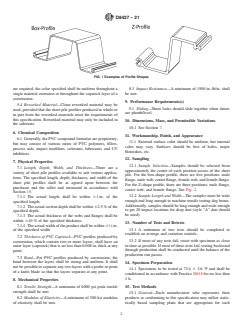
2.1 ASTM Standards: are determined by the engineer (see Fig. 1).
D618 Practice for Conditioning Plastics for Testing
5. Materials and Manufacture
D638 Test Method for Tensile Properties of Plastics
5.1 The rigid poly vinyl chloride (PVC) compound for
D883 Terminology Relating to Plastics
exterior profile extrusions meeting the requirements of this
D1600 Terminology forAbbreviatedTerms Relating to Plas-
specification are categorized by the cell class requirements in
tics
accordance with Specification D4216.
5.2 The virgin PVC compounds used for the products
This specification is under the jurisdiction of ASTM Committee D35 on
Geosynthetics and is the direct responsibility of Subcommittee D35.06 on Geosyn-
meetingthisspecificationshallmeetcell1-42443-33asdefined
thetic Specifications.
in Specification D4216. Compounds that have a higher cell
Current edition approved Dec. 1, 2021. Published December 2021. DOI:
classification because one or more properties are superior to
10.1520/D8427-21.
For referenced ASTM standards, visit the ASTM website, www.astm.org, or those in the specified compound are acceptable.
contact ASTM Customer Service at service@astm.org. For Annual Book of ASTM
5.3 Color—The color of the profiles shall be as agreed upon
Standards volume information, refer to the standard’s Document Summary page on
the ASTM website. between the purchaser and the seller. When no surface features
Copyright © ASTM International, 100 Barr Harbor Drive, PO Box C700, West Conshohocken, PA 19428-2959. United States
D8427 − 21
FIG. 1 Examples of Profile Shapes
are required, the color specified shall be uniform throughout a 8.3 Impact Resistance—A minimum of 1500 in.·lb/in. shall
single material extrusion or throughout the capstock layer of a be met.
coextrusion.
9. Performance Requirements(s)
5.4 Reworked Material—Clean reworked material may be
9.1 Sliding—Sheet locks should slide together when sheets
used, provided that the sheet pile profiles produced in whole or
are plumb/level.
in part from the reworked materials meet the requirements of
this specification. Reworked material may only be included in
10. Dimensions, Mass, and Permissible Variations
the substrate.
10.1 See Section 7.
6. Chemical Composition
11. Workmanship, Finish, and Appearance
6.1 Generally, the PVC compound formulae are proprietary,
11.1 External surface color should be uniform, but internal
but may consist of various ratios of PVC polymers, fillers,
color may vary. Surfaces should be free of holes, major
process aids, impact modifiers, colorants, lubricants, and UV
blemishes, etc.
inhibitors.
12. Sampling
7. Physical Properties
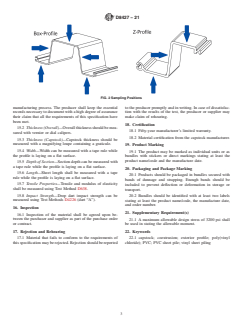
12.1 Sample Selection—Samples should be selected from
7.1 Length, Depth, Width, and Thickness—There are a
approximately the center of each position across of the sheet
variety of sheet pile profiles available to suit various applica-
pile. For the box-shape profile, there are five positions: male
tions. The specified length, depth, thickness, and width of the
flange,maleweb,centerflange,femaleweb,andfemaleflange.
sheet pile profiles shall be as agreed upon between the
For the Z-shape profile, there are three positions: male flange,
purchaser and the seller and measured in accordance with
center web, and female flange. See Fig. 2.
Section 15.
12.2 Sample Length and Width—The samples must be wide
7.1.1 The actual length shall be within 61 in. of the
enough and long enough to machine tensile testing dog bones.
specified length.
Additionally, samples should be long enough and wide enough
7.1.2 The actual section depth shall be within 62.5 % of the
to get 20 impact locations for drop dart (style “A” dart should
specified depth.
be used).
7.1.3 The actual thickness of the webs and flanges shall be
within 610 % of the specified thickness.
13. Number of Tests and Retests
7.1.4 The actual width of the product shall be within 6 ⁄4 in.
13.1 A minimum of two tests should be completed to
of the specified width.
establish an average and variation statistic.
7.2 Thickness of PVC Capstock—PVC profiles produced by
13.2 If most of any tests fail, retest with specimen as close
coextrusion, which contain two or more layers, shall have an
in time as possible. If most of these tests fail, testing backward
outer layer (capstock) that is no less than 0.008 in. thick at any
through production s
...