

ASTM D6067/D6067M-17
(Practice)Standard Practice for Using the Electronic Piezocone Penetrometer Tests for Environmental Site Characterization and Estimation of Hydraulic Conductivity
General Information
- Abstract
SIGNIFICANCE AND USE
4.1 Environmental site characterization projects almost always require information regarding subsurface soil stratigraphy and hydraulic parameters related to groundwater flow rate and direction. Soil stratigraphy often is determined by various drilling procedures and interpreting the data collected on borehole logs. The electronic piezocone penetrometer test is another means of determining soil stratigraphy that may be faster, less expensive, and provide greater resolution of the soil units than conventional drilling and sampling methods. For environmental site characterization applications, the electronic piezocone also has the additional advantage of not generating contaminated cuttings that may present other disposal problems (2, 3, 4, 5, 6, 7, 8, 9, 10). Investigators may obtain soil samples from adjacent borings for correlation purposes, but prior information or experience in the same area may preclude the need for borings (11). Most cone penetrometer rigs are equipped with direct push soil samplers (Guide D6282/D6282M) that can be used to confirm soil types.
4.2 The electronic piezocone penetration test is an in situ investigation method involving:
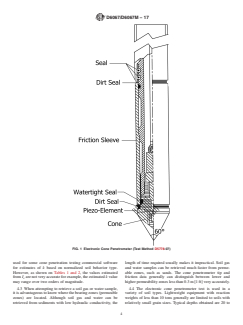
4.2.1 Pushing an electronically instrumented probe into the ground (see Fig. 1 for a diagram of a typical cone penetrometer). The position of the pore pressure element may vary but is typically located in the u2 position, as shown in Fig. 1 (Test Method D5778).
4.2.3.3 Robertson proposed the following equations estimating k from Ic and shown on Fig. 4 (11). These equations are used for some cone penetration testing commercial software for estimates of k based on normalized soil behavior type. However, as shown on Tables 1 and 2, the values estimated from Ic are not very accurate for example, the estimated k value may range over two orders of magnitude.
FIG. 4 Proposed Relationship Between Ic and Normalized Soil Behavior Type and Estimated Soil Permeability, k (Robertson (1))
4.3 When attempting to re...
SCOPE
1.1 The electronic cone penetrometer test often is used to determine subsurface stratigraphy for geotechnical and environmental site characterization purposes (1).2 The geotechnical application of the electronic cone penetrometer test is discussed in detail in Test Method D5778, however, the use of the electronic cone penetrometer test in environmental site characterization applications involves further considerations that are not discussed. For environmental site characterization, it is highly recommended to use the Piezocone (PCPT or CPTu) option in Test Method D5778 so information on hydraulic conductivity and aquifer hydrostatic pressures can be evaluated.
1.2 The purpose of this practice is to discuss aspects of the electronic cone penetrometer test that need to be considered when performing tests for environmental site characterization purposes.
1.3 The electronic cone penetrometer test for environmental site characterization projects often requires steam cleaning the push rods and grouting the hole. There are numerous ways of cleaning and grouting depending on the scope of the project, local regulations, and corporate preferences. It is beyond the scope of this practice to discuss all of these methods in detail. A detailed explanation of grouting procedures is discussed in Guide D6001.
1.4 Cone penetrometer tests are often used to locate aquifer zones for installation of wells (Practice D5092/D5092M, Guide D6274). The cone test may be combined with direct push soil sampling for confirming soil types (Guide D6282/D6282M). Direct push hydraulic injection profiling (Practice D8037/D8037M) is another complementary test for estimating hydraulic conductivity and direct push slug tests (D7242/D7242M) and used for confirming estimates. Cone penetrometers can be equipped with additional sensors for groundwater quality evaluations (Practice D6187). Location of other sensors must conform to requirements of Test Meth...
- Status
- Published
- Publication Date
- 14-Dec-2017
- Technical Committee
- D18 - Soil and Rock
- Drafting Committee
- D18.21 - Groundwater and Vadose Zone Investigations
Buy Documents
ASTM D6067/D6067M-17 - Standard Practice for Using the Electronic Piezocone Penetrometer Tests for Environmental Site Characterization and Estimation of Hydraulic Conductivity
REDLINE ASTM D6067/D6067M-17 - Standard Practice for Using the Electronic Piezocone Penetrometer Tests for Environmental Site Characterization and Estimation of Hydraulic Conductivity
Overview
ASTM D6067/D6067M-17: Standard Practice for Using the Electronic Piezocone Penetrometer Tests for Environmental Site Characterization and Estimation of Hydraulic Conductivity provides a recognized method for collecting in situ data on subsurface soil stratigraphy and key hydraulic properties using electronic piezocone penetrometer (CPTu) technology. Issued by ASTM International, this standard supports environmental site investigations by enabling accurate, fast, and cost-effective assessment of groundwater flow, contaminant transport, and aquifer characteristics, all with minimal environmental disturbance.
Key Topics
- Subsurface Soil Stratigraphy
Electronic piezocone penetrometer tests (CPTu or PCPT) provide high-resolution profiles of subsurface soil layers, often with greater detail and speed than traditional drilling and sampling approaches. - Hydraulic Conductivity Estimation
The technique facilitates the estimation of hydraulic conductivity, a crucial parameter governing groundwater movement, by leveraging measured soil behavior type and pore water pressure data. - Minimal Environmental Impact
This method does not generate contaminated soil cuttings during testing, reducing risk and the need for special disposal. - In Situ Testing
The electronic piezocone is directly advanced into the ground, allowing for real-time measurements without extensive drilling. Parameters measured include tip resistance, sleeve friction, and pore water pressure. - Pore Water Pressure Data
Interpreted pore pressure readings from the penetrometer help identify aquifers, aquitards, and perched water zones. Dissipation tests further assist in understanding groundwater flow and soil permeability. - Data Integration and Confirmation
CPTu data may be correlated with nearby soil borings and complemented by direct push sampling or hydraulic profiling for comprehensive site characterization.
Applications
- Environmental Site Characterization
This standard is ideal for characterizing sites where chemical (organic/inorganic) contaminants are of concern, supporting risk analysis and remediation planning. - Groundwater Monitoring Wells Installation
The CPTu method helps pinpoint aquifer zones, ensuring optimal placement of groundwater monitoring wells. - Hydraulic Conductivity Assessment
Practitioners can estimate groundwater flow rates and directions, informing the design of remediation systems or containment strategies. - Expedited Site Characterization
The rapid acquisition and interpretation of stratigraphic and hydraulic data speeds up project timelines and supports agile decision-making during site investigations. - Integration with Direct Push Technologies
The electronic piezocone may be deployed alongside direct push soil sampling or groundwater sampling to validate soil unit identification and enhance data reliability.
Related Standards
- ASTM D5778 - Test Method for Electronic Friction Cone and Piezocone Penetration Testing of Soils
- ASTM D6001 - Guide for Direct Push Groundwater Sampling for Environmental Site Characterization
- ASTM D5092/D5092M - Practice for Design and Installation of Groundwater Monitoring Wells
- ASTM D6282/D6282M - Guide for Direct Push Soil Sampling for Environmental Site Characterizations
- ASTM D8037/D8037M - Practice for Direct Push Hydraulic Logging for Profiling Permeability in Soils
- ASTM D6187 - Practice for Cone Penetrometer Technology Characterization of Petroleum Contaminated Sites
Practical Value
- Efficiency and Cost-Effectiveness
Electronic CPT provides a faster and less expensive alternative to traditional site characterization while delivering high-resolution subsurface details. - Reduced Environmental Liability
The non-intrusive nature of CPTu testing minimizes the production of waste, lessening liability and disposal costs. - Better Data for Decision Making
Real-time, reproducible data on soil properties and hydraulic conditions enable informed environmental management strategies. - Versatility
The method can be adapted with additional sensors for groundwater quality monitoring, further expanding its utility in site investigations.
ASTM D6067/D6067M-17 is an essential reference for environmental professionals seeking reliable, modern approaches to subsurface investigation and hydraulic conductivity estimation. By following this standard, practitioners can ensure high-quality data collection to support effective site characterization and environmental risk management.
Relations
- Effective Date
- 15-Dec-2017
- Effective Date
- 01-Nov-2023
- Effective Date
- 01-Jun-2020
- Effective Date
- 01-May-2020
- Effective Date
- 01-Oct-2019
- Effective Date
- 01-Apr-2019
- Effective Date
- 15-Dec-2018
- Effective Date
- 15-Dec-2018
- Effective Date
- 15-Nov-2016
- Refers
ASTM D5092/D5092M-16 - Standard Practice for Design and Installation of Groundwater Monitoring Wells - Effective Date
- 15-Nov-2016
- Effective Date
- 15-Mar-2016
- Effective Date
- 01-Aug-2015
- Effective Date
- 01-Jul-2015
- Effective Date
- 15-Jan-2015
- Effective Date
- 01-Aug-2014
Buy Documents
ASTM D6067/D6067M-17 - Standard Practice for Using the Electronic Piezocone Penetrometer Tests for Environmental Site Characterization and Estimation of Hydraulic Conductivity
REDLINE ASTM D6067/D6067M-17 - Standard Practice for Using the Electronic Piezocone Penetrometer Tests for Environmental Site Characterization and Estimation of Hydraulic Conductivity
Get Certified
Connect with accredited certification bodies for this standard

CIS Institut d.o.o.
Personal Protective Equipment (PPE) certification body. Notified Body NB-2890 for EU Regulation 2016/425 PPE.

Kiwa BDA Testing
Building and construction product certification.
Kmetijski inštitut Slovenije
Agricultural Institute of Slovenia. Soil testing, plant health, agricultural product analysis.
Sponsored listings
Frequently Asked Questions
ASTM D6067/D6067M-17 is a standard published by ASTM International. Its full title is "Standard Practice for Using the Electronic Piezocone Penetrometer Tests for Environmental Site Characterization and Estimation of Hydraulic Conductivity". This standard covers: SIGNIFICANCE AND USE 4.1 Environmental site characterization projects almost always require information regarding subsurface soil stratigraphy and hydraulic parameters related to groundwater flow rate and direction. Soil stratigraphy often is determined by various drilling procedures and interpreting the data collected on borehole logs. The electronic piezocone penetrometer test is another means of determining soil stratigraphy that may be faster, less expensive, and provide greater resolution of the soil units than conventional drilling and sampling methods. For environmental site characterization applications, the electronic piezocone also has the additional advantage of not generating contaminated cuttings that may present other disposal problems (2, 3, 4, 5, 6, 7, 8, 9, 10). Investigators may obtain soil samples from adjacent borings for correlation purposes, but prior information or experience in the same area may preclude the need for borings (11). Most cone penetrometer rigs are equipped with direct push soil samplers (Guide D6282/D6282M) that can be used to confirm soil types. 4.2 The electronic piezocone penetration test is an in situ investigation method involving: 4.2.1 Pushing an electronically instrumented probe into the ground (see Fig. 1 for a diagram of a typical cone penetrometer). The position of the pore pressure element may vary but is typically located in the u2 position, as shown in Fig. 1 (Test Method D5778). 4.2.3.3 Robertson proposed the following equations estimating k from Ic and shown on Fig. 4 (11). These equations are used for some cone penetration testing commercial software for estimates of k based on normalized soil behavior type. However, as shown on Tables 1 and 2, the values estimated from Ic are not very accurate for example, the estimated k value may range over two orders of magnitude. FIG. 4 Proposed Relationship Between Ic and Normalized Soil Behavior Type and Estimated Soil Permeability, k (Robertson (1)) 4.3 When attempting to re... SCOPE 1.1 The electronic cone penetrometer test often is used to determine subsurface stratigraphy for geotechnical and environmental site characterization purposes (1).2 The geotechnical application of the electronic cone penetrometer test is discussed in detail in Test Method D5778, however, the use of the electronic cone penetrometer test in environmental site characterization applications involves further considerations that are not discussed. For environmental site characterization, it is highly recommended to use the Piezocone (PCPT or CPTu) option in Test Method D5778 so information on hydraulic conductivity and aquifer hydrostatic pressures can be evaluated. 1.2 The purpose of this practice is to discuss aspects of the electronic cone penetrometer test that need to be considered when performing tests for environmental site characterization purposes. 1.3 The electronic cone penetrometer test for environmental site characterization projects often requires steam cleaning the push rods and grouting the hole. There are numerous ways of cleaning and grouting depending on the scope of the project, local regulations, and corporate preferences. It is beyond the scope of this practice to discuss all of these methods in detail. A detailed explanation of grouting procedures is discussed in Guide D6001. 1.4 Cone penetrometer tests are often used to locate aquifer zones for installation of wells (Practice D5092/D5092M, Guide D6274). The cone test may be combined with direct push soil sampling for confirming soil types (Guide D6282/D6282M). Direct push hydraulic injection profiling (Practice D8037/D8037M) is another complementary test for estimating hydraulic conductivity and direct push slug tests (D7242/D7242M) and used for confirming estimates. Cone penetrometers can be equipped with additional sensors for groundwater quality evaluations (Practice D6187). Location of other sensors must conform to requirements of Test Meth...
SIGNIFICANCE AND USE 4.1 Environmental site characterization projects almost always require information regarding subsurface soil stratigraphy and hydraulic parameters related to groundwater flow rate and direction. Soil stratigraphy often is determined by various drilling procedures and interpreting the data collected on borehole logs. The electronic piezocone penetrometer test is another means of determining soil stratigraphy that may be faster, less expensive, and provide greater resolution of the soil units than conventional drilling and sampling methods. For environmental site characterization applications, the electronic piezocone also has the additional advantage of not generating contaminated cuttings that may present other disposal problems (2, 3, 4, 5, 6, 7, 8, 9, 10). Investigators may obtain soil samples from adjacent borings for correlation purposes, but prior information or experience in the same area may preclude the need for borings (11). Most cone penetrometer rigs are equipped with direct push soil samplers (Guide D6282/D6282M) that can be used to confirm soil types. 4.2 The electronic piezocone penetration test is an in situ investigation method involving: 4.2.1 Pushing an electronically instrumented probe into the ground (see Fig. 1 for a diagram of a typical cone penetrometer). The position of the pore pressure element may vary but is typically located in the u2 position, as shown in Fig. 1 (Test Method D5778). 4.2.3.3 Robertson proposed the following equations estimating k from Ic and shown on Fig. 4 (11). These equations are used for some cone penetration testing commercial software for estimates of k based on normalized soil behavior type. However, as shown on Tables 1 and 2, the values estimated from Ic are not very accurate for example, the estimated k value may range over two orders of magnitude. FIG. 4 Proposed Relationship Between Ic and Normalized Soil Behavior Type and Estimated Soil Permeability, k (Robertson (1)) 4.3 When attempting to re... SCOPE 1.1 The electronic cone penetrometer test often is used to determine subsurface stratigraphy for geotechnical and environmental site characterization purposes (1).2 The geotechnical application of the electronic cone penetrometer test is discussed in detail in Test Method D5778, however, the use of the electronic cone penetrometer test in environmental site characterization applications involves further considerations that are not discussed. For environmental site characterization, it is highly recommended to use the Piezocone (PCPT or CPTu) option in Test Method D5778 so information on hydraulic conductivity and aquifer hydrostatic pressures can be evaluated. 1.2 The purpose of this practice is to discuss aspects of the electronic cone penetrometer test that need to be considered when performing tests for environmental site characterization purposes. 1.3 The electronic cone penetrometer test for environmental site characterization projects often requires steam cleaning the push rods and grouting the hole. There are numerous ways of cleaning and grouting depending on the scope of the project, local regulations, and corporate preferences. It is beyond the scope of this practice to discuss all of these methods in detail. A detailed explanation of grouting procedures is discussed in Guide D6001. 1.4 Cone penetrometer tests are often used to locate aquifer zones for installation of wells (Practice D5092/D5092M, Guide D6274). The cone test may be combined with direct push soil sampling for confirming soil types (Guide D6282/D6282M). Direct push hydraulic injection profiling (Practice D8037/D8037M) is another complementary test for estimating hydraulic conductivity and direct push slug tests (D7242/D7242M) and used for confirming estimates. Cone penetrometers can be equipped with additional sensors for groundwater quality evaluations (Practice D6187). Location of other sensors must conform to requirements of Test Meth...
ASTM D6067/D6067M-17 is classified under the following ICS (International Classification for Standards) categories: 13.080.20 - Physical properties of soils. The ICS classification helps identify the subject area and facilitates finding related standards.
ASTM D6067/D6067M-17 has the following relationships with other standards: It is inter standard links to ASTM D6067-10, ASTM D3740-23, ASTM D5778-20, ASTM D5088-20, ASTM D3740-19, ASTM C150/C150M-19, ASTM D6274-18, ASTM D6235-18, ASTM D8037/D8037M-16, ASTM D5092/D5092M-16, ASTM C150/C150M-16, ASTM D5088-15a, ASTM C150/C150M-15, ASTM D5088-15, ASTM D653-14. Understanding these relationships helps ensure you are using the most current and applicable version of the standard.
ASTM D6067/D6067M-17 is available in PDF format for immediate download after purchase. The document can be added to your cart and obtained through the secure checkout process. Digital delivery ensures instant access to the complete standard document.
Standards Content (Sample)
This international standard was developed in accordance with internationally recognized principles on standardization established in the Decision on Principles for the
Development of International Standards, Guides and Recommendations issued by the World Trade Organization Technical Barriers to Trade (TBT) Committee.
Designation: D6067/D6067M − 17
Standard Practice for
Using the Electronic Piezocone Penetrometer Tests for
Environmental Site Characterization and Estimation of
Hydraulic Conductivity
This standard is issued under the fixed designation D6067/D6067M; the number immediately following the designation indicates the
year of original adoption or, in the case of revision, the year of last revision. A number in parentheses indicates the year of last
reapproval. A superscript epsilon (´) indicates an editorial change since the last revision or reapproval.
1. Scope* D7242M) and used for confirming estimates. Cone penetrom-
eters can be equipped with additional sensors for groundwater
1.1 The electronic cone penetrometer test often is used to
qualityevaluations(PracticeD6187).Locationofothersensors
determine subsurface stratigraphy for geotechnical and envi-
2 must conform to requirements of Test Method D5778.
ronmentalsitecharacterizationpurposes (1). Thegeotechnical
application of the electronic cone penetrometer test is dis- 1.5 This practice is applicable only at sites where chemical
cussed in detail inTest Method D5778, however, the use of the (organic and inorganic) wastes are a concern and is not
electronic cone penetrometer test in environmental site char- intended for use at radioactive or mixed (chemical and radio-
acterization applications involves further considerations that active) waste sites due to specialized monitoring requirements
are not discussed. For environmental site characterization, it is of drilling equipment.
highly recommended to use the Piezocone (PCPT or CPTu)
1.6 Units—The values stated in either SI units or in-lb units
option in Test Method D5778 so information on hydraulic
(presented in brackets) are to be regarded separately as
conductivity and aquifer hydrostatic pressures can be evalu-
standard. The values stated in each system may not be exact
ated.
equivalents;therefore,eachsystemshallbeusedindependently
1.2 The purpose of this practice is to discuss aspects of the of the other. Units for conductivity are either m/s or cm/s
electronic cone penetrometer test that need to be considered depending on the sources cited.
when performing tests for environmental site characterization
1.7 All observed and calculated values shall conform to the
purposes.
guidelines for significant digits and rounding established in
1.3 The electronic cone penetrometer test for environmental Practice D6026, unless superseded by this standard.
site characterization projects often requires steam cleaning the
1.8 This standard does not purport to address all of the
push rods and grouting the hole. There are numerous ways of
safety concerns, if any, associated with its use. It is the
cleaning and grouting depending on the scope of the project,
responsibility of the user of this standard to establish appro-
local regulations, and corporate preferences. It is beyond the
priate safety, health, and environmental practices and deter-
scope of this practice to discuss all of these methods in detail.
mine the applicability of regulatory limitations prior to use.
A detailed explanation of grouting procedures is discussed in
1.9 This practice offers a set of instructions for performing
Guide D6001.
one or more specific operations. This document cannot replace
education or experience and should be used in conjunction
1.4 Cone penetrometer tests are often used to locate aquifer
with professional judgment. Not all aspects of this practice may
zones for installation of wells (Practice D5092/D5092M,
be applicable in all circumstances. This ASTM standard is not
Guide D6274). The cone test may be combined with direct
intended to represent or replace the standard of care by which
push soil sampling for confirming soil types (Guide D6282/
the adequacy of a given professional service must be judged,
D6282M). Direct push hydraulic injection profiling (Practice
nor should this document be applied without consideration of
D8037/D8037M) is another complementary test for estimating
a project’s many unique aspects. The word "Standard" in the
hydraulic conductivity and direct push slug tests (D7242/
title means only that the document has been approved through
the ASTM consensus process.
This practice is under the jurisdiction of ASTM Committee D18 on Soil and
1.10 This international standard was developed in accor-
Rock and is the direct responsibility of Subcommittee D18.21 on Groundwater and
dance with internationally recognized principles on standard-
Vadose Zone Investigations.
Current edition approved Dec. 15, 2017. Published February 2018. Originally
ization established in the Decision on Principles for the
approved in 1996. Last previous edition approved in 2010 as D6067–10. DOI:
Development of International Standards, Guides and Recom-
10.1520/D6067_D6067M-17.
mendations issued by the World Trade Organization Technical
The boldface numbers in parentheses refer to the list of references at the end of
this guide. Barriers to Trade (TBT) Committee.
*A Summary of Changes section appears at the end of this standard
Copyright © ASTM International, 100 Barr Harbor Drive, PO Box C700, West Conshohocken, PA 19428-2959. United States
D6067/D6067M − 17
2. Referenced Documents differentterms.Amorecompletediscussionoftheterminology
3 associated with Darcy’s law is given in the literature
2.1 ASTM Standards:
C150/C150M Specification for Portland Cement 3.1.4 hydraulic conductivity (in field aquifer tests), n—the
volume of water at the existing kinematic viscosity that will
D653 Terminology Relating to Soil, Rock, and Contained
Fluids move in a unit time under a unit hydraulic gradient through a
unit area measured at right angles to the direction of flow.
D3740 Practice for Minimum Requirements for Agencies
Engaged in Testing and/or Inspection of Soil and Rock as
3.2 Definitions of Terms Specific to This Standard in Accor-
Used in Engineering Design and Construction
dance with D5778:
D5088 Practice for Decontamination of Field Equipment
3.2.1 cone tip, n—the conical point of a cone penetrometer
Used at Waste Sites
on which the end bearing component of penetration resistance
D5092/D5092M Practice for Design and Installation of
is developed.
Groundwater Monitoring Wells
3.2.2 cone resistance, q,n—the measured end-bearing
c
D5778 Test Method for Electronic Friction Cone and Piezo-
componentofpenetrationresistance.Theresistancetopenetra-
cone Penetration Testing of Soils
tiondevelopedontheconeisequaltotheverticalforceapplied
D6001 Guide for Direct-Push Groundwater Sampling for
to the cone divided by the cone base area.
Environmental Site Characterization
3.2.3 cone penetration test, n—a series of penetration read-
D6026 Practice for Using Significant Digits in Geotechnical
ings performed at one location over the entire vertical depth
Data
when using a cone penetrometer. Also referred to as a cone
D6187 Practice for Cone Penetrometer Technology Charac-
sounding
terization of Petroleum Contaminated Sites with Nitrogen
Laser-Induced Fluorescence
3.2.4 electronic cone penetrometer, n—a friction cone pen-
D6235 Practice for Expedited Site Characterization of Va-
etrometer that uses force transducers, such as strain gauge load
dose Zone and Groundwater Contamination at Hazardous
cells, built into a nontelescoping penetrometer tip for measur-
Waste Contaminated Sites
ing within the penetrometer tip, the components of penetration
D6274 Guide for Conducting Borehole Geophysical Log-
resistance.
ging - Gamma
3.2.5 electronic piezocone penetrometer, n—an electronic
D6282/D6282M Guide for Direct Push Soil Sampling for
cone penetrometer equipped with a low volume fluid chamber,
Environmental Site Characterizations
porous element, and pressure transducer for determination of
D7242/D7242M Practice for Field Pneumatic Slug (Instan-
pore water pressure at the porous element soil interface
taneous Change in Head) Tests to Determine Hydraulic
measured simultaneously with end bearing and frictional
Properties of Aquifers with Direct Push Groundwater
components of penetration resistance.
Samplers
3.2.6 equilibrium pore water pressure, u ,n—at rest water
o
D8037/D8037M PracticeforDirectPushHydraulicLogging
pressure at depth of interest. Same as hydrostatic head. D653
for Profiling Variations of Permeability in Soils
3.2.7 excess pore water pressure, ∆u = u–u ,n—the differ-
3. Terminology
ence between pore water pressure measured as the penetration
occurs (u), and estimated equilibrium pore water pressure (u ),
3.1 Definitions:
or: ∆u=(u – u ). Excess pore water pressure can either be
3.1.1 For definitions of terms related to this standard, refer
positive or negative for shoulder position filters.
to Terminology D653.
-1
3.1.2 coeffıcient of permeability, k, [LT ]—the rate of dis-
3.2.8 friction ratio, R,n— the ratio of friction sleeve
f
charge of water under laminar flow conditions through a unit
resistance, f , to cone resistance, q , measured with the middle
s c
cross-sectional area of a porous medium under a unit hydraulic
of the friction sleeve at the same depth as the cone point. It is
gradient and standard temperature conditions (usually 20°C).
usually expressed as a percentage.
3.1.3 hydraulic conductivity, k—the rate of discharge of
3.2.9 friction reducer, n—anarrowlocalprotuberanceonthe
water under laminar flow conditions through a unit cross-
outside of the push rod surface, placed at a certain distance
sectional area of porous medium under a unit hydraulic
above the penetrometer tip, which is provided to reduce the
gradient and standard temperature conditions [20°C].
total side friction on the push rods and allow for greater
3.1.3.1 Discussion—In hydraulic conductivity testing, the
penetration depths for a given push capacity.
term coefficient of permeability is often used instead of
3.2.10 friction sleeve resistance, f,n—the friction compo-
s
hydraulic conductivity, and colloquially the term permeability
nent of penetration resistance developed on a friction sleeve,
is often used interchangeably with hydraulic conductivity. The
equaltotheshearforceappliedtothefrictionsleevedividedby
terms are used interchangeably in this standard as different
its surface area.
information resources are cited in the document that use
3.2.11 friction sleeve, n—an isolated cylindrical sleeve sec-
tion on a penetrometer tip upon which the friction component
For referenced ASTM standards, visit the ASTM website, www.astm.org, or
of penetration resistance develops.
contact ASTM Customer Service at service@astm.org. For Annual Book of ASTM
3.2.12 penetrometer, n—an apparatus consisting of a series
Standards volume information, refer to the standard’s Document Summary page on
the ASTM website. of cylindrical push rods with a terminal body (end section)
D6067/D6067M − 17
called the penetrometer tip and measuring devices for deter- 3.4.7 k—Coefficient of hydraulic conductivity or permeabil-
mination of the components of penetration resistance. ity (D18 Standards Preparation Manual).
3.4.8 K—Intrinsic(absolute)permeabilityinareaunits(D18
3.2.13 penetrometer tip, n—the terminal body (end section)
Standards Preparation Manual).
of the penetrometer which contains the active elements that
sense the components of penetration resistance.
3.5 Acronyms:
3.2.14 piezocone, n—same as electronic piezocone pen- 3.5.1 CPT—Cone Penetration Test.
etrometer.
3.5.2 PCPT or CPTu—Piezocone Penetration Test. D5778
3.2.15 piezocone pore pressure, u, n—fluid pressure mea-
sured using the piezocone penetration test. 4. Significance and Use
3.2.16 push rods, n—the thick walled tubes or rods used to 4.1 Environmental site characterization projects almost al-
advance the penetrometer tip. ways require information regarding subsurface soil stratigra-
phy and hydraulic parameters related to groundwater flow rate
3.3 Definitions of Terms Specific to This Standard:
and direction. Soil stratigraphy often is determined by various
3.3.1 bentonite, n—the common name for drilling fluid
drilling procedures and interpreting the data collected on
additives and well construction products consisting mostly of
borehole logs. The electronic piezocone penetrometer test is
naturally occurring sodium montmorillonite. Some bentonite
another means of determining soil stratigraphy that may be
products have chemical additives that may affect water quality
faster, less expensive, and provide greater resolution of the soil
analyses.
units than conventional drilling and sampling methods. For
3.3.2 dissipation test, n—test where the dissipation of ex-
environmental site characterization applications, the electronic
cess pore water pressure generated during push is monitored
piezocone also has the additional advantage of not generating
versus time to evaluate depth specific hydraulic conductivity
contaminated cuttings that may present other disposal prob-
and final pressure head of the soil when penetration is stopped.
lems (2, 3, 4, 5, 6, 7, 8, 9, 10). Investigators may obtain soil
3.3.2.1 Discussion—Either complete or 50 % dissipation
samples from adjacent borings for correlation purposes, but
time is monitored. Complete dissipation can be used to
prior information or experience in the same area may preclude
determineequilibriumporewaterpressureandthushydrostatic
the need for borings (11). Most cone penetrometer rigs are
head at a point in the aquifer. The time required for dissipation
equipped with direct push soil samplers (Guide D6282/
depends on the soil type.
D6282M) that can be used to confirm soil types.
3.3.3 soil behavior type index, I,n—Index where the
4.2 The electronic piezocone penetration test is an in situ
c
normalized cone parameters Q and F can be combined into
t r investigation method involving:
one Soil Behavior Type index, I , where I is the radius of the
c c
4.2.1 Pushing an electronically instrumented probe into the
essentially concentric circles that represent the boundaries
ground (see Fig. 1 for a diagram of a typical cone penetrom-
between each SBT zone on the normalized soil behavior type
eter). The position of the pore pressure element may vary but
classification charts.
is typically located in the u position, as shown in Fig. 1 (Test
3.3.3.1 Discussion—I is determined by equation using
c Method D5778).
normalized tip resistance, friction ratio and is a function and
4.2.2 Recording force resistances, such as tip resistance,
effective confining stresses. For the equation for I , refer to
c friction sleeve resistance, and pore water pressure.
references by Lunne & Robertson (1, 2).
4.2.3 Data interpretation.
4.2.3.1 The most common use of the interpreted data is
3.4 Symbols:
stratigraphy based on soil behavior types. Several charts are
3.4.1 I —soil behavior type index.
c
available.Atypical CPT soil behavior type classification chart
3.4.2 t —time for dissipation of 50 percent of the excess
is shown in Figs. 2 and 3 (1, 2). Figure 3 uses tip and friction
pore water pressure during dissipation tests.
sleeve resistance data normalized to the estimated in-situ
3.4.3 ∆ —excess pore pressure.
ground stresses. The first step in determining the extent and
u
motion of contaminants is to determine the subsurface stratig-
3.4.4 qt—Corrected cone resistance—The cone resistance
raphy. Since the contaminants will migrate primarily through
qc corrected for pore water effects. qt = qc + u (1- a ).
2 n
the more permeable strata, it is impossible to characterize an
3.4.4.1 Discussion—(Typical CPT a = net area ratio is 0.7
n
environmental site without valid stratigraphy. Cone penetrom-
to 0.8.)
eter data have been used as a stratigraphic tool for many years.
3.4.5 Qt—Normalizedconeresistance—Theconeresistance
The pore pressure channel of the cone can be used to evaluate
expressed in a non-dimensional form and taking account of the
the presence and hydraulic head of groundwater or to locate
in-situ vertical stresses. Qt = (qt – σv)/ σv’.
perched water zones.
3.4.6 Qtn—Normalized cone resistance (dimensionless)— 4.2.3.2 Hydraulic conductivity can be estimated based on
The cone resistance expressed in a non-dimensional form
soil behavior type (Figs. 1 and 2). These estimates span two to
taking account of the in-situ vertical stresses and where the three orders of magnitude.Alternately, pore pressure data (4.5)
n
stress exponent Qtn = ((qt – σ )/ p)*(p /σ ’) .
can be used for refined estimates of hydraulic conductivity.
v a a v
3.4.6.1 Discussion—(n) varies with soil type. Whenn=1, 4.2.3.3 Robertson proposed the following equations esti-
Qtn = Qt. mating kfrom I andshownonFig.4 (11).Theseequationsare
c
D6067/D6067M − 17
FIG. 1 Electronic Cone Penetrometer (Test Method D5778-07)
used for some cone penetration testing commercial software length of time required usually makes it impractical. Soil gas
for estimates of k based on normalized soil behavior type. and water samples can be retrieved much faster from perme-
However, as shown on Tables 1 and 2, the values estimated able zones, such as sands. The cone penetrometer tip and
from I arenotveryaccurateforexample,theestimated kvalue friction data generally can distinguish between lower and
c
may range over two orders of magnitude. higherpermeabilityzoneslessthan0.3m[1ft]veryaccurately.
4.3 When attempting to retrieve a soil gas or water sample, 4.4 The electronic cone penetrometer test is used in a
itisadvantageoustoknowwherethebearingzones(permeable variety of soil types. Lightweight equipment with reaction
zones) are located. Although soil gas and water can be weights of less than 10 tons generally are limited to soils with
retrieved from sediments with low hydraulic conductivity, the relatively small grain sizes. Typical depths obtained are 20 to
D6067/D6067M − 17
FIG. 2 Simplified Soil Classification Chart for Standard Electric Friction Cone (Robertson and Campanella 1986) (1)
40 m [60 to 120 ft], but depths to over 70 m [200 ft] with pressure indicates the presence of aquitards (clays), and low
heavier equipment weighing 20 tons or more are not uncom- excess pore water pressure indicates the presence of aquifers
mon. Since penetration is a direct result of vertical forces and (sands). This is not always the case, however. For example,
does not include rotation or drilling, it cannot be utilized in some silty sands and over-consolidated soils generate negative
rock or heavily cemented soils. Depth capabilities are a pore pressures if monitored above the shoulder of the cone tip.
function of many factors (D5778). See Fig. 1. The balance of the data, therefore, also must be
evaluated. There have been methods proposed to estimate
4.5 Pore Pressure Data:
hydraulic conductivity from dynamic excess pore water pres-
4.5.1 Excess pore water pressure data often are used in
sure measurements (12, 13, 14).
environmentalsitecharacterizationprojectstoidentifythinsoil
4.5.3 Dissipation Tests:
layers that will either be aquifers or aquitards. The pore
pressure channel often can detect these thin layers even if they 4.5.3.1 In general, since the groundwater flows primarily
are less than 20 mm [1 in.] thick. through sands and not clays, modeling the flow through the
4.5.2 Excess pore water pressure data taken during push are sands is most critical. The pore pressure data also can be
usedtoprovideanindicationofrelativehydraulicconductivity. monitored with the sounding halted. This is called a pore
Excess pore water pressure is generated during an electronic pressure dissipation test. A rapidly dissipating pore pressure
cone penetrometer test. Generally, high excess pore water indicates the presence of an aquifer while a very slow
D6067/D6067M − 17
FIG. 3 Normalized CPT Soil Behavior Type (SBT ) chart, Q –F (Robertson 1990) (1, 2)
N t
dissipation indicates the presence of an aquitard. Fig. 5 shows normalizedforoverburdenstressesintheground.Thisrequires
atypicaldissipationtestshowingthet determinedbywaiting the estimation of the wet and saturated density of the soil and
for50 %ofthehighestpressureregisteredtodissipate.Insome estimated water table location (2). The data points on the chart
soils there can first be a lag before the peak pore pressure are laboratory test data from correlated samples. Figure 6 is
occurs. This example also shows that sufficient time was developed for 10 cm diameter cones and a correction factor is
reached to allow the pore pressure to reach full equalization. required for 15 cm cones (multiply k values by factor of 1.5)
4.5.3.2 Fig. 6 shows one proposed relationship between t (2).
dissipation time and horizontal, hydraulic conductivity re- 4.5.3.3 IncludedinFig.6isaproposedrelationshipbetween
ported by Robertson (2, 11). This chart uses a tip resistance dissipationtime,soiltype,andhydraulicconductivityproposed
D6067/D6067M − 17
FIG. 4 Proposed Relationship Between I and Normalized Soil Behavior Type and Estimated Soil Permeability, k (Robertson (1))
c
TABLE 1 Estimation of Hydraulic Conductivity (Coefficient of TABLE 2 Estimation of Hydraulic Conductivity (Coefficient of
Permeability) from Non-Normalized CPT SBT Chart (1) Permeability) from Normalized CPT SBT Chart (1)
N
Zone Soil Behavior Type (SBT) Range of Permeability Zone Soil Behavior Type Range of Permeability
k (m/s) (SBT ) k (m/s)
N
-9 -8 -9 -8
1 Sensitive fine grained 3 × 10 to3×10 1 Sensitive fine grained 3 × 10 to3×10
-8 -6 -8 -6
2 Organic soils 1 × 10 to1×10 2 Organic soils 1 × 10 to1×10
-10 -9 -10 -9
3 Clay 1×10 to1×10 3 Clay 1×10 to1×10
-9 -8 -9 -7
4 Silty clay to clay 1 × 10 to1×10 4 Silt mixtures 3 × 10 to1×10
-8 -7 -7 -5
5 Clayey silt to silty clay 1 × 10 to1×10 5 Sand mixtures 1 × 10 to1×10
-7 -6 -5 -3
6 Sandy silt to clayey silt 1 × 10 to1×10 6 Sands 1 × 10 to1×10
-5 -6 -3
7 Silty sand to sandy silt 1 × 10 to1×10 7 Gravelly sands to dense 1×10 to 1
-5 -4
8 Sand to silty sand 1 × 10 to1×10 sands
-4 -3 -8 -6
9 Sand 1 × 10 to1×10 8 Very stiff sand to clayey 1×10 to1×10
-3
10 Gravelly sand to dense sand 1 × 10 to 1 sand
-8 -6 -8 -6
11 Very stiff fine-grained soil 1 × 10 to1×10 9 Very stiff fine-grained soil 1 × 10 to1×10
-7 -4
12 Very stiff sand to clayey sand 3 × 10 to3×10
D6067/D6067M − 17
FIG. 5 Example Dissipation Test Showing t Determination and Equalization of Pore Pressure (Robertson (2))
result, until recently the cone penetrometer was not used very
often for measuring the hydraulic conductivity of sands in
environmental applications. The HRP cone uses special high
resolution hardware and software to allow for high resolution
data collection even in rapidly dissipating sand formations (16,
17), although recent experience indicates that this might be
-3
limited to hydraulic conductivity values less than 10 cm/s
(18, 19). Partial drainage can also become an issue for cone
penetrationtestinginsoilswheret <50sandtheapproximate
limitsforundrainedconepenetrationareshownonFig.6 (20).
4.5.3.5 Athorough study of groundwater flow also includes
determining where the water cannot flow. Cone penetrometer
pore pressure dissipation tests can be used very effectively to
study the hydraulic conductivity of confining units. However,
long excessive times for dissipation may not be economical in
production CPT. Burns and Mayne (21) have developed
methods to model the pore pressure dissipations tests in clays
consideringthestresshistoryoftheclaysandcanpredict kand
consolidation characteristics. Their method uses a seismic
piezocone to measure the soil stiffness using down-hole shear
wave velocity measurements.
4.5.3.6 The pore pressure data also can be used to estimate
the depth to the water table or identify perched water zones.
FIG. 6 Relationship Between CPTu t (in minutes) and Soil Hy-
50 This is accomplished by allowing the excess pore water
draulic Conductivity (k) and Normalized Cone Resistance, Qtn
pressure to equilibrate and then subtract the appropriate head
(After Robertson (2, 11, 15))
pressure. Due to high excess pore pressures being generated,
typical pore pressure transducers are configured to measure
pressures up to 3.5 MPa [500 lb /in. ] or more. Since trans-
by Parez and Fauriel (15). This relationship is used in 4.5.3.4
f
by the high resolution piezocone (HRP) (16) for dissipation ducer accuracy is a function of maximum range, this provides
arelativedepthtowaterlevelaccuracyofabout 6100mm[0.5
tests in sands.
4.5.3.4 A pore pressure decay in a clean sand is almost ft]. Better accuracy can be achieved if the operator allows
sufficienttimeforthetransducertodissipatetheheatgenerated
instantaneous. The hydraulic conductivity, therefore, is very
difficult to measure in a sand with a cone penetrometer. As a while penetrating dry soil above the water table. Lower
D6067/D6067M − 17
pressuretransducersaresometimesusedjustforthepurposeof 5. Apparatus
determining the depth to the water table more accurately. For
5.1 Most apparatus required is discussed in Test Method
example, a 175-kPa [25-lb /in. ] transducer would provide
f
D5778. When using the electronic cone penetrometer test for
accuracy that is better than 10 mm [0.5 in.]. Incorporation of a
environmental site characterization purposes, however, other
temperature transducer and appropriate calibration allows for
items often are necessary.
high precision and rapid data collection. Caution must be used,
5.2 Safety Equipment—Environmental site characterization
however,topreventthesetransducersfrombeingdamageddue
often involves exposure to potentially hazardous substances.
to a quick rise in excess pressure. Some newer systems allow
Detection equipment to determine oxygen content and the
for large burst pressure protection without hysteresis, which
presence of combustible or toxic materials may be required.
enables users to collect data in highly stratified environments
Numerous air monitors are available to detect harmful
without as much concern for transducer damage.
situations,suchasthelackofoxygen,excesscarbonmonoxide
4.5.3.7 When coupled with appropriate models, three di-
or carbon dioxide, the presence of methane, or other combus-
mensional gradient can be derived from final pressure values
tible gasses. Other devices, such as flame-ionization or pho-
collected from multiple CPT locations. Once gradient distribu-
toionization detectors and LELs can be used to monitor vapors
tions have been derived, and hydraulic conductivity and
form the rods or the hole, or both, to forewarn the operators of
effective porosity distributions have been generated, seepage
potential contamination. Operator p
...
This document is not an ASTM standard and is intended only to provide the user of an ASTM standard an indication of what changes have been made to the previous version. Because
it may not be technically possible to adequately depict all changes accurately, ASTM recommends that users consult prior editions as appropriate. In all cases only the current version
of the standard as published by ASTM is to be considered the official document.
Designation: D6067 − 10 D6067/D6067M − 17
Standard Practice for
Using the Electronic Piezocone Penetrometer Tests for
Environmental Site Characterization and Estimation of
Hydraulic Conductivity
This standard is issued under the fixed designation D6067;D6067/D6067M; the number immediately following the designation indicates
the year of original adoption or, in the case of revision, the year of last revision. A number in parentheses indicates the year of last
reapproval. A superscript epsilon (´) indicates an editorial change since the last revision or reapproval.
1. Scope*
1.1 The electronic cone penetrometer test often is used to determine subsurface stratigraphy for geotechnical and environmental
site characterization purposes (1). The geotechnical application of the electronic cone penetrometer test is discussed in detail in
Test Method D5778, however, the use of the electronic cone penetrometer test in environmental site characterization applications
involves further considerations that are not discussed. For environmental site characterization, it is highly recommended to use the
Piezocone (PCPT or CPTu) option in Test Method D5778 so information on hydraulic conductivity and aquifer hydrostatic
pressures can be evaluated.
1.2 The purpose of this practice is to discuss aspects of the electronic cone penetrometer test that need to be considered when
performing tests for environmental site characterization purposes.
1.3 The electronic cone penetrometer test for environmental site characterization projects often requires steam cleaning the push
rods and grouting the hole. There are numerous ways of cleaning and grouting depending on the scope of the project, local
regulations, and corporate preferences. It is beyond the scope of this practice to discuss all of these methods in detail. A detailed
explanation of grouting procedures is discussed in Guide D6001.
1.4 The electronic cone penetrometer may be be combined with other direct push sampling and testingCone penetrometer tests
are often used to locate aquifer zones for installation of wells (Practice D5092/D5092Mmethods. Estimated, Guide D6274soil
types can be confirmed by soil sampling (Guide). The cone test may be combined with direct D6282). Cone penetrometer tests
are often used topush soil sampling for confirming soil types (Guide D6282/D6282Mlocate aquifers for installation of wells).
Direct push hydraulic injection profiling (Practice D5092D8037/D8037M, Guide) is D6274). another complementary test for
estimating hydraulic conductivity and direct push slug tests (D7242/D7242M) and used for confirming estimates. Cone
penetrometers can be equipped with additional sensors for groundwater quality evaluations (Practice D6187). Location of other
sensors must conform to requirements of Test Method D5778.
1.5 This practice is applicable only at sites where chemical (organic and inorganic) wastes are a concern and is not intended
for use at radioactive or mixed (chemical and radioactive) waste sites.sites due to specialized monitoring requirements of drilling
equipment.
1.6 Units—The values stated in either SI units or in-lb units (presented in brackets) are to be regarded as standard. No other
units of measurement are included in this standard.separately as standard. The values stated in each system may not be exact
equivalents; therefore, each system shall be used independently of the other. Units for conductivity are either m/s or cm/s
depending on the sources cited.
1.7 All observed and calculated values shall conform to the guidelines for significant digits and rounding established in Practice
D6026, unless superseded by this standard.
1.8 This standard does not purport to address all of the safety concerns, if any, associated with its use. It is the responsibility
of the user of this standard to establish appropriate safety safety, health, and healthenvironmental practices and determine the
applicability of regulatory limitations prior to use.
This practice is under the jurisdiction of ASTM Committee D18 on Soil and Rock and is the direct responsibility of Subcommittee D18.21 on Groundwater and Vadose
Zone Investigations.
Current edition approved May 1, 2010Dec. 15, 2017. Published June 2010February 2018. Originally approved in 1996. Last previous edition approved in 20032010 as
D6067–96(2003)D6067–10. DOI: 10.1520/D6067-10. 10.1520/D6067_D6067M-17.
The boldface numbers in parentheses refer to the list of references at the end of this guide.
*A Summary of Changes section appears at the end of this standard
Copyright © ASTM International, 100 Barr Harbor Drive, PO Box C700, West Conshohocken, PA 19428-2959. United States
D6067/D6067M − 17
1.9 Standard Practice—This practice offers a set of instructions for performing one or more specific operations. This document
cannot replace education or experience and should be used in conjunction with professional judgment. Not all aspects of this
practice may be applicable in all circumstances. This ASTM standard is not intended to represent or replace the standard of care
by which the adequacy of a given professional service must be judged, nor should this document be applied without consideration
of a project’s many unique aspects. The word "Standard" in the title means only that the document has been approved through the
ASTM consensus process.
1.10 This international standard was developed in accordance with internationally recognized principles on standardization
established in the Decision on Principles for the Development of International Standards, Guides and Recommendations issued
by the World Trade Organization Technical Barriers to Trade (TBT) Committee.
2. Referenced Documents
2.1 ASTM Standards:
C150C150/C150M Specification for Portland Cement
D653 Terminology Relating to Soil, Rock, and Contained Fluids
D3740 Practice for Minimum Requirements for Agencies Engaged in Testing and/or Inspection of Soil and Rock as Used in
Engineering Design and Construction
D5088 Practice for Decontamination of Field Equipment Used at Waste Sites
D5092D5092/D5092M Practice for Design and Installation of Groundwater Monitoring Wells
D5778 Test Method for Electronic Friction Cone and Piezocone Penetration Testing of Soils
D6001 Guide for Direct-Push Groundwater Sampling for Environmental Site Characterization
D6026 Practice for Using Significant Digits in Geotechnical Data
D6187 Practice for Cone Penetrometer Technology Characterization of Petroleum Contaminated Sites with Nitrogen
Laser-Induced Fluorescence
D6235 Practice for Expedited Site Characterization of Vadose Zone and Groundwater Contamination at Hazardous Waste
Contaminated Sites
D6274 Guide for Conducting Borehole Geophysical Logging - Gamma
D6282D6282/D6282M Guide for Direct Push Soil Sampling for Environmental Site Characterizations
D7242/D7242M Practice for Field Pneumatic Slug (Instantaneous Change in Head) Tests to Determine Hydraulic Properties of
Aquifers with Direct Push Groundwater Samplers
D8037/D8037M Practice for Direct Push Hydraulic Logging for Profiling Variations of Permeability in Soils
3. Terminology
3.1 Definitions:
3.1.1 For definitions of terms related to this standard, refer to Terminology D653.
-1
3.1.2 coeffıcient of permeability, k, [LT ]—the rate of discharge of water under laminar flow conditions through a unit
cross-sectional area of a porous medium under a unit hydraulic gradient and standard temperature conditions (usually 20°C).
3.1.3 hydraulic conductivity, k—the rate of discharge of water under laminar flow conditions through a unit cross-sectional area
of porous medium under a unit hydraulic gradient and standard temperature conditions [20°C].
3.1.3.1 Discussion—
In hydraulic conductivity testing, the term coefficient of permeability is often used instead of hydraulic conductivity, and
colloquially the term permeability is often used interchangeably with hydraulic conductivity. The terms are used interchangeably
in this standard as different information resources are cited in the document that use different terms. A more complete discussion
of the terminology associated with Darcy’s law is given in the literature
3.1.4 hydraulic conductivity (in field aquifer tests), n—the volume of water at the existing kinematic viscosity that will move
in a unit time under a unit hydraulic gradient through a unit area measured at right angles to the direction of flow.
3.2 Definitions of Terms Specific to This Standard:Standard in Accordance with D5778:
3.2.1 baseline, n—a set of zero load readings, expressed in terms of apparent resistance, that are used as reference values during
performance of testing and calibration.
3.2.2 bentonite, n—the common name for drilling fluid additives and well construction products consisting mostly of naturally
occurring sodium montmorillonite. Some bentonite products have chemical additives that may affect water quality analyses.
3.2.1 cone, cone tip, n—the conical point of a cone penetrometer on which the end bearing component of penetration resistance
is developed.
For referenced ASTM standards, visit the ASTM website, www.astm.org, or contact ASTM Customer Service at service@astm.org. For Annual Book of ASTM Standards
volume information, refer to the standard’s Document Summary page on the ASTM website.
D6067/D6067M − 17
3.2.2 cone resistance, q , n—the end bearingmeasured end-bearing component of penetration resistance. The resistance to
c
penetration developed on the cone is equal to the vertical force applied to the cone divided by the cone base area.
3.2.3 cone sounding, penetration test, n—a series of penetration readings performed at one location over the entire vertical depth
when using a cone penetrometer. Also referred to as a cone sounding
3.2.6 dissipation test, n—test where the dissipation of excess pore water pressure generated during push is monitored to evaluate
depth specific hydraulic conductivity and final pressure head of the soil when penetration is stopped.
3.2.6.1 Discussion—
Either complete or 50 % dissipation is monitored. Complete dissipation can be used to determine equilibrium pore water pressure
and thus hydrostatic head at a point in the aquifer. The time required for dissipation depends on the soil type.
3.2.4 electronic cone penetrometer, n—a friction cone penetrometer that uses force transducers, such as strain gagegauge load
cells, built into a nontelescoping penetrometer tip for measuring within the penetrometer tip, the components of penetration
resistance.
3.2.5 electronic piezocone penetrometer, n—an electronic cone penetrometer equipped with a low-volume low volume fluid
chamber, porous element, and pressure transducer for determination of pore water pressure at the porous element soil
interface.interface measured simultaneously with end bearing and frictional components of penetration resistance.
3.2.9 end bearing resistance, n—same as cone resistance or tip resistance, q .
c
3.2.6 equilibrium pore water pressure, u , n—at rest water pressure at depth of interest. Same as hydrostatic head. D653
o
3.2.7 excess pore water pressure, Δu = u–u , n—the difference between pore water pressure measured as the penetratoin occurs,
o0
penetration occurs (u,u), and estimated equilibrium pore water pressure, pressure (u .), or: Δu = (u – u ). Excess pore water
o0 0
pressure can be either be positive or negative.negative for shoulder position filters.
3.2.8 friction ratio, R , n— the ratio of friction sleeve resistance, f,f , to cone resistance, q , measured with the middle of the
f s c
friction sleeve at the same depth as the cone point. It is usually expressed as a percentage.
3.2.9 friction reducer, n—a narrow local protuberance on the outside of the push rod surface, placed at a certain distance above
the penetrometer tip, which is provided to reduce the total side friction on the push rods and allow for greater penetration depths
for a given push capacity.
3.2.10 friction sleeve resistance, f , n—the friction component of penetration resistance developed on a friction sleeve, equal to
s
the shear force applied to the friction sleeve divided by its surface area.
3.2.11 friction sleeve, n—an isolated cylindrical sleeve section on a penetrometer tip upon which the friction component of
penetration resistance develops.
3.2.16 local friction, n—same as friction sleeve resistance.
3.2.12 penetrometer, n—an apparatus consisting of a series of cylindrical push rods with a terminal body (end section) called
the penetrometer tip and measuring devices for determination of the components of penetration resistance.
3.2.13 penetrometer tip, n—the terminal body (end section) of the penetrometer which contains the active elements that sense
the components of penetration resistance.
3.2.14 piezocone, n—same as electronic piezocone penetrometer.
3.2.15 piezocone pore pressure, u, n—fluid pressure measured using the piezocone penetration test.
3.2.16 push rods, n—the thick walled tubes or rods used to advance the penetrometer tip.
3.2.22 sleeve friction or resistance, n—same as friction sleeve resistance, f.
3.2.23 stratigraphy, n—a classification of soil behavior type that categorizes soils of lateral continuity (2).
3.3 Acronyms:Definitions of Terms Specific to This Standard:
3.3.1 CPT—bentonite, n—Cone Penetration Test.the common name for drilling fluid additives and well construction products
consisting mostly of naturally occurring sodium montmorillonite. Some bentonite products have chemical additives that may affect
water quality analyses.
3.3.2 PCPT ordissipation test, CPTu—n—Piezocone Penetration Test.test where the dissipation of excess pore water pressure
generated during push is monitored versus time to evaluate depth specific hydraulic conductivity and final pressure head of the soil
when penetration is stopped. D5778
3.3.2.1 Discussion—
D6067/D6067M − 17
Either complete or 50 % dissipation time is monitored. Complete dissipation can be used to determine equilibrium pore water
pressure and thus hydrostatic head at a point in the aquifer. The time required for dissipation depends on the soil type.
3.3.3 soil behavior type index, I , n—Index where the normalized cone parameters Q and F can be combined into one Soil
c t r
Behavior Type index, I , where I is the radius of the essentially concentric circles that represent the boundaries between each SBT
c c
zone on the normalized soil behavior type classification charts.
3.3.3.1 Discussion—
I is determined by equation using normalized tip resistance, friction ratio and is a function and effective confining stresses. For
c
the equation for I , refer to references by Lunne & Robertson (1, 2).
c
3.4 Abbreviations:Symbols:
3.4.1 I —soil behavior type index.
c
3.4.2 t —time for dissipation of 50 percent of the excess excess pore water pressure during dissipation tests.
3.4.3 Δ —excess pore pressure.
u
3.4.4 qt—Corrected cone resistance—The cone resistance qc corrected for pore water effects. qt = qc + u (1- a ).
2 n
3.4.4.1 Discussion—
(Typical CPT a = net area ratio is 0.7 to 0.8.)
n
3.4.5 Qt—Normalized cone resistance—The cone resistance expressed in a non-dimensional form and taking account of the
in-situ vertical stresses. Qt = (qt – σv)/ σv’.
3.4.6 Qtn—Normalized cone resistance (dimensionless)—The cone resistance expressed in a non-dimensional form taking
n
account of the in-situ vertical stresses and where the stress exponent Qtn = ((qt – σ )/ p ) * (p /σ ’) .
v a a v
3.4.6.1 Discussion—
(n) varies with soil type. When n = 1, Qtn = Qt.
3.4.7 k—Coefficient of hydraulic conductivity or permeability (D18 Standards Preparation Manual).
3.4.8 K—Intrinsic (absolute) permeability in area units (D18 Standards Preparation Manual).
3.5 Acronyms:
3.5.1 CPT—Cone Penetration Test.
3.5.2 PCPT or CPTu—Piezocone Penetration Test. D5778
4. Significance and Use
4.1 Environmental site characterization projects almost always require information regarding subsurface soil stratigraphy and
hydraulic parameters related to groundwater flow rate and direction. Soil stratigraphy often is determined by various drilling
procedures and interpreting the data collected on borehole logs. The electronic piezocone penetrometer test is another means of
determining soil stratigraphy that may be faster, less expensive, and provide greater resolution of the soil units than conventional
drilling and sampling methods. For environmental site characterization applications, the electronic piezocone also has the
additional advantage of not generating contaminated cuttings that may present other disposal problems (32, 43, 24, 5, 6, 7, 8, 9,
10). Investigators may obtain soil samples from adjacent borings for correlation purposes, but prior information or experience in
the same area may preclude the need for borings (111). Most cone penetrometer rigs are equipped with direct push soil samplers
(Guide D6282D6282/D6282M) that can be used to confirm soil types.
4.2 The electronic piezocone penetration test is an in situ investigation method involving:
4.2.1 Pushing an electronically instrumented probe into the ground (see Fig. 1 for a diagram of a typical cone penetrometer).
The position of the pore pressure element may vary but is typically located in the u position position, as shown in Fig. 1 (Test
Method D5778).
4.2.2 Recording force resistances, such as tip resistance, local friction, friction sleeve resistance, and pore water pressure.
4.2.3 Data interpretation.
4.2.3.1 The most common use of the interpreted data is stratigraphy based on soil behavior types. Several charts are available.
A typical CPT soil behavior type classification chart is shown in Figs. 2 and 3 (101, 2). Figure 3 uses tip and friction sleeve
resistance data normalized to the estimated in-situ ground stresses. The first step in determining the extent and motion of
contaminants is to determine the subsurface stratigraphy. Since the contaminants will migrate with groundwater flowing primarily
through the more permeable strata, it is impossible to characterize an environmental site without valid stratigraphy. Cone
D6067/D6067M − 17
FIG. 1 Electronic Cone Penetrometer (Test Method D5778-07)
penetrometer data hashave been used as a stratigraphic tool for many years. The pore pressure channel of the cone can be used
to determine the depth to the water table evaluate the presence and hydraulic head of groundwater or to locate perched water zones.
4.2.3.2 Hydraulic conductivity can be estimated based on soil behavior type (Figs. 41 and 52). These estimates span two to three
orders of magnitude. Alternately, pore pressure data (4.5) can be used for refined estimates of hydraulic conductivity.
4.2.3.3 Robertson proposed the following equations estimating k from I and shown on Fig. 4 (11). These equations are used
c
for some cone penetration testing commercial software for estimates of k based on normalized soil behavior type. However, as
shown on Tables 1 and 2, the values estimated from I are not very accurate for example, the estimated k value may range over
c
two orders of magnitude.
4.3 When attempting to retrieve a soil gas or water sample, it is advantageous to know where the bearing zones (permeable
zones) are located. Although soil gas and water can be retrieved from on-bearing zones such as clays,sediments with low hydraulic
D6067/D6067M − 17
FIG. 2 Simplified Soil Classification Chart for Standard Electric Friction Cone (Robertson and Campanella 1986) (101)
conductivity, the length of time required usually makes it impractical. Soil gas and water samples can be retrieved much faster from
permeable zones, such as sands. The cone penetrometer tip and friction data generally can identify and locate the bearing zones
and nonbearing zones less than a foot thick distinguish between lower and higher permeability zones less than 0.3 m [1 ft] very
accurately.
4.4 The electronic cone penetrometer test is used in a variety of soil types. Lightweight equipment with reaction weights of less
than 10 tons generally are limited to soils with relatively small grain sizes. Typical depths obtained are 20 to 40 m, m [60 to 120
ft], but depths to over 70 m [200 ft] with heavier equipment weighing 20 tons or more are not uncommon. Since penetration is
a direct result of vertical forces and does not include rotation or drilling, it cannot be utilized in rock or heavily cemented soils.
Depth capabilities are a function of many factors including:(D5778).
4.4.1 The force resistance on the tip,
4.4.2 The friction along the push rods,
4.4.3 The force and reaction weight available,
4.4.4 Rod support provided by the soil, and
4.4.5 Large grained materials causing nonvertical deflection or unacceptable tool wear.
4.4.6 Depth is always site dependent. Local experience is desirable.
D6067/D6067M − 17
FIG. 3 Normalized Soil Classification Chart forCPT Soil Behavior Type (SBT Standard Electric Friction) chart, Q Cone –F (Robertson
N t
1990) (101, 2)
4.5 Pore Pressure Data:
4.5.1 Excess pore water pressure data often are used in environmental site characterization projects to identify thin soil layers
that will either be aquifers or aquitards. The pore pressure channel often can detect these thin layers even if they are less than 20
mm [1 in.] thick.
4.5.2 Excess pore water pressure data taken during push are used to provide an indication of relative hydraulic conductivity.
Excess pore water pressure is generated during an electronic cone penetrometer test. Generally, high excess pore water pressure
indicates the presence of aquitards (clays), and low excess pore water pressure indicates the presence of aquifers (sands). This is
not always the case, however. For example, some silty sands and over-consolidated soils generate negative pore pressures if
monitored above the shoulder of the cone tip. See Fig. 1. The balance of the data, therefore, also must be evaluated. There have
been methods proposed to estimate hydraulic conductivity from dynamic excess pore water pressure measurements (1112, 1213,
1314).
D6067/D6067M − 17
TABLE 1 Estimation of Hydraulic Conductivity (Coefficient of
Permeability) from Non-Normalized CPT SBT Chart (1)
Zone Soil Behavior Type (SBT) Range of Permeability
k (m/s)
-9 -8
1 Sensitive fine grained 3 × 10 to 3 × 10
-8 -6
2 Organic soils 1 × 10 to 1 × 10
-10 -9
3 Clay 1 × 10 to 1 × 10
-9 -8
4 Silty clay to clay 1 × 10 to 1 × 10
-8 -7
5 Clayey silt to silty clay 1 × 10 to 1 × 10
-7 -6
6 Sandy silt to clayey silt 1 × 10 to 1 × 10
-5 -6
7 Silty sand to sandy silt 1 × 10 to 1 × 10
-5 -4
8 Sand to silty sand 1 × 10 to 1 × 10
-4 -3
9 Sand 1 × 10 to 1 × 10
-3
10 Gravelly sand to dense sand 1 × 10 to 1
-8 -6
11 Very stiff fine-grained soil 1 × 10 to 1 × 10
-7 -4
12 Very stiff sand to clayey sand 3 × 10 to 3 × 10
FIG. 4 Estimation of Hydraulic Conductivity from Non-Normalized
CPT SBT Chart (10)
TABLE 2 Estimation of Hydraulic Conductivity (Coefficient of
Permeability) from Normalized CPT SBT Chart (1)
N
Zone Soil Behavior Type Range of Permeability
(SBT ) k (m/s)
N
-9 -8
1 Sensitive fine grained 3 × 10 to 3 × 10
-8 -6
2 Organic soils 1 × 10 to 1 × 10
-10 -9
3 Clay 1 × 10 to 1 × 10
-9 -7
4 Silt mixtures 3 × 10 to 1 × 10
-7 -5
5 Sand mixtures 1 × 10 to 1 × 10
-5 -3
6 Sands 1 × 10 to 1 × 10
-3
7 Gravelly sands to dense 1 × 10 to 1
sands
-8 -6
8 Very stiff sand to clayey 1 × 10 to 1 × 10
sand
-8 -6
9 Very stiff fine-grained soil 1 × 10 to 1 × 10
FIG. 5 Estimation of Hydraulic Conductivty from Normalized CPT
VSBT Chart (10)
4.5.3 Dissipation Tests:
4.5.3.1 In general, since the groundwater flows primarily through sands and not clays, modeling the flow through the sands is
most critical. The pore pressure data also can be monitored with the sounding halted. This is called a pore pressure dissipation test.
A rapidly dissipating pore pressure indicates the presence of an aquifer while a very slow dissipation indicates the presence of an
aquitard. Fig. 65 shows one proposed relationship between dissipation time, soil type, anda typical dissipation test showing the t
hydraulic conductivitydetermined by (waiting14). for 50 % of the highest pressure registered to dissipate. In some soils there can
first be a lag before the peak pore pressure occurs. This example also shows that sufficient time was reached to allow the pore
pressure to reach full equalization.
4.5.3.2 Fig. 6 shows one proposed relationship between t dissipation time and horizontal, hydraulic conductivity reported by
Robertson (2, 11). This chart uses a tip resistance normalized for overburden stresses in the ground. This requires the estimation
of the wet and saturated density of the soil and estimated water table location (2). The data points on the chart are laboratory test
2 2
data from correlated samples. Figure 6 is developed for 10 cm diameter cones and a correction factor is required for 15 cm cones
(multiply k values by factor of 1.5) (2).
4.5.3.3 Included in Fig. 6 is a proposed relationship between dissipation time, soil type, and hydraulic conductivity proposed
by Parez and Fauriel (15). This relationship is used in 4.5.3.4 by the high resolution piezocone (HRP) (16) for dissipation tests in
sands.
4.5.3.4 A pore pressure decay in a clean sand is almost instantaneous. The permeability (hydraulic conductivity), hydraulic
conductivity, therefore, is very difficult to measure in a sand with a cone penetrometer. As a result, until recently the cone
penetrometer was not used very often for measuring the permeability hydraulic conductivity of sands in environmental
applications. Newly developed The HRP cone uses special high resolution hardware and software nowto allow for high resolution
data collection even in rapidly dissipating sand formations (1516, 17), although recent experience indicates that this might be
-3
limited to hydraulic conductivity values less than 10 cm/s (18, 19). Partial drainage can also become an issue for cone penetration
testing in soils where t < 50s and the approximate limits for undrained cone penetration are shown on Fig. 6 (20).
4.5.3.5 A thorough study of groundwater flow also includes determining where the water cannot flow. Cone penetrometer pore
pressure dissipation tests can be used very effectively to study the permeability of aquitards hydraulic conductivity of confining
units. However, long excessive times for dissipation may not be economical in production CPT. Burns and Mayne (1621).) have
developed methods to model the pore pressure dissipations tests in clays considering the stress history of the clays and can predict
k and consolidation characteristics. Their method uses a seismic piezocone to measure the soil stiffness using down-hole shear
wave velocity measurements.
D6067/D6067M − 17
FIG. 4 Proposed Relationship Between I and Normalized Soil Behavior Type and Estimated Soil Permeability, k (Robertson (1))
c
4.5.3.6 The pore pressure data also can be used to estimate the depth to the water table or identify perched water zones. This
is accomplished by allowing the excess pore water pressure to equilibrate and then subtract the appropriate head pressure. Due to
high excess pore pressures being generated, typical pore pressure transducers are configured to measure pressures up to 3.5 MPa.
MPa [500 lb /in. ] or more. Since transducer accuracy is a function of maximum range, this provides a relative depth to water level
f
accuracy of about 6150 mm. 6100 mm [0.5 ft]. Better accuracy can be achieved if the operator allows sufficient time for the
transducer to dissipate the heat generated while penetrating dry soil above the water table. Lower pressure transducers are
sometimes used just for the purpose of determining the depth to the water table more accurately. For example, a 175-KPa 175-kPa
[25-lb /in. ] transducer would provide accuracy that is better than 10 mm. mm [0.5 in.]. Incorporation of a temperature transducer
f
and appropriate calibration allows for high precision and rapid data collection. Caution must be used, however, to prevent these
transducers from being damaged due to a quick rise in excess pressure. Some newer systems allow for large burst pressure
protection without hysteresis, which enables users to collect data in highly stratified environments without as much concern for
transducer damage.
4.5.3.7 When coupled with appropriate models, three dimensional gradient can be derived from final pressure values collected
from multiple CPT locations. Once gradient distributions have been derived, and hydraulic conductivity and effective porosity
distributions have been generated, seepage velocity distributions can be derived and visualized. This type of information is critical
D6067/D6067M − 17
FIG. 5 Example Dissipation Test Showing t Determination and Equalization of Pore Pressure (Robertson (2))
FIG. 6 Relationship Between CPTu t (in minutes) and Soil Hydraulic Conductivity (k) and Normalized Cone Resistance, Qtn (After Rob-
ertson (2, 11, 15))
to environmental investigations and remediation design. If contaminant concentration distributions are known, the same software
can be used to derive three dimensional distributions of contaminant mass flux.
4.6 For a complete description of a typical geotechnical electronic cone penetrometer test, see Test Method D5778.
4.7 This practice tests the soil in situ. Soil samples are not obtained. The interpretation of the results from this practice provides
estimates of the types of soil penetrated. Onboard CPT single rod soil samplers (D6282/D6282M) are available for short discrete
interval soil sampling. Continuous soil cores can be obtained rapidly in a separate location using continuous direct push dual tube
D6067
...