

ASTM F1640-21
(Guide)Standard Guide for Selection and Use of Contact Materials for Foods to Be Irradiated
General Information
- Abstract
SIGNIFICANCE AND USE
4.1 The judicious selection of a contact material is part of Good Manufacturing Practices (GMPs) for the irradiation of prepackaged foods. This guide recognizes the need to evaluate the impact of packaging materials on the safety and quality of foods irradiated to control the proliferation of food-borne pathogens, as well as their impact on foods irradiated for other purposes, such as for phytosanitary treatment, delay of ripening, or shelf-life extension.
4.2 As part of the evaluation, the selection process should consider the effects of irradiation on the chemical and physical properties of the contact material.
4.3 Packaging is not considered to be a food preservation technique for overcoming any deficiencies attributable to inadequate GMPs during preparation, storage, or treatment of foods to be irradiated. The quality of the irradiated food will depend heavily on its initial quality, control of the irradiation process, storage temperature and handling of the food after irradiation.
SCOPE
1.1 This guide provides a format to assist producers in selecting food contact materials that have the desirable characteristics for their intended use and that comply with applicable standards or government authorizations. It outlines parameters that should be considered when selecting food contact materials intended for use during irradiation of prepackaged foods and it examines the criteria for fitness for their use.
1.2 This guide identifies known regulations and regulatory frameworks worldwide pertaining to food contact materials for holding foods during irradiation, but it does not address all regulatory issues associated with the selection and use of packaging materials for foods to be irradiated. It is the responsibility of the user of this guide to determine the pertinent regulatory issues in each country where foods are to be irradiated and where irradiated foods are distributed.
1.3 This guide does not address all of the food safety issues associated with the synergistic effects of irradiation and packaging as food preservation techniques on the extension of shelf life or food quality. It is the responsibility of the user of this guide to determine the critical food safety issues and to conduct appropriate product assessment tests to determine the compatibility between the packaging application and irradiation relative to changes in sensory attributes and shelf life.
1.4 This guide does not address the use of irradiation as a processing aid for the production or sterilization of food packaging materials.
1.5 The values stated in SI units are to be regarded as standard. No other units of measurement are included in this standard.
1.6 This document is one of a set of standards that provides recommendations for properly implementing and utilizing radiation processing. It is intended to be read in conjunction with ISO/ASTM 52628.
1.7 This standard does not purport to address all of the safety concerns, if any, associated with its use. It is the responsibility of the user of this standard to establish appropriate safety, health, and environmental practices and determine the applicability of regulatory limitations prior to use.
1.8 This international standard was developed in accordance with internationally recognized principles on standardization established in the Decision on Principles for the Development of International Standards, Guides and Recommendations issued by the World Trade Organization Technical Barriers to Trade (TBT) Committee.
- Status
- Published
- Publication Date
- 14-Jun-2021
- Technical Committee
- E61 - Radiation Processing
- Drafting Committee
- E61.05 - Food Irradiation
Buy Documents
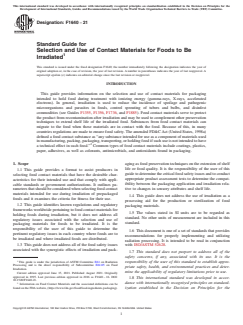
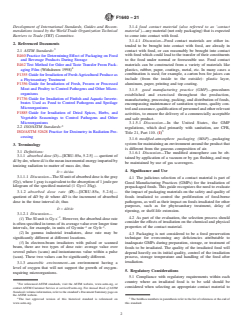
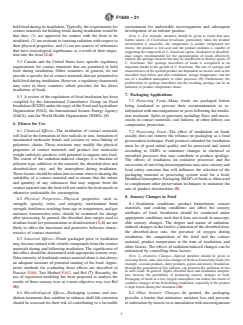

ASTM F1640-21 - Standard Guide for Selection and Use of Contact Materials for Foods to Be Irradiated
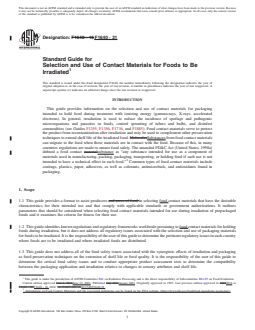
REDLINE ASTM F1640-21 - Standard Guide for Selection and Use of Contact Materials for Foods to Be Irradiated
Overview
ASTM F1640-21: Standard Guide for Selection and Use of Contact Materials for Foods to Be Irradiated offers a comprehensive framework to support food producers, packaging manufacturers, and regulatory authorities in choosing suitable materials that safely and effectively hold foods during irradiation processes. Developed by ASTM International, this guide helps ensure food safety and product quality when packaging is exposed to ionizing radiation, including gamma rays, X-rays, and accelerated electrons. Food irradiation is widely applied for pathogen control, phytosanitary treatment, and shelf-life extension; therefore, the proper selection of contact materials is fundamental to maintaining safety and compliance with Good Manufacturing Practices (GMPs) and regional or global regulations.
Key Topics
Food Contact Material Evaluation: Emphasizes the need to assess both the chemical and physical effects of irradiation on packaging materials-such as plastics, coatings, paper, adhesives, and other compounds-since substances may migrate into the food upon exposure.
Regulatory Context: Identifies existing regulatory frameworks (e.g., FDA, IAEA, WHO) but also underlines the user's responsibility to determine and comply with the relevant regulations in all countries where irradiated foods will be marketed.
Good Manufacturing Practices (GMPs): Positions the choice of packaging as central to GMPs for irradiation, highlighting that packaging should not compensate for deficiencies in food quality, handling, or processing.
Criteria for Fitness for Use: Covers:
- Potential chemical changes and migration of materials into food.
- Physical property alterations such as strength, seal integrity, brittleness, and gas or moisture permeability.
- Possible sensory impacts on foods (odor, taste, texture) due to irradiation of packaging.
- Microbiological considerations, especially regarding the risk of creating favorable conditions for undesirable microorganisms.
Role of Modified Atmosphere Packaging (MAP): Discusses how MAP may be used to complement irradiation for shelf-life extension, but requires careful assessment to avoid food safety hazards.
Applications
Prepackaged Foods Irradiation: Assists food producers in selecting and validating packaging materials suitable for irradiation, ensuring they retain integrity and do not leach undesirable substances into products.
Shelf-Life and Quality Preservation: Supports the use of irradiation for extending the shelf life of a broad range of foodstuffs-including produce, meat, spices, dairy, and grains-by guiding the packaging selection process.
Export and Compliance: Provides valuable reference for companies exporting irradiated foods, helping them navigate diverse international regulations and standards on food contact materials.
Risk Assessment and Product Development: Acts as a best-practices tool for food scientists, quality managers, and regulatory compliance teams conducting product safety assessments, sensory impact studies, and validation of new packaging systems for irradiated foods.
Related Standards
- ISO/ASTM 52628 - Practice for Dosimetry in Radiation Processing, referenced for procedural alignment.
- ASTM F1355 - Guide for Irradiation of Fresh Agricultural Produce as a Phytosanitary Treatment.
- ASTM F1356 - Guide for Irradiation of Fresh, Frozen, or Processed Meat and Poultry.
- ASTM F1736 - Guide for Irradiation of Finfish and Aquatic Invertebrates Used as Food.
- ASTM F1885 - Guide for Irradiation of Dried Spices, Herbs, and Vegetable Seasonings.
These standards collectively support a robust approach to safe, regulatory-compliant radiation processing and packaging of foods.
Conclusion
ASTM F1640-21 is a key resource for anyone involved in the selection and application of packaging materials for foods to be irradiated. By following its guidelines, stakeholders can enhance food safety, optimize product shelf life, and maintain regulatory compliance in the global food supply chain. Adhering to this standard is essential for high-quality, safe, and effective irradiation practices in the food industry.
Relations
- Effective Date
- 01-Dec-2019
- Effective Date
- 01-Nov-2018
- Effective Date
- 01-Jun-2014
- Effective Date
- 01-Dec-2010
- Effective Date
- 01-Feb-2009
- Effective Date
- 01-Jan-2008
- Effective Date
- 01-Jan-2006
- Effective Date
- 01-May-2004
- Effective Date
- 01-Jan-2004
- Effective Date
- 01-Nov-2003
- Effective Date
- 10-Jul-2003
- Effective Date
- 30-Dec-1999
- Effective Date
- 30-Dec-1999
- Effective Date
- 10-May-1998
- Effective Date
- 10-Oct-1996
Buy Documents
ASTM F1640-21 - Standard Guide for Selection and Use of Contact Materials for Foods to Be Irradiated
REDLINE ASTM F1640-21 - Standard Guide for Selection and Use of Contact Materials for Foods to Be Irradiated
Get Certified
Connect with accredited certification bodies for this standard

BSI Group
BSI (British Standards Institution) is the business standards company that helps organizations make excellence a habit.

Bureau Veritas
Bureau Veritas is a world leader in laboratory testing, inspection and certification services.

DNV
DNV is an independent assurance and risk management provider.
Sponsored listings
Frequently Asked Questions
ASTM F1640-21 is a guide published by ASTM International. Its full title is "Standard Guide for Selection and Use of Contact Materials for Foods to Be Irradiated". This standard covers: SIGNIFICANCE AND USE 4.1 The judicious selection of a contact material is part of Good Manufacturing Practices (GMPs) for the irradiation of prepackaged foods. This guide recognizes the need to evaluate the impact of packaging materials on the safety and quality of foods irradiated to control the proliferation of food-borne pathogens, as well as their impact on foods irradiated for other purposes, such as for phytosanitary treatment, delay of ripening, or shelf-life extension. 4.2 As part of the evaluation, the selection process should consider the effects of irradiation on the chemical and physical properties of the contact material. 4.3 Packaging is not considered to be a food preservation technique for overcoming any deficiencies attributable to inadequate GMPs during preparation, storage, or treatment of foods to be irradiated. The quality of the irradiated food will depend heavily on its initial quality, control of the irradiation process, storage temperature and handling of the food after irradiation. SCOPE 1.1 This guide provides a format to assist producers in selecting food contact materials that have the desirable characteristics for their intended use and that comply with applicable standards or government authorizations. It outlines parameters that should be considered when selecting food contact materials intended for use during irradiation of prepackaged foods and it examines the criteria for fitness for their use. 1.2 This guide identifies known regulations and regulatory frameworks worldwide pertaining to food contact materials for holding foods during irradiation, but it does not address all regulatory issues associated with the selection and use of packaging materials for foods to be irradiated. It is the responsibility of the user of this guide to determine the pertinent regulatory issues in each country where foods are to be irradiated and where irradiated foods are distributed. 1.3 This guide does not address all of the food safety issues associated with the synergistic effects of irradiation and packaging as food preservation techniques on the extension of shelf life or food quality. It is the responsibility of the user of this guide to determine the critical food safety issues and to conduct appropriate product assessment tests to determine the compatibility between the packaging application and irradiation relative to changes in sensory attributes and shelf life. 1.4 This guide does not address the use of irradiation as a processing aid for the production or sterilization of food packaging materials. 1.5 The values stated in SI units are to be regarded as standard. No other units of measurement are included in this standard. 1.6 This document is one of a set of standards that provides recommendations for properly implementing and utilizing radiation processing. It is intended to be read in conjunction with ISO/ASTM 52628. 1.7 This standard does not purport to address all of the safety concerns, if any, associated with its use. It is the responsibility of the user of this standard to establish appropriate safety, health, and environmental practices and determine the applicability of regulatory limitations prior to use. 1.8 This international standard was developed in accordance with internationally recognized principles on standardization established in the Decision on Principles for the Development of International Standards, Guides and Recommendations issued by the World Trade Organization Technical Barriers to Trade (TBT) Committee.
SIGNIFICANCE AND USE 4.1 The judicious selection of a contact material is part of Good Manufacturing Practices (GMPs) for the irradiation of prepackaged foods. This guide recognizes the need to evaluate the impact of packaging materials on the safety and quality of foods irradiated to control the proliferation of food-borne pathogens, as well as their impact on foods irradiated for other purposes, such as for phytosanitary treatment, delay of ripening, or shelf-life extension. 4.2 As part of the evaluation, the selection process should consider the effects of irradiation on the chemical and physical properties of the contact material. 4.3 Packaging is not considered to be a food preservation technique for overcoming any deficiencies attributable to inadequate GMPs during preparation, storage, or treatment of foods to be irradiated. The quality of the irradiated food will depend heavily on its initial quality, control of the irradiation process, storage temperature and handling of the food after irradiation. SCOPE 1.1 This guide provides a format to assist producers in selecting food contact materials that have the desirable characteristics for their intended use and that comply with applicable standards or government authorizations. It outlines parameters that should be considered when selecting food contact materials intended for use during irradiation of prepackaged foods and it examines the criteria for fitness for their use. 1.2 This guide identifies known regulations and regulatory frameworks worldwide pertaining to food contact materials for holding foods during irradiation, but it does not address all regulatory issues associated with the selection and use of packaging materials for foods to be irradiated. It is the responsibility of the user of this guide to determine the pertinent regulatory issues in each country where foods are to be irradiated and where irradiated foods are distributed. 1.3 This guide does not address all of the food safety issues associated with the synergistic effects of irradiation and packaging as food preservation techniques on the extension of shelf life or food quality. It is the responsibility of the user of this guide to determine the critical food safety issues and to conduct appropriate product assessment tests to determine the compatibility between the packaging application and irradiation relative to changes in sensory attributes and shelf life. 1.4 This guide does not address the use of irradiation as a processing aid for the production or sterilization of food packaging materials. 1.5 The values stated in SI units are to be regarded as standard. No other units of measurement are included in this standard. 1.6 This document is one of a set of standards that provides recommendations for properly implementing and utilizing radiation processing. It is intended to be read in conjunction with ISO/ASTM 52628. 1.7 This standard does not purport to address all of the safety concerns, if any, associated with its use. It is the responsibility of the user of this standard to establish appropriate safety, health, and environmental practices and determine the applicability of regulatory limitations prior to use. 1.8 This international standard was developed in accordance with internationally recognized principles on standardization established in the Decision on Principles for the Development of International Standards, Guides and Recommendations issued by the World Trade Organization Technical Barriers to Trade (TBT) Committee.
ASTM F1640-21 is classified under the following ICS (International Classification for Standards) categories: 55.040 - Packaging materials and accessories; 67.250 - Materials and articles in contact with foodstuffs. The ICS classification helps identify the subject area and facilitates finding related standards.
ASTM F1640-21 has the following relationships with other standards: It is inter standard links to ASTM F1355-19, ASTM F1885-18, ASTM F1355-06(2014), ASTM F1885-04(2010), ASTM F1736-09, ASTM F1356-08, ASTM F1355-06, ASTM E460-04, ASTM F1885-04, ASTM E460-88(2003)e1, ASTM F1736-03, ASTM F1355-99, ASTM F1356-99, ASTM F1885-98, ASTM F1736-96. Understanding these relationships helps ensure you are using the most current and applicable version of the standard.
ASTM F1640-21 is available in PDF format for immediate download after purchase. The document can be added to your cart and obtained through the secure checkout process. Digital delivery ensures instant access to the complete standard document.
Standards Content (Sample)
This international standard was developed in accordance with internationally recognized principles on standardization established in the Decision on Principles for the
Development of International Standards, Guides and Recommendations issued by the World Trade Organization Technical Barriers to Trade (TBT) Committee.
Designation: F1640 − 21
Standard Guide for
Selection and Use of Contact Materials for Foods to Be
Irradiated
This standard is issued under the fixed designation F1640; the number immediately following the designation indicates the year of
original adoption or, in the case of revision, the year of last revision. A number in parentheses indicates the year of last reapproval. A
superscript epsilon (´) indicates an editorial change since the last revision or reapproval.
INTRODUCTION
This guide provides information on the selection and use of contact materials for packaging
intended to hold food during treatment with ionizing energy (gamma-rays, X-rays, accelerated
electrons). In general, irradiation is used to reduce the incidence of spoilage and pathogenic
microorganisms and parasites in foods, control sprouting of tubers and bulbs, and disinfest
commodities (see Guides F1355, F1356, F1736, and F1885). Food contact materials serve to protect
the product from recontamination after irradiation and may be used to complement other preservation
techniques to extend shelf life of the irradiated food. Substances from food contact materials can
migrate to the food when these materials are in contact with the food. Because of this, in many
countries regulations are made to ensure food safety. The amended FD&CAct (United States, 1998a)
defined a food contact substance as “any substance intended for use as a component of materials used
inmanufacturing,packing,packaging,transporting,orholdingfoodifsuchuseisnotintendedtohave
a technical effect in such food.” Common types of food contact materials include coatings, plastics,
paper, adhesives, as well as colorants, antimicrobials, and antioxidants found in packaging.
1. Scope aging as food preservation techniques on the extension of shelf
life or food quality. It is the responsibility of the user of this
1.1 This guide provides a format to assist producers in
guidetodeterminethecriticalfoodsafetyissuesandtoconduct
selecting food contact materials that have the desirable char-
appropriate product assessment tests to determine the compat-
acteristics for their intended use and that comply with appli-
ibility between the packaging application and irradiation rela-
cable standards or government authorizations. It outlines pa-
tive to changes in sensory attributes and shelf life.
rametersthatshouldbeconsideredwhenselectingfoodcontact
materials intended for use during irradiation of prepackaged
1.4 This guide does not address the use of irradiation as a
foods and it examines the criteria for fitness for their use.
processing aid for the production or sterilization of food
1.2 This guide identifies known regulations and regulatory
packaging materials.
frameworks worldwide pertaining to food contact materials for
1.5 The values stated in SI units are to be regarded as
holding foods during irradiation, but it does not address all
standard. No other units of measurement are included in this
regulatory issues associated with the selection and use of
standard.
packaging materials for foods to be irradiated. It is the
responsibility of the user of this guide to determine the
1.6 This document is one of a set of standards that provides
pertinent regulatory issues in each country where foods are to
recommendations for properly implementing and utilizing
be irradiated and where irradiated foods are distributed.
radiation processing. It is intended to be read in conjunction
1.3 This guide does not address all of the food safety issues
with ISO/ASTM 52628.
associated with the synergistic effects of irradiation and pack-
1.7 This standard does not purport to address all of the
safety concerns, if any, associated with its use. It is the
This guide is under the jurisdiction of ASTM Committee E61 on Radiation
responsibility of the user of this standard to establish appro-
Processing and is the direct responsibility of Subcommittee E61.05 on Food
priate safety, health, and environmental practices and deter-
Irradiation.
mine the applicability of regulatory limitations prior to use.
Current edition approved June 15, 2021. Published August 2021. Originally
approved in 1995. Last previous edition approved in 2016 as F1640 – 16. DOI:
1.8 This international standard was developed in accor-
10.1520/F1640-21.
2 dance with internationally recognized principles on standard-
Information on Food Contact Materials and the associated definitions can be
found on the FDAwebsite, (https://www.fda.gov/food/food-ingredients-packaging). ization established in the Decision on Principles for the
Copyright © ASTM International, 100 Barr Harbor Drive, PO Box C700, West Conshohocken, PA 19428-2959. United States
F1640 − 21
Development of International Standards, Guides and Recom- 3.1.4 food contact material (also referred to as ‘contact
mendations issued by the World Trade Organization Technical material’)—any material (not only packaging) that is expected
Barriers to Trade (TBT) Committee. to come into contact with food.
3.1.4.1 Discussion—Food contact materials are either in-
2. Referenced Documents
tended to be brought into contact with food, are already in
contact with food, or can reasonably be brought into contact
2.1 ASTM Standards:
with food which could lead to the transfer of their constituents
E460 Practice for Determining Effect of Packaging on Food
and Beverage Products During Storage to the food under normal or foreseeable use. Food contact
materials can be constructed from a variety of materials like
E462 Test Method for Odor and Taste Transfer From Pack-
aging Film (Withdrawn 1998) plastics, rubber, paper, coatings, metal, etc. In many cases a
combination is used; for example, a carton box for juices can
F1355 GuideforIrradiationofFreshAgriculturalProduceas
a Phytosanitary Treatment include (from the inside to the outside): plastic layer,
aluminum, paper, printing and top coating.
F1356 Guide for Irradiation of Fresh, Frozen or Processed
Meat and Poultry to Control Pathogens and Other Micro-
3.1.5 good manufacturing practice (GMP)—procedures
organisms
established and exercised throughout the production,
F1736 Guide for Irradiation of Finfish and Aquatic Inverte-
manufacturing, processing, packing, and distribution of foods,
brates Used as Food to Control Pathogens and Spoilage
encompassing maintenance of sanitation systems, quality con-
Microorganisms
trolandassurance,qualificationofpersonnelandotherrelevant
F1885 Guide for Irradiation of Dried Spices, Herbs, and
activities, to ensure the delivery of a commercially acceptable
Vegetable Seasonings to Control Pathogens and Other
and safe product.
Microorganisms
3.1.5.1 Discussion—In the United States, the GMP
2.2 ISO/ASTM Standards:
regulations, which deal primarily with sanitation, are CFR,
ISO/ASTM 52628 Practice for Dosimetry in Radiation Pro-
Title 21, Part 110. (1)
cessing
3.1.6 modified-atmosphere packaging (MAP)—packaging
system for maintaining an environment around the product that
3. Terminology
is different from the gaseous composition of air.
3.1 Definitions:
3.1.6.1 Discussion—The modified atmosphere can be ob-
3.1.1 absorbed dose (D)—[ICRU-85a, 5.2.5] — quotient of
tained by application of a vacuum or by gas flushing, and may
dε¯ bydm,wheredε¯ isthemeanincrementalenergyimpartedby
be maintained by use of gas scavengers.
ionizing radiation to matter of mass dm, thus
4. Significance and Use
D 5 dε¯/dm
3.1.1.1 Discussion—TheSIunitofabsorbeddoseisthegray
4.1 The judicious selection of a contact material is part of
(Gy),where1grayisequivalenttotheabsorptionof1jouleper
Good Manufacturing Practices (GMPs) for the irradiation of
kilogram of the specified material (1 Gy=1 J/kg).
prepackaged foods. This guide recognizes the need to evaluate
˙
the impact of packaging materials on the safety and quality of
3.1.2 absorbed dose rate (D)—[ICRU-85a, 5.2.6]—
foods irradiated to control the proliferation of food-borne
quotient of dD by dt where dD is the increment of absorbed
pathogens, as well as their impact on foods irradiated for other
dose in the time interval dt, thus
purposes, such as for phytosanitary treatment, delay of
˙
D 5 dD/dt
ripening, or shelf-life extension.
3.1.2.1 Discussion—
–1
4.2 As part of the evaluation, the selection process should
(1) The SI unit is Gy-s . However, the absorbed-dose rate
consider the effects of irradiation on the chemical and physical
is often specified in terms of its average value over longer time
–1 –1
properties of the contact material.
intervals, for example, in units of Gy·min or Gy·h .
(2) In gamma industrial irradiators, dose rate may be
4.3 Packaging is not considered to be a food preservation
significantly different at different locations.
technique for overcoming any deficiencies attributable to
(3) In electron-beam irradiators with pulsed or scanned
inadequate GMPs during preparation, storage, or treatment of
beam, there are two types of dose rate: average value over
foods to be irradiated. The quality of the irradiated food will
several pulses (scans) and instantaneous value within a pulse
depend heavily on its initial quality, control of the irradiation
(scan). These two values can be significantly different.
process, storage temperature and handling of the food after
irradiation.
3.1.3 anaerobic environment—an environment having a
level of oxygen that will not support the growth of oxygen-
5. Regulatory Considerations
requiring microorganisms.
5.1 Compliance with regulatory requirements within each
country where an irradiated food is to be sold should be
For referenced ASTM standards, visit the ASTM website, www.astm.org, or
considered when selecting an appropriate contact material to
contact ASTM Customer Service at service@astm.org. For Annual Book of ASTM
Standards volume information, refer to the standard’s Document Summary page on
the ASTM website.
4 5
The last approved version of this historical standard is referenced on The boldface numbers in parenthesis refer to the list of references at the end of
www.astm.org. this standard.
...
This document is not an ASTM standard and is intended only to provide the user of an ASTM standard an indication of what changes have been made to the previous version. Because
it may not be technically possible to adequately depict all changes accurately, ASTM recommends that users consult prior editions as appropriate. In all cases only the current version
of the standard as published by ASTM is to be considered the official document.
Designation: F1640 − 16 F1640 − 21
Standard Guide for
Selection and Use of Contact Materials for Foods to Be
Irradiated
This standard is issued under the fixed designation F1640; the number immediately following the designation indicates the year of
original adoption or, in the case of revision, the year of last revision. A number in parentheses indicates the year of last reapproval. A
superscript epsilon (´) indicates an editorial change since the last revision or reapproval.
INTRODUCTION
This guide provides information on the selection and use of contact materials for packaging
intended to hold food during treatment with ionizing energy (gamma-rays, X-rays, accelerated
electrons). In general, irradiation is used to reduce the incidence of spoilage and pathogenic
microorganisms and parasites in foods, control sprouting of tubers and bulbs, and disinfest
commodities (see Guides F1355, F1356, F1736, and F1885). Food contact materials serve to protect
the product from recontamination after irradiation and may be used to complement other preservation
techniques to extend shelf life of the irradiated food. MoleculesSubstances from food contact materials
can migrate to the food when these materials are in contact with the food. Because of this, in many
countries regulations are made to ensure food safety. The amended FD&C Act (United States, 1998a)
defined a food contact materialsubstance as “any substance intended for use as a component of
materials used in manufacturing, packing, packaging, transporting, or holding food if such use is not
intended to have a technical effect in such food.” Common types of food contact materials include
coatings, plastics, paper, adhesives, as well as colorants, antimicrobials, and antioxidants found in
packaging.
1. Scope
1.1 This guide provides a format to assist producers and users of food in selecting food contact materials that have the desirable
characteristics for their intended use and that comply with applicable standards or government authorizations. It outlines
parameters that should be considered when selecting food contact materials intended for use during irradiation of prepackaged
foods and it examines the criteria for fitness for their use.
1.2 This guide identifies known regulations and regulatory frameworks worldwide pertaining to food contact materials for holding
foods during irradiation, but it does not address all regulatory issues associated with the selection and use of packaging materials
for foods to be irradiated. It is the responsibility of the user of this guide to determine the pertinent regulatory issues in each country
where foods are to be irradiated and where irradiated foods are distributed.
1.3 This guide does not address all of the food safety issues associated with the synergistic effects of irradiation and packaging
as food preservation techniques on the extension of shelf life or food quality. It is the responsibility of the user of this guide to
determine the critical food safety issues and to conduct appropriate product assessment tests to determine the compatibility
between the packaging application and irradiation relative to changes in sensory attributes and shelf life.
This guide is under the jurisdiction of ASTM Committee E61 on Radiation Processing and is the direct responsibility of Subcommittee E61.05 on Food Irradiation.
Current edition approved June 1, 2016June 15, 2021. Published July 2016August 2021. Originally approved in 1995. Last previous edition approved in 20092016 as
F1640 – 09.F1640 – 16. DOI: 10.1520/F1640-16.10.1520/F1640-21.
Information on Food Contact Materials and the associated definitions can be found on the FDA website, (https://www.fda.gov/food/food-ingredients-packaging).
Copyright © ASTM International, 100 Barr Harbor Drive, PO Box C700, West Conshohocken, PA 19428-2959. United States
F1640 − 21
1.4 This guide does not address the use of irradiation as a processing aid for the production or sterilization of food packaging
materials.
1.5 The values stated in SI units are to be regarded as standard. No other units of measurement are included in this standard.
1.6 This document is one of a set of standards that provides recommendations for properly implementing and utilizing radiation
processing. It is intended to be read in conjunction with ISO/ASTM 52628.
1.7 This standard does not purport to address all of the safety concerns, if any, associated with its use. It is the responsibility
of the user of this standard to establish appropriate safety safety, health, and healthenvironmental practices and determine the
applicability of regulatory limitations prior to use.
1.8 This international standard was developed in accordance with internationally recognized principles on standardization
established in the Decision on Principles for the Development of International Standards, Guides and Recommendations issued
by the World Trade Organization Technical Barriers to Trade (TBT) Committee.
2. Referenced Documents
2.1 ASTM Standards:
E460 Practice for Determining Effect of Packaging on Food and Beverage Products During Storage
E462 Test Method for Odor and Taste Transfer From Packaging Film (Withdrawn 1998)
F1355 Guide for Irradiation of Fresh Agricultural Produce as a Phytosanitary Treatment
F1356 Guide for Irradiation of Fresh, Frozen or Processed Meat and Poultry to Control Pathogens and Other Microorganisms
F1736 Guide for Irradiation of Finfish and Aquatic Invertebrates Used as Food to Control Pathogens and Spoilage
Microorganisms
F1885 Guide for Irradiation of Dried Spices, Herbs, and Vegetable Seasonings to Control Pathogens and Other Microorganisms
2.2 ISO/ASTM Standards:
ISO/ASTM 52628 Practice for Dosimetry in Radiation Processing
3. Terminology
3.1 Definitions:
3.1.1 absorbed dose (D)—[ICRU-85a, 5.2.5] — quotient of dε¯ by dm, where dε¯ is the mean incremental energy imparted by
ionizing radiation to matter of mass dm, thus
D 5 d¯ε/dm
3.1.1.1 Discussion—
The SI unit of absorbed dose is the gray (Gy), where 1 gray is equivalent to the absorption of 1 joule per kilogram of the specified
material (1 Gy=1 J/kg).
3.1.2 absorbed dose rate (D˙)—[ICRU-85a, 5.2.6]—quotient of dD by dt where dD is the increment of absorbed dose in the time
interval dt, thus
˙
D 5 dD/dt
3.1.2.1 Discussion—
–1
(1) The SI unit is Gy-s . However, the absorbed-dose rate is often specified in terms of its average value over longer time
–1 –1
intervals, for example, in units of Gy·min or Gy·h .
(2) In gamma industrial irradiators, dose rate may be significantly different at different locations.
(3) In electron-beam irradiators with pulsed or scanned beam, there are two types of dose rate: average value over several
pulses (scans) and instantaneous value within a pulse (scan). These two values can be significantly different.
3.1.3 anaerobic environment—an environment having a level of oxygen that will not support the growth of oxygen-requiring
microorganisms.
For referenced ASTM standards, visit the ASTM website, www.astm.org, or contact ASTM Customer Service at service@astm.org. For Annual Book of ASTM Standards
volume information, refer to the standard’s Document Summary page on the ASTM website.
The last approved version of this historical standard is referenced on www.astm.org.
F1640 − 21
3.1.4 food contact material (also referred to as ‘contact material’—material’)—any material (not only packaging) that is expected
to come into contact with food.
3.1.4.1 Discussion—
Food contact materials are either intended to be brought into contact with food, are already in contact with food, or can reasonably
be brought into contact with food which could lead to the transfer of their constituents to the food under normal or foreseeable
use. Food contact materials can be constructed from a variety of materials like plastics, rubber, paper, coatings, metal, etc. In many
cases a combination is used; for example, a carton box for juices can include (from the inside to the outside): plastic layer,
aluminum, paper, printing and top coating.
3.1.5 good manufacturing practice (GMP)—procedures established and exercised throughout the production, manufacturing,
processing, packing, and distribution of foods, encompassing maintenance of sanitation systems, quality control and assurance,
qualification of personnel and other relevant activities, to ensure the delivery of a commercially acceptable and safe product.
3.1.5.1 Discussion—
In the United States, the GMP regulations, which deal primarily with sanitation, are CFR, Title 21, Part 110. (1)
3.1.6 modified-atmosphere packaging (MAP)—packaging system for maintaining an environment around the product that is
different from the gaseous composition of air.
3.1.6.1 Discussion—
The modified atmosphere can be obtained by application of a vacuum or by gas flushing, and may be maintained by use of gas
scavengers.
4. Significance and Use
4.1 The judicious selection of a contact material is part of Good Manufacturing Practices (GMPs) for the irradiation of
prepackaged foods. This guide recognizes the need to evaluate the impact of packaging materials on the safety and quality of foods
irradiated to control the proliferation of food-borne pathogens, as well as their impact on foods irradiated for other purposes, such
as prevention of re-infestation,for phytosanitary treatment, delay of ripening, or shelf-life extension.
4.2 As part of the evaluation, the selection process should consider the effects of irradiation on the chemical and physical
properties of the contact material.
4.3 Packaging is not considered to be a food preservation technique for overcoming any deficiencies attributable to inadequate
GMPs during preparation, storage, or treatment of foods to be irradiated. The quality of the irradiated food will depend heavily
on its initial quality, control of the irradiation process, storage temperature and handling of the food after irradiation.
5. Regulatory Considerations
5.1 Compliance with regulatory requirements within each country where an irradiated food is to be sold should be considered
when selecting an appropriate contact material to hold food during its irradiation. Typically, the requirements for contact materials
for holding foods during irradiation would be that they: (1) are approved for contact with the food to be irradiated, (2) are resistant
to ionizing radiation with respect to their physical properties, and (3) are not sources of substances that have toxicological
significance as a result of their migratio
...