

ASTM E473-23b
(Terminology)Standard Terminology Relating to Thermal Analysis and Rheology
General Information
- Abstract
SCOPE
1.1 This terminology is a compilation of definitions of terms used in ASTM documents relating to thermal analysis and rheology. This terminology includes only those terms for which ASTM either has standards or is contemplating some action. It is not intended to be an all-inclusive listing of terms related to thermal analysis and rheology.
1.2 This terminology specifically supports the single-word form for terms using thermo as a prefix, such as thermoanalytical or thermomagnetometry, while recognizing that for some terms a two-word form can be used, such as thermal analysis. This terminology does not support, nor does it recommend, use of the grammatically incorrect, single-word form using thermal as a prefix, such as, thermalanalytical or thermalmagnetometry.
1.3 A definition is a single sentence with additional information included in a Discussion area. It is reviewed every five years.
1.4 This international standard was developed in accordance with internationally recognized principles on standardization established in the Decision on Principles for the Development of International Standards, Guides and Recommendations issued by the World Trade Organization Technical Barriers to Trade (TBT) Committee.
- Status
- Published
- Publication Date
- 30-Sep-2023
- Technical Committee
- E37 - Thermal Measurements
- Drafting Committee
- E37.03 - Nomenclature and Definitions

Overview
ASTM E473-23b: Standard Terminology Relating to Thermal Analysis and Rheology provides a comprehensive set of standardized terminology for use across ASTM documents dealing with thermal analysis and rheology. As a terminology standard, its primary purpose is to ensure consistent language, improve clarity in technical communication, and support the development and harmonization of global practices in thermal analysis and rheology. The standard includes definitions for terms that are commonly used in ASTM standards or are under consideration for future adoption, offering practitioners clear guidance on proper usage.
This international standard is maintained by ASTM Committee E37 on Thermal Measurements and was most recently reviewed and approved in 2023, following established principles for standardization in compliance with World Trade Organization guidelines.
Key Topics
ASTM E473-23b contains carefully defined terms that encompass critical concepts and methods in thermal analysis and rheology, including:
- Thermal Analysis Methods: Definitions of techniques such as differential scanning calorimetry (DSC), differential thermal analysis (DTA), thermogravimetric analysis (TGA), thermomechanical analysis (TMA), and thermomagnetometry.
- Rheological Techniques: Clear descriptions of rheometry, viscometry, and dynamic mechanical analysis (DMA), including related properties like viscosity, modulus, and shear stress.
- Data Interpretation Terms: Standardized language for interpreting experimental data, such as baseline, onset, peak, plateau, and valley, crucial for reporting and analysis in research and industry.
- Prefix and Form Usage: Guidance on correct single-word versus two-word forms for “thermo” and “thermal” prefixes to maintain consistency and grammatical correctness.
- Measurement and Instrumentation: Terminology related to instruments such as rheometers, calorimeters, and electrobalance, and measurement concepts like thermal lag, offset temperature, and energy ratios.
Throughout, each definition is supported by a single-sentence description, with additional discussion provided for context or clarification.
Applications
ASTM E473-23b is widely applicable across industries and scientific fields where precise measurement and characterization of material properties are critical. Typical applications include:
- Quality Control and Research: Used as a reference in laboratories to standardize reporting of results from thermal analysis and rheology experiments.
- Product Development: Assists manufacturers and researchers in accurately communicating testing methods and findings related to polymers, pharmaceuticals, composites, and other materials.
- Standard Development and Compliance: Enables organizations to align with international best practices and regulatory requirements by using consistent terminology.
- Education and Training: Serves as an essential resource for educators and students in materials science and engineering, providing a foundational vocabulary for coursework and laboratory work.
By fostering clear communication among manufacturers, researchers, regulatory bodies, and educators, this standard supports reliable data interpretation and international collaboration.
Related Standards
ASTM E473-23b often references or is used in conjunction with other key ASTM standards, including:
- ASTM E1142 - Terminology Relating to Thermophysical Properties
- ASTM E2161 - Terminology Relating to Performance Validation in Thermal Analysis and Rheology
- ASTM E2253 - Test Method for Temperature and Enthalpy Measurement Validation of Differential Scanning Calorimeters
- ASTM E2402 - Test Method for Mass Loss, Residue, and Temperature Measurement Validation of Thermogravimetric Analyzers
- ASTM E2918 - Test Method for Performance Validation of Thermomechanical Analyzers
For comprehensive materials characterization and analysis, users are encouraged to consult these related standards.
Keywords: ASTM E473-23b, thermal analysis terminology, rheology terms, thermal analysis standards, rheological analysis, ASTM standards, material testing vocabulary, scientific terminology standardization.
Relations
- Effective Date
- 01-Oct-2023
- Effective Date
- 01-Oct-2023
- Effective Date
- 01-May-2023
- Effective Date
- 01-Oct-2023
- Effective Date
- 01-Oct-2023
- Effective Date
- 01-Oct-2023
- Effective Date
- 01-Oct-2023
- Effective Date
- 01-Oct-2023
- Effective Date
- 01-Oct-2023
- Referred By
ASTM E2403-23 - Standard Test Method for Sulfated Ash of Organic Materials by Thermogravimetry - Effective Date
- 01-Oct-2023
- Effective Date
- 01-Oct-2023
- Effective Date
- 01-Oct-2023
- Effective Date
- 01-Oct-2023
- Referred By
ASTM E3142-18a(2023) - Standard Test Method for Thermal Lag of Thermal Analysis Apparatus - Effective Date
- 01-Oct-2023
- Effective Date
- 01-Oct-2023
Get Certified
Connect with accredited certification bodies for this standard

BSMI (Bureau of Standards, Metrology and Inspection)
Taiwan's standards and inspection authority.
Sponsored listings
Frequently Asked Questions
ASTM E473-23b is a standard published by ASTM International. Its full title is "Standard Terminology Relating to Thermal Analysis and Rheology". This standard covers: SCOPE 1.1 This terminology is a compilation of definitions of terms used in ASTM documents relating to thermal analysis and rheology. This terminology includes only those terms for which ASTM either has standards or is contemplating some action. It is not intended to be an all-inclusive listing of terms related to thermal analysis and rheology. 1.2 This terminology specifically supports the single-word form for terms using thermo as a prefix, such as thermoanalytical or thermomagnetometry, while recognizing that for some terms a two-word form can be used, such as thermal analysis. This terminology does not support, nor does it recommend, use of the grammatically incorrect, single-word form using thermal as a prefix, such as, thermalanalytical or thermalmagnetometry. 1.3 A definition is a single sentence with additional information included in a Discussion area. It is reviewed every five years. 1.4 This international standard was developed in accordance with internationally recognized principles on standardization established in the Decision on Principles for the Development of International Standards, Guides and Recommendations issued by the World Trade Organization Technical Barriers to Trade (TBT) Committee.
SCOPE 1.1 This terminology is a compilation of definitions of terms used in ASTM documents relating to thermal analysis and rheology. This terminology includes only those terms for which ASTM either has standards or is contemplating some action. It is not intended to be an all-inclusive listing of terms related to thermal analysis and rheology. 1.2 This terminology specifically supports the single-word form for terms using thermo as a prefix, such as thermoanalytical or thermomagnetometry, while recognizing that for some terms a two-word form can be used, such as thermal analysis. This terminology does not support, nor does it recommend, use of the grammatically incorrect, single-word form using thermal as a prefix, such as, thermalanalytical or thermalmagnetometry. 1.3 A definition is a single sentence with additional information included in a Discussion area. It is reviewed every five years. 1.4 This international standard was developed in accordance with internationally recognized principles on standardization established in the Decision on Principles for the Development of International Standards, Guides and Recommendations issued by the World Trade Organization Technical Barriers to Trade (TBT) Committee.
ASTM E473-23b is classified under the following ICS (International Classification for Standards) categories: 01.040.17 - Metrology and measurement. Physical phenomena (Vocabularies); 17.200.10 - Heat. Calorimetry. The ICS classification helps identify the subject area and facilitates finding related standards.
ASTM E473-23b has the following relationships with other standards: It is inter standard links to ASTM E473-23a, ASTM E1142-23b, ASTM E1142-23a, ASTM D6604-00(2022), ASTM E2070-23, ASTM E2716-23, ASTM E2550-21, ASTM F3418-20, ASTM E2890-21, ASTM E2403-23, ASTM E2041-23, ASTM E1641-23, ASTM C1470-20, ASTM E3142-18a(2023), ASTM E2958-21. Understanding these relationships helps ensure you are using the most current and applicable version of the standard.
ASTM E473-23b is available in PDF format for immediate download after purchase. The document can be added to your cart and obtained through the secure checkout process. Digital delivery ensures instant access to the complete standard document.
Standards Content (Sample)
This international standard was developed in accordance with internationally recognized principles on standardization established in the Decision on Principles for the
Development of International Standards, Guides and Recommendations issued by the World Trade Organization Technical Barriers to Trade (TBT) Committee.
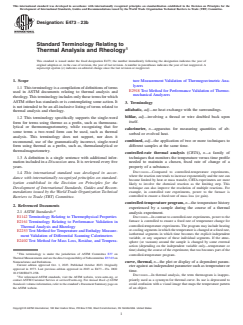
Designation: E473 − 23b
Standard Terminology Relating to
Thermal Analysis and Rheology
This standard is issued under the fixed designation E473; the number immediately following the designation indicates the year of
original adoption or, in the case of revision, the year of last revision. A number in parentheses indicates the year of last reapproval. A
superscript epsilon (´) indicates an editorial change since the last revision or reapproval.
1. Scope ture Measurement Validation of Thermogravimetric Ana-
lyzers
1.1 This terminology is a compilation of definitions of terms
E2918 Test Method for Performance Validation of Thermo-
used in ASTM documents relating to thermal analysis and
mechanical Analyzers
rheology. This terminology includes only those terms for which
ASTM either has standards or is contemplating some action. It
3. Terminology
is not intended to be an all-inclusive listing of terms related to
adiabatic, adj—no heat exchange with the surroundings.
thermal analysis and rheology.
bifilar, adj—involving a thread or wire doubled back upon
1.2 This terminology specifically supports the single-word
itself.
form for terms using thermo as a prefix, such as thermoana-
lytical or thermomagnetometry, while recognizing that for
calorimeter, n—apparatus for measuring quantities of ab-
some terms a two-word form can be used, such as thermal
sorbed or evolved heat.
analysis. This terminology does not support, nor does it
combined, adj—the application of two or more techniques to
recommend, use of the grammatically incorrect, single-word
different samples at the same time.
form using thermal as a prefix, such as, thermalanalytical or
thermalmagnetometry.
controlled-rate thermal analysis (CRTA), n—a family of
1.3 A definition is a single sentence with additional infor- techniques that monitors the temperature versus time profile
mation included in a Discussion area. It is reviewed every five needed to maintain a chosen, fixed rate of change of a
years. property of a substance.
DISCUSSION—Compared to controlled-temperature experiments,
1.4 This international standard was developed in accor-
where the reaction rate tends to increase exponentially and the rate can
dance with internationally recognized principles on standard-
become limited by heat or mass transfer, CRTA experiments are more
ization established in the Decision on Principles for the
likely to involve the chemical reaction as the limiting step. This
Development of International Standards, Guides and Recom-
technique can also improve the resolution of multiple reactions. For
mendations issued by the World Trade Organization Technical example, in controlled rate experiments, power to the furnace is
controlled to ensure a fixed rate of mass loss (or gain).
Barriers to Trade (TBT) Committee.
controlled-temperature program, n—the temperature history
2. Referenced Documents
experienced by a sample during the course of a thermal
2.1 ASTM Standards:
analysis experiment.
E1142 Terminology Relating to Thermophysical Properties DISCUSSION—In contrast to controlled-rate experiments, power to the
furnace is controlled to ensure a fixed rate of temperature change for
E2161 Terminology Relating to Performance Validation in
controlled-temperature experiments. The program may include heating
Thermal Analysis and Rheology
or cooling segments in which the temperature is changed at a fixed rate,
E2253 Test Method for Temperature and Enthalpy Measure-
isothermal segments in which time becomes the explicit independent
ment Validation of Differential Scanning Calorimeters
variable, or any sequence of these individual segments. If the atmo-
E2402 Test Method for Mass Loss, Residue, and Tempera-
sphere (or vacuum) around the sample is changed by some external
action (depending on the independent variable only—temperature or
time) during the course of the experiment, that too becomes part of the
This terminology is under the jurisdiction of ASTM Committee E37 on
controlled-temperature program.
Thermal Measurements and are the direct responsibility of Subcommittee E37.03 on
Nomenclature and Definitions. curve, thermal, n—the plot or display of a dependent param-
Current edition approved Oct. 1, 2023. Published October 2023. Originally
eter against an independent parameter such as temperature or
approved in 1973. Last previous edition approved in 2023 as E473 – 23a. DOI:
time.
10.1520/E0473-23B.
DISCUSSION—In thermal analysis, the term thermogram is inappro-
For referenced ASTM standards, visit the ASTM website, www.astm.org, or
priately used as a synonym for thermal curve. Its use is deprecated to
contact ASTM Customer Service at service@astm.org. For Annual Book of ASTM
avoid confusion with a visual image that maps the temperature pattern
Standards volume information, refer to the standard’s Document Summary page on
the ASTM website. of an object.
Copyright © ASTM International, 100 Barr Harbor Drive, PO Box C700, West Conshohocken, PA 19428-2959. United States
E473 − 23b
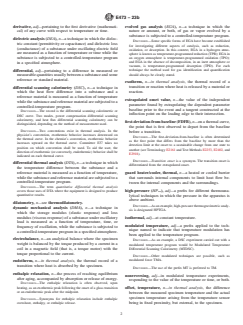
derivative, adj—pertaining to the first derivative (mathemati- evolved gas analysis (EGA), n—a technique in which the
cal) of any curve with respect to temperature or time. nature or amount, or both, of gas or vapor evolved by a
substance is subjected to a controlled-temperature program.
dielectric analysis (DEA), n—a technique in which the dielec-
DISCUSSION—Some specific forms of EGA have become established
tric constant (permittivity or capacitance) and dielectric loss
for investigating different aspects of catalysis, such as reduction,
(conductance) of a substance under oscillating electric field
oxidation, or desorption. In this context, EGA in a hydrogen atmo-
are measured as a function of temperature or time while the
sphere is known as temperature-programmed reduction (TPR); EGA in
substance is subjected to a controlled-temperature program an oxygen atmosphere is temperature-programmed oxidation (TPO);
and EGA in the absence of decomposition, in an inert atmosphere or
in a specified atmosphere.
vacuum, is temperature-programmed desorption (TPD). For each
technique the method used for gas identification and quantification
differential, adj—pertaining to a difference in measured or
should always be clearly stated.
measurable quantities usually between a substance and some
reference or standard material.
exotherm, n—in thermal analysis, the thermal record of a
transition or reaction where heat is released by a material or
differential scanning calorimetry (DSC), n—a technique in
reaction.
which the heat flow difference into a substance and a
reference material is measured as a function of temperature
extrapolated onset value, n—the value of the independent
while the substance and reference material are subjected to a
parameter found by extrapolating the dependent parameter
controlled-temperature program.
baseline prior to the event and a tangent constructed at the
DISCUSSION—The record is the differential scanning calorimetric or
inflection point on the leading edge to their intersection.
DSC curve. Two modes, power compensation differential scanning
calorimetry, and heat flux differential scanning calorimetry can be
first-deviation-from-baseline (FDFB), n—on a thermal curve,
distinguished, depending on the method of measurement used.
the point that is first observed to depart from the baseline
DISCUSSION—Two conventions exist in thermal analysis. In the
before a transition.
physicist’s convention, exothermic behavior increases downward on
DISCUSSION—The first-deviation-from-baseline is often determined
the thermal curve. In the chemist’s convention, exothermic behavior
as the first point that differs from the baseline by more than the
increases upward on the thermal curve. Committee E37 takes no
detection limit at the onset to a sustainable change from one state to
position on which convention shall be used. To aid the user, the
another (see Terminology E2161 and Test Methods E2253, E2402, and
direction of exothermic (or conversely, endothermic) behavior shall be
E2918).
indicated on each thermal curve.
DISCUSSION—Transition onset is a synonym. The transition onset is
differential thermal analysis (DTA), n—a technique in which
differentiated from the extrapolated onset.
the temperature difference between the substance and a
reference material is measured as a function of temperature, guard heater/cooler, thermal, n—a heated or cooled barrier
while the substance and reference material are subjected to a
that surrounds internal components to limit heat flow be-
controlled-temperature program. tween the internal components and the surroundings.
DISCUSSION—The term quantitative differential thermal analysis
high-pressure (HP.), adj—a prefix for different thermoana-
covers those uses of DTA where the equipment is designed to produce
quantitative results. lytical techniques in which the pressure in the apparatus is
above ambient.
dilatometry, n—see thermodilatometry.
DISCUSSION—As an example, high-pressure thermogravimetric a
...
This document is not an ASTM standard and is intended only to provide the user of an ASTM standard an indication of what changes have been made to the previous version. Because
it may not be technically possible to adequately depict all changes accurately, ASTM recommends that users consult prior editions as appropriate. In all cases only the current version
of the standard as published by ASTM is to be considered the official document.
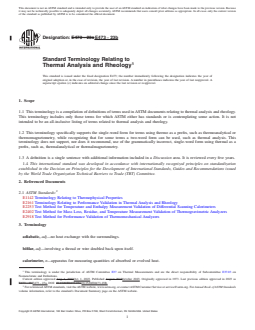
Designation: E473 − 23a E473 − 23b
Standard Terminology Relating to
Thermal Analysis and Rheology
This standard is issued under the fixed designation E473; the number immediately following the designation indicates the year of
original adoption or, in the case of revision, the year of last revision. A number in parentheses indicates the year of last reapproval. A
superscript epsilon (´) indicates an editorial change since the last revision or reapproval.
1. Scope
1.1 This terminology is a compilation of definitions of terms used in ASTM documents relating to thermal analysis and rheology.
This terminology includes only those terms for which ASTM either has standards or is contemplating some action. It is not
intended to be an all-inclusive listing of terms related to thermal analysis and rheology.
1.2 This terminology specifically supports the single-word form for terms using thermo as a prefix, such as thermoanalytical or
thermomagnetometry, while recognizing that for some terms a two-word form can be used, such as thermal analysis. This
terminology does not support, nor does it recommend, use of the grammatically incorrect, single-word form using thermal as a
prefix, such as, thermalanalytical or thermalmagnetometry.
1.3 A definition is a single sentence with additional information included in a Discussion area. It is reviewed every five years.
1.4 This international standard was developed in accordance with internationally recognized principles on standardization
established in the Decision on Principles for the Development of International Standards, Guides and Recommendations issued
by the World Trade Organization Technical Barriers to Trade (TBT) Committee.
2. Referenced Documents
2.1 ASTM Standards:
E1142 Terminology Relating to Thermophysical Properties
E2161 Terminology Relating to Performance Validation in Thermal Analysis and Rheology
E2253 Test Method for Temperature and Enthalpy Measurement Validation of Differential Scanning Calorimeters
E2402 Test Method for Mass Loss, Residue, and Temperature Measurement Validation of Thermogravimetric Analyzers
E2918 Test Method for Performance Validation of Thermomechanical Analyzers
3. Terminology
adiabatic, adj—no heat exchange with the surroundings.
bifilar, adj—involving a thread or wire doubled back upon itself.
calorimeter, n—apparatus for measuring quantities of absorbed or evolved heat.
This terminology is under the jurisdiction of ASTM Committee E37 on Thermal Measurements and are the direct responsibility of Subcommittee E37.03 on
Nomenclature and Definitions.
Current edition approved Aug. 1, 2023Oct. 1, 2023. Published August 2023October 2023. Originally approved in 1973. Last previous edition approved in 2023 as
E473 – 23.E473 – 23a. DOI: 10.1520/E0473-23a.10.1520/E0473-23B.
For referenced ASTM standards, visit the ASTM website, www.astm.org, or contact ASTM Customer Service at service@astm.org. For Annual Book of ASTM Standards
volume information, refer to the standard’s Document Summary page on the ASTM website.
Copyright © ASTM International, 100 Barr Harbor Drive, PO Box C700, West Conshohocken, PA 19428-2959. United States
E473 − 23b
combined, adj—the application of two or more techniques to different samples at the same time.
controlled-rate thermal analysis (CRTA), n—a family of techniques that monitors the temperature versus time profile needed
to maintain a chosen, fixed rate of change of a property of a substance.
DISCUSSION—
Compared to controlled-temperature experiments, where the reaction rate tends to increase exponentially and the rate can become limited by heat or
mass transfer, CRTA experiments are more likely to involve the chemical reaction as the limiting step. This technique can also improve the resolution
of multiple reactions. For example, in controlled rate experiments, power to the furnace is controlled to ensure a fixed rate of mass loss (or gain).
controlled-temperature program, n—the temperature history experienced by a sample during the course of a thermal analysis
experiment.
DISCUSSION—
In contrast to controlled-rate experiments, power to the furnace is controlled to ensure a fixed rate of temperature change for controlled-temperature
experiments. The program may include heating or cooling segments in which the temperature is changed at a fixed rate, isothermal segments in which
time becomes the explicit independent variable, or any sequence of these individual segments. If the atmosphere (or vacuum) around the sample is
changed by some external action (depending on the independent variable only—temperature or time) during the course of the experiment, that too
becomes part of the controlled-temperature program.
curve, thermal, n—the plot or display of a dependent parameter against an independent parameter such as temperature or time.
DISCUSSION—
In thermal analysis, the term thermogram is inappropriately used as a synonym for thermal curve. Its use is deprecated to avoid confusion with a visual
image that maps the temperature pattern of an object.
derivative, adj—pertaining to the first derivative (mathematical) of any curve with respect to temperature or time.
dielectric analysis (DEA), n—a technique in which the dielectric constant (permittivity or capacitance) and dielectric loss
(conductance) of a substance under oscillating electric field are measured as a function of temperature or time while the
substance is subjected to a controlled-temperature program in a specified atmosphere.
differential, adj—pertaining to a difference in measured or measurable quantities usually between a substance and some
reference or standard material.
differential scanning calorimetry (DSC), n—a technique in which the heat flow difference into a substance and a reference
material is measured as a function of temperature while the substance and reference material are subjected to a
controlled-temperature program.
DISCUSSION—
The record is the differential scanning calorimetric or DSC curve. Two modes, power compensation differential scanning calorimetry, and heat flux
differential scanning calorimetry can be distinguished, depending on the method of measurement used.
DISCUSSION—
Two conventions exist in thermal analysis. In the physicist’s convention, exothermic behavior increases downward on the thermal curve. In the
chemist’s convention, exothermic behavior increases upward on the thermal curve. Committee E37 takes no position on which convention shall be
used. To aid the user, the direction of exothermic (or conversely, endothermic) behavior shall be indicated on each thermal curve.
differential thermal analysis (DTA), n—a technique in which the temperature difference between the substance and a reference
material is measured as a function of temperature, while the substance and reference material are subjected to a
controlled-temperature program.
DISCUSSION—
The term quantitative differential thermal analysis covers those uses of DTA where the equipment is designed to produce quantitative results.
dilatometry, n—see thermodilatometry.
dynamic mechanical analysis (DMA), n—a technique in which the storage modulus (elastic response) and loss modulus
(viscous response) of a substance under oscillatory load is measured as a function of temperature, time, or frequency of
oscillation, while the substance is subjected to a controlled-temperature program in a specified atmosphere.
E473 − 23b
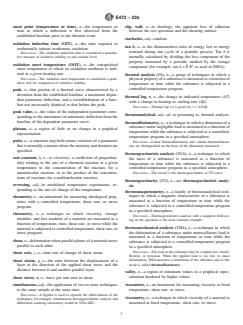
electrobalance, n—an analytical balance where the specimen weight is balanced by the torque produced by a current in a coil
in a magnetic field (that is, a torque motor) with the torque proportional to the current.
endotherm, n—in thermal analysis, the thermal record of a transition where heat is absorbed by the specimen.
enthalpic relaxation, n—the process of reaching equilibrium after aging, accompanied by absorption or release of energy.
DISCUSSION—
The enthalpic relaxation is often observed, upon heating, as an exothermic peak following the onset of a glass transition or an endothermic peak after
the midpoint.
DISCUSSION—
Synonyms for enthalpic relaxation include enthalpic overshoot, enthalpy, or enthalpic release.
evolved gas analysis (EGA), n—a technique in which the nature or amount, or both, of gas or vapor evolved by a substance is
subjected to a controlled-temperature program.
DISCUSSION—
Some specific forms of EGA have become established for investigating different aspects of catalysis, such as reduction, oxidation, or desorption. In
this context, EGA in a hydrogen atmosphere is known as temperature-programmed reduction (TPR); EGA in an oxygen atmosphere is
temperature-programmed oxidation (TPO); and EGA in the absence of decomposition, in an inert atmosphere or vacuum, is temperature-programmed
desorption (TPD). For each technique the method used for gas identification and quantification should always be clearly stated.
exotherm, n—in thermal analysis, the thermal record of a transition or reaction where he
...