

ASTM A666/A666M-24
(Specification)Standard Specification for Annealed or Cold-Worked Austenitic Stainless Steel Sheet, Strip, Plate, and Flat Bar
General Information
- Abstract
ABSTRACT
This specification covers austenitic stainless steels in the annealed and normally required cold-worked conditions. They shall be formed in different shapes such as sheets, strips, plates and flat bars. The steels shall adhere to specified chemical composition requirements. Mechanical properties such as yield strength, tensile strength, elongation, hardness, and bending shall be determined. The specimens shall be subjected to tension test, free-bend test, and controlled-bend or V-block test.
SCOPE
1.1 This specification covers austenitic stainless steels in the annealed and normally required cold-worked conditions for various structural, pressure vessel, magnetic, cryogenic, and heat-resisting applications.
1.2 The application of this specification, or the use of material covered by this specification does not automatically allow usage in pressure vessel applications. Only annealed conditions of grades specifically approved by the ASME code are permitted for pressure vessel use.
1.3 This specification is expressed in both inch-pound units and in SI units; however, unless the purchase order or contract specifies the applicable M specification designation (SI units), the inch-pound units shall apply. The values stated in either SI units or inch-pound units are to be regarded separately as standard. The values stated in each system may not be exact equivalents; therefore, each system shall be used independently of the other. Combining values from the two systems may result in non-conformance with the standard.
1.4 This standard does not purport to address all of the safety concerns, if any, associated with its use. It is the responsibility of the user of this standard to establish appropriate safety, health, and environmental practices and determine the applicability of regulatory limitations prior to use.
1.5 This international standard was developed in accordance with internationally recognized principles on standardization established in the Decision on Principles for the Development of International Standards, Guides and Recommendations issued by the World Trade Organization Technical Barriers to Trade (TBT) Committee.
- Status
- Published
- Publication Date
- 29-Feb-2024
- Technical Committee
- A01 - Steel, Stainless Steel and Related Alloys
- Drafting Committee
- A01.17 - Flat-Rolled and Wrought Stainless Steel
Buy Documents
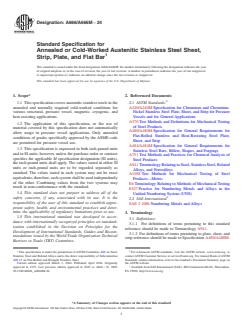
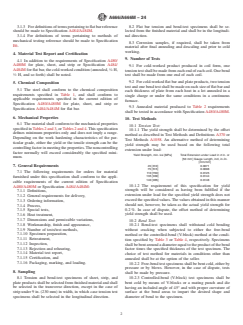
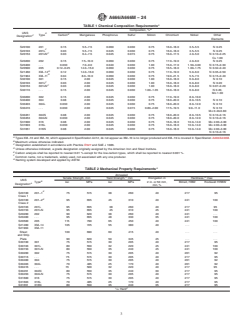
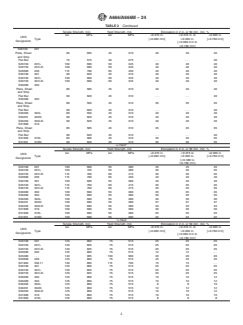
ASTM A666/A666M-24 - Standard Specification for Annealed or Cold-Worked Austenitic Stainless Steel Sheet, Strip, Plate, and Flat Bar
REDLINE ASTM A666/A666M-24 - Standard Specification for Annealed or Cold-Worked Austenitic Stainless Steel Sheet, Strip, Plate, and Flat Bar
Overview
ASTM A666/A666M-24 is the standard specification for annealed or cold-worked austenitic stainless steel sheet, strip, plate, and flat bar. Developed by ASTM International, this specification outlines detailed requirements for the chemical composition, mechanical properties, sampling, and testing of these stainless steel products. With dual measurement units (inch-pound and SI), this standard supports international trade and compliance in the manufacturing and processing of austenitic stainless steels used in critical applications.
Key Topics
- Product Forms: ASTM A666/A666M-24 applies to sheet, strip, plate, and flat bar formed from austenitic stainless steels in either annealed or cold-worked conditions.
- Material Grades: Covers a wide range of UNS designations such as S20100 (201), S30100 (301), S30400 (304), and S31600 (316), amongst others.
- Chemical Composition: Specifies maximum levels and ranges for elements like carbon, manganese, phosphorus, sulfur, silicon, chromium, and nickel, ensuring product quality and consistency.
- Mechanical Properties: Sets minimum values for mechanical parameters, including:
- Yield strength
- Tensile strength
- Elongation
- Hardness (Brinell and Rockwell)
- Bending performance
- Testing Requirements: Includes procedures for tension testing, free-bend testing, and controlled-bend (V-block) tests, aligning with referenced ASTM methods.
- Certification: Requires clear documentation of condition (annealed or the degree of cold work) and adherence to referenced standards for reporting.
Applications
Austenitic stainless steels manufactured to ASTM A666/A666M-24 are used in a wide variety of applications due to their corrosion resistance, strength, and formability:
- Structural and Architectural: Ideal for construction, facades, and load-bearing elements where durability and appearance are critical.
- Pressure Vessel and Heat-Resisting Uses: Common in industrial equipment, though only specific annealed grades approved by the ASME code may be used for pressure vessels.
- Cryogenics: Suitable for equipment handling extremely cold temperatures, such as storage tanks and piping.
- Magnetic Applications: Useful in environments requiring low magnetic permeability.
- Food Processing and Medical Equipment: Preferred for their hygienic properties and ease of cleaning.
It is important to note that compliance with ASTM A666/A666M-24 does not automatically authorize materials for all pressure vessel applications-only ASME-approved, annealed grades are permitted.
Related Standards
ASTM A666/A666M-24 references several important standards that together ensure comprehensive quality control for stainless steel products:
- ASTM A240/A240M: Specification for chromium and chromium-nickel stainless steel plate, sheet, and strip for pressure vessels and general applications.
- ASTM A370: Test methods and definitions for mechanical testing of steel products.
- ASTM A480/A480M: General requirements for flat-rolled stainless and heat-resisting steel plate, sheet, and strip.
- ASTM A484/A484M: General requirements for stainless steel bars, billets, shapes, and forgings.
- ASTM A751: Methods and practices for chemical analysis of steel products.
- ASTM E6 and ASTM A941: Terminology relating to metals testing and characterization.
Practical Value
Complying with ASTM A666/A666M-24 guarantees material traceability, mechanical performance, and uniformity, essential for safety-critical and high-performance applications. Manufacturers, engineers, and specifiers rely on this standard to ensure reliable sourcing, global acceptance, and consistent product quality in diverse industries such as construction, transportation, food processing, and energy. The adoption of dual units in the 2024 revision makes it easier to meet international procurement requirements. Use of this standard supports efficient project planning and mitigates the risk of non-conformance in demanding environments.
Relations
- Effective Date
- 01-Mar-2024
Buy Documents
ASTM A666/A666M-24 - Standard Specification for Annealed or Cold-Worked Austenitic Stainless Steel Sheet, Strip, Plate, and Flat Bar
REDLINE ASTM A666/A666M-24 - Standard Specification for Annealed or Cold-Worked Austenitic Stainless Steel Sheet, Strip, Plate, and Flat Bar
Get Certified
Connect with accredited certification bodies for this standard

Element Materials Technology
Materials testing and product certification.

Inštitut za kovinske materiale in tehnologije
Institute of Metals and Technology. Materials testing, metallurgical analysis, NDT.
Sponsored listings
Frequently Asked Questions
ASTM A666/A666M-24 is a technical specification published by ASTM International. Its full title is "Standard Specification for Annealed or Cold-Worked Austenitic Stainless Steel Sheet, Strip, Plate, and Flat Bar". This standard covers: ABSTRACT This specification covers austenitic stainless steels in the annealed and normally required cold-worked conditions. They shall be formed in different shapes such as sheets, strips, plates and flat bars. The steels shall adhere to specified chemical composition requirements. Mechanical properties such as yield strength, tensile strength, elongation, hardness, and bending shall be determined. The specimens shall be subjected to tension test, free-bend test, and controlled-bend or V-block test. SCOPE 1.1 This specification covers austenitic stainless steels in the annealed and normally required cold-worked conditions for various structural, pressure vessel, magnetic, cryogenic, and heat-resisting applications. 1.2 The application of this specification, or the use of material covered by this specification does not automatically allow usage in pressure vessel applications. Only annealed conditions of grades specifically approved by the ASME code are permitted for pressure vessel use. 1.3 This specification is expressed in both inch-pound units and in SI units; however, unless the purchase order or contract specifies the applicable M specification designation (SI units), the inch-pound units shall apply. The values stated in either SI units or inch-pound units are to be regarded separately as standard. The values stated in each system may not be exact equivalents; therefore, each system shall be used independently of the other. Combining values from the two systems may result in non-conformance with the standard. 1.4 This standard does not purport to address all of the safety concerns, if any, associated with its use. It is the responsibility of the user of this standard to establish appropriate safety, health, and environmental practices and determine the applicability of regulatory limitations prior to use. 1.5 This international standard was developed in accordance with internationally recognized principles on standardization established in the Decision on Principles for the Development of International Standards, Guides and Recommendations issued by the World Trade Organization Technical Barriers to Trade (TBT) Committee.
ABSTRACT This specification covers austenitic stainless steels in the annealed and normally required cold-worked conditions. They shall be formed in different shapes such as sheets, strips, plates and flat bars. The steels shall adhere to specified chemical composition requirements. Mechanical properties such as yield strength, tensile strength, elongation, hardness, and bending shall be determined. The specimens shall be subjected to tension test, free-bend test, and controlled-bend or V-block test. SCOPE 1.1 This specification covers austenitic stainless steels in the annealed and normally required cold-worked conditions for various structural, pressure vessel, magnetic, cryogenic, and heat-resisting applications. 1.2 The application of this specification, or the use of material covered by this specification does not automatically allow usage in pressure vessel applications. Only annealed conditions of grades specifically approved by the ASME code are permitted for pressure vessel use. 1.3 This specification is expressed in both inch-pound units and in SI units; however, unless the purchase order or contract specifies the applicable M specification designation (SI units), the inch-pound units shall apply. The values stated in either SI units or inch-pound units are to be regarded separately as standard. The values stated in each system may not be exact equivalents; therefore, each system shall be used independently of the other. Combining values from the two systems may result in non-conformance with the standard. 1.4 This standard does not purport to address all of the safety concerns, if any, associated with its use. It is the responsibility of the user of this standard to establish appropriate safety, health, and environmental practices and determine the applicability of regulatory limitations prior to use. 1.5 This international standard was developed in accordance with internationally recognized principles on standardization established in the Decision on Principles for the Development of International Standards, Guides and Recommendations issued by the World Trade Organization Technical Barriers to Trade (TBT) Committee.
ASTM A666/A666M-24 is classified under the following ICS (International Classification for Standards) categories: 77.140.20 - Stainless steels; 77.140.50 - Flat steel products and semi-products. The ICS classification helps identify the subject area and facilitates finding related standards.
ASTM A666/A666M-24 has the following relationships with other standards: It is inter standard links to ASTM A666-23. Understanding these relationships helps ensure you are using the most current and applicable version of the standard.
ASTM A666/A666M-24 is available in PDF format for immediate download after purchase. The document can be added to your cart and obtained through the secure checkout process. Digital delivery ensures instant access to the complete standard document.
Standards Content (Sample)
Designation: A666/A666M − 24
Standard Specification for
Annealed or Cold-Worked Austenitic Stainless Steel Sheet,
Strip, Plate, and Flat Bar
This standard is issued under the fixed designation A666/A666M; the number immediately following the designation indicates the year
of original adoption or, in the case of revision, the year of last revision. A number in parentheses indicates the year of last reapproval.
A superscript epsilon (´) indicates an editorial change since the last revision or reapproval.
This standard has been approved for use by agencies of the U.S. Department of Defense.
1. Scope* 2. Referenced Documents
1.1 This specification covers austenitic stainless steels in the 2.1 ASTM Standards:
annealed and normally required cold-worked conditions for A240/A240M Specification for Chromium and Chromium-
various structural, pressure vessel, magnetic, cryogenic, and Nickel Stainless Steel Plate, Sheet, and Strip for Pressure
heat-resisting applications. Vessels and for General Applications
A370 Test Methods and Definitions for Mechanical Testing
1.2 The application of this specification, or the use of
of Steel Products
material covered by this specification does not automatically
A480/A480M Specification for General Requirements for
allow usage in pressure vessel applications. Only annealed
Flat-Rolled Stainless and Heat-Resisting Steel Plate,
conditions of grades specifically approved by the ASME code
Sheet, and Strip
are permitted for pressure vessel use.
A484/A484M Specification for General Requirements for
1.3 This specification is expressed in both inch-pound units
Stainless Steel Bars, Billets, Shapes, and Forgings
and in SI units; however, unless the purchase order or contract
A751 Test Methods and Practices for Chemical Analysis of
specifies the applicable M specification designation (SI units),
Steel Products
the inch-pound units shall apply. The values stated in either SI
A941 Terminology Relating to Steel, Stainless Steel, Related
units or inch-pound units are to be regarded separately as
Alloys, and Ferroalloys
standard. The values stated in each system may not be exact
A1058 Test Methods for Mechanical Testing of Steel
equivalents; therefore, each system shall be used independently
Products—Metric
of the other. Combining values from the two systems may
E6 Terminology Relating to Methods of Mechanical Testing
result in non-conformance with the standard.
E527 Practice for Numbering Metals and Alloys in the
1.4 This standard does not purport to address all of the Unified Numbering System (UNS)
safety concerns, if any, associated with its use. It is the
2.2 SAE International
responsibility of the user of this standard to establish appro-
SAE J 1086 Numbering Metals and Alloys
priate safety, health, and environmental practices and deter-
mine the applicability of regulatory limitations prior to use.
3. Terminology
1.5 This international standard was developed in accor-
3.1 Definitions:
dance with internationally recognized principles on standard-
3.1.1 For definitions of terms pertaining to this standard
ization established in the Decision on Principles for the
reference should be made to Terminology A941.
Development of International Standards, Guides and Recom-
3.1.2 For definitions of terms pertaining to plate, sheet, and
mendations issued by the World Trade Organization Technical
strip reference should be made to Specification A480/A480M.
Barriers to Trade (TBT) Committee.
1 2
This specification is under the jurisdiction of ASTM Committee A01 on Steel, For referenced ASTM standards, visit the ASTM website, www.astm.org, or
Stainless Steel and Related Alloys and is the direct responsibility of Subcommittee contact ASTM Customer Service at service@astm.org. For Annual Book of ASTM
A01.17 on Flat-Rolled and Wrought Stainless Steel. Standards volume information, refer to the standard’s Document Summary page on
Current edition approved March 1, 2024. Published April 2024. Originally the ASTM website.
approved in 1972. Last previous edition approved in 2023 as A666 – 23. DOI: Available from SAE International (SAE), 400 Commonwealth Dr., Warrendale,
10.1520/A0666_A0666M-24. PA 15096, http://www.sae.org.
*A Summary of Changes section appears at the end of this standard
Copyright © ASTM International, 100 Barr Harbor Drive, PO Box C700, West Conshohocken, PA 19428-2959. United States
A666/A666M − 24
3.1.3 For definitions of terms pertaining to flat bar reference 8.2 Flat bar tension and bend-test specimens shall be se-
should be made to Specification A484/A484M. lected from the finished material and shall be in the longitudi-
3.1.4 For definitions of terms pertaining to methods of nal direction.
mechanical testing reference should be made to Specification
8.3 Corrosion samples, if required, shall be taken from
E6.
material after final annealing and descaling and prior to cold
working.
4. Material Test Report and Certification
9. Number of Tests
4.1 In addition to the requirements of Specification A480/
A480M for plate, sheet, and strip or Specification A484/ 9.1 For cold-worked product produced in coil form, one
A484M for flat bar, the cold-worked condition (annealed, ⁄4 H,
tension test shall be made from each end of each coil. One bend
⁄2 H, and so forth) shall be noted.
test shall be made from one end of each coil.
9.2 For cold-worked flat bar and plate products, two tension
5. Chemical Composition
test and one bend test shall be made on each size of flat bar and
5.1 The steel shall conform to the chemical composition
each thickness of plate from each heat in a lot annealed in a
requirements specified in Table 1, and shall conform to
single charge or under the same conditions in a continuous
applicable requirements specified in the current edition of
furnace.
Specification A480/A480M for plate, sheet, and strip or
9.3 Annealed material produced to Table 2 requirements
Specification A484/A484M for flat bar.
shall be tested in accordance with Specification A480/A480M.
6. Mechanical Properties
10. Test Methods
6.1 The material shall conform to the mechanical properties
10.1 Tension Test:
specified in Tables 2 and 3, or Tables 2 and 4. This specification
10.1.1 The yield strength shall be determined by the offset
defines minimum properties only and does not imply a range.
method as described in Test Methods and Definitions A370 or
Depending on the work hardening characteristics of the par-
Test Methods A1058. An alternative method of determining
ticular grade, either the yield or the tensile strength can be the
yield strength may be used based on the following total
controlling factor in meeting the properties. The noncontrolling
extension under load:
factor normally will exceed considerably the specified mini-
Yield Strength, min. ksi [MPa] Total Extension under Load in 2 in. or
mum.
[50 mm] Gauge Length, incl, in./in.
[mm/mm]
7. General Requirements 45 [310] 0.0071
75 [515] 0.0098
7.1 The following requirements for orders for material
110 [760] 0.0125
135 [930] 0.0144
furnished under this specification shall conform to the appli-
140 [965] 0.0148
cable requirements of the current edition of Specification
10.1.2 The requirement of this specification for yield
A480/A480M or Specification A484/A484M:
strength will be considered as having been fulfilled if the
7.1.1 Definitions,
extension under load for the specified yield strength does not
7.1.2 General requirements for delivery,
exceed the specified values. The values obtained in this manner
7.1.3 Ordering information,
should not, however, be taken as the actual yield strength for
7.1.4 Process,
0.2 %. In case of dispute, the offset method of determining
7.1.5 Special tests,
yield strength shall be used.
7.1.6 Heat treatment,
7.1.7 Dimensions and permissible variations,
10.2 Bend Test:
7.1.8 Workmanship, finish and appearance,
10.2.1 Bend-test specimens shall withstand cold bending
7.1.9 Number of tests/test methods,
without cracking when subjected to either the free-bend
7.1.10 Specimen preparation,
method or the controlled-bend (V-block) method at the condi-
7.1.11 Retreatment,
tion specified by Table 3 or Table 4, respectively. Specimens
7.1.12 Inspection,
shall be bent around a diameter equal to the product of the bend
7.1.13 Rejection and rehearing,
factor times the specified thickness of the test specimen. The
7.1.14 Material test report,
choice of test method for materials in conditions other than
7.1.15 Certification, and
annealed shall be at the option of the seller.
7.1.16 Packaging, marking, and loading.
10.2.2 Free-bend test specimens shall be bent cold, either by
pressure or by blows. However, in the case of dispute, tests
8. Sampling
shall be made by pressure.
8.1 Tension and bend-test specimens of sheet, strip, and 10.2.3 Controlled-bend (V-block) test specimens shall be
plate products shall be selected from finished material and shall bent cold by means of V-blocks or a mating punch and die
be selected in the transverse direction, except in the case of having an included angle of 45° and with proper curvature of
strip under 9 in. (230 mm) in width, in which case tension test surface at the bend areas to impart the desired shape and
specimens shall be selected in the longitudinal direction. diameter of bend to the specimen.
A666/A666M − 24
A
TABLE 1 Chemical Composition Requirements
B
Composition, %
UNS
D
E
Type
C Carbon Manganese Phosphorus Sulfur Silicon Chromium Nickel Other
Designation
Elements
S20100 201 0.15 5.5–7.5 0.060 0.030 0.75 16.0–18.0 3.5–5.5 N 0.25
F
S20103 201L 0.03 5.5–7.5 0.045 0.030 0.75 16.0–18.0 3.5–5.5 N 0.25
F
S20153 201LN 0.03 6.4–7.5 0.045 0.015 0.75 16.0–17.5 4.0–5.0 N 0.10–0.25
Cu 1.00
S20200 202 0.15 7.5–10.0 0.060 0.030 0.75 17.0–19.0 4.0–6.0 N 0.25
S20400 . . . 0.030 7.0–9.0 0.040 0.030 1.00 15.0–17.0 1.50–3.00 N 0.15–0.30
S20500 205 0.12–0.25 14.0–15.0 0.060 0.030 0.75 16.5–18.0 1.00–1.75 N 0.32–0.40
G
S21460 XM–14 0.12 14.0–16.0 0.060 0.030 0.75 17.0–19.0 5.0–6.0 N 0.35–0.50
G
S21904 XM–11 0.04 8.0–10.0 0.060 0.030 0.75 19.0–21.5 5.5–7.5 N 0.15–0.40
S30100 301 0.15 2.00 0.045 0.030 1.00 16.0–18.0 6.0–8.0 N 0.10
F
S30103 301L 0.03 2.00 0.045 0.030 1.00 16.0–18.0 6.0–8.0 N 0.20
F
S30153 301LN 0.03 2.00 0.045 0.030 1.00 16.0–18.0 6.0–8.0 N 0.07–0.20
S30116 . . . 0.15 2.00 0.045 0.030 1.00–1.35 16.0–18.0 6.0–8.0 N 0.20,
Mo 1.00
S30200 302 0.15 2.00 0.045 0.030 0.75 17.0–19.0 8.0–10.0
S30400 304 0.08 2.00 0.045 0.030 0.75 18.0–20.0 8.0–10.5 N 0.10
S30403 304L 0.030 2.00 0.045 0.030 0.75 18.0–20.0 8.0–12.0 N 0.10
S30416 . . . 0.030 2.00 0.045 0.015 0.80–2.00 17.5–19.5 9.0–11.0 N 0.10
Mo 0.40-0.80
S30451 304N 0.08 2.00 0.045 0.030 0.75 18.0–20.0 8.0–10.5 N 0.10–0.16
S30453 304LN 0.030 2.00 0.045 0.030 0.75 18.0–20.0 8.0–12.0 N 0.10–0.16
S31600 316 0.08 2.00 0.045 0.030 0.75 16.0–18.0 10.0–14.0 Mo 2.00–3.00
S31603 316L 0.030 2.00 0.045 0.030 0.75 16.0–18.0 10.0–14.0 Mo 2.00–3.00
S31651 316N 0.08 2.00 0.045 0.030 0.75 16.0–18.0 10.0–14.0 Mo 2.00–3.00
N 0.10–0.16
A
Types XM–10 and XM–19, which appeared in Specification A412, do not appear as XM–10 is no longer produced and XM–19 is covered in Specification A240/A240M.
B
Maximum unless otherwise indicated.
C
Designation established in accordance with Practice E527 and SAE J 1086.
D
Unless otherwise indicated, a grade designation originally assigned by the American Iron and Steel Institute.
E
Carbon analysis shall be reported to nearest 0.01 % except for the low-carbon types, which shall be reported to nearest 0.001 %.
F
Common name, not a trademark, widely used, not associated with any one producer.
G
Naming system developed and applied by ASTM.
A
TABLE 2 Mechanical Property Requirements
Annealed
C D
Tensile Strength, min Yield Strength, min Elongation in Hardness, max
UNS
B
Type ksi MPa ksi MPa 2 in. or 50 mm, Brinell, HBW Rockwell HRBW
A
Designation
min, %
E
S20100 201–1 75 515 38 260 40 217 95
Class 1
E
S20100 201–2 95 655 45 310 40 241 100
Class 2
S20103 201L 95 655 38 260 40 217 95
S20153 201LN 95 655 45 310 45 241 100
S20200 202 90 620 38 260 40 241 . . .
S20400 . . . 95 655 48 330 35 241 100
S20500 205 115 790 65 450 40 241 100
S21460 XM–14 105 725 55 380 40 . . . . . .
S21904 XM–11
Sheet 100 690 60 415 40 . . . . . .
and Strip
Plate 90 620 50 345 45 . . . . . .
S30100 301 75 515 30 205 40 217 95
S30103 301L 80 550 32 220 45 241 100
S30153 301LN 80 550 35 240 45 241 100
S30200 302 75 515 30 205 40 201 92
S30116 . . . 75 515 30 205 40 217 95
S30400 304 75 515 30 205 40 201 92
S30403 304L 70 485 25 170 40 201 92
S30416 . . . 73 500 32 220 40 217 95
S30451 304N 80 550 35 240 30 217 95
S30453 304LN 75 515 30 205 40 217 95
S31600 316 75 515 30 205 40 217 95
S31603 316L 70 485 25 170 40 217 95
S31651 316N 80 550 35 240 35 217 95
F
⁄16 Hard
A666/A666M − 24
TABLE 2 Continued
Tensile Strength, min Yield Strength, min Elongation in 2 in. or 50 mm, min, %
ksi MPa ksi MPa <0.015 in. $0.015 in. to >0.030 in.
UNS
Type [<0.380 mm] #0.030 in. [>0.760 mm]
Designation
[$0.380 mm to
#0.760 mm]
S20100 201
Plate, Sheet 95 655 45 310 40 40 40
and Strip
Flat Bar 75 515 40 275 . . . . . . 40
S20103 201L 100 690 50 345 40 40 40
S20153 201LN 100 690 50 345 40 40 40
S20500 205 115 790 65 450 40 40 40
S30100 301 90 620 45 310 40 40 40
S30103 301L 100 690 50 345 40 40 40
S30153 301LN 100 690 50 345 40 40 40
S30200 302
Plate, Sheet 85 585 45 310 40 40 40
and Strip
Flat Bar 90 620 45 310 . . . . . . 40
S30400 304
Plate, Sheet 80 550 45 310 35 35 35
and Strip
Flat Bar 90 620 45 310 . . . . . . 40
S30403 304L 80 550 45 310 40 40 40
S30451 304N 90 620 45 310 40 40 40
S30453 304LN 90 620 45 310 40 40 40
S31600 316
Plate, Sheet 85 585 45 310 3
...
This document is not an ASTM standard and is intended only to provide the user of an ASTM standard an indication of what changes have been made to the previous version. Because
it may not be technically possible to adequately depict all changes accurately, ASTM recommends that users consult prior editions as appropriate. In all cases only the current version
of the standard as published by ASTM is to be considered the official document.
Designation: A666 − 23 A666/A666M − 24
Standard Specification for
Annealed or Cold-Worked Austenitic Stainless Steel Sheet,
Strip, Plate, and Flat Bar
This standard is issued under the fixed designation A666;A666/A666M; the number immediately following the designation indicates the
year of original adoption or, in the case of revision, the year of last revision. A number in parentheses indicates the year of last
reapproval. A superscript epsilon (´) indicates an editorial change since the last revision or reapproval.
This standard has been approved for use by agencies of the U.S. Department of Defense.
1. Scope*
1.1 This specification covers austenitic stainless steels in the annealed and normally required cold-worked conditions for various
structural, pressure vessel, magnetic, cryogenic, and heat-resisting applications.
1.2 The application of this specification, or the use of material covered by this specification does not automatically allow usage
in pressure vessel applications. Only annealed conditions of grades specifically approved by the ASME code are permitted for
pressure vessel use.
1.3 This specification is expressed in both inch-pound units and in SI units; however, unless the purchase order or contract
specifies the applicable M specification designation (SI units), the inch-pound units shall apply. The values stated in either SI units
or inch-pound units are to be regarded separately as the standard. The values given in parentheses are for information only. stated
in each system may not be exact equivalents; therefore, each system shall be used independently of the other. Combining values
from the two systems may result in non-conformance with the standard.
1.4 This standard does not purport to address all of the safety concerns, if any, associated with its use. It is the responsibility
of the user of this standard to establish appropriate safety, health, and environmental practices and determine the applicability of
regulatory limitations prior to use.
1.5 This international standard was developed in accordance with internationally recognized principles on standardization
established in the Decision on Principles for the Development of International Standards, Guides and Recommendations issued
by the World Trade Organization Technical Barriers to Trade (TBT) Committee.
2. Referenced Documents
2.1 ASTM Standards:
A240/A240M Specification for Chromium and Chromium-Nickel Stainless Steel Plate, Sheet, and Strip for Pressure Vessels and
for General Applications
A370 Test Methods and Definitions for Mechanical Testing of Steel Products
A480/A480M Specification for General Requirements for Flat-Rolled Stainless and Heat-Resisting Steel Plate, Sheet, and Strip
A484/A484M Specification for General Requirements for Stainless Steel Bars, Billets, Shapes, and Forgings
A751 Test Methods and Practices for Chemical Analysis of Steel Products
This specification is under the jurisdiction of ASTM Committee A01 on Steel, Stainless Steel and Related Alloys and is the direct responsibility of Subcommittee A01.17
on Flat-Rolled and Wrought Stainless Steel.
Current edition approved March 1, 2023March 1, 2024. Published March 2023April 2024. Originally approved in 1972. Last previous edition approved in 20152023 as
A666 – 15.A666 – 23. DOI: 10.1520/A0666-23.10.1520/A0666_A0666M-24.
For referenced ASTM standards, visit the ASTM website, www.astm.org, or contact ASTM Customer Service at service@astm.org. For Annual Book of ASTM Standards
volume information, refer to the standard’s Document Summary page on the ASTM website.
*A Summary of Changes section appears at the end of this standard
Copyright © ASTM International, 100 Barr Harbor Drive, PO Box C700, West Conshohocken, PA 19428-2959. United States
A666/A666M − 24
A941 Terminology Relating to Steel, Stainless Steel, Related Alloys, and Ferroalloys
A1058 Test Methods for Mechanical Testing of Steel Products—Metric
E6 Terminology Relating to Methods of Mechanical Testing
E527 Practice for Numbering Metals and Alloys in the Unified Numbering System (UNS)
2.2 SAE International
SAE J 1086 Numbering Metals and Alloys
3. Terminology
3.1 Definitions:
3.1.1 For definitions of terms pertaining to this standard reference should be made to Terminology A941.
3.1.2 For definitions of terms pertaining to plate, sheet, and strip reference should be made to Specification A480/A480M.
3.1.3 For definitions of terms pertaining to flat bar reference should be made to Specification A484/A484M.
3.1.4 For definitions of terms pertaining to methods of mechanical testing reference should be made to Specification E6.
4. Material Test Report and Certification
4.1 In addition to the requirements of Specification A480/A480M for plate, sheet, and strip or Specification A484/A484M for flat
1 1
bar, the cold-worked condition (annealed, ⁄4 H, ⁄2 H, and so forth) shall be noted.
5. Chemical Composition
5.1 The steel shall conform to the chemical composition requirements specified in Table 1, and shall conform to applicable
requirements specified in the current edition of Specification A480/A480M for plate, sheet, and strip or Specification A484/A484M
for flat bar.
6. Mechanical Properties
6.1 The material shall conform to the mechanical properties specified in Tables 2 and 3, or Tables 2 and 4. This specification
defines minimum properties only and does not imply a range. Depending on the work hardening characteristics of the particular
grade, either the yield or the tensile strength can be the controlling factor in meeting the properties. The noncontrolling factor
normally will exceed considerably the specified minimum.
7. General Requirements
7.1 The following requirements for orders for material furnished under this specification shall conform to the applicable
requirements of the current edition of Specification A480/A480M or Specification A484/A484M:
7.1.1 Definitions,
7.1.2 General requirements for delivery,
7.1.3 Ordering information,
7.1.4 Process,
7.1.5 Special tests,
7.1.6 Heat treatment,
7.1.7 Dimensions and permissible variations,
7.1.8 Workmanship, finish and appearance,
Available from SAE International (SAE), 400 Commonwealth Dr., Warrendale, PA 15096, http://www.sae.org.
A666/A666M − 24
7.1.9 Number of tests/test methods,
7.1.10 Specimen preparation,
7.1.11 Retreatment,
7.1.12 Inspection,
7.1.13 Rejection and rehearing,
7.1.14 Material test report,
7.1.15 Certification, and
7.1.16 Packaging, marking, and loading.
8. Sampling
8.1 Tension and bend-test specimens of sheet, strip, and plate products shall be selected from finished material and shall be
selected in the transverse direction, except in the case of strip under 9 in. (229(230 mm) in width, in which case tension test
specimens shall be selected in the longitudinal direction.
8.2 Flat bar tension and bend-test specimens shall be selected from the finished material and shall be in the longitudinal direction.
8.3 Corrosion samples, if required, shall be taken from material after final annealing and descaling and prior to cold working.
9. Number of Tests
9.1 For cold-worked product produced in coil form, one tension test shall be made from each end of each coil. One bend test shall
be made from one end of each coil.
9.2 For cold-worked flat bar and plate products, two tension test and one bend test shall be made on each size of flat bar and each
thickness of plate from each heat in a lot annealed in a single charge or under the same conditions in a continuous furnace.
9.3 Annealed material produced to Table 2 requirements shall be tested in accordance with Specification A480/A480M.
10. Test Methods
10.1 Tension Test:
10.1.1 The yield strength shall be determined by the offset method as described in Test Methods and Definitions A370 or Test
Methods A1058. An alternative method of determining yield strength may be used based on the following total extension under
load:
Yield Strength, min. psi Total Extension under Load in 2 in.
Gauge Length, incl.
45 000 0.0071
75 000 0.0098
110 000 0.0125
135 000 0.0144
140 000 0.0148
Yield Strength, min. ksi [MPa] Total Extension under Load in 2 in. or
[50 mm] Gauge Length, incl, in./in.
[mm/mm]
45 [310] 0.0071
75 [515] 0.0098
110 [760] 0.0125
135 [930] 0.0144
140 [965] 0.0148
A666/A666M − 24
10.1.2 The requirement of this specification for yield strength will be considered as having been fulfilled if the extension under
load for the specified yield strength does not exceed the specified values. The values obtained in this manner should not, however,
be taken as the actual yield strength for 0.2 %. In case of dispute, the offset method of determining yield strength shall be used.
10.2 Bend Test:
10.2.1 Bend-test specimens shall withstand cold bending without cracking when subjected to either the free-bend method or the
controlled-bend (V-block) method at the condition specified by Table 3 or Table 4, respectively. Specimens shall be bent around
a diameter equal to the product of the bend factor times the specified thickness of the test specimen. The choice of test method
for materials in conditions other than annealed shall be at the option of the seller.
10.2.2 Free-bend test specimens shall be bent cold, either by pressure or by blows. However, in the case of dispute, tests shall be
made by pressure.
10.2.3 Controlled-bend (V-block) test specimens shall be bent cold by means of V-blocks or a mating punch and die having an
included angle of 45° and with proper curvature of surface at the bend areas to impart the desired shape and diameter of bend to
the specimen.
A666/A666M − 24
A
TABLE 1 Chemical Composition Requirements
B
Composition, %
UNS
D
E
Type
C Carbon Manganese Phosphorus Sulfur Silicon Chromium Nickel Other
Designation
Elements
S20100 201 0.15 5.5–7.5 0.060 0.030 0.75 16.0–18.0 3.5–5.5 N 0.25
F
S20103 201L 0.03 5.5–7.5 0.045 0.030 0.75 16.0–18.0 3.5–5.5 N 0.25
F
S20153 201LN 0.03 6.4–7.5 0.045 0.015 0.75 16.0–17.5 4.0–5.0 N 0.10–0.25
Cu 1.00
S20200 202 0.15 7.5–10.0 0.060 0.030 0.75 17.0–19.0 4.0–6.0 N 0.25
S20400 . . . 0.030 7.0–9.0 0.040 0.030 1.00 15.0–17.0 1.50–3.00 N 0.15–0.30
S20500 205 0.12–0.25 14.0–15.0 0.060 0.030 0.75 16.5–18.0 1.00–1.75 N 0.32–0.40
G
S21460 XM–14 0.12 14.0–16.0 0.060 0.030 0.75 17.0–19.0 5.0–6.0 N 0.35–0.50
G
S21904 XM–11 0.04 8.0–10.0 0.060 0.030 0.75 19.0–21.5 5.5–7.5 N 0.15–0.40
S30100 301 0.15 2.00 0.045 0.030 1.00 16.0–18.0 6.0–8.0 N 0.10
F
S30103 301L 0.03 2.00 0.045 0.030 1.00 16.0–18.0 6.0–8.0 N 0.20
F
S30153 301LN 0.03 2.00 0.045 0.030 1.00 16.0–18.0 6.0–8.0 N 0.07–0.20
S30116 . . . 0.15 2.00 0.045 0.030 1.00–1.35 16.0–18.0 6.0–8.0 N 0.20,
Mo 1.00
S30200 302 0.15 2.00 0.045 0.030 0.75 17.0–19.0 8.0–10.0
S30400 304 0.08 2.00 0.045 0.030 0.75 18.0–20.0 8.0–10.5 N 0.10
S30403 304L 0.030 2.00 0.045 0.030 0.75 18.0–20.0 8.0–12.0 N 0.10
S30416 . . . 0.030 2.00 0.045 0.015 0.80–2.00 17.5–19.5 9.0–11.0 N 0.10
Mo 0.40-0.80
S30451 304N 0.08 2.00 0.045 0.030 0.75 18.0–20.0 8.0–10.5 N 0.10–0.16
S30453 304LN 0.030 2.00 0.045 0.030 0.75 18.0–20.0 8.0–12.0 N 0.10–0.16
S31600 316 0.08 2.00 0.045 0.030 0.75 16.0–18.0 10.0–14.0 Mo 2.00–3.00
S31603 316L 0.030 2.00 0.045 0.030 0.75 16.0–18.0 10.0–14.0 Mo 2.00–3.00
S31651 316N 0.08 2.00 0.045 0.030 0.75 16.0–18.0 10.0–14.0 Mo 2.00–3.00
N 0.10–0.16
A
Types XM–10 and XM–19, which appeared in Specification A412, do not appear as XM–10 is no longer produced and XM–19 is covered in Specification A240/A240M.
B
Maximum unless otherwise indicated.
C
Designation established in accordance with Practice E527 and SAE J 1086.
D
Unless otherwise indicated, a grade designation originally assigned by the American Iron and Steel Institute.
E
Carbon analysis shall be reported to nearest 0.01 % except for the low-carbon types, which shall be reported to nearest 0.001 %.
F
Common name, not a trademark, widely used, not associated with any one producer.
G
Naming system developed and applied by ASTM.
A
TABLE 2 TensileMechanical Property Requirements
Annealed
C D
Tensile Strength, min Yield Strength, min Elongation in Hardness, max
UNS
B
Type psi MPa psi MPa 2 in. or 50 mm, Brinell Rockwell B
A
Designation
min, %
ksi MPa ksi MPa Brinell, HBW Rockwell
HRBW
E
S20100 201–1 75 000 515 38 000 260 40 217 95
E
S20100 201–1 75 515 38 260 40 217 95
Class 1
E
S20100 201–2 95 000 655 45 000 310 40 241 100
E
S20100 201–2 95 655 45 310 40 241 100
Class 2
S20103 201L 95 000 655 38 000 260 40 217 95
S20103 201L 95 655 38 260 40 217 95
S20153 201LN 95 000 655 45 000 310 45 241 100
S20153 201LN 95 655 45 310 45 241 100
S20200 202 90 000 620 38 000 260 40 241 . . .
S20200 202 90 620 38 260 40 241 . . .
S20400 . . . 95 000 655 48 000 330 35 241 100
S20400 . . . 95 655 48 330 35 241 100
S20500 205 115 000 790 65 000 450 40 241 100
S20500 205 115 790 65 450 40 241 100
S21460 XM–14 105 000 725 55 000 380 40 . . . . . .
S21460 XM–14 105 725 55 380 40 . . . . . .
S21904 XM–11
Sheet 100 000 690 60 000 415 40 . . . . . .
and Strip
Sheet 100 690 60 415 40 . . . . . .
and Strip
Plate 90 000 620 50 000 345 45 . . . . . .
Plate 90 620 50 345 45 . . . . . .
S30100 301 75 000 515 30 000 205 40 217 95
S30100 301 75 515 30 205 40 217 95
A666/A666M − 24
TABLE 2 Continued
S30103 301L 80 000 550 32 000 220 45 241 100
S30103 301L 80 550 32 220 45 241 100
S30153 301LN 80 000 550 35 000 240 45 241 100
S30153 301LN 80 550 35 240 45 241 100
S30200 302 75 000 515 30 000 205 40 201 92
S30200 302 75 515 30 205 40 201 92
S30116 . . . 75 000 515 30 000 205 40 217 95
S30116 . . . 75 515 30 205 40 217 95
S30400 304 75 000 515 30 000 205 40 201 92
S30400 304 75 515 30 205 40 201 92
S30403 304L 70 000 485 25 000 170 40 201 92
S30403 304L 70 485 25 170 40 201 92
S30416 . . . 73 500 32 220 40 217 95
S30451 304N 80 000 550 35 000 240 30 217 95
S30451 304N 80 550 35 240 30 217 95
S30453 304LN 75 000 515 30 000 205 40 217 95
S30453 304LN 75 515 30 205 40 217 95
S31600 316 75 000 515 30 000 205 40 217 95
S31600 316 75 515 30 205 40 217 95
S31603 316L 70 000 485 25 000 170 40 217 95
S31603 316L 70 485 25 170 40 217 95
S31651 316N 80 000 550 35 000 240 35 217 95
S31651 316N 80 550 35 240 35 217 95
F
⁄16 Hard
Tensile Strength, min Yield Strength, min Elongation in 2 in. or 50 mm, min, %
UNS
psi MPa psi MPa <0.015 in. $0.015 to >0.030 in.
Type
Designation #0.030 in.
ksi MPa ksi MPa <0.015 in. $0.015 in. to >0.030 in.
[<0.380 mm] #0.030 in. [>0.760 mm]
[$0.380 mm
to
#0.760 mm]
S20100 201
Plate, Sheet 95 000 655 45 000 310 40 40 40
and Strip
Plate, Sheet 95 655 45 310 40 40 40
and Strip
Flat Bar 75 000 515 40 000 275 . . . . . . 40
Flat Bar 75 515 40 275 . . . . . . 40
S20103 201L 100 000 690 50 000 345 40 40 40
S20103 201L 100 690 50 345 40 40 40
S20153 201LN 100 000 690 50 000 345 40 40 40
S20153 201LN 100 690 50 345 40 40 40
S20500 205 115 000 790 65 000 450 40 40 40
S20500 205 115 790 65 450 40 40 40
S30100 301 90 000 620 45 000 310 40 40 40
S30100 301 90 620 45 310 40 40 40
S30103 301L 100 000 690 50 000 345 40 40 40
S30103 301L 100 690 50 345 40 40 40
S30153 301LN 100 000 690 50 000 345 40 40 40
S30153 301LN 100 690 50 345 40 40 40
S30200 302
Plate, Sheet 85 000 585 45 000 310 40 40 40
and Strip
Plate, Sheet 85 585 45 310 40 40 40
and Strip
Flat Bar 90 000 620 45 000 310 . . . . . . 40
Flat Bar 90 620 45 310 . . . . . . 40
S30400 304
Plate, Sheet 80 000 550 45 000 310 35 35 35
and Strip
Plate, Sheet 80 550 45 310 35 35 35
and Strip
Flat Bar 90 000 620 45 000 310 . . . . . . 40
Flat Bar 90 620 45 310 . . . . . . 40
S30403 304L 80 000 550 45 000 310 40 40 40
S30403 304L 80 550 45 310 40 40 40
S30451 304N 90 000 620 45 000 310 40 40 40
S30451 304N 90 620 45 310 40 40 40
S30453 304LN 90 000 620 45 000 310 40 40 40
S30453 304LN 90 620 45 310 40 40 40
S31600 316
Plate, Sheet 85 000 585 45 000 310 35 35 35
and Strip
A666/A666M − 24
TABLE 2 Continued
Plate, Sheet 85 585 45 310 35 35 35
and Strip
Flat Bar 90 000 620 45 000 310 . . . . . . 40
Flat Bar 90 620 45 310 . . . . . . 40
S31603 316L 85 000 585 45 000 310 35 35 35
S31603 316L 85 585 45 310 35 35 35
S31651 316N 90 000 620 45 000 310 35 35 35
S31651 316N 90 620 45 310 35 35 35
F
⁄8 Hard
Tensile Strength, min Yield Strength, min Elongation in 2 in. or 50 mm, min, %
UNS psi MPa psi MPa <0.015 in. $0.015 to >0.030 in.
Type
Designation
#0.030 in.
ksi MPa ksi MPa <0.015 in. $0.015 to >0.030 in.
[<0.380 mm] #0.030 in. [>0.760 mm]
[$0.380 to
#0.760 mm]
S20100 201 100 000 690 55 000 380 45 45 45
S20100 201 100 690 55 380 45 45 45
S20103 201L 105 000 725 55 000 380 35 35 35
S20103 201L 105 725 55 380 35 35 35
S20153 201LN 110 000 760 60 000 415 35 35 35
S20153 201LN 110 760 60 415 35 35 35
S20500 205 115 000 790 65 000
...