

EN 16795:2015
(Main)Plastics - Method for estimating heat build up of flat surfaces by simulated solar radiation
- Abstract
This European Standard specifies a method for estimating the temperature increase of a flat polymer surface, due to its solar radiant energy absorption, compared to the ambient temperature.
For that purpose, a specimen and black and white reference plates are exposed to simulated solar radiation under specified conditions (simulated solar radiation, ambient air temperature, convective flow). For opaque specimens, a thermally sensitive electrical element at the backside or a pyrometer is used to measure the surface temperature. For translucent specimens, a pyrometer is used to measure surface temperature.
NOTE Some specific polymeric materials are translucent (transparent) and might have a transmittance window in a wavelength range where the used pyrometer is sensitive (e.g. polyethylene). The surface temperature of these materials cannot be measured with the contact and the contactless method.
- Status
- Published
- Publication Date
- 08-Dec-2015
- Technical Committee
- CEN/TC 249 - Plastics
- Drafting Committee
- CEN/TC 249/WG 19 - Light exposure
- Current Stage
- 9093 - Decision to confirm - Review Enquiry
- Start Date
- 06-Sep-2021
- Completion Date
- 07-Oct-2026

Overview
EN 16795:2015 - Plastics: Method for estimating heat build up of flat surfaces by simulated solar radiation - is a CEN European Standard that defines a laboratory procedure to estimate the temperature increase of a flat polymer surface caused by solar radiation compared to ambient temperature. The method exposes a specimen together with black-standard (BST) and white-standard (WST) reference plates to simulated solar radiation (xenon‑arc or metal‑halide lamps with filters) under controlled irradiance, ambient air temperature, relative humidity and convective airflow. Surface temperature is measured with a pyrometer or a thermally sensitive electrical element (e.g., RTD/thermocouple) depending on specimen opacity.
Key Topics and Requirements
- Test principle: simulate global solar spectrum and measure surface temperature rise relative to ambient using references (BST/WST).
- Radiation source: xenon‑arc or metal‑halide lamps with filters to remove short‑wavelength UV (<290 nm) and optionally some IR (>800 nm).
- Measurement devices:
- Pyrometer (contactless) or RTD/thermocouple (contact) mounted on backside; pyrometer must be traceably calibrated and account for material emissivity and observation angle.
- Radiometer to monitor irradiance (per ISO 9370).
- Apparatus & control: inert test chamber, controlled lamp wattage, defined airflow across specimens, chamber temperature and humidity control consistent with EN ISO 4892‑1.
- Uniformity: irradiance across exposure area should be at least 80% of maximum to limit sample-to-sample variability.
- Limitations: some translucent polymers (e.g., polyethylene) may transmit in the pyrometer’s spectral range; for these materials the contact and contactless surface temperature methods may be invalid.
- Calibration & reporting: instruments must be traceably calibrated (periodic re‑calibration recommended); test report shall record exposure conditions, instrument settings, emissivity assumptions and measured temperature rise.
Applications and Users
Practical applications include:
- Predicting in-service surface temperatures of polymer components (window profiles, building façades, vehicle interiors).
- Material selection and colour/finish evaluation to reduce heat build‑up and thermal degradation.
- R&D and quality control in plastics manufacturing and coatings development.
- Performance assessment for building designers, façade engineers, automotive materials specialists, and independent testing laboratories.
Typical users: testing laboratories, material manufacturers, product designers, architects and regulatory bodies assessing thermal performance and safety of polymeric surfaces under solar exposure.
Related Standards
- EN ISO 4892‑1 - Plastics - Methods of exposure to laboratory light sources - General guidance.
- ISO 9370 - Instrumental determination of radiant exposure in weathering tests - General guidance.
- EN 16465 (referenced) - describes calibration procedures related to surface temperature measurement.
Keywords: EN 16795:2015, heat build up, simulated solar radiation, plastics testing, surface temperature, pyrometer, xenon‑arc, irradiance uniformity, BST, WST.
Relations
- Effective Date
- 10-Jun-2026
- Effective Date
- 28-Jan-2026
- Effective Date
- 28-Jan-2026
Get Certified
Connect with accredited certification bodies for this standard

DIN CERTCO
DIN Group product certification.

Smithers Quality Assessments
US management systems and product certification.
Sponsored listings
Frequently Asked Questions
EN 16795:2015 is a standard published by the European Committee for Standardization (CEN). Its full title is "Plastics - Method for estimating heat build up of flat surfaces by simulated solar radiation". This standard covers: This European Standard specifies a method for estimating the temperature increase of a flat polymer surface, due to its solar radiant energy absorption, compared to the ambient temperature. For that purpose, a specimen and black and white reference plates are exposed to simulated solar radiation under specified conditions (simulated solar radiation, ambient air temperature, convective flow). For opaque specimens, a thermally sensitive electrical element at the backside or a pyrometer is used to measure the surface temperature. For translucent specimens, a pyrometer is used to measure surface temperature. NOTE Some specific polymeric materials are translucent (transparent) and might have a transmittance window in a wavelength range where the used pyrometer is sensitive (e.g. polyethylene). The surface temperature of these materials cannot be measured with the contact and the contactless method.
This European Standard specifies a method for estimating the temperature increase of a flat polymer surface, due to its solar radiant energy absorption, compared to the ambient temperature. For that purpose, a specimen and black and white reference plates are exposed to simulated solar radiation under specified conditions (simulated solar radiation, ambient air temperature, convective flow). For opaque specimens, a thermally sensitive electrical element at the backside or a pyrometer is used to measure the surface temperature. For translucent specimens, a pyrometer is used to measure surface temperature. NOTE Some specific polymeric materials are translucent (transparent) and might have a transmittance window in a wavelength range where the used pyrometer is sensitive (e.g. polyethylene). The surface temperature of these materials cannot be measured with the contact and the contactless method.
EN 16795:2015 is classified under the following ICS (International Classification for Standards) categories: 83.080.01 - Plastics in general. The ICS classification helps identify the subject area and facilitates finding related standards.
EN 16795:2015 has the following relationships with other standards: It is inter standard links to ISO 9370:2009, EN ISO 4628-2:2016, EN ISO 4892-1:2024. Understanding these relationships helps ensure you are using the most current and applicable version of the standard.
EN 16795:2015 is available in PDF format for immediate download after purchase. The document can be added to your cart and obtained through the secure checkout process. Digital delivery ensures instant access to the complete standard document.
Standards Content (Sample)
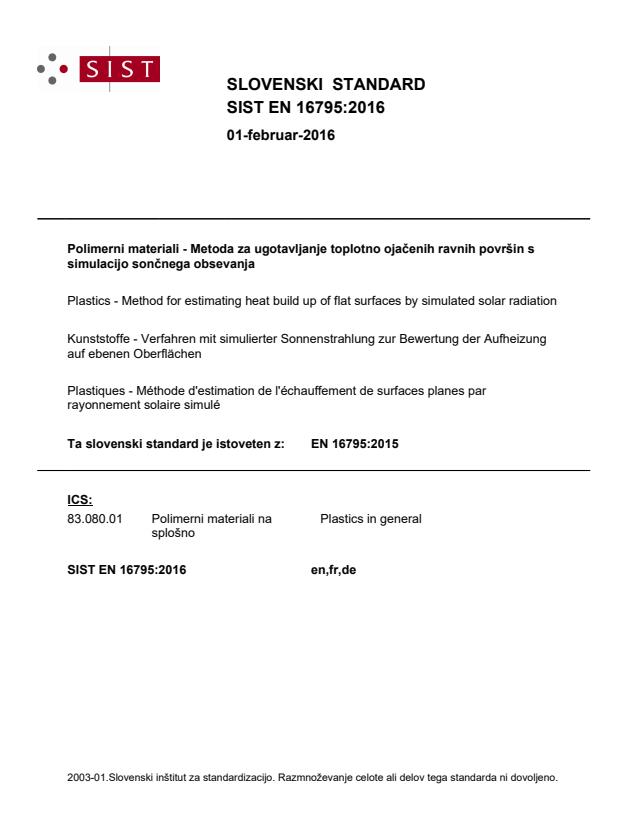
2003-01.Slovenski inštitut za standardizacijo. Razmnoževanje celote ali delov tega standarda ni dovoljeno.Kunststoffe - Verfahren mit simulierter Sonnenstrahlung zur Bewertung der Aufheizung auf ebenen OberflächenPlastiques - Méthode d'estimation de l'échauffement de surfaces planes par rayonnement solaire simuléPlastics - Method for estimating heat build up of flat surfaces by simulated solar radiation83.080.01Polimerni materiali na splošnoPlastics in generalICS:Ta slovenski standard je istoveten z:EN 16795:2015SIST EN 16795:2016en,fr,de01-februar-2016SIST EN 16795:2016SLOVENSKI
STANDARD
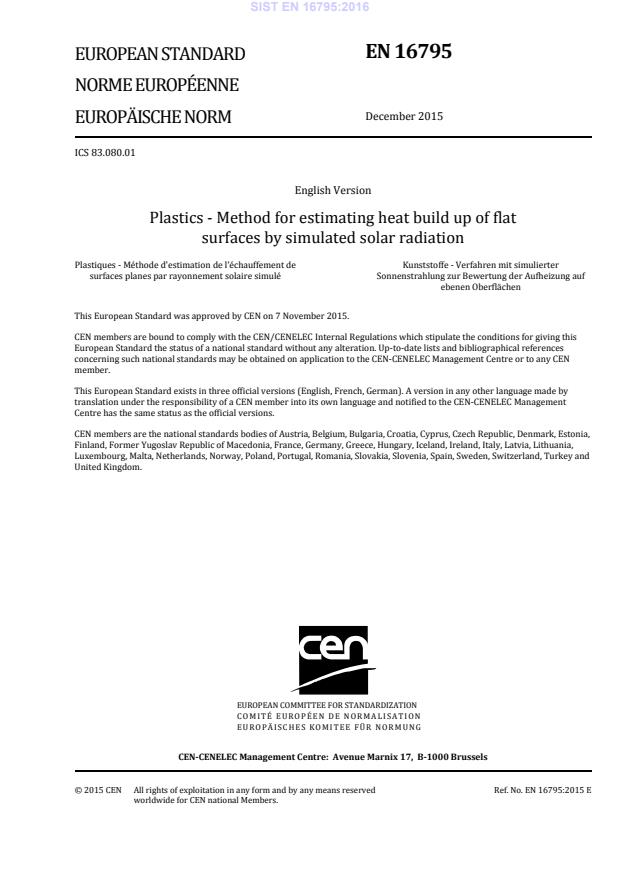
EUROPEAN STANDARD NORME EUROPÉENNE EUROPÄISCHE NORM
EN 16795
December
t r s w ICS
z uä r z rä r s English Version
Plastics æ Method for estimating heat build up of flat surfaces by simulated solar radiation Plastiques æ Méthode d 5estimation de l 5échauffement de surfaces planes par rayonnement solaire simulé
Kunststoffe æ Verfahren mit simulierter Sonnenstrahlung zur Bewertung der Aufheizung auf ebenen Oberflächen This European Standard was approved by CEN on
y November
t r s wä
egulations which stipulate the conditions for giving this European Standard the status of a national standard without any alterationä Upætoædate lists and bibliographical references concerning such national standards may be obtained on application to the CENæCENELEC Management Centre or to any CEN memberä
translation under the responsibility of a CEN member into its own language and notified to the CENæCENELEC Management Centre has the same status as the official versionsä
CEN members are the national standards bodies of Austriaá Belgiumá Bulgariaá Croatiaá Cyprusá Czech Republicá Denmarká Estoniaá Finlandá Former Yugoslav Republic of Macedoniaá Franceá Germanyá Greeceá Hungaryá Icelandá Irelandá Italyá Latviaá Lithuaniaá Luxembourgá Maltaá Netherlandsá Norwayá Polandá Portugalá Romaniaá Slovakiaá Sloveniaá Spainá Swedená Switzerlandá Turkey andUnited Kingdomä
EUROPEAN COMMITTEE FOR STANDARDIZATION COMITÉ EUROPÉEN DE NORMALISATION EUROPÄISCHES KOMITEE FÜR NORMUNG
CEN-CENELEC Management Centre:
Avenue Marnix 17,
B-1000 Brussels
t r s w CEN All rights of exploitation in any form and by any means reserved worldwide for CEN national Membersä Refä Noä EN
s x y { wã t r s w ESIST EN 16795:2016
...