


EN 203-1:2014
(Main)Gas heated catering equipment - Part 1: General safety rules
Gas heated catering equipment - Part 1: General safety rules
This European Standard specifies the general requirements and the constructional and operating characteristics relating to safety ), marking, and the associated test methods for gas heated commercial catering and bakery appliances.
The specific requirements are given in Part 2.
Requirements on materials and parts in contact with food and other sanitary aspects are given in Part 3.
Only appliances of types A1, A2, A3, B1 and B2, as defined in Clause 4, are considered in this European Standard.
This European Standard applies to all professional cooking and bakery appliances using gas for preparing food and drink.
Only the net calorific value (Hi) and net Wobbe number (Wi) are used.
Annex C, informative, lists the main types of equipment entering into the field of application of this European Standard.
NOTE This European Standard does not deal with rational use of energy. This aspect is mentioned in 6.10 only for the coherency with the associated Part 2 (clauses numbering) and to mention that if no Part 2 exists for a specific product, rational use of energy has however to be considered.
Großküchengeräte für gasförmige Brennstoffe - Teil 1: Allgemeine Sicherheitsanforderungen
Diese Europäische Norm legt die allgemeinen Anforderungen und die Eigenschaften der Bauweise und Bedienung bezüglich Sicherheit ), Kennzeichnung sowie die damit verbundenen Prüfmethoden für Großküchen- und Bäckereigeräte für gasförmige Brennstoffe fest.
Die speziellen Anforderungen sind in den Teilen 2 der Normenreihe festgelegt.
Anforderungen in Bezug auf Materialien und Bauteile in Kontakt mit Lebensmitteln und sonstige hygienische Aspekte sind in Teil 3 festgelegt.
Nur Geräte der Typen A1, A2, A3, B1 und B2, wie in Abschnitt 4 definiert, werden in dieser Europäischen Norm berücksichtigt.
Diese Europäische Norm gilt für alle gewerblichen Koch- und Backgeräte, die Gas für die Zubereitung von Speisen und Getränken verwenden.
Es werden nur die Werte der Wärmebelastung (Hi) und des Wobbeindex (Wi) verwendet.
Im informativen Anhang C sind die wesentlichen Gerätetypen des Anwendungsbereiches dieses Dokuments aufgelistet.
Diese Europäische Norm befasst sich nicht mit der rationellen Energienutzung. Dieser Aspekt wird in 6.10 nur im Zusammenhang mit den angegliederten Teilen 2 (Abschnittsnummerierung) erwähnt. Weiterhin soll darauf hingewiesen werden, dass, sofern kein Teil 2 für ein bestimmtes Produkt vorhanden ist, die rationelle Energienutzung trotzdem berücksichtigt werden muss.
Appareils de cuisine professionnelle utilisant les combustibles gazeux - Partie 1: Règles générales de sécurité
Ce document définit les exigences générales et les caractéristiques de construction et de fonctionnement relatives à la sécurité ), au marquage et les techniques d’essais associées des appareils de cuisson professionnelle et de boulangerie artisanale utilisant les combustibles gazeux.
Les exigences spécifiques sont données dans les parties 2.
Les exigences pour les matériaux et parties en contact avec les denrées alimentaires et autres aspects sanitaires sont données dans la partie 3.
Seuls les appareils des types A1, A2, A3, B1 et B2 définis à l’Article 4, sont étudiés dans cette norme.
Ce document s'applique à tous les appareils de cuisson professionnelle et de boulangerie artisanale utilisant les combustibles gazeux destinés à la préparation et à la cuisson des aliments et des boissons.
Seuls le pouvoir calorifique inférieur (Hi) et l'indice de Wobbe inférieur (Wi) sont utilisés.
L’Annexe C, informative, donne une liste des principaux types d’appareils entrant dans le champ d’application de la présente norme.
Ce document ne traite pas réellement de l’utilisation rationnelle de l’énergie. Cet aspect est mentionné en 6.10 seulement pour la cohérence avec les parties 2 associées (numérotation des paragraphes) et pour rappeler que dans les cas où il n’existe pas de partie 2 pour un produit spécifique, l’utilisation rationnelle de l’énergie doit cependant être considérée.
Plinske naprave za gostinstvo - 1. del: Splošna varnostna pravila
EN 203-1 določa splošne zahteve, konstrukcijske značilnosti in značilnosti delovanja v povezavi z varnostjo, označevanje in povezane preskusne metode za plinske naprave za gostinstvo in peko. Posebne zahteve so obravnavane v 2. delu. Zahteve za materiale in dele v stiku s hrano ter drugi sanitarni vidiki so obravnavani v 3. delu. Ta evropski standard obravnava samo naprave tipa A1, A2, A3, B1 in B2 iz točke 4. Ta evropski standard velja za vse profesionalne naprave za gostinstvo in peko, ki za pripravo hrane in pijače uporabljajo plin. Uporabljata se samo neto kalorična vrednost (Hi) in Wobbejev indeks (Wi). Informativna Priloga C navaja glavne vrste naprav, za katere se začne uporabljati ta evropski standard. Ta evropski standard ne obravnava racionalne rabe energije. Ta vidik je omenjen v točki 6.10 le za zagotavljanje skladnosti s povezanim 2. delom (oštevilčenje točk) in kot opomnik, da je treba upoštevati racionalno rabo energije, če za določen izdelek ne obstaja 2. del.
General Information
- Status
- Withdrawn
- Publication Date
- 25-Feb-2014
- Withdrawal Date
- 10-Feb-2026
- Technical Committee
- CEN/TC 106 - Large kitchen appliances using gaseous fuels
- Drafting Committee
- CEN/TC 106/WG 1 - Security
- Current Stage
- 9960 - Withdrawal effective - Withdrawal
- Start Date
- 22-Dec-2021
- Completion Date
- 11-Feb-2026
- Directive
- Not Harmonized2009/142/EC - Appliances burning gaseous fuels
Not Harmonized90/396/EEC - Appliances burning gaseous fuels
Relations
- Effective Date
- 08-Jun-2022
- Effective Date
- 29-Dec-2021
- Effective Date
- 09-Feb-2026
- Effective Date
- 09-Feb-2026
- Effective Date
- 09-Feb-2026
- Effective Date
- 28-Jan-2026
- Effective Date
- 28-Jan-2026
- Effective Date
- 28-Jan-2026
- Effective Date
- 28-Jan-2026
- Effective Date
- 28-Jan-2026
- Effective Date
- 28-Jan-2026
- Effective Date
- 28-Jan-2026
- Effective Date
- 28-Jan-2026
- Effective Date
- 28-Jan-2026
- Effective Date
- 28-Jan-2026


Frequently Asked Questions
EN 203-1:2014 is a standard published by the European Committee for Standardization (CEN). Its full title is "Gas heated catering equipment - Part 1: General safety rules". This standard covers: This European Standard specifies the general requirements and the constructional and operating characteristics relating to safety ), marking, and the associated test methods for gas heated commercial catering and bakery appliances. The specific requirements are given in Part 2. Requirements on materials and parts in contact with food and other sanitary aspects are given in Part 3. Only appliances of types A1, A2, A3, B1 and B2, as defined in Clause 4, are considered in this European Standard. This European Standard applies to all professional cooking and bakery appliances using gas for preparing food and drink. Only the net calorific value (Hi) and net Wobbe number (Wi) are used. Annex C, informative, lists the main types of equipment entering into the field of application of this European Standard. NOTE This European Standard does not deal with rational use of energy. This aspect is mentioned in 6.10 only for the coherency with the associated Part 2 (clauses numbering) and to mention that if no Part 2 exists for a specific product, rational use of energy has however to be considered.
This European Standard specifies the general requirements and the constructional and operating characteristics relating to safety ), marking, and the associated test methods for gas heated commercial catering and bakery appliances. The specific requirements are given in Part 2. Requirements on materials and parts in contact with food and other sanitary aspects are given in Part 3. Only appliances of types A1, A2, A3, B1 and B2, as defined in Clause 4, are considered in this European Standard. This European Standard applies to all professional cooking and bakery appliances using gas for preparing food and drink. Only the net calorific value (Hi) and net Wobbe number (Wi) are used. Annex C, informative, lists the main types of equipment entering into the field of application of this European Standard. NOTE This European Standard does not deal with rational use of energy. This aspect is mentioned in 6.10 only for the coherency with the associated Part 2 (clauses numbering) and to mention that if no Part 2 exists for a specific product, rational use of energy has however to be considered.
EN 203-1:2014 is classified under the following ICS (International Classification for Standards) categories: 97.040.20 - Cooking ranges, working tables, ovens and similar appliances. The ICS classification helps identify the subject area and facilitates finding related standards.
EN 203-1:2014 has the following relationships with other standards: It is inter standard links to EN 203-1:2005+A1:2008, EN 203-1:2021, EN IEC 60335-2-102:2024, EN IEC 60730-2-9:2019, EN 60335-1:2002, EN 126:2025, EN 161:2022+A1:2025, EN 88-2:2022+A1:2024, EN 10226-2:2005, EN 1106:2022+A1:2023, EN 125:2022+A1:2024, EN 88-1:2022+A1:2023, EN 10226-1:2004, EN 257:2022+A1:2023, EN 298:2022. Understanding these relationships helps ensure you are using the most current and applicable version of the standard.
EN 203-1:2014 is associated with the following European legislation: EU Directives/Regulations: 2009/142/EC, 90/396/EEC; Standardization Mandates: M/BC/CEN/89/6. When a standard is cited in the Official Journal of the European Union, products manufactured in conformity with it benefit from a presumption of conformity with the essential requirements of the corresponding EU directive or regulation.
EN 203-1:2014 is available in PDF format for immediate download after purchase. The document can be added to your cart and obtained through the secure checkout process. Digital delivery ensures instant access to the complete standard document.
Standards Content (Sample)
2003-01.Slovenski inštitut za standardizacijo. Razmnoževanje celote ali delov tega standarda ni dovoljeno.Plinske naprave za gostinstvo - 1. del: Splošna varnostna pravilaGroßküchengeräte für gasförmige Brennstoffe - Teil 1: Allgemeine SicherheitsanforderungenAppareils de cuisine professionnelle utilisant les combustibles gazeux - Partie 1: Règles générales de sécuritéGas heated catering equipment - Part 1: General safety rules97.040.20Cooking ranges, working tables, ovens and similar appliancesICS:Ta slovenski standard je istoveten z:EN 203-1:2014SIST EN 203-1:2014en,fr,de01-julij-2014SIST EN 203-1:2014SLOVENSKI
STANDARDSIST EN 203-1:2006+A1:20081DGRPHãþD
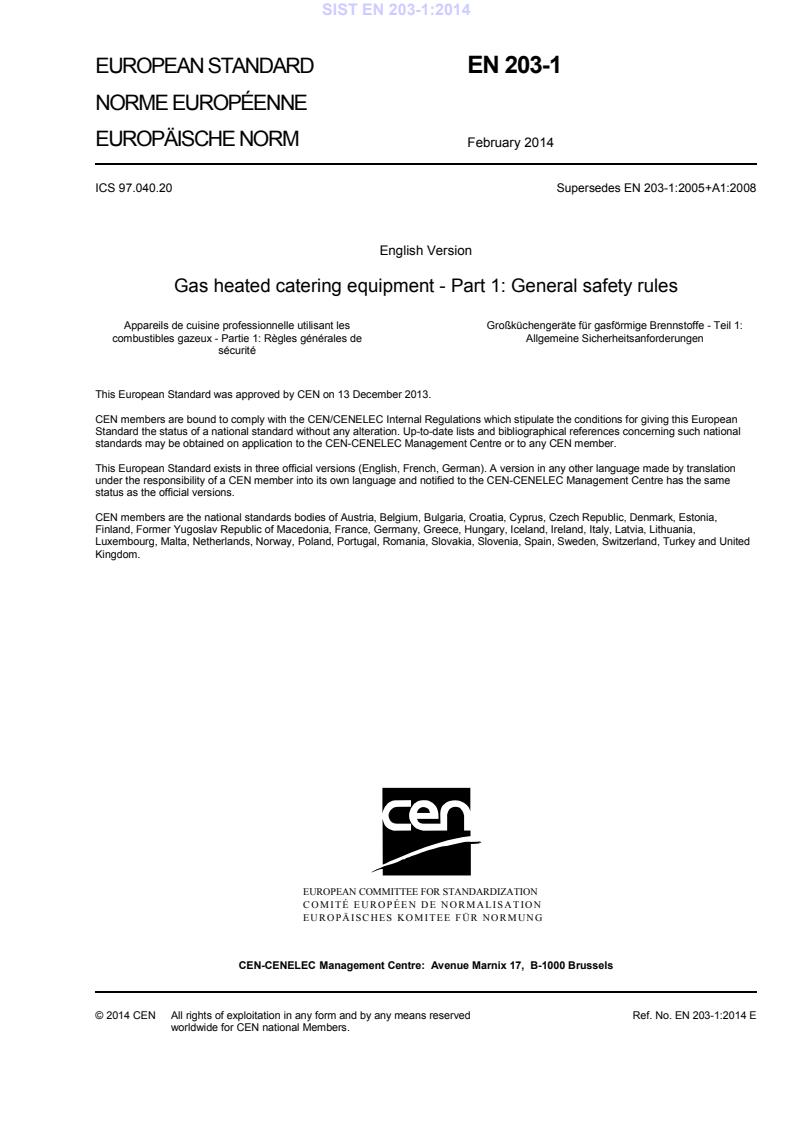
EUROPEAN STANDARD NORME EUROPÉENNE EUROPÄISCHE NORM
EN 203-1
February 2014 ICS 97.040.20 Supersedes EN 203-1:2005+A1:2008English Version
Gas heated catering equipment - Part 1: General safety rules
Appareils de cuisine professionnelle utilisant les combustibles gazeux - Partie 1: Règles générales de sécurité
Großküchengeräte für gasförmige Brennstoffe - Teil 1: Allgemeine Sicherheitsanforderungen This European Standard was approved by CEN on 13 December 2013.
CEN members are bound to comply with the CEN/CENELEC Internal Regulations which stipulate the conditions for giving this European Standard the status of a national standard without any alteration. Up-to-date lists and bibliographical references concerning such national standards may be obtained on application to the CEN-CENELEC Management Centre or to any CEN member.
This European Standard exists in three official versions (English, French, German). A version in any other language made by translation under the responsibility of a CEN member into its own language and notified to the CEN-CENELEC Management Centre has the same status as the official versions.
CEN members are the national standards bodies of Austria, Belgium, Bulgaria, Croatia, Cyprus, Czech Republic, Denmark, Estonia, Finland, Former Yugoslav Republic of Macedonia, France, Germany, Greece, Hungary, Iceland, Ireland, Italy, Latvia, Lithuania, Luxembourg, Malta, Netherlands, Norway, Poland, Portugal, Romania, Slovakia, Slovenia, Spain, Sweden, Switzerland, Turkey and United Kingdom.
EUROPEAN COMMITTEE FOR STANDARDIZATION
COMITÉ EUROPÉEN DE NORMALISATION EUROPÄISCHES KOMITEE FÜR NORMUNG
CEN-CENELEC Management Centre:
Avenue Marnix 17,
B-1000 Brussels © 2014 CEN All rights of exploitation in any form and by any means reserved worldwide for CEN national Members. Ref. No. EN 203-1:2014 ESIST EN 203-1:2014
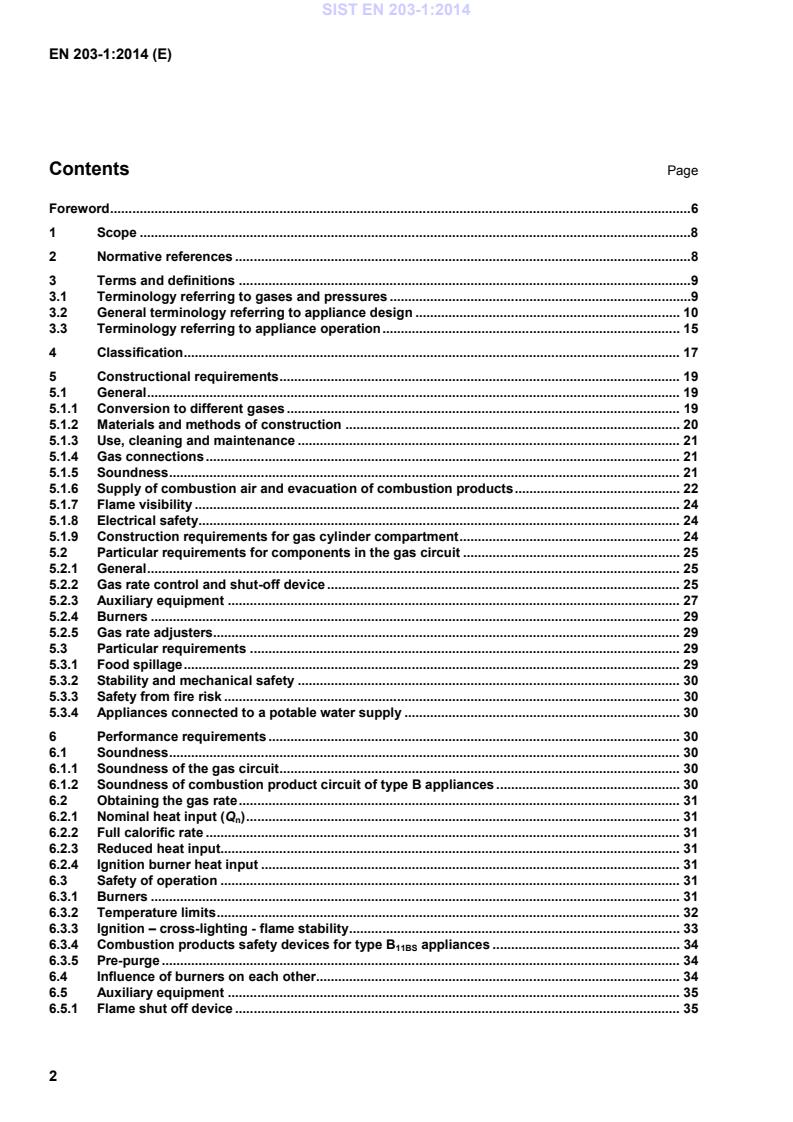
Foreword .6 1 Scope .8 2 Normative references .8 3 Terms and definitions .9 3.1 Terminology referring to gases and pressures .9 3.2 General terminology referring to appliance design . 10 3.3 Terminology referring to appliance operation . 15 4 Classification . 17 5 Constructional requirements . 19 5.1 General . 19 5.1.1 Conversion to different gases . 19 5.1.2 Materials and methods of construction . 20 5.1.3 Use, cleaning and maintenance . 21 5.1.4 Gas connections . 21 5.1.5 Soundness . 21 5.1.6 Supply of combustion air and evacuation of combustion products . 22 5.1.7 Flame visibility . 24 5.1.8 Electrical safety. 24 5.1.9 Construction requirements for gas cylinder compartment . 24 5.2 Particular requirements for components in the gas circuit . 25 5.2.1 General . 25 5.2.2 Gas rate control and shut-off device . 25 5.2.3 Auxiliary equipment . 27 5.2.4 Burners . 29 5.2.5 Gas rate adjusters. 29 5.3 Particular requirements . 29 5.3.1 Food spillage . 29 5.3.2 Stability and mechanical safety . 30 5.3.3 Safety from fire risk . 30 5.3.4 Appliances connected to a potable water supply . 30 6 Performance requirements . 30 6.1 Soundness . 30 6.1.1 Soundness of the gas circuit . 30 6.1.2 Soundness of combustion product circuit of type B appliances . 30 6.2 Obtaining the gas rate . 31 6.2.1 Nominal heat input (Qn) . 31 6.2.2 Full calorific rate . 31 6.2.3 Reduced heat input. 31 6.2.4 Ignition burner heat input . 31 6.3 Safety of operation . 31 6.3.1 Burners . 31 6.3.2 Temperature limits . 32 6.3.3 Ignition – cross-lighting - flame stability . 33 6.3.4 Combustion products safety devices for type B11BS appliances . 34 6.3.5 Pre-purge . 34 6.4 Influence of burners on each other. 34 6.5 Auxiliary equipment . 35 6.5.1 Flame shut off device . 35 SIST EN 203-1:2014
National situations . 69 A.1 Connection requirements in force in various countries (see 5.1.4) . 69 A.2 Requirements for flue connection in force in various countries (see 5.1.6.5) . 70 A.3 Categories, test gases and test pressures . 71 Annex B (normative)
Use of symbols on appliances and packaging . 72 B.1 General . 72 B.2 Electric power supply . 72 B.3 Type of gas . 72 B.4 Gas supply pressure . 72 B.5 Country of destination . 73 B.6 Category . 73 B.7 Other optional information . 73 B.8 Nominal heat input of burner . 73 B.9 Nominal heat input of set of burners on appliance . 73 Annex C (informative)
Trilingual list of appliances in the scope of EN 203-1 and corresponding Part 2 . 74 Annex D (normative)
Non pneumatic air/gas control devices . 75 D.1 Requirements . 75 D.1.1 Endurance . 75 D.1.2 Leakage of non-metallic control tubes . 75 D.1.3 Safety of operation . 75 D.1.4 Adjustment of air/gas ratio . 75 D.2 Tests . 76 D.2.1 Endurance . 76 D.2.2 Leakage of non-metallic control tubes . 76 D.2.3 Safety of operation . 76 D.2.4 Adjustment of the air/gas ratio controls . 77 Annex E (informative)
Composition of the gas circuit . 78 E.1 Minimum requirements for: . 78 SIST EN 203-1:2014
Clauses of this European Standard addressing essential requirements or other provisions of EU Directives . 80 Bibliography . 82
1) The term "safety" includes not only the safety of the appliance gas line but also that of the overall cooking appliance during its normal use in catering. SIST EN 203-1:2014
(IEC 60335-1:2001, modified) EN 60335-2-102, Household and similar electrical appliances – Safety – Part 2-102: Particular requirements for gas, oil and solid-fuel burning appliances having electrical connections (IEC 60335-2-102) EN 60730-2-9, Automatic electrical controls for household and similar use – Part 2-9: Particular requirements for temperature sensing controls (IEC 60730-2-9) EN ISO 228-1, Pipe threads where pressure-tight joints are not made on the threads - Part 1: Dimensions, tolerances and designation (ISO 228-1) ISO 301, Zinc alloy ingots intended for castings 3 Terms and definitions For the purposes of this document, the following terms and definitions apply. 3.1 Terminology referring to gases and pressures 3.1.1 reference conditions 15 °C, 1 013,25 mbar 3.1.2 units calorific value and Wobbe number: (MJ/m3) Note 1 to entry: Test pressures: 1 mbar = 102 Pa. 3.1.3 gas supply pressure p difference between the static pressure measured at the inlet connection of the appliance, with the appliance in operation, and atmospheric pressure Note 1 to entry: Gas supply pressure is expressed in millibars (mbar). 3.1.4 relative density d ratio of the masses of equal volumes of dry gas and dry air under the same conditions of temperature and pressure: 15 °C or 0 °C and 1 013,25 mbar [SOURCE: EN 437:2003+A1:2009, 3.10] 3.1.5 calorific value quantity of heat produced by the complete combustion, at a constant pressure equal to 1 013,25 mbar, of a unit volume or mass of gas, the constituents of the combustible mixture being taken at reference conditions and the products of combustion being brought back to the same conditions Note 1 to entry: A distinction is made between: SIST EN 203-1:2014
...
Questions, Comments and Discussion
Ask us and Technical Secretary will try to provide an answer. You can facilitate discussion about the standard in here.
Loading comments...