

EN 12939:2000
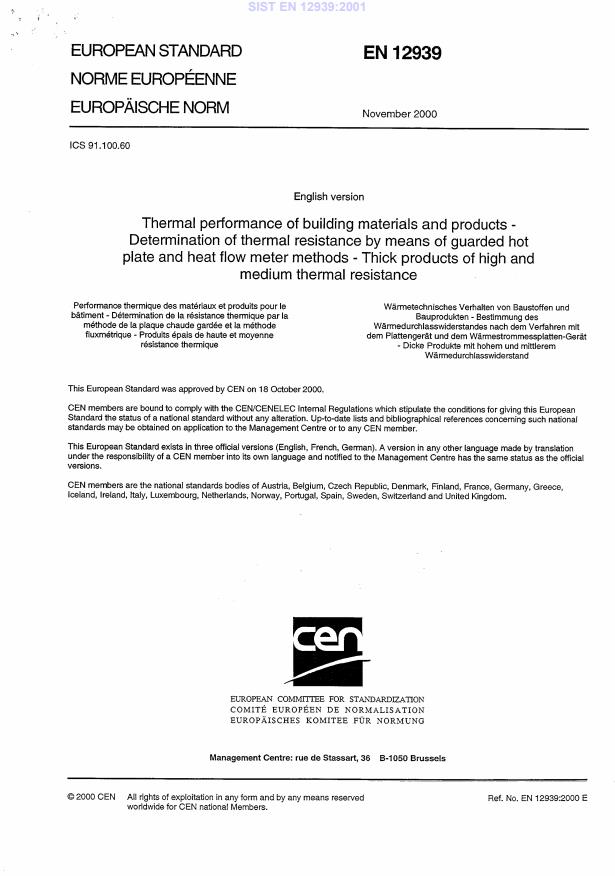
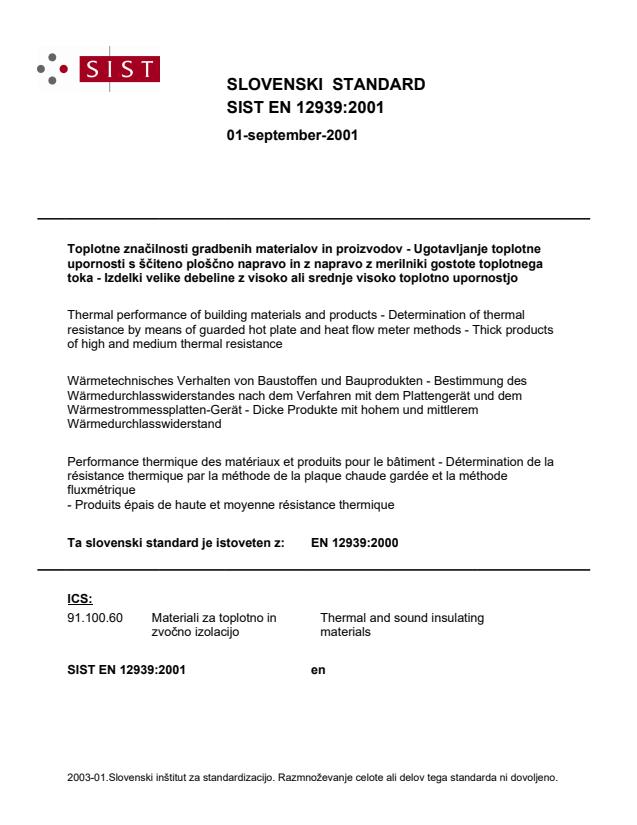
(Main)Thermal performance of building materials and products - Determination of thermal resistance by means of guarded hot plate and heat flow meter methods - Thick products of high and medium thermal resistance
- Abstract
This standard gives the procedures to determine the thermal resistance of products the thicknesses of which exceed the maximum thickness for guarded hot plate or heat flow meter apparatus. In any case most of the procedures described in this standard require apparatus that allows tests on specimens up to 100 mm thick. This standard gives guidelines to assess the relevance of the thickness effect, i.e. to establish whether the thermal resistance of a thick product can or cannot be calculated as the sum of the thermal resistances of slices cut from the product, these guidelines complement the indications given in ISO 8302:1991 on the guarded hot plate apparatus.This standard describes testing conditions which prevent the onset of convection. which could take place in some products under the considered temperature differences and thicknesses.
- Status
- Published
- Publication Date
- 21-Nov-2000
- Technical Committee
- CEN/TC 89 - Thermal performance of buildings and building components
- Drafting Committee
- CEN/TC 89/WG 8 - Thermal test methods
- Current Stage
- 9092 - Decision on results of review/2YR ENQ - revise - Review Enquiry
- Start Date
- 19-Oct-2020
- Completion Date
- 30-Sep-2026

Overview
EN 12939:2000 (CEN) specifies procedures for determining the thermal resistance of thick building materials and products using the guarded hot plate and heat flow meter methods. It applies to products whose thicknesses exceed the usual maximum for standard test apparatus; many procedures in the standard assume testing capability for specimens up to 100 mm thick. The standard focuses on thick products of high and medium thermal resistance and complements the guidance in ISO 8302:1991 for guarded hot plate testing.
Key Topics and Requirements
- Test methods covered
- Guarded hot plate method
- Heat flow meter (fluxmeter) method
- Specimen thickness
- Procedures for products thicker than conventional apparatus limits
- Most methods assume apparatus capable of testing up to 100 mm specimens
- Thickness effect assessment
- Guidelines to determine whether the thermal resistance of a thick product can be approximated by summing resistances of slices cut from the product (slice method)
- Criteria to assess when slice-based calculations are valid or when full-thickness testing is required
- Convection prevention
- Test conditions and setup recommendations to prevent natural convection that could occur in porous or thick materials under certain temperature differences and thicknesses
- Test environment and relevance
- Practical considerations to ensure representative thermal performance results for building applications
- Complementary references to ISO 8302 for guarded hot plate apparatus specifics
Applications
EN 12939 is intended for professionals who need reliable thermal-resistance data for thick insulating and building materials:
- Manufacturers of insulation boards, blocks, composite panels, and high-resistance materials-use the standard for product characterization and quality control
- Independent test laboratories-implement procedures for compliance testing and certification
- Building physicists and designers-use measured thermal resistance values for hygrothermal modeling, energy performance calculations, and specification writing
- R&D teams-evaluate material improvements and validate full-thickness thermal behavior versus sliced-sample approximations
Related Standards
- ISO 8302:1991 - Guarded hot plate apparatus and general guarded hot plate guidance (complementary)
- Other CEN/ISO standards on thermal conductivity and insulation testing may be used alongside EN 12939 for full assessment and reporting
EN 12939:2000 helps ensure accurate, repeatable measurement of thermal resistance for thick, high- and medium-resistance products-critical for energy-efficient building design, compliance, and material development.
Relations
- Effective Date
- 25-Aug-2026
- Effective Date
- 25-Aug-2026
- Refers
EN ISO 9288:2022 - Thermal insulation - Heat transfer by radiation - Vocabulary (ISO 9288:2022) - Effective Date
- 28-Jan-2026
- Effective Date
- 28-Jan-2026
- Effective Date
- 28-Jan-2026
- Effective Date
- 28-Jan-2026
- Effective Date
- 28-Jan-2026
- Effective Date
- 28-Jan-2026
- Effective Date
- 28-Jan-2026
- Effective Date
- 28-Jan-2026
- Effective Date
- 28-Jan-2026
- Effective Date
- 28-Jan-2026
- Effective Date
- 28-Jan-2026
- Effective Date
- 28-Jan-2026
- Effective Date
- 28-Jan-2026
Get Certified
Connect with accredited certification bodies for this standard

DIBt (Deutsches Institut für Bautechnik)
German Institute for Building Technology.
DIN CERTCO
DIN Group product certification.

Aboma Certification B.V.
Specialized in construction, metal, and transport sectors.
Sponsored listings
Frequently Asked Questions
EN 12939:2000 is a standard published by the European Committee for Standardization (CEN). Its full title is "Thermal performance of building materials and products - Determination of thermal resistance by means of guarded hot plate and heat flow meter methods - Thick products of high and medium thermal resistance". This standard covers: This standard gives the procedures to determine the thermal resistance of products the thicknesses of which exceed the maximum thickness for guarded hot plate or heat flow meter apparatus. In any case most of the procedures described in this standard require apparatus that allows tests on specimens up to 100 mm thick. This standard gives guidelines to assess the relevance of the thickness effect, i.e. to establish whether the thermal resistance of a thick product can or cannot be calculated as the sum of the thermal resistances of slices cut from the product, these guidelines complement the indications given in ISO 8302:1991 on the guarded hot plate apparatus.This standard describes testing conditions which prevent the onset of convection. which could take place in some products under the considered temperature differences and thicknesses.
This standard gives the procedures to determine the thermal resistance of products the thicknesses of which exceed the maximum thickness for guarded hot plate or heat flow meter apparatus. In any case most of the procedures described in this standard require apparatus that allows tests on specimens up to 100 mm thick. This standard gives guidelines to assess the relevance of the thickness effect, i.e. to establish whether the thermal resistance of a thick product can or cannot be calculated as the sum of the thermal resistances of slices cut from the product, these guidelines complement the indications given in ISO 8302:1991 on the guarded hot plate apparatus.This standard describes testing conditions which prevent the onset of convection. which could take place in some products under the considered temperature differences and thicknesses.
EN 12939:2000 is classified under the following ICS (International Classification for Standards) categories: 91.100.60 - Thermal and sound insulating materials. The ICS classification helps identify the subject area and facilitates finding related standards.
EN 12939:2000 has the following relationships with other standards: It is inter standard links to ISO 8301:1991, ISO 8302:1991, EN ISO 9288:2022, EN 12667:2001, EN 13763-18:2003, EN ISO 7345:2018, EN 13763-19:2003, EN 13163:2012+A1:2015, EN 14304:2009+A1:2013, EN 13166:2012+A2:2016, EN 13162:2012+A1:2015, EN 14308:2009+A1:2013, EN 14309:2009+A1:2013, EN 14320-1:2013, EN 14314:2009+A1:2013. Understanding these relationships helps ensure you are using the most current and applicable version of the standard.
EN 12939:2000 is associated with the following European legislation: EU Directives/Regulations: 305/2011, 89/106/EEC. When a standard is cited in the Official Journal of the European Union, products manufactured in conformity with it benefit from a presumption of conformity with the essential requirements of the corresponding EU directive or regulation.
EN 12939:2000 is available in PDF format for immediate download after purchase. The document can be added to your cart and obtained through the secure checkout process. Digital delivery ensures instant access to the complete standard document.
Standards Content (Sample)
2003-01.Slovenski inštitut za standardizacijo. Razmnoževanje celote ali delov tega standarda ni dovoljeno.Wärmetechnisches Verhalten von Baustoffen und Bauprodukten - Bestimmung des Wärmedurchlasswiderstandes nach dem Verfahren mit dem Plattengerät und demWärmestrommessplatten-Gerät - Dicke Produkte mit hohem und mittlerem WärmedurchlasswiderstandPerformance thermique des matériaux et produits pour le bâtiment - Détermination de la résistance thermique par la méthode de la plaque chaude gardée et la méthode fluxmétrique- Produits épais de haute et moyenne résistance thermiqueThermal performance of building materials and products - Determination of thermal resistance by means of guarded hot plate and heat flow meter methods - Thick products of high and medium thermal resistance91.100.60Thermal and sound insulating materialsICS:Ta s
...