

EN 13000:2010
(Main)Cranes - Mobile cranes
- Abstract
This European Standard is applicable to the design, construction, installation of safety devices, information for use, maintenance and testing of mobile cranes as defined in ISO 4306-2 with the exception of loader cranes (see 3.1.1 of EN 12999:2002). Examples of mobile crane types and of their major parts are given in Annexes A and B.
This standard does not cover hazards related to the lifting of persons.
NOTE The use of mobile cranes for the lifting of persons is subject to specific national regulations.
Mobile cranes covered by this European Standard are designed for a limited number of stress cycles and particular properties of motions, e.g. smooth application of the driving forces and loading conditions according to ISO 4301-2:1985, group A1.
For a duty cycle such as grab, magnet or similar work, additional provisions are required which are outside the scope of this European Standard.
The hazards covered by this European Standard are identified by Annex C.
This document is not applicable to mobile cranes which are manufactured before the date of publication of this document by CEN.
- Status
- Withdrawn
- Publication Date
- 26-Jan-2010
- Withdrawal Date
- 13-May-2014
- Technical Committee
- CEN/TC 147 - Cranes - Safety
- Drafting Committee
- CEN/TC 147 - Cranes - Safety
- Current Stage
- 9960 - Withdrawal effective - Withdrawal
- Start Date
- 14-May-2014
- Completion Date
- 14-May-2014
- Directive
- 2006/42/EC - Directive 2006/42/EC of the European Parliament and of the Council of 17 May 2006 on machinery, and amending Directive 95/16/EC (recast)OJ Ref: C, C 136 OJ Date: 26-May-2010
- Ref Project
SIST EN 13000:2010 - Cranes - Mobile cranes

Relations
- Effective Date
- 22-Dec-2008
- Effective Date
- 18-Jan-2023
- Effective Date
- 25-Aug-2026
- Effective Date
- 25-Aug-2026
- Effective Date
- 25-Aug-2026
- Effective Date
- 25-Aug-2026
- Effective Date
- 25-Aug-2026
- Effective Date
- 25-Aug-2026
- Effective Date
- 25-Aug-2026
- Effective Date
- 25-Aug-2026
- Refers
ISO 4309:2004 - Cranes — Wire ropes — Care, maintenance, installation, examination and discard - Effective Date
- 25-Aug-2026
- Effective Date
- 25-Aug-2026
- Effective Date
- 25-Aug-2026
- Effective Date
- 25-Aug-2026
- Effective Date
- 25-Aug-2026
Frequently Asked Questions
EN 13000:2010 is a standard published by the European Committee for Standardization (CEN). Its full title is "Cranes - Mobile cranes". This standard covers: This European Standard is applicable to the design, construction, installation of safety devices, information for use, maintenance and testing of mobile cranes as defined in ISO 4306-2 with the exception of loader cranes (see 3.1.1 of EN 12999:2002). Examples of mobile crane types and of their major parts are given in Annexes A and B. This standard does not cover hazards related to the lifting of persons. NOTE The use of mobile cranes for the lifting of persons is subject to specific national regulations. Mobile cranes covered by this European Standard are designed for a limited number of stress cycles and particular properties of motions, e.g. smooth application of the driving forces and loading conditions according to ISO 4301-2:1985, group A1. For a duty cycle such as grab, magnet or similar work, additional provisions are required which are outside the scope of this European Standard. The hazards covered by this European Standard are identified by Annex C. This document is not applicable to mobile cranes which are manufactured before the date of publication of this document by CEN.
This European Standard is applicable to the design, construction, installation of safety devices, information for use, maintenance and testing of mobile cranes as defined in ISO 4306-2 with the exception of loader cranes (see 3.1.1 of EN 12999:2002). Examples of mobile crane types and of their major parts are given in Annexes A and B. This standard does not cover hazards related to the lifting of persons. NOTE The use of mobile cranes for the lifting of persons is subject to specific national regulations. Mobile cranes covered by this European Standard are designed for a limited number of stress cycles and particular properties of motions, e.g. smooth application of the driving forces and loading conditions according to ISO 4301-2:1985, group A1. For a duty cycle such as grab, magnet or similar work, additional provisions are required which are outside the scope of this European Standard. The hazards covered by this European Standard are identified by Annex C. This document is not applicable to mobile cranes which are manufactured before the date of publication of this document by CEN.
EN 13000:2010 is classified under the following ICS (International Classification for Standards) categories: 53.020.20 - Cranes. The ICS classification helps identify the subject area and facilitates finding related standards.
EN 13000:2010 has the following relationships with other standards: It is inter standard links to EN 13000:2004, EN 13000:2010+A1:2014, ISO 8995-1:2002, ISO 7752-2:1985, ISO 12480-1:1997, ISO 2631-1:1997, ISO 13200:1995, ISO 11660-2:1994, ISO 4310:1981, ISO 11662-1:1995, ISO 4309:2004, ISO 7000:2004, ISO 4308-1:2003, ISO 4306-1:2007, ISO 4306-2:1994. Understanding these relationships helps ensure you are using the most current and applicable version of the standard.
EN 13000:2010 is associated with the following European legislation: EU Directives/Regulations: 2006/42/EC, 98/37/EC; Standardization Mandates: M/079, M/396. When a standard is cited in the Official Journal of the European Union, products manufactured in conformity with it benefit from a presumption of conformity with the essential requirements of the corresponding EU directive or regulation.
EN 13000:2010 is available in PDF format for immediate download after purchase. The document can be added to your cart and obtained through the secure checkout process. Digital delivery ensures instant access to the complete standard document.
Standards Content (Sample)
2003-01.Slovenski inštitut za standardizacijo. Razmnoževanje celote ali delov tega standarda ni dovoljeno.Dvigala (žerjavi) - Mobilna dvigalaKrane - FahrzeugkraneAppareils de levage à charge suspendue - Grues mobilesCranes - Mobile cranes53.020.20DvigalaCranesICS:Ta slovenski standard je istoveten z:EN 13000:2010SIST EN 13000:2010en,fr,de01-julij-2010SIST EN 13000:2010SLOVENSKI
STANDARDSIST EN 13000:20041DGRPHãþD
EUROPEAN STANDARD NORME EUROPÉENNE EUROPÄISCHE NORM
EN 13000
January 2010 ICS 53.020.20 Supersedes EN 13000:2004English Version
Cranes - Mobile cranes
Appareils de levage à charge suspendue - Grues mobiles Krane - Fahrzeugkrane This European Standard was approved by CEN on 19 December 2009.
CEN members are bound to comply with the CEN/CENELEC Internal Regulations which stipulate the conditions for giving this European Standard the status of a national standard without any alteration. Up-to-date lists and bibliographical references concerning such national standards may be obtained on application to the CEN Management Centre or to any CEN member.
This European Standard exists in three official versions (English, French, German). A version in any other language made by translation under the responsibility of a CEN member into its own language and notified to the CEN Management Centre has the same status as the official versions.
CEN members are the national standards bodies of Austria, Belgium, Bulgaria, Croatia, Cyprus, Czech Republic, Denmark, Estonia, Finland, France, Germany, Greece, Hungary, Iceland, Ireland, Italy, Latvia, Lithuania, Luxembourg, Malta, Netherlands, Norway, Poland, Portugal, Romania, Slovakia, Slovenia, Spain, Sweden, Switzerland and United Kingdom.
EUROPEAN COMMITTEE FOR STANDARDIZATION
COMITÉ EUROPÉEN DE NORMALISATION EUROPÄISCHES KOMITEE FÜR NORMUNG
Management Centre:
Avenue Marnix 17,
B-1000 Brussels © 2010 CEN All rights of exploitation in any form and by any means reserved worldwide for CEN national Members. Ref. No. EN 13000:2010: ESIST EN 13000:2010
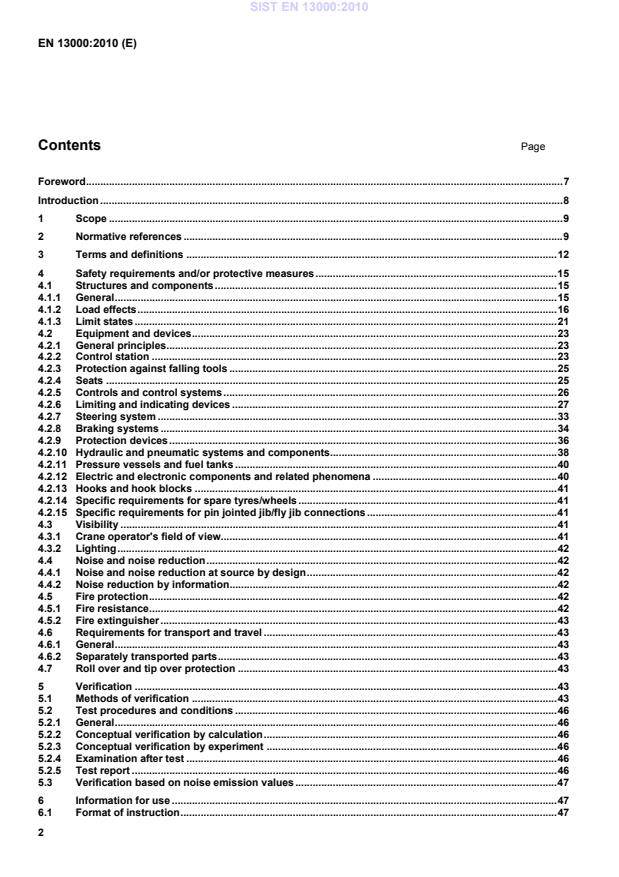
(normative)
Examples of mobile crane types . 53Annex B.1
(informative)
Major parts of telescopic cranes . 55Annex B.2
(informative)
Major parts of lattice jib cranes . 56Annex C
(normative)
List of hazards . 57Annex D
(normative)
Load effects of combined motions . 60Annex E
(normative)
Crane operator's seat dimensions . 64E.1General. 64E.2Dimensions of crane operator's seat. 64E.3Other dimensions or adjustments . 64Annex F
(normative)
Rigid body stability: Load effects due to acceleration . 66Annex G.1
(normative)
Noise test code for mobile cranes . 67G.1.1Introduction . 67G.1.2Normative references . 67G.1.3Terms and definitions . 67G.1.4Description of machinery family . 67G.1.5Sound power level determination . 68G.1.5.1Basic standard to be used . 68G.1.5.2Positioning of the crane . 68G.1.5.3Microphone positions . 68G.1.5.4Measurement and calculation procedure . 68G.1.6Emission sound pressure level determination . 69G.1.6.1Basic standard to be used . 69G.1.6.2Crane operator position . 69G.1.6.3Specifications concerning the crane operating cabin . 69G.1.6.4Specification relating to wind speed . 69G.1.6.5Measurement and calculation procedure . 69G.1.7Configuration . 70G.1.8Operating conditions . 70G.1.8.1General. 70G.1.8.2Test procedure . 70G.1.9Information on measurement uncertainties. 71G.1.10Information to be recorded . 71G.1.11Information to be reported . 71G.1.12Declaration and verification of noise emission values . 71Annex G.2
(normative)
Noise measurement, test report . 73G.2.1General data . 73SIST EN 13000:2010
(normative)
Limit values for structural and fine grain steel types . 76Annex J.1
(normative)
Minimum requirements for specification of hoist/derrick gears . 77Annex J.2
(normative)
Minimum requirements for specification of slewing gears . 79Annex J.3
(normative)
Minimum requirements for specification of travel gears . 81Annex J.4
(normative)
Minimum requirements for specification of drums . 83Annex K.1
(normative)
Minimum requirements for the specification of lifting hooks . 85Annex K.2
(normative)
Minimum requirements for specification of sheaves. 86Annex K.3
(normative)
Minimum requirements for specification of hook blocks . 88Annex K.4
(normative)
Minimum requirements for the specification of hydraulic cylinders . 90Annex K.5
(normative)
Minimum requirements for the specification of slew rings . 92Annex L
(normative)
Proof of competence . 94L.1General . 94L.2Proof of competence for steel structures . 94L.2.1General . 94L.2.2Method of permissible stresses . 94L.2.3Method of partial safety coefficients and limiting stresses . 94L.3Proof of competence for non steel structures . 95L.4Proof of competence for load bearing components . 95L.4.1General . 95L.4.2Proof of competence for mechanisms . 95L.4.3Proof of competence for ropes . 95L.4.4Proof of competence for chains . 95L.4.5Proof of competence for other components . 96L.5Proof of competence of rigid body stability of the crane . 96L.6Proof of competence – experimental . 96L.6.1Structural tests . 96L.6.2Rigid body stability tests . 96Annex M
(normative)
Test of steering systems for off-road mobile cranes . 97M.1Test conditions . 97M.2Test procedure . 97M.3Permitted steering control effort . 97Annex N.1
(informative)
Wind speed as a function of elevation . 98Annex N.2
(informative)
Impact pressure as a function of elevation . 99Annex N.3
(informative)
Storm wind map of Europe . 100Annex P
(normative)
Efficiency of sheave sets . 101Annex Q
(informative)
Manufacturer's sign . 102Annex R
(normative)
Certificate for wire rope, requirements. 103Annex S
(normative)
Certificate for chain, requirements . 104Annex T
(informative)
Test procedures: Selection of load cases . 105Annex U
(normative)
Test certificate. 106Annex V (informative)
Additional information of the concept of the limiting and indicating device. 107Annex W
(informative)
Selection of a suitable set of crane standards for a given application . 108Annex ZA (informative)
Relationship between this European Standard and the Essential Requirements of EU Directive 98/37EC . 109Annex ZB (informative)
Relation between this European Standard and the Essential Requirements of EU Directive 2006/42/EC . 110Bibliography . 111SIST EN 13000:2010
to the radial centre of the hemisphere, see G.1.5.1 and G.1.5.2 . 72Figure K.3.1 — Model of hook blocks (Examples) . 89Figure N.3.1 — Regions where same mean storm wind velocities are applicable . 100Figure Q.1 — Example of a Manufacturer's sign . 102Figure T.1 — Selection of load cases . 105 Tables Table 1 — Verification of safety requirements including the proof of competence . 44Table C.1 — List of hazards . 57Table D.1 — Load combinations, one or two simultaneous movements . 62Table D.2 — Load combinations, more than two simultaneous movements . 63Table E.1 — Seat dimensions and adjustments . 65SIST EN 13000:2010
as per Beaufort Scale and as per elevation .98Table N.2.1 — Quasistatic impact pressure as a function of mean wind speed
as per the Beaufort Scale and as a function of elevation .99Table R.1 — Rope certificate (Example) .103Table S.1 — Certificate for chain (Example) .104Table U.1 — Test certificate (Example).106 SIST EN 13000:2010
Safety”, the secretariat of which is held by BSI. This European Standard shall be given the status of a national standard, either by publication of an identical text or by endorsement, at the latest by July 2010, and conflicting national standards shall be withdrawn at the latest by July 2010. Attention is drawn to the possibility that some of the elements of this document may be the subject of patent rights. CEN [and/or CENELEC] shall not be held responsible for identifying any or all such patent rights. This document supersedes EN 13000:2004. This document has been prepared under a mandate given to CEN by the European Commission and the European Free Trade Association, and supports essential requirements of EU Directive(s). For relationship with EU Directive(s), see informative Annexes ZA and ZB, which are integral parts of this document. This standard applies to mobile cranes which are put on the market 12 months after the date of ratification by CEN of this standard or at the latest 2010-01-01. This document has been prepared by Product Working Group CEN/TC 147/WG 11 "Mobile Cranes", the secretariat of which is held by DIN. Annexes A, C, D, E, F, G.1 and G.2, H, J.1 to J.4, K.1 to K.5, L, M, P, R, S and U are normative. Annexes B.1 and B.2, N.1 to N.3, Q, T, V and W are informative.
According to the CEN/CENELEC Internal Regulations, the national standards organizations of the following countries are bound to implement this European Standard: Austria, Belgium, Bulgaria, Croatia, Cyprus, Czech Republic, Denmark, Estonia, Finland, France, Germany, Greece, Hungary, Iceland, Ireland, Italy, Latvia, Lithuania, Luxembourg, Malta, Netherlands, Norway, Poland, Portugal, Romania, Slovakia, Slovenia, Spain, Sweden, Switzerland and the United Kingdom.
EN ISO 6683:2008, Earth-moving machinery — Seat belts and seat belt anchorages — Performance requirements and tests (ISO 6683:2005) EN ISO 7096:2008, Earth-moving machinery — Laboratory evaluation of operator seat vibration (ISO 7096:2000) EN ISO 7250:1997, Basic human body measurements for technological design (ISO 7250:1996) EN ISO 7731:2008, Ergonomics — Danger signals for public and work areas — Auditory danger signals (ISO 7731:2003) EN ISO 11201:1995, Acoustics — Noise emitted by machinery and equipment — Measurement of emission sound pressure levels at a work station and at other specified positions — Engineering method in an essentially free field over a reflecting plane (ISO 11201:1995) EN ISO 12100-1:2003, Safety of machinery — Basic concepts, general principles for design — Part 1: Basic terminology, methodology (ISO 12100-1:2003) EN ISO 12100-2:2003, Safety of machinery — Basic concepts, general principles for design — Part 2: Technical principles (ISO 12100-2:2003) EN ISO 13732-1:2008, Ergonomics of the thermal environment — Methods for the assessment of human responses to contact with surfaces — Part 1: Hot surfaces (ISO 13732-1:2006) ISO 2631-1:1997, Mechanical vibration and shock — Evaluation of human exposure to whole-body vibration — Part 1: General requirements ISO 3795:1989, Road vehicles and tractors and machinery for agriculture and forestry — Determination of burning behaviour of interior materials ISO 3864-1:2002, Graphical symbols — Safety colours and safety signs — Part 1: Design principles for safety signs in workplaces and public areas ISO 4301-1:1986, Cranes and lifting appliances — Classification — Part 1: General ISO 4301-2:1985, Lifting appliances — Classification — Part 2: Mobile cranes ISO 4305:1991, Mobile cranes — Determination of stability ISO 4306-1:2007, Cranes — Vocabulary — Part 1: General ISO 4306-2:1994, Cranes — Vocabulary — Part 2: Mobile cranes ISO 4308-1:2003, Cranes and lifting appliances — Selection of wire ropes — Part 1: General ISO 4308-2:1988, Cranes and lifting appliances — Selection of wire ropes — Part 2: Mobile cranes — Coefficient of utilisation ISO 4309:2004, Cranes — Wire ropes — Care, maintenance, installation, examination and discard ISO 4310:1981, Cranes — Test code and procedures ISO 6309:1987, Fire protection — Safety signs SIST EN 13000:2010
EXAMPLES Jib angle indicator, fixed fly jib angle indicator, luffing fly jib indicator and/or mast angle indicator. 3.2 angle limiter device to limit the motion of parts of the crane regarding their angles EXAMPLES Jib angle limiter, fly jib angle limiter and/or mast angle limiter. 3.3 cabin control station with protective enclosure
NOTE See 3.6, 3.7 and 3.9.
1) The definitions are listed alphabetically. SIST EN 13000:2010
...