

EN 1925:1999
(Main)Natural stone test methods - Determination of water absorption coefficient by capillarity
- Abstract
This European standard specifies a method for determining the water absorption coefficient of natural stone by capillarily. Note: This method is not suitable for stones with an open porosity less than 1% when determined in accordance with prEN 1936.
- Status
- Published
- Publication Date
- 23-Mar-1999
- Technical Committee
- CEN/TC 246 - Natural stones
- Drafting Committee
- CEN/TC 246/WG 2 - Test methods
- Current Stage
- 9093 - Decision to confirm - Review Enquiry
- Start Date
- 30-Sep-2025
- Completion Date
- 14-Oct-2026


Overview
EN 1925:1999 is a European Standard (CEN) titled Natural stone test methods - Determination of water absorption coefficient by capillarity. The standard defines a laboratory method to assess how quickly and how much water a natural stone absorbs through capillary action. It is intended for use in evaluating stone behaviour in building and conservation contexts. Note: the method is not suitable for stones with an open porosity less than 1% when determined in accordance with prEN 1936.
Key topics and requirements
EN 1925 focuses on reproducible determination of the water absorption coefficient by capillarity for natural stone. Key technical topics typically addressed in the standard include:
- Scope and applicability - defining which stone types and porosity ranges are appropriate (exclusion for open porosity < 1%).
- Definitions and principles - describing the physical concept of capillary water uptake and the meaning of the absorption coefficient.
- Test specimens and conditioning - requirements for sampling, preparation and pre-conditioning of specimens to standard states.
- Apparatus and measurement - general requirements for equipment used to expose a specimen to water and to record mass or moisture uptake over time.
- Test procedure and data acquisition - a controlled procedure to measure capillary rise and to determine the absorption coefficient from observed water uptake.
- Expression of results and reporting - how to present results, test conditions and any deviations to ensure comparability. Because the standard is a formal CEN document, it emphasizes repeatability, traceability and clear reporting to support quality control and specification compliance.
Applications and users
EN 1925 is useful wherever the capillary moisture behaviour of natural stone matters:
- Testing laboratories performing material characterization and compliance testing.
- Stone producers and suppliers conducting quality control on blocks, slabs and finished products.
- Architects, engineers and specifiers assessing suitability of stone for façades, floors, paving, cladding and wet environments.
- Conservators and heritage professionals evaluating moisture risks to historic masonry and monuments.
- Building owners and contractors selecting materials and specifying durability/performance criteria.
Related standards
- prEN 1936 - referenced for open porosity determination (stones with open porosity < 1% are excluded from EN 1925).
- Other CEN natural stone test methods covering mechanical, frost and freeze–thaw, and durability tests.
Keywords: EN 1925, water absorption coefficient, capillarity, natural stone, test method, porosity, CEN.
Relations
- Effective Date
- 28-Jan-2026
- Effective Date
- 28-Jan-2026
- Effective Date
- 28-Jan-2026
- Effective Date
- 28-Jan-2026
- Effective Date
- 28-Jan-2026
- Effective Date
- 28-Jan-2026
- Effective Date
- 28-Jan-2026
- Effective Date
- 28-Jan-2026
- Effective Date
- 28-Jan-2026
- Effective Date
- 28-Jan-2026
- Effective Date
- 28-Jan-2026
Get Certified
Connect with accredited certification bodies for this standard

DIBt (Deutsches Institut für Bautechnik)
German Institute for Building Technology.
DIN CERTCO
DIN Group product certification.

Aboma Certification B.V.
Specialized in construction, metal, and transport sectors.
Sponsored listings
Frequently Asked Questions
EN 1925:1999 is a standard published by the European Committee for Standardization (CEN). Its full title is "Natural stone test methods - Determination of water absorption coefficient by capillarity". This standard covers: This European standard specifies a method for determining the water absorption coefficient of natural stone by capillarily. Note: This method is not suitable for stones with an open porosity less than 1% when determined in accordance with prEN 1936.
This European standard specifies a method for determining the water absorption coefficient of natural stone by capillarily. Note: This method is not suitable for stones with an open porosity less than 1% when determined in accordance with prEN 1936.
EN 1925:1999 is classified under the following ICS (International Classification for Standards) categories: 73.020 - Mining and quarrying; 91.100.15 - Mineral materials and products. The ICS classification helps identify the subject area and facilitates finding related standards.
EN 1925:1999 has the following relationships with other standards: It is inter standard links to EN 12440:2017, EN 1936:2006, EN 12670:2019, EN 12057:2015, EN 1469:2015, CEN/TR 17024:2017, EN 12058:2004, EN 12058:2015, EN 12059:2008+A1:2011, EN 1469:2004, EN 12057:2004. Understanding these relationships helps ensure you are using the most current and applicable version of the standard.
EN 1925:1999 is available in PDF format for immediate download after purchase. The document can be added to your cart and obtained through the secure checkout process. Digital delivery ensures instant access to the complete standard document.
Standards Content (Sample)
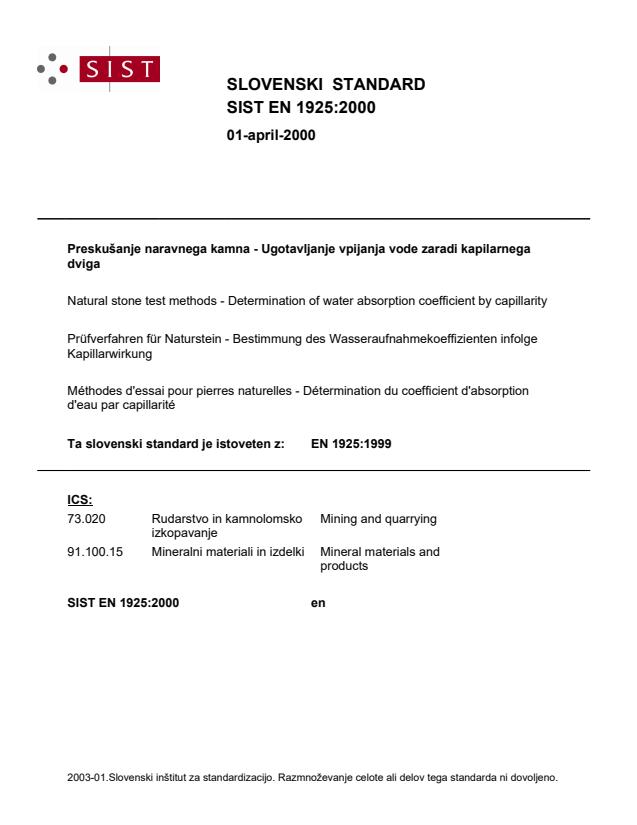
2003-01.Slovenski inštitut za standardizacijo. Razmnoževanje celote ali delov tega standarda ni dovoljeno.Preskušanje naravnega kamna - Ugotavljanje vpijanja vode zaradi kapilarnega dvigaPrüfverfahren für Naturstein - Bestimmung des Wasseraufnahmekoeffizienten infolge KapillarwirkungMéthodes d'essai pour pierres naturelles - Détermination du coefficient d'absorption d'eau par capillaritéNatural stone test methods - Determination of water absorption coefficient by capillarity
...