

prEN ISO 7889
(Main)Yoghurt - Enumeration of characteristic microorganisms - Colony-count technique (ISO 7889:2026)
- Abstract
This document specifies a method for the enumeration of the characteristic microorganisms Lactobacillus delbrueckii subsp. bulgaricus (in short: L. bulgaricus) and Streptococcus thermophilus (in short: S. thermophilus) by means of the colony-count technique.
The method is applicable to yoghurts (for the definition see CXS 243‑2003).
The colony-count technique (pour plates) is suitable for, but not limited to, the enumeration of L. bulgaricus and S. thermophilus in test samples with a minimum of 10 colonies counted on a plate. This corresponds to a level of the characteristic microorganisms L. bulgaricus and S. thermophilus that is expected to be higher than 100 cfu/g.
The colony-count technique (spread plates) is suitable for, but not limited to, the enumeration of L. bulgaricus and S. thermophilus in test samples with a minimum of 10 colonies counted on a plate. This corresponds to a level of the characteristic microorganisms L. bulgaricus and S. thermophilus that is expected to be higher than 1 000 cfu/g.
- Status
- Not Published
- Publication Date
- 29-Nov-2026
- Technical Committee
- CEN/TC 302 - Milk and milk products - Methods of sampling and analysis
- Drafting Committee
- CEN/TC 302 - Milk and milk products - Methods of sampling and analysis
- Current Stage
- 4020 - Submission to enquiry - Enquiry
- Start Date
- 30-Jul-2026
- Due Date
- 17-Mar-2027
- Completion Date
- 30-Jul-2026
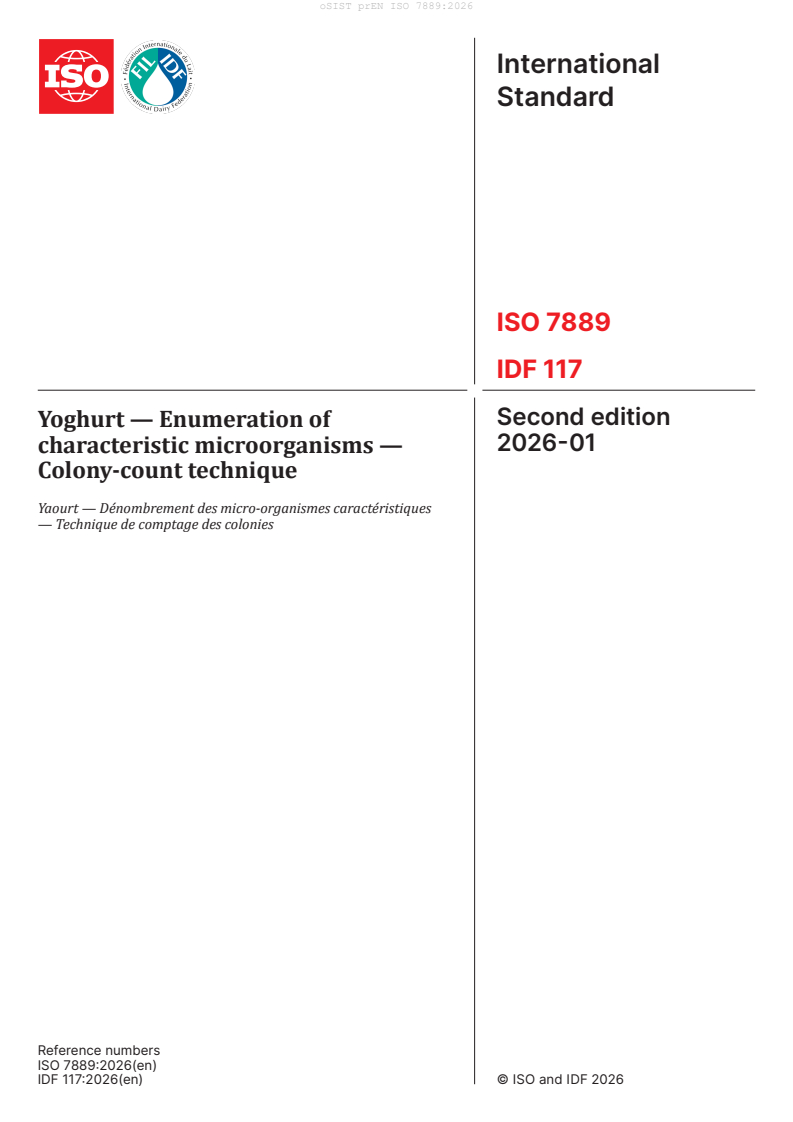

prEN ISO 7889 is the CEN reference for counting the characteristic microorganisms in yoghurt by the colony-count technique. It covers Lactobacillus delbrueckii subsp. bulgaricus (L. bulgaricus) and Streptococcus thermophilus (S. thermophilus), and tells laboratories how to prepare dilutions, plate the sample, incubate, count colonies, and report results as cfu per gram. ISO 7889:2026 / IDF 117:2026 is written for dairy microbiology laboratories, yoghurt producers, and food control users who need comparable counts for quality control.
What does prEN ISO 7889 specify?
prEN ISO 7889 specifies a microbiological method for enumerating the characteristic yoghurt organisms L. bulgaricus and S. thermophilus by colony count. The method applies to yoghurt, and it is organized as a step-by-step procedure from dilution through reporting, with annexes for the flow chart, media, and performance data.
The document is arranged into clauses 1 to 13, covering scope, references, terms, principle, media and reagents, equipment, sampling, test sample preparation, procedure, result expression, validation, test report, and quality assurance. Annex A gives the main flow of the procedure, Annex B gives the culture media and reagents, and Annex C gives performance characteristics from an interlaboratory study.
| Annex | What it covers |
|---|---|
| Annex A | Flow diagram of the main steps of the procedure |
| Annex B | Culture media and reagents, including preparation and performance testing |
| Annex C | Performance characteristics of the method from an interlaboratory study |
The scope also gives practical use limits for the two plating options. Pour plates are suitable when at least 10 colonies are counted on a plate, corresponding to levels expected above 100 cfu/g. Spread plates are suitable when at least 10 colonies are counted on a plate, corresponding to levels expected above 1 000 cfu/g.
What are the key requirements of prEN ISO 7889?
prEN ISO 7889 requires a full colony-count workflow: prepare decimal dilutions, inoculate selective media, incubate under the correct atmosphere and temperature, count the colonies, and calculate the result as cfu per gram. In practice, the method separates the two target organisms so that each can be counted on its own selective agar.
- Prepare dilutions according to ISO 6887-1 and ISO 6887-5 - Clause 4.2 and Clause 9 require decimal dilutions from the test portion and a single decimal dilution series from the initial suspension. This matters because the final count depends on getting plates with countable numbers of colonies.
- Use the correct selective media - Clause 4.3 assigns MRS 5.4 agar to L. bulgaricus and M17-S agar to S. thermophilus. In practice, the medium choice is what makes the counts organism-specific.
- Follow the correct inoculation approach - Clause 9 allows both pour plates and spread plates. For pour plates, 1.0 ml is used and 12 ml to 15 ml of agar is poured; for spread plates, 0.1 ml is used. If only one dilution is prepared, two plates are used.
- Count within the stated countable ranges - Clause 9 says to select dilution steps that give about 10 to 300 colonies per plate for pour plates and about 10 to 150 colonies per plate for spread plates. This helps avoid undercounting from crowded plates or unreliable low counts.
- Incubate under the specified atmospheres and temperatures - L. bulgaricus is incubated on MRS 5.4 at 37 °C in an anaerobic atmosphere for 72 h, while S. thermophilus is incubated on M17-S at 37 °C in a microaerobic atmosphere for 48 h. The atmosphere is part of the method, not just the temperature.
- Use the colony appearance described in the method - Clause 9.4 describes the usual colony size and form for both organisms and warns not to confuse sample particles or precipitate with colonies. This matters because the method depends on reading colonies on plates, not on instrumental detection.
- Confirm doubtful colonies when needed - Clause 9.5 makes confirmation optional and points to ISO 9232 | IDF 146. Alternative confirmation procedures may be used if they are validated in accordance with ISO 16140-4 or ISO 16140-6.
- Report and control the method consistently - Clauses 10 to 13 require results in cfu per gram, method validation in accordance with ISO 17468, a test report with the required identification details, and quality assurance with controls and media testing. That gives users traceable results that can be compared across laboratories.
What terms does prEN ISO 7889 define?
prEN ISO 7889 defines the two target organisms and the way their numbers are expressed in the test.
- Lactobacillus delbrueckii subsp. bulgaricus (L. bulgaricus) - the subspecies counted on MRS 5.4 agar after anaerobic incubation at 37 °C.
- Streptococcus thermophilus (S. thermophilus) - the species counted on M17-S agar after microaerobic incubation at 37 °C.
- Enumeration of L. bulgaricus and S. thermophilus - the determination of the number of colony-forming units per gram found by the specified test.
- MRS 5.4 - the selective agar used for L. bulgaricus, formulated at pH 5.4.
- M17-S - the M17 sucrose agar used for S. thermophilus.
- Colony-count technique - the plating method used here, either as pour plates or spread plates.
Who uses prEN ISO 7889?
prEN ISO 7889 is used by laboratories that test yoghurt and other dairy products for starter culture counts. That includes dairy microbiology labs, quality control laboratories in yoghurt manufacture, contract testing labs, and food control laboratories.
It is useful when a producer needs to check culture balance, compare batches, or document the microbiological status of a yoghurt product. It is also relevant when a buyer, auditor, or regulator needs a named method for routine microbiological testing of yoghurt.
What changed in prEN ISO 7889 from the previous edition?
prEN ISO 7889 second edition replaces ISO 7889 | IDF 117:2003 and is technically revised. The foreword states these main changes:
- M17 culture medium was amended so sucrose replaces lactose, allowing lactose-negative strains of S. thermophilus to be enumerated.
- The β-glycerophosphate level in M17-S was reduced, improving colony size and morphology in pilot studies and productivity.
- Microaerobic incubation of M17-S became mandatory.
- Spread plates were added as an alternative to pour plates.
- Annex C was added with performance characteristics from an interlaboratory study.
Which standards are used with prEN ISO 7889?
prEN ISO 7889 is used together with several ISO standards that support sampling, preparation, confirmation, media quality, and validation.
- ISO 6887-1 - general rules for preparing the initial suspension and decimal dilutions.
- ISO 6887-5 - specific rules for milk and milk products.
- ISO 7218 - general microbiological requirements, counting practice, good laboratory practice, and result calculation.
- ISO 11133 - preparation, storage, and performance testing of culture media.
- ISO 9232 | IDF 146 - identification of the characteristic yoghurt microorganisms for optional confirmation.
- ISO 17468 - validation framework used for the reference method and the performance characteristics.
- ISO 707 | IDF 50 - sampling guidance for milk and milk products.
- ISO 16140-4 and ISO 16140-6 - validation of alternative procedures used for confirmation.
What does the prEN ISO 7889 document contain?
prEN ISO 7889 contains the full laboratory procedure, the media formulas and preparation directions, and the verification information needed for routine use. Annex B gives the selective media compositions, pH adjustment reagents, storage guidance, and performance testing criteria for MRS 5.4 and M17-S.
Clause 9 describes the practical workflow for pour plates and spread plates, including volumes, incubation atmospheres, and colony counting limits. Clause 12 sets out the minimum test report content, and Clause 13 gives quality assurance expectations such as positive controls, negative controls, blanks, and media performance testing. Annex C summarizes interlaboratory data for repeatability and reproducibility, which helps users judge how the method behaves in practice.
Get Certified
Connect with accredited certification bodies for this standard

BSI Group
BSI (British Standards Institution) is the business standards company that helps organizations make excellence a habit.

Bureau Veritas
Bureau Veritas is a world leader in laboratory testing, inspection and certification services.

DNV
DNV is an independent assurance and risk management provider.
Sponsored listings
Frequently Asked Questions
prEN ISO 7889 is a draft published by the European Committee for Standardization (CEN). Its full title is "Yoghurt - Enumeration of characteristic microorganisms - Colony-count technique (ISO 7889:2026)". This standard covers: This document specifies a method for the enumeration of the characteristic microorganisms Lactobacillus delbrueckii subsp. bulgaricus (in short: L. bulgaricus) and Streptococcus thermophilus (in short: S. thermophilus) by means of the colony-count technique. The method is applicable to yoghurts (for the definition see CXS 243‑2003). The colony-count technique (pour plates) is suitable for, but not limited to, the enumeration of L. bulgaricus and S. thermophilus in test samples with a minimum of 10 colonies counted on a plate. This corresponds to a level of the characteristic microorganisms L. bulgaricus and S. thermophilus that is expected to be higher than 100 cfu/g. The colony-count technique (spread plates) is suitable for, but not limited to, the enumeration of L. bulgaricus and S. thermophilus in test samples with a minimum of 10 colonies counted on a plate. This corresponds to a level of the characteristic microorganisms L. bulgaricus and S. thermophilus that is expected to be higher than 1 000 cfu/g.
This document specifies a method for the enumeration of the characteristic microorganisms Lactobacillus delbrueckii subsp. bulgaricus (in short: L. bulgaricus) and Streptococcus thermophilus (in short: S. thermophilus) by means of the colony-count technique. The method is applicable to yoghurts (for the definition see CXS 243‑2003). The colony-count technique (pour plates) is suitable for, but not limited to, the enumeration of L. bulgaricus and S. thermophilus in test samples with a minimum of 10 colonies counted on a plate. This corresponds to a level of the characteristic microorganisms L. bulgaricus and S. thermophilus that is expected to be higher than 100 cfu/g. The colony-count technique (spread plates) is suitable for, but not limited to, the enumeration of L. bulgaricus and S. thermophilus in test samples with a minimum of 10 colonies counted on a plate. This corresponds to a level of the characteristic microorganisms L. bulgaricus and S. thermophilus that is expected to be higher than 1 000 cfu/g.
prEN ISO 7889 is classified under the following ICS (International Classification for Standards) categories: 07.100.30 - Food microbiology; 67.100.99 - Other milk products. The ICS classification helps identify the subject area and facilitates finding related standards.
prEN ISO 7889 is available in PDF format for immediate download after purchase. The document can be added to your cart and obtained through the secure checkout process. Digital delivery ensures instant access to the complete standard document.
Standards Content (Sample)
SLOVENSKI STANDARD
01-oktober-2026
Jogurt - Štetje značilnih mikroorganizmov - Tehnika štetja kolonij (ISO 7889:2026)
Yoghurt - Enumeration of characteristic microorganisms - Colony-count technique (ISO
7889:2026)
Joghurt - Auszählung charakteristischer Mikroorganismen - Koloniezählverfahren (ISO
7889:2026)
Yaourt - Dénombrement des micro-organismes caractéristiques - Technique de
comptage des colonies (ISO 7889:2026)
Ta slovenski standard je istoveten z: prEN ISO 7889
ICS:
07.100.30 Mikrobiologija živil Food microbiology
67.100.99 Drugi mlečni proizvodi Other milk products
2003-01.Slovenski inštitut za standardizacijo. Razmnoževanje celote ali delov tega standarda ni dovoljeno.
International
Standard
ISO 7889
IDF 117
Second edition
Yoghurt — Enumeration of
2026-01
characteristic microorganisms —
Colony-count technique
Yaourt — Dénombrement des micro-organismes caractéristiques
— Technique de comptage des colonies
Reference numbers
ISO 7889:2026(en)
IDF 117:2026(en) © ISO and IDF 2026
ISO 7889:2026(en)
IDF 117:2026(en)
© ISO and IDF 2026
All rights reserved. Unless otherwise specified, or required in the context of its implementation, no part of this publication may
be reproduced or utilized otherwise in any form or by any means, electronic or mechanical, including photocopying, or posting on
the internet or an intranet, without prior written permission. Permission can be requested from either ISO at the address below
or ISO’s member body in the country of the requester.
ISO copyright office International Dairy Federation
CP 401 • Ch. de Blandonnet 8 Silver Building • Bd Auguste Reyers 70/B
CH-1214 Vernier, Geneva B-1030 Brussels
Phone: +41 22 749 01 11 Phone: +32 2 325 67 40
Fax: +32 2 325 67 41
Email: copyright@iso.org Email: info@fil-idf.org
Website: www.iso.org Website: www.fil-idf.org
Published in Switzerland
ii
ISO 7889:2026(en)
IDF 117:2026(en)
Contents Page
Foreword .iv
Introduction .vi
1 Scope . 1
2 Normative references . 1
3 Terms and definitions . 1
4 Principle . 2
4.1 General .2
4.2 Preparation of dilutions .2
4.3 Inoculation .2
4.3.1 L. bulgaricus .2
4.3.2 S. thermophilus .2
4.4 Incubation .3
4.4.1 L. bulgaricus .3
4.4.2 S. thermophilus .3
4.5 Enumeration and confirmation .3
5 Culture media and reagents . 3
6 Equipment and consumables . 3
7 Sampling . 4
8 Preparation of test sample . 4
9 Procedure . 4
9.1 Test portion, initial suspension and dilutions .4
9.2 Pour plates: Inoculation and incubation .4
9.3 Spread plates: Inoculation and incubation .5
9.4 Counting of colonies .5
9.5 Confirmation (optional) .5
10 Expression of results . 6
11 Validation of the method . 6
11.1 Validation in accordance with ISO 17468 .6
11.2 Performance characteristics .6
12 Test report . 7
13 Quality assurance . 7
Annex A (informative) Flow diagram of the main steps of the procedures . 8
Annex B (normative) Culture media and reagents . 9
Annex C (informative) Performance characteristics of the method .13
Bibliography .15
iii
ISO 7889:2026(en)
IDF 117:2026(en)
Foreword
ISO (the International Organization for Standardization) is a worldwide federation of national standards
bodies (ISO member bodies). The work of preparing International Standards is normally carried out through
ISO technical committees. Each member body interested in a subject for which a technical committee
has been established has the right to be represented on that committee. International organizations,
governmental and non-governmental, in liaison with ISO, also take part in the work. ISO collaborates closely
with the International Electrotechnical Commission (IEC) on all matters of electrotechnical standardization.
The procedures used to develop this document and those intended for its further maintenance are described
in the ISO/IEC Directives, Part 1. In particular, the different approval criteria needed for the different types
of ISO document should be noted. This document was drafted in accordance with the editorial rules of the
ISO/IEC Directives, Part 2 (see www.iso.org/directives).
ISO draws attention to the possibility that the implementation of this document may involve the use of (a)
patent(s). ISO takes no position concerning the evidence, validity or applicability of any claimed patent
rights in respect thereof. As of the date of publication of this document, ISO had not received notice of (a)
patent(s) which may be required to implement this document. However, implementers are cautioned that
this may not represent the latest information, which may be obtained from the patent database available at
www.iso.org/patents. ISO shall not be held responsible for identifying any or all such patent rights.
Any trade name used in this document is information given for the convenience of users and does not
constitute an endorsement.
For an explanation of the voluntary nature of standards, the meaning of ISO specific terms and expressions
related to conformity assessment, as well as information about ISO’s adherence to the World Trade
Organization (WTO) principles in the Technical Barriers to Trade (TBT), see www.iso.org/iso/foreword.html.
This document was prepared by Technical Committee ISO/TC 34, Food products, Subcommittee SC 5, Milk
and milk products, and the International Dairy Federation (IDF). It is being published jointly by ISO and IDF.
This second edition cancels and replaces the first edition (ISO 7889 | IDF 117:2003), which has been
technically revised.
The main changes are as follows:
— The culture medium M17 has been amended: lactose is replaced by sucrose to (also) enumerate lactose-
negative strains of S. thermophilus.
— The concentration ß-glycerophosphate, the main selective agent of M17 culture medium and a powerful
[14][15]
buffer, is lowered from 1,9 % to 1 %. This reduction improved the size and morphology of
[10]
S. thermophilus colonies during pilot studies and can improve the productivity.
— For better performance, microaerobic incubation of M17-S has been changed to mandatory.
— Spread plates have been added to the method as alternative for pour plates.
— Performance characteristics, with the results of an interlaboratory study, which are based on the method
of this second edition have been included as Annex C.
Any feedback or questions on this document should be directed to the user’s national standards body. A
complete listing of these bodies can be found at www.iso.org/members.html.
iv
ISO 7889:2026(en)
IDF 117:2026(en)
IDF (the International Dairy Federation) is a non-profit private sector organization representing the
interests of various stakeholders in dairying at the global level. IDF members are organized in National
Committees, which are national associations composed of representatives of dairy-related national interest
groups including dairy farmers, dairy processing industry, dairy suppliers, academics and governments/
food control authorities.
ISO and IDF collaborate closely on all matters of standardization relating to methods of analysis and
sampling for milk and milk products. Since 2001, ISO and IDF jointly publish their International Standards
using the logos and reference numbers of both organizations.
IDF draws attention to the possibility that the implementation of this document may involve the use of (a)
patent(s). IDF takes no position concerning the evidence, validity or applicability of any claimed patent
rights in respect thereof. As of the date of publication of this document, IDF had not received notice of (a)
patent(s) which may be required to implement this document. However, implementers are cautioned that
this may not represent the latest information, which may be obtained from the patent database available at
www.iso.org/patents. IDF shall not be held responsible for identifying any or all such patent rights.
Any trade name used in this document is information given for the convenience of users and does not
constitute an endorsement.
This document was prepared by IDF Standing Committee on Methods for Dairy Microbiology and ISO Technical
Committee ISO/TC 34, Food products, Subcommittee SC 5, Milk and milk products. It is being published jointly
by ISO and IDF.
The work was carried out by the IDF/ISO Action Team (D14) of the Standing Committee on Methods for Dairy
Microbiology under the aegis of its project leader Arnold F. Dijkstra (NL).
v
ISO 7889:2026(en)
IDF 117:2026(en)
Introduction
Lactobacillus delbrueckii subsp. bulgaricus (in short: L. bulgaricus) and Streptococcus thermophilus (in short:
[7]
S. thermophilus) are used to produce yoghurt as defined in CXS 243-2003 .
S. thermophilus ferments lactose in milk, producing lactic acid, formic acid and carbon dioxide. These
compounds lower the pH of the milk, which stimulates the growth of L. bulgaricus. Some strains of
S. thermophilus also produce folic acid and fatty acids, which are beneficial for L. bulgaricus. L. bulgaricus
possesses proteolytic enzymes (proteases) that break down milk proteins (casein) into amino acids. These
amino acids are essential for the growth of both L. bulgaricus and S. thermophilus. For well protocooperation
and the physiological and sensory characteristics of the yoghurt, the ratio of S. thermophilus and L. bulgaricus
[8]
is very important. Proper protocooperation also controls the post acidification when yoghurt is stored
[17]
until the shelf life.
An accurate enumeration method for L. bulgaricus and S. thermophilus by means of the colony-count
technique, such as the one given in this document, is therefore important to guarantee the quality of yoghurt.
The main technical changes listed in the Foreword, introduced in this document compared to ISO 7889 |
IDF 117:2003, are considered as major (see ISO 17468).
These technical changes have a major impact on the performance characteristics of the method.
vi
ISO 7889:2026(en)
International Standard
IDF 117:2026(en)
Yoghurt — Enumeration of characteristic microorganisms —
Colony-count technique
1 Scope
This document specifies a method for the enumeration of the characteristic microorganisms Lactobacillus
delbrueckii subsp. bulgaricus (in short: L. bulgaricus) and Streptococcus thermophilus (in short: S. thermophilus)
by means of the colony-count technique.
[7]
The method is applicable to yoghurts (for the definition see CXS 243-2003 ).
The colony-count technique (pour plates) is suitable for, but not limited to, the enumeration of L. bulgaricus
and S. thermophilus in test samples with a minimum of 10 colonies counted on a plate. This corresponds to
a level of the characteristic microorganisms L. bulgaricus and S. thermophilus that is expected to be higher
than 100 cfu/g.
The colony-count technique (spread plates) is suitable for, but not limited to, the enumeration of L. bulgaricus
and S. thermophilus in test samples with a minimum of 10 colonies counted on a plate. This corresponds to
a level of the characteristic microorganisms L. bulgaricus and S. thermophilus that is expected to be higher
than 1 000 cfu/g.
2 Normative references
The following documents are referred to in the text in such a way that some or all of their content constitutes
requirements of this document. For dated references, only the edition cited applies. For undated references,
the latest edition of the referenced document (including any amendments) applies.
ISO 6887-1, Microbiology of the food chain — Preparation of test samples, initial suspension and decimal
dilutions for microbiological examination — Part 1: General rules for the preparation of the initial suspension
and decimal dilutions
ISO 6887-5, Microbiology of the food chain — Preparation of test samples, initial suspension and decimal
dilutions for microbiological examination — Part 5: Specific rules for the preparation of milk and milk products
ISO 7218, Microbiology of the food chain — General requirements and guidance for microbiological examinations
ISO 11133, Microbiology of food, animal feed and water — Preparation, production, storage and performance
testing of culture media
3 Terms and definitions
For the purposes of this document, the following terms and definitions apply.
ISO and IEC maintain terminology databases for use in standardization at the following addresses:
— ISO Online browsing platform: available at https:// www .iso .org/ obp
— IEC Electropedia: available at https:// www .electropedia .org/
ISO 7889:2026(en)
IDF 117:2026(en)
3.1
Lactobacillus delbrueckii subsp. bulgaricus
L. bulgaricus
[9]
subspecies of Lactobacillus delbrueckii forming characteristic colonies on De Man, Rogosa and Sharpe agar
at pH 5,4 (MRS 5.4), when incubated in an anaerobic atmosphere at 37 °C
Note 1 to entry: Morphological, cultural and physiological properties of L. bulgaricus are specified in ISO 9232 | IDF 146.
3.2
Streptococcus thermophilus
S. thermophilus
species of Streptococcus forming characteristic colonies on M17 sucrose agar (M17-S) when incubated in a
microaerobic atmosphere at 37 °C
Note 1 to entry: Morphological, cultural and physiological properties of S. thermophilus are specified in ISO 9232 |
IDF 146.
3.3
enumeration of L. bulgaricus and S. thermophilus
determination of the number of colony-forming units (cfu) of L. bulgaricus (3.1) and S. thermophilus (3.2)
found per gram when a specified test is conducted
Note 1 to entry: Specified test is given in Clause 9.
4 Principle
4.1 General
The enumeration of L. bulgaricus and S. thermophilus by pour-plate technique or spread-plate technique
consists of four successive steps (preparation of dilutions, inoculation, incubation, enumeration). A flow
diagram of the main steps of the procedure is given in Annex A.
4.2 Preparation of dilutions
For the preparation of decimal dilutions from the test portion, follow ISO 6887-1 and ISO 6887-5.
4.3 Inoculation
4.3.1 L. bulgaricus
The selective MRS 5.4 agar is inoculated by pour-plate technique or spread-plate technique with the initial
suspension.
Other plates are prepared under the same conditions, using decimal dilutions of the initial suspension.
4.3.2 S. thermophilus
The selective M17-S agar is inoculated by pour-plate technique or spread-plate technique with the initial
suspension.
Other plates are prepared under the same conditions, using decimal dilutions of the initial suspension.
NOTE S. thermophilus has limited capacity for carbohydrate utilization. Most S. thermophilus strains are able to
utilize only glucose, lactose and sucrose as carbon sources. Some strains can also utilize fructose and about 30 %
are able to grow on galactose. Although lactose is the preferred sugar for growth, some commercial S. thermophilus
strains lack the lactose uptake system LacS and will not grow on the traditional M17 with lactose as carbohydrate.
[12][16]
Autolytic properties of some strains of S. thermophilus were reduced from 90 % to 95 % in lactose to 0 % to
[13]
5 % in sucrose. Replacing lactose by sucrose showed no negative effect on S. thermophilus plate counts and enables
lactose-negative strains also to form colonies.
ISO 7889:2026(en)
IDF 117:2026(en)
4.4 Incubation
4.4.1 L. bulgaricus
The MRS 5.4 agar plates are anaerobically incubated at 37 °C for 72 h.
4.4.2 S. thermophilus
The M17-S agar plates are incubated microaerobic at 37 °C for 48 h.
4.5 Enumeration and confirmation
The number of L. bulgaricus and S. thermophilus per gram of the test sample is calculated from the number of
colonies obtained on plates at dilution levels so as to give a significant result.
NOTE Optionally, selected colonies from the plates can be confirmed by means of appropriate tests (see
ISO 9232 | IDF 146).
5 Culture media and reagents
Follow good laboratory practices in accordance with ISO 7218. The composition of culture media and
reagents and their preparation are specified in Annex B. For performance testing of culture media, follow
the procedures in accordance with Clause B.5 and ISO 11133.
6 Equipment and consumables
Disposable equipment is an acceptable alternative to reusable items if these have the suitable specifications.
The usual microbiological laboratory equipment (see ISO 7218) and, in particular, the following shall be
used.
6.1 Apparatus for dry sterilization (oven, capable of operating between 160 °C to 180 °C) or
wet sterilization (autoclave, capable of operating at 121 °C ± 3 °C).
6.2 Drying cabinet or oven, capable of operating between 25 °C and 50 °C.
6.3 Incubator, capable of operating at 37 °C ± 1 °C.
6.4 Water bath or similar apparatus, capable of operating at 44 °C to 47 °C and of boiling water.
6.5 pH-meter, having an accuracy of calibration of ±0,1 pH-unit at 20 °C to 25 °C.
6.6 Refrigerator, capable of operating at 5 °C ± 3 °C.
6.7 Sterile loops, of approximate diameter 3 mm (10 µl volume), and of 1 µl volume, or inoculation needle
or wire.
6.8 Sterile tubes, bottles or flasks with caps, of appropriate capacity. Bottles, flasks or tubes with non-
toxic metallic or plastic screw-caps may be used.
6.9 Sterile graduated pipettes or automatic pipettes, of nominal capacities 25 ml, 10 ml, 1 ml and
0,1 ml.
6.10 Sterile Petri dishes, with a diameter of approximately 90 mm.
ISO 7889:2026(en)
IDF 117:2026(en)
6.11 Appropriate apparatus for achieving a microaerobic atmosphere with oxygen content of
5 % ± 2 %, carbon dioxide 10 % ± 3 %, optional hydrogen ≤10 %, with the balance nitrogen.
The appropriate microaerobic atmosphere can be obtained using gas-tight jars and gas-generating kits,
precisely following the manufacturer’s instructions. Alternatively, the jar or incubator may be filled with an
appropriate gas mixture prior to incubation.
6.12 Appropriate apparatus for achieving an anaerobic atmosphere with oxygen content of <1 %,
carbon dioxide 10 % to 20 %, with the balance nitrogen.
The appropriate anaerobic atmosphere can be obtained using gas-tight jars and gas-generating kits,
precisely following the manufacturer’s instructions. Alternatively, the jar or incubator may be filled with an
appropriate gas mixture prior to incubation.
6.13 Colony-counting equipment (optional), manual or automated, consisting, for example, of an
illuminated base with a dark background, fitted with a magnifying screen to aid colony detection, with a
magnification of ×1,5, and (optionally) a mechanical or electronic digital counter.
7 Sampling
Sampling is not part of the method specified in this document. Follow the specific International Standard
dealing with the product concerned. If there is no specific International Sta
...