


EN 15268:2008
(Main)Petrol filling stations - Safety requirements for the construction of submersible pump assemblies
General Information
- Abstract
This European Standard applies to submersible pump assemblies intended for use with dispensers installed at petrol filling stations and used to dispense liquid fuels in accordance with EN 228 and EN 590 into tanks of motor vehicles, light aircrafts, boats and portable containers. The submersible pump assemblies are intended for use and storage at ambient temperatures between –20 °C and +40 °C.
Additional measures can be required for use and storage at temperatures outside this range and are subject to negotiation between the manufacturer and purchaser.
This European Standard specifies requirements for equipment with a maximum working pressure not exceeding 350 kPa (3,5 bar), power consumption not exceeding 7 KW and a maximum power supply voltage of 500 V.
This European Standard specifies requirements for submersible pump assemblies of classes IIA T3 (explosion group IIA and temperature class T3) and IIB T4 (explosion group IIB and temperature class T4) using liquid fuels.
This European Standard deals with all significant hazards, hazardous situations and events relevant to submersible pump assemblies, when they are used as intended and under conditions of misuse which are reasonably foreseeable by the manufacturer (see Clause 4).
This European Standard specifies safety requirements for design, installation, commissioning, use and maintenance.
Noise is not considered a significant hazard for the equipment in the scope of this European Standard.
This European Standard does not cover requirements for mobile equipment.
NOTE 1 For other fuels than those in accordance with EN 228 and EN 590 a manufacturer should consider the need for extra measures (dealing with possible additional or different hazards).
NOTE 2 This European Standard does not include any requirements for metering performance such as may be specified for the EU under the Measuring Instruments Directive nor those specified under the Electromagnetic Compatibility Directive.
[...]
- Status
- Published
- Publication Date
- 09-Sep-2008
- Technical Committee
- CEN/TC 393 - Equipment for storage tanks and for service stations
- Drafting Committee
- CEN/TC 393/WG 1 - Submersible petrol pumps
- Current Stage
- 9093 - Decision to confirm - Review Enquiry
- Start Date
- 03-Dec-2024
- Completion Date
- 23-Sep-2026
- Directive
- Harmonized Standard2006/42/EC - Directive 2006/42/EC of the European Parliament and of the Council of 17 May 2006 on machinery, and amending Directive 95/16/EC (recast)OJ Ref: C, C 214 OJ Date: 08-Sep-2009
Harmonized Standard2014/34/EU - Directive 2014/34/EU Of The European Parliament And Of The Council of 26 February 2014 on the harmonisation of the laws of the Member States relating to equipment and protective systems intended for use in potentially explosive atmospheres (recast)OJ Ref: C, C 126, HARMONIZIRAN OJ Date: 08-Apr-2016
Not Harmonized94/9/EC - Equipment and protective systems intended for use in potentially explosive atmospheres (ATEX)OJ Ref: C, C 20 OJ Date: 27-Jan-2009
Not Harmonized98/37/EC - MachineryOJ Ref: C, C 22 OJ Date: 28-Jan-2009


Overview
EN 15268:2008 is a CEN (European) standard that defines safety requirements for the construction of submersible pump assemblies used at petrol filling stations. It applies to submersible pumps used with fuel dispensers for dispensing liquid fuels specified in EN 228 (petrol) and EN 590 (diesel) into motor vehicle, light aircraft, boat and portable container tanks. The standard covers design, installation, commissioning, use and maintenance for equipment intended for ambient temperatures between –20 °C and +40 °C, with additional measures negotiable outside that range.
Key technical limits:
- Maximum working pressure: 350 kPa (3.5 bar)
- Maximum motor power: 7 kW
- Maximum supply voltage: 500 V
- Explosion-protection classes: IIA T3 and IIB T4
Noise is not considered a significant hazard in the scope of this standard. Mobile equipment and metering performance requirements (e.g., Measuring Instruments Directive) are excluded.
Key topics and technical requirements
- Risk assessment and hazard analysis: Formal documented analysis of ignition sources and other hazards (EN 13463-1 referenced).
- Explosion prevention & protection: Requirements for electrostatic control, capacitance discharge limits and ignition control for parts exposed to explosive atmospheres.
- Capacitors must discharge to ≤ 0.2 mJ within 10 s after disconnection.
- External junction boxes must meet equipment category 2 requirements.
- Connectors and plugs in ignition-capable circuits are treated as normally sparking unless they require ≥ 15 N separating force or are mechanically locked.
- Materials compatibility: All fuel-exposed parts must resist chemical attack by the intended fuels and vapours.
- Pressure safety: Pressurised systems must include a pressure relief device limiting pressure to ≤ 350 kPa and be designed for the maximum working pressure.
- Electrical safety: Conformance with EN 60204-1 for electrical equipment and EN 60034-1 for motors; earth bonding and considerations for converter-fed motors (bearing currents, overvoltage).
- Leakage & containment: Design to ensure no leakage under normal operating conditions; pressurised parts sized appropriately.
- Scope of hazards: Mechanical (pump dropping), thermal, electrical, material hazards and foreseeable misuse are addressed.
Applications and who uses it
EN 15268 is intended for:
- Manufacturers of submersible pumping units, manifold and column pipe assemblies
- Petrol filling station designers and contractors
- Installation and commissioning engineers
- Safety and compliance officers in fuel retail and storage industries
- Notified bodies and test laboratories assessing conformity to EU directives
Practical uses include designing safe submersible pump assemblies for forecourts, selecting compliant materials and components, specifying electrical protection and explosion prevention measures, and preparing technical documentation for conformity assessment.
Related standards
Key normative references and related standards cited in EN 15268 include:
- EN 228, EN 590 (fuel specifications)
- EN 13463-1, EN 13463-6 (non-electrical equipment in explosive atmospheres)
- EN 60079 series (explosive atmospheres)
- EN 60204-1, EN 60034-1 (electrical safety and motors)
- EN ISO 12100 (risk assessment and machinery safety)
Using EN 15268 helps ensure compliant, safe submersible pump assemblies for petrol filling stations, aligning design and operational practices with European safety and explosion-protection expectations.
Relations
- Effective Date
- 22-Apr-2026
- Effective Date
- 22-Apr-2026
- Effective Date
- 09-Feb-2026
- Effective Date
- 09-Feb-2026
- Effective Date
- 09-Feb-2026
- Effective Date
- 09-Feb-2026
- Effective Date
- 09-Feb-2026
- Effective Date
- 09-Feb-2026
- Effective Date
- 09-Feb-2026
- Refers
EN 60079-7:2015 - Explosive atmospheres - Part 7: Equipment protection by increased safety "e" - Effective Date
- 09-Feb-2026
- Effective Date
- 09-Feb-2026
- Effective Date
- 28-Jan-2026
- Effective Date
- 28-Jan-2026
- Effective Date
- 28-Jan-2026
- Effective Date
- 28-Jan-2026
Get Certified
Connect with accredited certification bodies for this standard

Element Materials Technology
Materials testing and product certification.

ABS Group Brazil
ABS Group certification services in Brazil.

ABS Quality Evaluations Inc.
American Bureau of Shipping quality certification.
Sponsored listings
Frequently Asked Questions
EN 15268:2008 is a standard published by the European Committee for Standardization (CEN). Its full title is "Petrol filling stations - Safety requirements for the construction of submersible pump assemblies". This standard covers: This European Standard applies to submersible pump assemblies intended for use with dispensers installed at petrol filling stations and used to dispense liquid fuels in accordance with EN 228 and EN 590 into tanks of motor vehicles, light aircrafts, boats and portable containers. The submersible pump assemblies are intended for use and storage at ambient temperatures between –20 °C and +40 °C. Additional measures can be required for use and storage at temperatures outside this range and are subject to negotiation between the manufacturer and purchaser. This European Standard specifies requirements for equipment with a maximum working pressure not exceeding 350 kPa (3,5 bar), power consumption not exceeding 7 KW and a maximum power supply voltage of 500 V. This European Standard specifies requirements for submersible pump assemblies of classes IIA T3 (explosion group IIA and temperature class T3) and IIB T4 (explosion group IIB and temperature class T4) using liquid fuels. This European Standard deals with all significant hazards, hazardous situations and events relevant to submersible pump assemblies, when they are used as intended and under conditions of misuse which are reasonably foreseeable by the manufacturer (see Clause 4). This European Standard specifies safety requirements for design, installation, commissioning, use and maintenance. Noise is not considered a significant hazard for the equipment in the scope of this European Standard. This European Standard does not cover requirements for mobile equipment. NOTE 1 For other fuels than those in accordance with EN 228 and EN 590 a manufacturer should consider the need for extra measures (dealing with possible additional or different hazards). NOTE 2 This European Standard does not include any requirements for metering performance such as may be specified for the EU under the Measuring Instruments Directive nor those specified under the Electromagnetic Compatibility Directive. [...]
This European Standard applies to submersible pump assemblies intended for use with dispensers installed at petrol filling stations and used to dispense liquid fuels in accordance with EN 228 and EN 590 into tanks of motor vehicles, light aircrafts, boats and portable containers. The submersible pump assemblies are intended for use and storage at ambient temperatures between –20 °C and +40 °C. Additional measures can be required for use and storage at temperatures outside this range and are subject to negotiation between the manufacturer and purchaser. This European Standard specifies requirements for equipment with a maximum working pressure not exceeding 350 kPa (3,5 bar), power consumption not exceeding 7 KW and a maximum power supply voltage of 500 V. This European Standard specifies requirements for submersible pump assemblies of classes IIA T3 (explosion group IIA and temperature class T3) and IIB T4 (explosion group IIB and temperature class T4) using liquid fuels. This European Standard deals with all significant hazards, hazardous situations and events relevant to submersible pump assemblies, when they are used as intended and under conditions of misuse which are reasonably foreseeable by the manufacturer (see Clause 4). This European Standard specifies safety requirements for design, installation, commissioning, use and maintenance. Noise is not considered a significant hazard for the equipment in the scope of this European Standard. This European Standard does not cover requirements for mobile equipment. NOTE 1 For other fuels than those in accordance with EN 228 and EN 590 a manufacturer should consider the need for extra measures (dealing with possible additional or different hazards). NOTE 2 This European Standard does not include any requirements for metering performance such as may be specified for the EU under the Measuring Instruments Directive nor those specified under the Electromagnetic Compatibility Directive. [...]
EN 15268:2008 is classified under the following ICS (International Classification for Standards) categories: 75.200 - Petroleum products and natural gas handling equipment. The ICS classification helps identify the subject area and facilitates finding related standards.
EN 15268:2008 has the following relationships with other standards: It is inter standard links to ISO 1817:2005, ISO 8598:1996, EN IEC 60079-14:2024, EN 50495:2010, EN 50525-2-21:2011, EN 50525-2-51:2011, EN IEC 60079-0:2018, EN IEC 60079-26:2024, EN 60079-15:2005, EN 60079-7:2015, EN 60034-1:2010, EN ISO 80079-37:2016, EN 228:2025, EN 2286:1989, EN 590:2025. Understanding these relationships helps ensure you are using the most current and applicable version of the standard.
EN 15268:2008 is associated with the following European legislation: EU Directives/Regulations: 2006/42/EC, 2014/34/EU, 94/9/EC, 98/37/EC; Standardization Mandates: M/079, M/396, M/BC/CEN/92/46. When a standard is cited in the Official Journal of the European Union, products manufactured in conformity with it benefit from a presumption of conformity with the essential requirements of the corresponding EU directive or regulation.
EN 15268:2008 is available in PDF format for immediate download after purchase. The document can be added to your cart and obtained through the secure checkout process. Digital delivery ensures instant access to the complete standard document.
Standards Content (Sample)
2003-01.Slovenski inštitut za standardizacijo. Razmnoževanje celote ali delov tega standarda ni dovoljeno.Tankstellen - Sicherheitstechnische Anforderungen an die Bauweise von Tauchpumpen-BaugruppenStations-service - Prescriptions de sécurité pour la construction des assemblages de pompes immergéesPetrol filling stations - Safety requirements for the construction of submersible pump assemblies75.200Petroleum products and natural gas handling equipment23.080ýUSDONHPumpsICS:Ta slovenski standard je istoveten z:EN 15268:2008SIST EN 15268:2009en,fr,de01-marec-2009SIST EN 15268:2009SLOVENSKI
STANDARD
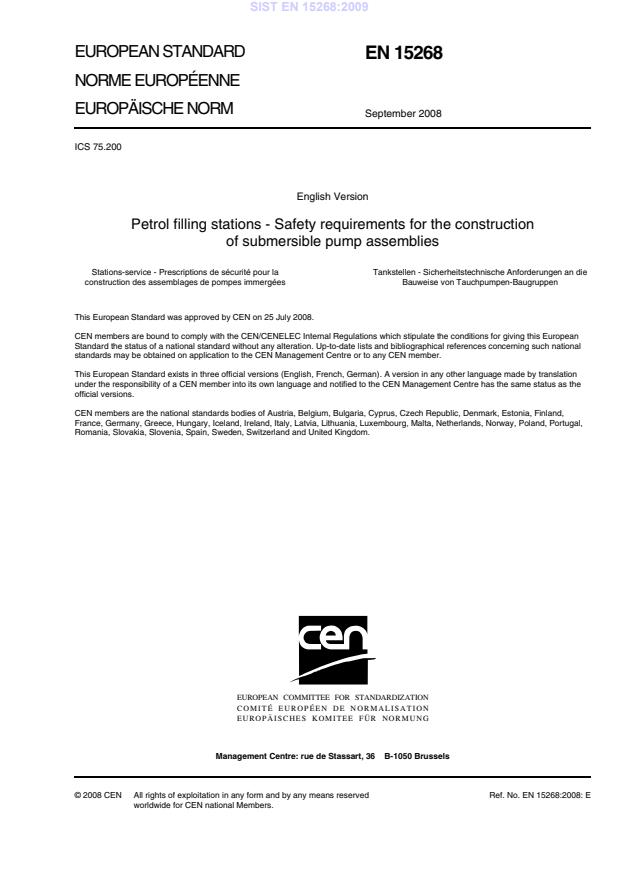
EUROPEAN STANDARDNORME EUROPÉENNEEUROPÄISCHE NORMEN 15268September 2008ICS 75.200 English VersionPetrol filling stations - Safety requirements for the constructionof submersible pump assembliesStations-service - Prescriptions de sécurité pour laconstruction des assemblages de pompes immergéesTankstellen - Sicherheitstechnische Anforderungen an dieBauweise von Tauchpumpen-BaugruppenThis European Standard was approved by CEN on 25 July 2008.CEN members are bound to comply with the CEN/CENELEC Internal Regulations which stipulate the conditions for giving this EuropeanStandard the status of a national standard without any alteration. Up-to-date lists and bibliographical references concerning such nationalstandards may be obtained on application to the CEN Management Centre or to any CEN member.This European Standard exists in three official versions (English, French, German). A version in any other language made by translationunder the responsibility of a CEN member into its own language and notified to the CEN Management Centre has the same status as theofficial versions.CEN members are the national standards bodies of Austria, Belgium, Bulgaria, Cyprus, Czech Republic, Denmark, Estonia, Finland,France, Germany, Greece, Hungary, Iceland, Ireland, Italy, Latvia, Lithuania, Luxembourg, Malta, Netherlands, Norway, Poland, Portugal,Romania, Slovakia, Slovenia, Spain, Sweden, Switzerland and United Kingdom.EUROPEAN COMMITTEE FOR STANDARDIZATIONCOMITÉ EUROPÉEN DE NORMALISATIONEUROPÄISCHES KOMITEE FÜR NORMUNGManagement Centre: rue de Stassart, 36
B-1050 Brussels© 2008 CENAll rights of exploitation in any form and by any means reservedworldwide for CEN national Members.Ref. No. EN 15268:2008: ESIST EN 15268:2009
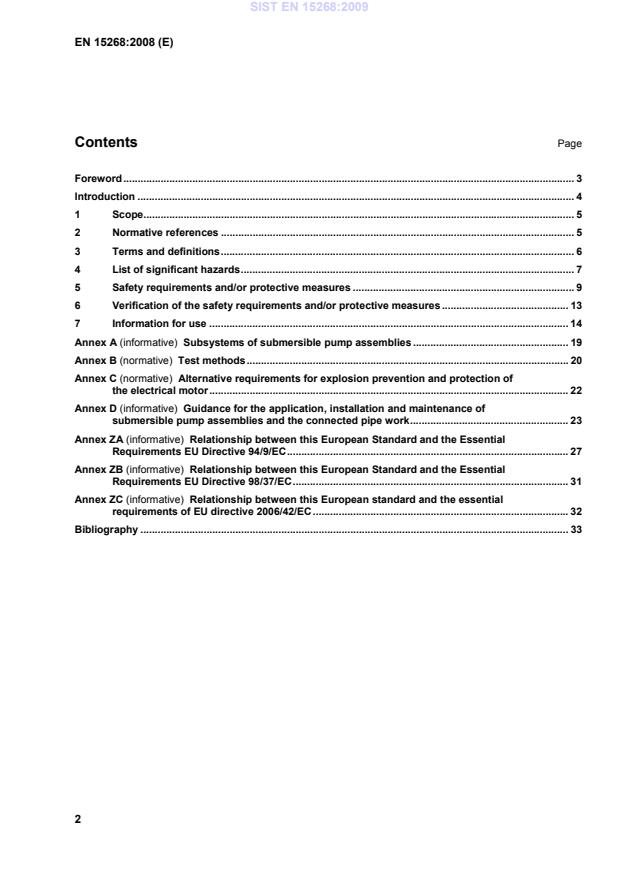
Subsystems of submersible pump assemblies.19 Annex B (normative)
Test methods.20 Annex C (normative)
Alternative requirements for explosion prevention and protection of the electrical motor.22 Annex D (informative)
Guidance for the application, installation and maintenance of submersible pump assemblies and the connected pipe work.23 Annex ZA (informative)
Relationship between this European Standard and the Essential Requirements EU Directive 94/9/EC.27 Annex ZB (informative)
Relationship between this European Standard and the Essential Requirements EU Directive 98/37/EC.31 Annex ZC (informative)
Relationship between this European standard and the essential requirements of EU directive 2006/42/EC.32 Bibliography.33
1 Mechanical hazards due to: Pump falling into the tank 5.4; 5.5
— machine parts or work pieces, e.g.:
c) mass and stability (potential energy of
elements which may move under
the effect of gravity);
e) inadequacy of mechanical strength.
2 Electrical hazards due to: – – 2.1 contact of persons with live parts (direct contact) Electrical components, e.g. motors, solenoid valves, control systems, lighting 5.1.2; 5.3 2.2 contact of persons with parts which have become live under faulty conditions (indirect contact) Electrical components, e.g. motors, solenoid valves, control systems, lighting 5.1.2; 5.3 2.4 electrostatic phenomena Ignition of vapour 5.2.1; 5.3.2; 5.3.3 3 Thermal hazards, resulting in: – – 3.1 burns and other injuries by possible explosions Ignition of possible explosive atmosphere by electrical or non-electrical parts or electrical charge 5.3.1; 5.3.2; 5.3.4; 5.3.5; 5.6 SIST EN 15268:2009
7 Hazards generated by materials and substances (and their constituent elements) processed or used by the machinery – – 7.1 Hazards from contact with or inhalation of harmful fluids, gases, mists, fumes and dusts Exposure to fuel 5.1.3; 5.2.1; 5.2.2; 5.2.3; 5.7 7.2 Fire or explosion hazard Electrical and non-electrical parts 5.1; 5.3; 5.6; 5.7 10 Unexpected start-up, unexpected overrun/overspeed (or any similar malfunction) from: – – 10.1 Failure/disorder of the control system Unexpected liquid flow
5.1.2 10.2 Restoration of energy supply after an interruption Unexpected liquid flow 5.1.2 10.3 External influences on electrical equipment Unexpected liquid flow 5.1.2 10.6 Errors made by the operator (due to mismatch of machinery with human characteristics and abilities) Unexpected liquid flow 5.1.2; 7.2; 7.3 11 Impossibility of stopping the machine in the best possible conditions Unexpected liquid flow 5.1.2; 7.2 13 Failure of the power supply Unexpected liquid flow 5.1.2 14 Failure of the control circuit Unexpected liquid flow 5.1.2 15 Errors of fitting Leakage 7.2; 7.3 16 Break-up during operation Leakage 5.2; 5.4; 5.7 5 Safety requirements and/or protective measures 5.1 General 5.1.1 Submersible pump assemblies and components shall comply with the safety requirements and/or protective measures of this clause. In addition, the machine shall be designed according to the principles of EN ISO 12100-1 and -2 for hazards relevant but not significant, which are not dealt with by this European Standard (e.g. sharp edges). SIST EN 15268:2009
1) fixed to their mountings without possibility of self-loosening; 2) constructed in such a way that the conductors cannot slip out from their location during tightening of the terminal; 3) such that proper contact is assured without damage to the conductors that would impair the ability of the conductors to fulfil their function, even if multi-stranded conductors are used in terminals intended for direct clamping of a conductor. NOTE Special precautions against electrolytic corrosion should be considered. 5.3.6 Components made of light metal alloys shall comply with the requirements of EN 13463-1:2001, 8.2. 5.3.7 Submersible pumping units for use in areas where category 2 equipment is required shall comply with one of the requirements given in Table 2: Table 2 — Requirements for areas where category 2 is required
Options Non-electrical parts Electrical parts Option A EN 13463-1 (cat. 2) EN 60079-0 (cat. 2) Option B EN 13463-1 (cat. 3) + liquid exposure IPL1 (EN 13463-6) EN 60079-15 (cat. 3) + liquid exposure SIL1 (prEN 50495:2006-08) Option C No ignition source in normal operation + liquid exposure IPL1 (EN 13463-6) special requirements (Annex C) + liquid exposure SIL1
(prEN 50495:2006-08)
5.3.8 Parts of submersible pumping units for use in areas where category 1 equipment is required shall comply with one of the requirements in Table 3: SIST EN 15268:2009
(prEN 50495:2006-08) + liquid cover monitoring device SIL1
(prEN 50495:2006-08)
The liquid cover according to Table 3, option C, can be reached by use of an external level control device, which shuts off the submersible pumping unit at a certain minimum fuel level in the tank. This minimum fuel level shall be set 100 mm above the highest product inlet. 5.3.9 The manifold assembly shall meet the requirements of EN 60079-0 and EN 13463-1 for category 2 equipment. Field electrical connections of submersible pump assemblies shall conform to electrical requirements of EN 60079-14 for category 2 equipment. Cables used in explosive atmospheres shall comply with either EN 60079-14 and HD 21.13 S1 or EN 60079-14 and HD 22.4 S4 or shall fulfil the requirements of EN 13617-1:2004, 5.3.2.4. 5.4 Mechanical stability 5.4.1 For pumps with adjustable column pipe assemblies means shall be provided to maintain the fixed position of the pumping unit. 5.4.2 When installed and operated in accordance with the manufacturers instructions the submersible pump assembly shall not break free of its anchorage. 5.5 Handling The manufacturer of submersible pump assemblies shall provide integral device or devices or shall identify auxiliary supporting devices to achieve safe handling of the machine, or define methods for safe handling in the information for use. 5.6 Additional requirements for components All integral piping and pipe work fittings operating at pump working pressures, and all sealing surfaces shall have melting points greater than 310 °C. 5.7 Leak detection facility The submersible pump assembly shall have the capability for connection of a leak detection system, which will shut-off the submersible pump in the event of a leak in the connected pipe work. For guidance see Annex D.3. SIST EN 15268:2009
There shall be no leakage. 5.2.1 B.3 Hydrostatic burst strength There shall be no rupture or permanent distortion ofthe liquid handling part. External leakage from joints orseals does not constitute a failed test. 5.2.3 B.4 Pressure test There shall beno leakage to the outside or to wiring compartments of the submersible pumping assembly,and there shall be no evidence of casting porosity. 5.2.3 B.5 Liquid exposure temperature risetest (not applicable to Table 2, option A and Table 3, option A) The temperature of the part of the submersible pumpassembly exposed to explosive atmosphere shall notexceed: - 130 °C for category 2 (T4) and 195 °C for category 2(T3), applicable to Table 2, option B and C;
- 103 °C for category 1 (T4) and 155 °C for category 1 (T3), applicable to Table 3, option B and C. 5.3.7
5.3.8 B.12 Routine hydraulic/pressure tests Internal air pressure test Under stable conditions there shall be no decrease ofpressure from the initial applied pressure. 5.1.3 B.6 Electrical housing test There shall be no decrease of pressure. 5.1.3 B.7 Pressure relief device test The device shall function correctly. 5.2.2 B.8 Routine electrical tests Continuity of the protectivebonding circuit The continuity shall be < 0,1 Ω for 10 s. 5.1.2 B.9 Insulation resistance Insulation resistance shall be > 1 MΩ. 5.1.2 B.10 Voltage test Insulation, no failure at Uac
= (1 000 + 2U) V, where Uis the working voltage. 5.1.2 B.11
6.1.2 All routine tests shall be performed on 100 % of production. 7 Information for use 7.1 General Information for use shall be provided in accordance with Clause 6 of EN ISO 12100-2:2003 and with the following. SIST EN 15268:2009
For machines and their related products intended to be put on the market in the EEA, CE marking as defined in the applicable European directive(s), e.g. Machinery, Lifts, Explosive Atmospheres ATEX, Pressure Equipment. year of construction, that is the year in which the manufacturing process is completed; designation of series or type, if any; serial or identification number, if any; rating information (mandatory for electrotechnical products: voltage, frequency, power, etc.). The information printed directly on the submersible pump assembly shall be permanent and remain throughout the expected life of the equipment. The marking plate shall be located so that it is readily visible and can be read with the submersible pumping assembly installed in its normal operational location. 7.2.2 Additional marking for use in explosive atmospheres For use in explosive atmospheres the following additional marking shall apply:
number of this European Standard, i.e. EN 15268; symbol for explosion group IIA or IIB; temperature class T3 or T4; ambient temperature range if it is outside the temperature range of –20 °C to +40 °C; number of the type test certificate; symbol "X" following the number of the test certificate if applicable; if applicable, additionally required information according to types of ignition protection. SIST EN 15268:2009
II 2 G EN 15268 IIB T3 NB YY ATEX ZZZZ X with
CE XXXX CE marking and number of notified body responsible for the control of the quality system of the manufacturer during the control period;
explosion protection marking; II 2
equipment group and category of the submersible pump assembly; G type of explosive atmosphere, with G for gas, vapour or mist; EN 15268 number of the product standard; IIB
explosion group; T3 temperature class; NB YY ATEX
...