


EN 13175:2019
(Main)LPG Equipment and accessories - Specification and testing for Liquefied Petroleum Gas (LPG) pressure vessel valves and fittings
LPG Equipment and accessories - Specification and testing for Liquefied Petroleum Gas (LPG) pressure vessel valves and fittings
This document specifies minimum requirements for the design, testing and production testing of valves, including appropriate fittings, which are connected to mobile or static LPG pressure vessels above 150 l water capacity. Pressure relief valves and their ancillary equipment, contents gauges and automotive LPG components are outside the scope of this document.
This document does not apply to refineries or other process plants.
Flüssiggas-Geräte und Ausrüstungsteile - Spezifikation und Prüfung für Ventile und Fittinge an Druckbehältern für Flüssiggas (LPG)
Dieses Dokument legt Mindestanforderungen für die Auslegung, die Prüfung und die Produktionsprüfung von Ventilen, einschließlich zugehöriger Fittinge, fest, die an ortsbeweglichen oder ortsfesten Druck-behältern für Flüssiggas (LPG, en: liquefied petroleum gas) mit einem Fassungsraum über 150 l angebracht sind. Dieses Dokument gilt nicht für Sicherheitsventile und deren Zusatzausrüstung, Füllstands¬anzeiger und Bauteile für mit LPG betriebene Fahrzeuge.
Dieses Dokument gilt nicht für Raffinerien oder andere verfahrenstechnische Anlagen.
Équipements pour GPL et leurs accessoires - Spécifications et essais des équipements et accessoires des réservoirs pour gaz de pétrole liquéfié (GPL)
Le présent document spécifie les exigences minimales de conception, d'essais et d'essais de production pour les équipements, y compris leurs accessoires, qui sont raccordés à des réservoirs de GPL sous pression fixes ou mobiles, dont la capacité en eau est supérieure à 150 l. Les soupapes de sécurité et leurs équipements auxiliaires, les jauges de niveau et les composants pour véhicules GPL sont en dehors du domaine d'application du présent document.
Le présent document ne s'applique pas aux raffineries ou autres usines de traitement.
Oprema in pribor za utekočinjeni naftni plin (UNP) - Specifikacija in preskušanje ventilov in fitingov za tlačne posode za UNP
Ta evropski standard določa minimalne zahteve za načrtovanje, preskušanje in proizvodno preskušanje ventilov, vključno z ustreznimi fitingi, ki so priključeni na prenosne ali statične tlačne posode za utekočinjeni naftni plin (UNP) s prostornino vode nad 150 l. Tlačni varnostni ventili in njihova pomožna oprema, kazalniki nivoja ter sestavni deli za utekočinjeni plin za motorna vozila ne spadajo na področje uporabe tega evropskega standarda.
Ta evropski standard se ne uporablja za rafinerije in druge procesne obrate.
General Information
- Status
- Withdrawn
- Publication Date
- 16-Apr-2019
- Withdrawal Date
- 13-Apr-2025
- Technical Committee
- CEN/TC 286 - Liquefied petroleum gas equipment and accessories
- Current Stage
- 9960 - Withdrawal effective - Withdrawal
- Start Date
- 03-Jun-2020
- Completion Date
- 14-Apr-2025
Relations
- Effective Date
- 24-Apr-2019
- Effective Date
- 18-Jan-2023
- Effective Date
- 18-Sep-2019


Frequently Asked Questions
EN 13175:2019 is a standard published by the European Committee for Standardization (CEN). Its full title is "LPG Equipment and accessories - Specification and testing for Liquefied Petroleum Gas (LPG) pressure vessel valves and fittings". This standard covers: This document specifies minimum requirements for the design, testing and production testing of valves, including appropriate fittings, which are connected to mobile or static LPG pressure vessels above 150 l water capacity. Pressure relief valves and their ancillary equipment, contents gauges and automotive LPG components are outside the scope of this document. This document does not apply to refineries or other process plants.
This document specifies minimum requirements for the design, testing and production testing of valves, including appropriate fittings, which are connected to mobile or static LPG pressure vessels above 150 l water capacity. Pressure relief valves and their ancillary equipment, contents gauges and automotive LPG components are outside the scope of this document. This document does not apply to refineries or other process plants.
EN 13175:2019 is classified under the following ICS (International Classification for Standards) categories: 23.060.01 - Valves in general. The ICS classification helps identify the subject area and facilitates finding related standards.
EN 13175:2019 has the following relationships with other standards: It is inter standard links to EN 13175:2014, EN 13175:2019+A1:2020, EN 13175:2019/prA1:2020. Understanding these relationships helps ensure you are using the most current and applicable version of the standard.
EN 13175:2019 is associated with the following European legislation: EU Directives/Regulations: 2008/68/EC, 2014/68/EU; Standardization Mandates: M/071, M/086. When a standard is cited in the Official Journal of the European Union, products manufactured in conformity with it benefit from a presumption of conformity with the essential requirements of the corresponding EU directive or regulation.
You can purchase EN 13175:2019 directly from iTeh Standards. The document is available in PDF format and is delivered instantly after payment. Add the standard to your cart and complete the secure checkout process. iTeh Standards is an authorized distributor of CEN standards.
Standards Content (Sample)
SLOVENSKI STANDARD
01-junij-2019
Nadomešča:
SIST EN 13175:2015
Oprema in pribor za utekočinjeni naftni plin (UNP) - Specifikacija in preskušanje
ventilov in fitingov za tlačne posode za UNP
LPG Equipment and accessories - Specification and testing for Liquefied Petroleum Gas
(LPG) pressure vessel valves and fittings
Flüssiggas-Geräte und Ausrüstungsteile - Spezifikation und Prüfung für Ventile und
Fittinge an Druckbehältern für Flüssiggas (LPG)
Equipements pour GPL et leurs accessoires - Spécifications et essais des équipements
et accessoires des réservoirs pour gaz de pétrole liquéfié
Ta slovenski standard je istoveten z: EN 13175:2019
ICS:
23.020.32 Tlačne posode Pressure vessels
23.060.01 Ventili na splošno Valves in general
75.180.01 Oprema za industrijo nafte in Equipment for petroleum and
zemeljskega plina na splošno natural gas industries in
general
2003-01.Slovenski inštitut za standardizacijo. Razmnoževanje celote ali delov tega standarda ni dovoljeno.
EN 13175
EUROPEAN STANDARD
NORME EUROPÉENNE
April 2019
EUROPÄISCHE NORM
ICS 23.060.01 Supersedes EN 13175:2014
English Version
LPG Equipment and accessories - Specification and testing
for Liquefied Petroleum Gas (LPG) pressure vessel valves
and fittings
Équipements pour GPL et leurs accessoires - Flüssiggas-Geräte und Ausrüstungsteile - Spezifikation
Spécifications et essais des équipements et accessoires und Prüfung für Ventile und Fittinge an
des réservoirs pour gaz de pétrole liquéfié (GPL) Druckbehältern für Flüssiggas (LPG)
This European Standard was approved by CEN on 11 February 2019.
CEN members are bound to comply with the CEN/CENELEC Internal Regulations which stipulate the conditions for giving this
European Standard the status of a national standard without any alteration. Up-to-date lists and bibliographical references
concerning such national standards may be obtained on application to the CEN-CENELEC Management Centre or to any CEN
member.
This European Standard exists in three official versions (English, French, German). A version in any other language made by
translation under the responsibility of a CEN member into its own language and notified to the CEN-CENELEC Management
Centre has the same status as the official versions.
CEN members are the national standards bodies of Austria, Belgium, Bulgaria, Croatia, Cyprus, Czech Republic, Denmark, Estonia,
Finland, Former Yugoslav Republic of Macedonia, France, Germany, Greece, Hungary, Iceland, Ireland, Italy, Latvia, Lithuania,
Luxembourg, Malta, Netherlands, Norway, Poland, Portugal, Romania, Serbia, Slovakia, Slovenia, Spain, Sweden, Switzerland,
Turkey and United Kingdom.
EUROPEAN COMMITTEE FOR STANDARDIZATION
COMITÉ EUROPÉEN DE NORMALISATION
EUROPÄISCHES KOMITEE FÜR NORMUNG
CEN-CENELEC Management Centre: Rue de la Science 23, B-1040 Brussels
© 2019 CEN All rights of exploitation in any form and by any means reserved Ref. No. EN 13175:2019 E
worldwide for CEN national Members.
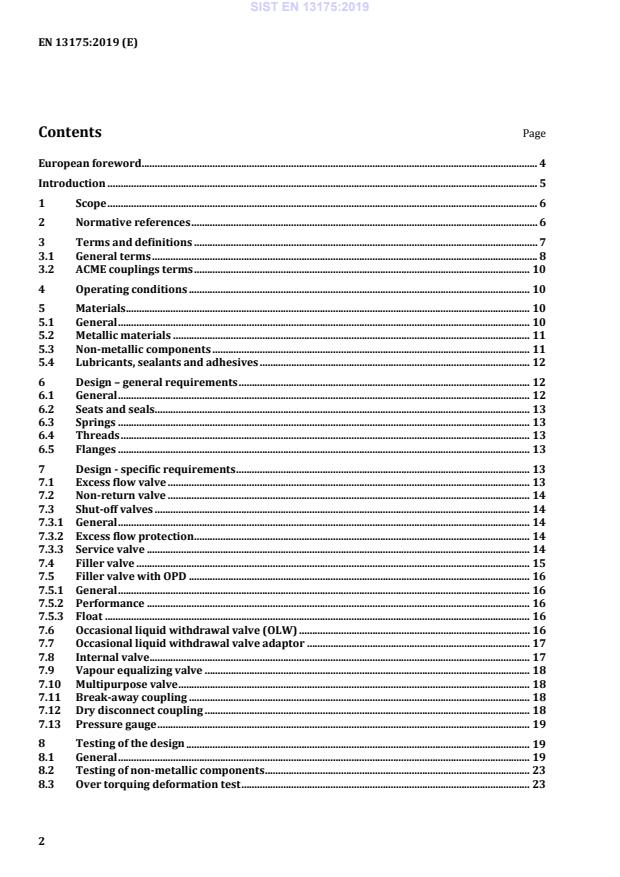
Contents Page
European foreword . 4
Introduction . 5
1 Scope . 6
2 Normative references . 6
3 Terms and definitions . 7
3.1 General terms . 8
3.2 ACME couplings terms . 10
4 Operating conditions . 10
5 Materials . 10
5.1 General . 10
5.2 Metallic materials . 11
5.3 Non-metallic components . 11
5.4 Lubricants, sealants and adhesives . 12
6 Design – general requirements . 12
6.1 General . 12
6.2 Seats and seals . 13
6.3 Springs . 13
6.4 Threads . 13
6.5 Flanges . 13
7 Design - specific requirements . 13
7.1 Excess flow valve . 13
7.2 Non-return valve . 14
7.3 Shut-off valves . 14
7.3.1 General . 14
7.3.2 Excess flow protection . 14
7.3.3 Service valve . 14
7.4 Filler valve . 15
7.5 Filler valve with OPD . 16
7.5.1 General . 16
7.5.2 Performance . 16
7.5.3 Float . 16
7.6 Occasional liquid withdrawal valve (OLW) . 16
7.7 Occasional liquid withdrawal valve adaptor . 17
7.8 Internal valve . 17
7.9 Vapour equalizing valve . 18
7.10 Multipurpose valve . 18
7.11 Break-away coupling . 18
7.12 Dry disconnect coupling . 18
7.13 Pressure gauge . 19
8 Testing of the design . 19
8.1 General . 19
8.2 Testing of non-metallic components . 23
8.3 Over torquing deformation test . 23
8.4 External leak tightness test . 23
8.5 Internal leak tightness test . 24
8.6 Residual flow test . 25
8.7 Pressure strength test . 25
8.8 Excess flow test . 25
8.8.1 General . 25
8.8.2 Excess flow test with air . 26
8.8.3 Excess flow test with water . 26
8.8.4 Excess flow strength test . 27
8.9 Endurance test . 27
8.10 Weak section strength test . 28
8.11 Stress cracking test . 28
8.11.1 General . 28
8.11.2 Mercury(l)nitrate immersion test . 29
8.11.3 Moist ammonia air stress cracking test . 29
8.12 Vacuum test . 29
8.13 Flow resistance test . 29
8.14 Filler valve flow test . 29
8.15 OPD test . 29
8.15.1 General . 29
8.15.2 Level test . 29
8.15.3 Vibration Test . 29
8.16 Test report . 30
9 Production testing . 30
10 Marking . 30
11 Documentation . 31
12 Packaging . 32
Annex A (normative) ACME connections . 33
Annex B (normative) Special low temperature requirements for valves . 37
Annex C (informative) Inspection of 3 1/4 inch ACME couplings . 38
C.1 Introduction. 38
C.2 Definitions . 38
C.3 Visual examination . 38
C.4 Dimensional check . 39
Annex D (normative) Dry disconnect couplings . 41
Annex E (informative) Connection and adaptor designs of preferred Occasional Liquid
Withdrawal valves . 46
E.1 OLW valve connection and adaptor . 46
Annex F (normative) Production testing and inspection . 49
Annex ZA (informative) Relationship between this European Standard and the essential
requirements of Directive 2014/68/EU aimed to be covered . 51
Bibliography . 53
European foreword
This document (EN 13175:2019) has been prepared by Technical Committee CEN/TC 286 “Liquefied
petroleum gas equipment and accessories”, the secretariat of which is held by NSAI.
This European Standard shall be given the status of a national standard, either by publication of an
identical text or by endorsement, at the latest by October 2019, and conflicting national standards shall
be withdrawn at the latest by October 2019.
Attention is drawn to the possibility that some of the elements of this document may be the subject of
patent rights. CEN shall not be held responsible for identifying any or all such patent rights.
This document supersedes EN 13175:2014.
This document has been prepared under a mandate given to CEN by the European Commission and the
European Free Trade Association and supports essential requirements of EU Directive(s).
For relationship with EU Directive(s), see informative Annex ZA, which is an integral part of this
document.
This document has been submitted for reference into:
— the technical annexes of the ADR [1].
NOTE These regulations take precedence over any clause of this document. It is emphasized that ADR is being
revised regularly at intervals of two years which may lead to temporary non-compliances with the clauses of this
document.
The major changes to this revision include:
— changes in 7.6, Occasional liquid withdrawal valve (OLW);
— new 7.7, Occasional liquid withdrawal valve adaptor;
— new Annex E, Connection and adaptor designs of preferred Occasional Liquid Withdrawal valves.
According to the CEN-CENELEC Internal Regulations, the national standards organisations of the
following countries are bound to implement this European Standard: Austria, Belgium, Bulgaria, Croatia,
Cyprus, Czech Republic, Denmark, Estonia, Finland, Former Yugoslav Republic of Macedonia, France,
Germany, Greece, Hungary, Iceland, Ireland, Italy, Latvia, Lithuania, Luxembourg, Malta, Netherlands,
Norway, Poland, Portugal, Romania, Serbia, Slovakia, Slovenia, Spain, Sweden, Switzerland, Turkey and
the United Kingdom.
Introduction
This document calls for the use of substances and procedures that may be injurious to health and/or the
environment if adequate precautions are not taken. It refers only to technical suitability; it does not
absolve the user from their legal obligations at any stage.
It has been assumed in the drafting of this document that the execution of its provisions is entrusted to
appropriately qualified and experienced people.
All pressures are gauge pressures unless otherwise stated.
NOTE This document requires measurement of material properties, dimensions and pressures. All such
measurements are subject to a degree of uncertainty due to tolerances in measuring equipment, etc. It can be
beneficial to refer to the leaflet “measurement uncertainty leaflet” SP INFO 2000 27 [4].
1 Scope
This document specifies minimum requirements for the design, testing and production testing of valves,
including appropriate fittings, which are connected to mobile or static LPG pressure vessels above 150 l
water capacity. Pressure relief valves and their ancillary equipment, contents gauges and automotive LPG
components are outside the scope of this document.
This document does not apply to refineries or other process plants.
2 Normative references
The following documents are referred to in the text in such a way that some or all of their content
constitutes requirements of this document. For dated references, only the edition cited applies. For
undated references, the latest edition of the referenced document (including any amendments) applies.
EN 549:1994, Rubber materials for seals and diaphragms for gas appliances and gas equipment
EN 751-1:1996, Sealing materials for metallic threaded joints in contact with 1st, 2nd and 3rd family gases
and hot water — Part 1: Anaerobic jointing compounds
EN 751-2:1996, Sealing materials for metallic threaded joints in contact with 1st, 2nd and 3rd family gases
and hot water — Part 2: Non-hardening jointing compounds
EN 751-3:1996, Sealing materials for metallic threaded joints in contact with 1st, 2nd and 3rd family gases
and hot water — Part 3: Unsintered PTFE tapes
EN 837-1:1996, Pressure gauges — Part 1: Bourdon tube pressure gauges — Dimensions, metrology,
requirements and testing
EN 1092-1:2018, Flanges and their joints — Circular flanges for pipes, valves, fittings and accessories, PN
designated — Part 1: Steel flanges
EN 1267:2012, Industrial valves — Test of flow resistance using water as test fluid
EN 1563:2018, Founding — Spheroidal graphite cast irons
EN 1759-1:2004, Flanges and their joint — Circular flanges for pipes, valves, fittings and accessories, Class
designated — Part 1: Steel flanges, NPS 1/2 to 24
EN 1774:1997, Zinc and zinc alloys — Alloys for foundry purposes — Ingot and liquid
EN 1983:2013, Industrial valves — Steel ball valves
EN 10270-3:2011, Steel wire for mechanical springs — Part 3: Stainless spring steel wire
EN 12164:2016, Copper and copper alloys — Rod for free machining purposes
EN 12165:2016, Copper and copper alloys — Wrought and unwrought forging stock
EN 12420:2014, Copper and copper alloys — Forgings
EN 12516-1:2014+A1:2018, Industrial valves — Shell design strength — Part 1: Tabulation method for
steel valve shells
EN 12516-4:2014+A1:2018, Industrial valves — Shell design strength — Part 4: Calculation method for
valve shells manufactured in metallic materials other than steel
EN 13445-2:2014, Unfired pressure vessels — Part 2: Materials
EN 13547:2013, Industrial valves — Copper alloy ball valves
EN 13709:2010, Industrial valves — Steel globe and globe stop and check valves
EN 13789:2010, Industrial valves — Cast iron globe valves
EN 13799:2012, LPG equipment and accessories — Contents gauges for Liquefied Petroleum Gas (LPG)
pressure vessels
EN 13906-1:2013, Cylindrical helical springs made from round wire and bar — Calculation and design —
Part 1: Compression springs
EN 15202:2012, LPG equipment and accessories — Essential operational dimensions for LPG cylinder valve
outlet and associated equipment connections
EN 60079-0:2012, Explosive atmospheres — Part 0: Equipment — General requirements (IEC 60079
0:2011, modified)
EN ISO 196:1995, Wrought copper and copper alloys — Detection of residual stress — Mercury(I) nitrate
test (ISO 196:1978)
EN ISO 11114-1:2012, Gas cylinders — Compatibility of cylinder and valve materials with gas contents —
Part 1: Metallic materials (ISO 11114-1:2012)
ISO 7-1:1994, Pipe threads where pressure-tight joints are made on the threads — Part 1: Dimensions,
tolerances and designation
ISO 301:2006, Zinc alloy ingots intended for castings
ISO 2859-1:1999, Sampling procedures for inspection by attributes — Part 1: Sampling schemes indexed by
acceptance quality limit (AQL) for lot-by-lot inspection
ISO 6957:1988, Copper alloys — Ammonia test for stress corrosion resistance
ANSI/ASME B1.20.1 - 1983, Pipe threads, general purpose (inch) issued by American National Standards
Institute in 1983
ASME B1.5 - 1990, ACME Screw Threads issued by American Society of Mechanical Engineers in 1990
3 Terms and definitions
For the purposes of this document, the following terms and definitions apply.
ISO and IEC maintain terminological databases for use in standardization at the following addresses:
• IEC Electropedia: available at http://www.electropedia.org/
• ISO Online browsing platform: available at http://www.iso.org/obp
3.1 General terms
3.1.1
liquefied petroleum gas
LPG
low pressure liquefied gas composed of one or more light hydrocarbons which are assigned to UN 1011,
UN 1075, UN 1965, UN 1969 or UN 1978 only and which consists mainly of propane, propene, butane,
butane isomers, butene with traces of other hydrocarbon gases
3.1.2
pressure vessel
assembly of the pressure envelope (including the openings and their closures) and non-pressure-
retaining parts attached directly to it
3.1.3
maximum allowable pressure
maximum pressure for which the equipment is designed
Note 1 to entry: All pressures are gauge pressures unless otherwise stated.
3.1.4
fitting
pressure containing component fitted to an LPG pressure system
3.1.5
internal leak tightness
resistance to leakage across the valve seal or other internal sealing components when the valve is closed
3.1.6
external leak tightness
resistance to leakage through the fitting to or from the atmosphere
3.1.7
residual flow
allowable flow through an excess flow or a non-return valve, when the valve is in the closed position
3.1.8
sealing element
non-metallic resilient component which effects a seal by contact with the valve seat
3.1.9
excess flow valve
valve designed to close automatically, with a small residual flow, when the fluid flow passing through it
exceeds a predetermined value, and to re-open when the pressure differential across the valve has been
restored below a certain value
3.1.10
non-return valve
valve designed to close automatically to restrict reverse flow
3.1.11
shut-off valve
valve to provide a leak tight seal which is operated either manually, remotely or is self-closing
3.1.12
service valve
valve for fluid off-take which is manually operated to provide a leak tight seal
3.1.13
filler valve
valve system for liquid fill service
3.1.14
plug
component which seals a female connection
3.1.15
cap
component which seals a male connection
3.1.16
overfill protection device
OPD
device designed to automatically reduce the filling rate to a minimal flow when the fill level reaches a
predetermined amount
3.1.17
occasional liquid withdrawal valve
OLW valve
normally blanked valve, used for occasional liquid withdrawal which is designed to be opened by the
engagement of a special connector valve
3.1.18
internal valve
valve which has its seal within the profile of the pressure vessel
3.1.19
self-closing valve
normally closed valve that provides a leak tight seal, opens by the engagement of a special connector or
by fluid passing through it and closes automatically upon removal of the connector or by stopping the
fluid flow
3.1.20
vapour equalizing valve
valve which permits vapour to flow in either direction in order to equalize vapour pressure between
pressure vessels during liquid transfer, and which incorporates an excess flow valve and a self-closing
valve opened by a special connector valve
3.1.21
multipurpose valve
valve which incorporates two or more service functions and which meets the combined requirements of
the individual functions
3.1.22
breakaway coupling
coupling which separates at a predetermined section when required and each separated section contains
a self-closing shut-off valve, which seals automatically
Note 1 to entry: Also referred to as a safe break.
3.1.23
dry disconnect coupling
quick coupling which connects and disconnects with minimum LPG release and each separated section
contains a self-closing shut-off valve, which seals automatically
3.1.24
Standard Temperature and Pressure
STP
15,6 °C (288,7 K), 1,013 bar absolute (0,101 3 MPa absolute)
3.2 ACME couplings terms
3.2.1
male coupling
coupling with a male thread
3.2.2
female coupling
coupling which includes a female threaded loose nut on a centre spigot
4 Operating conditions
4.1 Valves and fittings designed in accordance with this document shall be suitable for a minimum
operating temperature of −20 °C.
NOTE In service, temperatures below this can be encountered during short periods, for example, during filling.
4.2 For some parts of Europe and certain applications, temperatures lower than −20 °C can be
encountered; for these conditions the requirements of Annex B shall be applied.
4.3 Valves and fittings shall be designed for a maximum operating temperature of 65 °C.
4.4 Valves and fittings shall be designed for a maximum allowable pressure of 30 bar.
4.5 Valves and fittings shall be designed for a minimum pressure of 50 mbar absolute.
NOTE Vacuum conditions on the valve or fitting, arising from butane at low temperature or evacuation of the
pressure vessel can expose the valve or fitting to a vacuum of 50 mbar absolute.
5 Materials
5.1 General
5.1.1 All materials in contact with LPG shall be physically and chemically compatible with LPG under
all the normal operating conditions for which the valve or fitting is intended.
5.1.2 Materials for valve or fitting components shall be selected to give adequate strength in service.
Consideration shall also be given to other modes of failure such as atmospheric corrosion, brass
dezincification, stress corrosion, impact or material failure.
5.1.3 Alternative materials to those listed in 5.2 are not precluded, providing they comply with a
standard or specification that ensures control of chemical and physical properties, and quality
appropriate to the end use.
5.2 Metallic materials
5.2.1 Metallic materials for valves and fittings shall be steel, stainless steel, copper alloys, aluminium
alloys, zinc alloys, or other suitable materials.
5.2.2 Shell materials shall be selected in EN 12516-1:2014+A1:2018, EN 12516-4:2014+A1:2018 or
EN 13445-2:2014.
5.2.3 Materials for steel flanges shall be in accordance with EN 1092-1:2018.
5.2.4 Stainless steel for components shall contain not less than 16 % chromium and shall contain not
less than 7 % nickel.
5.2.5 Springs shall be manufactured from stainless steel in accordance with EN 10270-3:2011.
5.2.6 Hot stamped brass shall be non-porous and suitable for machining or other processing. Leaded
brass shall be CW614N or CW617N in accordance with EN 12420:2014, EN 12164:2016 and
EN 12165:2016. Sand-cast brass shall not be used. Cold drawn brass rods shall only be used for machining
after adequate testing for internal cracking, porosity or other inclusions and shall be heat treated if
required. Components produced from stamping brass shall not exhibit cold shuts also known as folds, or
surface defects.
5.2.7 Components manufactured from hot stamped brass or bodies made of drawn brass or machined
from brass rod shall be capable of withstanding, without cracking, the stress cracking test (see 8.11)
5.2.8 Spheroidal graphite cast iron shall comply with EN 1563:2018, with an elongation at fracture of
more than 18 %. Other ductile irons or cast irons shall not be used.
5.2.9 ZnAl4 and ZnAl4Cu1 shall be in accordance with ISO 301:2006 or EN 1774:1997.
5.2.10 Castings shall be free from inclusions and surface defects which could adversely affect the
strength, leak tightness or performance of the valve or fitting.
5.2.11 For guidance on the choice of metallic materials, see EN ISO 11114-1:2012.
5.3 Non-metallic components
All non-metallic materials in contact with LPG shall not distort, harden or adhere to the body or seat face
to such an extent as to impair the function of the valve.
All rubber materials shall also comply with the requirements of EN 549:1994. The ozone test in
EN 549:1994 shall only be carried out where gaskets/seals are exposed to atmosphere.
NOTE For guidance on the choice of non-metallic materials, see EN ISO 11114-2:2013.
5.4 Lubricants, sealants and adhesives
Where used on threads and seals; lubricants, sealants, and adhesives shall be compatible with LPG and
shall not interfere with the operation of the valve or fitting.
Sealants shall comply with EN 751-1:1996, EN 751-2:1996 or EN 751-3:1996.
6 Design – general requirements
6.1 General
6.1.1 Valves and fittings shall be capable of withstanding all service conditions, including fatigue, to
which they will be subjected during normal conditions of use (or carriage where appropriate) as detailed
in Table 3.
6.1.2 Moving parts shall have sufficient clearance to ensure freedom of movement under all normal
conditions of service. Where necessary, means of guidance shall be provided to ensure correct seating or
sealing.
6.1.3 All components vital to the function of a valve or fitting shall be secured to prevent disassembly
during normal operation. Internal valves shall be either automatically operated or remotely operated to
prevent inadvertent operation.
6.1.4 Valves and fittings shall be designed to ensure external leak tightness, internal leak tightness and
their function shall not be affected as a result of vibration during transportation.
6.1.5 For mobile applications, the valves and fittings shall be capable of withstanding a deceleration of
100 times gravity, after reaching a minimum velocity of 10m/s, in the X, Y and Z axis and shall remain
leak tight.
6.1.6 In transport applications, valves and fittings directly connect to the shell (including the internal
stop-valve and its seating) shall be protected in accordance with section 4.1.6.8 of the ADR. This may be
achieved by the provision of weak sections or shear grooves in the valve or fitting that allows the sealing
mechanism to remain within the shell after failure. These valves and fittings shall fulfil the test
requirements of 8.10.
NOTE To provide valve protection on transportable containers.
6.1.7 The design shall take account of the use of dissimilar materials.
EXAMPLE Electrochemical corrosion or material expansion.
6.1.8 Electrical equipment, when used with a valve or fitting shall meet the requirements of
EN 60079-0:2012 where appropriate.
6.1.9 Valves shall have their flow resistance determined using water as a test fluid.
6.1.10 Possible stress corrosion shall be eliminated by either design or heat treatment.
6.1.11 The design shall take account of the following:
a) minimizing the use of raw materials;
b) minimizing the environmental impact of in-service maintenance and end of life disposal; and
c) efficient packaging of finished product.
6.2 Seats and seals
6.2.1 Valves and fittings shall be designed to allow installation without damaging non-metallic seats or
seals.
6.2.2 Sealing may be achieved by either elastomeric or other non-metallic material.
When a metal to metal closure is used, the residual flow test requirements of 8.6 shall be met.
6.2.3 The sealing element ensuring internal leak tightness shall be attached or otherwise assembled
such that it will not become dislodged under service conditions. The means to secure the sealing element
shall not rely solely on adhesive.
6.3 Springs
Springs shall be designed in accordance with EN 13906-1:2013.
6.4 Threads
6.4.1 Taper threaded pressure vessel connections shall comply with ANSI/ASME B1.20.1 - 1983.
Thread sizes shall not exceed DN 80.
6.4.2 Where taper threads are used, the design shall ensure that over-torquing shall not impede the
correct operation of the valve or fitting, see 8.3.
6.4.3 Taper threaded sections of a body designed for a pressure vessel connection shall be constructed
with wrenching flats.
6.4.4 All threads other than taper threaded pressure vessel connections shall be in accordance with a
European Standard or an International Standard or shall be ACME threads in accordance with Annex A
or ANSI/ASME B1.20.1 - 1983. Where the design includes 3 1/4 inch x 6 ACME threads, periodic
inspections of the couplings are required. Annex C provides recommendations for these periodic
inspections.
6.4.5 To avoid mismatching with ANSI/ASME B1.20.1 – 1983 threads, ISO 7-1:1994 threads shall not
be used.
6.5 Flanges
Flanges shall comply with EN 1092-1:2018 or EN 1759-1:2004.
7 Design - specific requirements
7.1 Excess flow valve
7.1.1 Excess flow valves shall be designed so that when closed the flow past the seat to allow for
reduction of differential pressure across the valve, shall not exceed that of an opening of 1,8 mm cross
sectional area.
7.1.2 Excess flow valves shall operate at a flow-rate of not more than 10 % above, nor less than 20 %
below the rated closing flow capacity specified and it shall close automatically at a pressure differential
across the valve of not more than 1,4 bar.
7.1.3 The connection to the pressure vessel shall not affect the function of the valve or its rated flow.
7.2 Non-return valve
The connection to the pressure vessel shall not affect the operation of the non-return valve.
7.3 Shut-off valves
7.3.1 General
Shut-off valves shall be of the ball valve or globe valve type or shall be a service valve. Ball valves shall be
in accordance with EN 1983:2013 or EN 13547:2013. Globe valves shall be in accordance with
EN 13709:2010 or EN 13789:2010. Service valves shall meet the requirements of 7.3.3
The position and/or direction of closure of shut-off devices shall be clearly apparent. This can be achieved
either by marking, indicators or remote signal.
7.3.2 Excess flow protection
Valves with a minimum cross section of LPG passage through the valve greater than 7 mm (equivalent
to a diameter of 3 mm) for liquid phase withdrawal, shall be protected by an excess flow valve.
Valves with a minimum cross section of LPG passage through the valve greater than the equivalent cross-
sectional area of 50 mm (equivalent to a diameter of 8 mm) for vapour phase withdrawal, shall be
protected by an excess flow valve.
7.3.3 Service valve
7.3.3.1 Valve operating mechanism
7.3.3.1.1 The valve operating mechanism shall be manually operated.
7.3.3.1.2 The valve operating mechanism shall be designed in such a way that it remains captive, and
it achieves direct contact with the valve body in the absence of the sealing element. The valve shall be
designed in such a way that the valve operating mechanism cannot be removed during normal use and
without showing evidence of tampering.
7.3.3.1.3 Under normal use the valve shall operate without difficulty even after prolonged use and shall
satisfy the requirements of 8.7 with the closing torque not exceeding 3 Nm.
7.3.3.1.4 The sealing element, to ensure internal leak tightness, shall be attached or otherwise
assembled such that it will not become dislocated under service conditions. The means to secure the
sealing element shall not rely solely on cement or adhesive.
7.3.3.1.5 All valves shall close when turned clockwise and open when turned anti-clockwise. It is
recommended that the valve operating mechanism is visibly marked with a portion of circle terminating
in two arrows. One arrow marked “–“ and the other arrow marked “+”, to indicate the result of the
rotation as detailed in Figure 1.
Figure 1 — Hand-wheel marking
7.3.3.2 Valve body
Where the valve body is made of more than one component, precautions shall be taken to ensure that
there can be no unintentional disassembly. Disassembly shall require specialized equipment.
For transportable tanks, ADR [1] requires either protection against the danger of being wrenched off by
external stresses or a design resisting these stress, which is demonstrated by the weak section strength
test, see 8.10.
7.3.3.3 Sealing mechanism
The mechanism shall ensure internal leak tightness.
7.3.3.4 Operating torque
After the endurance test in accordance with 8.7 which is representative of the service valve life, the
operating torque shall not exceed 3 Nm.
7.4 Filler valve
7.4.1 The filler valve shall be either:
a) manually operated; or
b) a remotely operated shut-off valve in combination with a non-return valve; or
c) a double non-return valve, at least one of which meets the requirements of 8.5, the other non-return
valve may meet the requirements of either 8.5 or 8.6; or
d) a system that provides an equivalent level of safety.
7.4.2 Where supplied as an assembled unit, the filler valve shall meet the following criteria:
a) the non-return valve components shall meet the requirements of 7.2; and
b) where liquid can be trapped, means shall be provided to relieve excess pressure; and
c) where the body is made of two or more components, it shall not be possible to disassemble the
components with a torque of less than 80 Nm.
7.4.3 Devices with a vessel connection up to DN 20 shall have a minimum filling rate greater or equal
to 5 m /h (water) under a differential pressure of 4 bar. Larger vessel connections shall have a minimum
filling rate of 8 m /h (water) under a differential pressure of 4 bar.
7.4.4 The fill connection shall be provided with a leak tight cap or blind flange. When the fill connection
is provided with a soft-seated non-return valve in combination with a shut-off valve, a leak tight cap shall
not be required. Consideration shall be given to providing dust protection.
NOTE Plugs and caps can be provided with a locking mechanism to prevent unauthorized interference.
7.4.5 Typical filler valve inlet connections are listed in Annex A.
When a dry disconnect coupling is used as a filler valve, the essential dimensions for a DN 50 and DN 80
connections are shown in Annex D.
7.4.6 Where the connecting seal is retained in the body of the filler valve, the seal retaining groove shall
be provided with a vent hole in order to prevent the ejection of the seal on disconnection.
7.4.7 The valve may be provided with an extension for use with buried pressure vessels.
7.4.8 The valve shall include one or two weak sections.
— For valves without an extension, a weak section e.g. break-off grooves or shear points, shall be
included so as to leave the main closure intact in the event of the valve being fractured. For valves
with a vessel connection up to DN 25, the bending force to fracture shall be at minimum of 250 Nm.
For valves with a vessel connection of DN 32 or greater, the bending force to fracture shall be
between 400 Nm and 500 Nm.
— For valves with an extension, there shall be two weak sections, one below the fill connection and the
other in the middle of the extension. They shall be such that the fracture by bending occurs at the
upper weak section with a bending force applied to the fill connection of between 400 Nm and
500 Nm. The weak section in the lower part shall break when a bending force of between 550 Nm
and 750 Nm is applied.
Regardless of the type of fracture, the lower check shall remain operational. There shall be no
deformation of the connecting threads between the different parts, nor between the lower body and the
pressure vessel.
7.5 Filler valve with OPD
7.5.1 General
The filler valve with OPD shall meet the requirements of 7.4.
7.5.2 Performance
7.5.2.1 The device shall have a minimum filling rate greater or equal to 8 m /h (water) under a
differential pressure of 4 b
...
EN 13175:2019は液化石油ガス(LPG)圧力容器用のバルブおよび付属品に関する仕様と試験を定めた標準です。この文書は、150リットル以上の水容量を持つ移動式または静的LPG圧力容器に接続されるバルブの設計、試験および生産試験に必要な最低要件を指定しています。この標準は、LPGシステムの安全性と信頼性を確保するために重要な役割を果たします。 この標準の強みは、具体的で実用的な要件を提供する点です。特に、バルブが要求される機能と性能に応じたテストプロトコルが導入されているため、製造業者は高品質な製品を市場に供給するための基準を持つことができます。また、標準化により、異なる製造業者の製品間での互換性を確保し、最終的に消費者にとっての安全性が向上します。 さらに、EN 13175:2019は、LPG装置の設計および評価のための基幹となる文書であり、特に移動式および静的圧力容器に焦点を当てているため、これらの分野での使用が期待されています。自動車用LPG部品や圧力解放弁、内容計は範囲外となるため、標準化の焦点が明確であり、乱雑さが排除されています。この点が、業界にとってさらに有用なガイドラインを提供する中心的な要素となっています。 全体として、SIST EN 13175:2019は、液化石油ガス設備の安全性確保と品質維持のための強固な基盤を示す文書であり、その範囲と要件は業界における標準化の必要性を反映しています。
EN 13175:2019 표준 문서는 LPG 장비 및 액세서리에 관한 중요한 지침을 제공하며, 특히 액화 석유 가스(LPG) 압력 용기 밸브와 연결 부품의 설계 및 테스트에 대한 최소 요구사항을 규정하고 있습니다. 이 표준의 범위는 150리터 이상의 수조 용량을 가진 이동식 또는 고정식 LPG 압력 용기에 연결되는 밸브 및 관련 부품에 초점을 맞추고 있습니다. 이 표준의 강점은 다양한 LPG 압력 용기와 연관된 밸브 및 피팅의 설계와 생산 과정에서의 일관성을 보장하는 데 있습니다. 또한, 고급 시험 방법을 통해 안전성을 강화하고, 사용자와 환경을 보호하는데 기여합니다. 따라서 이 문서는 LPG 관련 산업에서 필수적인 안전 기준을 준수하는 데 중요한 역할을 하고 있습니다. EN 13175:2019는 정유소나 기타 공정 플랜트에는 적용되지 않지만, LPG 압력 용기를 사용하는 다양한 응용 프로그램에 필수적인 지침을 제공합니다. 따라서 이 표준은 LPG 장비와 관련된 업계 종사자들에게 매우 중요하며, 관련 제품의 품질 개선 및 안전성을 높이는 데 기여할 수 있습니다. 이 문서는 또한 밸브와 부품의 적절한 설계 및 검증 절차를 통해 사용자 신뢰성을 확보하는데 중요한 참고 자료로 작용합니다. 결과적으로, EN 13175:2019는 LPG 산업의 요구를 충족시키기 위한 필수적인 기준으로 자리 잡고 있으며, 해당 분야의 전문가들에게 큰 가치를 제공합니다.
The EN 13175:2019 standard provides a comprehensive framework for the specification and testing of Liquefied Petroleum Gas (LPG) pressure vessel valves and fittings. Its scope is clearly delineated, focusing specifically on the minimum requirements necessary for the design, production, and testing of valves associated with mobile or static LPG pressure vessels that exceed 150 liters in water capacity. By establishing these rigorous standards, it ensures that both safety and efficacy are prioritized in the use of LPG equipment. One of the notable strengths of the EN 13175:2019 standard is its thorough approach to defining the criteria and processes for valve and fitting production. This includes the necessary testing protocols that manufacturers must undertake, which directly supports the integrity and reliability of LPG systems. Furthermore, the exclusion of pressure relief valves, ancillary equipment, contents gauges, and automotive LPG components from its scope allows for a focused and specialized standard that addresses the specific needs of LPG pressure vessel systems. The document's relevance in the industry cannot be overstated, as it serves as an essential guideline for manufacturers, ensuring compliance with safety regulations and promoting uniformity in performance standards across the sector. Its applicability specifically to vessels with significant water capacities further enhances its utility, catering to larger scale applications that require stringent adherence to safety measures. In summary, EN 13175:2019 stands as a vital reference point within the LPG field, demonstrating significant attention to detail and a commitment to best practices in the design and testing of LPG pressure vessel valves and fittings.
Questions, Comments and Discussion
Ask us and Technical Secretary will try to provide an answer. You can facilitate discussion about the standard in here.
Loading comments...