

EN 1999-1-3:2023/FprA1
(Amendment)Eurocode 9 - Design of aluminium structures - Part 1-3: Structures susceptible to fatigue
- Abstract
1.1 Scope of EN 1999-1-3
(1) This document gives the basis for the design of aluminium alloy structures subject to fatigue in the ultimate limit state.
(2) This document gives rules for:
- safe life design;
- damage tolerant design;
- design assisted by testing.
(3) This document does not cover pressurized containment vessels or pipework.
1.2 Assumptions
(1) The general assumptions of EN 1990 apply.
(2) The provisions of EN 1999-1-1 apply.
(3) EN 1999-1-3 is intended to be used in conjunction with EN 1990, EN 1991 (all parts), relevant parts in EN 1992 to EN 1999, EN 1090-1 and EN 1090-3 for requirements for execution, and ENs, EADs and ETAs for construction products relevant to aluminium structures.
- Status
- Not Published
- Publication Date
- 10-Feb-2027
- Technical Committee
- CEN/TC 250 - Structural Eurocodes
- Drafting Committee
- CEN/TC 250/SC 9/WG 1 - Update and Simplification of all parts of EN 1999
- Current Stage
- 4599 - Dispatch of FV draft to CMC - Finalization for Vote
- Start Date
- 13-Aug-2026
- Due Date
- 01-May-2027
- Completion Date
- 13-Aug-2026

EN 1999-1-3:2023/FprA1 is a CEN draft amendment to Eurocode 9, Part 1-3, for the fatigue design of aluminium structures. It updates the rules for aluminium alloy structures in the ultimate limit state, including safe life design, damage tolerant design and design assisted by testing. The document is used with the Eurocode basis documents and the relevant execution and product standards for aluminium structures.
What does EN 1999-1-3:2023/FprA1 specify?
EN 1999-1-3:2023/FprA1 updates EN 1999-1-3:2023, which gives the basis for designing aluminium alloy structures subject to fatigue. The scope covers fatigue design in the ultimate limit state and is organised around the main text, with amendment points to the introduction, scope, normative references, fatigue design clauses and Annexes D and E.
It applies with EN 1990-1, EN 1991, the relevant parts of EN 1992 to EN 1999, EN 1090-1 and EN 1090-3, plus ENs, EADs and ETAs for construction products relevant to aluminium structures. In practice, that means the fatigue checks are not read in isolation - they sit inside the wider Eurocode design and execution framework.
| Annex | What it covers |
|---|---|
| D | Stress concentration factors |
| E | Scope and field of application |
The scope excludes pressurized containment vessels and pipework.
What are the key requirements of EN 1999-1-3:2023/FprA1?
EN 1999-1-3:2023/FprA1 strengthens how fatigue design is tied to the general Eurocode basis and to the two main design philosophies for fatigue. It also updates where the designer gets fatigue actions from and how local detail effects are treated.
Design basis and load sources
- Clause 1.1 keeps the focus on aluminium alloy structures subject to fatigue in the ultimate limit state (ULS). In practice, fatigue must be checked as part of the structural design, not only as a detailing issue.
- Clause 0.2 and Clause 2 direct the user to EN 1990-1:2023+A1:2026 and the other Eurocodes. This matters because reliability, load combinations and companion design rules come from the wider Eurocode system.
- Clause 4.3.1 takes fatigue loading from EN 1991 (all parts), and other relevant European Standards may be used for loads not covered there. That tells the designer where to build the cyclic load history.
Safe life and damage tolerant design
- Clause 4.2.1 on safe life design (SLD) calls for reliability over the full design service life without regular in-service inspection or monitoring for fatigue cracks. Use this where a local crack could quickly lead to failure.
- Clause 4.2.2 on damage tolerant design (DTD) accepts that cracks may form, but expects slow propagation, detectability, multiple load paths or crack-arresting details. In practice, this means the inspection strategy becomes part of the design decision.
- Both approaches require constructional details, materials and stress levels that give an appropriate reliability level aligned with EN 1990-1.
Partial factors and local detail effects
- Clause 4.4 links the partial factors for fatigue loads to EN 1990-1:2023+A1:2026. That keeps the fatigue check consistent with the general load-factor framework.
- Annex D updates the stress concentration factor figure for rounded corners in flat plate and unreinforced apertures. For the reader, this affects how openings and local geometry are assessed for fatigue.
- Annex E has a note change to the scope and field of application, which affects how specific constructional detail types are treated.
What terms does EN 1999-1-3:2023/FprA1 define?
- Safe life design (SLD) - a fatigue design approach intended to keep the structure in service for its design life without routine crack inspection or monitoring.
- Damage tolerant design (DTD) - a fatigue design approach that allows for crack formation but limits the risk of failure through detectability, load paths or crack-arresting detail.
- Ultimate limit state (ULS) - the design state used here for verifying safety against failure under fatigue-related actions.
- National Annexes - national documents where each Member State sets its chosen values for regulatory safety matters.
- European Assessment Document (EAD) - a document used with European Technical Assessments for construction products relevant to aluminium structures.
- European Technical Assessment (ETA) - the technical assessment used for a construction product where relevant to aluminium structures.
Who uses EN 1999-1-3:2023/FprA1?
EN 1999-1-3:2023/FprA1 is used by structural engineers, detail designers, checking engineers and execution teams working with aluminium structures. It also matters to quality managers and buyers who need to specify the correct fatigue design basis, inspection approach and execution standards.
Typical tasks include:
- choosing between SLD and DTD
- checking fatigue loading from EN 1991
- coordinating design with EN 1990-1 and the other Eurocodes
- selecting details that control stress concentrations
- aligning design, fabrication and inspection requirements
What changed in EN 1999-1-3:2023/FprA1 from the previous edition?
EN 1999-1-3:2023/FprA1 modifies EN 1999-1-3:2023 in several places.
- Replaces references to EN 1990 with EN 1990-1.
- Updates references to EN 1999-1-1:2023 and EN 1999-1-4:2023 to their +A1:2026 versions.
- Revises the Eurocodes list in the introduction and adds a direct-application statement for EN 1999 with EN 1990-1 and the other Eurocodes.
- Corrects the scope wording in Clause 1.1.
- Replaces the normative reference to EN 1990 with EN 1990-1:2023+A1:2026.
- Expands the guidance in 4.2.1 and 4.2.2 on reliability, inspection and crack management.
- Clarifies the source of fatigue loading in 4.3.1.
- Updates the note in 4.4 on partial factors for fatigue loads.
- Replaces Figure D.1 on stress concentration factors.
- Adjusts the note in E.2 on scope and field of application.
Which standards are used with EN 1999-1-3:2023/FprA1?
- EN 1990-1:2023+A1:2026 - gives the basis for new structures, including the general reliability framework and load-factor rules used here.
- EN 1991 (all parts) - provides the fatigue loading actions.
- Relevant parts of EN 1992 to EN 1999 - supply the companion Eurocode design rules used alongside this part.
- EN 1999-1-1:2023+A1:2026 - provides the general aluminium design provisions used together with this fatigue part.
- EN 1999-1-4:2023+A1:2026 - is another linked aluminium part referenced in the amendments.
- EN 1090-1 and EN 1090-3 - provide execution requirements for aluminium structures.
- ENs, EADs and ETAs - provide the product and assessment documents needed for construction products relevant to aluminium structures.
What does the EN 1999-1-3:2023/FprA1 document contain?
The document contains a European foreword and a contents list, followed by numbered amendments throughout the standard. Those amendments touch the introduction to the Eurocodes, the introduction to EN 1999, the scope, normative references, the fatigue design clauses and the annex material.
It also includes a revised stress concentration factor figure in Annex D and a note change in Annex E. For design and checking work, the useful parts are the updated cross-references, the reliability wording for SLD and DTD, and the clarified source of fatigue loading.
Relations
- Effective Date
- 30-Jul-2025
Get Certified
Connect with accredited certification bodies for this standard

DIBt (Deutsches Institut für Bautechnik)
German Institute for Building Technology.
DIN CERTCO
DIN Group product certification.

Aboma Certification B.V.
Specialized in construction, metal, and transport sectors.
Sponsored listings
Frequently Asked Questions
EN 1999-1-3:2023/FprA1 is a draft published by the European Committee for Standardization (CEN). Its full title is "Eurocode 9 - Design of aluminium structures - Part 1-3: Structures susceptible to fatigue". This standard covers: 1.1 Scope of EN 1999-1-3 (1) This document gives the basis for the design of aluminium alloy structures subject to fatigue in the ultimate limit state. (2) This document gives rules for: - safe life design; - damage tolerant design; - design assisted by testing. (3) This document does not cover pressurized containment vessels or pipework. 1.2 Assumptions (1) The general assumptions of EN 1990 apply. (2) The provisions of EN 1999-1-1 apply. (3) EN 1999-1-3 is intended to be used in conjunction with EN 1990, EN 1991 (all parts), relevant parts in EN 1992 to EN 1999, EN 1090-1 and EN 1090-3 for requirements for execution, and ENs, EADs and ETAs for construction products relevant to aluminium structures.
1.1 Scope of EN 1999-1-3 (1) This document gives the basis for the design of aluminium alloy structures subject to fatigue in the ultimate limit state. (2) This document gives rules for: - safe life design; - damage tolerant design; - design assisted by testing. (3) This document does not cover pressurized containment vessels or pipework. 1.2 Assumptions (1) The general assumptions of EN 1990 apply. (2) The provisions of EN 1999-1-1 apply. (3) EN 1999-1-3 is intended to be used in conjunction with EN 1990, EN 1991 (all parts), relevant parts in EN 1992 to EN 1999, EN 1090-1 and EN 1090-3 for requirements for execution, and ENs, EADs and ETAs for construction products relevant to aluminium structures.
EN 1999-1-3:2023/FprA1 is classified under the following ICS (International Classification for Standards) categories: 91.010.30 - Technical aspects. The ICS classification helps identify the subject area and facilitates finding related standards.
EN 1999-1-3:2023/FprA1 has the following relationships with other standards: It is inter standard links to EN 1999-1-3:2023. Understanding these relationships helps ensure you are using the most current and applicable version of the standard.
EN 1999-1-3:2023/FprA1 is available in PDF format for immediate download after purchase. The document can be added to your cart and obtained through the secure checkout process. Digital delivery ensures instant access to the complete standard document.
Standards Content (Sample)
SLOVENSKI STANDARD
01-maj-2026
Evrokod 9 - Projektiranje konstrukcij iz aluminijevih zlitin - 1-3. del: Konstrukcije,
občutljive na utrujanje
Eurocode 9 - Design of aluminium structures - Part 1-3: Structures susceptible to fatigue
Eurocode 9 - Bemessung und Konstruktion von Aluminiumtragwerken - Teil 1-3:
Ermüdungsbeanspruchte Tragwerke
Eurocode 9 - Calcul des structures en aluminium - Partie 1-3 : Structures sensibles à la
fatigue
Ta slovenski standard je istoveten z: EN 1999-1-3:2023/prA1
ICS:
91.010.30 Tehnični vidiki Technical aspects
91.080.17 Aluminijaste konstrukcije Aluminium structures
2003-01.Slovenski inštitut za standardizacijo. Razmnoževanje celote ali delov tega standarda ni dovoljeno.
DRAFT
EUROPEAN STANDARD
EN 1999-1-3:2023
NORME EUROPÉENNE
EUROPÄISCHE NORM
prA1
March 2026
ICS
English Version
Eurocode 9 - Design of aluminium structures - Part 1-3:
Structures susceptible to fatigue
Eurocode 9 - Calcul des structures en aluminium - Eurocode 9 - Bemessung und Konstruktion von
Partie 1-3 : Structures sensibles à la fatigue Aluminiumtragwerken - Teil 1-3:
Ermüdungsbeanspruchte Tragwerke
This draft amendment is submitted to CEN members for enquiry. It has been drawn up by the Technical Committee CEN/TC 250.
This draft amendment A1, if approved, will modify the European Standard EN 1999-1-3:2023. If this draft becomes an
amendment, CEN members are bound to comply with the CEN/CENELEC Internal Regulations which stipulate the conditions for
inclusion of this amendment into the relevant national standard without any alteration.
This draft amendment was established by CEN in three official versions (English, French, German). A version in any other
language made by translation under the responsibility of a CEN member into its own language and notified to the CEN-CENELEC
Management Centre has the same status as the official versions.
CEN members are the national standards bodies of Austria, Belgium, Bulgaria, Croatia, Cyprus, Czech Republic, Denmark, Estonia,
Finland, France, Germany, Greece, Hungary, Iceland, Ireland, Italy, Latvia, Lithuania, Luxembourg, Malta, Netherlands, Norway,
Poland, Portugal, Republic of North Macedonia, Romania, Serbia, Slovakia, Slovenia, Spain, Sweden, Switzerland, Türkiye and
United Kingdom.
Recipients of this draft are invited to submit, with their comments, notification of any relevant patent rights of which they are
aware and to provide supporting documentation.
Warning : This document is not a European Standard. It is distributed for review and comments. It is subject to change without
notice and shall not be referred to as a European Standard.
EUROPEAN COMMITTEE FOR STANDARDIZATION
COMITÉ EUROPÉEN DE NORMALISATION
EUROPÄISCHES KOMITEE FÜR NORMUNG
CEN-CENELEC Management Centre: Rue de la Science 23, B-1040 Brussels
© 2026 CEN All rights of exploitation in any form and by any means reserved Ref. No. EN 1999-1-3:2023/prA1:2026 E
worldwide for CEN national Members.
EN 1999-1-3:2023/prA1:2026 (E)
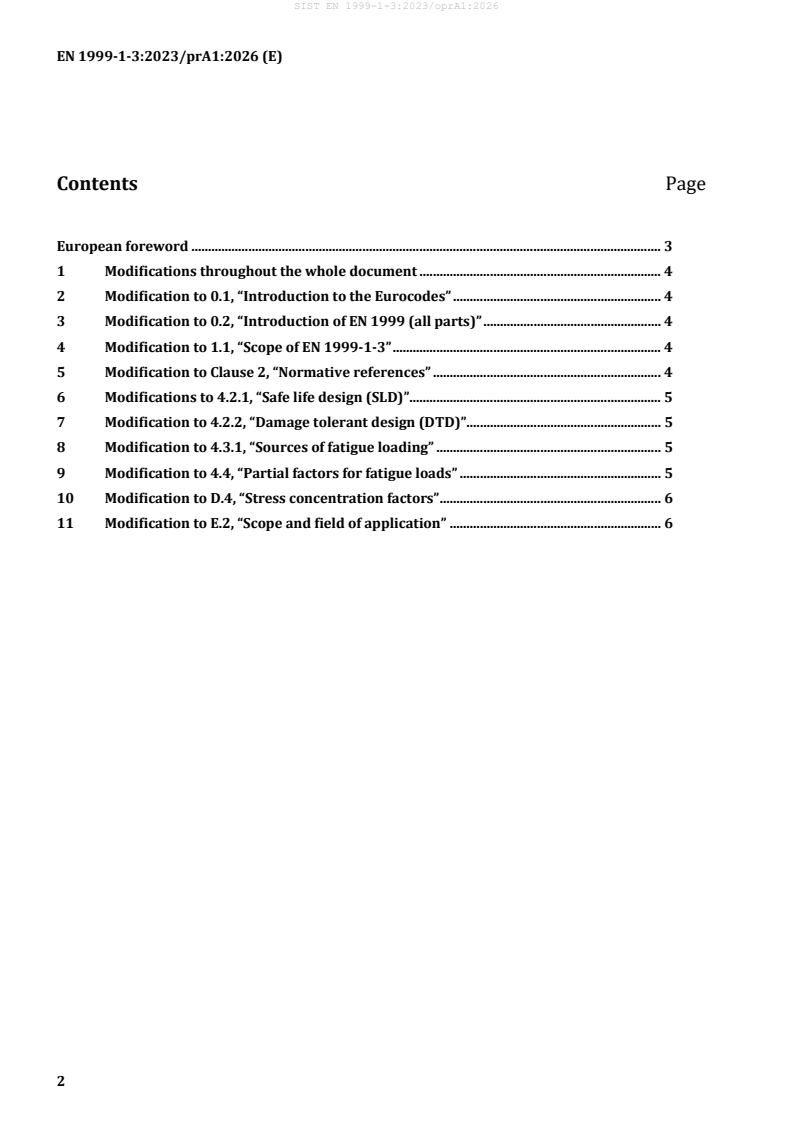
Contents Page
European foreword . 3
1 Modifications throughout the whole document . 4
2 Modification to 0.1, “Introduction to the Eurocodes” . 4
3 Modification to 0.2, “Introduction of EN 1999 (all parts)” . 4
4 Modification to 1.1, “Scope of EN 1999-1-3” . 4
5 Modification to Clause 2, “Normative references” . 4
6 Modifications to 4.2.1, “Safe life design (SLD)”. 5
7 Modification to 4.2.2, “Damage tolerant design (DTD)”. 5
8 Modification to 4.3.1, “Sources of fatigue loading” . 5
9 Modification to 4.4, “Partial factors for fatigue loads” . 5
10 Modification to D.4, “Stress concentration factors” . 6
11 Modification to E.2, “Scope and field of application” . 6
EN 1999-1-3:2023/prA1:2026 (E)
European foreword
This document (EN 1999-1-3:2023/prA1:2026) has been prepared by Technical Committee CEN/TC 250
“Structural Eurocodes”, the secretariat of which is held by BSI. CEN/TC 250 is responsible for all
Structural Eurocodes and has been assigned responsibility for structural and geotechnical design matters
by CEN.
This document is currently submitted to the CEN Enquiry.
The first generation of EN Eurocodes was published between 2002 and 2007. This document forms part
of the second generation of the Eurocodes, which have been prepared under Mandate M/515 i
...