

EN 13763-12:2025
(Main)Explosives for civil uses - Detonators and detonating cord relays - Part 12: Verification of resistance to hydrostatic pressure of detonators, detonating cord relays and surface connectors
- Abstract
This document specifies a method for determination of resistance to hydrostatic pressure of electric detonators, non-electric detonators, electronic detonators, surface connectors and detonating cord relays.
Detonating cord relays, stated by the manufacturer to be used in dry conditions, are excluded.
This document is applicable to explosives for civil uses.
- Status
- Published
- Publication Date
- 30-Sep-2025
- Technical Committee
- CEN/TC 321 - Explosives for civil uses
- Drafting Committee
- CEN/TC 321/WG 4 - Detonators and relays
- Current Stage
- 6060 - Definitive text made available (DAV) - Publishing
- Start Date
- 01-Oct-2025
- Due Date
- 04-Apr-2022
- Completion Date
- 01-Oct-2025

Overview
EN 13763-12:2025 - published by CEN - specifies a laboratory method to verify resistance to hydrostatic pressure of electric, non-electric and electronic detonators, surface connectors and detonating cord relays used in explosives for civil uses. The standard describes immersion and pressure-testing of test pieces, subsequent initiation, and-where applicable-measurement of delay accuracy. It supersedes EN 13763-12:2003 and forms part of the EN 13763 series for detonators and detonating cord relays.
Key topics and requirements
- Scope and exclusions
- Applies to detonators, detonating cord relays and surface connectors for civil explosives.
- Excludes plain/semi‑finished detonators, shock tubes and leading wires as test objects, coupling accessories, electronic initiation systems and detonating cord relays specified by the manufacturer for dry conditions.
- Test principle
- Test pieces are immersed in water (grade 3, EN ISO 3696:1995) inside a water tank or a pressure vessel and held under controlled hydrostatic pressure and temperature, then initiated to verify function and delay performance.
- Apparatus and conditions
- Pressure vessel capable of maintaining (0.30 ± 0.01) MPa or a higher value specified in EN 13763-1:2025; corrosion‑resistant construction.
- Water heating, temperature (±1 °C) and pressure (±0.01 MPa) measurement devices, means of initiation, delay‑time measurement equipment and programming unit for programmable electronic detonators.
- Sampling and procedure
- Typical sample size: 50 test pieces; special sampling for delay series (five delay values × ten pieces).
- Immersion under test pressure for 48 h, followed by initiation within 2 h of removal and observation of detonation and delay timing.
- Results and reporting
- Records whether items detonate and, where applicable, calculate adjusted nominal delay time and maximum standard deviation per EN 13763-16:2025. Test report content is defined (Annex ZA links to Directive 2014/28/EU).
Applications and users
- Who uses it
- Detonator manufacturers, independent test laboratories, quality assurance teams, regulatory bodies, procurement and compliance officers in mining, quarrying, civil construction and demolition.
- Practical uses
- Routine quality control and batch verification.
- Type approval and certification testing of detonators, connectors and detonating cord relays.
- Safety assessment and R&D when evaluating performance after hydrostatic exposure (e.g., submerged boreholes or puddles on surface).
- Demonstrating conformity with EU market requirements for explosives for civil uses.
Related standards
- EN 13763-1:2025 (requirements)
- EN 13763-16:2025 (delay accuracy verification)
- EN 13763-27:2025 (test methods for electronic initiation systems)
- EN 13857-1:2025 (vocabulary)
- EN ISO 3696:1995 (water for analytical use)
Keywords: EN 13763-12:2025, hydrostatic pressure test, detonators, detonating cord relays, surface connectors, explosives for civil uses, CEN, pressure vessel, delay accuracy, test method.
Relations
- Effective Date
- 23-Oct-2019
- Effective Date
- 28-Jan-2026
- Effective Date
- 28-Jan-2026
- Effective Date
- 28-Jan-2026
- Effective Date
- 28-Jan-2026
- Effective Date
- 28-Jan-2026
- Effective Date
- 28-Jan-2026
- Effective Date
- 28-Jan-2026
- Referred By
EN 13763-1:2004 - Explosives for civil uses - Detonators and relays - Part 1: Requirements - Effective Date
- 28-Jan-2026
Get Certified
Connect with accredited certification bodies for this standard

ECOCERT
Organic and sustainability certification.

Eurofins Food Testing Global
Global leader in food, environment, and pharmaceutical product testing.

Intertek Bangladesh
Intertek certification and testing services in Bangladesh.
Sponsored listings
Frequently Asked Questions
EN 13763-12:2025 is a standard published by the European Committee for Standardization (CEN). Its full title is "Explosives for civil uses - Detonators and detonating cord relays - Part 12: Verification of resistance to hydrostatic pressure of detonators, detonating cord relays and surface connectors". This standard covers: This document specifies a method for determination of resistance to hydrostatic pressure of electric detonators, non-electric detonators, electronic detonators, surface connectors and detonating cord relays. Detonating cord relays, stated by the manufacturer to be used in dry conditions, are excluded. This document is applicable to explosives for civil uses.
This document specifies a method for determination of resistance to hydrostatic pressure of electric detonators, non-electric detonators, electronic detonators, surface connectors and detonating cord relays. Detonating cord relays, stated by the manufacturer to be used in dry conditions, are excluded. This document is applicable to explosives for civil uses.
EN 13763-12:2025 is classified under the following ICS (International Classification for Standards) categories: 71.100.30 - Explosives. Pyrotechnics and fireworks. The ICS classification helps identify the subject area and facilitates finding related standards.
EN 13763-12:2025 has the following relationships with other standards: It is inter standard links to EN 13763-12:2003, EN 13763-16:2025, EN ISO 3696:1995, EN 13763-1:2025, EN 13857-1:2025, EN 13763-27:2025, CEN/TS 13763-27:2003, EN 13763-25:2025, EN 13763-1:2004. Understanding these relationships helps ensure you are using the most current and applicable version of the standard.
EN 13763-12:2025 is associated with the following European legislation: EU Directives/Regulations: 2014/28/EU; Standardization Mandates: M/055, M/562. When a standard is cited in the Official Journal of the European Union, products manufactured in conformity with it benefit from a presumption of conformity with the essential requirements of the corresponding EU directive or regulation.
EN 13763-12:2025 is available in PDF format for immediate download after purchase. The document can be added to your cart and obtained through the secure checkout process. Digital delivery ensures instant access to the complete standard document.
Standards Content (Sample)
SLOVENSKI STANDARD
01-december-2025
Eksplozivi za civilno uporabo - Detonatorji in zakasnilniki - 12. del: Preverjanje
odpornosti detonatorjev, zakasnilnikov in površinskih konektorjev proti
hidrostatskemu tlaku
Explosives for civil uses - Detonators and detonating cord relays - Part 12: Verification of
resistance to hydrostatic pressure of detonators, detonating cord relays and surface
connectors
Explosivstoffe für zivile Zwecke - Zünder und Sprengschnurverzögerer - Teil 12:
Überprüfung der Widerstandsfähigkeit von Zündern, Sprengschnurverzögerern und
Oberflächenverbindern gegen hydrostatischen Druck
Explosifs à usage civil - Détonateurs et relais pour cordeau détonant - Partie 12 :
Vérification de la résistance à la pression hydrostatique des détonateurs, des relais pour
cordeau détonant et des connecteurs de surface
Ta slovenski standard je istoveten z: EN 13763-12:2025
ICS:
71.100.30 Eksplozivi. Pirotehnika in Explosives. Pyrotechnics and
ognjemeti fireworks
2003-01.Slovenski inštitut za standardizacijo. Razmnoževanje celote ali delov tega standarda ni dovoljeno.
EN 13763-12
EUROPEAN STANDARD
NORME EUROPÉENNE
October 2025
EUROPÄISCHE NORM
ICS 71.100.30 Supersedes EN 13763-12:2003
English Version
Explosives for civil uses - Detonators and detonating cord
relays - Part 12: Verification of resistance to hydrostatic
pressure of detonators, detonating cord relays and surface
connectors
Explosifs à usage civil - Détonateurs et relais pour Explosivstoffe für zivile Zwecke - Zünder und
cordeau détonant - Partie 12 : Vérification de la Sprengschnurverzögerer - Teil 12: Überprüfung der
résistance à la pression hydrostatique des détonateurs, Widerstandsfähigkeit von Zündern,
des relais pour cordeau détonant et des connecteurs de Sprengschnurverzögerern und Oberflächenverbindern
surface gegen hydrostatischen Druck
This European Standard was approved by CEN on 29 September 2025.
CEN members are bound to comply with the CEN/CENELEC Internal Regulations which stipulate the conditions for giving this
European Standard the status of a national standard without any alteration. Up-to-date lists and bibliographical references
concerning such national standards may be obtained on application to the CEN-CENELEC Management Centre or to any CEN
member.
This European Standard exists in three official versions (English, French, German). A version in any other language made by
translation under the responsibility of a CEN member into its own language and notified to the CEN-CENELEC Management
Centre has the same status as the official versions.
CEN members are the national standards bodies of Austria, Belgium, Bulgaria, Croatia, Cyprus, Czech Republic, Denmark, Estonia,
Finland, France, Germany, Greece, Hungary, Iceland, Ireland, Italy, Latvia, Lithuania, Luxembourg, Malta, Netherlands, Norway,
Poland, Portugal, Republic of North Macedonia, Romania, Serbia, Slovakia, Slovenia, Spain, Sweden, Switzerland, Türkiye and
United Kingdom.
EUROPEAN COMMITTEE FOR STANDARDIZATION
COMITÉ EUROPÉEN DE NORMALISATION
EUROPÄISCHES KOMITEE FÜR NORMUNG
CEN-CENELEC Management Centre: Rue de la Science 23, B-1040 Brussels
© 2025 CEN All rights of exploitation in any form and by any means reserved Ref. No. EN 13763-12:2025 E
worldwide for CEN national Members.
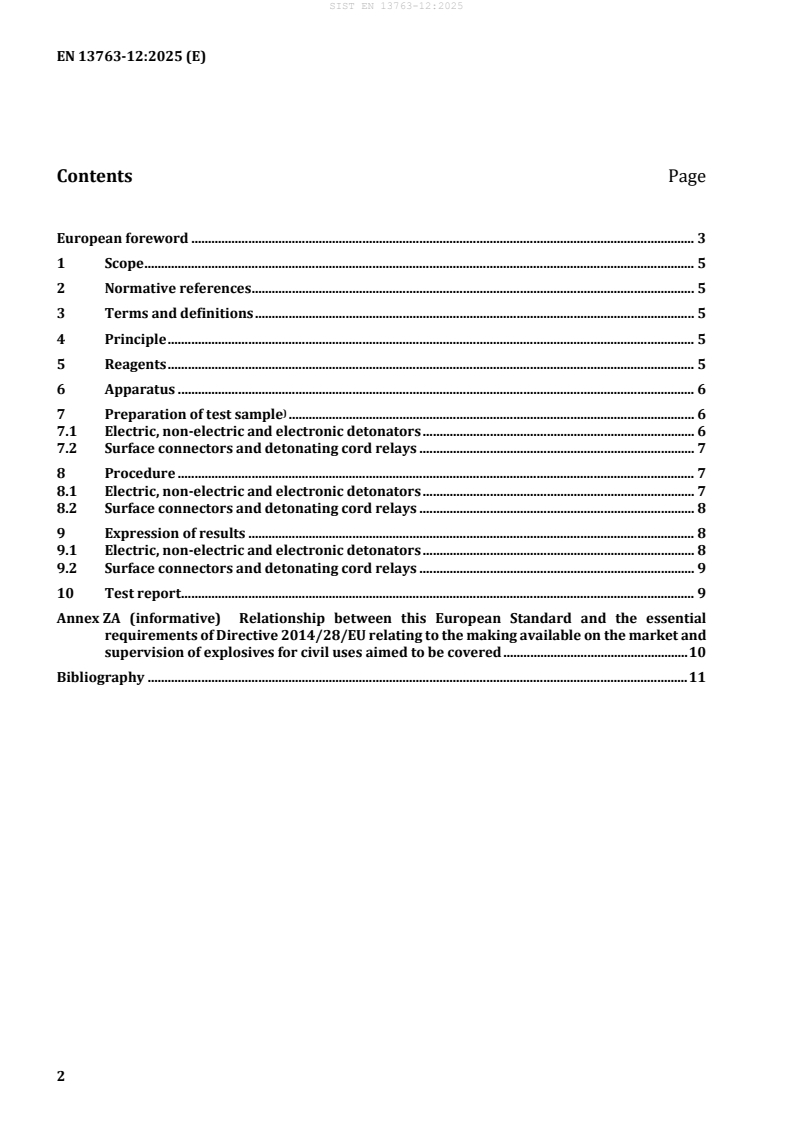
Contents Page
European foreword . 3
1 Scope . 5
2 Normative references . 5
3 Terms and definitions . 5
4 Principle . 5
5 Reagents . 5
6 Apparatus . 6
)
7 Preparation of test sample . 6
7.1 Electric, non-electric and electronic detonators . 6
7.2 Surface connectors and detonating cord relays . 7
8 Procedure . 7
8.1 Electric, non-electric and electronic detonators . 7
8.2 Surface connectors and detonating cord relays . 8
9 Expression of results . 8
9.1 Electric, non-electric and electronic detonators . 8
9.2 Surface connectors and detonating cord relays . 9
10 Test report . 9
Annex ZA (informative) Relationship between this European Standard and the essential
requirements of Directive 2014/28/EU relating to the making available on the market and
supervision of explosives for civil uses aimed to be covered . 10
Bibliography . 11
European foreword
This document (EN 13763-12:2025) has been prepared by Technical Committee CEN/TC 321 “Explosives
for civil uses”, the secretariat of which is held by UNE.
This European Standard shall be given the status of a national standard, either by publication of an
identical text or by endorsement, at the latest by April 2026, and conflicting national standards shall be
withdrawn at the latest by April 2026.
Attention is drawn to the possibility that some of the elements of this document may be the subject of
patent rights. CEN shall not be held responsible for identifying any or all such patent rights.
This document supersedes EN 13763-12:2003.
EN 13763-12:2003:
a) the document title has been changed from “Detonators and relays — Part 12: Determination of
resistance to hydrostatic pressure” to “Detonators and detonating cord relays — Part 12: Verification
of resistance to hydrostatic pressure of detonators, detonating cord relays and surface connectors”;
b) the Scope has been revised to clarify the covered and not covered explosives;
c) the normative references have been updated;
d) Clause 4 “Principle” has been added;
e) the clause “Apparatus” has been revised and completed;
f) the clause “Test pieces” is now called “Preparation of test sample” and has been revised to clearer
address the explosive articles covered in this document and to include electronic detonators;
g) the clause “Procedure” has been restructured to clearer address the explosive articles covered in this
document as well as revised and enlarged for clarification;
h) Clause 8 “Expression of results” has been added;
i) the clause “Test report” does no longer require conformity with EN ISO/IEC 17025 and the
information to be provided has been revised;
j) former Annex A “Range of applicability of the test method” has been removed;
k) Annex ZA has been updated;
l) the Bibliography has been added and lists EN ISO/IEC 17025:2017.
This document has been prepared under a standardization request addressed to CEN by the European
Commission. The Standing Committee of the EFTA States subsequently approves these requests for its
Member States.
For the relationship with EU Legislation, see informative Annex ZA, which is an integral part of this
document.
A list of all parts in the EN 13763 series, published under the general title Explosives for civil uses —
Detonators and detonating cord relays, can be found on the CEN website.
Any feedback and questions on this document should be directed to the users’ national standards body.
A complete listing of these bodies can be found on the CEN website.
According to the CEN-CENELEC Internal Regulations, the national standards organisations of the
following countries are bound to implement this European Standard: Austria, Belgium, Bulgaria, Croatia,
Cyprus, Czech Republic, Denmark, Estonia, Finland, France, Germany, Greece, Hungary, Iceland, Ireland,
Italy, Latvia, Lithuania, Luxembourg, Malta, Netherlands, Norway, Poland, Portugal, Republic of North
Macedonia, Romania, Serbia, Slovakia, Slovenia, Spain, Sweden, Switzerland, Türkiye and the United
Kingdom.
1 Scope
This document specifies a method for the verification of the resistance to hydrostatic pressure of electric
detonators, non-electric detonators, electronic detonators, surface connectors and detonating cord
relays.
This document does not apply to plain detonators, semi-finished detonators.
This document does not apply to shock tubes and leading wires, coupling accessories and electronic
initiation systems.
2 Normative references
The following documents are referred to in the text in such a way that some or all of their content
constitutes requirements of this document. For dated references, only the edition cited applies. For
undated references, the latest edition of the referenced document (including any amendments) applies.
EN 13763-1:2025, Explosives for civil uses — Detonators and detonating cord relays — Part 1:
Requirements
EN 13763-16:2025, Explosives for civil uses — Detonators and detonating cord relays — Part 16:
Verification of delay accuracy of electric detonators, non-electric detonators, surface connectors and
detonating cord relays
EN 13763-27:2025, Explosives for civil uses — Detonators and detonating cord relays — Part 27: Test
methods for electronic initiation systems
EN 13857-1:2025; Explosives for civil uses — Part 1: Vocabulary
EN ISO 3696:1995, Water for analytical laboratory use - Specification and test methods (ISO 3696:1987)
3 Terms and definitions
For the purposes of this document, the terms and definitions given in EN 13857-1:2025 apply.
ISO and IEC maintain terminology databases for use in standardization at the following addresses:
— ISO Online browsing platform: available at https://www.iso.org/obp
— IEC Electropedia: available at https://www.electropedia.org
4 Principle
When electric, non-electric and electronic detonators are used in boreholes they are exposed to
hydrostatic pressure either by water or other explosives. When surface connectors and detonating cord
relays are used, they can be exposed to hydrostatic pressure if placed in water puddles.
For the verification of the resistance of detonators, detonating cord relays and surface connectors against
hydrostatic pressure, a test piece is immersed either in a water tank or in water in a pressure vessel. After
the immersion in water, the test piece is initiated and, if applicable, the specified delay accuracy is
verified.
5 Reagents
5.1 Water, conforming to grade 3 of EN ISO 3696:1995.
6 Apparatus
6.1 Pressure vessel, filled with water (5.1). It shall be possible to maintain the water pressure at a
level of either (0,3 ± 0,01) MPa or the value specified in accordance with EN 13763-1:2025, 4.2.1.3 (for
electric detonators), 4.3.1.3 (for non-electric detonators), 4.4.1.3 (for electronic detonators), with a
tolerance ± 0,01 MPa in case that this value is > 0,3 MPa. The pressure vessel shall be made from a
material that does not cause corrosion to the detonator shell during testing.
6.2 Water heating device, capable of reaching the maximum temperature of use as specified in
accordance with EN 13763-1:2025,
...