

EN 12873-1:2014
(Main)Influence of materials on water intended for human consumption - Influence due to migration - Part 1: Test method for factory-made products made from or incorporating organic or glassy (porcelain/vitreous enamel) materials
General Information
- Abstract
This European Standard specifies a procedure to determine the migration of substances from factory-made or factory-applied products for use in contact with water intended for human consumption. Materials used to make such products include plastics, rubber and glassy (porcelain/vitreous enamel) materials.
This European Standard is applicable to products intended to be used under various conditions for the transport and storage of water intended for human consumption, including raw water used for the production of water intended for human consumption. It covers the extraction by water of substances from the finished products.
- Status
- Published
- Publication Date
- 01-Jul-2014
- Withdrawal Date
- 30-Jan-2015
- Technical Committee
- CEN/TC 164 - Water supply
- Drafting Committee
- CEN/TC 164/WG 3 - Effects of materials in contact with drinking water
- Current Stage
- 9060 - Closure of 2 Year Review Enquiry - Review Enquiry
- Start Date
- 04-Mar-2026
- Completion Date
- 04-Mar-2026



Overview
EN 12873-1:2014 is a CEN European standard that defines a laboratory test method to determine migration of substances from factory-made or factory-applied products that contact water intended for human consumption. It covers products made from or incorporating organic materials (plastics, rubber) and glassy materials (porcelain / vitreous enamel) used for the transport and storage of drinking water, including raw water used in water production. The standard specifies how to extract and analyse substances that may leach into water (migration), but does not itself set acceptance limits.
Key topics and technical requirements
- Scope and applicability: Factory-made products, fittings, pipes, hoses, linings and other components in contact with drinking water.
- Test conditions: Defined cold-water and elevated-temperature procedures (including specific temperatures and migration periods) to simulate real-use conditions.
- Sample preparation: Rules for sampling, transport, storage and preparation of test pieces (homogeneous and non‑homogeneous products).
- Surface area-to-volume (S/V) ratio: Determination and control of S/V for migration testing to standardize exposure.
- Pre-treatment procedures: Flushing, prewashing and stagnation procedures before migration testing.
- Migration water collection and analysis: Guidance on blank tests, analytical methods, calculation of substance concentrations and migration rates.
- Documentation: Required content of the test report (test conditions, results, procedural details).
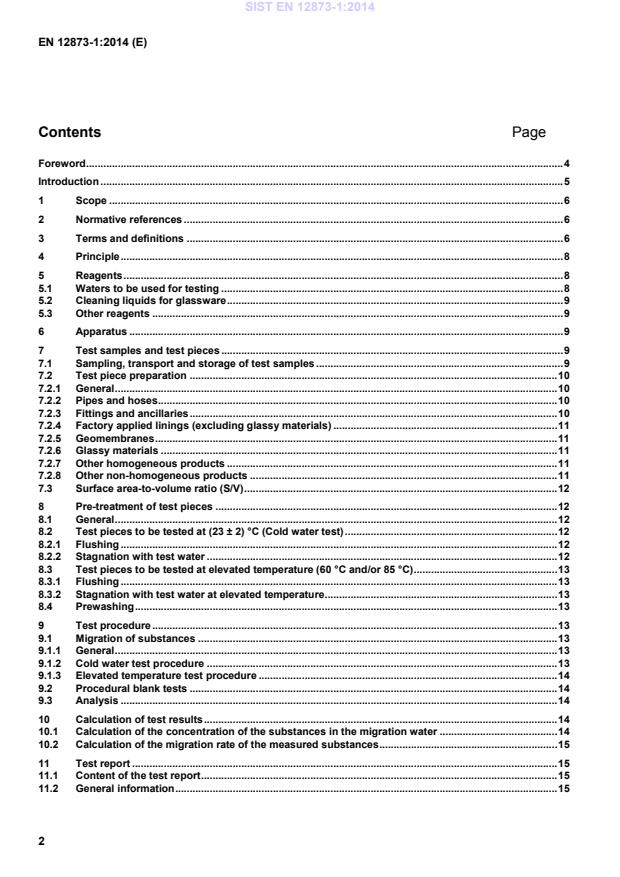
- Annexes: Practical arrangements including flushing pipes > DN 80 (Annex A), testing of non-homogeneous products (Annex B), schedules for migration-water collection (Annex C), control procedures (Annex D), flow diagrams (Annex E) and a cell system for glassy materials (Annex F).
- Normative references: Includes EN 15826 and relevant EN ISO analytical methods referenced for chlorine and enamel specimen preparation.
Applications
- Evaluating leaching/migration from materials and components used in potable-water systems.
- Supporting product development, material selection and design for water-contact applications (pipes, fittings, tanks, enamels).
- Performing type-testing and quality control for manufacturers of plastics, rubber, porcelain/vitreous enamel components.
- Supplying reproducible migration data for regulatory assessments, conformity testing and risk evaluation by water utilities and public health bodies.
Who should use this standard
- Manufacturers of drinking-water components (pipes, fittings, linings)
- Independent testing laboratories and quality control teams
- Water utilities and asset owners assessing material compatibility
- Certification bodies and regulators reviewing migration test evidence
Related standards
- EN 12873 series (other parts): Part 2 (site-applied products), Part 3 (ion-exchange/absorbent resins), Part 4 (membrane systems)
- EN 15826 (enamel terminology), EN ISO 7393-2 and EN ISO 28764 (analytical and specimen preparation methods)
Keywords: EN 12873-1:2014, migration testing, drinking water materials, porcelain, vitreous enamel, plastics, rubber, migration rate, surface area-to-volume.
Relations
- Effective Date
- 22-Feb-2012
- Effective Date
- 28-Jan-2026
- Effective Date
- 28-Jan-2026
- Effective Date
- 28-Jan-2026
- Effective Date
- 24-Jun-2026
- Effective Date
- 28-Jan-2026
- Effective Date
- 28-Jan-2026
- Referred By
EN ISO 21509:2015 - Plastics and ebonite - Verification of Shore durometers (ISO 21509:2006) - Effective Date
- 28-Jan-2026
- Effective Date
- 28-Jan-2026
- Effective Date
- 28-Jan-2026
- Effective Date
- 28-Jan-2026
- Effective Date
- 28-Jan-2026
- Effective Date
- 28-Jan-2026
- Effective Date
- 28-Jan-2026
- Effective Date
- 28-Jan-2026
Get Certified
Connect with accredited certification bodies for this standard

BSI Group
BSI (British Standards Institution) is the business standards company that helps organizations make excellence a habit.

Bureau Veritas
Bureau Veritas is a world leader in laboratory testing, inspection and certification services.

DNV
DNV is an independent assurance and risk management provider.
Sponsored listings
Frequently Asked Questions
EN 12873-1:2014 is a standard published by the European Committee for Standardization (CEN). Its full title is "Influence of materials on water intended for human consumption - Influence due to migration - Part 1: Test method for factory-made products made from or incorporating organic or glassy (porcelain/vitreous enamel) materials". This standard covers: This European Standard specifies a procedure to determine the migration of substances from factory-made or factory-applied products for use in contact with water intended for human consumption. Materials used to make such products include plastics, rubber and glassy (porcelain/vitreous enamel) materials. This European Standard is applicable to products intended to be used under various conditions for the transport and storage of water intended for human consumption, including raw water used for the production of water intended for human consumption. It covers the extraction by water of substances from the finished products.
This European Standard specifies a procedure to determine the migration of substances from factory-made or factory-applied products for use in contact with water intended for human consumption. Materials used to make such products include plastics, rubber and glassy (porcelain/vitreous enamel) materials. This European Standard is applicable to products intended to be used under various conditions for the transport and storage of water intended for human consumption, including raw water used for the production of water intended for human consumption. It covers the extraction by water of substances from the finished products.
EN 12873-1:2014 is classified under the following ICS (International Classification for Standards) categories: 13.060.20 - Drinking water; 67.250 - Materials and articles in contact with foodstuffs. The ICS classification helps identify the subject area and facilitates finding related standards.
EN 12873-1:2014 has the following relationships with other standards: It is inter standard links to EN 12873-1:2003, EN ISO 19496-1:2017, EN ISO 28764:2015, EN ISO 7393-2:2018, EN 1420:2026, CEN/TR 16950:2016, EN ISO 14663-2:2006, EN ISO 21509:2015, EN ISO 7391-2:2006, EN ISO 12086-2:2006, EN ISO 22088-4:2006, EN ISO 7823-3:2007, EN ISO 23667:2007, EN 1420:2016, EN ISO 14910-2:2006. Understanding these relationships helps ensure you are using the most current and applicable version of the standard.
EN 12873-1:2014 is associated with the following European legislation: EU Directives/Regulations: 98/83/EC; Standardization Mandates: M/136 REV2. When a standard is cited in the Official Journal of the European Union, products manufactured in conformity with it benefit from a presumption of conformity with the essential requirements of the corresponding EU directive or regulation.
EN 12873-1:2014 is available in PDF format for immediate download after purchase. The document can be added to your cart and obtained through the secure checkout process. Digital delivery ensures instant access to the complete standard document.
Standards Content (Sample)
2003-01.Slovenski inštitut za standardizacijo. Razmnoževanje celote ali delov tega standarda ni dovoljeno.Vpliv materiala na pitno vodo - Vpliv migracije - 1. del: Preskusna metoda za industrijske proizvode, ki so izdelani iz organskih ali steklastih materialov (porcelan/steklovina) ali jih vsebujejoEinfluss von Materialien auf Trinkwasser - Einfluss infolge der Migration - Teil 1: Prüfverfahren für fabrikmäßig hergestellte Produkte aus oder mit organischen oder glasartigen Materialien (Emails/Emaillierungen)Influence des matériaux en contact sur l’eau destinée à la consommation humaine - Influence de la migration - Partie 1: Méthode d’essai des matériaux de fabrication industrielle constitués de ou contenant des matériaux organiques ou vitreux (émaux vitrifiés)Influence of materials on water intended for human consumption - Influence due to migration - Part 1: Test method for factory-made products made from or incorporating organic or glassy (porcelain/vitreous enamel) materials67.250Materiali in predmeti v stiku z živiliMaterials and articles in contact with foodstuffs13.060.20Pitna vodaDrinking waterICS:Ta slovenski standard je istoveten z:EN 12873-1:2014SIST EN 12873-1:2014en,de01-oktober-2014SIST EN 12873-1:2014SLOVENSKI
STANDARDSIST EN 12873-1:20041DGRPHãþD
EUROPEAN STANDARD NORME EUROPÉENNE EUROPÄISCHE NORM
EN 12873-1
July 2014 ICS 13.060.20; 67.250 Supersedes EN 12873-1:2003English Version
Influence of materials on water intended for human consumption - Influence due to migration - Part 1: Test method for factory-made products made from or incorporating organic or glassy (porcelain/vitreous enamel) materials
Influence des matériaux en contact sur l'eau destinée à la consommation humaine - Influence de la migration - Partie 1: Méthode d'essai des matériaux de fabrication industrielle constitués de ou contenant des matériaux organiques ou vitreux (émaux vitrifiés)
Einfluss von Materialien auf Trinkwasser - Einfluss infolge der Migration - Teil 1: Prüfverfahren für fabrikmäßig hergestellte Produkte aus oder mit organischen oder glasartigen Materialien (Emails/Emaillierungen) This European Standard was approved by CEN on 14 May 2014.
CEN members are bound to comply with the CEN/CENELEC Internal Regulations which stipulate the conditions for giving this European Standard the status of a national standard without any alteration. Up-to-date lists and bibliographical references concerning such national standards may be obtained on application to the CEN-CENELEC Management Centre or to any CEN member.
This European Standard exists in three official versions (English, French, German). A version in any other language made by translation under the responsibility of a CEN member into its own language and notified to the CEN-CENELEC Management Centre has the same status as the official versions.
CEN members are the national standards bodies of Austria, Belgium, Bulgaria, Croatia, Cyprus, Czech Republic, Denmark, Estonia, Finland, Former Yugoslav Republic of Macedonia, France, Germany, Greece, Hungary, Iceland, Ireland, Italy, Latvia, Lithuania, Luxembourg, Malta, Netherlands, Norway, Poland, Portugal, Romania, Slovakia, Slovenia, Spain, Sweden, Switzerland, Turkey and United Kingdom.
EUROPEAN COMMITTEE FOR STANDARDIZATION
COMITÉ EUROPÉEN DE NORMALISATION EUROPÄISCHES KOMITEE FÜR NORMUNG
CEN-CENELEC Management Centre:
Avenue Marnix 17,
B-1000 Brussels © 2014 CEN All rights of exploitation in any form and by any means reserved worldwide for CEN national Members. Ref. No. EN 12873-1:2014 ESIST EN 12873-1:2014
Arrangement for flushing pipes with nominal size greater than DN 80 . 18 Annex B (informative)
Additional procedures for testing non-homogeneous products and pipes with nominal size greater than DN 80 . 21 B.1 Arrangements for testing. 21 B.2 Flushing of the test piece . 21 B.3 Blank test. 21 B.4 Sealing . 21 B.5 Calculation of the surface area-to-volume ratio (S/V) value for test arrangement 1 . 24 Annex C (informative)
Examples of extended collection and analysis of migration waters . 26 Annex D (informative)
Procedural tests using standard additions (positive controls) . 28 Annex E (informative)
Flow diagrams for migration test procedure for cold water temperature and elevated temperature . 29 Annex F (informative)
Description of a cell system for testing glassy materials . 31 Bibliography . 33
This European Standard specifies a procedure to determine the migration of substances from factory-made or factory-applied products for use in contact with water intended for human consumption. Materials used to make such products include plastics, rubber and glassy (porcelain/vitreous enamel) materials. This European Standard is applicable to products intended to be used under various conditions for the transport and storage of water intended for human consumption, including raw water used for the production of water intended for human consumption. It covers the extraction by water of substances from the finished products. 2 Normative references The following documents, in whole or in part, are normatively referenced in this document and are indispensable for its application. For dated references, only the edition cited applies. For undated references, the latest edition of the referenced document (including any amendments) applies. EN 15826, Vitreous and porcelain enamels - Terminology EN ISO 7393-2, Water quality - Determination of free chlorine and total chlorine - Part 2: Colorimetric method using N, N-diethyl-1, 4-phenylenediamine, for routine control purposes (ISO 7393-2) EN ISO 28764, Vitreous and porcelain enamels - Production of specimens for testing enamels on sheet steel, sheet aluminium and cast iron (ISO 28764) 3 Terms and definitions For the purposes of this document, the following terms and definitions apply. 3.1
test technical operation that consists of the determination of one or more characteristics of a given product 3.2 test procedure specified technical method for performing a test 3.3 test report document that presents test results and other information relevant to a test 3.4 test laboratory laboratory that performs tests 3.5
product manufactured item, in its finished form, that comes into contact with water intended for human consumption, or a component part of a manufactured item 3.6
homogeneous product a product where the water contact surface is made from the same material as the remainder of the product SIST EN 12873-1:2014
(60 ± 2) °C or (85 ± 2) °C. 6.4 Laboratory glassware, steel and stainless-steel plates and sand blasted glass plates shall be cleaned by washing with a biodegradable laboratory detergent, followed by exposing to either hydrochloric acid solution (5.2.2) (except for stainless steel) or nitric acid solution (5.2.4) for 2 to 3 days and finally by thoroughly rinsing with test water (5.1.2). Drain the plates and dry them in a hot air cabinet. 7 Test samples and test pieces 7.1 Sampling, transport and storage of test samples Sample products in accordance with the relevant product standards or national regulations where applicable. Ensure that the surface of test pieces intended to come into contact with test water shall be free from adhesive tape, labels, ink or pencil marks. Care shall be taken to ensure that the transport and storage conditions shall not influence the test results. SIST EN 12873-1:2014
...