

EN 16637-2:2023
(Main)Construction products: Assessment of release of dangerous substances - Part 2: Horizontal dynamic surface leaching test
- Abstract
This document specifies a dynamic surface leaching test (DSLT) which is aimed at determining the release per unit surface area as a function of time of inorganic and/or non-volatile organic substances from a monolithic, plate- or sheet-like product, when it is put into contact with an aqueous solution (leachant). The test method is not suitable for substances that are volatile under ambient conditions.
This test is a parameter specific test focusing on identifying and specifying parameter specific properties tested under specified conditions. It is not aimed at simulating real situations. The application of results to specific intended conditions of use can be established by means of modelling (not included in this document).
The test method applies to more or less regularly shaped test portions consisting of monolithic test pieces with minimum dimensions of 40 mm in all directions [volume > 64 000 mm3 (64 cm3)]. It also applies to plate- or sheet-like products with surface areas of minimum 10 000 mm2 (100 cm2) exposed to the leachant. Products designed to drain water (e.g. draining tiles, porous asphalt) and monolithic granular products according to EN 16637 1:2023, Table 1, are also tested by this test method. All products to be tested are assumed to maintain their integrity over a time frame relevant for the considered intended use.
The modification for granular construction products with low hydraulic conductivity (Annex A) applies for granular particles with so little drainage capacity between the grains that percolation in percolation tests and in practice is nearly impossible.
Metals, metallic coatings and organic coatings on metals are excluded from the scope of this document because the principles of this test (diffusion) are not obeyed by these products. Guidance on the need for testing of these products is under consideration.
For some coatings (e.g. some renders with organic binders according to EN 15824 [9]) in intermittent contact with water, physical and chemical properties might be changed in permanent contact with water. For these products, this document is not appropriate.
Guidance on the applicability of the test method to a given product is outlined in EN 16637 1.
NOTE 1 This test method is only applicable if the product is chemically stable and the matrix does not dissolve. For construction products that are possibly used in contact with water this is usually the case as construction products are then supposed to be dimensionally stable. If a product possibly wears substantially in its intended use, the test cannot provide proper information. If the product contains a substantial amount of water-soluble compounds, e.g. gypsum or anhydrite, the matrix could (partially) dissolve and lead to dimensional instability of the test piece. In this case, the test standard also cannot be used.
NOTE 2 It is not always possible to optimize test conditions simultaneously for inorganic and organic substances. Optimum test conditions can also vary between different groups of organic substances. Test requirements for organic substances are generally more stringent than those for inorganic substances. The test conditions suitable for measuring the release of organic substances will generally also be applicable to inorganic substances.
- Status
- Published
- Publication Date
- 31-Oct-2023
- Withdrawal Date
- 09-May-2022
- Current Stage
- 6060 - Definitive text made available (DAV) - Publishing
- Start Date
- 01-Nov-2023
- Due Date
- 17-Dec-2021
- Completion Date
- 01-Nov-2023

Overview
EN 16637-2:2023 (identical to EN 16637-2:2023) specifies the Horizontal Dynamic Surface Leaching Test (DSLT) for construction products. The method determines the release per unit surface area as a function of time for inorganic and non‑volatile organic substances from monolithic, plate‑ or sheet‑like products when exposed to an aqueous leachant. It is a parameter‑specific laboratory test (not a field simulation); results can be applied to intended use scenarios by modelling.
Key technical topics and requirements
- Scope and applicability
- Applies to monolithic test pieces with minimum dimensions of 40 mm in all directions (volume > 64 000 mm3 / 64 cm3) and to plate/sheet products with at least 10 000 mm2 (100 cm2) surface area exposed to leachant.
- Includes products designed to drain water and granular products with low hydraulic conductivity via Annex A modification.
- Excludes metals, metallic coatings and organic coatings on metals, and substances volatile under ambient conditions.
- Not suitable for products that dissolve, lose dimensional stability, or wear substantially during use.
- Test principle
- Dynamic horizontal tank (tank test) where samples are contacted with leachant across multiple eluate steps to measure time‑dependent surface release.
- Emphasis on release expressed per unit surface area and identification of release mechanisms (diffusion, dissolution, etc.).
- Procedures and measurements
- Requirements for sample preparation, determination of geometric surface area, number of eluates, test conditions, weight loss measurement and analytical preparation of eluates.
- Annexes provide procedures for granular low hydraulic conductivity products (A), identification of release mechanisms (B) and performance data (E).
- Limitations
- The test is parameter‑specific, not intended to reproduce real exposure scenarios; modelling is required to extrapolate to field conditions.
- Test conditions for organics can be more stringent than for inorganics.
Practical applications and users
- Who uses it:
- Construction product manufacturers for product characterization and CE marking evidence.
- Independent testing laboratories performing type testing (TT) and factory production control (FPC).
- Regulatory bodies, product committees and environmental assessors evaluating release of regulated dangerous substances (RDS).
- Typical uses:
- Characterising leaching behaviour of façades, concrete elements, tiles, and plate/sheet products.
- Generating standardized data for compliance with environmental protection rules and notified national regulations.
- Supporting modelling of long‑term release to soil, surface water and groundwater.
Related standards
- EN 16637‑1 - Guidance for determination and use of leaching tests.
- EN 16637‑3 - Horizontal up‑flow percolation test for granular products.
Keywords: horizontal dynamic surface leaching test, DSLT, EN 16637‑2, release of dangerous substances, construction products, leaching, surface area release, granular low hydraulic conductivity, CE marking.
Relations
- Effective Date
- 19-Jan-2023
- Effective Date
- 28-Jan-2026
- Refers
EN 16687:2023 - Construction products: Assessment of release of dangerous substances - Terminology - Effective Date
- 28-Jan-2026
- Effective Date
- 28-Jan-2026
- Effective Date
- 28-Jan-2026
- Effective Date
- 28-Jan-2026
- Effective Date
- 12-Aug-2026
- Effective Date
- 28-Jan-2026
- Effective Date
- 28-Jan-2026
- Effective Date
- 28-Jan-2026
- Effective Date
- 28-Jan-2026
- Effective Date
- 28-Jan-2026
- Effective Date
- 28-Jan-2026
- Effective Date
- 28-Jan-2026
- Effective Date
- 28-Jan-2026
Get Certified
Connect with accredited certification bodies for this standard

DIBt (Deutsches Institut für Bautechnik)
German Institute for Building Technology.
DIN CERTCO
DIN Group product certification.

Aboma Certification B.V.
Specialized in construction, metal, and transport sectors.
Sponsored listings
Frequently Asked Questions
EN 16637-2:2023 is a standard published by the European Committee for Standardization (CEN). Its full title is "Construction products: Assessment of release of dangerous substances - Part 2: Horizontal dynamic surface leaching test". This standard covers: This document specifies a dynamic surface leaching test (DSLT) which is aimed at determining the release per unit surface area as a function of time of inorganic and/or non-volatile organic substances from a monolithic, plate- or sheet-like product, when it is put into contact with an aqueous solution (leachant). The test method is not suitable for substances that are volatile under ambient conditions. This test is a parameter specific test focusing on identifying and specifying parameter specific properties tested under specified conditions. It is not aimed at simulating real situations. The application of results to specific intended conditions of use can be established by means of modelling (not included in this document). The test method applies to more or less regularly shaped test portions consisting of monolithic test pieces with minimum dimensions of 40 mm in all directions [volume > 64 000 mm3 (64 cm3)]. It also applies to plate- or sheet-like products with surface areas of minimum 10 000 mm2 (100 cm2) exposed to the leachant. Products designed to drain water (e.g. draining tiles, porous asphalt) and monolithic granular products according to EN 16637 1:2023, Table 1, are also tested by this test method. All products to be tested are assumed to maintain their integrity over a time frame relevant for the considered intended use. The modification for granular construction products with low hydraulic conductivity (Annex A) applies for granular particles with so little drainage capacity between the grains that percolation in percolation tests and in practice is nearly impossible. Metals, metallic coatings and organic coatings on metals are excluded from the scope of this document because the principles of this test (diffusion) are not obeyed by these products. Guidance on the need for testing of these products is under consideration. For some coatings (e.g. some renders with organic binders according to EN 15824 [9]) in intermittent contact with water, physical and chemical properties might be changed in permanent contact with water. For these products, this document is not appropriate. Guidance on the applicability of the test method to a given product is outlined in EN 16637 1. NOTE 1 This test method is only applicable if the product is chemically stable and the matrix does not dissolve. For construction products that are possibly used in contact with water this is usually the case as construction products are then supposed to be dimensionally stable. If a product possibly wears substantially in its intended use, the test cannot provide proper information. If the product contains a substantial amount of water-soluble compounds, e.g. gypsum or anhydrite, the matrix could (partially) dissolve and lead to dimensional instability of the test piece. In this case, the test standard also cannot be used. NOTE 2 It is not always possible to optimize test conditions simultaneously for inorganic and organic substances. Optimum test conditions can also vary between different groups of organic substances. Test requirements for organic substances are generally more stringent than those for inorganic substances. The test conditions suitable for measuring the release of organic substances will generally also be applicable to inorganic substances.
This document specifies a dynamic surface leaching test (DSLT) which is aimed at determining the release per unit surface area as a function of time of inorganic and/or non-volatile organic substances from a monolithic, plate- or sheet-like product, when it is put into contact with an aqueous solution (leachant). The test method is not suitable for substances that are volatile under ambient conditions. This test is a parameter specific test focusing on identifying and specifying parameter specific properties tested under specified conditions. It is not aimed at simulating real situations. The application of results to specific intended conditions of use can be established by means of modelling (not included in this document). The test method applies to more or less regularly shaped test portions consisting of monolithic test pieces with minimum dimensions of 40 mm in all directions [volume > 64 000 mm3 (64 cm3)]. It also applies to plate- or sheet-like products with surface areas of minimum 10 000 mm2 (100 cm2) exposed to the leachant. Products designed to drain water (e.g. draining tiles, porous asphalt) and monolithic granular products according to EN 16637 1:2023, Table 1, are also tested by this test method. All products to be tested are assumed to maintain their integrity over a time frame relevant for the considered intended use. The modification for granular construction products with low hydraulic conductivity (Annex A) applies for granular particles with so little drainage capacity between the grains that percolation in percolation tests and in practice is nearly impossible. Metals, metallic coatings and organic coatings on metals are excluded from the scope of this document because the principles of this test (diffusion) are not obeyed by these products. Guidance on the need for testing of these products is under consideration. For some coatings (e.g. some renders with organic binders according to EN 15824 [9]) in intermittent contact with water, physical and chemical properties might be changed in permanent contact with water. For these products, this document is not appropriate. Guidance on the applicability of the test method to a given product is outlined in EN 16637 1. NOTE 1 This test method is only applicable if the product is chemically stable and the matrix does not dissolve. For construction products that are possibly used in contact with water this is usually the case as construction products are then supposed to be dimensionally stable. If a product possibly wears substantially in its intended use, the test cannot provide proper information. If the product contains a substantial amount of water-soluble compounds, e.g. gypsum or anhydrite, the matrix could (partially) dissolve and lead to dimensional instability of the test piece. In this case, the test standard also cannot be used. NOTE 2 It is not always possible to optimize test conditions simultaneously for inorganic and organic substances. Optimum test conditions can also vary between different groups of organic substances. Test requirements for organic substances are generally more stringent than those for inorganic substances. The test conditions suitable for measuring the release of organic substances will generally also be applicable to inorganic substances.
EN 16637-2:2023 is classified under the following ICS (International Classification for Standards) categories: 91.100.01 - Construction materials in general. The ICS classification helps identify the subject area and facilitates finding related standards.
EN 16637-2:2023 has the following relationships with other standards: It is inter standard links to CEN/TS 16637-2:2014, EN ISO 5667-3:2024, EN 16687:2023, EN ISO 11465:2025, EN 17195:2023, EN 17087:2019, EN 1520:2026, CEN/TS 17197:2018, CEN/TS 17200:2018+AC:2018, EN 16637-1:2023, EN 17197:2023, CEN/TS 17200:2018, EN 17200:2023, CEN/TS 17459:2022, EN 17845:2023. Understanding these relationships helps ensure you are using the most current and applicable version of the standard.
EN 16637-2:2023 is associated with the following European legislation: EU Directives/Regulations: 305/2011; Standardization Mandates: M/366. When a standard is cited in the Official Journal of the European Union, products manufactured in conformity with it benefit from a presumption of conformity with the essential requirements of the corresponding EU directive or regulation.
EN 16637-2:2023 is available in PDF format for immediate download after purchase. The document can be added to your cart and obtained through the secure checkout process. Digital delivery ensures instant access to the complete standard document.
Standards Content (Sample)
SLOVENSKI STANDARD
01-april-2024
Nadomešča:
SIST-TS CEN/TS 16637-2:2014
Gradbeni proizvodi - Ocenjevanje sproščanja nevarnih snovi - 2. del: Horizontalni
dinamični preskus izluževanja s površine
Construction products - Assessment of release of dangerous substances - Part 2:
Horizontal dynamic surface leaching test
Bauprodukte - Bewertung der Freisetzung von gefährlichen Stoffen - Teil 2: Horizontale
dynamische Oberflächenauslaugprüfung
Produits de construction - Evaluation de l‘émission de substances dangereuses - Partie
2: Essais horizontaux et dynamiques de la lixivation des surfaces
Ta slovenski standard je istoveten z: EN 16637-2:2023
ICS:
13.020.99 Drugi standardi v zvezi z Other standards related to
varstvom okolja environmental protection
91.100.01 Gradbeni materiali na Construction materials in
splošno general
2003-01.Slovenski inštitut za standardizacijo. Razmnoževanje celote ali delov tega standarda ni dovoljeno.
EN 16637-2
EUROPEAN STANDARD
NORME EUROPÉENNE
November 2023
EUROPÄISCHE NORM
ICS 91.100.01 Supersedes CEN/TS 16637-2:2014
English Version
Construction products: Assessment of release of
dangerous substances - Part 2: Horizontal dynamic surface
leaching test
Produits de construction - Évaluation du relargage de Bauprodukte - Bewertung der Freisetzung von
substances dangereuses - Partie 2 : Essai dynamique gefährlichen Stoffen - Teil 2: Horizontale dynamische
horizontal de lixiviation de surface Oberflächenauslaugprüfung
This European Standard was approved by CEN on 30 July 2023.
CEN members are bound to comply with the CEN/CENELEC Internal Regulations which stipulate the conditions for giving this
European Standard the status of a national standard without any alteration. Up-to-date lists and bibliographical references
concerning such national standards may be obtained on application to the CEN-CENELEC Management Centre or to any CEN
member.
This European Standard exists in three official versions (English, French, German). A version in any other language made by
translation under the responsibility of a CEN member into its own language and notified to the CEN-CENELEC Management
Centre has the same status as the official versions.
CEN members are the national standards bodies of Austria, Belgium, Bulgaria, Croatia, Cyprus, Czech Republic, Denmark, Estonia,
Finland, France, Germany, Greece, Hungary, Iceland, Ireland, Italy, Latvia, Lithuania, Luxembourg, Malta, Netherlands, Norway,
Poland, Portugal, Republic of North Macedonia, Romania, Serbia, Slovakia, Slovenia, Spain, Sweden, Switzerland, Türkiye and
United Kingdom.
EUROPEAN COMMITTEE FOR STANDARDIZATION
COMITÉ EUROPÉEN DE NORMALISATION
EUROPÄISCHES KOMITEE FÜR NORMUNG
CEN-CENELEC Management Centre: Rue de la Science 23, B-1040 Brussels
© 2023 CEN All rights of exploitation in any form and by any means reserved Ref. No. EN 16637-2:2023 E
worldwide for CEN national Members.
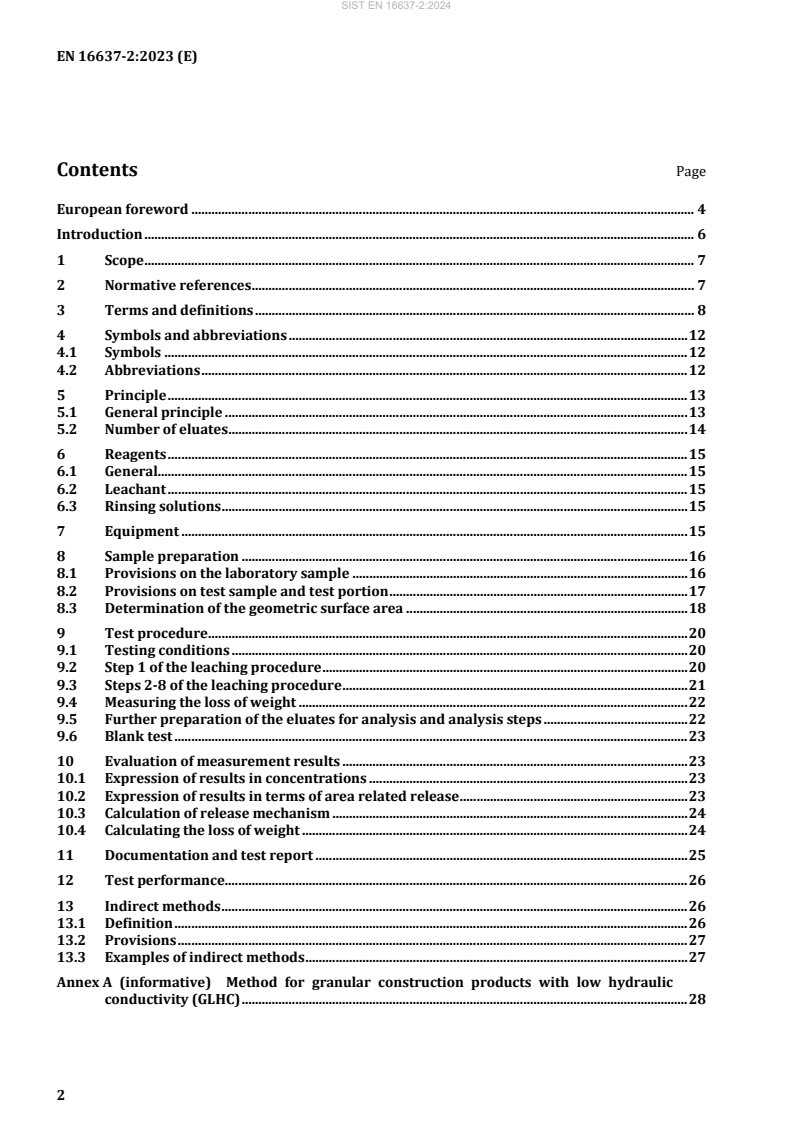
Contents Page
European foreword . 4
Introduction . 6
1 Scope . 7
2 Normative references . 7
3 Terms and definitions . 8
4 Symbols and abbreviations . 12
4.1 Symbols . 12
4.2 Abbreviations . 12
5 Principle . 13
5.1 General principle . 13
5.2 Number of eluates . 14
6 Reagents . 15
6.1 General. 15
6.2 Leachant . 15
6.3 Rinsing solutions . 15
7 Equipment . 15
8 Sample preparation . 16
8.1 Provisions on the laboratory sample . 16
8.2 Provisions on test sample and test portion . 17
8.3 Determination of the geometric surface area . 18
9 Test procedure . 20
9.1 Testing conditions . 20
9.2 Step 1 of the leaching procedure . 20
9.3 Steps 2-8 of the leaching procedure . 21
9.4 Measuring the loss of weight . 22
9.5 Further preparation of the eluates for analysis and analysis steps . 22
9.6 Blank test . 23
10 Evaluation of measurement results . 23
10.1 Expression of results in concentrations . 23
10.2 Expression of results in terms of area related release . 23
10.3 Calculation of release mechanism . 24
10.4 Calculating the loss of weight . 24
11 Documentation and test report . 25
12 Test performance . 26
13 Indirect methods . 26
13.1 Definition . 26
13.2 Provisions . 27
13.3 Examples of indirect methods . 27
Annex A (informative) Method for granular construction products with low hydraulic
conductivity (GLHC) . 28
A.1 Scope . 28
A.2 Terms, definitions and abbreviations . 28
A.3 Principle . 28
A.4 Equipment . 28
A.5 Sampling . 30
A.6 Procedure . 30
A.7 Data handling and reporting . 33
Annex B (informative) Assessment of release mechanisms (if required) . 34
B.1 Overview of release mechanisms . 34
B.2 Procedure of identification of release mechanisms . 35
B.3 Concentrations close to the limit of quantification . 36
B.4 Diffusion controlled release of a substance . 38
B.5 Dissolution controlled release of a substance . 40
B.6 Other release mechanism . 41
B.7 Calculation of release . 43
B.8 Examples . 44
B.9 Interpretation of shortened DSL tests for FPC . 60
Annex C (informative) Examples of the test set up for construction products (DSLT) . 63
Annex D (informative) Examples of data about the L/A ratio . 64
Annex E (informative) Summary of cumulative results EN 16637-2 (64 days) . 65
E.1 Repeatability and reproducibility limits . 65
E.2 Inorganic substances . 66
E.3 Organic substances . 68
Annex F (informative) Uncertainty in surface measurements with the aluminium foil
method . 70
Bibliography . 71
European foreword
This document (EN 16637-2:2023) has been prepared by Technical Committee CEN/TC 351
“Construction products: Assessment of release of dangerous substances”, the secretariat of which is
held by NEN.
This European Standard shall be given the status of a national standard, either by publication of an
identical text or by endorsement, at the latest by May 2024 and conflicting national standards shall be
withdrawn at the latest by May 2024.
Attention is drawn to the possibility that some of the elements of this document may be the subject of
patent rights. CEN shall not be held responsible for identifying any or all such patent rights.
This document supersedes CEN/TS 16637-2:2014.
This document has been prepared under a standardization request addressed to CEN by the European
Commission. The Standing Committee of the EFTA States subsequently approves these requests for its
Member States.
The main changes compared to the previous edition are as follows:
— transfer of technical specification into a European Standard (see Clause 12 and Annex E);
— addition of requirements on the number of eluates (see 5.2);
— addition of requirements on the determination of the geometric surface area for test pieces thinner
than 40 mm (see 8.3.3);
— addition of information on the determination of the geometric surface area for irregular test pieces
(see Annex F);
— updating of normative and informative cross-references.
This document was elaborated on the basis of CEN/TS 15863 [2], which is based on NEN 7375 [3].
This document specifies a dynamic surface leaching test for determination of surface dependent release
of substances from monolithic or plate-like or sheet-like construction products or granular construction
products with low hydraulic conductivity under standardized conditions.
EN 16637, Construction products: Assessment of release of dangerous substances, is currently composed
with the following parts:
— Part 1: Guidance for the determination of leaching tests and additional testing steps;
— Part 2: Horizontal dynamic surface leaching test;
— Part 3: Horizontal up-flow percolation test.
EN 16637-1 deals with the determination and use of test methods for leaching of construction products
taking specific situations into account. EN 16637-3 specifies an up-flow percolation test to determine
the leaching behaviour of granular construction products under standardized percolation conditions.
Background information on characterization of leaching behaviour of construction products can be
found in Technical Reports provided by CEN/TC 351 (i.e. CEN/TR 16098 [4], CEN/TR 16496 [5]).
Any feedback and questions on this document should be directed to the users’ national standards body.
A complete listing of these bodies can be found on the CEN website.
According to the CEN-CENELEC Internal Regulations, the national standards organizations of the
following countries are bound to implement this European Standard: Austria, Belgium, Bulgaria,
Croatia, Cyprus, Czech Republic, Denmark, Estonia, Finland, France, Germany, Greece, Hungary, Iceland,
Ireland, Italy, Latvia, Lithuania, Luxembourg, Malta, Netherlands, Norway, Poland, Portugal, Republic of
North Macedonia, Romania, Serbia, Slovakia, Slovenia, Spain, Sweden, Switzerland, Türkiye and the
United Kingdom.
Introduction
The European Standards EN 16637-1, EN 16637-2 and EN 16637-3 are developed to assess the release
of regulated dangerous substances (RDS) from construction products into soil, surface water and
groundwater in the framework of Mandate M/366. The horizontal test methods developed under the
Mandate M/366 are intended to be used to show compliance with notified regulations. The tests cover
the release of substances from construction products and in particular, those that are regulated in
notified regulations in one or more EU Member States.
EN 16637-1 specifies how the CEN Technical Product Committees and EOTA experts should determine
the appropriate leaching test for the determination of the release of RDS from a construction product
into soil, surface water and groundwater. EN 16637-1 gives background information for CEN Technical
Product Committees on the following aspects:
a) description of the intended conditions of use of the construction product (e.g. above ground
exposed to the precipitation, or shielded from direct infiltration, in surface or groundwater) with
respect to the release of RDS into soil, surface water and groundwater;
b) identification of main release mechanisms, and the appropriate leaching test for a given
construction product.
EN 16637-2 specifies a horizontal test to assess surface dependent release from monolithic, plate-like
or sheet-like construction products (tank test).
EN 16637-3 specifies a horizontal test to assess release from granular construction products.
The test methods can be used for both steps in the hierarchy [type testing (TT) and factory production
control (FPC)] and form the reference tests for the intended uses and conditions specified in
EN 16637-1. In this hierarchy of testing conditionally “indirect tests” can be used, but are not specified.
The release of substances upon contact with water results in a potential risk to the environment during
the intended use of construction products. The intent of these tests is to identify the leaching behaviour
of construction products and thereby allow assessments of the release of RDS from such products to
soil, surface water and groundwater under intended conditions of use in relation to CE marking and
assessment and verification of constancy of performance.
This document does not address impact assessment. However, since the test methods described in the
document may be used in the context of impact assessments and regulation based on impact
assessments, some guidance on this issue is provided in EN 16637-1:2023, Annex A (informative).
In addition to existing validation results, in 2011 CEN/TC 351 began an extensive research program on
robustness validation of the existing tank leaching and percolation tests. This was carried out by a
consortium of European experts on 20 construction products to unify differences from the protocols of
the different CEN Members and to check the influence of testing conditions on the test result (e.g.
temperature, flow rate, renewal scheme). The results [6] of the research program confirmed the
robustness of the horizontal tests known from former works. Conclusions from the program have been
implemented into the Technical Specifications for the test methods. The performance of the leaching
tests regarding repeatability and reproducibility was deduced from a second validation step and
respective data [7], [8] are included in this document and in EN 16637-3:2023.
1 Scope
This document specifies a dynamic surface leaching test (DSLT) which is aimed at determining the
release per unit surface area as a function of time of inorganic and/or non-volatile organic substances
from a monolithic, plate- or sheet-like product, when it is put into contact with an aqueous solution
(leachant). The test method is not suitable for substances that are volatile under ambient conditions.
This test is a parameter specific test focusing on identifying and specifying parameter specific
properties tested under specified conditions. It is not aimed at simulating real situations. The
application of results to specific intended conditions of use can be established by means of modelling
(not included in this document).
The test method applies to more or less regularly shaped test portions consisting of monolithic test
3 3
pieces with minimum dimensions of 40 mm in all directions [volume > 64 000 mm (64 cm )]. It also
2 2
applies to plate- or sheet-like products with surface areas of minimum 10 000 mm (100 cm ) exposed
to the leachant. Products designed to drain water (e.g. draining tiles, porous asphalt) and monolithic
granular products according to EN 16637-1:2023, Table 1, are also tested by this test method. All
products to be tested are assumed to maintain their integrity over a time frame relevant for the
considered intended use.
The modification for granular construction products with low hydraulic conductivity (Annex A) applies
for granular particles with so little drainage capacity between the grains that percolation in percolation
tests and in practice is nearly impossible.
Metals, metallic coatings and organic coatings on metals are excluded from the scope of this document
because the principles of this test (diffusion) are not obeyed by these products. Guidance on the need
for testing of these products is under consideration.
For some coatings (e.g. some renders with organic binders according to EN 15824 [9]) in intermittent
contact with water, physical and chemical properties might be changed in permanent contact with
water. For these products, this document is not appropriate.
Guidance on the applicability of the test method to a given product is outlined in EN 16637-1.
NOTE 1 This test method is only applicable if the product is chemically stable and the matrix does not dissolve.
For construction products that are possibly used in contact with water this is usually the case as construction
products are then supposed to be dimensionally stable. If a product possibly wears substantially in its intended
use, the test cannot provide proper information. If the product contains a substantial amount of water-soluble
compounds, e.g. gypsum or anhydrite, the matrix could (partially) dissolve and lead to dimensional instability of
the test piece. In this case, the test standard also cannot be used.
NOTE 2 It is not always possible to optimize test conditions simultaneously for inorganic and organic
substances. Optimum test conditions can also vary between different groups of organic substances. Test
requirements for organic substances are generally more stringent than those for inorganic substances. The test
conditions suitable for measuring the release of organic substances will generally also be applicable to inorganic
substances.
2 Normative references
The following documents are referred to in the text in such a way that some or all of their content
constitutes requirements of this document. For dated references, only the edition cited applies. For
undated references, the latest edition of the referenced document (including any amendments) applies.
EN 15934, Sludge, treated biowaste, soil and waste — Calculation of dry matter fraction after
determination of dry residue or water content
EN 16637-1, Construction products: Assessment of release of dangerous substances — Part 1: Guidance for
the determination of leaching tests and additional testing steps
EN 16687:2023, Construction products: Assessment of release of dangerous substances — Terminology
EN 17087, Construction products: Assessment of release of dangerous substances — Preparation of test
portions from the laboratory sample for testing of release and analysis of content
EN 17195, Construction products: Assessment of release of dangerous substances — Analysis of inorganic
substances in eluates
EN ISO 5667-3, Water quality — Sampling — Part 3: Preservation and handling of water samples
(ISO 5667-3)
3 Terms and definitions
For the purposes of this document, the terms and definitions given in EN 16687:2023 and the following
terms and definitions apply.
ISO and IEC maintain terminology databases for use in standardization at the following addresses:
— IEC Electropedia: available at https://www.electropedia.org/
— ISO Online browsing platform: available at https://www.iso.org/obp/
3.1
eluate
solution obtained from a leaching test
[SOURCE: EN 16687:2023, 3.3.2.8]
3.2
laboratory sample
sample or sub-sample(s) sent to or received by the laboratory
Note 1 to entry: When the laboratory sample is further prepared by subdividing, cutting, sawing, coring, drying,
grinding, mixing, curing or by combinations of these operations, the result is the test sample. When no preparation
of the laboratory sample is required, the laboratory sample is the test sample. A test portion is removed from the
test sample for the performance of the test or for analysis.
Note 2 to entry: The laboratory sample is the final sample from the point of view of sample collection but it is the
initial sample from the point of view of the laboratory.
[SOURCE: IUPAC 2014, modified — abridged and specified]
3.3
leachant
liquid that is brought into contact with the test portion in the leaching procedure
Note 1 to entry: Usually demineralized water is used as leachant for laboratory leaching tests.
[SOURCE: EN 16687:2023, 3.3.2.7]
3.4
leaching behaviour
release and change with time in release from a solid product in contact with a leachant as a function of
major release controlling factors
Note 1 to entry: Examples of such factors are pH, L/S, L/A, temperature.
[SOURCE: EN 16687:2023, 3.3.2.10]
3.5
release mechanism
physical-chemical processes that control the release of substances from a solid construction product
into a leachant
Note 1 to entry: In the case of monolithic products, the main release mechanisms are diffusion of substances,
dissolution of substances, initial surface wash-off of substances and/or dissolution of the matrix. In case of
granular products, the main release mechanisms are washout and solubility. Additional factors like pH or DOC
also have an influence on the mechanism of the release.
Note 2 to entry: The release mechanism for every substance can be determined using the results of the release
test (tank leaching test). Determination of the release mechanism is relevant for modelling of the source term and
so for determination of the effects on soil and water over a time period.
[SOURCE: EN 16687:2023, 3.3.2.18, modified — Note 2 to entry is limited to tank leaching test]
3.6
liquid to surface area ratio
L/A
ratio between the volume of liquid (L) which in a given step of the test is in contact with the exposed
surface area (A) of the test portion
Note 1 to entry: L/A is expressed in l/m .
[SOURCE: EN 16687:2023, 3.3.2.13]
3.7
monolithic product
product which has certain minimum dimensions and physical and mechanical properties that ensure its
integrity over a certain period of time in the considered intended conditions of use
Note 1 to entry: Monolithic products are usually tested by a dynamic surface leaching test.
[SOURCE: EN 16687:2023, 3.1.2.4]
3.8
plate-like product
product formed as a semi-rigid or rigid plate, which has certain minimum dimensions and physical and
mechanical properties that ensure its integrity over a certain period of time in the considered intended
conditions of use
Note 1 to entry: Plate-like products are usually tested by a dynamic surface leaching test.
[SOURCE: EN 16687:2023, 3.1.2.5]
3.9
release
emission
liberation of chemical substances (e.g. non-volatile organic compounds, heavy metals, salts)
from a construction product into soil, surface water or ground water or into the leachant of a test
facility
Note 1 to entry: Release to soil, surface and groundwater can be expressed in terms of area related release (tank
) or in terms of mass related release (percolation test, e.g. mg/kg).
leaching test, e.g. mg/m
Note 2 to entry: The terms “emission” and “release” have fundamentally the same meaning. However, it is often a
tradition to use the term “emission” when describing liberation of chemical substances or radiation into air and to
use the term “release” when describing the liberation of chemical substances into soil or water.
[SOURCE: EN 16687:2023, 3.3.2.16]
3.10
release rate
product specific rate describing the mass of a substance released from a product at a given time interval
in a laboratory leaching test
Note 1 to entry: The release rate is expressed in (mg/m )/d (tank leaching test) or in (mg/kg)/d (percolation
test). The first, area related release rate is also called “flux”.
[SOURCE: EN 16687:2023, 3.3.2.19, modified — Note 2 to entry deleted]
3.11
leachant renewal scheme
selection of time intervals after which the leachant is renewed
[SOURCE: EN 16687:2023, 3.3.2.11]
3.12
sample
portion of material selected from a larger quantity of material
Note 1 to entry: The manner of selection of the sample is usually prescribed in a sampling plan.
Note 2 to entry: The term “sample” is often accompanied by a prefix (e.g. laboratory sample, test sample)
specifying the type of sample and/or the specific step in the sampling process to which the obtained material
relates.
[SOURCE: ISO 11074:2015 [22], 4.1.17, modified — “soil” deleted]
3.13
sheet-like product
product formed as a flexible or semi-flexible sheet, which has certain minimum dimensions and
physical and mechanical properties that ensure its integrity over a certain period of time in the
considered intended conditions of use
Note 1 to entry: Sheet-like products are usually tested by the dynamic surface leaching test.
[SOURCE: EN 16687:2023, 3.1.2.6]
3.14
test piece
single monolithic, plate- or sheet-like piece as part of the test portion
[SOURCE: EN 16687:2023, 3.2.2.5]
3.15
test portion
analytical portion
amount of the test sample taken for testing/analysis purposes, usually of known dimension, mass or
volume
Note 1 to entry: The test portion might consist of more than one test piece.
[SOURCE: EN 16687:2023, 3.2.2.3, modified — Note 1 to entry and Note 2 to entry deleted, new Note 1
to entry added]
3.16
test sample
analytical sample
sample, prepared from the laboratory sample, from which test portions are removed for testing or for
analysis
[SOURCE: IUPAC 2014]
3.17
exposed surface
A
part of the total surface of the test portion exposed to the leachant
[SOURCE: EN 16687:2023, 3.3.2.12]
3.18
compacted granular product
granular product with a low permeability, due to very small pores between the particles
Note 1 to entry: Compacted granular products are usually tested by a test method for granular construction
products with low hydraulic conductivity, because the percolation test is not applicable due to the low
permeability of the products.
[SOURCE: EN 16687:2023, 3.1.2.2]
3.19
monolithic granular product
granular product with specific requirements on the grain size distribution to be tested in the dynamic
surface leaching test (DSLT)
[SOURCE: EN 16687:2023, 3.1.2.3]
3.20
test method for granular construction products with low hydraulic conductivity
GLHC
release test method in which a granular construction product with low hydraulic conductivity is
exposed with one defined surface to a leachant renewed at subsequent time intervals
[SOURCE: EN 16687:2023, 3.3.2.4]
3.21
dynamic surface leaching test
DSLT
release test method in which a monolithic, sheet-like or plate-like product is immersed in a leachant
renewed at subsequent time intervals
[SOURCE: EN 16687:2023, 3.3.2.3, modified — Note 1 to entry deleted]
3.22
limit of quantification
LOQ
lowest value of an analyte (determinant) that can be determined with an acceptable level of accuracy
and precision, generally determined as three times the limit of detection of the method
Note 1 to entry The LOQ is the lowest concentration of an analyte that can be quantified within defined limits of
certainty after replicate measurements. As a “rule of thumb”, this is usually taken as three times the limit of
detection of the analytical method.
[SOURCE: EN 16687:2023, 3.3.1.14, modified — Note 1 to entry added]
3.23
method detection limit
MDL
lowest analyte concentration that can be detected with a specified analytical method including sample
preparation with a defined statistical probability
[SOURCE: EN 16687:2023, 3.3.1.12, modified — Note 1 to entry deleted]
4 Symbols and abbreviations
4.1 Symbols
For the purposes of this document, the following symbols apply.
A geometric area of the test portion exposed surface of test piece(s), in m
c concentration of the substance in eluate i, in µg/l
i
L volume of liquid in contact with the test portion, in l
m loss of weight, in g/m
a
m mass of the solid matter that has fallen off during the test, in g
s
R cumulative area release of the substance for period n including fraction i = 1 to n, in mg/m
n
r area release of the substance in fraction i, in mg/m
i
P test piece
V volume of the test portion, in l
P
V volume of the leachant, in l
l
4.2 Abbreviations
For the purposes of this document, the following abbreviations apply:
DL detection limit
DOC dissolved organic carbon
DSLT dynamic surface leaching test
GLHC test for granular construction products with low hydraulic conductivity
FEP fluorinated ethylene propylene
FPC factory production control
HDPE high-density polyethylene
LOQ limit of quantification
MDL method detection limit
PAH polycyclic aromatic hydrocarbon
PCB polychlorinated biphenyl
PE polyethylene
PET polyethylene terephthalate
PMMA polymethyl methacrylate
PP polypropylene
PTFE polytetrafluorethylene
RDS regulated dangerous substances
TPH total petroleum hydrocarbons
5 Principle
5.1 General principle
This document describes a method to determine as a function of time the release of substances from a
monolithic, plate-like or sheet-like product with a leachant in contact with its surface.
The test portion of the product is placed in a reactor/leaching vessel and the exposed surface is
completely submerged in a leachant. The leachant is introduced in the reactor up to a given volume of
liquid to surface area ratio (L/A ratio), at a given temperature and renewed at predetermined time
intervals.
The following test conditions are fixed:
a) the type of leachant (standard leachant pH-neutral demineralized water as specified in 6.2);
b) the temperature (see 9.1);
c) the L/A ratio (l/m ) (see 9.2);
d) the total duration of the test (see 9.3);
e) the number of eluates to be collected at fixed time intervals (see 9.3).
This test method produces eluates, which shall subsequently be characterized by physical, chemical and
ecotoxicological methods according to existing standard methods. Special precautions may be
necessary with respect to the choice of equipment design and materials, handling of eluates and
prevention of biodegradation when the leaching of non-volatile organic substances is of interest.
For those products that have a too low hydraulic conductivity to perform a regular percolation test
according to EN 16637-3:2023 (e.g. clay or paste-like products), a modified “Method for granular
construction products with low hydraulic conductivity (GLHC)” is given in Annex A. This method is
different from the DSLT with respect to the test equipment and sample preparation in order to ensure
the exposure of a well-defined surface. All other conditions (e.g. liquid to area ratio, renewal times,
leachant and data handling) are the same as for the regular DSLT.
The eluate fractions are characterized physically and chemically according to existing standards.
Loss of solid material from the test piece during testing is an indication of limited long-term stability.
The results of the test are expressed as a function of time, in terms of both milligrams of substances
released cumulatively per m of geometric surface area of the product exposed to leaching, and
milligrams of the substances released per litre of eluate, each after 64 days.
NOTE The results can be additionally expressed and reported in terms of the flux (milligrams of substances
released per m per second) for each eluate fraction as a function of time.
The test conditions (L/A ratio, leachant renewal scheme) have been designed such that the
identification of leaching mechanisms and their relative importance is enabled. The main leaching
mechanisms that can be distinguished and identified are:
f) diffusion (through the pores and / or from the surface to the bulk of the leachant);
g) initial surface wash-off;
h) other processes (e.g. solubility control, changes in speciation, depletion).
5.2 Number of eluates
By reference the dynamic surface leaching test requires the analysis of eight eluates to determine the
release of dangerous substances for a period up to 64 days. These results are needed for
characterization of the construction product and allow the determination of the release mechanism
according to Annex B.
For specific scenarios, other than characterization, it may be beneficial to combine eluates or limit the
duration of the total test as long as the duration of each step is respected. Examples of such scenarios
are:
a) Release at a specified time period. If it is sufficient to know the cumulative release at a
predetermined period of time, for instance 36 days, the test can be stopped after the collection of
up to the (in this case) seventh eluate.
b) Long term monitoring. In the case scenario descriptions require periods much longer than 64 days
(e.g. construction products functioning as drains), additional fractions may be collected over longer
periods of time. Additional time steps should be based on diffusion and be not too long to prevent
equilibrium.
c) Factory production control or screening. In the case of factory production control or for screening
purposes different test methods may be used:
1) In the case of testing in accordance with the standard collected successive eluates can be
combined into one or more mixed eluates, e.g. 0 days to 64 days (mixture of eluates 1 to 8) or
0 days to 1 day (mixture of eluates 1 to 2), 1 day to 9 days (mixture of eluates 3 to 5) and 9 days
to 64 days (mixture of eluates 6 to 8). If it is sufficient to know the cumulative release at a
shorter period as mentioned under a), other options may be considered, e.g. at 1 day (eluates 1
to 2) or 4 days (eluates 1 to 4). For testing as intended it is emphasized that time steps should
not be combined or changed, only the successive eluates collected after each time step as
defined in this document.
2) Following an alternative testing procedure (indirect test method), the release after for instance
1 day or 4 days, may be extrapolated to predict the release after 64 days or other appropriate
period. Also, other time steps may be applied, e.g. one period of 1 day instead of two-time steps
of 6 hours and 18 hours or other leaching tests may be used. Further guidance on the use of
indirect test methods is given in Clause 13.
NOTE Some compounds, e.g. biocides, might not be stable over such a long period without
stabilizing or freezing. It may be necessary to consider the recommendations given in EN ISO 5667-3 or
the standards for analysis of these compounds.
As long as the time scheme is based on the one of this document and the test is performed according to
this document, the release measured on a combined eluate is equal to the cumulative release of the
reference test. The release mechanisms specified in Annex B cannot be determined in case combined
eluates are analysed.
6 Reagents
6.1 General
Use only reagents of recognized analytical grade (pro analysi, 99,9 % purity), unless otherwise
specified.
6.2 Leachant
Use as a leachant demineralized water or deionized water or water of equivalent purity with a
conductivity < 0,5 mS/m.
When the release of organic compounds is studied, the leachant might be stabilized with a preservative
in order to avoid biodegradation, e.g. sodium azide (NaN ) at a concentration of 0,1 %. For
ecotoxicological tests, preservatives should not be used. Addition of preservatives can also affect the
release of inorganic substances.
6.3 Rinsing solutions
Use as rinsing solution nitric acid (pro analysi), c(HNO ) = 0,1 mol/l and an organic solvent (e.g.
acetone, pro analysi).
7 Equipment
7.1 General
Check the materials and equipment specified in 7.2 to 7.11 and 7.13 before use for proper operation
and absence of interfering elements that may affect the result of the test (see 9.6).
The equipment specified in 7.4, 7.9, 7.10 and 7.12 shall also be calibrated according to accreditation or
national standards.
Usual laboratory apparatus, and in particular the following:
7.2 Leaching vessels or tanks
Use leaching vessels or tanks of different size from glass or plastics (e.g. HDPE, PMMA, PTFE, PE, PET,
PP, PVC), which can be closed, to avoid prolonged contact with the air. If only non-volatile organic
substances are of interest, stainless steel may be used. If both inorganic substances and non-volatile
organic substances are of interest, glass equipment should be used.
The contact with the air is kept limited to avoid uptake of CO from the air in case of leaching from
alkaline products. To avoid carbonation or oxidation the test may be carried out in a N atmosphere.
The minimum distance between the exposed surface(s) of the test portion(s) facing the walls and the
walls of the vessel or tank shall be 20 mm, all around the test portion. Examples are given in Annex C
and Annex D.
Supports made of material inert to leaching shall be used to allow direct contact with water also on the
bottom sides of the test piece. Supports shall not affect significantly the surface area of the sample
exposed to the leachant. Sheet-like or plate-like products may be fixed on the inside of leaching vessel
or tank with the exposed area facing into the vessel/tank (see Annex C and Annex D) or be placed in the
tank by attaching it to the lid with a wire.
7.3 Diamond blade cutting device and/or core drilling device (dry process) or other
appropriate cutting tools (see EN 17087).
7.4 Laboratory balance, with an accuracy of at least 0,1 g.
7.5 Device for measuring sample dimensions, with an accuracy of at least 1 mm.
7.6 Measuring cylinders for volume determination, with 1 % accuracy.
7.7 Filtering device, either a vacuum filtration device (between
...