


EN ISO 24212:2024
(Main)Remediation techniques applied at contaminated sites (ISO 24212:2024)
Remediation techniques applied at contaminated sites (ISO 24212:2024)
This document provides requirements and guidance on key aspects of remediation techniques. It describes the principles, main characteristics, advantages and limitations to be considered in the selection within an option appraisal of individual or combinations of in situ and on-site remediation techniques, including:
— the type of contaminants to be dealt with;
— current and/or intended site use;
— local legal, policy, socio-economic and environmental contexts.
This document is applicable to the remediation of contaminated sites, i.e. where soil, or soil gas, ambient air or groundwater are contaminated. It identifies which phase/matrix can be targeted by a technique, e.g. fluid (groundwater, gas, non-aqueous phase liquid) or solid, and which contaminant it can applied to. This document also provides information on hazards that can be associated with the implementation of remediation.
This document does not provide:
— an exhaustive list of remediation techniques;
— guidance on sites contaminated with radioactive substances, pathogenic or infectious agents, or “pyrotechnic devices” (e.g. unexploded ordnances);
— guidance on ex situ techniques that are set up off-site;
— a framework that covers all individual situations, or prescribes which technique(s) to use in a specific context.
Sanierungstechniken an kontaminierten Standorten (ISO 24212:2024)
Dieses Dokument enthält Anforderungen und Leitlinien zu den wichtigsten Aspekten von Sanierungstechniken. Es beschreibt die Grundsätze, wichtigsten Merkmale, Vorteile und Grenzen, die bei der Auswahl im Rahmen einer Machbarkeitsbewertung einzelner oder kombinierter In situ- und On site-Sanierungstechniken zu berücksichtigen sind, einschließlich:
der Art der zu behandelnden Kontaminanten;
der derzeitigen und/oder beabsichtigten Nutzung des Standorts;
lokaler rechtlicher, politischer, sozioökonomischer und ökologischer Zusammenhänge.
Dieses Dokument ist für die Sanierung von kontaminierten Standorten anwendbar, d. h. wo Boden oder Bodenluft, Umgebungsluft oder Grundwasser kontaminiert sind. Es ermittelt, auf welche Phase/Matrix eine Technik abzielen kann, z. B. Flüssigkeit (Grundwasser, Gas, nichtwässrige Flüssigkeit) oder Feststoff, und auf welche Kontaminanten sie angewendet werden kann. Dieses Dokument enthält auch Informationen zu Gefährdungen, die mit der Durchführung von Sanierungen verbunden sein können.
Dieses Dokument enthält keine:
vollumfängliche Liste von Sanierungstechniken;
Leitlinien für Standorte, mit radioaktiven Substanzen, pathogenen oder infektiösen Stoffen oder „pyrotechnischen Gegenständen“ (z. B. nicht detonierten Kampfmitteln);
Leitlinien zu Ex situ-Techniken, die außerhalb des Standorts durchgeführt werden;
Ansätze, die alle einzelnen Situationen abdecken, oder die vorschreiben, welche Technik(en) in der jeweiligen Situation anzuwenden ist/sind.
Techniques de dépollution appliquées aux sites pollués (ISO 24212:2024)
Le présent document fournit des exigences et des recommandations relatives aux principaux aspects des techniques de dépollution. Il décrit les principes, les principales caractéristiques, les avantages et les limites à prendre en compte lors de la sélection, dans le cadre d'un bilan coûts-avantages des techniques de dépollution in situ et sur site, individuelles ou combinées, notamment:
— le type de polluants à gérer;
— l'usage des sites actuel et/ou prévu;
— le contexte local juridique, politique, socio-économique et environnemental.
Le présent document est applicable à la dépollution des sites pollués, c'est-à-dire lorsque le sol, les gaz du sol, l'air ambiant ou les eaux souterraines sont pollués. Il identifie la phase/matrice qui peut être ciblée par une technique, par exemple un fluide (eaux souterraines, gaz, liquide de la phase organique non miscible) ou un solide et le polluant auquel cette technique peut s'appliquer. Le présent document fournit également des informations sur les dangers qui peuvent être associés à la mise en œuvre d'une dépollution.
Le présent document ne donne pas:
— de liste exhaustive de techniques de dépollution;
— de recommandation sur les sites pollués par des substances radioactives, des agents pathogènes ou infectieux, ou par des «dispositifs pyrotechniques» (par exemple, des munitions n'ayant pas explosé);
— de recommandation sur les techniques ex situ mises en œuvre hors site;
— un cadre couvrant toutes les situations individuelles ou prescrivant la ou les techniques à utiliser dans un contexte spécifique.
Tehnike sanacije, ki se uporabljajo na onesnaženih območjih (ISO 24212:2024)
Ta dokument podaja zahteve in smernice o ključnih vidikih tehnik sanacije. Opisuje načela, glavne značilnosti, prednosti in omejitve, ki jih je treba upoštevati pri izbiri v okviru ocene možnosti posameznih tehnik sanacije na kraju samem (in situ) ter njihovih kombinacij, med drugim:
– vrsto onesnaževal, ki jih je treba obravnavati;
– trenutno in/ali predvideno uporabo območja;
– lokalni pravni, politični, družbeno-ekonomski in okoljski okvir.
Ta dokument se uporablja za sanacijo onesnaženih območij, tj. kjer so onesnažena tla ali plin v tleh, zunanji zrak ali podtalnica. Opredeljuje, za katero fazo/matrico je mogoče uporabiti tehniko, npr. tekočo (podtalnica, plin, brezvodna tekočina) ali trdno, in za katerega onesnaževalca.
Ta dokument podaja tudi informacije o nevarnostih, ki so lahko povezane z izvedbo sanacije.
Ta dokument ne podaja:
– izčrpnega seznama tehnik sanacije;
– smernic v zvezi z območji, ki so onesnažena z radioaktivnimi snovmi, patogeni ali povzročitelji okužb oziroma »pirotehničnimi izdelki« (npr. neeksplodirana eksplozivna sredstva);
– smernic v zvezi s tehnikami na drugem kraju (ex situ), ki se izvajajo zunaj območja;
– okvira, ki zajema vse posamezne situacije ali predpisuje, katere tehnike je treba uporabiti v določenem kontekstu.
General Information
Overview - EN ISO 24212:2024 (Remediation techniques applied at contaminated sites)
EN ISO 24212:2024 (adopted by CEN) provides requirements and guidance for selecting and applying remediation techniques at contaminated sites. The standard describes principles, main characteristics, advantages and limitations of individual and combined in situ and on-site remediation options. It supports option appraisal by linking technique applicability to contaminant types, targeted matrices (soil, soil gas, ambient air, groundwater, non‑aqueous phase liquids) and site‑specific contexts such as current/intended land use, legal and socio‑environmental constraints. The document also summarises hazards associated with remediation implementation and generic risk management considerations.
Key topics and technical requirements
- Scope of applicability: Techniques aimed at contaminated soil, soil gas, ambient air and groundwater; identifies which phase/matrix a technique can target.
- Technique descriptions: For common remedial approaches (for example ISCO - in situ chemical oxidation; ISCR - in situ chemical reduction; EISB - enhanced in situ bioremediation) the standard provides:
- Principle and technology description
- Scope and operating window (where applicable)
- Design considerations and dimensioning guidance
- Key monitoring parameters
- Advantages, limitations and EHS (environment, health and safety) aspects
- Potential combinations with other techniques or containment measures
- Selection process: Good practice for strategy/option appraisal including identification of feasible strategies, detailed evaluation and selection of a final remediation approach considering local legal, policy and socio‑economic context.
- Hazards & risk management: Generic risk management process covering hazards such as dust, odours, contaminated wastes, plant/equipment risks, ground stability, UXO considerations, confined spaces and long‑term monitoring needs.
- Limitations: Does not present an exhaustive list of techniques; excludes sites contaminated with radioactive substances, pathogenic/infectious agents or pyrotechnic devices, and does not cover off‑site ex‑situ techniques.
Applications - who uses EN ISO 24212:2024
- Environmental consultants and remediation designers conducting option appraisals and developing remedial action plans
- Site owners, developers and project managers planning brownfield redevelopment or risk‑based land management
- Regulators and permitting authorities assessing proposed remediation strategies
- Environmental engineers and contractors selecting, configuring and monitoring on‑site/in‑situ remediation systems
- Risk assessors and health & safety professionals integrating remediation hazards into site safety plans
Practical value / benefits
- Helps match remedial techniques to contaminants and target matrices (soil, groundwater, NAPL, vapour)
- Improves transparency in remediation option appraisal and decision‑making
- Provides a common reference for EHS, monitoring and combined‑technique planning
Related standards
- Documents from ISO Technical Committee ISO/TC 190 (Soil quality) and CEN/TC 444 are closely related; consult national standards bodies for harmonised guidance and complementary standards on site investigation, soil quality assessment and risk assessment.
Standards Content (Sample)
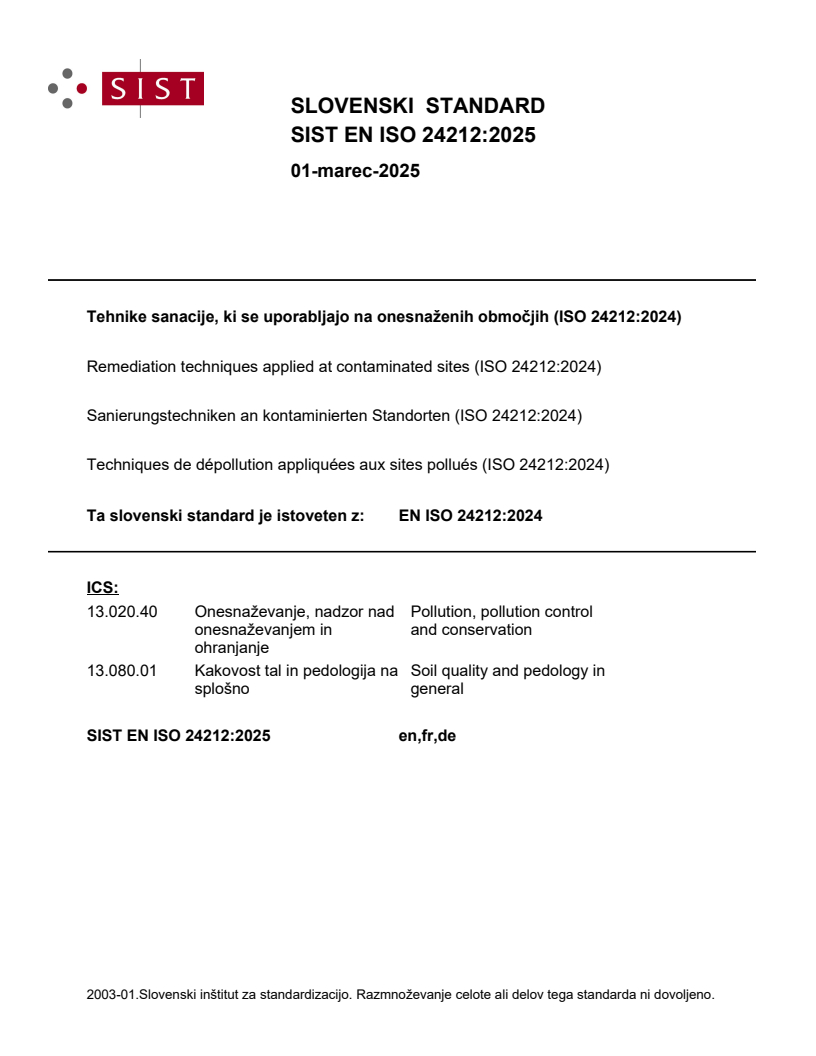
SLOVENSKI STANDARD
01-marec-2025
Tehnike sanacije, ki se uporabljajo na onesnaženih območjih (ISO 24212:2024)
Remediation techniques applied at contaminated sites (ISO 24212:2024)
Sanierungstechniken an kontaminierten Standorten (ISO 24212:2024)
Techniques de dépollution appliquées aux sites pollués (ISO 24212:2024)
Ta slovenski standard je istoveten z: EN ISO 24212:2024
ICS:
13.020.40 Onesnaževanje, nadzor nad Pollution, pollution control
onesnaževanjem in and conservation
ohranjanje
13.080.01 Kakovost tal in pedologija na Soil quality and pedology in
splošno general
2003-01.Slovenski inštitut za standardizacijo. Razmnoževanje celote ali delov tega standarda ni dovoljeno.
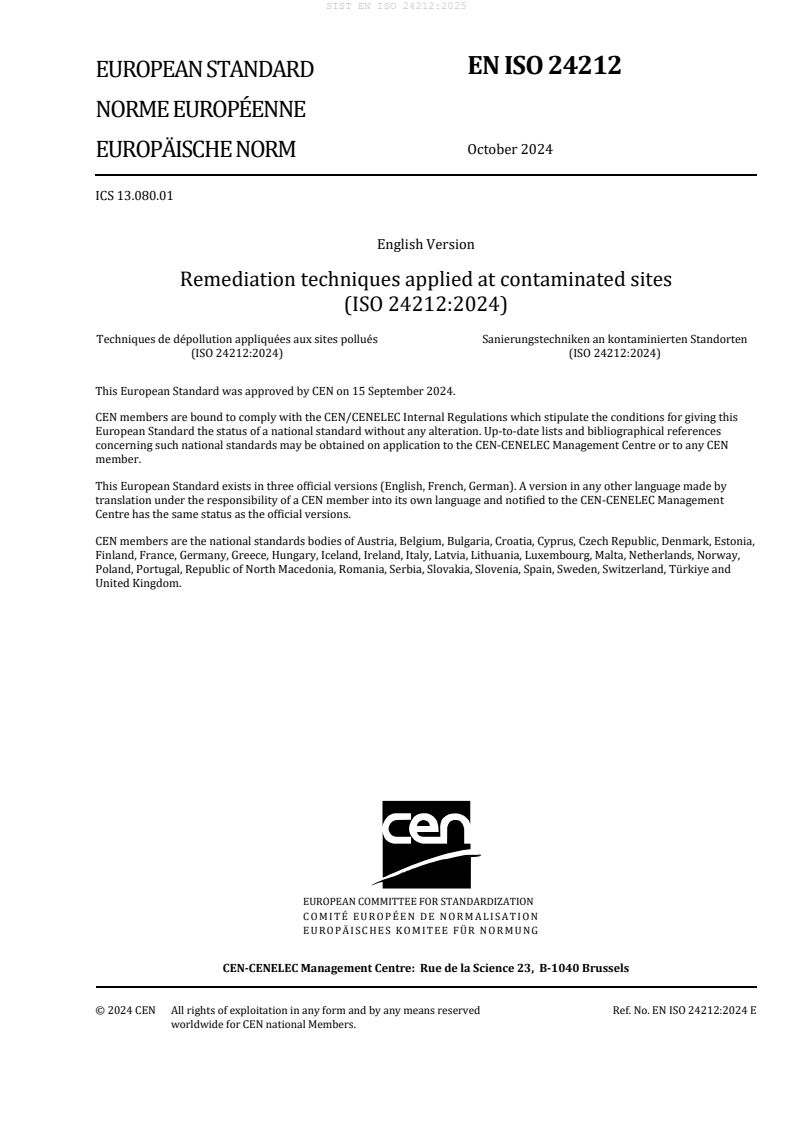
EN ISO 24212
EUROPEAN STANDARD
NORME EUROPÉENNE
October 2024
EUROPÄISCHE NORM
ICS 13.080.01
English Version
Remediation techniques applied at contaminated sites
(ISO 24212:2024)
Techniques de dépollution appliquées aux sites pollués Sanierungstechniken an kontaminierten Standorten
(ISO 24212:2024) (ISO 24212:2024)
This European Standard was approved by CEN on 15 September 2024.
CEN members are bound to comply with the CEN/CENELEC Internal Regulations which stipulate the conditions for giving this
European Standard the status of a national standard without any alteration. Up-to-date lists and bibliographical references
concerning such national standards may be obtained on application to the CEN-CENELEC Management Centre or to any CEN
member.
This European Standard exists in three official versions (English, French, German). A version in any other language made by
translation under the responsibility of a CEN member into its own language and notified to the CEN-CENELEC Management
Centre has the same status as the official versions.
CEN members are the national standards bodies of Austria, Belgium, Bulgaria, Croatia, Cyprus, Czech Republic, Denmark, Estonia,
Finland, France, Germany, Greece, Hungary, Iceland, Ireland, Italy, Latvia, Lithuania, Luxembourg, Malta, Netherlands, Norway,
Poland, Portugal, Republic of North Macedonia, Romania, Serbia, Slovakia, Slovenia, Spain, Sweden, Switzerland, Türkiye and
United Kingdom.
EUROPEAN COMMITTEE FOR STANDARDIZATION
COMITÉ EUROPÉEN DE NORMALISATION
EUROPÄISCHES KOMITEE FÜR NORMUNG
CEN-CENELEC Management Centre: Rue de la Science 23, B-1040 Brussels
© 2024 CEN All rights of exploitation in any form and by any means reserved Ref. No. EN ISO 24212:2024 E
worldwide for CEN national Members.
Contents Page
European foreword . 3
European foreword
This document (EN ISO 24212:2024) has been prepared by Technical Committee ISO/TC 190 "Soil
quality" in collaboration with Technical Committee CEN/TC 444 “Environmental characterization of
solid matrices” the secretariat of which is held by NEN.
This European Standard shall be given the status of a national standard, either by publication of an
identical text or by endorsement, at the latest by April 2025, and conflicting national standards shall be
withdrawn at the latest by April 2025.
Attention is drawn to the possibility that some of the elements of this document may be the subject of
patent rights. CEN shall not be held responsible for identifying any or all such patent rights.
Any feedback and questions on this document should be directed to the users’ national standards
body/national committee. A complete listing of these bodies can be found on the CEN website.
According to the CEN-CENELEC Internal Regulations, the national standards organizations of the
following countries are bound to implement this European Standard: Austria, Belgium, Bulgaria,
Croatia, Cyprus, Czech Republic, Denmark, Estonia, Finland, France, Germany, Greece, Hungary, Iceland,
Ireland, Italy, Latvia, Lithuania, Luxembourg, Malta, Netherlands, Norway, Poland, Portugal, Republic of
North Macedonia, Romania, Serbia, Slovakia, Slovenia, Spain, Sweden, Switzerland, Türkiye and the
United Kingdom.
Endorsement notice
The text of ISO 24212:2024 has been approved by CEN as EN ISO 24212:2024 without any modification.
International
Standard
ISO 24212
First edition
Remediation techniques applied at
2024-09
contaminated sites
Techniques de dépollution appliquées aux sites pollués
Reference number
ISO 24212:2024(en) © ISO 2024
ISO 24212:2024(en)
© ISO 2024
All rights reserved. Unless otherwise specified, or required in the context of its implementation, no part of this publication may
be reproduced or utilized otherwise in any form or by any means, electronic or mechanical, including photocopying, or posting on
the internet or an intranet, without prior written permission. Permission can be requested from either ISO at the address below
or ISO’s member body in the country of the requester.
ISO copyright office
CP 401 • Ch. de Blandonnet 8
CH-1214 Vernier, Geneva
Phone: +41 22 749 01 11
Email: copyright@iso.org
Website: www.iso.org
Published in Switzerland
ii
ISO 24212:2024(en)
Contents Page
Foreword .viii
Introduction .ix
1 Scope . 1
2 Normative references . 1
3 Terms and definitions . 1
4 Abbreviated terms . 3
5 Overview . 5
5.1 Structure of this document .5
5.2 Generic concepts associated with remediation .6
6 Good practice for carrying out a strategies appraisal prior to implementing remediation
strategy . 8
6.1 General .8
6.2 Identifying feasible remediation strategies .9
6.3 Detailed evaluation of strategies appraisal .9
6.4 Selecting the final remediation strategy .11
7 Generic recommendations for the selection of remediation techniques .11
7.1 General .11
7.2 Considering the site’s context . 12
7.3 Remediation set up on-site . 13
7.4 Techniques prerequistes . 13
7.5 Techniques collateral effects .14
7.6 Laboratory testing and pilot tests.14
8 Generic recommendations for managing hazards and risks during remediation . 14
8.1 General .14
8.2 Risk management process . 15
8.2.1 General . 15
8.2.2 Hazards and controls associated with contaminated soil and groundwater . 15
8.2.3 Asbestos .16
8.2.4 Dust .16
8.2.5 Offensive or noxious odours .16
8.2.6 Contaminated waste .16
8.2.7 Remediation equipment .16
8.2.8 Unexpected finds .17
8.2.9 Long-term monitoring .17
8.2.10 Outdoor work .17
8.2.11 Remote or isolated working .17
8.2.12 Underground services and pipelines .17
8.2.13 Ground stability .18
8.2.14 Excavations .18
8.2.15 Unexploded ordnance (UXO) .18
8.2.16 Confined space .18
8.2.17 Hazardous chemicals and dangerous goods .18
8.2.18 Hazardous manual tasks .19
8.2.19 Slips, trips and falls .19
8.2.20 Plant and equipment .19
8.2.21 Noise .19
9 Remediation techniques description .20
9.1 In situ chemical oxidation (ISCO) . . 20
9.1.1 Technique principle . 20
9.1.2 Scope and applicability of the technique (operating window) . 20
9.1.3 Technology description . 20
iii
ISO 24212:2024(en)
9.1.4 Design considerations and dimensioning . 20
9.1.5 Key monitoring parameters .21
9.1.6 Advantages and limitations .21
9.1.7 Specific EHS aspects . .21
9.1.8 Other techniques or containment approaches that can be combined with the
technique . 22
9.2 In situ chemical reduction (ISCR) . 22
9.2.1 Technique principle . 22
9.2.2 Scope and applicability of the technique . 22
9.2.3 Technology description . 22
9.2.4 Design considerations and dimensioning . 22
9.2.5 Key monitoring parameters . 22
9.2.6 Advantages and limitations . 23
9.2.7 Specific EHS aspects . . 23
9.2.8 Other techniques that can be combined with the technique . 23
9.3 Enhanced in situ bioremediation (EISB) . 23
9.3.1 Technique principle . 23
9.3.2 Scope and applicability of the technique (operating window) . 23
9.3.3 Description of technology .24
9.3.4 Design considerations and dimensioning .24
9.3.5 Key monitoring parameters .24
9.3.6 Advantages and limitations .24
9.3.7 Specific EHS aspects . . 25
9.3.8 Other techniques or containment approaches that can be combined with the
technique . 25
9.4 Monitored natural attenuation (MNA) . 25
9.4.1 Technique principle . 25
9.4.2 Scope and applicability of the technique (operating window) . 25
9.4.3 Description of technology . 25
9.4.4 Design considerations and dimensioning . 25
9.4.5 Key monitoring parameters . 25
9.4.6 Advantages and limitations . 26
9.4.7 Specific EHS aspects . . 26
9.4.8 Other techniques or containment approaches that can be combined with the
technique . 26
9.5 Incineration . 26
9.5.1 Technique principle . 26
9.5.2 Scope and applicability of the technique . 26
9.5.3 Technology description . 26
9.5.4 Design considerations and dimensioning .27
9.5.5 Key monitoring parameters .27
9.5.6 Advantages and limitations .27
9.5.7 Specific EHS aspects . . 28
9.5.8 Other techniques or containment approaches that can be combined with the
technique . 28
9.6 In situ thermal remediation (ISTR) . 28
9.6.1 Technique principle . 28
9.6.2 Scope and applicability of the technique (operating window) . 28
9.6.3 Description of technology . 28
9.6.4 Design consideration and dimensioning . 29
9.6.5 Key monitoring parameters . 29
9.6.6 Advantages and limits . 29
9.6.7 Specific EHS aspects . . 30
9.6.8 Other techniques or containment approaches that can be combined with the
technique . 30
9.7 On-site thermal desorption . 30
9.7.1 Technique principle . 30
9.7.2 Scope and applicability of the technique (operating window) . 30
9.7.3 Technology description . 30
iv
ISO 24212:2024(en)
9.7.4 Design considerations and dimensioning . 30
9.7.5 Key monitoring parameters .31
9.7.6 Advantages and limits .31
9.7.7 Specific EHS aspects . .31
9.7.8 Other techniques or containment approaches that can be combined with the
technique .31
9.8 Soil vapour extraction (SVE) .31
9.8.1 Technique principle .31
9.8.2 Scope and applicability of the technique (operating window) .32
9.8.3 Technology description .32
9.8.4 Design and dimensioning considerations .32
9.8.5 Key monitoring parameters .32
9.8.6 Advantages and limits . 33
9.8.7 Specific EHS aspects . . 33
9.8.8 Other techniques or containment approaches that can be combined with the
technique . 33
9.9 Air-sparging . 33
9.9.1 Technique principle . 33
9.9.2 Scope and applicability of the technique (operating window) . 33
9.9.3 Technology description . 34
9.9.4 Design considerations and dimensioning . 34
9.9.5 Key monitoring parameters . 34
9.9.6 Advantages and limits . 34
9.9.7 Specific EHS aspects . . 34
9.9.8 Other techniques or containment approaches that can be combined with the
technique . 34
9.10 Multi-phase extraction (MPE) . 35
9.10.1 Technique principle . 35
9.10.2 Scope and applicability of the technique (operating window) . 35
9.10.3 Technology description . 35
9.10.4 Design considerations and dimensioning . 35
9.10.5 Key monitoring parameters . 35
9.10.6 Advantages and limitations . 36
9.10.7 Specific EHS aspects . . 36
9.10.8 Other techniques or containment approaches that can be combined with the
technique . 36
9.11 Dual pump liquid extraction (DPLE) . 36
9.11.1 Technique principle . 36
9.11.2 Scope and applicability of the technique (operating window) . 36
9.11.3 Technology description .37
9.11.4 Design considerations and dimensioning .37
9.11.5 Key monitoring parameters .37
9.11.6 Advantages and limitations .37
9.11.7 Specific EHS aspects . .37
9.11.8 Other techniques or containment approaches that can be combined with the
technique .37
9.12 Hydraulic techniques for groundwater remediation . 38
9.12.1 Technique principle . 38
9.12.2 Scope and applicability of the technique (operating window) . 38
9.12.3 Technology description . 38
9.12.4 Design considerations and dimensioning . 38
9.12.5 Key monitoring parameters . 39
9.12.6 Advantages and limitations . 39
9.12.7 Specific EHS aspects . . 39
9.12.8 Other techniques or containment approaches that can be combined with the
technique . 39
9.13 Soil washing . 39
9.13.1 Technique principle . 39
9.13.2 Scope and applicability of the technique (operating window) . 39
v
ISO 24212:2024(en)
9.13.3 Technology description . 40
9.13.4 Design and dimensioning considerations . 40
9.13.5 Key monitoring parameters . 40
9.13.6 Advantages and limitations . 40
9.13.7 Specific EHS aspects . . 40
9.13.8 Other techniques or containment approaches that can be combined with the
technique .41
9.14 Biopiling .41
9.14.1 Technique principle .41
9.14.2 Scope and applicability of the technique (operating window) .41
9.14.3 Technology description .41
9.14.4 Design considerations and dimensioning .41
9.14.5 Advantages and limitations .42
9.14.6 Key monitoring parameters .42
9.14.7 Specific EHS aspect .42
9.14.8 Other techniques or containment approaches that can be combined with the
technique .42
9.15 Landfarming .43
9.15.1 Technique principle .43
9.15.2 Scope and applicability of the technique (operating window) .43
9.15.3 Technology description .43
9.15.4 Design considerations and dimensioning .43
9.15.5 Key monitoring parameters . 44
9.15.6 Advantages and limitations . 44
9.15.7 Specific EHS aspects . . 44
9.15.8 Other techniques or containment approaches that can be combined with the
technique . 44
9.16 Vertical barrier technologies (VBT) . 44
9.16.1 Technique principle . 44
9.16.2 Scope and applicability of the technique .45
9.16.3 Technology description .45
9.16.4 Design considerations and dimensioning .45
9.16.5 Key monitoring parameters .45
9.16.6 Advantages and limitations .45
9.16.7 Specific EHS aspects . . 46
9.16.8 Other techniques or containment approaches that can be combined with the
technique . 46
9.17 Cover systems . . 46
9.17.1 Technique principle . 46
9.17.2 Scope and applicability of the technique . 46
9.17.3 Technology description .47
9.17.4 Design considerations and dimensioning .47
9.17.5 Key monitoring parameters . 48
9.17.6 Avantages and limitations . 48
9.17.7 Specific EHS aspects . . 48
9.18 Permeable reactive barrier (PRB) systems . 49
9.18.1 Technique principle . 49
9.18.2 Scope and applicability of the technique (operating window) . 49
9.18.3 Technology description . 49
9.18.4 Design considerations and dimensioning . 49
9.18.5 Key monitoring parameters .
...
Frequently Asked Questions
EN ISO 24212:2024 is a standard published by the European Committee for Standardization (CEN). Its full title is "Remediation techniques applied at contaminated sites (ISO 24212:2024)". This standard covers: This document provides requirements and guidance on key aspects of remediation techniques. It describes the principles, main characteristics, advantages and limitations to be considered in the selection within an option appraisal of individual or combinations of in situ and on-site remediation techniques, including: — the type of contaminants to be dealt with; — current and/or intended site use; — local legal, policy, socio-economic and environmental contexts. This document is applicable to the remediation of contaminated sites, i.e. where soil, or soil gas, ambient air or groundwater are contaminated. It identifies which phase/matrix can be targeted by a technique, e.g. fluid (groundwater, gas, non-aqueous phase liquid) or solid, and which contaminant it can applied to. This document also provides information on hazards that can be associated with the implementation of remediation. This document does not provide: — an exhaustive list of remediation techniques; — guidance on sites contaminated with radioactive substances, pathogenic or infectious agents, or “pyrotechnic devices” (e.g. unexploded ordnances); — guidance on ex situ techniques that are set up off-site; — a framework that covers all individual situations, or prescribes which technique(s) to use in a specific context.
This document provides requirements and guidance on key aspects of remediation techniques. It describes the principles, main characteristics, advantages and limitations to be considered in the selection within an option appraisal of individual or combinations of in situ and on-site remediation techniques, including: — the type of contaminants to be dealt with; — current and/or intended site use; — local legal, policy, socio-economic and environmental contexts. This document is applicable to the remediation of contaminated sites, i.e. where soil, or soil gas, ambient air or groundwater are contaminated. It identifies which phase/matrix can be targeted by a technique, e.g. fluid (groundwater, gas, non-aqueous phase liquid) or solid, and which contaminant it can applied to. This document also provides information on hazards that can be associated with the implementation of remediation. This document does not provide: — an exhaustive list of remediation techniques; — guidance on sites contaminated with radioactive substances, pathogenic or infectious agents, or “pyrotechnic devices” (e.g. unexploded ordnances); — guidance on ex situ techniques that are set up off-site; — a framework that covers all individual situations, or prescribes which technique(s) to use in a specific context.
EN ISO 24212:2024 is classified under the following ICS (International Classification for Standards) categories: 13.080.01 - Soil quality and pedology in general. The ICS classification helps identify the subject area and facilitates finding related standards.
You can purchase EN ISO 24212:2024 directly from iTeh Standards. The document is available in PDF format and is delivered instantly after payment. Add the standard to your cart and complete the secure checkout process. iTeh Standards is an authorized distributor of CEN standards.
EN ISO 24212:2024の標準化文書は、汚染されたサイトにおける修復技術に関する重要な要件とガイダンスを提供しています。この文書は、修復技術の選定に際して考慮すべき原則、主な特性、利点、制限について詳述しており、特に以下の点に焦点を当てています。 まず、特定の汚染物質の種類や、現在または将来的なサイトの利用方法、さらには地域の法的、政策的、社会経済的、および環境的文脈を考慮することが求められます。このように、EN ISO 24212:2024は、汚染された土壌、土壌ガス、大気中の空気、地下水を対象とする修復技術の選定において、包括的な視点を提供する文書です。 この文書は、修復技術がターゲットとするフェーズやマトリックス(例えば、流体や固体)を明確に定義し、それぞれの技術が適用可能な汚染物質を特定しています。また、修復実施時に関連する危険要因についても情報が提供されており、実施にあたってのリスク管理が重要であることを示唆しています。 ただし、EN ISO 24212:2024は、すべての修復技術の網羅的なリストを提供するものではなく、放射性物質や感染性病原体、「火薬装置」(未発火弾薬等)に汚染されたサイトに関するガイダンスを提供するものでもありません。また、オフサイトでの実施を前提とした外部技術に関する指針や、すべての個別状況を網羅するフレームワーク、特定の文脈に応じて使用する技術を指定する内容も含まれていません。 この標準文書は、修復技術におけるベストプラクティスを示すものであり、様々な汚染状況における適切な修復手法の選定にとって非常に価値のあるリソースです。これにより、専門家がより効果的かつ安全に修復活動を行うことを可能にし、結果として環境保全に寄与することが期待されます。
표준 EN ISO 24212:2024는 오염된 위치에서 적용되는 복원 기술에 관한 요구사항 및 지침을 제공합니다. 이 문서는 복원 기술의 주요 측면에 대한 원칙, 주요 특성, 장점 및 제한 사항을 설명하여 개별 또는 조합된 인사이트 및 현장 복원 기술의 선택 시 고려해야 할 요소들을 정의합니다. 여기에는 다루어야 할 오염 물질의 유형, 현재 및 또는 의도된 사이트 사용, 지역의 법률, 정책, 사회경제적 및 환경적 맥락이 포함됩니다. 이 표준은 토양, 토양 가스, 대기 또는 지하수가 오염된 오염된 사이트의 복원에 적용되며, 특정 기술이 목표로 할 수 있는 단계/행렬, 예를 들어 유체(지하수, 가스, 비수성 액체) 또는 고체를 식별합니다. 또한 이 문서는 복원 실행과 관련된 위험 정보도 제공합니다. 그러나 EN ISO 24212:2024는 복원 기술의 포괄적인 목록을 제공하지 않으며, 방사성 물질, 병원성 또는 전염성 물질, 또는 “화약 장치”와 같은 오염이 있는 사이트에 대한 지침을 포함하지 않습니다. 또한, 오프사이트에 설정된 외부 기술에 대한 안내를 제시하지 않으며, 모든 개별 상황을 포괄하는 프레임워크를 제공하지도 않습니다. 특정 맥락에서 사용할 기술을 처방하는 것도 포함되어 있지 않습니다. 전체적으로 이 표준은 오염된 사이트의 복원 기술 선택 및 적용에 있어 실질적이고 유용한 지침을 제공하며, 다양한 오염 물질 및 사이트의 복원 관리에 있어 중요한 참고자료가 됩니다.
The standard EN ISO 24212:2024 provides a comprehensive framework for addressing the complexities associated with remediation techniques applied at contaminated sites. Its scope is carefully defined, offering requirements and guidance that emphasize the selection of appropriate remediation methods based on several critical factors, including the type of contaminants, intended site use, and relevant local contexts. One of the strengths of this standard is its detailed approach to the principles and main characteristics of various in situ and on-site remediation techniques. By analyzing advantages and limitations, the standard supports practitioners in making informed decisions during the option appraisal process. This is particularly relevant for environments where soil, soil gas, ambient air, or groundwater contamination poses significant health and environmental risks. Moreover, EN ISO 24212:2024 outlines which phases or matrices can be targeted by specific remediation techniques, including fluid and solid states, ensuring that users can align their methodologies with the characteristics of the contaminants they are dealing with. Additionally, it addresses potential hazards related to the implementation of remediation strategies, an essential consideration for both safety and compliance. However, it is crucial to note the boundaries set by this standard. It does not provide an exhaustive list of remediation techniques nor guidance for sites contaminated with radioactive substances or specific hazardous agents. Furthermore, it excludes ex situ techniques and does not aim to dictate a one-size-fits-all framework for every situation. This specificity reinforces the importance of contextual understanding in remediation projects and the necessity for practitioners to evaluate each case individually. Overall, EN ISO 24212:2024 is highly relevant in the field of environmental remediation, serving as a vital resource for ensuring effective, safe, and contextually appropriate remediation of contaminated sites. Its clarity in outlining criteria for selecting remediation techniques makes it an invaluable document for environmental professionals.
Questions, Comments and Discussion
Ask us and Technical Secretary will try to provide an answer. You can facilitate discussion about the standard in here.
Loading comments...