

EN 18159:2026
(Main)Double skin metal faced insulating sandwich panels for roofing and cladding - Environmental product declarations - Product category rules complementary to EN 15804 for double skin metal faced insulating sandwich panels for roofing and cladding
- Abstract
This document provides product category rules (c-PCR), that are complementary to EN 15804:2012+A2:2019, for Type III environmental declarations for sandwich panels within the scope of EN 14509 1:— and EN 14509 2:—, which are used for non-structural and structural purposes in building envelopes and for sandwich panels with perforated faces and for sandwich panels with core materials others than defined in EN 14509 1:— and EN 14509 2:—.
Manufactured on industrial plant, double skin metal faced insulating sandwich panels are designed to be laid with overlapping edges in the following applications:
— roofs and discontinuous roofing;
— outer walls and wall cladding;
— walls (incl. partition walls) and (suspended) ceilings inside the building envelope.
This document is intended to be used cradle-to-grave, declaring modules A1-A3, modules C1-C4 and module D, according to EN 15804:2012+A2:2019
NOTE The assessment of social and economic performances at product level is not covered by this document.
- Status
- Published
- Publication Date
- 20-Oct-2026
- Technical Committee
- CEN/TC 128 - Roof covering products for discontinuous laying and products for wall cladding
- Drafting Committee
- CEN/TC 128/SC 11/WG 10 - Sandwich panels - c-PCR
- Current Stage
- 6060 - Definitive text made available (DAV) - Publishing
- Start Date
- 21-Oct-2026
- Due Date
- 22-Dec-2026
- Completion Date
- 21-Oct-2026

EN 18159:2026 is a CEN document for Environmental Product Declarations (EPD) of double skin metal faced insulating sandwich panels for roofing and cladding. It is complementary to EN 15804 and tells manufacturers, LCA practitioners and verifiers how to describe these panels, which life-cycle modules to report, and what additional technical information to include for building-envelope applications.
What does EN 18159:2026 specify?
EN 18159:2026 specifies product category rules (c-PCR) for Type III environmental declarations of sandwich panels covered by the prEN 14509 family, including panels with perforated faces and panels with core materials other than those defined in that family. It is written for industrially manufactured panels used in roofs, outer walls, wall cladding, internal walls, partition walls and suspended ceilings inside the building envelope.
The document is organized into clauses 1 to 9, followed by Annexes A to M. Clause 1 sets the scope, Clause 2 lists the normative references, and later clauses cover terms, general aspects, life-cycle assessment (LCA) rules, EPD content, the project report, and verification.
| Annex | What it covers |
|---|---|
| A | Requirements and guidance on the reference service life (RSL) |
| B | Waste |
| C | Impact categories, indicators, methodologies and characterization factors |
| D | End-of-life formulae |
| E | Data quality assessment schemes for generic and specific data |
| F | Illustration of material flows of sandwich panels |
| G | Default transport data for module A4 |
| H | Default installation data for module A5 |
| I | Default deconstruction data for module C1 |
| J | Default transport data for module C2 |
| K | Default rates for reuse, recycling and losses |
| L | Interpolation rules |
| M | Selection of additional environmental indicators |
What are the key requirements of EN 18159:2026?
EN 18159:2026 sets the rules for how an EPD for these sandwich panels is built, what life-cycle stages are included, and how end-of-life and additional environmental information are handled. In practice, it tells you what product data you need, what can be estimated with defaults, and what must be stated clearly in the declaration.
Scope and product identification
Clause 6.1 requires the product category to include all sandwich panels within the prEN 14509 scope for structural and non-structural use, plus panels with perforated faces and panels with other core materials. Face materials and core materials have to be specified in the EPD. That matters because the environmental results depend on the exact metal face and insulation core.
Life-cycle stages to declare
Clause 6.2 requires reporting across the relevant EN 15804 modules, including product stage, construction process stage, use stage, end-of-life, and module D. For faces, transport impacts shall be included where relevant, and actual distances and transport modes shall be used when known. This means the EPD should follow the real supply chain and installation route, not just generic assumptions.
Clause 6.2.2 says a separate declaration of A1-A3 is not compulsory, but all transport steps between processes within and between A1 and A3 shall be included and reported where they occur. Annex F shows the material flow logic used for the panels. That helps avoid double counting or missing factory and upstream transport steps.
Construction, use and end-of-life rules
Clause 6.2.3 refers to A4 and A5, with default data in Annexes G and H when site-specific information is not available. Annex H includes installation losses and diesel use, so a project team can build a practical site scenario even when contractor data are incomplete.
Clause 6.2.6 and 6.2.8 cover C1 to C4 and the handling of waste up to end-of-waste state. Annex I gives default deconstruction data, Annex J gives transport data for C2, and Annex K gives default reuse, recycling, recovery and disposal rates. In practice, the user needs to choose a realistic end-of-life route, because reuse and recycling are treated differently from disposal.
Clause 6.2.7 and Table 2 define module D for benefits and loads beyond the system boundary. For metal faces, module D includes the conversion of scrap into recycled cast metal and the reuse of products, with transport and related energy and water use where relevant. This is the place where credits for recovered material are shown.
Calculation rules and declared unit
Clause 6.3.3 sets the declared unit as 1 m of a sandwich panel. Annex L allows interpolation between thicknesses, but only within the same panel category, meaning the same face material, facings weight, core material and core density. This matters if one EPD is used for a product range rather than one exact thickness.
Clause 6.3.4 uses the reference service life (RSL) rules in Annex A. Annex A states an RSL of at least 50 years, with use according to the product description, appropriate maintenance, and consideration of location, weather and coating quality for steel faces. That informs durability assumptions in EPD scenarios and in building assessments.
EPD content and additional indicators
Clause 7 requires the EPD to declare general information, LCA-derived indicators, scenarios and technical information, and any additional information on dangerous substance release during use. Clause 7.5 covers aggregation of information modules, so results can be presented in the format required by the EPD programme.
Clause 5.4.2 and Annex M limit some additional environmental indicators for faces. The indicators for freshwater ecotoxicity, human cancer effects and human non-cancer effects should not be declared unless mandatory in the intended market, and the particulate matter indicator should not be declared when source-data reliability is doubtful. In practice, this keeps the declaration focused on indicators that are better supported by the available data.
What terms does EN 18159:2026 define?
- EPD - Environmental product declaration, the Type III declaration format used for reporting product environmental information.
- PCR - Product category rules, the rules that define how a product group is assessed and declared.
- c-PCR - Complementary product category rules, the additional rules that work with EN 15804 for this product group.
- LCA - Life cycle assessment, the method used to calculate environmental impacts across life-cycle stages.
- LCI - Life cycle inventory analysis, the collection and calculation of input and output flows.
- LCIA - Life cycle impact assessment, the step that turns inventory data into environmental impact indicators.
- RSL - Reference service life, the assumed service life used in the EPD scenario.
- CF - Characterization factor, the factor used in impact calculations.
- ND - Not declared, used where an indicator is not reported.
Who uses EN 18159:2026?
EN 18159:2026 is used by manufacturers of double skin metal faced insulating sandwich panels, LCA consultants, EPD programme operators, and independent verifiers. It is also used by quality, sustainability and procurement teams that need comparable EPDs for roofing, cladding and building-envelope panels.
In practice, these users apply it when preparing an EPD, selecting the right system boundary, choosing default data for transport, installation or deconstruction, and documenting the panel build-up. Architects, specifiers and buyers use the resulting EPD to compare product variants and to feed building-level environmental assessments.
Which standards are used with EN 18159:2026?
- EN 15804:2012+A2:2019 - the core rules for EPDs of construction products; EN 18159 is complementary to it.
- EN 16783:2017 - provides the wider EPD framework for thermal insulation products and is referenced for general information on core materials.
- prEN 14509-1 - defines self-supporting applications for factory-made double skin metal faced insulating sandwich panels.
- prEN 14509-2 - defines structural applications for these panels.
- EN ISO 9229:2020 - supplies the thermal-insulation vocabulary used in the document.
What does the EN 18159:2026 document contain?
EN 18159:2026 contains the rules for LCA calculation, the required EPD content, and the verification and validity framework for the declaration. It also contains a project-report section that asks for the LCA-related elements and the documentation needed for verification.
The annexes provide the practical tools behind the rules. These include the RSL guidance, impact-category and characterization-factor data, end-of-life formulae, data-quality schemes, a material-flow illustration, and default data for transport, installation and deconstruction.
It also includes default rates for reuse, recycling and losses, plus interpolation rules for declaring panel thickness ranges. Annex M explains why some additional environmental indicators are treated cautiously for this product group, especially for metal-faced panels.
Relations
- Effective Date
- 04-Nov-2026
- Effective Date
- 04-Nov-2026
- Effective Date
- 04-Nov-2026
- Effective Date
- 04-Nov-2026
Get Certified
Connect with accredited certification bodies for this standard

DIBt (Deutsches Institut für Bautechnik)
German Institute for Building Technology.

DIN CERTCO
DIN Group product certification.

Aboma Certification B.V.
Specialized in construction, metal, and transport sectors.
Sponsored listings
Frequently Asked Questions
EN 18159:2026 is a standard published by the European Committee for Standardization (CEN). Its full title is "Double skin metal faced insulating sandwich panels for roofing and cladding - Environmental product declarations - Product category rules complementary to EN 15804 for double skin metal faced insulating sandwich panels for roofing and cladding". This standard covers: This document provides product category rules (c-PCR), that are complementary to EN 15804:2012+A2:2019, for Type III environmental declarations for sandwich panels within the scope of EN 14509 1:— and EN 14509 2:—, which are used for non-structural and structural purposes in building envelopes and for sandwich panels with perforated faces and for sandwich panels with core materials others than defined in EN 14509 1:— and EN 14509 2:—. Manufactured on industrial plant, double skin metal faced insulating sandwich panels are designed to be laid with overlapping edges in the following applications: — roofs and discontinuous roofing; — outer walls and wall cladding; — walls (incl. partition walls) and (suspended) ceilings inside the building envelope. This document is intended to be used cradle-to-grave, declaring modules A1-A3, modules C1-C4 and module D, according to EN 15804:2012+A2:2019 NOTE The assessment of social and economic performances at product level is not covered by this document.
This document provides product category rules (c-PCR), that are complementary to EN 15804:2012+A2:2019, for Type III environmental declarations for sandwich panels within the scope of EN 14509 1:— and EN 14509 2:—, which are used for non-structural and structural purposes in building envelopes and for sandwich panels with perforated faces and for sandwich panels with core materials others than defined in EN 14509 1:— and EN 14509 2:—. Manufactured on industrial plant, double skin metal faced insulating sandwich panels are designed to be laid with overlapping edges in the following applications: — roofs and discontinuous roofing; — outer walls and wall cladding; — walls (incl. partition walls) and (suspended) ceilings inside the building envelope. This document is intended to be used cradle-to-grave, declaring modules A1-A3, modules C1-C4 and module D, according to EN 15804:2012+A2:2019 NOTE The assessment of social and economic performances at product level is not covered by this document.
EN 18159:2026 is classified under the following ICS (International Classification for Standards) categories: 91.040.01 - Buildings in general; 91.060.01 - Elements of buildings in general. The ICS classification helps identify the subject area and facilitates finding related standards.
EN 18159:2026 has the following relationships with other standards: It is inter standard links to EN 15804:2012+A2:2019, EN 15941:2024, EN 16783:2024, EN ISO 9229:2020. Understanding these relationships helps ensure you are using the most current and applicable version of the standard.
EN 18159:2026 is associated with the following European legislation: EU Directives/Regulations: 305/2011; Standardization Mandates: M/616. When a standard is cited in the Official Journal of the European Union, products manufactured in conformity with it benefit from a presumption of conformity with the essential requirements of the corresponding EU directive or regulation.
EN 18159:2026 is available in PDF format for immediate download after purchase. The document can be added to your cart and obtained through the secure checkout process. Digital delivery ensures instant access to the complete standard document.
Standards Content (Sample)
SLOVENSKI STANDARD
01-december-2026
Izolacijske sendvič plošče (panele) s kovinsko oblogo z dvojno plastjo za strešno
kritino in obloge - Okoljske deklaracije za proizvode - Pravila za kategorije
proizvodov za izolacijske sendvič plošče (panele) s kovinsko oblogo z dvojno
plastjo za strešno kritino in obloge, ki dopolnjujejo standard EN 15804
Double skin metal faced insulating sandwich panels for roofing and cladding -
Environmental Product Declarations - Product category rules complementary to EN
15804 for double skin metal faced insulating sandwich panels for roofing and cladding
Sandwichelemente mit beidseitigen Metalldeckschichten für Bedachungen und
Bekleidungen - Umweltproduktdeklarationen - Produktkategorieregeln ergänzend zur EN
15804 für Sandwichelemente mit beidseitigen Metalldeckschichten für Bedachungen und
Bekleidungen
Panneaux sandwich isolants double peau à parement métallique pour couverture et
bardage - Déclarations environnementales de produits - Règles de catégorie de produit
complémentaires à l'EN 15804 pour les panneaux sandwich isolants double peau à
parement métallique pour couverture et bardage
Ta slovenski standard je istoveten z: EN 18159:2026
ICS:
13.020.20 Okoljska ekonomija. Environmental economics.
Trajnostnost Sustainability
91.060.01 Stavbni elementi na splošno Elements of buildings in
general
2003-01.Slovenski inštitut za standardizacijo. Razmnoževanje celote ali delov tega standarda ni dovoljeno.
EN 18159
EUROPEAN STANDARD
NORME EUROPÉENNE
October 2026
EUROPÄISCHE NORM
ICS 91.060.01
English Version
Double skin metal faced insulating sandwich panels for
roofing and cladding - Environmental product declarations
- Product category rules complementary to EN 15804 for
double skin metal faced insulating sandwich panels for
roofing and cladding
Panneaux sandwichs isolants double peau à parement Sandwichelemente mit beidseitigen
métallique pour couverture et bardage - Déclarations Metalldeckschichten für Bedachungen und
environnementales de produits - Règles de catégorie Bekleidungen - Umweltproduktdeklarationen -
de produit complémentaires à l'EN 15804 pour les Produktkategorieregeln ergänzend zur EN 15804 für
panneaux sandwichs isolants double peau à parement Sandwichelemente mit beidseitigen
métallique pour couverture et bardage Metalldeckschichten für Bedachungen und
Bekleidungen
This European Standard was approved by CEN on 14 September 2026.
CEN members are bound to comply with the CEN/CENELEC Internal Regulations which stipulate the conditions for giving this
European Standard the status of a national standard without any alteration. Up-to-date lists and bibliographical references
concerning such national standards may be obtained on application to the CEN-CENELEC Management Centre or to any CEN
member.
This European Standard exists in three official versions (English, French, German). A version in any other language made by
translation under the responsibility of a CEN member into its own language and notified to the CEN-CENELEC Management
Centre has the same status as the official versions.
CEN members are the national standards bodies of Austria, Belgium, Bulgaria, Croatia, Cyprus, Czech Republic, Denmark, Estonia,
Finland, France, Germany, Greece, Hungary, Iceland, Ireland, Italy, Latvia, Lithuania, Luxembourg, Malta, Netherlands, Norway,
Poland, Portugal, Republic of North Macedonia, Romania, Serbia, Slovakia, Slovenia, Spain, Sweden, Switzerland, Türkiye and
United Kingdom.
EUROPEAN COMMITTEE FOR STANDARDIZATION
COMITÉ EUROPÉEN DE NORMALISATION
EUROPÄISCHES KOMITEE FÜR NORMUNG
CEN-CENELEC Management Centre: Rue de la Science 23, B-1040 Brussels
© 2026 CEN All rights of exploitation in any form and by any means reserved Ref. No. EN 18159:2026 E
worldwide for CEN national Members.
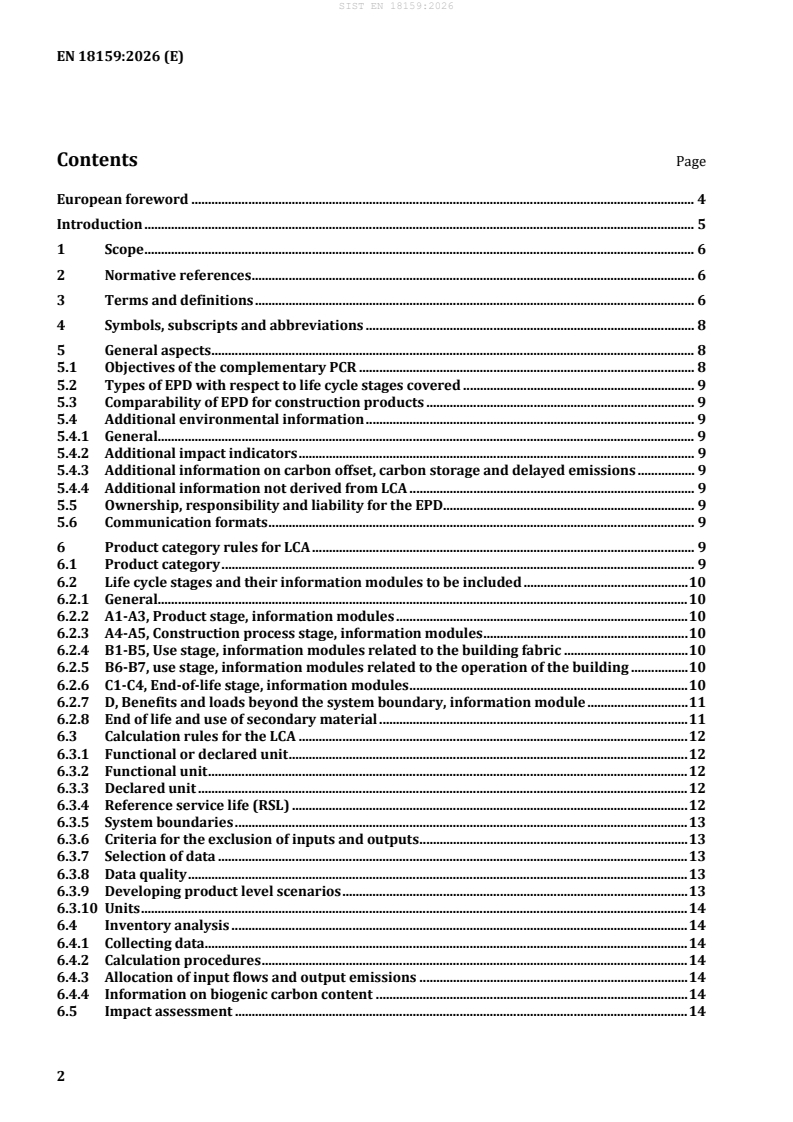
Contents Page
European foreword . 4
Introduction . 5
1 Scope . 6
2 Normative references . 6
3 Terms and definitions . 6
4 Symbols, subscripts and abbreviations . 8
5 General aspects . 8
5.1 Objectives of the complementary PCR . 8
5.2 Types of EPD with respect to life cycle stages covered . 9
5.3 Comparability of EPD for construction products . 9
5.4 Additional environmental information . 9
5.4.1 General. 9
5.4.2 Additional impact indicators . 9
5.4.3 Additional information on carbon offset, carbon storage and delayed emissions . 9
5.4.4 Additional information not derived from LCA . 9
5.5 Ownership, responsibility and liability for the EPD. 9
5.6 Communication formats . 9
6 Product category rules for LCA . 9
6.1 Product category . 9
6.2 Life cycle stages and their information modules to be included . 10
6.2.1 General. 10
6.2.2 A1-A3, Product stage, information modules . 10
6.2.3 A4-A5, Construction process stage, information modules . 10
6.2.4 B1-B5, Use stage, information modules related to the building fabric . 10
6.2.5 B6-B7, use stage, information modules related to the operation of the building . 10
6.2.6 C1-C4, End-of-life stage, information modules . 10
6.2.7 D, Benefits and loads beyond the system boundary, information module . 11
6.2.8 End of life and use of secondary material . 11
6.3 Calculation rules for the LCA . 12
6.3.1 Functional or declared unit . 12
6.3.2 Functional unit . 12
6.3.3 Declared unit . 12
6.3.4 Reference service life (RSL) . 12
6.3.5 System boundaries . 13
6.3.6 Criteria for the exclusion of inputs and outputs . 13
6.3.7 Selection of data . 13
6.3.8 Data quality . 13
6.3.9 Developing product level scenarios . 13
6.3.10 Units . 14
6.4 Inventory analysis . 14
6.4.1 Collecting data . 14
6.4.2 Calculation procedures . 14
6.4.3 Allocation of input flows and output emissions . 14
6.4.4 Information on biogenic carbon content . 14
6.5 Impact assessment . 14
6.5.1 General . 14
6.5.2 Core environmental impact indicators . 14
6.5.3 Additional environmental impact indicators . 14
7 Content of the EPD . 14
7.1 Declaration of general information . 14
7.2 Declaration of environmental indicators derived from LCA . 14
7.2.1 General . 14
7.2.2 Rules for declaring LCA information per module . 14
7.2.3 Indicators describing environmental impacts based on life cycle impact assessment (LCIA)
............................................................................................................................................................................. 15
7.2.4 Indicators describing resource use and environmental information based on life cycle
inventory (LCI) . 15
7.2.5 Information on biogenic carbon content . 15
7.3 Scenarios and additional technical information . 15
7.3.1 General . 15
7.3.2 Construction process stage . 15
7.3.3 B1-B7 use stage . 15
7.3.4 End-of-life . 16
7.4 Additional information on release of dangerous substances to indoor air, soil and water
during the use stage . 16
7.4.1 Indoor air . 16
7.4.2 Soil and water . 16
7.5 Aggregation of information modules . 16
8 Project report . 16
8.1 General . 16
8.2 LCA-related elements of the project report . 16
8.3 Documentation on additional information . 16
8.4 Data availability for verification . 16
9 Verification and validity of an EPD. 16
Annex A (normative) Requirements and guidance on the reference service life. 17
Annex B (informative) Waste . 18
Annex C (normative) Impact categories and related indicators, methodologies and
characterization factors (CF) . 19
Annex D (informative) End of life formulae . 20
Annex E (informative) Schemes to be applied for data quality assessment of generic and specific
data . 21
Annex F (informative) Illustration of material flows of sandwich panels . 22
Annex G (informative) Default data for transport (module A4) . 24
Annex H (normative) Default data for installation (Module A5) . 26
Annex I (normative) Default data for deconstruction (Module C1) . 27
Annex J (informative) Default data for transport (Module C2) . 28
Annex K (normative) Default rates of reuse, recycling and losses . 29
Annex L (normative) Interpolation rules . 30
Annex M (informative) Selection of additional environmental indicators . 31
Bibliography . 33
European foreword
This document (EN 18159:2026) has been prepared by Technical Committee CEN/TC 128 “Double skin
metal faced insulating sandwich panels for roofing and cladding”, the secretariat of which is held by NBN.
This European Standard shall be given the status of a national standard, either by publication of an
identical text or by endorsement, at the latest by April 2027, and conflicting national standards shall be
withdrawn at the latest by April 2027.
Attention is drawn to the possibility that some of the elements of this document may be the subject of
patent rights. CEN shall not be held responsible for identifying any or all such patent rights.
This document is intended to be used in conjunction with EN 15804:2012+A2:2019 and EN 16783:2024.
This document has been prepared under a standardization request addressed to CEN by the European
Commission. The Standing Committee of the EFTA States subsequently approves these requests for its
Member States.
Any feedback and questions on this document should be directed to the users’ national standards body.
A complete listing of these bodies can be found on the CEN website.
According to the CEN-CENELEC Internal Regulations, the national standards organisations of the
following countries are bound to implement this European Standard: Austria, Belgium, Bulgaria, Croatia,
Cyprus, Czech Republic, Denmark, Estonia, Finland, France, Germany, Greece, Hungary, Iceland, Ireland,
Italy, Latvia, Lithuania, Luxembourg, Malta, Netherlands, Norway, Poland, Portugal, Republic of North
Macedonia, Romania, Serbia, Slovakia, Slovenia, Spain, Sweden, Switzerland, Türkiye and the United
Kingdom.
Introduction
As in EN 15804:2012+A2:2019, in addition:
This document provides rules for environmental product declarations (EPD) for metal faced insulating
sandwich panels for structural and non-structural purposes in building envelopes. These sandwich
panels consist of a thermal insulating core, e.g. of mineral wool or polyurethane, between outer layers of
metal. Both sides of the core are bonded firmly to the two outer layers.
This document complements the core product category rules for all construction products and services
as established in EN 15804:2012+A2:2019.
1 Scope
This document provides product category rules (c-PCR), that are complementary to
EN 15804:2012+A2:2019, for Type III environmental declarations for sandwich panels within the scope
of EN 14509-1:— and EN 14509-2:—, which are used for non-structural and structural purposes in
building envelopes and for sandwich panels with perforated faces and for sandwich panels with core
materials others than defined in EN 14509-1:— and EN 14509-2:—.
Manufactured on industrial plant, double skin metal faced insulating sandwich panels are designed to be
laid with overlapping edges in the following applications:
— roofs and discontinuous roofing;
— outer walls and wall cladding;
— walls (incl. partition walls) and (suspended) ceilings inside the building envelope.
This document is intended to be used cradle-to-grave, declaring modules A1-A3, modules C1-C4 and
module D, according to EN 15804:2012+A2:2019
NOTE The assessment of social and economic performances at product level is not covered by this document.
2 Normative references
The following documents are referred to in the text in such a way that some or all of their content
constitutes requirements of this document. For dated references, only the edition cited applies. For
undated references, the latest edition of the referenced document (including any amendments) applies.
EN 14509-1:—, Factory-made double skin metal faced insulating panels for self-supporting applications
EN 14509-2:—, Factory-made double skin metal faced insulating panels for structural applications
EN 15804:2012+A2:2019, Sustainability of construction works — Environmental product declarations —
Core rules for the product category of construction products
EN 16783:2024, Thermal insulation products — Environmental Product Declarations (EPD) — Product
Category Rules (PCR) complementary to EN 15804 for factory made and in-situ formed products
EN ISO 9229:2020, Thermal insulation — Vocabulary (ISO 9229:2020)
EN 15941:2024, Sustainability of construction works — Data quality for environmental assessment of
products and construction work — Selection and use of data
3 Terms and definitions
For the purposes of this document, the terms and definitions given in EN 15804:2012+A2:2019 and in
EN ISO 9229:2020 and the following apply.
3.1
core
layer of material, having thermal insulating properties, which is bonded between two metal faces
Under preparation. Stage at the time of publication: prEN 14509-1:2026
Under preparation. Stage at the time of publication: prEN 14509-2:2026
As impacted by EN 15804:2012+A2:2019/AC:2021
Note 1 to entry: Panels with special edge details in the longitudinal joints might utilize different core materials
from the main insulating core (e.g. for improved fire performance) if these edge details have no influence on the
mechanical performance of the panel.
3.2
face
flat, lightly profiled or profiled thin metal sheet bonded to the core
3.3
mineral wool
MW
insulation wool manufactured from molten stone, slag or glass
[SOURCE: EN 13162:2012+A1:2015, 3.1.1]
3.4
stone wool
SW
insulation wool manufactured from molten stone
3.5
glass wool
GW
Insulation wool manufactured from molten glass
3.6
phenolic foam
PF
rigid cellular foam, the polymer structure of which is made primarily from the polycondensation of
phenol, its homologues and/or derivatives, with or without aldehydes or ketones
[SOURCE: EN 13166:2012+A2:2016, 3.1.1]
3.7
expanded polystyrene
EPS
rigid cellular plastic material, manufactured by moulding beads or granules of expandable polystyrene
or one of its copolymers, with an air filled closed cellular structure, which is divided into four types
related to the intended use:
— EPSi: for load bearing applications, where i stands for the declared value (expressed in compressive
stress at 10 % deformation)
— EPS S: for non load bearing applications
— EPS SD: for non load bearing applications with acoustic properties
— EPS T: for floating floor applications
[SOURCE: EN 13163:2012+A2:2016, 3.1.1]
3.8
extruded polystyrene foam
XPS
rigid cellular plastics insulation material expanded and extruded with or without a skin, from polystyrene
or one of its copolymers and which has a closed cell structure
[SOURCE: EN 13164:2012+A1:2015, 3.1.1]
3.9
rigid polyurethane foam
PU
family of rigid cellular thermoset polymeric insulation products with a substantially closed cell
structure including both polymer types based on PIR and PUR
[SOURCE: EN 13165:2012+A2:2016, 3.1.1]
3.9.1
PIR
rigid cellular thermoset polymeric insulation product with a substantially closed cell structure based on
polymers mainly of polyisocyanurate groups
[SOURCE: EN 13165:2012+A2:2016, 3.1.1.1]
3.9.2
PUR
rigid cellular thermoset polymeric insulation product with a substantially closed cell structure based on
polymers mainly of polyurethane groups
[SOURCE: EN 13165:2012+A2:2016, 3.1.1.2]
4 Symbols, subscripts and abbreviations
For the purposes of this document, the abbreviations given in EN 14509-1:—, EN 14509-2:—,
EN ISO 9229:2020, EN 16783:2024 and EN 15804:2012+A2:2019 and the following apply.
EPD Environmental product declaration
PCR Product category rules
LCA Life cycle assessment
LCI Life cycle inventory analysis
LCIA Life cycle impact assessment
RSL Reference service life
c-PCR Complementary product category rules
CF Characterization factor
ND Not declared
5 General aspects
5.1 Objectives of the complementary PCR
As in EN 15804:2012+A2:2019.
5.2 Types of EPD with respect to life cycle stages covered
The modules A1-A3, modules C1-C4 and module D shall be declared as in EN 15804:2012+A2:2019.
5.3 Comparability of EPD for construction products
As in EN 15804:2012+A2:2019.
5.4 Additional environmental information
5.4.1 General
As in EN 15804:2012+A2:2019.
5.4.2 Additional impact indicators
As in EN 15804:2012+A2:2019, in addition:
For faces, the following additional environmental impact indicators in EN 15804:2012+A2:2019 should
not be declared in the EPD except if mandatory in a country or market for declaration where the EPD is
intended to be used:
— eco-toxicity (Freshwater);
— human toxicity, cancer effects;
— human toxicity, non-cancer effects;
NOTE 1 Under the current EN 15804:2012+A2:2019 the additional indicators are optional, due to high
uncertainties and limited experience with the indicator.
The additional impact indicator designated in EN 15804:2012+A2:2019 as ‘Potential incidence of disease
due to particulate matter emissions (PM)’ should not be declared when doubt has been identified about
the reliability of source data.
NOTE 2 See also Annex M.
5.4.3 Additional information on carbon offset, carbon storage and delayed emissions
As in EN 15804:2012+A2:2019.
5.4.4 Additional information not derived from LCA
As in EN 15804:2012+A2:2019.
5.5 Ownership, responsibility and liability for the EPD
As in EN 15804:2012+A2:2019.
5.6 Communication formats
As in EN 15804:2012+A2:2019.
6 Product category rules for LCA
6.1 Product category
The product category referred to in this document includes all sandwich panels considered within the
scope of EN 14509-1:— and EN 14509-2:— which are used for structural and non-structural purposes in
building envelopes and for sandwich panels with perforated faces and for sandwich panels with core
materials others than defined in EN 14509-1:— and EN 14509-2:—.
Face materials (e.g. steel, stainless steel, aluminium, copper) and core materials (e.g.
...