

EN 12237:2003
(Main)Ventilation for buildings - Ductwork - Strength and leakage of circular sheet metal ducts
- Abstract
This standard specifies requirements and test methods for strength and air leakage of circular ductwork used in air conditioning and ventilation systems in buildings.
The standard is intended to establish the mechanical strength and leakage required to verify the fitness for the intended service as installed ductwork.
The standard is primarily intended for in-situ measurements, but provisions are also made for its use in laboratory testing. The requirements and methods are applicable also to rectangular ductwork in respect of air leakage.
- Status
- Published
- Publication Date
- 01-Apr-2003
- Withdrawal Date
- 30-Oct-2003
- Technical Committee
- CEN/TC 156 - Ventilation for buildings
- Drafting Committee
- CEN/TC 156/WG 3 - Ductwork
- Current Stage
- 9093 - Decision to confirm - Review Enquiry
- Start Date
- 16-May-2024
- Completion Date
- 21-Oct-2026
Buy Documents


Overview
EN 12237:2003 - "Ventilation for buildings - Ductwork - Strength and leakage of circular sheet metal ducts" (CEN) specifies requirements and test methods to verify the mechanical strength and air leakage performance of circular sheet‑metal ductwork used in building ventilation and air‑conditioning systems. The standard is intended primarily for in‑situ (on‑site) measurements, with provisions for laboratory testing, and its air‑leakage methods are also applicable to rectangular ductwork.
Key topics and technical requirements
- Scope and purpose
- Establishes acceptance criteria to verify fitness for intended service as installed ductwork.
- Applies to ductwork assemblies and product series.
- Airtightness classes
- Defines air‑tightness classes (A–D) with associated static pressure limits and permitted leakage limits; numerical limits and curves are given in the standard (see Table 2).
- Leakage measurement
- Uses the leakage factor f = qv / Aj (leakage flow per unit duct surface area).
- Leakage must be below the class limit for test pressures up to the design operating pressure.
- Measured leakage is corrected to standard conditions (standard temp and barometric pressure) - correction method provided.
- Strength requirements
- Ductwork must withstand specified static pressure limits without permanent deformation or sudden changes in leakage/pressure.
- Deformation reportable when cross‑sectional area reduces by ≥10%.
- Test sampling and procedure
- In‑situ sample should represent the installed system; test section surface area ≥10% of total (preferably ≥10 m²).
- For generic product testing, minimum test surface area is 10 m² and straight ducts ≥2.5 m included.
- Test pressures (positive and negative) are applied and held within ±5% for at least 5 minutes for stable readings.
- Test rig & calibration
- Test equipment must be inspected and carry a calibration certificate (calibrated within one year).
- Reporting
- The standard specifies detailed test report contents (test conditions, equipment, Aj, total joint length, corrected leakage, achieved airtightness class, observed deformations, etc.).
- Annex A
- Provides a recommended procedure when measured leakage exceeds permitted rates (stepwise extension of test area).
Practical applications
- Ensures compliance of ventilation ductwork with performance and safety expectations.
- Used during commissioning, acceptance testing, and periodic verification of HVAC installations.
- Useful for design validation, product development testing, and quality control in manufacturing.
- Applicable to retrofit, new construction, and troubleshooting air‑leakage issues (energy efficiency, indoor air quality, pressure control).
Who uses EN 12237
- HVAC designers and specifiers
- Ductwork manufacturers and fabricators
- Installation contractors and site testers
- Commissioning engineers and building inspectors
- Test laboratories and accreditation bodies
- Facility managers concerned with energy and IAQ performance
Related standards
- EN 1505 / EN 1506 (sheet metal air ducts - dimensions)
- prEN 1507 (rectangular duct strength & leakage)
- ENV 12097 (ductwork components maintenance)
- EN 12236 (ductwork hangers and supports)
Keywords: EN 12237, ductwork, air leakage, circular sheet metal ducts, ventilation standard, duct strength, airtightness classes, in‑situ testing, HVAC commissioning.
Relations
- Effective Date
- 28-Jan-2026
- Effective Date
- 15-Jul-2026
- Effective Date
- 28-Jan-2026
- Effective Date
- 28-Jan-2026
- Effective Date
- 28-Jan-2026
- Effective Date
- 28-Jan-2026
- Effective Date
- 28-Jan-2026
- Effective Date
- 28-Jan-2026
- Referred By
EN 1366-1:2014+A1:2020 - Fire resistance tests for service installations - Part 1: Ventilation ducts - Effective Date
- 28-Jan-2026
- Referred By
EN 14215:2003 - Textile floor coverings - Classification of machine-made pile rugs and runners - Effective Date
- 28-Jan-2026
- Effective Date
- 28-Jan-2026
- Effective Date
- 28-Jan-2026
- Effective Date
- 28-Jan-2026
- Effective Date
- 28-Jan-2026
- Effective Date
- 28-Jan-2026
Buy Documents
Get Certified
Connect with accredited certification bodies for this standard

DIBt (Deutsches Institut für Bautechnik)
German Institute for Building Technology.
DIN CERTCO
DIN Group product certification.

Aboma Certification B.V.
Specialized in construction, metal, and transport sectors.
Sponsored listings
Frequently Asked Questions
EN 12237:2003 is a standard published by the European Committee for Standardization (CEN). Its full title is "Ventilation for buildings - Ductwork - Strength and leakage of circular sheet metal ducts". This standard covers: This standard specifies requirements and test methods for strength and air leakage of circular ductwork used in air conditioning and ventilation systems in buildings. The standard is intended to establish the mechanical strength and leakage required to verify the fitness for the intended service as installed ductwork. The standard is primarily intended for in-situ measurements, but provisions are also made for its use in laboratory testing. The requirements and methods are applicable also to rectangular ductwork in respect of air leakage.
This standard specifies requirements and test methods for strength and air leakage of circular ductwork used in air conditioning and ventilation systems in buildings. The standard is intended to establish the mechanical strength and leakage required to verify the fitness for the intended service as installed ductwork. The standard is primarily intended for in-situ measurements, but provisions are also made for its use in laboratory testing. The requirements and methods are applicable also to rectangular ductwork in respect of air leakage.
EN 12237:2003 is classified under the following ICS (International Classification for Standards) categories: 91.140.30 - Ventilation and air-conditioning systems. The ICS classification helps identify the subject area and facilitates finding related standards.
EN 12237:2003 has the following relationships with other standards: It is inter standard links to EN 14239:2004, EN 17192:2026, EN 1470:2008, EN 1886:2007, EN 12236:2002, EN 15772:2012, EN 1307:2014, EN 12599:2012, EN 1366-1:2014+A1:2020, EN 14215:2003, EN 15242:2007, EN 15398:2020, CEN/TR 14788:2006, EN 1963:2007, EN 12097:2006. Understanding these relationships helps ensure you are using the most current and applicable version of the standard.
EN 12237:2003 is associated with the following European legislation: EU Directives/Regulations: 305/2011, 89/106/EEC. When a standard is cited in the Official Journal of the European Union, products manufactured in conformity with it benefit from a presumption of conformity with the essential requirements of the corresponding EU directive or regulation.
EN 12237:2003 is available in PDF format for immediate download after purchase. The document can be added to your cart and obtained through the secure checkout process. Digital delivery ensures instant access to the complete standard document.
Standards Content (Sample)
2003-01.Slovenski inštitut za standardizacijo. Razmnoževanje celote ali delov tega standarda ni dovoljeno.Lüftung von Gebäuden - Luftleitungen - Festigkeit und Dichtheit von Luftleitungen mit rundem Querschnitt aus BlechVentilation des bâtiments - Réseau de conduits - Résistance et étanchéité des conduits circulaires en tôleVentilation for buildings - Ductwork - Strength and leakage of circular sheet metal ducts91.140.30VLVWHPLVentilation and air-conditioningICS:Ta slovenski standard je istoveten z:EN 12237:2003SIST EN 12237:2004en01-februar-2004SIST EN 12237:2004SLOVENSKI
STANDARD
EUROPEAN STANDARDNORME EUROPÉENNEEUROPÄISCHE NORMEN 12237April 2003ICS 91.140; 91.140.30English versionVentilation for buildings - Ductwork - Strength and leakage ofcircular sheet metal ductsVentilation des bâtiments - Réseau de conduits -Résistance et étanchéité des conduits circulaires en tôleLüftung von Gebäuden - Luftleitungen - Festigkeit undDichtheit von Luftleitungen mit rundem Querschnitt ausBlechThis European Standard was approved by CEN on 18 December 2002.CEN members are bound to comply with the CEN/CENELEC Internal Regulations which stipulate the conditions for giving this EuropeanStandard the status of a national standard without any alteration. Up-to-date lists and bibliographical references concerning such nationalstandards may be obtained on application to the Management Centre or to any CEN member.This European Standard exists in three official versions (English, French, German). A version in any other language made by translationunder the responsibility of a CEN member into its own language and notified to the Management Centre has the same status as the officialversions.CEN members are the national standards bodies of Austria, Belgium, Czech Republic, Denmark, Finland, France, Germany, Greece,Hungary, Iceland, Ireland, Italy, Luxembourg, Malta, Netherlands, Norway, Portugal, Slovakia, Spain, Sweden, Switzerland and UnitedKingdom.EUROPEAN COMMITTEE FOR STANDARDIZATIONCOMITÉ EUROPÉEN DE NORMALISATIONEUROPÄISCHES KOMITEE FÜR NORMUNGManagement Centre: rue de Stassart, 36
B-1050 Brussels© 2003 CENAll rights of exploitation in any form and by any means reservedworldwide for CEN national Members.Ref. No. EN 12237:2003 ESIST EN 12237:2004
Recommended procedure if the permitted air leakage rate is exceeded whentesting a specific installation.10Bibliography.11SIST EN 12237:2004
air ducts –Requirements forstrength andleakageDuctworkhangers andsupports –Requirementsfor strengthFlangesSheet metalair ducts withrectangularcross section-DimensionsMeasurement ofduct surface areaRequirements forductworkcomponents tofacilitatemaintenanceDetermination ofmechanical energylossFlexibleductsDuctwork made ofinsulation ductboardsFigure 1 - Position of EN 12237 in the field of mechanical building servicesSIST EN 12237:2004
...
2003-01.Slovenski inštitut za standardizacijo. Razmnoževanje celote ali delov tega standarda ni dovoljeno.Lüftung von Gebäuden - Luftleitungen - Festigkeit und Dichtheit von Luftleitungen mit rundem Querschnitt aus BlechVentilation des bâtiments - Réseau de conduits - Résistance et étanchéité des conduits circulaires en tôleVentilation for buildings - Ductwork - Strength and leakage of circular sheet metal ducts91.140.30VLVWHPLVentilation and air-conditioningICS:Ta slovenski standard je istoveten z:EN 12237:2003SIST EN 12237:2004de01-februar-2004SIST EN 12237:2004SLOVENSKI
STANDARD
EUROPÄISCHE NORMEUROPEAN STANDARDNORME EUROPÉENNEEN 12237April 2003ICS 91.140; 91.140.30Deutsche FassungLüftung von Gebäuden - Luftleitungen - Festigkeit und Dichtheitvon Luftleitungen mit rundem Querschnitt aus BlechVentilation for buildings - Ductwork - Strength and leakageof circular sheet metal ductsVentilation des bâtiments - Réseau de conduits -Résistance et étanchéité des conduits circulaires en tôleDiese Europäische Norm wurde vom CEN am 18.Dezember 2002 angenommen.Die CEN-Mitglieder sind gehalten, die CEN/CENELEC-Geschäftsordnung zu erfüllen, in der die Bedingungen festgelegt sind, unter denendieser Europäischen Norm ohne jede Änderung der Status einer nationalen Norm zu geben ist. Auf dem letzen Stand befindliche Listendieser nationalen Normen mit ihren bibliographischen Angaben sind beim Management-Zentrum oder bei jedem CEN-Mitglied auf Anfrageerhältlich.Diese Europäische Norm besteht in drei offiziellen Fassungen (Deutsch, Englisch, Französisch). Eine Fassung in einer anderen Sprache,die von einem CEN-Mitglied in eigener Verantwortung durch Übersetzung in seine Landessprache gemacht und dem Management-Zentrum mitgeteilt worden ist, hat den gleichen Status wie die offiziellen Fassungen.CEN-Mitglieder sind die nationalen Normungsinstitute von Belgien, Dänemark, Deutschland, Finnland, Frankreich, Griechenland, Irland,Island, Italien, Luxemburg, Malta, Niederlande, Norwegen, Österreich, Portugal, Schweden, Schweiz, der Slowakei, Spanien, derTschechischen Republik, Ungarn und dem Vereinigten Königreich.EUROPÄISCHES KOMITEE FÜR NORMUNGEUROPEAN COMMITTEE FOR STANDARDIZATIONCOMITÉ EUROPÉEN DE NORMALISATIONManagement-Zentrum: rue de Stassart, 36
B-1050 Brüssel© 2003 CENAlle Rechte der Verwertung, gleich in welcher Form und in welchemVerfahren, sind weltweit den nationalen Mitgliedern von CEN vorbehalten.Ref. Nr. EN 12237:2003 DSIST EN 12237:2004
Empfohlene Vorgehensweise, wenn die zulässige Luftleckrate bei der Prüfungeiner bestimmten Installation überschritten wird.10Literaturhinweise.11SIST EN 12237:2004
...
SLOVENSKI SIST EN 12237
STANDARD
februar 2004
Prezračevanje stavb – Razvod zraka – Okrogli pločevinasti zračni kanali –
Odpornost in tesnost – Zahteve in preskušanje
Ventilation for buildings – Ductwork – Strength and leakage of circular sheet
metal ducts
Ventilation des bâtiments – Réseau de conduits – Résistance et étanchéité des
conduits circulaires en tôle
Lüftung von Gebäuden – Luftleitungen – Festigkeit und Dichtheit von
Luftleitungen mit rundem Querschnitt aus Blech
Referenčna oznaka
ICS 91.140.30 SIST EN 12237:2004 (sl)
Nadaljevanje na straneh II in od 1 do 10
© 2014-10. Slovenski inštitut za standardizacijo. Razmnoževanje celote ali delov tega standarda ni dovoljeno.
SIST EN 12237 : 2004
NACIONALNI UVOD
Standard SIST EN 12237 (sl), Prezračevanje stavb – Razvod zraka – Okrogli pločevinasti zračni
kanali – Odpornost in tesnost – Zahteve in preskušanje, 2004, ima status slovenskega standarda in je
istoveten evropskemu standardu EN 12237 (en), Ventilation for buildings – Ductwork – Strength and
leakage of circular sheet metal ducts, 2003-04.
NACIONALNI PREDGOVOR
Evropski standard EN 12237:2003 je pripravil tehnični odbor Evropskega komiteja za standardizacijo
CEN/TC 156 Prezračevanje stavb, katerega tajništvo je v pristojnosti BSI.
Slovenski standard SIST EN 12237:2004 je prevod evropskega standarda EN 12237:2003. V primeru
spora glede besedila slovenskega prevoda v tem standardu je odločilen izvirni evropski standard v
angleškem jeziku. Slovensko izdajo standarda je pripravil tehnični odbor SIST/TC OGS Ogrevanje
stavb.
Odločitev za prevzem tega standarda je 8. januarja 2004 sprejel tehnični odbor SIST/TC OGS
Ogrevanje stavb.
ZVEZA Z NACIONALNIMI STANDARDI
S privzemom tega evropskega standarda veljajo za omejeni namen referenčnih standardov vsi
standardi, navedeni v izvirniku, razen standardov, ki so že sprejeti v nacionalno standardizacijo:
SIST EN 12792:2004 Prezračevanje stavb – Simboli, terminologija in grafični simboli (nadomestil
CR 12792, Prezračevanje stavb – Simboli in terminologija)
SIST EN 14239:2004 Prezračevanje stavb – Zračni vodi – Merjenje površine zračnih vodov
OSNOVA ZA PRIVZEM STANDARDA
– privzem standarda EN 12237:2003
OPOMBE
– Povsod, kjer se v besedilu standarda uporablja izraz “evropski standard”, v SIST EN 12237:2004
to pomeni “slovenski standard”.
– Nacionalni uvod in nacionalni predgovor nista sestavni del standarda.
– Ta nacionalni dokument je enakovreden EN 12237:2004 in je objavljen z dovoljenjem
CEN
Rue de Stassart 36
1050 Bruselj
Belgija
This national document is identical with EN 12237:2004 and is published with the permission of
CEN
Rue de Stassart, 36
1050 Bruxelles
Belgium
II
EVROPSKI STANDARD EN 12237
EUROPEAN STANDARD
EUROPÄISCHE NORM
NORME EUROPÉENNE april 2003
ICS: 91.140; 91.140.30
Slovenska izdaja
Prezračevanje stavb – Razvod zraka – Okrogli pločevinasti zračni kanali –
Odpornost in tesnost – Zahteve in preskušanje
Ventilation for buildings – Ductwork – Ventilation des bâtiments – Lüftung von Gebäuden –
Strength and leakage of circular sheet Réseau de conduits – Luftleitungen – Festigkeit und
metal ducts Résistance et étanchéité Dichtheit von Luftleitungen mit
desconduit scirculaires en tôle rundem Querschnittaus Blech
Ta evropski standard je CEN sprejel 18. decembra 2002.
Člani CEN morajo izpolnjevati notranja pravila CEN/CENELEC, ki določajo pogoje, pod katerimi ta
evropski standard dobi status nacionalnega standarda brez kakršnih koli sprememb. Seznami
najnovejših izdaj teh nacionalnih standardov in njihovi bibliografski podatki so na zahtevo na voljo pri
Upravnem centru ali katerem koli članu CEN.
Ta evropski standard obstaja v treh uradnih izdajah (nemški, angleški in francoski). Izdaje v drugih
jezikih, ki jih člani CEN na lastno odgovornost prevedejo v svoj uradni jezik in izdajo ter prijavijo pri
Upravnem centru, veljajo kot uradne izdaje.
Člani CEN so nacionalni organi za standarde Avstrije, Belgije, Češke republike, Danske, Finske,
Francije, Grčije, Islandije, Irske, Italije, Luksemburga, Madžarske, Malte, Nemčije, Nizozemske,
Norveške, Portugalske, Slovaške, Španije, Švedske, Švice in Združenega kraljestva.
CEN
Evropski komite za standardizacijo
European Committee for Standardization
Comité Européen de Normalisation
Europäisches Komitee für Normung
Upravni center: rue de Strassart, 36 B-1050 Bruselj
© 2003 CEN Lastnice avtorskih pravic so vse države članice CEN. Ref. oznaka EN 12237:2003 E
SIST EN 12237 : 2004
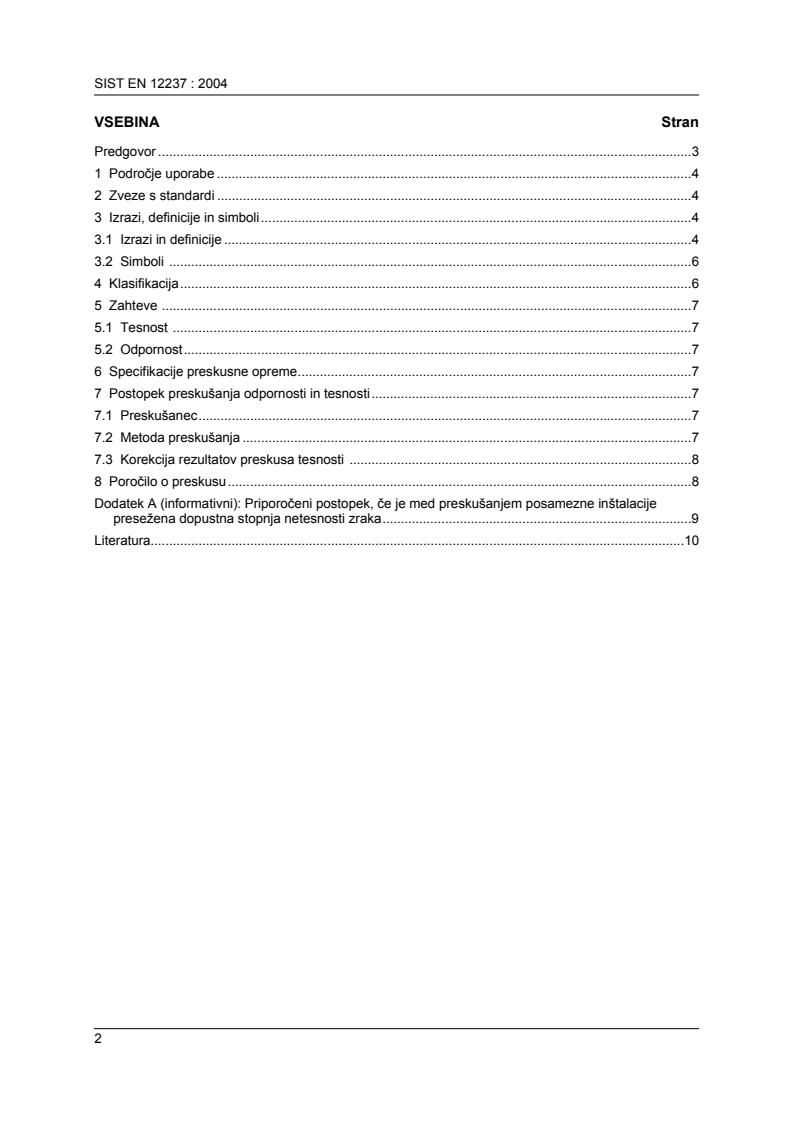
VSEBINA Stran
Predgovor .3
1 Področje uporabe .4
2 Zveze s standardi .4
3 Izrazi, definicije in simboli.4
3.1 Izrazi in definicije .4
3.2 Simboli .6
4 Klasifikacija.6
5 Zahteve .7
5.1 Tesnost .7
5.2 Odpornost.7
6 Specifikacije preskusne opreme.7
7 Postopek preskušanja odpornosti in tesnosti.7
7.1 Preskušanec.7
7.2 Metoda preskušanja .7
7.3 Korekcija rezultatov preskusa tesnosti .8
8 Poročilo o preskusu.8
Dodatek A (informativni): Priporočeni postopek, če je med preskušanjem posamezne inštalacije
presežena dopustna stopnja netesnosti zraka.9
Literatura.10
SIST EN 12237 : 2004
Predgovor
Ta dokument (EN 12237:2003) je pripravil tehnični odbor CEN/TC 156 Prezračevanje stavb, katerega
sekretariat vodi BSI.
Ta evropski standard mora z objavo istovetnega besedila ali z razglasitvijo dobiti status nacionalnega
standarda najpozneje do oktobra 2003, nacionalne standarde, ki so v nasprotju s tem standardom, pa
je treba umakniti najpozneje do oktobra 2003.
Dodatek A je informativni.
Ta standard je del skupine standardov za zračne kanale, ki se uporabljajo za prezračevanje in
klimatiziranje stavb, v katerih se zadržujejo ljudje. Umestitev tega standarda na področju mehanskih
sistemov v stavbah je prikazana na sliki 1.
Mehanski sistemi v stavbah
Sistemi za prezra čevanje
Regulacijski sistemi Ogrevalni sistemi
in klimatizacijo
Klimatske naprave Zračni kanali Inštalacije
Pravokotni
Okrogli pločevinasti
Okrogli pločevinasti Obešala in
pločevinasti zračni
zračni kanali
zračni kanali kanali podporniki
Odpornost in
Mere Odpornost in
tesnost
tesnost
Pravokotni Zahteve za
Merjenje površine
pločevinasti zračni komponente zračnih
Prirobnice
zračnega kanala
kanali kanalov za lažje
Mere vzdrževanje
Določanje Zračni kanali,
Označevanje Gibki zračni kanali
mehanske izdelani iz
energijske izgube izolacijskih plošč
Slika 1: Umestitev EN 12237 na področju mehanskih sistemov v stavbah
V skladu z notranjimi predpisi CEN/CENELEC morajo ta evropski standard obvezno uvesti nacionalne
organizacije za standarde naslednjih držav: Avstrije, Belgije, Češke republike, Danske, Finske,
Francije, Grčije, Islandije, Irske, Italije, Luksemburga, Madžarske, Malte, Nemčije, Nizozemske,
Norveške, Portugalske, Slovaške, Španije, Švedske, Švice in Združenega kraljestva.
SIST EN 12237 : 2004
1 Področje uporabe
Ta evropski standard določa zahteve in metode preskušanja odpornosti in tesnosti okroglih zračnih
kanalov, ki se uporabljajo v klimatizacijskih in prezračevalnih sistemih v stavbah.
Standard je namenjen določitvi mehanske odpornosti in tesnosti, ki sta potrebni za potrditev
primernosti za predvideno delovanje ko
...