

EN 15746-1:2020
(Main)Railway applications - Track - Road-rail machines and associated equipment - Part 1: Technical requirements for travelling and working
General Information
- Abstract
1.1 General
This document deals with the technical requirements to minimize the specific railway hazards of self-propelled road-rail machines - henceforward referred to as machines - and associated equipment, which can arise during the commissioning, operation and maintenance of the machines when carried out in accordance with the specification given by the manufacturer or his authorized representative.
These risks are normally common regardless of the track gauge. However, additional requirements can apply for travelling and working on infrastructures with narrow gauge or broad gauge lines, railways utilizing other than adhesion between the rail and rail wheels and underground infrastructures.
This document is also applicable for machines and associated equipment that in working configuration are partly supported on the ballast or the formation. Such machines are capable of independent self-propelled movement on the ground.
This document does not apply to the following:
- the requirements for quality of the work or performance of the machine;
- the specific requirements established by the machine operator for the use of machines, which will be the subject of negotiation between the manufacturer and the Infrastructure Manager;
- moving and working while not on rails;
- separate machines temporarily mounted on machines and associated equipment;
- demountable machines as defined in 3.2;
- trailers as defined in 3.3, including road-rail trailers.
Vehicles which are not track-guided themselves but have attachments that are track-guided are not road-rail machines.
The requirements within this document are amended and added to by the requirements in EN 15746 4 for machines designed and intended to use urban rail.
This document does not establish the additional requirements for the following:
- operation subject to special rules, e.g. potentially explosive atmospheres;
- hazards due to natural causes, e.g. earthquake, lightning, flooding;
- working methods;
- operation in severe working conditions requiring special measures, e.g. work in tunnels or in cuttings, extreme environmental conditions such as: freezing temperatures, high temperatures, corrosive environments, tropical environments, contaminating environments, strong magnetic fields;
- hazards due to errors in software;
- hazards occurring when used to handle suspended loads which may swing freely.
For a road-rail machine it is assumed that an EU road permissible host vehicle will offer an accepted safety level for its designed basic functions before conversion. Unless explicitly stated otherwise in a particular clause this specific aspect is not dealt with in this European Standard.
Other track construction and maintenance machines used on railway tracks are dealt with in other European Standards, see Annex F.
1.2 Validity of this document
This document applies to all machines which are ordered one year after the publication date by CEN of this document.
- Status
- Published
- Publication Date
- 22-Dec-2020
- Withdrawal Date
- 29-Jun-2021
- Technical Committee
- CEN/TC 256 - Railway applications
- Drafting Committee
- CEN/TC 256/SC 1/WG 5 - Track construction and maintenance machines
- Current Stage
- 6060 - Definitive text made available (DAV) - Publishing
- Start Date
- 23-Dec-2020
- Due Date
- 03-Feb-2020
- Completion Date
- 23-Dec-2020



Overview
EN 15746-1:2020 - identical to EN 15746-1:2020 - defines the technical requirements for self‑propelled road‑rail machines and associated equipment used on railway track for travelling and working. Its purpose is to minimize railway‑specific hazards during commissioning, operation and maintenance when machines are used in accordance with the manufacturer's specification. The standard applies across track gauges (with additional gauge‑specific requirements where needed) and covers machines that may be partly supported on ballast or formation but are capable of independent self‑propelled ground movement.
This standard does not cover work quality/performance requirements, operator‑specific conditions that must be negotiated with infrastructure managers, non‑rail working, demountable modules, trailers (including road‑rail trailers), or vehicles that are not track‑guided. It is complemented by EN 15746‑4 where machines are intended for urban rail use. The standard applies to machines ordered one year after the CEN publication date.
Key topics and technical requirements
SIST EN 15746‑1:2021 addresses a comprehensive set of railway safety topics for road‑rail machines, including:
- Machine categorization and type approval - classification of machine types and implications for testing and approval.
- Clearances and travelling/working gauges - defining travelling gauge, working limits and lateral exceedance on curves.
- Interaction with infrastructure - wheel loads, stresses induced into rails, ballast and formation loads.
- Safety against derailment - requirements and dynamic testing adapted to machine speed categories.
- Stability and overturning prevention - static and dynamic stability proofs, load‑moment control and display.
- Running gear and suspension - wheel arrangements, wheel profiles, rail wheel suspension systems.
- Braking and towing devices - braking performance, emergency recovery and towing provisions.
- Driving/working cabs, controls, visibility and audibility - operator ergonomics, lighting, marker lamps and warning systems.
- Electrical/electromagnetic requirements - equipotential bonding, antennae/pantograph considerations and EMC.
- Failure recovery, on/off tracking and setting up - emergency devices, turntable use and packing away.
- Special equipment - MEWPs, excavators used as MEWPs and related provisions.
(The standard excludes hazards from extreme natural events, explosive atmospheres, software errors, and suspended swinging loads.)
Practical applications and users
This standard is essential for:
- Manufacturers of road‑rail machines converting road vehicles for rail use,
- Infrastructure Managers specifying safe machine use on track,
- Safety engineers and certifying bodies carrying out type approval and conformity assessment,
- Procurement teams ensuring purchased equipment complies with railway safety requirements,
- Maintenance and operations personnel who apply procedures consistent with design limits.
Using SIST EN 15746‑1:2021 helps reduce derailment, overturning and infrastructure damage risks and supports regulatory compliance for track maintenance fleets.
Related standards
- EN 15746‑4 (requirements for machines intended for urban rail)
- Other European standards for track construction and maintenance machines (refer to Annex F of EN 15746‑1)
Keywords: SIST EN 15746‑1:2021, road‑rail machines, railway applications, track, technical requirements, derailment prevention, stability, braking, electromagnetic compatibility, machine categorization.
Relations
- Effective Date
- 09-May-2018
- Effective Date
- 25-Aug-2026
- Effective Date
- 25-Aug-2026
- Effective Date
- 21-Jul-2026
- Effective Date
- 07-Jul-2026
- Effective Date
- 26-May-2026
- Effective Date
- 09-Feb-2026
- Effective Date
- 09-Feb-2026
- Effective Date
- 09-Feb-2026
- Effective Date
- 09-Feb-2026
- Effective Date
- 09-Feb-2026
- Effective Date
- 09-Feb-2026
- Effective Date
- 09-Feb-2026
- Effective Date
- 09-Feb-2026
- Effective Date
- 09-Feb-2026
Get Certified
Connect with accredited certification bodies for this standard

Zavod za gradbeništvo Slovenije (ZAG) - Inšpekcija
ZAG inspection body for construction products, structures, and materials.
Sponsored listings
Frequently Asked Questions
EN 15746-1:2020 is a standard published by the European Committee for Standardization (CEN). Its full title is "Railway applications - Track - Road-rail machines and associated equipment - Part 1: Technical requirements for travelling and working". This standard covers: 1.1 General This document deals with the technical requirements to minimize the specific railway hazards of self-propelled road-rail machines - henceforward referred to as machines - and associated equipment, which can arise during the commissioning, operation and maintenance of the machines when carried out in accordance with the specification given by the manufacturer or his authorized representative. These risks are normally common regardless of the track gauge. However, additional requirements can apply for travelling and working on infrastructures with narrow gauge or broad gauge lines, railways utilizing other than adhesion between the rail and rail wheels and underground infrastructures. This document is also applicable for machines and associated equipment that in working configuration are partly supported on the ballast or the formation. Such machines are capable of independent self-propelled movement on the ground. This document does not apply to the following: - the requirements for quality of the work or performance of the machine; - the specific requirements established by the machine operator for the use of machines, which will be the subject of negotiation between the manufacturer and the Infrastructure Manager; - moving and working while not on rails; - separate machines temporarily mounted on machines and associated equipment; - demountable machines as defined in 3.2; - trailers as defined in 3.3, including road-rail trailers. Vehicles which are not track-guided themselves but have attachments that are track-guided are not road-rail machines. The requirements within this document are amended and added to by the requirements in EN 15746 4 for machines designed and intended to use urban rail. This document does not establish the additional requirements for the following: - operation subject to special rules, e.g. potentially explosive atmospheres; - hazards due to natural causes, e.g. earthquake, lightning, flooding; - working methods; - operation in severe working conditions requiring special measures, e.g. work in tunnels or in cuttings, extreme environmental conditions such as: freezing temperatures, high temperatures, corrosive environments, tropical environments, contaminating environments, strong magnetic fields; - hazards due to errors in software; - hazards occurring when used to handle suspended loads which may swing freely. For a road-rail machine it is assumed that an EU road permissible host vehicle will offer an accepted safety level for its designed basic functions before conversion. Unless explicitly stated otherwise in a particular clause this specific aspect is not dealt with in this European Standard. Other track construction and maintenance machines used on railway tracks are dealt with in other European Standards, see Annex F. 1.2 Validity of this document This document applies to all machines which are ordered one year after the publication date by CEN of this document.
1.1 General This document deals with the technical requirements to minimize the specific railway hazards of self-propelled road-rail machines - henceforward referred to as machines - and associated equipment, which can arise during the commissioning, operation and maintenance of the machines when carried out in accordance with the specification given by the manufacturer or his authorized representative. These risks are normally common regardless of the track gauge. However, additional requirements can apply for travelling and working on infrastructures with narrow gauge or broad gauge lines, railways utilizing other than adhesion between the rail and rail wheels and underground infrastructures. This document is also applicable for machines and associated equipment that in working configuration are partly supported on the ballast or the formation. Such machines are capable of independent self-propelled movement on the ground. This document does not apply to the following: - the requirements for quality of the work or performance of the machine; - the specific requirements established by the machine operator for the use of machines, which will be the subject of negotiation between the manufacturer and the Infrastructure Manager; - moving and working while not on rails; - separate machines temporarily mounted on machines and associated equipment; - demountable machines as defined in 3.2; - trailers as defined in 3.3, including road-rail trailers. Vehicles which are not track-guided themselves but have attachments that are track-guided are not road-rail machines. The requirements within this document are amended and added to by the requirements in EN 15746 4 for machines designed and intended to use urban rail. This document does not establish the additional requirements for the following: - operation subject to special rules, e.g. potentially explosive atmospheres; - hazards due to natural causes, e.g. earthquake, lightning, flooding; - working methods; - operation in severe working conditions requiring special measures, e.g. work in tunnels or in cuttings, extreme environmental conditions such as: freezing temperatures, high temperatures, corrosive environments, tropical environments, contaminating environments, strong magnetic fields; - hazards due to errors in software; - hazards occurring when used to handle suspended loads which may swing freely. For a road-rail machine it is assumed that an EU road permissible host vehicle will offer an accepted safety level for its designed basic functions before conversion. Unless explicitly stated otherwise in a particular clause this specific aspect is not dealt with in this European Standard. Other track construction and maintenance machines used on railway tracks are dealt with in other European Standards, see Annex F. 1.2 Validity of this document This document applies to all machines which are ordered one year after the publication date by CEN of this document.
EN 15746-1:2020 is classified under the following ICS (International Classification for Standards) categories: 93.100 - Construction of railways. The ICS classification helps identify the subject area and facilitates finding related standards.
EN 15746-1:2020 has the following relationships with other standards: It is inter standard links to EN 15746-1:2010+A1:2011, ISO 8755:2001, ISO 16754:2008, EN IEC 60947-5-5:2026, EN IEC 60947-10:2026, EN IEC 60947-6-1:2026, EN 60947-5-4:2003, EN 50317:2025, EN 60947-5-5:1997/A11:2013, EN IEC 60947-5-8:2021, EN 50121-3-1:2017, EN IEC 60947-1:2021, EN 60947-5-5:1997/A1:2005, EN 60947-5-2:2007, EN 60947-5-4:2003/A1:2019. Understanding these relationships helps ensure you are using the most current and applicable version of the standard.
EN 15746-1:2020 is associated with the following European legislation: EU Directives/Regulations: 2006/42/EC, 2008/57/EC; Standardization Mandates: M/483. When a standard is cited in the Official Journal of the European Union, products manufactured in conformity with it benefit from a presumption of conformity with the essential requirements of the corresponding EU directive or regulation.
EN 15746-1:2020 is available in PDF format for immediate download after purchase. The document can be added to your cart and obtained through the secure checkout process. Digital delivery ensures instant access to the complete standard document.
Standards Content (Sample)
SLOVENSKI STANDARD
01-marec-2021
Nadomešča:
SIST EN 15746-1:2011+A1:2012
Železniške naprave - Zgornji ustroj proge - Dvopotna železniška vozila in oprema -
1. del: Tehnične zahteve za vožnjo in delovanje
Railway applications - Track - Road-rail machines and associated equipment - Part 1:
Technical requirements for travelling and working
Bahnanwendungen - Oberbau - Zweiwege-Maschinen und zugehörige Ausrüstungen -
Teil 1: Technische Anforderungen an die Versetzfahrt und den Arbeitseinsatz
Applications ferroviaires - Voie - Machines rail-route et équipements associés - Partie 1 :
Exigences techniques pour le déplacement et le travail
Ta slovenski standard je istoveten z: EN 15746-1:2020
ICS:
45.060.01 Železniška vozila na splošno Railway rolling stock in
general
2003-01.Slovenski inštitut za standardizacijo. Razmnoževanje celote ali delov tega standarda ni dovoljeno.
EN 15746-1
EUROPEAN STANDARD
NORME EUROPÉENNE
December 2020
EUROPÄISCHE NORM
ICS 93.100 Supersedes EN 15746-1:2010+A1:2011
English Version
Railway applications - Track - Road-rail machines and
associated equipment - Part 1: Technical requirements for
travelling and working
Applications ferroviaires - Voie - Machines rail-route et Bahnanwendungen - Oberbau - Zweiwege-Maschinen
équipements associés - Partie 1 : Prescriptions und zugehörige Ausrüstungen - Teil 1: Technische
techniques pour le déplacement et le travail Anforderungen an die Versetzfahrt und den
Arbeitseinsatz
This European Standard was approved by CEN on 5 May 2019.
CEN members are bound to comply with the CEN/CENELEC Internal Regulations which stipulate the conditions for giving this
European Standard the status of a national standard without any alteration. Up-to-date lists and bibliographical references
concerning such national standards may be obtained on application to the CEN-CENELEC Management Centre or to any CEN
member.
This European Standard exists in three official versions (English, French, German). A version in any other language made by
translation under the responsibility of a CEN member into its own language and notified to the CEN-CENELEC Management
Centre has the same status as the official versions.
CEN members are the national standards bodies of Austria, Belgium, Bulgaria, Croatia, Cyprus, Czech Republic, Denmark, Estonia,
Finland, France, Germany, Greece, Hungary, Iceland, Ireland, Italy, Latvia, Lithuania, Luxembourg, Malta, Netherlands, Norway,
Poland, Portugal, Republic of North Macedonia, Romania, Serbia, Slovakia, Slovenia, Spain, Sweden, Switzerland, Turkey and
United Kingdom.
EUROPEAN COMMITTEE FOR STANDARDIZATION
COMITÉ EUROPÉEN DE NORMALISATION
EUROPÄISCHES KOMITEE FÜR NORMUNG
CEN-CENELEC Management Centre: Rue de la Science 23, B-1040 Brussels
© 2020 CEN All rights of exploitation in any form and by any means reserved Ref. No. EN 15746-1:2020 E
worldwide for CEN national Members.
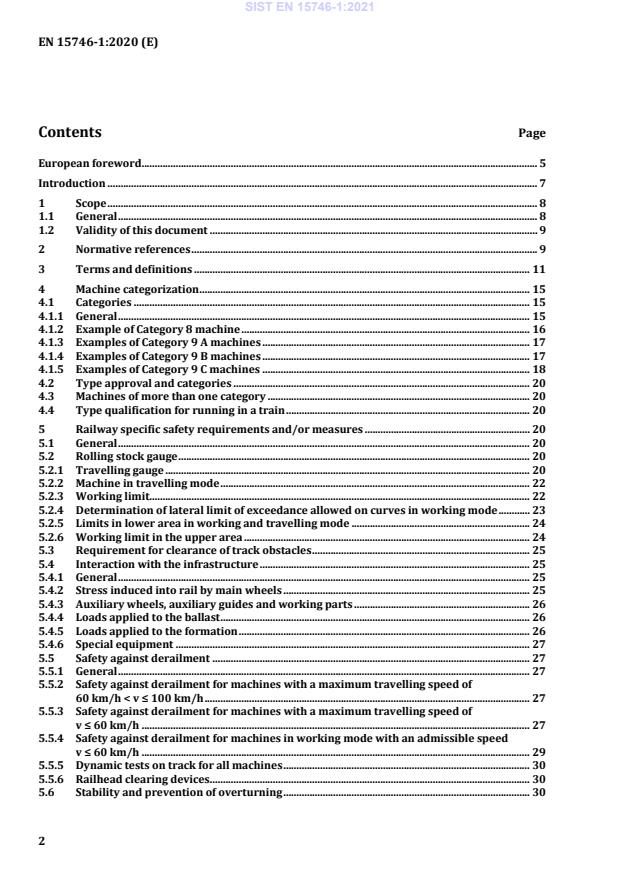
Contents Page
European foreword . 5
Introduction . 7
1 Scope . 8
1.1 General . 8
1.2 Validity of this document . 9
2 Normative references . 9
3 Terms and definitions . 11
4 Machine categorization . 15
4.1 Categories . 15
4.1.1 General . 15
4.1.2 Example of Category 8 machine . 16
4.1.3 Examples of Category 9 A machines . 17
4.1.4 Examples of Category 9 B machines . 17
4.1.5 Examples of Category 9 C machines . 18
4.2 Type approval and categories . 20
4.3 Machines of more than one category . 20
4.4 Type qualification for running in a train . 20
5 Railway specific safety requirements and/or measures . 20
5.1 General . 20
5.2 Rolling stock gauge . 20
5.2.1 Travelling gauge . 20
5.2.2 Machine in travelling mode . 22
5.2.3 Working limit. 22
5.2.4 Determination of lateral limit of exceedance allowed on curves in working mode . 23
5.2.5 Limits in lower area in working and travelling mode . 24
5.2.6 Working limit in the upper area . 24
5.3 Requirement for clearance of track obstacles . 25
5.4 Interaction with the infrastructure . 25
5.4.1 General . 25
5.4.2 Stress induced into rail by main wheels . 25
5.4.3 Auxiliary wheels, auxiliary guides and working parts . 26
5.4.4 Loads applied to the ballast . 26
5.4.5 Loads applied to the formation . 26
5.4.6 Special equipment . 27
5.5 Safety against derailment . 27
5.5.1 General . 27
5.5.2 Safety against derailment for machines with a maximum travelling speed of
60 km/h < v ≤ 100 km/h . 27
5.5.3 Safety against derailment for machines with a maximum travelling speed of
v ≤ 60 km/h . 27
5.5.4 Safety against derailment for machines in working mode with an admissible speed
v ≤ 60 km/h . 29
5.5.5 Dynamic tests on track for all machines . 30
5.5.6 Railhead clearing devices . 30
5.6 Stability and prevention of overturning . 30
5.6.1 Proof of stability against overturning, machine stationary in rail configuration . 30
5.6.2 Proof of stability when moving along the track in working mode . 33
5.6.3 Load moment control and display device . 34
5.7 Machine frame structure . 36
5.7.1 Design of the machine frame . 36
5.7.2 Demountable modules . 36
5.7.3 Lifting and jacking points . 37
5.8 Inter-machine couplings . 37
5.8.1 General . 37
5.8.2 Towing adaptor . 38
5.9 Running gear . 38
5.9.1 General . 38
5.9.2 Distribution of the wheelset forces in travelling mode . 39
5.9.3 Machine rail wheel base . 39
5.9.4 Rail wheel and wheel profile in travelling mode . 39
5.9.5 Rail wheel arrangements . 41
5.9.6 Load on rail wheels . 41
5.9.7 Load on rail wheels in working configuration . 43
5.9.8 Operation of spring loaded points . 44
5.9.9 Ratio of wheel load on guiding wheels to road axle load . 44
5.10 Rail wheel suspension. 45
5.10.1 Rail wheel suspension systems . 45
5.10.2 Positively locked suspension . 46
5.10.3 Active suspension . 46
5.10.4 All suspension systems . 46
5.11 Braking . 46
5.11.1 General braking requirements . 46
5.11.2 Requirements for Category 9 machines in travelling and working modes . 46
5.12 Driving and working cabs and places . 48
5.13 Controls . 48
5.14 Visibility and audibility of the machine . 48
5.14.1 General . 48
5.14.2 Marker lights in travelling mode . 48
5.14.3 Lighting with failed engine . 49
5.14.4 Lamp brackets . 49
5.14.5 Light switching arrangements . 51
5.14.6 Head lights . 51
5.14.7 Lighting in working mode . 51
5.14.8 Warning horns . 51
5.14.9 Colour of the machine . 51
5.15 Warning systems for personnel of traffic on adjacent track . 52
5.15.1 General . 52
5.15.2 Permanently mounted acoustic warning systems . 52
5.15.3 Permanently mounted optical warning systems . 52
5.15.4 Designated space for mobile warning devices . 52
5.16 Electrical equipment and equipotential bonding . 53
5.16.1 Equipotential bonding . 53
5.16.2 Antennae . 53
5.16.3 Pantograph . 53
5.17 Electromagnetic compatibility . 53
5.17.1 Emissions from machines . 53
5.17.2 Immunity of machines from railway environment . 53
5.18 Power supply . 54
5.19 Failure recovery conditions . 54
5.19.1 Towing devices . 54
5.19.2 Emergency device . 54
5.20 On and off tracking . 54
5.20.1 General . 54
5.20.2 Use of turntables . 55
5.21 Setting up and packing away . 55
5.21.1 General . 55
5.21.2 Emergency recovery of equipment . 55
5.22 Mobile elevating work platform (MEWP) and excavators/loaders used as MEWPs . 55
5.23 Attachments . 55
5.23.1 General . 55
5.23.2 General attachments for raising and lowering personnel . 56
5.23.3 Attachments with rail guidance wheels . 56
5.24 Environmental protection . 56
5.24.1 General . 56
5.24.2 Carriage and storage of fuel and oil . 56
5.24.3 Tanks and equipment . 56
6 Marking and numbering of the machines . 56
6.1 Warning signs and pictograms . 56
6.2 Machine identification number . 57
7 User information . 57
8 Verification of the conformity to the requirements and/or particular safety
measures . 60
Annex A (normative) Special national conditions . 61
Annex B (normative) Check list for conformity . 73
Annex C (informative) Certificates . 78
C.1 Certificate of type approval to EN 15746-1:2020 . 78
C.2 Conformance control document for the technical requirements of EN 15746-1:2020 . 79
C.2.1 Machine identification . 79
C.2.2 General characteristics . 79
Annex D (informative) Machine numbering structure for Category 9 machines not designed
to operate track signalling and control systems . 81
Annex E (informative) Machine identification plate for Category 9 machines not designed to
operate track signalling and control systems . 84
Annex F (informative) Structure of European Standards for track construction and
maintenance machines . 85
Bibliography . 87
European foreword
This document (EN 15746-1:2020) has been prepared by Technical Committee CEN/TC 256 “Railway
applications”, the secretariat of which is held by DIN.
This European Standard shall be given the status of a national standard, either by publication of an
identical text or by endorsement, at the latest by June 2021, and conflicting national standards shall be
withdrawn at the latest by June 2021.
Attention is drawn to the possibility that some of the elements of this document may be the subject of
patent rights. CEN shall not be held responsible for identifying any or all such patent rights.
This document supersedes EN 15746-1:2010+A1:2011.
Principal amended clauses compared to EN 15746-1:2010+A1:2011:
— general All references updated to latest issue;
— running, travelling and working modes adopted;
— requirements solely for running mode moved to new EN 15746-3:2020;
— 4.3 New clause;
— 5.5 Clause on safety against derailment enhanced to provide greater clarity and increased options
for testing;
— 5.6 Specific requirements for prevention of overturning moved from EN 15746-2:2010+A1:2011,
5.11 with enhanced requirements for RCI/RCL and data recording;
— 5.7 Requirements for frame structure simplified;
— requirements for demountable modules added;
— 5.8 Requirements for couplings made more specific for road-rail machines;
— 5.14 Requirements for lighting amended;
— 5.16 Requirements for pantographs enhanced;
— 5.24 New clause for environmental protection;
— Annexes All annexes reviewed and updated;
— Annex C Now informative;
— Annex D Now informative and the identification number changed to commence ZZ;
— Annex E Now informative.
EN 15746, Railway applications — Track — Road-rail machines and associated equipment, is currently
composed with the following parts:
— Part 1: Technical requirements for travelling and working;
— Part 2: General safety requirements;
— Part 3: Technical requirements for running;
— Part 4: Technical requirements for running, travelling and working on urban rail.
According to the CEN-CENELEC Internal Regulations, the national standards organisations of the
following countries are bound to implement this European Standard: Austria, Belgium, Bulgaria,
Croatia, Cyprus, Czech Republic, Denmark, Estonia, Finland, France, Germany, Greece, Hungary, Iceland,
Ireland, Italy, Latvia, Lithuania, Luxembourg, Malta, Netherlands, Norway, Poland, Portugal, Republic of
North Macedonia, Romania, Serbia, Slovakia, Slovenia, Spain, Sweden, Switzerland, Turkey and the
United Kingdom.
Introduction
This European Standard was prepared to meet the essential requirements of EU Directives to facilitate
an open market for goods and services.
This document is the first of a series of four parts of the European Standard: Railway applications —
Track — Road-rail machines and associated equipment, dealing with railway specific risks of the road-
rail machines when running, travelling and working on railway infrastructures:
— Part 1 covers the technical requirements for the machines in travelling and working modes, and is
applicable for all machines.
— Part 2 covers the safety requirements for the machines in travelling and working modes; this is a
document harmonized with the European Machinery Directive 2006/42/EC.
— Part 3 covers the essential requirements for the machines that have a running mode and run on
tracks within the scope of the Railway Directive 2007/58/EC; this is a document harmonized with
the Railway Interoperability Directive 2008/57/EC and its associated Technical Specifications for
Interoperability (TSI).
— Part 4 covers the technical requirements for the machines that have a running mode on urban rail
and/or for machines intended to have running, travelling and/or working mode on urban rail.
Part 1 defines requirements for approval of the machine for use on the railway. Depending on the
decision of the Infrastructure Manager or National rules the assessment of conformance could be by the
Infrastructure Manager concerned, by a third party assessor or declaration of conformity by the
manufacturer.
Part 2 defines requirements for the machine to be declared conformant by the manufacturer, except in
the case of machines classified under Annex 4 of the Machinery Directive, which require a conformity
check in conjunction with a notified body.
Part 3 defines requirements for running on the European railway network. Assessment of conformity is
by a notified body as prescribed in the Railway Interoperability Directive.
Part 4 defines requirements for approval of the machine for use on urban rail. Depending on the
decision of the manager of the network or National rules the assessment of conformance could be by
the Urban Rail Manager concerned, by a third party assessor or declaration of conformity by the
manufacturer.
The risks which exist in all mechanical, electrical, hydraulic, pneumatic and other components of
machines and which are dealt with in the relevant European Standards are not within the scope of this
European Standard. Where necessary, references are made to appropriate standards of this type.
1 Scope
1.1 General
This document deals with the technical requirements to minimize the specific railway hazards of self-
propelled road-rail machines – henceforward referred to as machines – and associated equipment,
which can arise during the commissioning, operation and maintenance of the machines when carried
out in accordance with the specification given by the manufacturer or his authorized representative.
These risks are normally common regardless of the track gauge. However, additional requirements can
apply for travelling and working on infrastructures with narrow gauge or broad gauge lines, railways
utilizing other than adhesion between the rail and rail wheels and underground infrastructures.
This document is also applicable for machines and associated equipment that in working configuration
are partly supported on the ballast or the formation. Such machines are capable of independent self-
propelled movement on the ground.
This document does not apply to the following:
— the requirements for quality of the work or performance of the machine;
— the specific requirements established by the machine operator for the use of machines, which will
be the subject of negotiation between the manufacturer and the Infrastructure Manager;
— moving and working while not on rails;
— separate machines temporarily mounted on machines and associated equipment;
— demountable machines as defined in 3.2;
— trailers as defined in 3.3, including road-rail trailers.
Vehicles which are not track-guided themselves but have attachments that are track-guided are not
road-rail machines.
The requirements within this document are amended and added to by the requirements in EN 15746-4
for machines designed and intended to use urban rail.
This document does not establish the additional requirements for the following:
— operation subject to special rules, e.g. potentially explosive atmospheres;
— hazards due to natural causes, e.g. earthquake, lightning, flooding;
— working methods;
— operation in severe working conditions requiring special measures, e.g. work in tunnels or in
cuttings, extreme environmental conditions such as: freezing temperatures, high temperatures,
corrosive environments, tropical environments, contaminating environments, strong magnetic
fields;
— hazards due to errors in software;
— hazards occurring when used to handle suspended loads which may swing freely.
For a road-rail machine it is assumed that an EU road permissible host vehicle will offer an accepted
safety level for its designed basic functions before conversion. Unless explicitly stated otherwise in a
particular clause this specific aspect is not dealt with in this European Standard.
Other track construction and maintenance machines used on railway tracks are dealt with in other
European Standards, see Annex F.
1.2 Validity of this document
This document applies to all machines which are ordered one year after the publication date by CEN of
this document.
2 Normative references
The following documents are referred to in the text in such a way that some or all of their content
constitutes requirements of this document. For dated references, only the edition cited applies. For
undated references, the latest edition of the referenced document (including any amendments) applies.
EN 280, Mobile elevating work platforms — Design calculations — Stability criteria — Construction —
Safety — Examinations and tests
EN 286-3, Simple unfired pressure vessels designed to contain air or nitrogen — Part 3: Steel pressure
vessels designed for air braking equipment and auxiliary pneumatic equipment for railway rolling stock
EN 286-4, Simple unfired pressure vessels designed to contain air or nitrogen — Part 4: Aluminium alloy
pressure vessels designed for air braking equipment and auxiliary pneumatic equipment for railway
rolling stock
EN 13309, Construction machinery — Electromagnetic compatibility of machines with internal power
supply
EN 13715, Railway applications — Wheelsets and bogies — Wheels — Tread profile
EN 14033-1:2017, Railway applications — Track — Railbound construction and maintenance
machines — Part 1: Technical requirements for running
EN 14033-2:2017, Railway applications — Track — Railbound construction and maintenance
machines — Part 2: Technical requirements for travelling and working
EN 14363:2016+A1:2018, Railway applications — Testing and Simulation for the acceptance of running
characteristics of railway vehicles — Running Behaviour and stationary tests
EN 14601, Railway applications — Straight and angled end cocks for brake pipe and main reservoir pipe
EN 15273-2:2013+A1:2016, Railway applications — Gauges — Part 2: Rolling stock gauge
EN 15528, Railway applications — Line categories for managing the interface between load limits of
vehicles and infrastructure
EN 15566, Railway applications — Railway rolling stock — Draw gear and screw coupling
EN 15746-2:2020, Railway applications — Track — Road-rail machines and associated equipment —
Part 2: General safety requirements
EN 15746-3:2020, Railway applications — Track — Road-rail machines and associated equipment —
Part 3: Technical requirements for running
EN 15746-4:2020, Railway applications — Track — Road-rail machines and associated equipment —
Part 4: Technical requirements for running, travelling and working on urban rail
EN 15954-1:2013, Railway applications — Track — Trailers and associated equipment — Part 1:
Technical requirements for running and working
EN 15954-2, Railway applications — Track — Trailers and associated equipment — Part 2: General
safety requirements
EN 15807, Railway applications — Pneumatic half couplings
EN 15877-1:2012+A1:2018, Railway applications — Marking on railway vehicles — Part 1: Freight
wagons
EN 50121-3-1:2017, Railway applications — Electromagnetic compatibility — Part 3-1: Rolling stock —
Train and complete vehicle
EN 50121-3-2:2016, Railway applications — Electromagnetic compatibility — Part 3-2: Rolling stock -
Apparatus
EN 50122-1:2011, Railway applications — Fixed installations — Electrical safety, earthing and the
return circuit — Part 1: Protective provisions against electric shock
EN 50206-1, Railway applications — Rolling stock — Pantographs: Characteristics and tests — Part 1:
Pantographs for main line vehicles
EN 50206-2, Railway applications — Rolling stock — Pantographs: Characteristics and tests — Part 2:
Pantographs for metros and light rail vehicles
EN 50317, Railway applications — Current collection systems — Requirements for and validation of
measurements of the dynamic interaction between pantograph and overhead contact line
EN 50318, Railway applications — Current collection systems — Validation of simulation of the dynamic
interaction between pantograph and overhead contact line
EN 50367, Railway applications — Current collection systems — Technical criteria for the interaction
between pantograph and overhead line (to achieve free access)
EN 50405, Railway applications — Current collection systems — Pantographs, testing methods for contact
strips
EN 60947 (all parts), Low-voltage switchgear and controlgear (IEC 60947, all parts)
As impacted by EN 50121-3-1:2017/A1:2019.
As impacted by EN 50121-3-2:2016/A1:2019.
As impacted by EN 50122-1:2011/A1:2011, EN 50122-1:2011/A2:2016, EN 50122-1:2011/A3:2017 and EN
50122-1:2011/A4:2017.
EN ISO 7731, Ergonomics — Danger signals for public and work areas — Auditory danger signals
(ISO 7731)
ISO 16754, Earth moving machinery — Determination of average ground contact pressure for crawler
machines
ISO 8755, Commercial road vehicles — 40 mm drawbar eye — Interchangeability
DIN 74054 (all parts), Mechanical connections between towing vehicles and trailers
3 Terms and definitions
For the purposes of this document, the following terms and definitions apply.
ISO and IEC maintain terminological databases for use in standardization at the following addresses:
• IEC Electropedia: available at http://www.electropedia.org/
• ISO Online browsing platform: available at http://www.iso.org/obp
3.1
road-rail machine
self-propelled machine that can move on rails and ground
Note 1 to entry It is normally a road vehicle adapted for moving on rail also, but can be a specially designed rail
vehicle for moving on the ground also.
Note 2 to entry It does not imply that the machine is suitable for use on the public road.
3.2
demountable machine
machine that can travel and work only on rail and which is not intended to operate track signalling and
control systems, but is not able to travel on the ground
Note 1 to entry Such a machine is designed to get on and off track by its own means or with other lifting
equipment. In the case of demounting by its own means these are not intended for operating on the ground.
Note 2 to entry Such a machine is permitted to work on the railway only under special operating conditions
granted by the Infrastructure Manager and travel under special conditions granted by the authorized body and/or
the Infrastructure Manager.
3.3
trailer
non-self-propelled machine that can be hauled on rail wheels
Note 1 to entry: Trailers are not intended to operate track signalling and control systems and are not designed
to be transported between work areas on their rail wheels.
3.4
mobile elevating work platform
MEWP
mobile machine intended to move persons to working positions where they carry out work from the
work platform with the intention that persons get on and off the work platform at one defined access
position, and which consists as a minimum of a work platform with controls, an extending structure and
a chassis
3.5
lifting accessory
loose lifting tackle, i.e. components or equipment not attached to the machine and placed between the
machinery and the load or on the load in order to attach it
3.6
host vehicle
basic road vehicle or machine which is converted to operate additionally on rails; this vehicle is either
EU road permissible or CE marked
3.7
manufacturer
body that designs and constructs a road-rail machine, or converts the original machine/vehicle to a
road-rail machine
3.8
running mode
machine configuration that allows movement along the track, all parts stowed and locked with
everything within the applicable gauge, whilst the machine interrelates with the signalling and control
systems for normal railway traffic
Note 1 to entry: The mode only relates to the technical configuration of the machine independent of the
operational mode (e.g. movements during shunting and regular train running). The operational mode is defined
by the Infrastructure Manager.
3.9
travelling mode
machine configuration that allows movement along the track, all parts stowed with everything within
the applicable gauge, whilst the machine does not require to interrelate with the signalling and control
systems (in this condition there is no need to ensure operation of signalling systems or for cab based
signalling equipment), and which as a mode also includes shunting
Note 1 to entry: A machine in travelling mode does not need to meet the operational requirements for the
movement of trains on the railway network.
Note 2 to entry: The mode only relates to the technical configuration of the machine independent of the
operational mode (e.g. movements during shunting and regular train running). The operational mode is defined
by the Infrastructure Manager.
3.10
working mode
mode by which the machine is used to perform any of its permitted design tasks, as soon as any part of
the machine is un-stowed it is in working mode
3.11
shunting
movement along the track, controlled by operational signals, or radio, of self-propelled machines, either
on its own or towing or propelling one or more vehicles or machines
3.12
on and off tracking mode
mode of the machine when it is in a state that enables it to be on or off tracked
3.13
running
moving the machine in running mode along the track
3.14
operating track
track corresponding to the criteria of the Infrastructure Manager on which vehicles may run under
normal signalling arrangements (with or without a speed limit)
3.15
working track
track not open for normal traffic
3.16
degraded working track
track being maintained for which the geometrical parameters may reach the limiting values and for
which special operational restrictions may apply
Note 1 to entry: The limiting values as specified in EN 14033-2:2017, Annex F.
3.17
railway infrastructure
all installations required for the running of railway vehicles
EXAMPLE Tracks, level crossings, overhead contact line systems, signals.
3.18
machine operator
private or public undertaking which operates machines for the construction and maintenance of the
infrastructure
3.19
operator
person who handles the controls of a machine in order to perform the functions of the machine
3.20
driver
person who handles the controls of a machine in order to control the machine when moving along the
track
Note 1 to entry: The driver and operator can be the same.
3.21
train
self-propelled machine or assembly of vehicles/machines attached by couplings conforming to the
relevant regulations of the authorized body and/or Infrastructure Manager
Note 1 to entry: This is only relevant to Category 8 machines and category 9 machines with a running mode.
Note 2 to entry: This does not exclude Category 9 machines from shunting conventional rail vehicles, where
permitted by the Infrastructure Manager
3.22
special train
assembly of vehicles/machines attached by couplings to a Category 9 machine, and conforming to the
relevant requirements of the Infrastructure Manager
3.23
rail level
datum point corresponding to the top of the rail
Note 1 to entry: Further guidance shown in Figure 5.
3.24
rated load
load that the lifting equipment has been designed for normal operation and the manufacturer states can
be lifted in any specified position
3.25
authorized body
body in a state that, in accordance with the laws and prescriptions in force in that state, is competent to
approve rail vehicles for the use in public rail traffic
3.26
type testing
examination of the first machine, of a new type, for build conformity to the requirements of this
standard
3.27
type conformance testing
procedure to verify that the machine conforms to the design of the first machine of the type that has
been approved
3.28
type approval certificate
document issued after the checking of documents and/or testing of vehicles in which the agreement of
the use of the mac
...