

FprEN 13040-1
(Main)Soil improvers and growing media - Sample preparation - Part 1: Sample preparation for chemical and physical tests, determination of dry matter content, moisture content and laboratory bulk density
- Abstract
This document specifies a routine method for preparing a sample of organic soil improver, inorganic soil improver, growing medium, compost or digestate prior to chemical analysis and physical testing. The procedures described herein apply only to those samples that are supplied to a laboratory in the form in which they will be used for their intended purpose and to samples with a manufacturer’s guidance for reconstitution.
NOTE 1 The determination of the laboratory bulk density is given in Annex A.
NOTE 2 The results of an interlaboratory trial to determine moisture content and dry matter content are given in Annex B.
NOTE 3 The results of an interlaboratory trial to determine laboratory bulk density are given in Annex B.
NOTE 4 This method has been validated in an interlaboratory study with specific products that were present on the market during the study (as included in Annex B, being bark (Pinus pinaster 20 mm to 40 mm fraction), biowaste compost (Rottegrad 3), soil improver (pellets, sieved 4 mm), blend (consisting of white peat, green compost, wood fibre, lime and inorganic fertilizer (NPK + micro elements))).
- Status
- Not Published
- Publication Date
- 06-Jan-2027
- Technical Committee
- CEN/TC 223 - Soil improvers and growing media
- Drafting Committee
- CEN/TC 223/WG 4 - Analytical methods
- Current Stage
- 5020 - Submission to Vote - Formal Approval
- Start Date
- 17-Sep-2026
- Due Date
- 21-Dec-2024
- Completion Date
- 17-Sep-2026

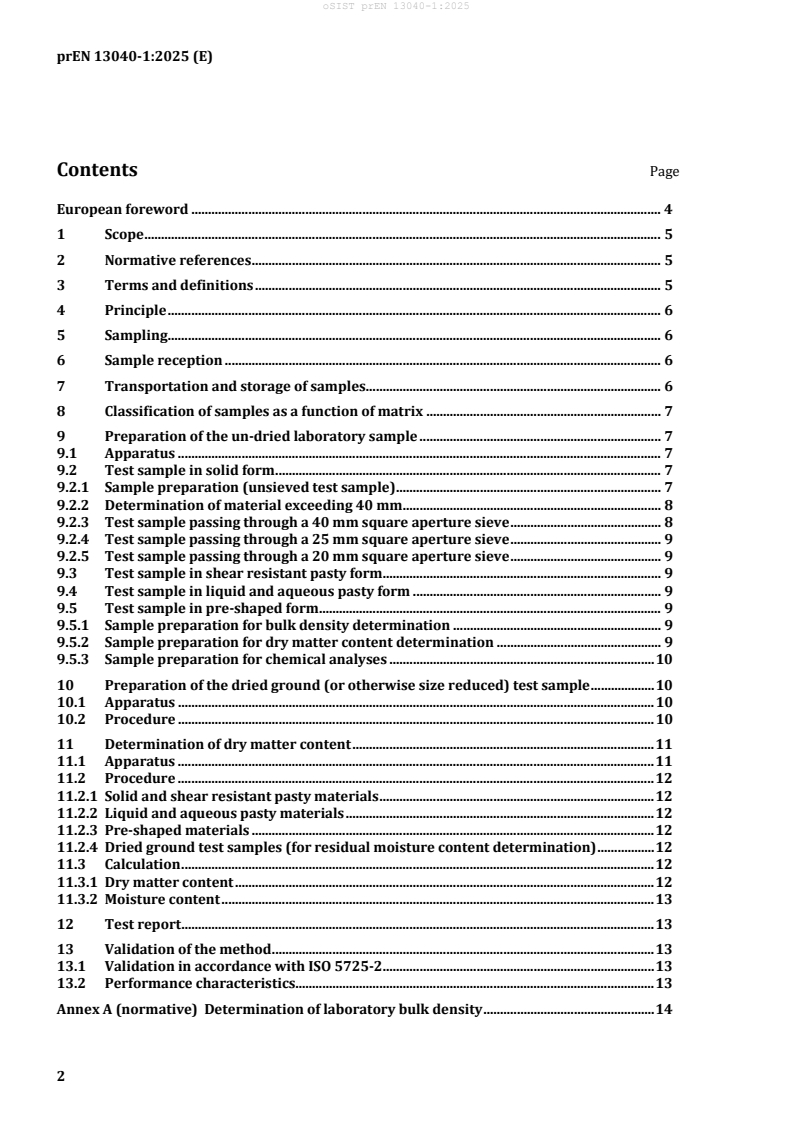
FprEN 13040-1 is a CEN draft European Standard for sample preparation of soil improvers and growing media. It sets a routine method for preparing samples before chemical analysis and physical testing, and for determining dry matter content, moisture content and laboratory bulk density. The document is intended for laboratories and others handling organic soil improver, inorganic soil improver, growing medium, compost or digestate.
What does FprEN 13040-1 specify?
FprEN 13040-1 specifies how to prepare a laboratory sample so that test samples are representative and suitable for analysis. It applies to samples delivered in the form in which they will be used, and to samples supplied with manufacturer guidance for reconstitution.
Sampling itself is outside the method. Clause 5 points users to EN 12579 for sampling, and the method starts once the laboratory receives the sample.
The document is organized into:
- Clauses 1 to 13, covering scope, references, terms, principle, sample handling, preparation, dry matter content, reporting and validation
- Annex A, which gives the laboratory bulk density method
- Annex B, which gives performance characteristics from validation work
| Annex | What it covers |
|---|---|
| Annex A | Determination of laboratory bulk density |
| Annex B | Performance characteristics of the method |
What are the key requirements of FprEN 13040-1?
FprEN 13040-1 is built around representative sampling, careful sample conditioning, matrix-based preparation and documented results. In practice, the laboratory has to classify the sample correctly, avoid unnecessary moisture loss or physical damage, and choose the right preparation route for the test requested.
Clause 4 - principle: The laboratory sample is coded and subdivided to produce a representative test sample. Dry matter and moisture are determined by oven drying, and laboratory bulk density is obtained from the mass of a known volume. This matters because the whole method depends on the test portion reflecting the submitted material.
Clauses 6 and 7 - reception, transport and storage: The lab checks the sample against the accompanying information and records client name, report recipient, sampling place and date, sampler, sample identification and requested analysis. Samples are transported and stored without compaction or treatment that would change moisture, particle size or density, and fresh materials are analysed within 2 weeks of receipt. This protects results from changes before testing starts.
Clause 8 - matrix classification: The document separates samples into solid, shear resistant pasty, liquid and aqueous pasty, and pre-shaped samples. The physical state is decisive for the preparation route, with estimated dry matter content used as support. This matters because the same material cannot be treated the same way in the laboratory.
Clause 9 - preparation of the un-dried laboratory sample: Solid samples are mixed, subdivided and sieved according to particle size, with different routes for 40 mm, 25 mm and 20 mm sieves. The clause also gives rules for material retained on sieves and for when EN 12580 applies to bulk density instead of the normal preparation path. The practical effect is that coarse material is handled without destroying its structure more than necessary.
Clauses 9.3 to 9.5 - pasty and pre-shaped materials: Shear resistant pasty samples are homogenized manually, while liquid and aqueous pasty samples are shaken, stirred and blended, except where blending is not allowed for specific determinations such as OUR or when stones and impurities must be preserved. Pre-shaped samples follow separate preparation routes for bulk density, dry matter content and chemical analyses. This keeps the preparation aligned with the later test.
Clause 10 - dried ground or size-reduced test sample: The document gives a drying and grinding route for further determinations, including a case for samples containing or suspected to contain high NH4-N, where tartaric acid is used before drying. It also gives routes to avoid loss of volatile components and to reduce dried material to the particle size needed for later analyses. This is important when one prepared sample has to support more than one test.
Clause 11 - dry matter and moisture content: The standard specifies oven-drying conditions, constant-mass checks and calculation of dry matter content and moisture content. Results are taken from repeated measurements and expressed as percentages by mass. For the reader, this means the standard gives both the lab procedure and the way to calculate the reported values.
Clause 12 and Annex A - reporting and bulk density: Test reports must identify the document, identify the sample, give results to the required precision and note any non-standard or optional operations. Annex A adds the bulk density method for solid, shear resistant pasty, liquid and aqueous pasty, and pre-shaped samples. This is the part used when a volume-based density result is needed for later calculations.
What terms does FprEN 13040-1 define?
- Test sample - the sample prepared from the laboratory sample, from which test portions are taken.
- Test portion - the quantity of material actually used for the test or observation.
- Laboratory compacted bulk density - the density of a material measured in a known-volume cylinder after compaction under defined conditions.
- Solid samples - samples with an estimated dry matter content of at least 30 % m/m, such as compost or peat.
- Shear resistant pasty samples - samples with an estimated dry matter content between 15 % m/m and 30 % m/m, such as sludge or thick digestate.
- Liquid and aqueous pasty samples - samples with an estimated dry matter content below 15 % m/m, such as liquid sludge or thin digestate.
- Pre-shaped samples - formed products such as slabs, blocks or plugs that need special handling before testing.
Who uses FprEN 13040-1?
FprEN 13040-1 is used by laboratories testing soil improvers, growing media, compost and digestate. It is also relevant to producers, quality managers and sampling services that need a common preparation route before chemical or physical testing.
In practice, users apply it when they:
- receive and register samples
- prepare samples for moisture, dry matter, bulk density and other analyses
- choose sieving, mixing, drying or grinding steps
- document results for reports, product control or conformity work
What changed in FprEN 13040-1 from the previous edition?
FprEN 13040-1 will supersede EN 13040:2007. The foreword lists these technical changes:
- the title has been changed
- Clause 7 on transportation and storage has been completed
- Clause 8 on classification by matrix has been introduced
- Clause 9 now includes new types of test samples
- Clause 10 has been updated
- Clause 11 now includes new types of test samples, including dried ground samples for residual moisture content
- Annex A has been completed with different bulk density procedures by matrix type
- formulas A.1 and A.2 have been modified
Which standards are used with FprEN 13040-1?
FprEN 13040-1 cites these standards and related parts:
- CEN/TS 17732:2022 - provides terminology used with soil improvers and growing media
- EN 12579:2024 - gives the sampling rules that sit before this preparation method
- EN 12580:2022 - supports quantity determination and is also used where bulk density is measured for coarse material
- prEN 15761:2022 - provides the method for pre-shaped growing media bulk density and is used for pre-shaped sample preparation
- ISO 5725-2 - provides the validation framework for repeatability and reproducibility
- EN 13041:2011 - is cited for physical analyses of the prepared 25 mm test sample
- prEN 13650:2025, prEN 13654-1:2025, prEN 13654-2:2025 and prEN 18253:2025 - are named where dried ground samples need to be reduced further for later chemical determinations
What does the FprEN 13040-1 document contain?
FprEN 13040-1 contains step-by-step preparation routes for solid, shear resistant pasty, liquid and aqueous pasty, and pre-shaped samples. It also contains apparatus lists, handling rules, drying conditions, calculations for dry matter and moisture content, and the reporting requirements.
Annex A adds a detailed bulk density procedure with test cylinder arrangements, figure-based equipment descriptions, calculation formulas and reporting rules. Annex B summarizes the validation work and performance characteristics from an interlaboratory study, including the matrices used to check repeatability and reproducibility.
Relations
- Effective Date
- 16-Sep-2026
- Effective Date
- 28-Jan-2026
- Effective Date
- 28-Jan-2026
- Effective Date
- 28-Jan-2026
- Effective Date
- 28-Jan-2026
- Effective Date
- 28-Jan-2026
- Effective Date
- 28-Jan-2026
- Effective Date
- 28-Jan-2026
- Effective Date
- 28-Jan-2026
- Effective Date
- 28-Jan-2026
- Effective Date
- 28-Jan-2026
- Effective Date
- 28-Jan-2026
- Effective Date
- 08-May-2019
Get Certified
Connect with accredited certification bodies for this standard

Control Union Certifications
Global certification for agriculture and sustainability.

ECOCERT
Organic and sustainability certification.

FSC International
Forest Stewardship Council certification.
Sponsored listings
Frequently Asked Questions
FprEN 13040-1 is a draft published by the European Committee for Standardization (CEN). Its full title is "Soil improvers and growing media - Sample preparation - Part 1: Sample preparation for chemical and physical tests, determination of dry matter content, moisture content and laboratory bulk density". This standard covers: This document specifies a routine method for preparing a sample of organic soil improver, inorganic soil improver, growing medium, compost or digestate prior to chemical analysis and physical testing. The procedures described herein apply only to those samples that are supplied to a laboratory in the form in which they will be used for their intended purpose and to samples with a manufacturer’s guidance for reconstitution. NOTE 1 The determination of the laboratory bulk density is given in Annex A. NOTE 2 The results of an interlaboratory trial to determine moisture content and dry matter content are given in Annex B. NOTE 3 The results of an interlaboratory trial to determine laboratory bulk density are given in Annex B. NOTE 4 This method has been validated in an interlaboratory study with specific products that were present on the market during the study (as included in Annex B, being bark (Pinus pinaster 20 mm to 40 mm fraction), biowaste compost (Rottegrad 3), soil improver (pellets, sieved 4 mm), blend (consisting of white peat, green compost, wood fibre, lime and inorganic fertilizer (NPK + micro elements))).
This document specifies a routine method for preparing a sample of organic soil improver, inorganic soil improver, growing medium, compost or digestate prior to chemical analysis and physical testing. The procedures described herein apply only to those samples that are supplied to a laboratory in the form in which they will be used for their intended purpose and to samples with a manufacturer’s guidance for reconstitution. NOTE 1 The determination of the laboratory bulk density is given in Annex A. NOTE 2 The results of an interlaboratory trial to determine moisture content and dry matter content are given in Annex B. NOTE 3 The results of an interlaboratory trial to determine laboratory bulk density are given in Annex B. NOTE 4 This method has been validated in an interlaboratory study with specific products that were present on the market during the study (as included in Annex B, being bark (Pinus pinaster 20 mm to 40 mm fraction), biowaste compost (Rottegrad 3), soil improver (pellets, sieved 4 mm), blend (consisting of white peat, green compost, wood fibre, lime and inorganic fertilizer (NPK + micro elements))).
FprEN 13040-1 is classified under the following ICS (International Classification for Standards) categories: 65.080 - Fertilizers. The ICS classification helps identify the subject area and facilitates finding related standards.
FprEN 13040-1 has the following relationships with other standards: It is inter standard links to EN 16202:2026, EN ISO 19581:2025, EN ISO 11665-6:2020, EN 12579:2024, EN ISO 22125-2:2019, EN ISO 13165-3:2024, EN ISO 11929-4:2023, EN ISO 23548:2025, EN ISO 18589-5:2021, EN ISO 13163:2022, EN ISO 18589-1:2021, EN ISO 11665-5:2020, EN 13040:2007. Understanding these relationships helps ensure you are using the most current and applicable version of the standard.
FprEN 13040-1 is associated with the following European legislation: EU Directives/Regulations: 2019/1009; Standardization Mandates: M/564, M/564 Amd 1, M/564 Amd 2, M/XXX. When a standard is cited in the Official Journal of the European Union, products manufactured in conformity with it benefit from a presumption of conformity with the essential requirements of the corresponding EU directive or regulation.
FprEN 13040-1 is available in PDF format for immediate download after purchase. The document can be added to your cart and obtained through the secure checkout process. Digital delivery ensures instant access to the complete standard document.
Standards Content (Sample)
SLOVENSKI STANDARD
oSIST prEN 13040-1:2025
01-december-2025
Izboljševalci tal in rastni substrati - Priprava vzorcev - 1. del: Priprava vzorcev za
kemijske in fizikalne preskuse, določanje suhe snovi, vlage in laboratorijsko
stisnjene prostorninske gostote
Soil improvers and growing media - Sample preparation - Part 1: Sample preparation for
chemical and physical tests, determination of dry matter content, moisture content and
laboratory bulk density
Bodenverbesserungsmittel und Kultursubstrate - Probenvorbereitung - Teil 1:
Probenvorbereitung für chemische und physikalische Untersuchungen, Bestimmung des
Trockensubstanzgehalts, des Feuchtigkeitsgehalts und der Laborschüttdichte
Amendements du sol et supports de culture - Préparation des échantillons - Partie 1 :
Préparation des échantillons pour les essais chimiques et physiques, détermination de la
teneur en matière sèche, du taux d’humidité et de la masse volumique apparente en
laboratoire
Ta slovenski standard je istoveten z: prEN 13040-1
ICS:
65.080 Gnojila Fertilizers
oSIST prEN 13040-1:2025 en,fr,de
2003-01.Slovenski inštitut za standardizacijo. Razmnoževanje celote ali delov tega standarda ni dovoljeno.
oSIST prEN 13040-1:2025
oSIST prEN 13040-1:2025
DRAFT
EUROPEAN STANDARD
prEN 13040-1
NORME EUROPÉENNE
EUROPÄISCHE NORM
October 2025
ICS 65.080 Will supersede EN 13040:2007
English Version
Soil improvers and growing media - Sample preparation -
Part 1: Sample preparation for chemical and physical tests,
determination of dry matter content, moisture content and
laboratory bulk density
Amendements du sol et supports de culture - Bodenverbesserungsmittel und Kultursubstrate -
Préparation des échantillons - Partie 1 : Préparation Probenvorbereitung - Teil 1: Probenvorbereitung für
des échantillons pour les essais chimiques et chemische und physikalische Untersuchungen,
physiques, détermination de la teneur en matière Bestimmung des Trockensubstanzgehalts, des
sèche, du taux d'humidité et de la masse volumique Feuchtigkeitsgehalts und der Laborschüttdichte
apparente en laboratoire
This draft European Standard is submitted to CEN members for enquiry. It has been drawn up by the Technical Committee
CEN/TC 223.
If this draft becomes a European Standard, CEN members are bound to comply with the CEN/CENELEC Internal Regulations
which stipulate the conditions for giving this European Standard the status of a national standard without any alteration.
This draft European Standard was established by CEN in three official versions (English, French, German). A version in any other
language made by translation under the responsibility of a CEN member into its own language and notified to the CEN-CENELEC
Management Centre has the same status as the official versions.
CEN members are the national standards bodies of Austria, Belgium, Bulgaria, Croatia, Cyprus, Czech Republic, Denmark, Estonia,
Finland, France, Germany, Greece, Hungary, Iceland, Ireland, Italy, Latvia, Lithuania, Luxembourg, Malta, Netherlands, Norway,
Poland, Portugal, Republic of North Macedonia, Romania, Serbia, Slovakia, Slovenia, Spain, Sweden, Switzerland, Türkiye and
United Kingdom.
Recipients of this draft are invited to submit, with their comments, notification of any relevant patent rights of which they are
aware and to provide supporting documentation.
Warning : This document is not a European Standard. It is distributed for review and comments. It is subject to change without
notice and shall not be referred to as a European Standard.
EUROPEAN COMMITTEE FOR STANDARDIZATION
COMITÉ EUROPÉEN DE NORMALISATION
EUROPÄISCHES KOMITEE FÜR NORMUNG
CEN-CENELEC Management Centre: Rue de la Science 23, B-1040 Brussels
© 2025 CEN All rights of exploitation in any form and by any means reserved Ref. No. prEN 13040-1:2025 E
worldwide for CEN national Members.
oSIST prEN 13040-1:2025
prEN 13040-1:2025 (E)
Contents Page
European foreword . 4
1 Scope . 5
2 Normative references . 5
3 Terms and definitions . 5
4 Principle . 6
5 Sampling . 6
6 Sample reception . 6
7 Transportation and storage of samples . 6
8 Classification of samples as a function of matrix . 7
9 Preparation of the un-dried laboratory sample . 7
9.1 Apparatus . 7
9.2 Test sample in solid form . 7
9.2.1 Sample preparation (unsieved test sample) . 7
9.2.2 Determination of material exceeding 40 mm . 8
9.2.3 Test sample passing through a 40 mm square aperture sieve . 8
9.2.4 Test sample passing through a 25 mm square aperture sieve . 9
9.2.5 Test sample passing through a 20 mm square aperture sieve . 9
9.3 Test sample in shear resistant pasty form. 9
9.4 Test sample in liquid and aqueous pasty form . 9
9.5 Test sample in pre-shaped form . 9
9.5.1 Sample preparation for bulk density determination . 9
9.5.2 Sample preparation for dry matter content determination . 9
9.5.3 Sample preparation for chemical analyses . 10
10 Preparation of the dried ground (or otherwise size reduced) test sample . 10
10.1 Apparatus . 10
10.2 Procedure . 10
11 Determination of dry matter content . 11
11.1 Apparatus . 11
11.2 Procedure . 12
11.2.1 Solid and shear resistant pasty materials . 12
11.2.2 Liquid and aqueous pasty materials . 12
11.2.3 Pre-shaped materials . 12
11.2.4 Dried ground test samples (for residual moisture content determination) . 12
11.3 Calculation . 12
11.3.1 Dry matter content . 12
11.3.2 Moisture content . 13
12 Test report . 13
13 Validation of the method . 13
13.1 Validation in accordance with ISO 5725-2. 13
13.2 Performance characteristics. 13
Annex A (normative) Determination of laboratory bulk density . 14
oSIST prEN 13040-1:2025
prEN 13040-1:2025 (E)
Annex B (informative) Performance characteristics of the method . 19
Bibliography . 22
oSIST prEN 13040-1:2025
prEN 13040-1:2025 (E)
European foreword
This document (prEN 13040-1:2025) has been prepared by Technical Committee CEN/TC 223 “Soil
improvers and growing media”, the secretariat of which is held by NEN.
This document is currently submitted to CEN Enquiry.
This document will supersede EN 13040:2007.
prEN 13040-1:2025 includes the following significant technical changes with respect to EN 13040:2007:
— The title has been changed;
— Clause 7 (Transportation and storage of samples) has been completed;
— Clause 8 (Classification of samples as function of matrix) has been introduced;
— In Clause 9 (Preparation of the un-dried laboratory sample) new types of test samples have been
added;
— Clause 10 (Preparation of the dried ground (or otherwise size reduced) test samples) has been
updated;
— In Clause 11 (Determination of dry matter content) new types of test samples included the dried
ground sample for the residual moisture content determination, have been added;
— Annex A has been completed considering different procedures to determine laboratory bulk density
depending on the classification of samples as function of matrix (Clause 8);
— Formula (A.1) and A.2 have been modified.
This document has been prepared under a standardization request addressed to CEN by the European
Commission. The Standing Committee of the EFTA States subsequently approves these requests for its
Member States.
oSIST prEN 13040-1:2025
prEN 13040-1:2025 (E)
1 Scope
This document specifies a routine method for preparing a sample of organic soil improver, inorganic soil
improver, growing medium, compost or digestate prior to chemical analysis and physical testing. The
procedures described herein apply only to those samples that are supplied to a laboratory in the form in
which they will be used for their intended purpose and to samples with a manufacturer’s guidance for
reconstitution.
NOTE 1 The determination of the laboratory bulk density is given in Annex A.
NOTE 2 The results of an interlaboratory trial to determine moisture content are given in Annex B.
NOTE 3 The results of an interlaboratory trial to determine laboratory bulk density are given in Annex B.
2 Normative references
The following documents are referred to in the text in such a way that some or all of their content
constitutes requirements of this document. For dated references, only the edition cited applies. For
undated references, the latest edition of the referenced document (including any amendments) applies.
CEN/TS 17732:2022, Soil improvers and growing media — Terminology
EN 12579:2024, Soil improvers and growing media — Sampling
EN 12580:2022, Soil improvers and growing media — Determination of a quantity
prEN 15761:2022, Pre-shaped growing media — Determination of the dimensions measured and bulk
density
3 Terms and definitions
For the purposes of this document, the terms and definitions given in EN 12579:2024,
CEN/TS 17732:2022 and the following apply.
ISO and IEC maintain terminology databases for use in standardization at the following addresses:
— ISO Online browsing platform: available at https://www.iso.org/obp/
— IEC Electropedia: available at https://www.electropedia.org/
3.1
test sample
sample prepared from the laboratory sample and from which test portions will be taken
3.2
test portion
quantity of material drawn from the test sample (or from the laboratory sample if both are the same) and
on which the tests or observations are actually carried out
3.3
laboratory compacted bulk density
density, expressed in grams per litre of the material as determined in the laboratory using a cylinder of
known volume; the sample being compacted under defined conditions
oSIST prEN 13040-1:2025
prEN 13040-1:2025 (E)
4 Principle
The laboratory sample is coded and sub-divided to prepare the test sample in such a manner as to be
representative of the sample as submitted to the laboratory. Dry matter and humidity content are
determined by oven drying and laboratory bulk density is determined by weighting a known volume of
the material.
5 Sampling
Sampling is not part of the method specified in this document. Follow EN 12579:2024 dealing with soil
improvers and growing media. It is important that the laboratory receives a sample that is representative
of the product under consideration. The sample should not have been damaged or changed during
transport or storage.
6 Sample reception
Upon receipt of the laboratory sample, the laboratory shall confirm that the sample relates to the
accompanying documentation. The sampler shall submit with the sample, at least the following minimum
requirements:
a) name of the client;
b) to whom the results shall be reported, if different from a);
c) place and date the sample was taken;
d) name of the sampler;
e) discrete sample identification;
f) analysis required.
The laboratory shall confirm that a sufficient sample has been provided for the analyses to be undertaken
by recording the date the sample was received and giving the sample a unique laboratory identification
code. This code shall be recorded on all subsequent sub sample containers and on the documentation
supplied with the sample.
7 Transportation and storage of samples
The laboratory sample shall be transported and stored without compaction or any other treatment which
may irreversibly alter its moisture content, particle size, packing characteristics or any feature which
affects density.
A sample, as submitted to the laboratory shall be stored so that it shall not undergo any further
decomposition, physical damage, hydration or dehydration. Recommended storage should be at
3 °C ± 2 °C, in a closed polyethylene bag so that the sample fills volume of the container completely. The
storage period depends on several factors including what is the normal custom in the analysing
laboratory or country. Analysis of fresh materials shall be undertaken within 2 weeks of receipt of the
sample. When transport takes place, the sampling plan shall consider:
a) the time between sampling and start of transport;
b) transport time;
c) starting time of analysis in the laboratory.
oSIST prEN 13040-1:2025
prEN 13040-1:2025 (E)
The sum of these 3 periods is limited to the maximum storage times.
It is recommended that all such samples should be stored for a minimum of 28 days from the date of
reporting the results to the client.
8 Classification of samples as a function of matrix
The sample pre-treatment shall be differentiated accordingly to the physical state. The following 4 matrix
types are distinguished for performing the sample pre-treatment:
a) Solid samples: these samples have an estimated dry matter content of at least 30 % m/m.
NOTE 1 Examples are compost, dried digestate, peat, coir, wood fibre.
b) Shear resistant pasty samples: these samples have an estimated dry matter content between
15 % m/m and 30 % m/m.
NOTE 2 Examples are sludge, thick fraction of digestate.
c) Liquid and aqueous pasty samples: these samples have an estimated dry matter content of less than
15 % m/m.
NOTE 3 Examples are sludge, crude digestate, thin fraction of digestate.
d) Pre-shaped samples.
NOTE 4 Examples are mineral wool and polyurethane products (slabs, blocks).
The classification of the delivered laboratory sample in the relevant matrix type and the associated
sample pre-treatment can be performed on the basis of visual assessment in combination with the
estimated dry matter content. However, the physical state based on the visual observation is decisive for
performing the sample pre-treatment.
9 Preparation of the un-dried laboratory sample
9.1 Apparatus
9.1.1 Sieves 20 mm, 25 mm, 40 mm and 60 mm square aperture size.
9.1.2 Analytical balance with a scale interval of 0,1 g and a capacity of weighing 6 000 g.
9.1.3 Laboratory blender.
9.1.4 Sharp knife or a saw.
9.2 Test sample in solid form
9.2.1 Sample preparation (unsieved test sample)
Thoroughly mix the laboratory sample, gently breaking any lump or agglomerate of the sample that has
been caused, by, for example, compression during transportation. If the parameters “macroscopic
impurities and stones” do not have to be determined, discard visible macroscopic impurities that are not
naturally occurring in the materials. Some samples (e.g. compressed coir brick) shall be reconstituted
before the previous step following manufacturer’s guidance if the procedure has not been performed
during sampling.
oSIST prEN 13040-1:2025
prEN 13040-1:2025 (E)
Handle with care to avoid breaking intrinsic parts and to avoid a loss of moisture.
If necessary, divide the sample to form sub-samples. Recognized procedures such as coning and
quartering shall be used for sub-sampling. The size of the final test sample shall be large enough to truly
represent the laboratory sample and to provide sufficient uniform material for all defined physical and
chemical tests that are required to be carried out. It is unlikely that a laboratory sample of less than 10 l
shall be sufficient for all physical and chemical analyses.
During preparation the sample shall not be cut or ground.
9.2.2 Determination of material exceeding 40 mm
Weigh approximately 1 000 ml of the unsieved test sample (m ) and pass it through a 40 mm square
a
aperture sieve and agitate gently if required.
Record the weight (m ) of the amount of sample that does not pass the sieve and express this value (c) as
b
a fraction of the total sub-sample mass, see Formula (1).
m
b
c= (1)
m
a
where
m is the mass in grams of the sub-sample;
a
m is the mass in grams of material retained on a 40 mm square aperture sieve;
b
c is the fraction retained on a 40 mm square aperture sieve.
This value may be helpful in choosing the sieving steps.
9.2.3 Test sample passing through a 40 mm square aperture sieve
Take approximately 5 l of the unsieved sample (9.2.1) and pass through a 40 mm sieve.
a) When 20 % m/m or less of the sample has been retained on the 40 mm sieve, the retained particles
shall be physically reduced in equal parts as few times as necessary to permit the entire sample to
pass through the sieve. Thoroughly mix the whole sub-sample with the broken particles that have
been retained on the sieve taking care to minimize physical damage to the sample as a whole.
Particles with length of more than 80 mm that pass through the sieve may be reduced to a length of
approximately 40 mm.
b) When 20-40 % of the sample has been retained on the 40 mm sieve, repeat the sieving with a 60 mm
sieve. The retained particles shall be physically reduced in equal parts as few times as necessary to
permit the entire sample to pass through the 60 mm sieve. Thoroughly mix the whole sub-sample
with the broken particles that have been retained on the sieve taking care to minimize physical
damage to the sample as a whole.
Particles with length of more than 80 mm that pass through the sieve may be reduced to a length of
approximately 40 mm.
c) When more than 40 % of the sample has been retained on the 40 mm sieve, the bulk density shall be
measured according to EN 12580:2022. For subsequent analyses on volume (e.g. pH, EC, CAT
extraction etc.) a test portion of about 5 l should be sieved on the 60 mm sieve, and the retained
particles shall be physically reduced in equal parts as few times as necessary to permit the entire
sample to pass through the sieve.
oSIST prEN 13040-1:2025
prEN 13040-1:2025 (E)
9.2.4 Test sample passing through a 25 mm square aperture sieve
Take approximately 5 l of the unsieved sample (9.2.1) and pass through a 25 mm sieve. Any particle of
the sample > 25 mm and/or flexible fibres > 80 mm shall be physically reduced in equal parts and as few
times as are necessary to be ≤ 25 mm and ≤ 80 mm for flexible fibres.
Thoroughly mix the whole sub-sample with the broken particles that have been retained on the sieve
taking care to minimize physical damage to the sample as a whole.
NOTE This test sample is suitable for physical methods of analyses (see EN 13041:2011).
9.2.5 Test sample passing through a 20 mm square aperture sieve
Take about 5 l of the unsieved sample (9.2.1) and using a scoop, pass the material through a 20 mm screen
and agitate gently if required. If more than 10 % m/m is retained on the screen, then the procedure shall
be inappropriate to the material under test. If less than 10 % is retained, this material shall be broken
down in equal parts and as few times as necessary to permit the entire sample to pass through the sieve.
Particles with length of more than 60 mm that pass through the sieve may be reduced to a length of
approximately 20 mm.
9.3 Test sample in shear resistant pasty form
Shear resistant pasty laboratory samples are homogenized by manual conversion. If the pasty samples
contain coarser parts, the sample shall be homogenized by mechanical mixing.
Mechanical homogenization is not allowed if the parameters “stones and impurities” have to be
determined.
9.4 Test sample in liquid and aqueous pasty form
Liquid and aqueous pasty samples containing less than 15 % of dry matter are often heterogeneous and
can consist of, e.g. a sludge layer and a liquid layer. These samples shall, after shaking and stirring with a
spatula, be homogenized with a robust blender. Ensure that any solid sludge layer on the bottom is
loosened and well mixed. Place the sample bottle under the blender, with the rotor knife approximately
3 cm from the bottom of the sample bottle. Homogenize the sample with the greatest possible rotational
speed, while avoiding excessive foaming. The blender may be moved vertically back and forth during
homogenization to optimize homogenization. After homogenization, the sample bottle is closed. After
mixing, immediately take sub-samples and/or test samples for the analyses to be performed. If, after
storage of the homogenized samples, additional test portions shall be taken, the sample shall be re-
homogenized with a blender.
The use of a blender is not allowed for the determination of the oxygen uptake rate (OUR) and residual
gas production. Mechanical homogenization is not allowed if the parameters “stones and impurities” have
to be determined.
9.5 Test sample in pre-shaped form
9.5.1 Sample preparation for bulk density determination
For slabs and blocks, remove the wrap or cover and proceed according to prEN 15761:2022.
For plugs, proceed according to prEN 15761:2022.
9.5.2 Sample preparation for dry matter content determination
Slabs and blocks: remove the wrap or cover and, using a sharp knife or a saw, make pieces of
approximately 60 ml. When cut from a common slab of 7,5 cm height that would mean a piece with a
length of 4,0 cm and a width of approximately 2,0 cm. Obtain a final volume of e.g. 2 l from different
specimen.
oSIST prEN 13040-1:2025
p
...