

EN 1918-4:2016
(Main)Gas infrastructure - Underground gas storage - Part 4: Functional recommendations for storage in rock caverns
- Abstract
This European Standard covers the functional recommendations for design, construction, testing, commissioning, operation, maintenance and abandonment of underground gas storage (UGS) facilities in mined rock caverns up to and including the wellhead.
This European Standard does not cover the technology of lined rock.
NOTE 1 Even if not covered in this standard, the lined rock is an available technology.
This European Standard specifies practices which are safe and environmentally acceptable.
For necessary surface facilities for underground gas storage, EN 1918-5 applies.
In this context, "gas" is any hydrocarbon fuel:
- which is in a gaseous state at a temperature of 15 °C and under a pressure of 0,1 MPa (this includes natural gas, compressed natural gas (CNG) and liquefied petroleum gas (LPG). The stored product is also named fluid);
- which meets specific quality requirements in order to maintain underground storage integrity, performance, environmental compatibility and fulfils contractual requirements.
This European Standard specifies common basic principles for underground gas storage facilities. Users of this European Standard should be aware that more detailed standards and/or codes of practice exist. A non-exhaustive list of relevant standards can be found in Annex A.
This European Standard is intended to be applied in association with these national standards and/or codes of practice and does not replace them.
In the event of conflicts in terms of more restrictive requirements in the national legislation/regulation with the requirements of this European Standard, the national legislation/regulation takes precedence as illustrated in CEN/TR 13737 (all parts).
NOTE 2 CEN/TR 13737 (all parts) contains:
- clarification of relevant legislation/regulations applicable in a country;
- if appropriate, more restrictive national requirements;
- national contact point for the latest information.
This European Standard is not intended to be applied retrospectively to existing facilities.
- Status
- Published
- Publication Date
- 22-Mar-2016
- Withdrawal Date
- 29-Sep-2016
- Technical Committee
- CEN/TC 234 - Gas infrastructure
- Drafting Committee
- CEN/TC 234/WG 4 - Gas underground storage
- Current Stage
- 9092 - Decision on results of review/2YR ENQ - revise - Review Enquiry
- Start Date
- 20-Dec-2022
- Completion Date
- 07-Oct-2026


Overview
EN 1918-4:2016 - "Gas infrastructure - Underground gas storage - Part 4: Functional recommendations for storage in rock caverns" is a European Standard published by CEN. It provides functional recommendations for the design, construction, testing, commissioning, operation, maintenance and abandonment of underground gas storage (UGS) facilities in mined rock caverns, covering all elements up to and including the wellhead. The standard specifies practices intended to be safe and environmentally acceptable and is part of the EN 1918 series (Parts 1–5). It does not cover lined-rock technology and is not intended to be applied retrospectively to existing facilities.
Key topics and technical requirements
The standard sets out common basic principles and functional recommendations across the UGS lifecycle. Major technical topics include:
- Design principles
- Geological exploration and geological modelling requirements
- Determination of Maximum Operating Pressure (MOP) and Minimum Operating Pressure (MIP) related to cavern and casing shoe datum
- Stored-product containment and integrity (cavern and well containment capability)
- Cavern stability and construction
- Geomechanical considerations for mined rock caverns
- Construction parameters, concrete plug specifications and well/shaft access design
- Wells and completions
- Casing, cementing, liners, completion and wellhead equipment including master valves and landing nipples
- Testing, commissioning and first gas-filling
- Pre-commissioning tests and acceptance criteria for safe start-up
- Operation, monitoring and maintenance
- Monitoring systems and observation (monitoring) wells
- Maintenance, HSE and environmental conservation measures
- Definitions and management of cushion gas and working gas inventories
- Abandonment
- Withdrawal of product, plugging of wells/accesses, decommissioning of surface facilities and post‑abandonment monitoring
- Regulatory context
- Interaction with national legislation (nationally more restrictive requirements take precedence) and reference to CEN/TR 13737 for national implementation guidance
Practical applications and users
EN 1918-4:2016 is aimed at practitioners and stakeholders involved in UGS in rock caverns, including:
- Underground gas storage designers and geotechnical/geological engineers
- Construction contractors for mined caverns and wellworks
- Asset operators and facility managers responsible for commissioning, operation and maintenance
- Regulators, permitting authorities and HSE professionals assessing safety and environmental compliance
- Consultants preparing feasibility studies, risk assessments, monitoring programmes and abandonment plans
The standard helps ensure consistent safety, integrity and environmental performance for rock-cavern UGS projects and supports alignment with other EN 1918 parts (notably EN 1918-5 for surface facilities).
Related standards
- EN 1918-1 to EN 1918-5 (UGS series) - Part 5 for surface facilities
- CEN/TR 13737 (guidance on national legislative requirements)
Keywords: EN 1918-4:2016, underground gas storage, UGS, rock caverns, cavern stability, MOP, wellhead, gas storage design, operation, abandonment.
Relations
- Effective Date
- 30-Mar-2016
- Effective Date
- 28-Jan-2026
- Effective Date
- 19-Jan-2023
Get Certified
Connect with accredited certification bodies for this standard

Element Materials Technology
Materials testing and product certification.

ABS Group Brazil
ABS Group certification services in Brazil.

ABS Quality Evaluations Inc.
American Bureau of Shipping quality certification.
Sponsored listings
Frequently Asked Questions
EN 1918-4:2016 is a standard published by the European Committee for Standardization (CEN). Its full title is "Gas infrastructure - Underground gas storage - Part 4: Functional recommendations for storage in rock caverns". This standard covers: This European Standard covers the functional recommendations for design, construction, testing, commissioning, operation, maintenance and abandonment of underground gas storage (UGS) facilities in mined rock caverns up to and including the wellhead. This European Standard does not cover the technology of lined rock. NOTE 1 Even if not covered in this standard, the lined rock is an available technology. This European Standard specifies practices which are safe and environmentally acceptable. For necessary surface facilities for underground gas storage, EN 1918-5 applies. In this context, "gas" is any hydrocarbon fuel: - which is in a gaseous state at a temperature of 15 °C and under a pressure of 0,1 MPa (this includes natural gas, compressed natural gas (CNG) and liquefied petroleum gas (LPG). The stored product is also named fluid); - which meets specific quality requirements in order to maintain underground storage integrity, performance, environmental compatibility and fulfils contractual requirements. This European Standard specifies common basic principles for underground gas storage facilities. Users of this European Standard should be aware that more detailed standards and/or codes of practice exist. A non-exhaustive list of relevant standards can be found in Annex A. This European Standard is intended to be applied in association with these national standards and/or codes of practice and does not replace them. In the event of conflicts in terms of more restrictive requirements in the national legislation/regulation with the requirements of this European Standard, the national legislation/regulation takes precedence as illustrated in CEN/TR 13737 (all parts). NOTE 2 CEN/TR 13737 (all parts) contains: - clarification of relevant legislation/regulations applicable in a country; - if appropriate, more restrictive national requirements; - national contact point for the latest information. This European Standard is not intended to be applied retrospectively to existing facilities.
This European Standard covers the functional recommendations for design, construction, testing, commissioning, operation, maintenance and abandonment of underground gas storage (UGS) facilities in mined rock caverns up to and including the wellhead. This European Standard does not cover the technology of lined rock. NOTE 1 Even if not covered in this standard, the lined rock is an available technology. This European Standard specifies practices which are safe and environmentally acceptable. For necessary surface facilities for underground gas storage, EN 1918-5 applies. In this context, "gas" is any hydrocarbon fuel: - which is in a gaseous state at a temperature of 15 °C and under a pressure of 0,1 MPa (this includes natural gas, compressed natural gas (CNG) and liquefied petroleum gas (LPG). The stored product is also named fluid); - which meets specific quality requirements in order to maintain underground storage integrity, performance, environmental compatibility and fulfils contractual requirements. This European Standard specifies common basic principles for underground gas storage facilities. Users of this European Standard should be aware that more detailed standards and/or codes of practice exist. A non-exhaustive list of relevant standards can be found in Annex A. This European Standard is intended to be applied in association with these national standards and/or codes of practice and does not replace them. In the event of conflicts in terms of more restrictive requirements in the national legislation/regulation with the requirements of this European Standard, the national legislation/regulation takes precedence as illustrated in CEN/TR 13737 (all parts). NOTE 2 CEN/TR 13737 (all parts) contains: - clarification of relevant legislation/regulations applicable in a country; - if appropriate, more restrictive national requirements; - national contact point for the latest information. This European Standard is not intended to be applied retrospectively to existing facilities.
EN 1918-4:2016 is classified under the following ICS (International Classification for Standards) categories: 75.200 - Petroleum products and natural gas handling equipment. The ICS classification helps identify the subject area and facilitates finding related standards.
EN 1918-4:2016 has the following relationships with other standards: It is inter standard links to EN 1918-4:1998, EN 1918-5:2016, FprEN 1918-4. Understanding these relationships helps ensure you are using the most current and applicable version of the standard.
EN 1918-4:2016 is associated with the following European legislation: Standardization Mandates: M/017. When a standard is cited in the Official Journal of the European Union, products manufactured in conformity with it benefit from a presumption of conformity with the essential requirements of the corresponding EU directive or regulation.
EN 1918-4:2016 is available in PDF format for immediate download after purchase. The document can be added to your cart and obtained through the secure checkout process. Digital delivery ensures instant access to the complete standard document.
Standards Content (Sample)
2003-01.Slovenski inštitut za standardizacijo. Razmnoževanje celote ali delov tega standarda ni dovoljeno.NFLRQDOQDGasinfrastruktur - Untertagespeicherung von Gas - Teil 4: Funktionale Empfehlungen für die Speicherung in FelskavernenInfrastructures gazières - Stockage souterrain de gaz - Partie 4: Recommandations fonctionnelles pour le stockage en cavitésGas infrastructure - Underground gas storage - Part 4: Functional recommendations for storage in rock caverns75.200Petroleum products and natural gas handling equipmentICS:Ta slovenski standard je istoveten z:EN 1918-4:2016SIST EN 1918-4:2016en,fr,de01-november-2016SIST EN 1918-4:2016SLOVENSKI
STANDARDSIST EN 1918-4:19991DGRPHãþD
EUROPEAN STANDARD NORME EUROPÉENNE EUROPÄISCHE NORM
EN 1918-4
March
t r s x ICS
y wä t r r Supersedes EN
s { s zæ vã s { { zEnglish Version
Gas infrastructure æ Underground gas storage æ Part
vã Functional recommendations for storage in rock cavernsInfrastructures gazières æ Stockage souterrain de gaz æ Partie
vã Recommandations fonctionnelles pour le stockage en cavités minées
Gasinfrastruktur æ Untertagespeicherung von Gas æ Teil
vã Funktionale Empfehlungen für die Speicherung in Felskavernen This European Standard was approved by CEN on
{ January
t r s xä
egulations which stipulate the conditions for giving this European Standard the status of a national standard without any alterationä Upætoædate lists and bibliographical references concerning such national standards may be obtained on application to the CENæCENELEC Management Centre or to any CEN memberä
translation under the responsibility of a CEN member into its own language and notified to the CENæCENELEC Management Centre has the same status as the official versionsä
CEN members are the national standards bodies of Austriaá Belgiumá Bulgariaá Croatiaá Cyprusá Czech Republicá Denmarká Estoniaá Finlandá Former Yugoslav Republic of Macedoniaá Franceá Germanyá Greeceá Hungaryá Icelandá Irelandá Italyá Latviaá Lithuaniaá Luxembourgá Maltaá Netherlandsá Norwayá Polandá Portugalá Romaniaá Slovakiaá Sloveniaá Spainá Swedená Switzerlandá Turkey and United Kingdomä
EUROPEAN COMMITTEE FOR STANDARDIZATION COMITÉ EUROPÉEN DE NORMALISATION EUROPÄISCHES KOMITEE FÜR NORMUNG
CEN-CENELEC Management Centre:
Avenue Marnix 17,
B-1000 Brussels
t r s x CEN All rights of exploitation in any form and by any means reserved worldwide for CEN national Membersä Refä Noä EN
s { s zæ vã t r s x ESIST EN 1918-4:2016
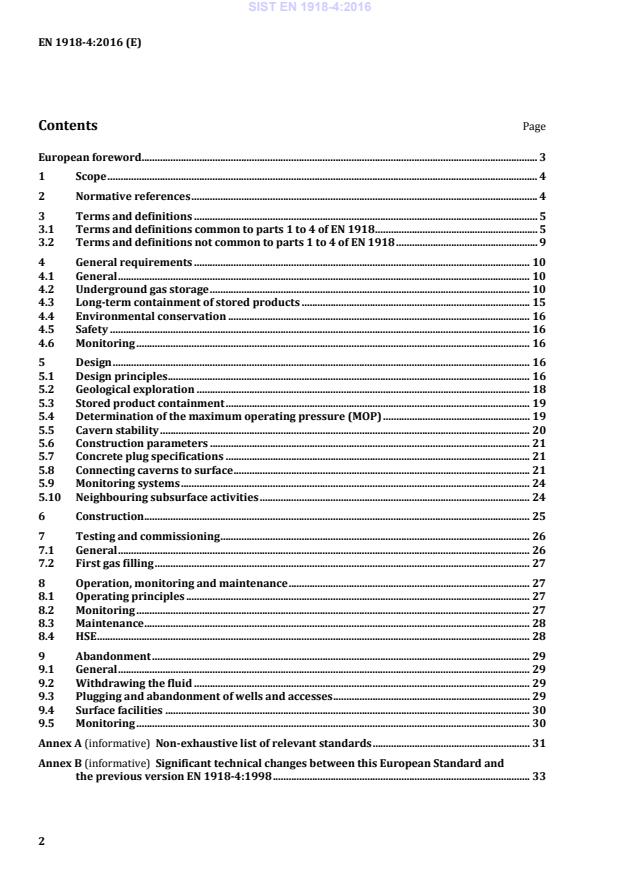
Non-exhaustive list of relevant standards . 31 Annex B (informative)
Significant technical changes between this European Standard and the previous version EN 1918-4:1998 . 33
MOP maximum pressure of the storage reservoir or cavern, normally at maximum inventory of gas in storage, which has not to be exceeded in order to ensure the integrity of the UGS and is based on the outcome of geological/technical engineering and is approved by authorities Note 1 to entry: The maximum operating pressure is related to a datum depth and in caverns usually to the casing shoe of the last cemented casing. 3.1.26 minimum operating pressure minimum pressure of the storage reservoir or cavern, normally reached at the end of the decline phase of the withdrawal profile and for caverns is based on geomechanical investigations to ensure stability and limit the effect of subsidence and normally has to be approved by authorities and has not to be underrun Note 1 to entry: The minimum pressure is related to a datum depth. 3.1.27 monitoring well observation well well for purposes of monitoring the storage horizon and/or overlying or underlying horizons for subsurface phenomena such as pressure fluctuation, fluid flow and qualities, temperature, etc. 3.1.28 operating well well used for gas withdrawal and/or injection 3.1.29 overburden all sediments or rock that overlie a geological formation SIST EN 1918-4:2016
It contains fluids which are internally in pressure communication. 3.1.33 saturation percentages of pore space occupied by fluids 3.1.34 seismic technology technology to characterize the subsurface image with respect to extent, geometry, fault pattern and fluid content applying acoustic waves, impressed by sources near to surface in the subsurface strata, which pass through strata with different seismic responses and filtering effects back to surface where they are recorded and analysed 3.1.35 string entity of casing or tubing plus additional equipment, screwed or welded together as parts of a well respectively completion 3.1.36 subsurface safety valve valve installed in casing and/or tubing beneath the wellhead or the lower end of the tubing for the purpose of stopping the flow of gas in case of emergency 3.1.37 tubing pipe or set of pipes that are screwed or welded together to form a string, through which fluids are injected or withdrawn or which can be used for monitoring 3.1.38 well borehole and its technical equipment including the wellhead 3.1.39 well integrity well condition without uncontrolled release of fluids throughout the life cycle SIST EN 1918-4:2016
Key 1 operating wells 2 monitoring wells 3 indicator horizon 4 caprock 5 storage reservoir and stored gas 6 salt dome 7 cavern Figure 1 — Storage in aquifers, oil and gas fields, solution mined salt caverns SIST EN 1918-4:2016
Key 1 LPG outlet 10 concrete plug (shaft) 2 LPG inlet 11 LPG, vapor phase 3 seepage water outlet 12 rock mass 4 ground level 13 concrete plug (tunnel) 5 water inlet for water curtain 14 access tunnel 6 operation shaft 15 LPG, liquid phase 7 water table 16 water 8 water curtain boreholes 17 LPG pump 9 water curtain gallery 18 water pump Figure 2 — Cross section of a typical unlined rock cavern for LPG 4.3 Long-term containment of stored products The storage facility shall be designed, constructed and operated to ensure the continuing long-term containment of the stored fluids. This presupposes: — adequate prior knowledge of the geological formation in which the storage is to be developed and of its geological environment; — acquisition of all relevant information needed for specifying parameter limits for construction and operation; SIST EN 1918-4:2016
...