

EN 13253:2016
(Main)Geotextiles and geotextile-related products - Characteristics required for use in erosion control works (coastal protection, bank revetments)
- Abstract
This European Standard specifies the relevant characteristics of geotextiles and geotextile-related products used in erosion control works for preventing the migration of fine-graded material into layers of coarser material due to alternating hydraulic gradients, and the appropriate test methods to determine these characteristics.
This European Standard covers applications in coastal protection and bank revetment. This European Standard does not cover surface erosion, where the geotextile or geotextile-related product is located at the surface.
The intended use of these geotextiles or geotextile-related products is to fulfil one or more of the following functions: filtration, separation, and reinforcement. The separation function will always occur in conjunction with filtration or reinforcement, and hence will not be specified alone.
This European Standard is not applicable to geosynthetic barriers, as defined in EN ISO 10318 1.
This European Standard provides for the assessment and verification of constancy of performance of the product to this European Standard and for factory production control procedures.
Particular application cases may contain requirements regarding additional properties and – preferably standardized – test methods, if they are technically relevant.
This European Standard may be used to derive design values by taking into account factors within the context of the definitions given in EN 1997 1 (Eurocode 7), e.g. factors of safety. The design life of the product should be determined, since its function may be temporary, as a construction expediency, or permanent, for the lifetime of the structure.
Particular application cases may contain requirements regarding additional properties and - preferably standardized - test methods, if they are technically relevant.
This European Standard may be used to derive design values by taking into account factors within the context of the definitions given in EN 1997-1 (Eurocode 7), e.g. factors of safety. The design life of the product should be determined, since its function may be temporary, as a construction expediency, or permanent, for the lifetime of the structure.
- Status
- Published
- Publication Date
- 11-Oct-2016
- Withdrawal Date
- 30-Jul-2018
- Technical Committee
- CEN/TC 189 - Geotextiles and geotextile-related products
- Drafting Committee
- CEN/TC 189/WG 1 - ad hoc group Asphalt reinforcement
- Current Stage
- 9093 - Decision to confirm - Review Enquiry
- Start Date
- 21-Apr-2023
- Completion Date
- 21-Oct-2026

Overview
EN 13253:2016 (CEN) specifies the characteristics and test methods for geotextiles and geotextile-related products used in erosion control works - primarily coastal protection and bank revetments. The standard addresses products intended to prevent migration of fine-graded material into coarser layers under alternating hydraulic gradients and covers the functions of filtration, separation and reinforcement (separation is always specified together with filtration or reinforcement). It excludes surface erosion applications and geosynthetic barriers (see EN ISO 10318‑1).
EN 13253:2016 also provides procedures for the assessment and verification of constancy of performance (AVCP) and for factory production control (FPC), plus guidance on deriving design values in the context of Eurocode 7 (EN 1997‑1) and considerations for product service life.
Key topics and requirements
- Primary functions defined: filtration, separation (always concurrent), reinforcement.
- Relevant characteristics and tests (standard references included):
- Stiffness (at 2 %, 5 % and 10 % strain)
- Tensile strength of seams and joints
- Static puncture (CBR test) and dynamic perforation
- Friction characteristics (direct shear, inclined plane)
- Tensile creep and creep rupture
- Resistance to mechanical damage during installation
- Water permeability normal to the plane
- Characteristic opening size (filtration properties)
- Release of dangerous substances
- Durability and service life: Annex B details weathering, durability testing and guidance for service lives up to 5, 25, 50 or 100 years.
- Quality system requirements: AVCP, Product Type Determination (PTD), FPC schemes, initial inspection and continuous surveillance (Annex A).
- Marking and documentation: requirements for product identification and performance declaration; links to Construction Products Regulation addressed in Annex ZA.
Relevant normative test standards cited include EN ISO 11058, EN ISO 12236, EN ISO 12956, EN ISO 13431, EN ISO 10319 and others.
Applications and users
Who uses EN 13253:2016:
- Coastal and river engineers specifying filter/revetment systems
- Geotechnical designers deriving design values per EN 1997‑1
- Geosynthetic manufacturers developing and declaring product performance
- Contractors and installers validating product suitability and installation resilience
- Regulatory bodies and procurement teams evaluating conformity and AVCP documentation
Practical applications:
- Subsurface geotextile layers in seawalls, breakwaters, shore revetments and riverbank protection
- Filtration/separation layers beneath armour stone or gabions to prevent soil migration
- Reinforcing layers within revetment structures where hydraulic gradients and cyclic flows occur
Related standards
- EN 1997‑1 (Eurocode 7) - geotechnical design context
- EN ISO 10318‑1 - geosynthetics terminology
- EN ISO 11058, EN ISO 12236, EN ISO 12956, EN ISO 13431 - referenced test methods
EN 13253:2016 is part of a suite of geosynthetic application standards and should be used with project-specific requirements and local regulations when specifying erosion-control geotextiles.
Relations
- Effective Date
- 19-Oct-2016
- Effective Date
- 25-Aug-2026
- Effective Date
- 27-May-2026
- Effective Date
- 28-Jan-2026
- Effective Date
- 28-Jan-2026
- Effective Date
- 28-Jan-2026
- Effective Date
- 28-Jan-2026
- Effective Date
- 28-Jan-2026
- Effective Date
- 28-Jan-2026
- Effective Date
- 28-Jan-2026
- Effective Date
- 28-Jan-2026
- Effective Date
- 28-Jan-2026
- Effective Date
- 28-Jan-2026
- Effective Date
- 28-Jan-2026
- Effective Date
- 28-Jan-2026
Get Certified
Connect with accredited certification bodies for this standard

Control Union Certifications
Global certification for agriculture and sustainability.

Hohenstein Institut
Textile testing and certification.

Bureau Veritas Bangladesh
Bureau Veritas certification services in Bangladesh.
Sponsored listings
Frequently Asked Questions
EN 13253:2016 is a standard published by the European Committee for Standardization (CEN). Its full title is "Geotextiles and geotextile-related products - Characteristics required for use in erosion control works (coastal protection, bank revetments)". This standard covers: This European Standard specifies the relevant characteristics of geotextiles and geotextile-related products used in erosion control works for preventing the migration of fine-graded material into layers of coarser material due to alternating hydraulic gradients, and the appropriate test methods to determine these characteristics. This European Standard covers applications in coastal protection and bank revetment. This European Standard does not cover surface erosion, where the geotextile or geotextile-related product is located at the surface. The intended use of these geotextiles or geotextile-related products is to fulfil one or more of the following functions: filtration, separation, and reinforcement. The separation function will always occur in conjunction with filtration or reinforcement, and hence will not be specified alone. This European Standard is not applicable to geosynthetic barriers, as defined in EN ISO 10318 1. This European Standard provides for the assessment and verification of constancy of performance of the product to this European Standard and for factory production control procedures. Particular application cases may contain requirements regarding additional properties and – preferably standardized – test methods, if they are technically relevant. This European Standard may be used to derive design values by taking into account factors within the context of the definitions given in EN 1997 1 (Eurocode 7), e.g. factors of safety. The design life of the product should be determined, since its function may be temporary, as a construction expediency, or permanent, for the lifetime of the structure. Particular application cases may contain requirements regarding additional properties and - preferably standardized - test methods, if they are technically relevant. This European Standard may be used to derive design values by taking into account factors within the context of the definitions given in EN 1997-1 (Eurocode 7), e.g. factors of safety. The design life of the product should be determined, since its function may be temporary, as a construction expediency, or permanent, for the lifetime of the structure.
This European Standard specifies the relevant characteristics of geotextiles and geotextile-related products used in erosion control works for preventing the migration of fine-graded material into layers of coarser material due to alternating hydraulic gradients, and the appropriate test methods to determine these characteristics. This European Standard covers applications in coastal protection and bank revetment. This European Standard does not cover surface erosion, where the geotextile or geotextile-related product is located at the surface. The intended use of these geotextiles or geotextile-related products is to fulfil one or more of the following functions: filtration, separation, and reinforcement. The separation function will always occur in conjunction with filtration or reinforcement, and hence will not be specified alone. This European Standard is not applicable to geosynthetic barriers, as defined in EN ISO 10318 1. This European Standard provides for the assessment and verification of constancy of performance of the product to this European Standard and for factory production control procedures. Particular application cases may contain requirements regarding additional properties and – preferably standardized – test methods, if they are technically relevant. This European Standard may be used to derive design values by taking into account factors within the context of the definitions given in EN 1997 1 (Eurocode 7), e.g. factors of safety. The design life of the product should be determined, since its function may be temporary, as a construction expediency, or permanent, for the lifetime of the structure. Particular application cases may contain requirements regarding additional properties and - preferably standardized - test methods, if they are technically relevant. This European Standard may be used to derive design values by taking into account factors within the context of the definitions given in EN 1997-1 (Eurocode 7), e.g. factors of safety. The design life of the product should be determined, since its function may be temporary, as a construction expediency, or permanent, for the lifetime of the structure.
EN 13253:2016 is classified under the following ICS (International Classification for Standards) categories: 59.080.70 - Geotextiles. The ICS classification helps identify the subject area and facilitates finding related standards.
EN 13253:2016 has the following relationships with other standards: It is inter standard links to EN 13253:2014+A1:2015, ISO 10390:2005, EN ISO 12236:2026, EN ISO 10320:2019, EN ISO 9862:2023, EN ISO 13426-1:2019, EN ISO 13426-2:2024, EN 14814:2016, EN ISO 12956:2020, EN ISO 10722:2019, EN ISO 3696:1995, EN ISO 12957-2:2024, EN ISO 13438:2018, EN 12224:2000, EN ISO 13431:2024. Understanding these relationships helps ensure you are using the most current and applicable version of the standard.
EN 13253:2016 is associated with the following European legislation: EU Directives/Regulations: 305/2011; Standardization Mandates: M/107, M/386. When a standard is cited in the Official Journal of the European Union, products manufactured in conformity with it benefit from a presumption of conformity with the essential requirements of the corresponding EU directive or regulation.
EN 13253:2016 is available in PDF format for immediate download after purchase. The document can be added to your cart and obtained through the secure checkout process. Digital delivery ensures instant access to the complete standard document.
Standards Content (Sample)
2003-01.Slovenski inštitut za standardizacijo. Razmnoževanje celote ali delov tega standarda ni dovoljeno.Geotextilien und geotextilverwandte Produkte - Geforderte Eigenschaften für die Anwendung in Erosionsschutzanlagen (Küstenschutz, Deckwerksbau)Géotextiles et produits apparentés - Caractéristiques requises pour l’utilisation dans les ouvrages de lutte contre l’érosion (protection côtière et revêtement de berge)Geotextiles and geotextile-related products - Characteristics required for use in erosion control works (coastal protection, bank revetments)93.020Zemeljska dela. Izkopavanja. Gradnja temeljev. Dela pod zemljoEarthworks. Excavations. Foundation construction. Underground works59.080.70GeotekstilijeGeotextilesICS:Ta slovenski standard je istoveten z:EN 13253:2016SIST EN 13253:2016en,fr,de01-december-2016SIST EN 13253:2016SLOVENSKI
STANDARDSIST EN 13253:2014+A1:20151DGRPHãþD
EUROPEAN STANDARD NORME EUROPÉENNE EUROPÄISCHE NORM
EN 13253
October
t r s x ICS
w {ä r z rä y r Supersedes EN
s u t w uã t r s v ªA sã t r s wEnglish Version
Geotextiles and geotextileærelated products æ Characteristics required for use in erosion control works Géotextiles et produits apparentés æ Caractéristiques requises pour l 5utilisation dans les ouvrages de lutte
Geotextilien und geotextilverwandte Produkte æ Geforderte Eigenschaften für die Anwendung in This European Standard was approved by CEN on
v June
t r s xä
egulations which stipulate the conditions for giving this European Standard the status of a national standard without any alterationä Upætoædate lists and bibliographical references concerning such national standards may be obtained on application to the CENæCENELEC Management Centre or to any CEN memberä
translation under the responsibility of a CEN member into its own language and notified to the CENæCENELEC Management Centre has the same status as the official versionsä
CEN members are the national standards bodies of Austriaá Belgiumá Bulgariaá Croatiaá Cyprusá Czech Republicá Denmarká Estoniaá Finlandá Former Yugoslav Republic of Macedoniaá Franceá Germanyá Greeceá Hungaryá Icelandá Irelandá Italyá Latviaá Lithuaniaá Luxembourgá Maltaá Netherlandsá Norwayá Polandá Portugalá Romaniaá Slovakiaá Sloveniaá Spainá Swedená Switzerlandá Turkey andUnited Kingdomä
EUROPEAN COMMITTEE FOR STANDARDIZATION COMITÉ EUROPÉEN DE NORMALISATION EUROPÄISCHES KOMITEE FÜR NORMUNG
CEN-CENELEC Management Centre:
Avenue Marnix 17,
B-1000 Brussels
t r s x CEN All rights of exploitation in any form and by any means reserved worldwide for CEN national Membersä Refä Noä EN
s u t w uã t r s x ESIST EN 13253:2016
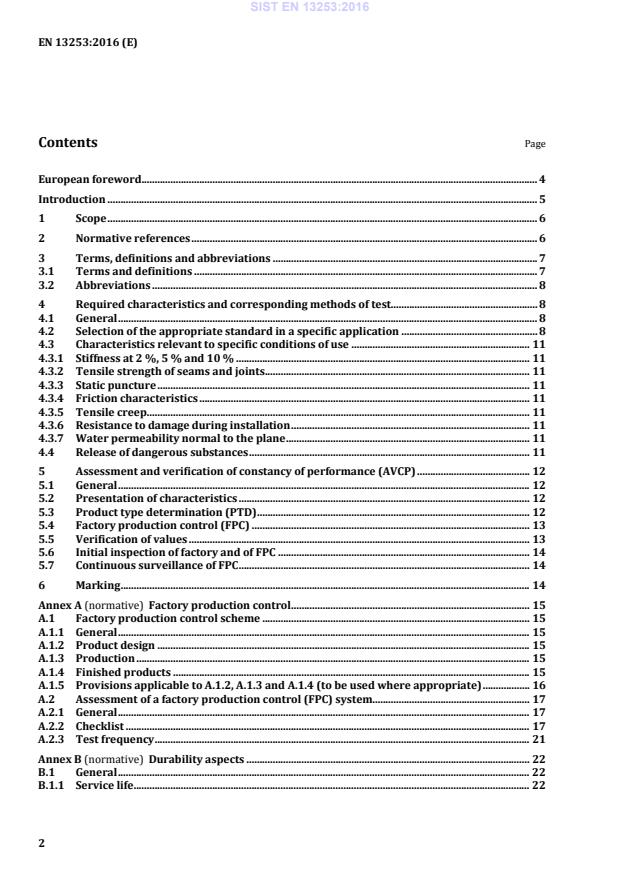
Factory production control . 15 A.1 Factory production control scheme . 15 A.1.1 General . 15 A.1.2 Product design . 15 A.1.3 Production . 15 A.1.4 Finished products . 15 A.1.5 Provisions applicable to A.1.2, A.1.3 and A.1.4 (to be used where appropriate) . 16 A.2 Assessment of a factory production control (FPC) system. 17 A.2.1 General . 17 A.2.2 Checklist . 17 A.2.3 Test frequency . 21 Annex B (normative)
Durability aspects . 22 B.1 General . 22 B.1.1 Service life . 22 SIST EN 13253:2016
Guidelines for the selection of the appropriate standard in a specific application . 28 Annex D (informative)
Significant technical changes to the superseded standard . 30 Annex ZA (informative)
Clauses of this European Standard addressing the provisions of the EU Construction Products Regulation . 31 Bibliography . 44
A: relevant to all conditions of use
S: relevant to specific conditions of use
“–”: indicates that the characteristic is not relevant for that function. SIST EN 13253:2016
Static puncture resistance may not be relevant for some types of products, e.g. GGR, GCO-R or GST. b
If the mechanical properties (tensile strength and static puncture) are coded “A” in this Table, the use of only one, either tensile strength or static puncture, is usually sufficient in a project specification. c
The strength of internal structural junctions of geocells shall be tested in accordance with EN ISO 13426-1. d
The strength of internal structural junctions of geocomposites shall be tested in accordance with EN ISO 13426-2. SIST EN 13253:2016
For the durability aspects, see Table 1 and Annex B. The results of PTD tests shall be recorded and be available for inspection. The sample for the PTD tests shall be drawn according to EN ISO 9862 from a normal production run using the same materials and forming processes as used for the full production process. The size of the sample shall be big enough to allow the determination of the characteristics specified in Table 2. Handmade samples, short trial batches and other development prototypes may be tested by the same methods, but shall not be used for establishing characteristic values in PTD tests. 5.4 Factory production control (FPC) A FPC scheme shall be established and documented in a manual prior to a product type being placed on the market. Subsequently, any fundamental changes in raw materials and additives, manufacturing procedures or the control scheme that affect the properties or use of a product shall be recorded in the manual. The manual shall include the FPC procedures relevant to the declared properties, as confirmed by the product type determination. The FPC procedures shall consist of a permanent internal production control system to ensure that such products comply with this European Standard and that the measured values conform to the declared values. Annex A (normative) lists all the items that shall be considered to determine the appropriate control measures for a product. The manufacturer shall establish control measures for the relevant items and record them in his FPC manual. These measures shall be described in detail, including the type of tests to be performed and the frequency of these tests (see also A.2). When relevant, the procedure given in A.2.3 shall be used to check the conformity of the product for one or more characteristics. 5.5 Verification of values If verification of values is required, the compliance of characteristics with the values defined in 5.2 shall be based on measurements made on two representative samples (A and B), taken from two different rolls. Sampling shall be made in accordance with EN ISO 9862. For on-site quality control purposes CEN/TR 15019 may also be considered. The characteristics given in Table 2 shall be measured in accordance with the corresponding European Standards on specimens prepared from sample A. If the test result(s) for a particular characteristic is (are) within the tolerance value(s) given by the manufacturer, the product is accepted as complying with respect to this characteristic. If the test result(s) for a particular characteristic is (are) outside 1,5 times the tolerance value(s), the product does not comply with respect to that characteristic. If the test result(s) for a particular characteristic is (are) within 1 and 1,5 times the tolerance value(s), specimens prepared from sample B shall be tested. If the test result(s) of the sample B specimens for the same characteristic is (are) within the given tolerance value(s), the product is accepted as complying with respect to that characteristic. If the test result(s) is (are) outside the tolerance value(s), the product is not accepted. SIST EN 13253:2016
Factory production control A.1 Factory production control scheme A.1.1 General The items to be addressed in the factory production control manual relating to the system of control, determined from 5.4, are given in A.1. The single steps of factory production control are addressed in the check-list (A.2). NOTE Manufacturers operating an FPC system, which complies with EN ISO 9001 and which addresses the provisions of this European standard, are considered to be able to satisfy the FPC requirements of this European Standard. A.1.2 Product design The manufacturer shall describe how product design requirements and criteria are identified, checked, controlled and updated to be unambiguous and relevant to the use of the product and its specification. The manufacturer shall describe the communication of the product design to the internal production departments or to external subcontractors. A.1.3 Production A.1.3.1 Raw or incoming materials The manufacturer shall define the acceptance criteria of raw or incoming materials and the procedures that he operates to ensure that these are met. The manufacturer shall document by analyses and/or certificates from his suppliers that all raw or incoming materials meet the declared performance, including durability performance. A.1.3.2 Production process The relevant features of the plant and production process shall be defined giving the frequency of the inspections, checks and tests, together with the values or criteria required on equipment and on work in process. The actions to be taken when control values or criteria are not obtained shall be recorded. These records shall be available for inspection. A.1.4 Finished products A.1.4.1 Tests on the finished product The size of the samples and the frequency of sampling, together with the results obtained, shall be recorded. These records shall be available for inspection. A.1.4.2 Alternative tests Where alternative tests to the reference tests are used, details of the alternative tests and procedures together with their correlation with the reference tests shall be recorded and shall be made available for inspection. SIST EN 13253:2016
Design 1.1 – Has the manufacturer a description how design requirements and criteria are identified, checked, controlled and updated to be unambiguous and relevant to the use of the product and its specification? To be assessed only if claimed by the manufacturer Refer to the manufacturer's documentation. 1.2 – Has the manufacturer a description of the communication of the design to the internal production departments or to external subcontractors? To be assessed only if claimed by the manufacturer. Refer to the manufacturer's documentation. 2 Product identification and traceability 2.1 – What are the means used for the unique identification of any individual finished product? E Refer to the manufacturer's documentation. 2.2 – Is it possible to identify and check date, place and general manufacturing conditions (including E Refer to the manufacturer's SIST EN 13253:2016
3 Production process control 3.1 – Are there documents which define the production process parameters which could affect quality? E Refer to the manufacturer's documentation. 3.2 –Are the standards and procedures implemented? E
3.3 – Are the specified requirements concerning process validation, including the associated personnel and equipment, documented? E Refer to the manufacturer's documentation. 4 Inspection and testing on receipt of raw materials 4.1 – Are there specification sheets concerning incoming raw materials? E Refer to the manufacturer's documentation. 4.2 – Are there documents which define what shall be done in case of non-conformance of raw materials? E Refer to the manufacturer's documentation. 4.3 – Are the nature and frequency of the evaluation of incoming raw materials described and followed? E Refer to the manufacturer's documentation. 5 Inspection and testing during manufacturing 5.1 – Are there inspections or tests during the manufacturing process with specific requirement for the results? E Refer to the manufacturer's documentation. 5.2 – Are there documents concerning inspection or testing during the manufacturing process with requirement for the results? E Refer to the manufacturer's documentation. 5.3 – Do they define what shall be done in case of non-conformance of the product with the requirements? E Refer to the manufacturer's documentation. 5.4 – Are non-conforming products isolated from conform products when they are detected during manufacturing? E Refer to the manufacturer's documentation. 5.5 – Is there a procedure for handling non-conforming products? E Refer to the manufacturer's documentation. 6 Final inspection and testing 6.1 – Are there installations, equipment and personnel for final inspection and tests? E Refer to the manufacturer's documentation. This requirement may be fulfilled by concluding a subcontracting agreement with one or more SIST EN 13253:2016
...