

EN 10209:2023
(Main)Cold rolled low carbon steel flat products for vitreous enamelling - Technical delivery conditions
- Abstract
This document applies to cold rolled non-coated low carbon steel flat products in rolled widths equal to or over 600 mm and in thicknesses equal to or less than 3 mm, delivered in sheet, wide strip, slit wide strip or cut lengths obtained from slit wide strip or sheet.
It does not apply to cold rolled narrow strip (rolling width < 600 mm) or to cold rolled flat products for which there is a specific standard, in particular the following:
- cold-rolled low carbon steel flat products for cold forming (EN 10130);
- cold-rolled non-oriented electrical steel sheet and strip delivered in fully processed state (EN 10106);
- cold rolled electrical non-alloy and alloy steel sheet and strip delivered in the semi-processed state (EN 10341);
- cold reduced blackplate (EN 10205);
- steel sheet and strip for welded gas cylinders (EN 10120);
- cold-rolled uncoated non-alloy mild steel narrow strip for cold forming (EN 10139);
- cold-rolled structural steels for general purposes;
- cold-rolled flat products made of high yield strength for cold forming (EN 10268).
- Status
- Published
- Publication Date
- 25-Jul-2023
- Technical Committee
- ECISS/TC 109 - Coated and uncoated flat products to be used for cold forming
- Drafting Committee
- ECISS/TC 109/WG 3 - Hot and cold rolled steels for enamelling
- Current Stage
- 6060 - Definitive text made available (DAV) - Publishing
- Start Date
- 26-Jul-2023
- Due Date
- 15-Feb-2024
- Completion Date
- 26-Jul-2023

Overview
EN 10209:2023 - Cold rolled low carbon steel flat products for vitreous enamelling - Technical delivery conditions - is the CEN standard that defines technical delivery requirements for non‑coated, cold‑rolled low carbon steel flat products intended for vitreous enamelling. It applies to sheets, wide strip, slit wide strip and cut lengths with rolled widths ≥ 600 mm and thicknesses ≤ 3 mm. EN 10209:2023 supersedes EN 10209:2013 and was approved by CEN in 2023.
Key topics and requirements
The standard specifies practical and testable requirements relevant to the production, delivery and assessment of enamelled steel substrates:
- Scope & designation
- Applies to cold rolled, non‑coated low carbon steel flat products for enamelling; excludes narrow strip (< 600 mm) and products covered by other EN standards.
- Steelmaking and processing
- Manufacturer’s choice of production route unless otherwise agreed; purchasers must be informed of processes.
- Deoxidation & chemical composition
- Requirements for deoxidation method and compositional limits appropriate for enamelling suitability.
- Suitability for vitreous enamelling
- Criteria and tests to ensure substrate compatibility with enamel (resistance to fish scaling, adherence).
- Delivery condition & mechanical properties
- Delivery state, tensile properties (including r‑value definitions), and directional test requirements.
- Surface characteristics
- Surface appearance, surface finish symbols, roughness measurement and acceptable stretcher strain marks.
- Weldability, tolerances & identification
- Guidance on weldability, dimensional tolerances, marking and packaging.
- Testing, sampling & inspection
- Sampling plans, test methods and inspection documentation, including retest procedures.
- Normative annexes
- Annex A: fish scaling / hydrogen permeation tests
- Annex B: pickling mass loss (iron loss) method
- Annex C: enamel adherence test
- Annex D: selection characteristics for enamelling grades
Applications
EN 10209:2023 is used wherever steel substrates are to be coated with vitreous (glass) enamel - i.e., in the manufacture and specification of enamelled components. It ensures the steel’s surface, composition and mechanical behaviour are suitable for reliable enamelling and long‑term performance.
Who uses this standard
- Steel producers and strip/sheet mills (product specification & marking)
- Enamellers and coating processors (acceptance criteria & test methods)
- OEMs and specifiers (procurement and quality requirements)
- Design, quality and inspection engineers (testing, sampling and documentation)
Related standards
Relevant normative and referenced standards include EN 10021, EN 10027‑1/2, EN 10204, EN ISO 6892‑1, ISO 10113 and other EN standards listed as exclusions (e.g., EN 10130, EN 10106, EN 10341, EN 10205).
Keywords: EN 10209:2023, cold rolled low carbon steel, vitreous enamelling, enamelled steel sheet, wide strip, fish scaling test, enamel adherence, technical delivery conditions.
Relations
- Effective Date
- 18-Jan-2023
- Effective Date
- 25-Aug-2026
- Effective Date
- 28-Jan-2026
- Effective Date
- 28-Jan-2026
- Effective Date
- 28-Jan-2026
- Effective Date
- 28-Jan-2026
- Effective Date
- 28-Jan-2026
- Effective Date
- 28-Jan-2026
- Refers
EN 10049:2013 - Measurement of roughness average Ra and peak count RPc on metallic flat products - Effective Date
- 28-Jan-2026
- Effective Date
- 28-Jan-2026
- Effective Date
- 28-Jan-2026
Get Certified
Connect with accredited certification bodies for this standard

Element Materials Technology
Materials testing and product certification.

Inštitut za kovinske materiale in tehnologije
Institute of Metals and Technology. Materials testing, metallurgical analysis, NDT.
Sponsored listings
Frequently Asked Questions
EN 10209:2023 is a standard published by the European Committee for Standardization (CEN). Its full title is "Cold rolled low carbon steel flat products for vitreous enamelling - Technical delivery conditions". This standard covers: This document applies to cold rolled non-coated low carbon steel flat products in rolled widths equal to or over 600 mm and in thicknesses equal to or less than 3 mm, delivered in sheet, wide strip, slit wide strip or cut lengths obtained from slit wide strip or sheet. It does not apply to cold rolled narrow strip (rolling width < 600 mm) or to cold rolled flat products for which there is a specific standard, in particular the following: - cold-rolled low carbon steel flat products for cold forming (EN 10130); - cold-rolled non-oriented electrical steel sheet and strip delivered in fully processed state (EN 10106); - cold rolled electrical non-alloy and alloy steel sheet and strip delivered in the semi-processed state (EN 10341); - cold reduced blackplate (EN 10205); - steel sheet and strip for welded gas cylinders (EN 10120); - cold-rolled uncoated non-alloy mild steel narrow strip for cold forming (EN 10139); - cold-rolled structural steels for general purposes; - cold-rolled flat products made of high yield strength for cold forming (EN 10268).
This document applies to cold rolled non-coated low carbon steel flat products in rolled widths equal to or over 600 mm and in thicknesses equal to or less than 3 mm, delivered in sheet, wide strip, slit wide strip or cut lengths obtained from slit wide strip or sheet. It does not apply to cold rolled narrow strip (rolling width < 600 mm) or to cold rolled flat products for which there is a specific standard, in particular the following: - cold-rolled low carbon steel flat products for cold forming (EN 10130); - cold-rolled non-oriented electrical steel sheet and strip delivered in fully processed state (EN 10106); - cold rolled electrical non-alloy and alloy steel sheet and strip delivered in the semi-processed state (EN 10341); - cold reduced blackplate (EN 10205); - steel sheet and strip for welded gas cylinders (EN 10120); - cold-rolled uncoated non-alloy mild steel narrow strip for cold forming (EN 10139); - cold-rolled structural steels for general purposes; - cold-rolled flat products made of high yield strength for cold forming (EN 10268).
EN 10209:2023 is classified under the following ICS (International Classification for Standards) categories: 77.140.50 - Flat steel products and semi-products. The ICS classification helps identify the subject area and facilitates finding related standards.
EN 10209:2023 has the following relationships with other standards: It is inter standard links to EN 10209:2013, ISO 10113:2020, EN 10021:2006, EN ISO 6892-1:2019, EN 10204:2004, EN 10027-2:2015, EN ISO 377:2017, EN 10027-1:2016, EN 10049:2013, EN 10131:2006, EN 10079:2007. Understanding these relationships helps ensure you are using the most current and applicable version of the standard.
EN 10209:2023 is available in PDF format for immediate download after purchase. The document can be added to your cart and obtained through the secure checkout process. Digital delivery ensures instant access to the complete standard document.
Standards Content (Sample)
SLOVENSKI STANDARD
01-september-2023
Hladno valjani ploščati izdelki iz maloogljičnih jekel za emajliranje - Tehnični
dobavni pogoji
Cold rolled low carbon steel flat products for vitreous enamelling - Technical delivery
conditions
Kaltgewalzte Flacherzeugnisse aus weichen Stählen zum Emaillieren - Technische
Lieferbedingungen
Produits plats laminés à froid, en acier doux pour émaillage par vitrification - Conditions
techniques de livraison
Ta slovenski standard je istoveten z: EN 10209:2023
ICS:
77.140.50 Ploščati jekleni izdelki in Flat steel products and semi-
polizdelki products
2003-01.Slovenski inštitut za standardizacijo. Razmnoževanje celote ali delov tega standarda ni dovoljeno.
EN 10209
EUROPEAN STANDARD
NORME EUROPÉENNE
July 2023
EUROPÄISCHE NORM
ICS 77.140.50 Supersedes EN 10209:2013
English Version
Cold rolled low carbon steel flat products for vitreous
enamelling - Technical delivery conditions
Produits plats laminés à froid, en acier doux pour Kaltgewalzte Flacherzeugnisse aus weichen Stählen
émaillage par vitrification - Conditions techniques de zum Emaillieren - Technische Lieferbedingungen
livraison
This European Standard was approved by CEN on 28 May 2023.
CEN members are bound to comply with the CEN/CENELEC Internal Regulations which stipulate the conditions for giving this
European Standard the status of a national standard without any alteration. Up-to-date lists and bibliographical references
concerning such national standards may be obtained on application to the CEN-CENELEC Management Centre or to any CEN
member.
This European Standard exists in three official versions (English, French, German). A version in any other language made by
translation under the responsibility of a CEN member into its own language and notified to the CEN-CENELEC Management
Centre has the same status as the official versions.
CEN members are the national standards bodies of Austria, Belgium, Bulgaria, Croatia, Cyprus, Czech Republic, Denmark, Estonia,
Finland, France, Germany, Greece, Hungary, Iceland, Ireland, Italy, Latvia, Lithuania, Luxembourg, Malta, Netherlands, Norway,
Poland, Portugal, Republic of North Macedonia, Romania, Serbia, Slovakia, Slovenia, Spain, Sweden, Switzerland, Türkiye and
United Kingdom.
EUROPEAN COMMITTEE FOR STANDARDIZATION
COMITÉ EUROPÉEN DE NORMALISATION
EUROPÄISCHES KOMITEE FÜR NORMUNG
CEN-CENELEC Management Centre: Rue de la Science 23, B-1040 Brussels
© 2023 CEN All rights of exploitation in any form and by any means reserved Ref. No. EN 10209:2023 E
worldwide for CEN national Members.
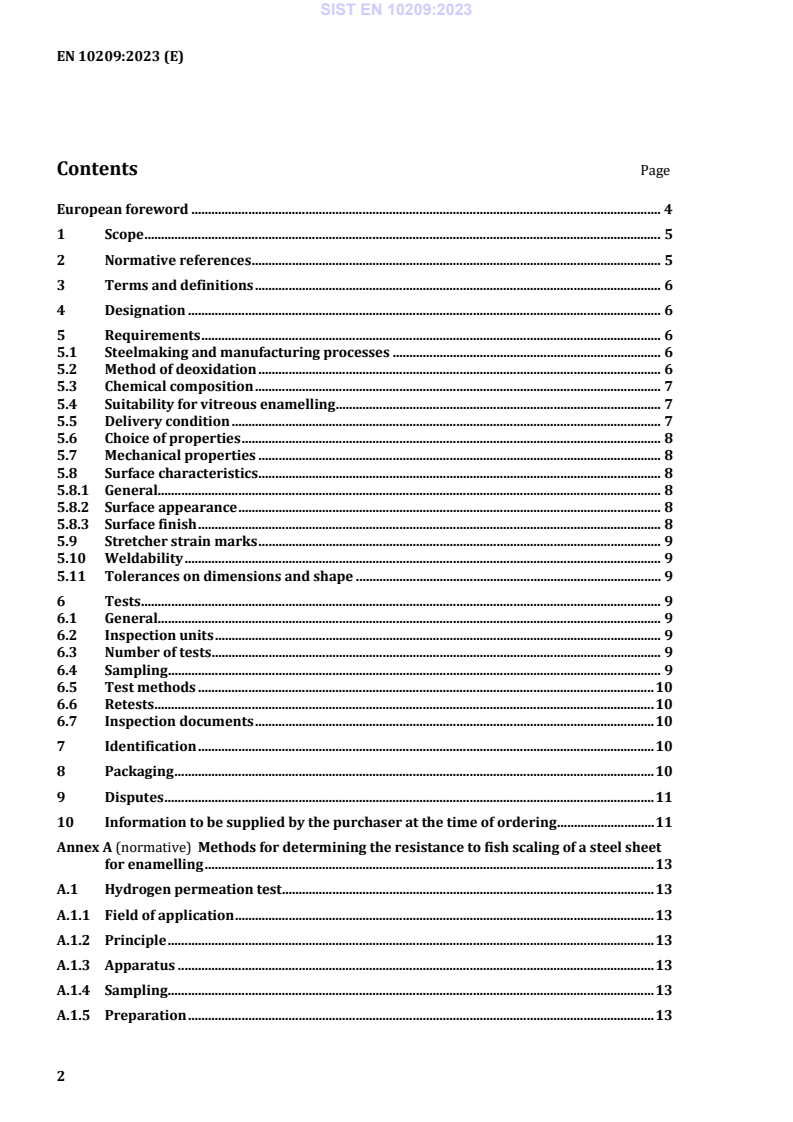
Contents Page
European foreword . 4
1 Scope . 5
2 Normative references . 5
3 Terms and definitions . 6
4 Designation . 6
5 Requirements . 6
5.1 Steelmaking and manufacturing processes . 6
5.2 Method of deoxidation . 6
5.3 Chemical composition . 7
5.4 Suitability for vitreous enamelling . 7
5.5 Delivery condition . 7
5.6 Choice of properties . 8
5.7 Mechanical properties . 8
5.8 Surface characteristics . 8
5.8.1 General. 8
5.8.2 Surface appearance . 8
5.8.3 Surface finish . 8
5.9 Stretcher strain marks . 9
5.10 Weldability . 9
5.11 Tolerances on dimensions and shape . 9
6 Tests . 9
6.1 General. 9
6.2 Inspection units . 9
6.3 Number of tests . 9
6.4 Sampling . 9
6.5 Test methods . 10
6.6 Retests . 10
6.7 Inspection documents . 10
7 Identification . 10
8 Packaging . 10
9 Disputes . 11
10 Information to be supplied by the purchaser at the time of ordering . 11
Annex A (normative) Methods for determining the resistance to fish scaling of a steel sheet
for enamelling . 13
A.1 Hydrogen permeation test . 13
A.1.1 Field of application . 13
A.1.2 Principle . 13
A.1.3 Apparatus . 13
A.1.4 Sampling . 13
A.1.5 Preparation . 13
A.1.6 Check the degreasing quality . 14
A.1.7 Permeation test procedure . 14
A.1.8 Hydrogen detection . 14
A.1.9 Evaluation. 15
A.2 Fish scaling test using special enamel . 16
Annex B (normative) Method for determining mass loss (iron loss) due to pickling for steel
grades for direct enamelling in accordance with 5.4.2 . 17
B.1 Principle . 17
B.2 Apparatus . 17
B.3 Sampling . 17
B.4 Preparation . 18
B.5 Weighing . 18
B.6 Cleaning . 18
B.7 Checks on degreasing quality . 18
B.8 Pickling . 18
B.9 Drying . 19
B.10 Weighing after cooling . 19
B.11 Evaluation. 19
Annex C (normative) Method for determining the adherence level of enamel applied to a
steel sheet . 20
C.1 Field of application . 20
C.2 Principle . 20
C.3 Apparatus . 20
C.4 Description of the apparatus . 20
C.5 Procedure . 20
C.6 Adherence level evaluation . 21
C.6.1 Flat pieces . 21
C.6.2 Thinner sheet steel < 0,3 mm . 21
C.6.3 Deformed pieces . 21
Annex D (informative) Characteristics for the selection of enamelling steel grades. 25
Bibliography . 26
European foreword
This document (EN 10209:2023) has been prepared by Technical Committee CEN/TC 459 “ECISS -
European Committee for Iron and Steel Standardization” , the secretariat of which is held by AFNOR.
This European Standard shall be given the status of a national standard, either by publication of an
identical text or by endorsement, at the latest by January 2024 and conflicting national standards shall
be withdrawn at the latest by January 2024.
Attention is drawn to the possibility that some of the elements of this document may be the subject of
patent rights. CEN shall not be held responsible for identifying any or all such patent rights.
This document supersedes EN 10209:2013.
In comparison with the previous edition, the following technical modifications have been made:
— DC07EK steel grade added;
— r value in Mechanical Properties (Table 2) changed;
— Table 2: definition of Tensile test direction more precise;
— Annex A: conditions of the fish scaling test, devices to be used (removal of Strohlein apparatus)
redefined.
Any feedback and questions on this document should be directed to the users’ national standards body.
A complete listing of these bodies can be found on the CEN website.
According to the CEN-CENELEC Internal Regulations, the national standards organizations of the
following countries are bound to implement this European Standard: Austria, Belgium, Bulgaria, Croatia,
Cyprus, Czech Republic, Denmark, Estonia, Finland, France, Germany, Greece, Hungary, Iceland, Ireland,
Italy, Latvia, Lithuania, Luxembourg, Malta, Netherlands, Norway, Poland, Portugal, Republic of North
Macedonia, Romania, Serbia, Slovakia, Slovenia, Spain, Sweden, Switzerland, Türkiye and the United
Kingdom.
Through its sub-committee SC 9 “Coated and uncoated flat products to be used for cold forming” (secretariat:
AFNOR).
1 Scope
This document applies to cold rolled non-coated low carbon steel flat products in rolled widths equal to
or over 600 mm and in thicknesses equal to or less than 3 mm, delivered in sheet, wide strip, slit wide
strip or cut lengths obtained from slit wide strip or sheet.
It does not apply to cold rolled narrow strip (rolling width < 600 mm) or to cold rolled flat products for
which there is a specific standard, in particular the following:
— cold-rolled low carbon steel flat products for cold forming (EN 10130);
— cold-rolled non-oriented electrical steel sheet and strip delivered in fully processed state (EN 10106);
— cold rolled electrical non-alloy and alloy steel sheet and strip delivered in the semi-processed state
(EN 10341);
— cold reduced blackplate (EN 10205);
— steel sheet and strip for welded gas cylinders (EN 10120);
— cold-rolled uncoated non-alloy mild steel narrow strip for cold forming (EN 10139);
— cold-rolled structural steels for general purposes;
— cold-rolled flat products made of high yield strength for cold forming (EN 10268).
2 Normative references
The following documents are referred to in the text in such a way that some or all of their content
constitutes requirements of this document. For dated references, only the edition cited applies. For
undated references, the latest edition of the referenced document (including any amendments) applies.
EN 10021, General technical delivery conditions for steel products
EN 10027-1, Designation systems for steels — Part 1: Steel names
EN 10027-2, Designation systems for steels — Part 2: Numerical system
EN 10049, Measurement of roughness average Ra and peak count RPc on metallic flat products
EN 10079:2007, Definition of steel products
EN 10131, Cold rolled uncoated and zinc or zinc-nickel electrolytically coated low carbon and high yield
strength steel flat products for cold forming — Tolerances on dimensions and shape
EN 10204, Metallic products — Types of inspection documents
EN ISO 377, Steel and steel products — Location and preparation of samples and test pieces for mechanical
testing (ISO 377)
EN ISO 6892-1, Metallic materials — Tensile testing — Part 1: Method of test at room temperature
(ISO 6892-1)
ISO 10113, Metallic materials — Sheet and strip — Determination of plastic strain ratio
3 Terms and definitions
For the purposes of this document, the terms and definitions given in EN 10079:2007 apply.
ISO and IEC maintain terminology databases for use in standardization at the following addresses:
— ISO Online browsing platform: available at https://www.iso.org/obp/
— IEC Electropedia: available at https://www.electropedia.org/
4 Designation
4.1 Steel names shall be attributed in accordance with EN 10027-1; numerical designations shall be
attributed in accordance with EN 10027-2.
All steels reported in Table 2 are non-alloy and alloy quality steels.
4.2 Products conforming to this document shall be designated, in order, in the following way:
a) product designation (e.g. strip, sheet or “slit strip cut longitudinally”);
b) number of this document (EN 10209);
c) name or numerical designation of the steel, shown in Table 2;
d) where appropriate, the symbol relating to surface finish (see Table 1).
Examples of conventional designations:
Designation of a steel sheet with the symbolic designation DC01EK and the numerical designation 1.0390 with
rough surface finish (r):
Sheet EN 10209 DC01EK r or
Sheet EN 10209 — 1.0390 r
Designation of a wide strip of steel with the symbolic designation DC06ED and the numerical designation 1.0872
with normal surface finish (m):
Wide strip EN 10209 — DC06ED m or
Wide strip EN 10209 — 1.0872 m.
5 Requirements
5.1 Steelmaking and manufacturing processes
Unless otherwise agreed at the time of ordering, the production methods shall be left to the discretion of
the manufacturer.
The purchaser shall be informed of these processes if specified in the purchase order.
5.2 Method of deoxidation
See Table 2.
5.3 Chemical composition
The maximum values for the chemical compositions based on ladle analysis shall be as given in Table 2.
5.4 Suitability for vitreous enamelling
5.4.1 Qualities DC01EK, DC04EK, DC05EK, DC06EK and DC07EK are suitable for one or two coats of
conventional enamelling.
5.4.2 Qualities DC03ED, DC04ED and DC06ED are suitable for direct enamelling, as well as for the two
coats – one fire process and for the special applications of two coat enamelling for sag resistance.
5.4.3 The following methods of test are defined in order to determine the suitability of the steel for
enamelling:
— hydrogen permeation test (see Annex A) (alternatively, if agreed at the time of ordering, an
enamelling test as described in A.2 may be specified);
NOTE These two tests enable the risk of fish scaling following enamelling to be assessed.
— iron loss test for qualities of steel for direct enamelling as described in 5.4.2 (see Annex B).
5.4.4 An enamel adherence test (see Annex C) is also defined (pretreatment and enamelling conditions
shall be agreed at the time of ordering).
5.4.5 The application of the methods of test described in Annex A, Annex B and Annex C may be the
subject of an agreement at the time of ordering.
5.5 Delivery condition
5.5.1 Products specified in this document should be supplied in the skin-passed condition. If agreed at
the time of ordering non-skin-passed products may be supplied.
5.5.2 The products are normally delivered oiled. In this case, both the surfaces are preserved by a layer
of neutral non-drying oil, free of foreign bodies and uniformly spread in such a way that under normal
conditions of packaging, transportation, handling and storage the products will show no corrosion for up
to three months.
If the conditions of transportation or storage are such that special protection against corrosion is
required, the purchaser shall inform the manufacturer at the time of the ordering.
The layer of oils shall be capable of being removed by alkaline solutions or normal solvents.
The choice of protective oils may be the subject of special agreement.
The product can be supplied protected by specific coatings that are compatible with enamelling process
without degreasing upon agreement between supplier and purchaser.
If the purchaser does not require the surfaces to be oiled, this shall be clearly indicated at the time of the
ordering.
NOTE If the order is for unoiled products, the manufacturer is not responsible for the risk of rust. The
purchaser is also advised that there is a greater risk of the appearance of light scratches during handling,
transportation, and application.
5.6 Choice of properties
The products covered by this document shall correspond to the requirements of Table 1 and Table 2.
Subject to agreement between the supplier and the purchaser, they may be supplied with particular
suitability for the production of a specific part; in this case a maximum rejection percentage may be set
by mutual agreement and acceptance on the basis of mechanical properties would not apply.
5.7 Mechanical properties
The mechanical properties given in Table 2 only apply to skin-passed products. These mechanical
properties are valid for the period specified in Table 2 from the date on which the products are made
available.
The date of availability shall be notified to the purchaser with reasonable prior notice compatible with
the validity of the mechanical properties.
5.8 Surface characteristics
5.8.1 General
The surface characteristics consist of the surface appearance and surface finish.
5.8.2 Surface appearance
The products are supplied with a surface appearance which does not adversely affect suitability for
forming, the application of an enamel coating and the uniform appearance of the enamelled surface on
the exposed surface.
When supplied as wide strip and slit strip, the percentage of surface defects may be higher than when
supplied as sheet and cut lengths. This shall be taken into account by the purchaser and the permissible
percentage of surface defects shall be set by special agreement at the time of ordering.
Unless otherwise agreed, a single surface of the product shall comply with the specified requirements.
The other surface shall be such that during subsequent treatment it does not have a deleterious effect on
the better surface.
5.8.3 Surface finish
The surface finish may be normal or rough.
In the absence of a requirement in the order, products shall be supplied with the normal surface finish.
The limiting figures for average surface roughness for the two types of finish are given in Table 1.
The measurements shall be made in accordance with EN 10049.
If specially agreed at the time of ordering, other ranges for surfaces are specified for specific end uses.
Table 1 — Surface finishes and standard roughness
Surface finish Symbol Roughness
0,6 µm < R ≤ 1,9 µm
Normal m
a
R > 1,6 µm
Rough r
a
5.9 Stretcher strain marks
All the products are generally subjected to a light skin-pass after annealing at the manufacturer's works
to avoid the formation of stretcher strain marks during subsequent forming. The tendency to form such
marks may reappear a certain time after the skin-pass. It is therefore in the purchaser's interest to form
the products as soon as possible.
Quality DC06EK, DC06ED and DC07EK products do not exhibit stretcher strain marks after deformation.
For the other qualities the absence of stretcher strain marks may be guaranteed for six months after the
products are made available.
5.10 Weldability
The material is specified as suitable for normal welding procedures as long as the products are degreased
beforehand. The welding procedure shall be specified at the time of ordering (see Clause 10 h)).
5.11 Tolerances on dimensions and shape
Tolerances on dimensions and shape shall be as given in EN 10131.
6 Tests
6.1 General
6.1.1 The purchaser shall specify at the time of ordering his requirements for:
— type of inspection and testing: specific or non-specific, see EN 100
...