

EN 513:2026
(Main)Plastics - Poly(vinyl chloride) (PVC) based profiles - Determination of the resistance to artificial weathering
- Abstract
This document specifies a method for exposing specimens made from poly(vinyl chloride) (PVC) based profiles to xenon-arc radiation, in order to assess changes in characteristics.
It is applicable to PVC based profiles including those covered with foil, paint, print, thermo-laminated foils or coextruded.
NOTE The determination of changes in colour and variations of properties after exposure of PVC based profiles to xenon-arc radiation is described in an informative Annex A.
- Status
- Published
- Publication Date
- 23-Feb-2027
- Technical Committee
- CEN/TC 249 - Plastics
- Drafting Committee
- CEN/TC 249/WG 21 - Profiles for windows and doors
- Current Stage
- 6060 - Definitive text made available (DAV) - Publishing
- Start Date
- 05-Aug-2026
- Due Date
- 24-Feb-2027
- Completion Date
- 24-Feb-2027

EN 513:2026 is a CEN European Standard for plastics, published for PVC based profiles. It specifies a xenon-arc artificial weathering method for exposing specimens so that changes in characteristics after exposure can be assessed. It is used for PVC based profiles, including profiles covered with foil, paint, print, thermo-laminated foils or coextruded layers.
What does EN 513:2026 specify?
EN 513:2026 specifies the laboratory exposure of specimens from poly(vinyl chloride) (PVC) based profiles to xenon-arc radiation. The purpose is to assess how the profile changes after controlled artificial weathering, especially for products intended for outdoor use.
The scope covers PVC based profiles with surface treatments and multilayer constructions such as foils, paint, print and coextrusions. Clause 7 and Clause 9 show that the referring product standard sets the number of specimens and the chosen exposure method, while Annex A gives related evaluation methods for colour and property changes.
| Annex | What it covers |
|---|---|
| Annex A | Informative procedures for checking colour change and variations in properties after xenon-arc exposure |
What are the key requirements of EN 513:2026?
EN 513:2026 sets a controlled exposure method, defined test conditions, and a reporting set that lets users compare results between products and laboratories. In practice, the standard is about keeping the exposure conditions fixed, then measuring how the exposed profile differs from the unexposed reference.
Exposure principle and apparatus
Specimens taken from the exposed surface of a profile are placed under xenon-arc radiation with specified irradiance, temperatures, relative humidity and a spray cycle. Clause 6 requires equipment that complies with the general laboratory weathering standards and uses an open-frame specimen holder so the back of the specimen remains exposed.
This matters because the back exposure and the controlled chamber conditions affect how the surface ages, so the test is only comparable when the setup matches the standard.
Weathering methods
Clause 9 provides two exposure methods: one for moderate climate and one for severe climate. The choice of method is made by the referring standard, which means the product specification decides how harsh the weathering simulation should be.
For users, this is the main selection step. A buyer, manufacturer or test lab must know which climate severity the product is being qualified against before starting the test.
Specimens, conditioning and exposure control
Clause 7 requires the test specimens to come from the surface exposed to UV radiation, with the specimen length aligned to the profile direction. The non-exposed reference specimens are stored in the dark.
Clause 8 says conditioning is normally not required before exposure, unless another standard says otherwise. Clause 10 requires the operator to verify the apparatus conditions before testing, monitor temperatures during exposure, record irradiance at intervals, stop the test when the specified radiant exposure is reached, and document any cleaning or other deviations.
Test reporting
Clause 11 lists the information that must be in the test report, including the exposure method, specimen identification, apparatus details, radiation source and filter system, specimen holder type, temperature settings, humidity, air temperature, radiant exposure, exposure time and any incidents that could have influenced the result.
That report is what makes the test traceable. It lets a quality manager or customer see exactly how the result was generated.
Informative follow-up evaluations
Annex A gives optional procedures for checking colour change and other property variations after exposure. It covers visual colour assessment, colorimetric coordinates, Charpy impact strength for PVC-U and PVC-UE profiles, tensile impact, flexural properties, chalking, coating adhesion, peel strength and falling weight impact resistance for PVC-UE profiles.
What terms does EN 513:2026 define?
EN 513:2026 uses these key terms and abbreviations:
- Radiant exposure - the time integral of irradiance, expressed as energy per unit area.
- PVC-U - unplasticized poly(vinyl chloride).
- PVC-UE - expanded unplasticized poly(vinyl chloride).
- BST - black-standard thermometer used to monitor specimen heating.
- WST - white-standard thermometer used to monitor the lighter reference temperature in the chamber.
Who uses EN 513:2026?
EN 513:2026 is used by laboratories, profile manufacturers, test engineers, quality managers and buyers who need to assess the weathering resistance of PVC based profiles. It is relevant to producers of profiles for windows, doors and other outdoor applications, especially when surface appearance, coating adhesion or impact performance after weathering must be checked.
It is also used when a product standard or customer specification needs a repeatable xenon-arc test for acceptance, comparison or quality control.
What changed in EN 513:2026 from the previous edition?
EN 513:2026 supersedes EN 513:2018. The European foreword states these significant technical changes:
- the specimen holder type, backed or open framed, is now included in the test report;
- EN ISO/CIE 11664-6 with CIEDE2000 was added as an alternative colour measurement method for uniform colours in Annex A.2.3;
- references were updated.
Which standards are used with EN 513:2026?
EN 513:2026 relies on EN ISO 472 for plastics vocabulary, EN ISO 4892-1 for general laboratory weathering guidance, EN ISO 4892-2 for xenon-arc lamp exposure, and ISO 9370 for radiant exposure measurement.
The document also points to EN 12608-1:2026 for choosing the weathering method, and Annex A uses related test methods for follow-up checks, including EN ISO 179-1, EN ISO 8256:2023, EN ISO 178, EN ISO 4628-6, EN ISO 2409, EN 17271 and EN 13245-2:2008.
What does the EN 513:2026 document contain?
EN 513:2026 contains a short technical core and one informative annex. The core covers scope, references, terms, symbols, principle, apparatus, specimen handling, conditioning, weathering conditions, procedure and reporting.
Table 1 sets the two exposure cycles for the two climate severities. Annex A then provides practical methods for evaluating the exposed profiles, including visual colour comparison, instrumental colour measurement, impact tests, flexural testing, chalking, coating adhesion, peel strength and falling weight impact resistance.
Relations
- Effective Date
- 11-Dec-2024
- Effective Date
- 02-Sep-2026
- Effective Date
- 12-Aug-2026
- Referred By
EN 607:2023 - Eaves gutters and fittings made of PVC-U - Definitions, requirements and testing - Effective Date
- 12-Aug-2026
- Referred By
EN 26:2015 - Gas-fired instantaneous water heaters for the production of domestic hot water - Effective Date
- 12-Aug-2026
- Effective Date
- 12-Aug-2026
- Effective Date
- 12-Aug-2026
- Referred By
EN 607:2004 - Eaves gutters and fittings made of PVC-U - Definitions, requirements and testing - Effective Date
- 12-Aug-2026
- Effective Date
- 12-Aug-2026
- Referred By
EN 14471:2005 - Chimneys - System chimneys with plastic flue liners - Requirements and test methods - Effective Date
- 12-Aug-2026
- Effective Date
- 12-Aug-2026
- Effective Date
- 12-Aug-2026
- Effective Date
- 12-Aug-2026
Get Certified
Connect with accredited certification bodies for this standard

DIN CERTCO
DIN Group product certification.

Smithers Quality Assessments
US management systems and product certification.
Sponsored listings
Frequently Asked Questions
EN 513:2026 is a standard published by the European Committee for Standardization (CEN). Its full title is "Plastics - Poly(vinyl chloride) (PVC) based profiles - Determination of the resistance to artificial weathering". This standard covers: This document specifies a method for exposing specimens made from poly(vinyl chloride) (PVC) based profiles to xenon-arc radiation, in order to assess changes in characteristics. It is applicable to PVC based profiles including those covered with foil, paint, print, thermo-laminated foils or coextruded. NOTE The determination of changes in colour and variations of properties after exposure of PVC based profiles to xenon-arc radiation is described in an informative Annex A.
This document specifies a method for exposing specimens made from poly(vinyl chloride) (PVC) based profiles to xenon-arc radiation, in order to assess changes in characteristics. It is applicable to PVC based profiles including those covered with foil, paint, print, thermo-laminated foils or coextruded. NOTE The determination of changes in colour and variations of properties after exposure of PVC based profiles to xenon-arc radiation is described in an informative Annex A.
EN 513:2026 is classified under the following ICS (International Classification for Standards) categories: 83.140.99 - Other rubber and plastics products. The ICS classification helps identify the subject area and facilitates finding related standards.
EN 513:2026 has the following relationships with other standards: It is inter standard links to EN 513:2018, EN ISO 4892-2:2013, EN 13245-3:2025, EN 607:2023, EN 26:2015, EN 12608-1:2016+A1:2020, EN 89:2015, EN 607:2004, EN 13245-1:2025, EN 14471:2005, EN 12608-1:2016, EN 12608-2:2023, EN 12608:2003. Understanding these relationships helps ensure you are using the most current and applicable version of the standard.
EN 513:2026 is available in PDF format for immediate download after purchase. The document can be added to your cart and obtained through the secure checkout process. Digital delivery ensures instant access to the complete standard document.
Standards Content (Sample)
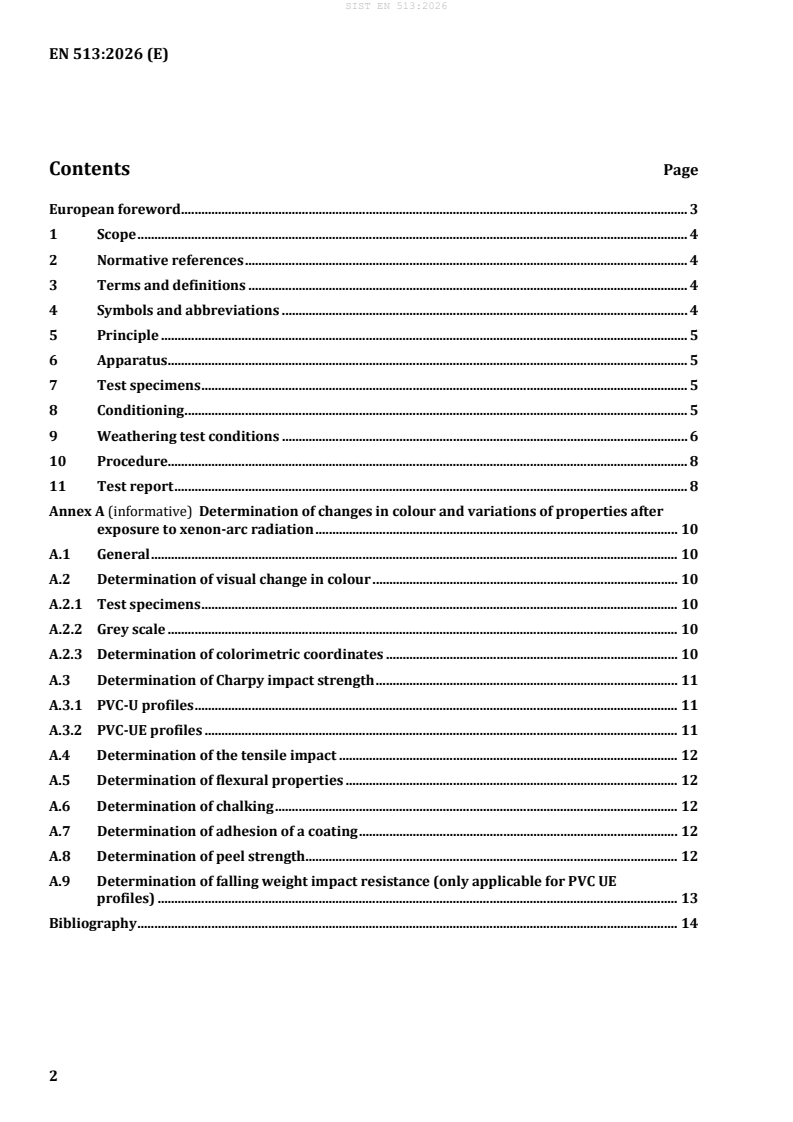
Contents
- 1 Scope
- 2 Normative references
- 3 Terms and definitions
- 3.1 radiant exposure
- 4 Symbols and abbreviations
- 5 Principle
- 6 Apparatus
- 7 Test specimens
- 8 Conditioning
- 9 Weathering test conditions
- 10 Procedure
- 11 Test report
- Annex A
- Bibliography
1 Scope
This document specifies a method for exposing specimens made from poly(vinyl chloride) (PVC) based profiles to xenon-arc radiation, in order to assess changes in characteristics. It is applicable to PVC based profiles including those covered with foil, paint, print, thermo-laminated foils or coextruded.
NOTE The determination of changes in colour and variations of properties after exposure of PVC based profiles to xenon-arc radiation is described in an informative Annex A.
2 Normative references
The following documents are referred to in the text in such a way that some or all of their content constitutes requirements of this document. For dated references, only the edition cited applies. For undated references, the latest edition of the referenced document (including any amendments) applies. EN ISO 472, Plastics — Vocabulary (ISO 472) EN ISO 4892-1:2024, Plastics — Methods of exposure to laboratory light sources — Part 1: General guidance and requirements (ISO 4892-1:2024) EN ISO 4892-2:2013, Plastics — Methods of exposure to laboratory light sources — Part 2: Xenon-arc lamps (ISO 4892-2:2013) ISO 9370:2017, Plastics — Instrumental determination of radiant exposure in weathering tests — General guidance and basic test method
3 Terms and definitions
For the purposes of this document, the terms and definitions given in EN ISO 472 and the following apply. ISO and IEC maintain terminology databases for use in standardization at the following addresses:
- ISO Online browsing platform: available at https://www.iso.org/obp
- IEC Electropedia: available at https://www.electropedia.org/
3.1 radiant exposure
H time integral of irradiance
Note 1 to entry: measured in joules per square metre (J/m ).
[SOURCE: ISO 9370:2017, 3.27]
4 Symbols and abbreviations
For the purposes of this document, the following symbols and abbreviations apply. PVC-U unplasticized poly(vinyl chloride) PVC-UE expanded unplasticized poly(vinyl chloride) BST black-standard thermometer WST white-standard thermometer
SIST EN 513:2026 EN 513:2026 (E)
5 Principle
Specimens taken from the surface of a profile, subjected to weathering in practice, shall be exposed to xenon-arc radiation under specified conditions of irradiance, black and white standard temperatures, relative humidity and spray cycle.
After the exposure, the changes in characteristics of the specimens are determined.
6 Apparatus
The apparatus shall comply with EN ISO 4892-1 and EN ISO 4892-2 and shall include:
a) a xenon-arc lamp in accordance with method A of EN ISO 4892-2:2013 with a spectral irradiance in
the band pass of 300 nm to 800 nm of (550 ± 55) W/m or a spectral irradiance in the band pass of 2 2 300 nm to 400 nm of (60 ± 2) W/m or a spectral irradiance at 340 nm of (0,51 ± 0,02) W/(m nm). NOTE 1 In apparatuses with rotating specimen holders, the UV/(UV+VIS) irradiance ratio depends strongly on the wavelength-dependent reflection behaviour of the specimens in the test chamber. This ratio is not constant and varies with the reflective properties of the specimens. NOTE 2 When comparing apparatuses controlled at different wavelength ranges, higher tolerances may be
accepted due to the conversion. Typical range is (550 ± 120) W/m for spectral irradiance in the band pass of 2 2 300 nm to 800 nm, (60 ± 12) W/m for the band pass of 300 nm to 400 nm and (0,51 ± 0,08) W/(m nm) for spectral irradiance at 340 nm.
b) a black-standard thermometer (BST) in accordance with EN ISO 4892-1:2024, 5.2, and EN ISO 4892-2:2013, 6.2.1, and a means of recording temperatures during one cycle; c) a white-standard thermometer (WST) in accordance with EN ISO 4892-1:2024, 5.2, and EN ISO 4892-2:2013, 6.2.1, and a means of recording temperatures during one cycle; d) a device to determine the radiant exposures stated in a) according to ISO 9370; e) specimen holders in the form of an open frame, leaving the back of the specimen exposed according to EN ISO 4892-2:2013, 4.6.
7 Test specimens
The number of test specimens shall be as specified in the referring standard. NOTE Additional details regarding test specimens for determining changes in colour and variations of properties after exposure of PVC based profiles to xenon-arc radiation are given in Annex A. The test specimens shall be taken from the surface of the profile exposed to UV radiation, ensuring that the longitudinal direction of the test specimens corresponds to that of the profile. The non-exposed reference test specimens shall be stored in the dark.
8 Conditioning
Unless otherwise specified, conditioning is not required before an exposure to laboratory radiation sources.
NOTE Additional details regarding conditioning before determining changes in colour and variations of properties after exposure of PVC based profiles to xenon-arc radiation are given in Annex A.
SIST EN 513:2026 EN 513:2026 (E)
9 Weathering test conditions
Two different weathering test conditions of exposure are specified:
- method 1 for moderate climate (M);
- method 2 for severe climate (S).
The choice of test conditions is specified in EN 12608-1:2026, Annex B. The test conditions are specified in Table 1.
SIST EN 513:2026 EN 513:2026 (E) Table 1 — Weathering test conditions for method 1 (M) and method 2 (S) Method 1 (M) Relative humidity
Black- White- UV irradiance standard standard
temperature temperature
Exposure period
Broadband Narrowband
(300 nm to (340 nm) °C °C 400 nm)
2 2 W/m W/(m nm) 102 min dry 60 ± 2 0,51 ± 0,02 60 ± 3 40 – 45 65 ± 10 18 min water 60 ± 2 0,51 ± 0,02 — — — spray Method 2 (S) Relative humidity
Black- White- UV irradiance standard standard
temperature temperature
Exposure period
Broadband Narrowband
(300 nm to (340 nm) °C °C 400 nm)
2 2 W/m W/(m nm) 114 min dry 60 ± 2 0,51 ± 0,02 65 ± 3 45 – 50 65 ± 10 6 min water spray 60 ± 2 0,51 ± 0,02 — — — The air temperature and/or the air velocity in the test chamber shall be controlled to a constant value such that the BST and WST temperatures equal the required values at the end of the dry period. NOTE Typical chamber temperature settings are below 38 °C depending on the instrument type.
SIST EN 513:2026 EN 513:2026 (E)
10 Procedure
Put the test specimens in the specimen holders in accordance with Clause 6, e). Select the appropriate filter arrangement to achieve the spectral irradiance distribution in accordance with EN ISO 4892-2:2013, method A.
Before placing the specimens in the test chamber, be sure that the apparatus is operating under the desired conditions (see Clause 9).
...