

EN 12309-2:2026
(Main)Gas-fired sorption appliances for heating and/or cooling with a net heat input not exceeding 70 kW - Part 2: Safety
- Abstract
1.1 Scope of EN 12309 series
Appliances covered by EN 12309 include one or a combination of the following:
- gas fired sorption chiller;
- gas fired sorption chiller/heater;
- gas fired sorption heat pump.
EN 12309 applies to appliances only when used for space heating and cooling with or without heat recovery.
EN 12309 applies to appliances having flue gas systems of type B and C (according to EN 1749:2020) and to appliances designed for outdoor installations, including type A. EN 12309 does not apply to air conditioners, it only applies to appliances having:
- integral burners under the control of fully automatic burner control systems;
- closed system refrigerant circuits in which the refrigerant does not come into direct contact with the water or air to be cooled or heated;
- mechanical means to assist transportation of the combustion air and/or the flue gas.
The above appliances can have one or more primary or secondary functions (i.e. heat recovery - see definitions in EN 12309-1:2023). In the case of packaged units (consisting of several parts), the standard applies only to those designed and supplied as a complete package.
The appliances having their condenser cooled by air and by the evaporation of external additional water are not covered by this European Standard.
Installations used for heating and/or cooling of industrial processes are not within the scope of these standards.
NOTE All the symbols given in this text are used regardless of the language used.
1.2 Scope of EN 12309-2
This document deals with the safety of gas-driven sorption heat pumps as defined in EN 12309 1:2023. Only types B12, B13, B22, B23, C12, C13, C32 and C33 and outdoor installations, including type A appliances, are covered in this document. This document does not include specific requirements on surface temperatures of external parts particular to children and elderly people.
- Status
- Not Published
- Publication Date
- 13-Oct-2026
- Technical Committee
- CEN/TC 299 - Gas-fired sorption appliances and domestic gas-fired washing and drying appliances
- Drafting Committee
- CEN/TC 299/WG 2 - Gas-fired sorption appliances
- Current Stage
- 6055 - CEN Ratification completed (DOR) - Publishing
- Start Date
- 24-Aug-2026
- Due Date
- 06-Mar-2024
- Completion Date
- 24-Aug-2026

EN 12309-2 is a CEN European Standard for the safety of gas-fired sorption appliances for heating and/or cooling with a net heat input not exceeding 70 kW. It focuses on gas-driven sorption heat pumps used for space heating and cooling, including outdoor installations and selected Type B and Type C appliances. For manufacturers, test laboratories, installers and certifiers, it sets the safety design, operating checks, test methods, marking and instructions needed for these appliances.
What does EN 12309-2 specify?
EN 12309-2 is part of the EN 12309 series for gas-fired sorption appliances, including gas-fired sorption chillers, chiller/heaters and heat pumps. This part deals with safety for gas-driven sorption heat pumps as defined in EN 12309-1, and it applies only to Type B12, B13, B22, B23, C12, C13, C32 and C33 appliances, plus outdoor installations including Type A.
The scope is limited to appliances used for space heating and cooling, with or without heat recovery. It excludes air conditioners, industrial process installations, appliances with condensers cooled by air and external additional water evaporation, and packaged units unless they are designed and supplied as a complete package.
The document is organized into the main clauses below, followed by informative annexes that support calculation, test interpretation and EU compliance mapping.
| Annex | What it covers |
|---|---|
| Annex A | Alternative method for determining nominal, maximum and minimum heat input for appliances with pneumatic gas/air ratio control |
| Annex B | Conversion of NO emission values |
| Annex C | Example calculation of NO weighting factors |
| Annex D | Gross-to-net and net-to-gross calorific value ratios for Gas Families 1, 2 and 3 |
| Annex ZA | Relationship with Regulation (EU) 2016/426 |
| Annex ZB | Relationship with Commission Regulation (EU) No 813/2013 |
What are the key requirements of EN 12309-2?
EN 12309-2 focuses on safe construction, reliable combustion control, pressure protection, temperature limits, and verified test methods. In practice, the standard tells the designer what must be fixed, supervised, declared, measured and documented before the appliance can be placed on the market.
Classification and appliance design
Clause 4 classifies appliances by gas, by the mode of air supply and evacuation of combustion products, by the temperatures of the heat transfer media, and by denomination. This matters because the appliance type drives the applicable construction details, test arrangement and marking.
Clause 5 requires safe construction and design of the appliance, including materials, accessibility for maintenance, thermal insulation, gas connection, soundness, air proving, gas/air ratio control, combustion air supply and flue gas evacuation, electrical and electromagnetic safety, response to supply fluctuations, rotating parts and pressurized parts. For a manufacturer, that means the whole appliance has to be built as a safe system, not just with safe individual components.
Controls, ignition and flame supervision
Clause 5.2 covers the safety and control devices, including gas rate adjusters, range-rating devices, aeration adjusters, automatic gas/air ratio controls, gas pressure regulators, multifunctional controls, automatic shut-off valves, automatic burner control systems and gas strainers. These requirements matter because the appliance must keep the gas train and control sequence stable under normal use and fault conditions.
Clause 5.5 requires a flame supervision device with a safe start check. If flame is detected during pre-purge, the appliance must shut down or lock out. After flame failure, the appliance must either lock out or attempt reignition according to the defined sequence, and the extinction safety time TSE must not exceed 3 s.
Clause 5.6 covers flame ignition and safety time TSA. The standard requires the ignition flame to be established at the main burner or at a separate ignition burner, and it requires the safety time to be declared and verified under test. This is important because it limits how long fuel can be present before ignition is confirmed.
Clause 5.8 adds practical burner safeguards: flame ports must not be adjustable, injectors and removable restrictors must be permanently identified, and burner parts must not be removable without tools. That helps prevent incorrect setting, incorrect replacement and misalignment after service.
Soundness, pressure protection and test points
Clause 5.11 requires at least two gas pressure test points, one upstream of the first control and safety device and one downstream of the last gas flow rate control. This gives technicians a way to measure inlet and operating pressures without disturbing the appliance.
Clause 5.12 requires pressure relief devices for refrigerant-containing parts to protect against over-pressurization, including fire scenarios. The devices must be non-adjustable, and the relief method must be pressure activated or, where permitted, temperature activated with a declared maximum relief temperature. For buyers and maintenance teams, this means the refrigerant side has explicit overpressure protection and a declared operating limit.
Thermal safety and operating performance
Clause 6 covers operational requirements such as soundness, heat inputs, limiting temperatures, ignition and cross-lighting, combustion, temperature-environment operation, overheat cut-off, maximum working pressure, pre-purge, condensate formation, NOx and combustion product temperature.
The most practical points are the surface temperature limits, the component temperature limits and the motor winding limits in Clause 6.3. Clause 6.7 requires the overheat cut-off device to stay inactive in normal operation, to cut off gas before a hazardous condition or damage occurs, and to stay within its own maximum operating temperature. In service terms, this is the main safeguard against overheating faults.
Clause 6.10 requires the pre-purge to be long enough and to provide enough air volume before ignition. Clause 6.11 requires condensate to form only where intended and to drain properly, without affecting the appliance or surroundings. Clause 6.12 assigns the appliance to a NOx class from Table 4, and Clause 6.13 requires the combustion products temperature to stay within the limits of the materials used.
Outdoor installation, risk assessment, marking and instructions
Clause 5.13 adds requirements for outdoor installations, including combustion air inlets, access panels and doors, opening dimensions, fixing screws and frost protection. Clause 5.14 and 5.15 address corrosion resistance in contact with condensate, condensate discharge and control of combustion products temperature. These points matter because outdoor and condensing appliances face weather, moisture and freeze risk.
Clause 8 requires a documented risk assessment that considers foreseeable use, manufacturing faults, critical component failures, installation errors and operator errors. Clause 9 requires marking, packaging, warnings and technical and user instructions in the language(s) of the destination country. For practical compliance, this is where the appliance identity, installation limits and service information are made visible to the installer and user.
What terms does EN 12309-2 define?
EN 12309-2 uses the terms and definitions of EN 12309-1:2023, and it adds the following key term.
- Automatic recycling - the automatic process in which flame loss stops the gas supply and then restarts the full start sequence automatically.
- Extinction safety time (TSE) - the time allowed for the flame supervision device to de-energize the automatic shut-off valves after flame failure.
- Safety time (TSA) - the declared time used to verify how the appliance behaves when ignition is delayed.
- Net calorific value (NCV) - the lower heating-value basis used in heat input and NO calculations.
- Gross calorific value (GCV) - the higher heating-value basis used in the annexes and in NO reporting conversions.
- Gas utilization efficiency (GUE) - the efficiency factor used in Annex C when weighting NO values for appliances with several rates.
Who uses EN 12309-2?
EN 12309-2 is used by manufacturers of gas-fired sorption heat pumps, chillers and chiller/heaters when they design the appliance, choose safety devices and prepare technical files. It is also used by component suppliers for burners, valves, regulators, controls, sensors, fans and pressure relief devices, because the appliance-level requirements depend on those parts.
Test laboratories and certification bodies use EN 12309-2 for type testing, operating checks, combustion tests, temperature tests, NOx verification and review of safety documentation. Installers, service organizations, quality managers and buyers use it to confirm installation limits, marking, instructions and the appliance types covered.
What changed in EN 12309-2 from the previous edition?
EN 12309-2 states that it supersedes EN 12309-2:2015. The significant changes listed for this edition are:
- Harmonization to Regulation (EU) 2016/426.
- Clarification of the scope of Part 2 of EN 12309.
- Minimum quality properties for materials.
- Minimum dimensions for gas/air ratio control tubes.
- Minimum IP protection degree.
- New requirements for pressurized parts of the appliance.
- New requirements for overheat cut-off devices.
- New maximum air leakage rate for gas circuits.
- New requirements and a test method for maximum component temperature.
- Clarified generic test conditions.
- New tolerance for NOx emissions.
- New safety tests at the limit of the temperature operating range.
- New water temperature for NOx measurements.
- New extreme conditions for checking ignition safety time.
Which standards are used with EN 12309-2?
EN 12309-2 relies on a set of referenced standards for controls, flues, pressure equipment, electrical safety and test gases.
- EN 12309-1:2023 - gives the terms and definitions for the series.
- prEN 12309-3:2022 - provides the requirements, test conditions and test methods that support the series.
- EN 1749:2020 - classifies gas appliances by combustion air supply and combustion product evacuation.
- EN 437:2021 - provides test gases and test pressures.
- EN 298:2022, EN 161:2022, EN 257:2022, EN 88-1:2022, EN 88-2:2022, EN 12067-2:2022, EN 13611:2019 - cover burner controls, shut-off valves, thermostats, pressure regulators, gas/air ratio control and general control-device requirements.
- EN 378-2:2016, EN 378-3:2016+A1:2020, EN 13136:2013+A1:2018, EN 14276-1:2020, EN 14276-2:2020, EN 13445-3:2021 - support refrigerating-system safety, pressure-relief calculation and pressure-vessel design.
- EN 60335-1:2012, EN 60335-2-102:2016, EN IEC 60730-2-9:2019, EN 60529:1991 - cover electrical safety, temperature controls and enclosure protection.
- EN 15502-1:2021 - is cited as an example source for a risk assessment method.
- CR 1404:1994, ISO 1182:2020, ISO 3864-2:2016 - support emissions determination, non-combustibility and safety label design.
- EN ISO 228-1:2003 and ISO 7-1:1994 - cover pipe thread dimensions and designation.
What does the EN 12309-2 document contain?
EN 12309-2 contains detailed design requirements, operational requirements, test methods and verification procedures for safety. Clause 7 sets out the test gases, pressures, test room conditions, limit-gas use, electrical supply conditions, range-rated operation and measurement tolerances used during testing.
The document also contains procedures for soundness, heat input, limiting temperatures, ignition and flame stability, combustion, operating temperature range, overheat cut-off, pressure-relief devices, pre-purge effectiveness, condensate discharge, NO measurement and combustion product temperature. These are the core checks used in type testing, certification and technical conformity assessment.
Annex A gives a calculation route for appliances with pneumatic gas/air ratio control systems. Annex B and Annex C support NO conversion and weighting calculations, and Annex D provides calorific value ratios for Gas Families 1, 2 and 3. The figures at the end of the document show test and sampling arrangements, including leakage indication, abnormal draught testing, type C test apparatus and sampling probes for type B and type C appliances.
Relations
- Effective Date
- 28-Jan-2023
Get Certified
Connect with accredited certification bodies for this standard

DNV
DNV is an independent assurance and risk management provider.

Lloyd's Register
Lloyd's Register is a global professional services organisation specialising in engineering and technology.

DIBt (Deutsches Institut für Bautechnik)
German Institute for Building Technology.
Sponsored listings
Frequently Asked Questions
EN 12309-2:2026 is a draft published by the European Committee for Standardization (CEN). Its full title is "Gas-fired sorption appliances for heating and/or cooling with a net heat input not exceeding 70 kW - Part 2: Safety". This standard covers: 1.1 Scope of EN 12309 series Appliances covered by EN 12309 include one or a combination of the following: - gas fired sorption chiller; - gas fired sorption chiller/heater; - gas fired sorption heat pump. EN 12309 applies to appliances only when used for space heating and cooling with or without heat recovery. EN 12309 applies to appliances having flue gas systems of type B and C (according to EN 1749:2020) and to appliances designed for outdoor installations, including type A. EN 12309 does not apply to air conditioners, it only applies to appliances having: - integral burners under the control of fully automatic burner control systems; - closed system refrigerant circuits in which the refrigerant does not come into direct contact with the water or air to be cooled or heated; - mechanical means to assist transportation of the combustion air and/or the flue gas. The above appliances can have one or more primary or secondary functions (i.e. heat recovery - see definitions in EN 12309-1:2023). In the case of packaged units (consisting of several parts), the standard applies only to those designed and supplied as a complete package. The appliances having their condenser cooled by air and by the evaporation of external additional water are not covered by this European Standard. Installations used for heating and/or cooling of industrial processes are not within the scope of these standards. NOTE All the symbols given in this text are used regardless of the language used. 1.2 Scope of EN 12309-2 This document deals with the safety of gas-driven sorption heat pumps as defined in EN 12309 1:2023. Only types B12, B13, B22, B23, C12, C13, C32 and C33 and outdoor installations, including type A appliances, are covered in this document. This document does not include specific requirements on surface temperatures of external parts particular to children and elderly people.
1.1 Scope of EN 12309 series Appliances covered by EN 12309 include one or a combination of the following: - gas fired sorption chiller; - gas fired sorption chiller/heater; - gas fired sorption heat pump. EN 12309 applies to appliances only when used for space heating and cooling with or without heat recovery. EN 12309 applies to appliances having flue gas systems of type B and C (according to EN 1749:2020) and to appliances designed for outdoor installations, including type A. EN 12309 does not apply to air conditioners, it only applies to appliances having: - integral burners under the control of fully automatic burner control systems; - closed system refrigerant circuits in which the refrigerant does not come into direct contact with the water or air to be cooled or heated; - mechanical means to assist transportation of the combustion air and/or the flue gas. The above appliances can have one or more primary or secondary functions (i.e. heat recovery - see definitions in EN 12309-1:2023). In the case of packaged units (consisting of several parts), the standard applies only to those designed and supplied as a complete package. The appliances having their condenser cooled by air and by the evaporation of external additional water are not covered by this European Standard. Installations used for heating and/or cooling of industrial processes are not within the scope of these standards. NOTE All the symbols given in this text are used regardless of the language used. 1.2 Scope of EN 12309-2 This document deals with the safety of gas-driven sorption heat pumps as defined in EN 12309 1:2023. Only types B12, B13, B22, B23, C12, C13, C32 and C33 and outdoor installations, including type A appliances, are covered in this document. This document does not include specific requirements on surface temperatures of external parts particular to children and elderly people.
EN 12309-2:2026 is classified under the following ICS (International Classification for Standards) categories: 27.080 - Heat pumps; 91.140.30 - Ventilation and air-conditioning systems. The ICS classification helps identify the subject area and facilitates finding related standards.
EN 12309-2:2026 has the following relationships with other standards: It is inter standard links to EN 12309-2:2015. Understanding these relationships helps ensure you are using the most current and applicable version of the standard.
EN 12309-2:2026 is associated with the following European legislation: EU Directives/Regulations: 2016/426, 813/2013; Standardization Mandates: M/535, M/595. When a standard is cited in the Official Journal of the European Union, products manufactured in conformity with it benefit from a presumption of conformity with the essential requirements of the corresponding EU directive or regulation.
EN 12309-2:2026 is available in PDF format for immediate download after purchase. The document can be added to your cart and obtained through the secure checkout process. Digital delivery ensures instant access to the complete standard document.
Standards Content (Sample)
SLOVENSKI STANDARD
oSIST prEN 12309-2:2023
01-oktober-2023
Absorpcijske in adsorpcijske plinske naprave za gretje in/ali hlajenje z grelno
močjo do vključno 70 kW - 2. del: Varnost
Gas-fired sorption appliances for heating and/or cooling with a net heat input not
exceeding 70 kW - Part 2: Safety
Gasbefeuerte Sorptions-Geräte für Heizung und/oder Kühlung mit einer
Nennwärmebelastung nicht über 70 kW - Teil 2: Sicherheit
Appareils à sorption fonctionnant au gaz pour le chauffage et/ou le refroidissement de
débit calorifique sur PCI inférieur à 70 kW - Partie 2 : Sécurité
Ta slovenski standard je istoveten z: prEN 12309-2
ICS:
27.080 Toplotne črpalke Heat pumps
91.140.30 Prezračevalni in klimatski Ventilation and air-
sistemi conditioning systems
oSIST prEN 12309-2:2023 en,fr,de
2003-01.Slovenski inštitut za standardizacijo. Razmnoževanje celote ali delov tega standarda ni dovoljeno.
oSIST prEN 12309-2:2023
oSIST prEN 12309-2:2023
DRAFT
EUROPEAN STANDARD
prEN 12309-2
NORME EUROPÉENNE
EUROPÄISCHE NORM
September 2023
ICS 27.080; 91.140.30 Will supersede EN 12309-2:2015
English Version
Gas-fired sorption appliances for heating and/or cooling
with a net heat input not exceeding 70 kW - Part 2: Safety
Appareils à sorption fonctionnant au gaz pour le Gasbefeuerte Sorptions-Geräte für Heizung und/oder
chauffage et/ou le refroidissement de débit calorifique Kühlung mit einer Nennwärmebelastung nicht über 70
sur PCI inférieur à 70 kW - Partie 2 : Sécurité kW - Teil 2: Sicherheit
This draft European Standard is submitted to CEN members for enquiry. It has been drawn up by the Technical Committee
CEN/TC 299.
If this draft becomes a European Standard, CEN members are bound to comply with the CEN/CENELEC Internal Regulations
which stipulate the conditions for giving this European Standard the status of a national standard without any alteration.
This draft European Standard was established by CEN in three official versions (English, French, German). A version in any other
language made by translation under the responsibility of a CEN member into its own language and notified to the CEN-CENELEC
Management Centre has the same status as the official versions.
CEN members are the national standards bodies of Austria, Belgium, Bulgaria, Croatia, Cyprus, Czech Republic, Denmark, Estonia,
Finland, France, Germany, Greece, Hungary, Iceland, Ireland, Italy, Latvia, Lithuania, Luxembourg, Malta, Netherlands, Norway,
Poland, Portugal, Republic of North Macedonia, Romania, Serbia, Slovakia, Slovenia, Spain, Sweden, Switzerland, Türkiye and
United Kingdom.
Recipients of this draft are invited to submit, with their comments, notification of any relevant patent rights of which they are
aware and to provide supporting documentation.
Warning : This document is not a European Standard. It is distributed for review and comments. It is subject to change without
notice and shall not be referred to as a European Standard.
EUROPEAN COMMITTEE FOR STANDARDIZATION
COMITÉ EUROPÉEN DE NORMALISATION
EUROPÄISCHES KOMITEE FÜR NORMUNG
CEN-CENELEC Management Centre: Rue de la Science 23, B-1040 Brussels
© 2023 CEN All rights of exploitation in any form and by any means reserved Ref. No. prEN 12309-2:2023 E
worldwide for CEN national Members.
oSIST prEN 12309-2:2023
prEN 12309-2:2023(E)
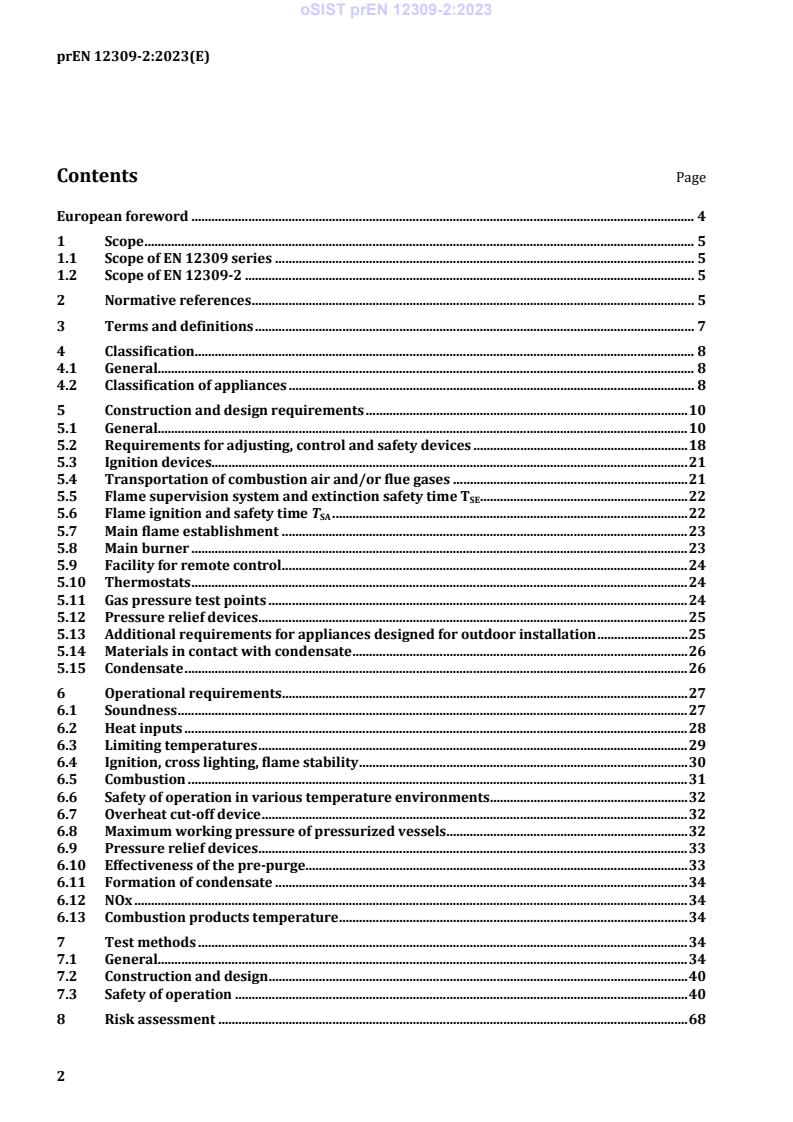
Contents Page
European foreword . 4
1 Scope . 5
1.1 Scope of EN 12309 series . 5
1.2 Scope of EN 12309-2 . 5
2 Normative references . 5
3 Terms and definitions . 7
4 Classification. 8
4.1 General. 8
4.2 Classification of appliances . 8
5 Construction and design requirements . 10
5.1 General. 10
5.2 Requirements for adjusting, control and safety devices . 18
5.3 Ignition devices. 21
5.4 Transportation of combustion air and/or flue gases . 21
5.5 Flame supervision system and extinction safety time T . 22
SE
5.6 Flame ignition and safety time T . 22
SA
5.7 Main flame establishment . 23
5.8 Main burner . 23
5.9 Facility for remote control. 24
5.10 Thermostats . 24
5.11 Gas pressure test points . 24
5.12 Pressure relief devices . 25
5.13 Additional requirements for appliances designed for outdoor installation . 25
5.14 Materials in contact with condensate . 26
5.15 Condensate . 26
6 Operational requirements . 27
6.1 Soundness . 27
6.2 Heat inputs . 28
6.3 Limiting temperatures . 29
6.4 Ignition, cross lighting, flame stability . 30
6.5 Combustion . 31
6.6 Safety of operation in various temperature environments . 32
6.7 Overheat cut-off device . 32
6.8 Maximum working pressure of pressurized vessels . 32
6.9 Pressure relief devices . 33
6.10 Effectiveness of the pre-purge. 33
6.11 Formation of condensate . 34
6.12 NOx . 34
6.13 Combustion products temperature . 34
7 Test methods . 34
7.1 General. 34
7.2 Construction and design . 40
7.3 Safety of operation . 40
8 Risk assessment . 68
oSIST prEN 12309-2:2023
prEN 12309-2:2023(E)
9 Marking and instructions . 69
9.1 Appliance marking . 69
9.2 Instructions . 71
9.3 Presentation . 74
9.4 Supplementary marking and instructions in the case of appliances to be installed
outdoor or in partially protected places . 74
10 Figures . 75
Annex A (informative) Alternative method for the determination of the nominal heat input
or the maximum and minimum heat input for appliances using a pneumatic gas/air
ratio control system . 84
Annex B (informative) Calculation of conversions of NO . 86
x
Annex C (informative) Example of calculation of weighting factors NO . 87
x
Annex D (informative) Ratio of calorific value Gross to Net and Net to Gross for Gas
Families 1, 2 and 3 . 89
Annex ZA (informative) Relationship between this European Standard and the essential
requirements of Regulation (EU) 2016/426 of 9 March 2016 [OJEU L 81/99,
31.03.2016] aimed to be covered . 90
Annex ZB (informative) Relationship between this European Standard and ecodesign
requirements of Commission Regulation (EU) No 813/2013 of 2 August 2013 [OJEU L
239/136, 6.9.2013] aimed to be covered . 93
Bibliography . 94
oSIST prEN 12309-2:2023
prEN 12309-2:2023(E)
European foreword
This document (prEN 12309-2:2023) has been prepared by Technical Committee CEN/TC 299 “Gas-
fired sorption appliances, indirect fired sorption appliances, gas-fired endothermic engine heat pumps
and domestic gas-fired washing and drying appliances”, the secretariat of which is held by UNI.
This document is currently submitted to the CEN Enquiry.
This document will supersede EN 12309-2:2015.
This document includes the following significant technical changes with respect to EN 12309-2:2015:
— Harmonization to Regulation (EU) 2016/426 (see Annex ZA).
— Clarification of the scope of this part 2 to EN 12309.
— Minimum quality properties of materials (see 5.1.2).
— Minimum dimensions for gas / air ratio control tubes (see 5.1.9.2).
— Minimum IP protection degree (see 5.1.12).
— New requirements for pressurized parts of the appliance (see 5.1.15).
— New requirements for overheat cut-off devices (see 5.10.2).
— New maximum air leakage rate for gas circuits (see 6.1.2).
— New requirements and testing method for maximum component temperature (see 6.3.4 and
7.3.3.5).
— Clarification of the generic test conditions (Tables 5, 6 and 7).
— New tolerance for NOx emissions (see 7.1.8).
— New safety tests in case of operations at the limit of the temperature operating range (see 7.3.6.2).
— New water temperature for NOx measurements (see 7.3.11 and Table 13).
— New extreme conditions for checking of the ignition safety time (see Table 14).
This document has been prepared under a standardization request addressed to CEN by the European
Commission. The Standing Committee of the EFTA States subsequently approves these requests for its
Member States.
For the relationship with EU Legislation, see informative Annexes ZA and ZB, which are an integral part
of this document.
This document is part of a series of standards under the general title, Gas-fired sorption appliances for
heating and/or cooling with a net heat input not exceeding 70 kW. A list of all parts in a series can be
found on the CEN website.
These documents will be reviewed whenever new mandates could apply.
This document deals particularly with the operational safety of the appliance.
oSIST prEN 12309-2:2023
prEN 12309-2:2023(E)
1 Scope
1.1 Scope of EN 12309 series
Appliances covered by EN 12309 include one or a combination of the following:
— gas fired sorption chiller;
— gas fired sorption chiller/heater;
— gas fired sorption heat pump.
EN 12309 applies to appliances only when used for space heating and cooling with or without heat
recovery.
EN 12309 applies to appliances having flue gas systems of type B and C (according to EN 1749:2020)
and to appliances designed for outdoor installations, including type A. EN 12309 does not apply to air
conditioners, it only applies to appliances having:
— integral burners under the control of fully automatic burner control systems;
— closed system refrigerant circuits in which the refrigerant does not come into direct contact with
the water or air to be cooled or heated;
— mechanical means to assist transportation of the combustion air and/or the flue gas.
The above appliances can have one or more primary or secondary functions (i.e. heat recovery - see
definitions in EN 12309-1:2023). In the case of packaged units (consisting of several parts), the
standard applies only to those designed and supplied as a complete package.
The appliances having their condenser cooled by air and by the evaporation of external additional
water are not covered by this European Standard.
Installations used for heating and/or cooling of industrial processes are not within the scope of these
standards.
NOTE All the symbols given in this text are used regardless of the language used.
1.2 Scope of EN 12309-2
This document deals with the safety of gas-driven sorption heat pumps as defined in EN 12309-1:2023.
Only types B12, B13, B22, B23, C12, C13, C32 and C33 and outdoor installations, including type A
appliances, are covered in this document. This document does not include specific requirements on
surface temperatures of external parts particular to children and elderly people.
2 Normative references
The following documents are referred to in the text in such a way that some or all of their content
constitutes requirements of this document. For dated references, only the edition cited applies. For
undated references, the latest edition of the referenced document (including any amendments) applies.
EN 88-1:2022, Safety and control devices for gas burners and gas burning appliances - Part 1: Pressure
regulators for inlet pressures up to and including 50 kPa
EN 88-2:2022, Safety and control devices for gas burners and gas burning appliances - Part 2: Pressure
regulators for inlet pressures above 50 kPa up to and including 500 kPa
oSIST prEN 12309-2:2023
prEN 12309-2:2023(E)
EN 126:2012, Multifunctional controls for gas burning appliances
EN 161:2022, Automatic shut-off valves for gas burners and gas appliances
EN 257:2022, Mechanical thermostats for gas-burning appliances
EN 298:2022, Automatic burner control systems for burners and appliances burning gaseous or liquid
fuels
EN 378-2:2016, Refrigerating systems and heat pumps - Safety and environmental requirements - Part 2:
Design, construction, testing, marking and documentation
EN 378-3:2016+A1:2020, Refrigerating systems and heat pumps - Safety and environmental requirements
- Part 3: Installation site and personal protection
EN 437:2021, Test gases - Test pressures - Appliance categories
EN 1057:2006+A1:2010, Copper and copper alloys - Seamless, round copper tubes for water and gas in
sanitary and heating applications
EN 1092-1:2018, Flanges and their joints - Circular flanges for pipes, valves, fittings and accessories, PN
designated - Part 1: Steel flanges
EN 1092-2:1997, Flanges and their joints - Circular flanges for pipes, valves, fittings and accessories, PN
designated - Part 2: Cast iron flanges
EN 1092-3:2003/AC:2007, Flanges and their joints - Circular flanges for pipes, valves, fittings and
accessories, PN designated - Part 3: Copper alloy flanges
EN 1092-4:2002, Flanges and their joints - Circular flanges for pipes, valves, fittings and accessories, PN
designated - Part 4: Aluminium alloy flanges
EN 1254-2:2021, Copper and copper alloys - Plumbing fittings - Part 2: Compression fittings for use with
copper tubes
CR 1404:1994, Determination of emissions from appliances burning gaseous fuels during type-testing
EN 1749:2020, Classification of gas appliances according to the method of supplying combustion air and
of evacuation of the combustion products (types)
EN 12067-2:2022, Safety and control devices for burners and appliances burning gaseous or liquid fuels -
Control functions in electronic systems - Part 2: Fuel/air ratio control/supervision of the electronic type
EN 12309-1:2023, Gas-fired sorption appliances for heating and/or cooling with a net heat input not
exceeding 70 kW - Part 1: Terms and definitions
prEN 12309-3:2022, Gas-fired sorption appliances for heating and/or cooling with a net heat input not
exceeding 70 kW - Part 3: Requirements, test conditions and test methods
EN 12309-7:2014, Gas-fired sorption appliances for heating and/or cooling with a net heat input not
exceeding 70 kW - Part 7: Specific provisions for hybrid appliances
EN 13136:2013+A1:2018, Refrigerating systems and heat pumps - Pressure relief devices and their
associated piping - Methods for calculation
oSIST prEN 12309-2:2023
prEN 12309-2:2023(E)
EN 13445-3:2021, Unfired pressure vessels - Part 3: Design
EN 13611:2019, Safety and control devices for burners and appliances burning gaseous and/or liquid
fuels - General requirements
EN 14276-1:2020, Pressure equipment for refrigerating systems and heat pumps - Part 1: Vessels -
General requirements
EN 14276-2:2020, Pressure equipment for refrigerating systems and heat pumps - Part 2: Piping - General
requirements
EN 15502-1:2021, Gas-fired heating boilers - Part 1: General requirements and tests
EN 60335-1:2012 , Household and similar electrical appliances - Safety - Part 1: General requirements
(IEC 60335-1:2010, modified)
EN 60335-2-102:2016, Household and similar electrical appliances - Safety - Part 2-102: Particular
requirements for gas, oil and solid-fuel burning appliances having electrical connections (IEC 60335-2-
102:2004, modified)
EN 60529:1991 , Degrees of protection provided by enclosures (IP Code) (IEC 60529:1989)
EN IEC 60730-2-9:2019 , Automatic electrical controls - Part 2-9: Particular requirements for
temperature sensing controls (IEC 60730-2-9:2008, modified)
EN ISO 228-1:2003, Pipe threads where pressure-tight joints are not made on the threads - Part 1:
Dimensions, tolerances and designation (ISO 228-1:2000)
EN ISO 3166-1:2020, Codes for the representation of names of countries and their subdivisions - Part 1:
Country code (ISO 3166-1:2020)
ISO 7-1:1994 , Pipe threads where pressure-tight joints are made on the threads - Part 1: Dimensions,
tolerances and designation
ISO 1182:2020, Reaction to fire tests for products - Non-combustibility test
ISO 3864-2:2016, Graphical symbols - Safety colours and safety signs - Part 2: Design principles for
product safety labels
3 Terms and definitions
For the purposes of this document, the terms and definitions given in EN 12309-1:2023 and the
following apply.
ISO and IEC maintain terminology databases for use in standardization at the following addresses:
— ISO Online browsing platform: available at https://www.iso.org/obp/
— IEC Electropedia: available at https://www.electropedia.org/
As impacted by EN 60335-1:2012/A11:2014, EN 60335-1:2012/A13:2017, EN 60335-1:2012/A1:2019, EN
60335-1:2012/A14:2019, EN 60335-1:2012/A2:2019, EN 60335-1:2012/A15:202.
As impacted by EN 60529:1991/A2:2013.
As impacted by EN IEC 60730-2-9:2019/A1:2019, EN IEC 60730-2-9:2019/A2:2020
As impacted by ISO 7-1:1994/Cor 1:2007.
oSIST prEN 12309-2:2023
prEN 12309-2:2023(E)
3.1
automatic recycling
automatic process by which, after loss of flame during operation, the gas supply is interrupted and the
full start procedure is re-initiated automatically
4 Classification
4.1 General
Appliances can be classified according to:
— the gases they use;
— the mode of air supply and evacuation of combustion products;
— the temperatures of their heat transfer media;
— their denomination.
4.2 Classification of appliances
4.2.1 Classification of gases
Gases are classified into three families, divided into groups according to the value of the Wobbe index.
Families and groups of gas used in this standard are in accordance with those of the EN 437:2021.
4.2.2 Classification according to the mode of air supply and evacuation of the combustion
products
The types of appliances as defined in EN 1749:2020 are applicable.
4.2.3 Classification according to the temperatures of the heat transfer media
4.2.3.1 General
The classification according to the temperatures of the heat transfer media is formed in such a way that
the heat transfer media are indicated together with their temperatures (in °C). A short classification is
formed in such a way that a characteristic letter is used for the heat transfer medium: A for air, W for
water and B for brine.
For the purposes of this standard, all references to the term “absorber” shall be taken to mean
“adsorber” where the function of the appliance is based on adsorption.
4.2.3.2 Cooling mode
When the appliance is operating in the cooling mode, the temperatures indicated in the first place refer
to the outdoor heat exchanger and the temperatures in the second place to the indoor heat exchanger.
Air and water/brine temperatures for the outdoor heat exchanger are inlet temperatures. Water/brine
temperatures for the indoor heat exchanger are outlet temperatures.
EXAMPLE A27/W7 means an inlet temperature of air for the outdoor heat exchanger of 27 °C and an outlet
temperature of water for the indoor heat exchanger of 7 °C.
4.2.3.3 Heating mode
When the appliance is operating in the heating mode, the values indicated in the first place refer to the
outdoor heat exchanger and the values in the second place to the indoor heat exchanger.
oSIST prEN 12309-2:2023
prEN 12309-2:2023(E)
Air and water/brine temperatures for the outdoor heat exchanger are inlet temperatures. Water/brine
temperatures for the indoor heat exchanger are outlet temperatures.
EXAMPLE B0/W50 means an inlet temperature of brine for the outdoor heat exchanger of 0 °C and an outlet
temperature of water for the condenser/absorber of 50 °C.
4.2.4 Classification according to denomination
4.2.4.1 Cooling mode
Appliances designed to operate in the cooling mode are denominated in such a way that the heat
transfer medium for the outdoor heat exchanger is indicated first, followed by the heat transfer medium
for the indoor heat exchanger. Examples of such appliances are given in Table 1.
Table 1 — Examples of appliances designed to provide cooling
Heat transfer medium Denomination
Outdoor heat exchanger Indoor heat exchanger
a
Air Water Air Cooled Liquid Chiller
Air Cooled Liquid Chiller Heater
a a
Water Water Water Cooled Liquid Chiller
Water Cooled Liquid Chiller Heater
a
Brine Water Brine Cooled Liquid Chiller
Brine Cooled Liquid Chiller Heater
a
This description also applies where the water contains additives to prevent corrosion as
specified in the appliance’s instructions.
4.2.4.2 Heating mode
For the purposes of this standard, appliances designed to operate in the heating mode are denominated
in such a way that the heat transfer medium for the outdoor heat exchanger is indicated first, followed
by the heat transfer medium for the indoor heat exchanger. Examples of such appliances are given in
Table 2.
Table 2 — Examples of appliances designed to provide heating
Heat transfer medium Denomination
Outdoor heat exchanger Indoor heat exchanger
a
Air Water Air/water Heat pump
a a
Water Water Water/water Heat Pump
a
Brine Water Brine/Water Heat Pump
a
This description also applies where the water contains additives to prevent corrosion as specified
in the appliance’s instructions.
oSIST prEN 12309-2:2023
prEN 12309-2:2023(E)
5 Construction and design requirements
5.1 General
5.1.1 Conversion to different gases
The following operations are allowed in order to convert from a gas of one family or group to a gas of
another family or group:
a) adjustment of the gas rate of the main burner and ignition burner;
b) change of injectors or restrictor;
c) change of the ignition burner or its components;
d) change of the gas rate modulation system;
e) putting out of service and sealing a gas rate adjuster and/or a regulator;
f) changes of configuration parameters by data exchange (for requirement see EN 13611:2019).
For each of the operations mentioned above the appliance shall be tested with each of the gases. These
operations shall be possible without having to interfere with the connections of the appliance to its
pipe-work (gas, water, duct system).
5.1.2 Materials and method of construction
When the appliance is installed in accordance with the appliance's instructions, all components,
including the heat exchangers and the refrigerant circuit, shall withstand the mechanical, chemical and
thermal conditions to which they may be subjected in the course of normal use.
In addition, the appliance shall be designed in such a way that if combustion condensation takes place,
this shall not:
— affect the operational safety;
— drop outside the appliance.
This latter requirement does not apply to the flow of condensate which is produced at the outlet of the
combustion products evacuation duct or from a purpose made condensate discharge system.
Materials for parts under pressure of the water circuit shall be appropriate for their duty and envisaged
use.
The following materials satisfy these criteria:
a) steels that have the properties and chemical composition as described in EN 15502-1:2021,
Annex A;
b) cast irons that have the mechanical properties as described in EN 15502-1:2021, Annex B;
c) the non-ferrous materials as described in EN 15502-1:2021, Annex C and Annex D.
For other materials, the technical documentation shall provide proof of the suitability of that material.
Copper shall not be used for gas carrying parts where its temperature is likely to exceed 100 °C.
Compatible material shall be used for the refrigerant carrying parts, as described in 5.1.15.
Asbestos or materials containing asbestos shall not be used.
oSIST prEN 12309-2:2023
prEN 12309-2:2023(E)
Solder with a melting point below 450 °C after application shall not be used for gas carrying parts. Hard
solder containing cadmium in its formulation shall not be used in the construction of the appliance.
Where appropriate, materials used on the appliance shall be non-combustible in accordance with the
requirements of ISO 1182:2020.
5.1.3 Accessibility for maintenance and use
Parts that are intended to be removable for maintenance or cleaning shall be readily accessible,
promote assembly and be difficult to assemble incorrectly. Such parts shall be impossible to assemble
incorrectly where incorrect assembly would create a hazardous condition or result in damage to the
appliance and its controls.
It shall be possible to clean the combustion vessel and the parts in contact with combustion products in
accordance with the appliance’s instructions without using special tools unless these are supplied as
necessary accessories with the appliance.
Access shall be possible to all handles, buttons etc. required during normal use of the appliance, without
having to remove any part of the case. For this purpose, the opening of a door or access panel is
permitted.
Constructional parts accessible during use and maintenance shall be free from sharp edges and corners
that might cause damage or personal injury during use or maintenance.
5.1.4 Thermal insulation
Any thermal insulation shall retain its insulating properties under the influences of temperature and
ageing. The insulation shall withstand the normally expected thermal and mechanical stresses. The
insulation of parts associated with the combustion products circuit shall be non combustible. All
insulation shall be securely located and protected against mechanical damage, condensate and vermin.
5.1.5 Gas connection
The appliance gas inlet connection shall be accessible.
The clearance around the inlet connection, after removing the case if necessary, shall be adequate to
allow the use of tools required to make the connection. It shall be possible to make all the connections
without special tools.
It shall be possible to connect the appliance by rigid or flexible metallic means to the gas supply.
A compression fitting suitable for copper tube shall comply with EN 1254-2:2021 and
EN 1057:2006+A1:2010.
If the appliance has a threaded connection, this thread shall comply with EN ISO 228-1:2003 or
ISO 7-1:1994. In the first case (EN ISO 228-1:2003), the end of the appliance inlet connection shall be
sufficiently flat to allow the use of a sealing washer.
If flanges are used, they shall comply with EN 1092-1:2018, EN 1092-2:1997, EN 1092-3:2003/AC:2007
or EN 1092-4:2002 as appropriate and the counterflanges and sealing gaskets shall be provided.
5.1.6 Soundness
5.1.6.1 Soundness of the gas circuit
The gas circuit shall consist of metallic parts.
Holes for screws, studs, etc., intended for the assembly of parts shall not open into gasways. The wall
thickness between drillings and gasways shall be at least 1 mm. This does not apply to orifices for
measurement purposes.
oSIST prEN 12309-2:2023
prEN 12309-2:2023(E)
The soundness of parts and assemblies making up the gas circuit and likely to be dismantled for routine
maintenance in situ shall be achieved by means of mechanical joints, e.g. metal-to-metal joints, packing,
or O-ring joints, i.e. excluding the use of all sealing materials such as tape, paste or liquid. However, the
sealing materials mentioned above may be used for permanent assemblies. These sealing materials
shall remain effective under all conditions of appliance use. It shall not be possible for water to
penetrate into the gas circuit.
Where parts of the gas circuit are assembled without threads, soundness of the assembly shall not be
achieved by means of soft solder or by means of adhesives.
5.1.6.2 Soundness of the combustion circuit
The combustion circuit shall be constructed so as to prevent any leakage of combustion products.
Any means used to achieve soundness of the combustion circuit shall be such that it remains effective
under normal conditions of use and servicing.
Parts, which have to be removed during routine service and affect the soundness of the appliance
and/or its ducts, shall be sealed by mechanical means, excluding pastes, liquids and tapes. The need for
replacement of the seal(s), following a cleaning or servicing operation as stated in the technical
instructions, is permitted.
Where the appliance case forms part of the combustion circuit and it can be removed without the use of
tools, either the appliance shall not operate, or there shall be no leakage of combustion products into
the room where the appliance is installed when the case is replaced incorrectly.
However, parts of the assembly that are not intended to be dismantled for maintenance may be joined
in such a way, that permanent soundness is ensured during continuous service under normal
conditions of use.
The ducts, bends, if any, and the terminal or fitting piece shall fit together correctly and form a stable
assembly.
Parts intended to be dismantled for periodic servicing shall be designed and arranged so that
soundness is ensured after reassembly.
Any fitting piece shall allow a sound connection to be made to the system intended for the evacuation of
combustion products and supply of air.
5.1.7 Air proving
Appliances with fans shall be fitted with a system for air proving.
Except for appliances with gas/air ratio controls, before each fan starts it shall be checked that there is
no simulation of air flow in the absence of air flow.
The system for supervision of the combustion air rate or combustion products rate shall be activated
directly by the flow of combustion air or combustion products. This is also valid for appliances with
more than one fan speed in which the flows associated with each fan speed are monitored.
The supply of combustion air shall be checked by one of the following methods:
a) gas /air ratio controls;
b) continuous supervision of the combustion air rate or combustion products rate;
c) start up supervision of the combustion air rate or combustion products rate provided that for
indoor installations:
— the combustion products circuit is completely surrounded by the air supply circuit, and
oSIST prEN 12309-2:2023
prEN 12309-2:2023(E)
— there is a shutdown at least every 24 h , and
— there is an indirect system for air proving (e.g. fan speed supervision) during operation.
5.1.8 Air proving device
5.1.8.1 General
Depending on the principle of air proving, the applicable requirements are described in the clauses
below.
The appliance is installed as stated in 7.1.6.4. The appliance is supplied with one of the reference gases
for the category to which it belongs.
The appliance is fitted with the longest combustion air supply and combustion products evacuation
ducts stated in the installation instructions. The tests may be carried out without the terminal or fitting
piece.
The CO concentration is determined as stated in 7.3.5.
5.1.8.2 Supervision of the combustion air rate or the combustion products rate
Under the test conditions 7.3.13.1 the following requirement shall be met.
At a reduced flow rate the CO concentration (dry, air-free) may not exceed a specific value.
The following methods of flow reduction are to be examined:
a) progressive blockage of the air inlet;
b) progressive blockage of the combustion products evacuation ducts;
c) progressive reduction of the fan speed, for example by reduction of the fan voltage.
There are two alternative supervision strategies for the air proving; a start up supervision or a
continuous supervision. Based on the supervision strategy the appliance shall at a reduced flow rate
meet one of the following two requirements:
d) continuous supervision: Shutdown before the CO concentration exceeds
1) 0,2 % over the range of modulation specified in the installation instructions), or
2) COmes x Q / Q ≤ 0,20 % below the minimum rate of the modulation range.
KB
where
Q is the instantaneous heat input, in kW;
Q is the heat input at the minimum rate, in kW;
KB
COmes is the measured CO concentration (dry, air free)
d) or
e) start up supervision: Not start if the CO concentration exceeds 0,1 %.
Some appliances can be used in a way that it is very likely they can shutdown at least once per 24 h without
having a specific function to ensure this.
oSIST prEN 12309-2:2023
prEN 12309-2:2023(E)
5.1.9 Gas/air ratio controls
5.1.9.1 Fixed or adjustable gas/air ratio settings
Gas/air ratio controls shall be designed and constructed so that reasonably foreseeable damage does
not give rise to a change capable of affecting safety.
Pneumatic gas/air ratio controls shall comply with the relevant requirements of EN 88-1:2022.
Electronic gas/air ratio controls shall comply with the relevant requirements of EN 12067-2:2022.
If the installation instructions (see 9.2.1) state that the gas/air ratio control settings are not intended to
be adjusted during installation, appliance service or when the gas valve is replaced then the appliance
shall incorporate additional provisions to discourage unauthorized interference with the gas/air ratio
control settings.
The following examples are considered to be suitable additional provisions:
a) physical removal of the adjustment screws (or other method of rendering these inoperative);
b) physically preventing access to the adjustment screws (e.g. filling access holes);
c) addition of a suitably worded warning label affixed to the gas valve and/or in close proximity to the
adjuster screws. This label shall be clearly visible to whilst gaining access to the adjuster screws.
NOTE 1 Gas/air ratio controls typically have two adjustments (“throttle” and “offset”) and the requirements of
this clause apply to both.
If the appliance installation instructions indicate that the valve can be adjusted using appropriate
instruments a provision shall be provided to indicate that the valve setting has been changed.
NOTE 2 An example of a suitable provision is to use a paint spot on the adjusting device.
If at the time of installation or service there is an indication that the gas/air ratio control settings have
been altered then the appliance instructions shall include how the settings should be checked. The
appliance installation instructions shall indicate the action to be taken if the settings are found to be
incorrect.
If the appliance installation instructions allow the gas/air ratio controls to be adjusted then the method
for adjustment shall be described.
5.1.9.2 Leakage of gas/air ratio control tubes
Under the test conditions in 7.3.14, the following requirement shall be met.
Control tubes may be made of metal with suitable mechanical connections or of other materials with at
least equivalent properties and in this case are considered immune to breakage, accidental
disconnection and leakage after initial soundness checks. As such, they are not subject to specific tests.
Control tubes for air or combustion products shall have a minimum cross-sectional area of 12 mm with
a minimum internal dimension of 1 mm. They shall be located and fixed so that any retention of
condensate is avoided and positioned such that creasing, leakage or breakage is prevented. When
control tubes are not made of metal or of other materials with at least equivalent properties, their
disconnection, breakage or leakage shall not lead to an unsafe situation. This implies either locking out
or safe operation with no leakage of gas outside the appliance. Where more than one control tube is
used the relevant connection position for each shall be obvious. Provided that evidence is given and
precautions are taken to avoid condensation in the control tubes, the minimum cross-sectional area of
air control tubes shall be 5 mm .
oSIST prEN 12309-2:2023
prEN 12309-2:2023(E)
5.1.9.3 Adjustment of the gas/air ratio
Under the test conditions in 7.3.15, the following requirement shall be met.
The installation instructions (see 9.2) shall declare maximum and minimum CO levels between which
no adjustment action is required.
the test of 5.1.8.2 shall be repeated at the test conditions from
If the gas/air ratio is adjustable for CO2
7.3.15.
5.1.10 Supply of combustion air and evacuation of combustion products
5.1.10.1 General
All appliances shall be designed so that there is an adequate supply of combustion air during ignition
and operation over the whole range of possible heat inputs.
Openings for the access of primary air shall have dimensions greater than 4 mm.
5.1.10.2 Appliance combustion air inlet
The cross-section of the combustion air passageways to the appliance shall not be adjustable.
5.1.10.3 Appliance flue gas outlet
5.1.10.3.1 General
The cross section of the appliance flue gas outlet shall not be adjustable after installation i.e. flue
dampers are not permitted.
5.1.10.3.2 Type B and B appliances
12 13
Connection to the flue shall be made by means of a flue outlet preceded by a draught diverter. This
device is part of the appliance.
The flue outlet shall be female and allow, if necessary by means of an adapter supplied with the
appliance, connection to a flue pipe whose diameter complies with the standards in force where the
appliance is to be installed.
The internal diameter of the flue outlet shall be such as to ensure compliance with requirements
concerning operation.
It shall be possible to insert a flue pipe of nominal external diameter (D-2) mm to a depth of at least D/4
but not so far that the evacuation of the combustion products is impaired. However, for a vertical
connection, the depth of insertion can be reduced to 15 mm.
NOTE D is the outside diameter of the duct.
5.1.10.3.3 Type B and B appliances
22 23
The flue outlet shall be female and allow, if necessary by means of an adapter s
...